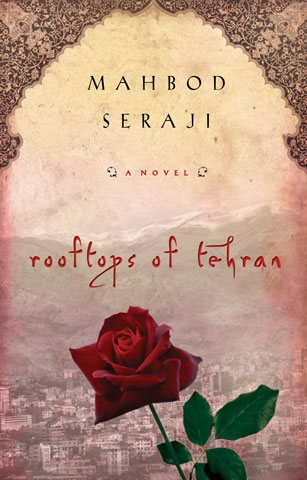
Mahbod Seraji, Rooftops of Tehran

From the Novel Readings archives: A very interesting conversation this morning with an Iranian student taking my current summer course had me thinking again about Mahbod Seraji’s Rooftops of Tehran, which I reviewed last year. My student, who plans on becoming a journalist, is passionately interested in telling stories about the experience of living in Iran today, especially for women and children. I was fascinated to hear her account of having read Jane Eyre years ago in a Farsi version which she now realizes was heavily censored or revised–so that, for instance, Jane is a much less rebellious character. She brought out a number of ways in which our 19th-century readings (so far we’ve worked on Pride and Prejudice, Scott’s “The Two Drovers,” and Jane Eyre) resonate for her with very contemporary situations in Iran–in much the way that Azar Nafisi’s Reading Lolita in Tehran (a book she admires) suggests as well. One of the things we also discussed was how novels (both in the 19th-century and today) offer their readers a look at the human side of history and politics, something Mahbod Seraji had as an explicit goal when writing Rooftops of Tehran.

After I posted my review last year, Mahbod Seraji contacted me and we ended up having a long and very interesting phone conversation, about the novel and about his experiences as an Iranian-American author finding himself expected to answer questions about Iran or “the Middle East” as well as about his book. Clearly there is a hunger for information and understanding that is, in many ways, a good thing, but the expectation that he should be willing to speak as if somehow expert or representative also reflects a continuing inability to recognize that individuality is not a “Western” prerogative. Still, not unlike Scott writing about Highlanders for a primarily English audience, writing about Iran for an American audience inevitably  has a pedagogical component, as Seraji is well aware. I really appreciated both the opportunity to speak directly with him about his work and his interest in my own reading of it. That’s the kind of connection and exchange I think we all hope blogging will create.


In a talk at the American University of Cairo on “the image of the Arab in Western Literature” (linked here), Ahdaf Soueif emphasizes the limited range of character types (and particularly the limited kinds of agency) allotted to Arab characters even in literary fiction celebrated in the West for its sympathetic portrayal of Arab cultures and perspectives. (Two of the novels she focuses on are Robert Stone’s Damascus Gate and Richard Zimler’s The Search for Sana.) Although she stresses that the life work of Arab writers is not to represent themselves or their world to the West, she does also suggest the value of contributions by those at the “touching point” between cultures, particularly Arab-American writers and artists, many of whom, as she says, have “come out” since 9/11 to declare and explore their dual identities. I’m sure she would agree that her argument can be expanded from strictly Angl0-Arab encounters to “touching points” between the West and Iran: as a member of the so-called “Axis of Evil,” Iran is more likely to be misunderstood, misrepresented, or demonized in the popular imagination (at least in America) than most of its neighbours.

In the interview with Mahbod Seraji provided at the end of Rooftops of Tehran, the novelist addresses this problem directly:

‘As for current Americans’ misconceptions about Iran, I see a lot of misrepresentation in the media. Because the governments of Iran and the U.S. don’t get along, we tend to mischaracterize the people of Iran as evil. The media immediately conveys images and information that dehumanizes the Iranian people. Likewise, we’re encouraged to forget that our so-called enemies have feelings and are capable of love and friendship. We see them as so dissimilar, we can’t imagine that we may actually have a lot in common.’

Rooftops of Tehran is clearly offered as a corrective to these tendencies, an alternative representation of “the people of Iran” that emphasizes “common” human feelings and experiences: Seraji says that “love, hate, humour, friendships are universal qualities shared by people of all nations.” But, as he also remarks, “our cultures influence the ways in which we may respond to situations”: how we express love, hate, or friendship, for example, or what we find funny, will vary based on the world we live in, the values we are taught, and the examples set by those around us. Further, love, hate, and friendship may sound like highly personal experiences, but as Seraji’s novel highlights, even the most intimate relationships are lived in political contexts, affected by who has power and the ends towards which that power is directed. Rooftops of Tehran suggests that abusive power–political tyranny–warps people’s lives and characters by constraining, sometimes brutally, their individual desires. Though the love story at the heart of the novel may in some respects demystify Persian culture for North American readers because its basic ingredients seem so familiar (boy meets girl and falls in love, but girl is engaged to boy’s friend and mentor, boy nurtures forbidden passion, etc.), key plot developments including the horrific act at the novel’s center defamiliarize this world again, because their extremity is so difficult to translate, to explain, outside the context of pervasive and arbitrary oppression that frames the superficial normalcy of the characters’ lives. Yes, they love and hate, tease and bully, read and study, dream of becoming teachers or engineers–but the alley where they play out their lives and loves is subject to surveillance and invasion by the Shah’s secret police, against whom there can be no protest or recourse. Though it is a romance, then, Rooftops of Tehran can’t help but also be a novel of political protest, not just against the Shah’s regime but against the Western powers, especially the US, that support it.

Seraji remarks the disbelief expressed by his American college classmates in the 1970s when he told them about the CIA’s involvement in the overthrow of Iranian Prime Minister Mossadegh in 1953: “half of the class accused me of lying because ‘the American government just doesn’t do bad things like that.'” Inevitably, part of his project in the novel is pedagogical, not just about Iran and the life and traditions of its ordinary people, but about how they perceive America and why. Historical and political information of this kind is difficult to integrate elegantly into fiction, especially when, as here, the focus is personal and style is spare, with little exposition. Seraji feeds us tidbits through his characters, as when the protagonist, Pasha, recalls his father saying of the SAVAK, “They live among us, work with us, come to our homes for dinner, participate in our happiness, mourn our losses, and then someday you find out that they have a second job working for the most loathed agency ever created in this country, thanks to the Americans and their CIA.” Pasha’s mentor, known as ‘Doctor,’ “used to say that Mossadegh’s overthrow was the biggest American foreign policy blunder in history. ‘No one in the Middle East will ever again trust the Americans and their phony guardianship of democracy,’ he declare[s] angrily.” Though Pasha dreams of studying in the US, Doctor’s fate teaches him to “‘hate the CIA'” as well: “‘They’re responsible for Doctor’s death, and the deaths of all the other young people executed by the Shah.'” To me, these conversations seemed artificial, though part of that may be simply the difference between a culture in which politics are literally a life and death matter and my own world, in which we take our freedoms so for granted that only a bare majority turn out to vote–or my own circle, more narrowly, in which politics are rarely discussed, much less heatedly. Still, if these moments are dubiously effective aesthetically, they certainly offer the novel’s target audience a different perspective on America’s international role.

And yet for all this, Rooftops of Tehran is not primarily a political novel. It conveys a strong sense of Persian culture, particularly in the ways it differs from Western norms. Again, some of the information is conveyed a bit awkwardly, as when Pasha reflects,

We Persians are not sophisticated when it comes to dealing with pain. I’ve heard that people in the West, especially in the United States, seek therapy when they experience emotional traumas. Our therapist is time. We trust that time heals everything, and that there is no need to dwell on pain. We don’t seek psychological treatment because we’re not as fragile as the Westerners, or so we claim. . . . We bring solace to our hearts by displaying our emotion.

His father explains “the intensity of our mourning” as a historical phenomenon:

‘A recurring theme in our history has been the massacre of our people, in what are now forgotten genocides at the hands of invaders like Alexander of Macedonia, the barbarian who burned down Persepolis; the Arabs, who brutalized our nation for hundreds of years; and Genghis Khan, who in the thirteenth century slaughtered three million of our citizens. . . . Our only recourse in the face of unpardonable evil has been to wail inconsolably.’

There is a great deal of mourning and wailing in Rooftops of Tehran; what is unexpected about it to Western sensibilities is not grief in the face of suffering and loss but the extent to which that grief is expressed through the tears of the male characters in particular. Seraji explains that Iran is one of “what the experts call ‘Affective’ cultures,” while North Americans live in “‘Neutral’ cultures”–and thus “would come across as cold and unfeeling to the people in the Affective cultures.” Again, then, we return to the point that universal emotions have historically and culturally specific expressions; though at times (as above) a Western reader may feel at the receiving end of a lecture from the course Seraji says he teaches called “Understanding Personal and Cultural Differences,” overall the novel is quite effective in bridging those differences by evoking those common human feelings. And in the end, Rooftops of Tehran is as much a romance, a love story, as anything else–a love story, and the story of the elusive quality referred to repeatedly in the novel as “That.” If love is threatened, often destroyed, by the oppressive conditions in which Pasha and his friends must shape their lives, “That” (a potent, if often latent, blend of courage, independence, loyalty, and resistance) defines the alternative to tyranny and flourishes (like the red rose Pasha plants in honor of his murdered mentor) despite–or even, perversely, because of–the arid and unforgiving environment in which it is planted.
Google Books Makes the Scottish Literature Challenge More Challenging…

I’m reading Scott’s The Antiquary as one of my books for Wuthering Expectations‘s “Scottish Literature Reading Challenge.” My only hard copy is an elegant but fragile 19th-century edition, but that’s no problem: I just downloaded it from Google Books, “a digital copy of a book that was preserved for generations on library shelves before it was carefully scanned by Google as part of a project to make the world’s books discoverable online.”  I am happily reading it on my Sony Reader–happily, that is, except that I have to repeatedly infer the wording because their careful scanning wasn’t followed by anything like careful proofreading. “Die” repeatedly appears instead of “the,” for instance, and “9” instead of “?” It’s mostly not that hard to figure out what is meant, though it’s confusing that one of the protagonists keeps changing from “Lovel” to “Level,” and then sometimes when we get deep into Scots, I can’t be sure what it’s supposed to say, and when it comes to the (not infrequent) Latin, well, I have no idea at all. And sometimes–well, sometimes, I get to something like this:

I knew Anaelnw. Tic irai shrewd and prudent,
Wisdom and cunning had their shires of him;
But be was ihrew ah u a wayward child,
And pleased again by lays which childhood please’;
A»—took of faLIes graced with print of wood,
Ordae the jingling of a rusty medal,
Or the rare melody of nine old ditty,
That fint Wm sun? to pltase King Pcpiu’i cradle.

And then I just know that all the predictions about how Google Books will change the way we do everything are wrong, wrong, wrong.

Penelope Fitzgerald, The Bookshop

The Bookshop is a gem of a book: spare but revealing, quirky but unsentimental. Its story is minimal: Florence Green, a widow, decides it is time to “make it clear to herself, and possibly to others, that she existed in her own right.” Her plan is to open a bookshore in the damp East Anglian town of Hardborough where she lives; the site she has chosen is the Old House, a property that has somehow survived over five hundred years and has stood empty for months. For no particularly good reason, Florence’s plan arouses, not so much hostility or outright antagonism, as a kind of discomfort in the town. She has a passive-aggressive rival for the Old House, Mrs Gamart, who declares her interest in establishing an Arts Center in it and tries a number of petty maneuvers for turning Florence out. Eventually, she succeeds. In the meantime, Florence has tried to make the shop, as well as the small lending library she establishes in it, a success, but neither ever really is successful, and in the end Florence has to accept that “the town in which she had lived for nearly ten years did not want a bookshop.” There are no great revelations along the way, but every action and interaction, every person and conversation,  is sharply rendered: this is my first experience reading Fitzgerald but she promptly joins my list of writers who just know, somehow, which words (and how many words) to use and just where to put them so that you are at once surprised and pleased by each sentence. I appreciated Florence, too, who, though not a heroic idealist, displays both resolution and independence of mind in the face of the soggy resistance of the other residents of Hardborough.  ‘It’s a peculiar thing to take a step forward in middle age,” she tells her banker, “but having done it, I don’t intend to retreat.” When she opens the shop, she plans no celebration, “because she was uncertain who should be asked. The frame of mind, however, is everything. Given that, one can have a very satisfactory party all by oneself.” Reading that line, it struck me as an insight particularly apt for a book lover. She isn’t all by herself in her endeavor, as it turns out: she is joined in the store by 10-year-old Christine Gipping, who comes to  “help out,” and who, in one of the book’s darting moments of humor, raps Mrs Gamart across the knuckles (literally) when she bustles in and interferes with the precedence list at the lending library, which Florence has put under Christine’s charge. Milo North, a minor celebrity in town because he does “something in TV,” is an ally of sorts, until he is enlisted in one of Mrs Gamart’s conspiracies against Florence’s posession of the Old House. And the town’s reclusive intellectual, Edmund  Brundish, writes Florence a letter of support when she opens and advises her, when she asks for his opinion, that she ought to stock Lolita:

I have read Lolita, as you requested. It is a good book, and therefore you should try to sell it to the inhabitants of Hardborough. They won’t understand it, but that is all to the good. Understanding makes the mind lazy.

She does order Lolita for the shop, and the window display attracts significant attention–enough that it becomes the grounds of a legal complaint by Mrs Gamart, who claims it provides “a temporary obstruction unreasonable in quantum and duration to the use of the highway.” The epistolary exchange between Florence and her lawyer, Mr Thornton, following Mrs Gamart’s complaint is a treat; it ends with the succinct message, “Coward!” Mrs Gamart’s campaign also eventually draws Edmund Brundish out of hiding: more than anyone else in the novel, he attempts to take a stand on principle. But Florence’s bookshop is not part of a crusade for high culture, and The Bookshop is not a satire about anti-intellectualism or freedom from censorship. It’s just a story about a small community too soggy to take a clear impression from the weight of an outsider’s plans. It’s also a story in which it seems perfectly natural that everyone, Florence included, believes in the “rapper” who haunts the Old House. This is not Sarah Waters territory here, no realm of the gothic or uncanny:

‘Your rapper’s been at my adjustable spanners,’ said the plumber, without rancour, when she came to see how the work was going forward. His tool bag had been upended and scattered; pale blue tiles with a nice design of waterlilies had been flung broadside about the upstairs passage. The bathroom, with its water supply half connected, had the alert air of having witnessed something.

In the end, it’s Florence, not the poltergeist, who is unnatural and unwanted in Hardborough.

Again with the metacriticism? Time to get on with it.

I’ve been keeping an eye on the fairly new site ARCADE developed by (and, it seems, primarily for) folks at Stanford. It’s an ambitious and complicated site; it’s interesting to me in part because it organizes and institutionalizes some of the usually more freewheeling features of “Web 2.0,” particularly blogging. I don’t much like the feel of things over there for just that reason: it takes the fun out, somehow, when there’s an editorial board rather than a blogroll. It also doesn’t seem as if the Arcade folks are much interested in linking up with the rest of the existing blogosphere–and there’s not much sign, either, that they have trawled around in it, including in its archives, to see how they might add to conversations that have gone on already, or to contextualize their site and its intentions against, say, key statements about academic blogging such as John Holbo’s launch post for The Valve. I think it would be a bigger draw for people who have been blogging for a while if its contributors seemed interested in what’s been going on in this form for the last several years.

Of course it’s their place, and of course they can do what they want. It’s just a bit wearing to see posts like the latest one by Gregory Jusdanis called “Professors are from Mars, Journalists are from Pluto” and see that it sets up the same dance around the same maypole we’ve been around before. Indeed, this is the same set of concerns that got me started in blogging in the first place–so my objection is not that the questions about the relationship between academic criticism and what Jusdanis calls “journalistic” criticism aren’t important or interesting. I also know better than to pretend that my own forays into this territory were groundbreaking: for me, as for Jusdanis, presumably, a time just came when I wanted to think about the purpose and audience of literary criticism, to understand and contextualize my own dissatisfaction with the academic ‘research’ culture that (as a number of the professional histories I went on to read make very clear) is the result of a range of forces many of which have little to do with literature and a lot to do with economic and institutional developments. I think a lot of literary academics look sort of wistfully out of their office windows and wish their career hadn’t led them so far away from the wider public conversation about books and culture; they publish in dryasdust peer-reviewed journals but linger over the TLS and the NYRB hoping that some day they will write something that people will read by choice, not because they need to fill out their own list of works cited. And a lot of them (Jusdanis and me both included) look at James Wood and wonder why he has the cultural authority–even, as far as this is possible for a book critic–the celebrity, while their hard-earned credentials (and believe me, I appreciate that they are hard to earn) earn them no ‘street cred’ at all. In fact, as I was surprised to discover, holding a Ph.D. in literature is as likely to make non-academics resent your input on their reading (or worse) as seek it out.

So I am in sympathy with Jusdanis’s desire to explore the differences between what “we” do and what “they” do…except that I’ve been exploring that for some time, including looking pretty closely at books of criticism for general readers by both academics and non-academics. I’m not complaining that Jusdanis has not looked at any of my previous posts on this–though he might have looked around, as I tried to do as I was getting underway, to see who else is talking about these questions. Blogging is all about the linking, and I think he’ll find it’s a livelier and more varied conversation than he presupposes in all of his generalizations about what “we” do (some of us are, actually, “attuned to the language and style of those who make their living by writing literary criticism” and do not at all “prefer our colorless cell of functional writing”). But for me, now, having done this dance before, I don’t think I want to do it again. One of my earliest posts (and one of my snarkiest ones) was a lament about the infinite regress of metacriticism that characterizes so much academic work today. That wasn’t my finest moment as a blogger, but the claustrophobia it expressed continues to overwhelm me when I open another scholarly book and contemplate the obligatory ‘methodology’ discussion. We call this ‘rigor,’ and it is, in a way, but its value to our understanding of literary texts is not self-evident. Will I read Jane Eyre wrong, somehow, if I haven’t cleared a way through the lumber-room of recent criticism on the Brontes before hazarding an opinion? The risk is rather that I will fail to acknowledge or respond to someone else’s argument about what the novel means or how it works, but that’s a rather different thing. The debates may be interesting, but often they are more revealing about divisions or trends in academic criticism than about the works in question, so we’re inevitably talking both to and about each other. No wonder ‘outsiders’ don’t care. Frankly, I’m not that interested in us anymore, and I’m certainly not interested in scrabbling around to find some new angle on Jane Eyre or Middlemarch in the manner of what I’ve called the pickle approach to criticism. At this point I just want to get on with it: trying to find a critical voice, and to hone and articulate perceptions that reflect both rigorous reading and a more personal, affective, and engaged vision of criticism.

It has been surprising and exciting to me to realize how blinkered I was about non-academic book culture, and chastening to realize how little use my own specialized reading has been as preparation to join in. At the same time, I think it’s true (as Jusdanis implies) that the academic habits of research and argumentation, the contextual knowledge accumulated through years of study and teaching, and the years of experience as a writer and editor, are, in other ways, valuable preparation, if only I can learn to ‘wear’ them lightly enough. Jusdanis is right that it is “hard to shift up and down.” Despite my three years of practising here on this blog, for instance, where I have self-consciously tried to free myself to write in a more personal way, my review of Jane’s Fame for Open Letters is (as the editors pointed out) “straightforward”–I should feel free, they said pleasantly, “to digress.”

I know what they mean: I read with admiration and envy some of the pieces by, say, Lydia Kiesling at The Millions (this one, for instance), or, to look to OLM for an example, something like Sam Sacks’s review of Andre Aciman’s Eight White Nights–what a beautiful balance they achieve of personal revelation or response, reflective commentary, and precise analysis. But digression, personal revelation, even visceral response are all typically anathema to the conventions of academic criticism. I have some academic projects on the go, and it’s essential to me professionally (I think) that I keep working on them. But I’m also going to set myself some other goals that take me outside my critical comfort zone in a more deliberate way than my blog posts do–though they will likely begin as, or appear in, posts along the way. I’m thinking of a phrase in an essay by Lee Edwards: she concludes the essay by saying that Middlemarch is no longer one of the ‘books of her life.’ That specific conclusion is, of course, unacceptable to me! But I like the idea of the ‘books of our lives.’ What are mine, and what will I say about them? Stay tuned!

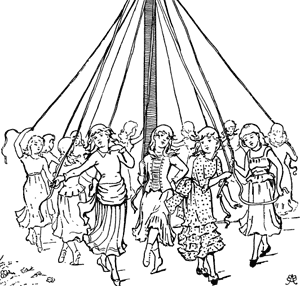
Image from Women Working, 1800-1930(Open Collections Program, Harvard University Library) (Digitized historical, manuscript, and image resources selected from Harvard University’s library and museum collections that explore women’s roles in the US economy between the beginning of the nineteenth century and the Great Depression)

This Week in My Classes – Yes, Really!

That’s right: I’m teaching again, starting this Thursday. Why do I put in for summer courses? Though the extra $$ is always welcome, a stronger motivation is the classroom experience itself, which is intensified in the summer session because we cover a full term course in just over three weeks, meeting ten hours a week. Usually, the students are taking just the one course, so it is easier to build up some momentum as everyone remembers, from class to class, what we’ve been talking about. We get to know each other well, and usually there is good energy in the room. The pace is relentless (or, as I urge them to see it on their syllabus, the fun is non-stop!) and it all goes by in what seems like a flash–but an intense one. This year I’m offering the early half of our pair of 19th-century fiction courses, the Austen to Dickens part. For a limited time only (because once the course is underway, I’m going to password-protect the site) you can read all about it here! In deference to our limited time, I’ve reduced the number of long novels: during the regular term I typically assign five, usually starting with Pride and Prejudice or Persuasion, sometimes including Waverley, always Vanity Fair, usuallyJane Eyre (though sometimes I rotate in The Tenant of Wildfell Hall), sometimes North and South, and ending with Dickens, usually Great Expectations but sometimes Hard Times or, if I’m feeling my oats, Bleak House, and once, because I was doing a French Revolution / Napoleonic Wars motif throughout, A Tale of Two Cities. It’s just not physically possible for us to turn that many pages in the time we have, but I think “The Two Drovers” gives us a lot of what is important about Scott, and though A Christmas Carol is maybe not the richest Dickens option, it pairs really interestingly with Silas Marner, which is a gem. I’m going to make them write a lot, and I’d rather they have time to read pretty closely; I think (I hope!) I’ve found a reasonable balance. One of the challenges of these summer classes is that we meet for 2.5 hours at a time, which can actually mean more classroom time on smaller sections of text–again, an opportunity to read closely, but to avoid tedium I’ll probably work in group exercises, video clips (responsible framed, or so I hope, with interpretive problems, so we don’t just zone out), and maybe even some games! First up will be Pride and Prejudice, which I haven’t actually taught (or read) in a few years. I’m looking forward to giving it a fresh look–especially after working on a review of Jane’s Fame: How Jane Austen Conquered the World for the June issue of Open Letters Monthly (due out any moment now).

The hectic pace will probably, perversely, be good for my reading and blogging schedule. The looser routine of the last week or so has been bad for my self-discipline! But I needed some puttering time after the intensity of last term. I made a lot of demands on my students (they felt it, judging from my course evaluations)–but that of course also means, though the students don’t always seem to recognize this, that I put myself under a lot of pressure as well. You hear these urban legends (mostly, it sometimes seems, put out by Margaret Wente) about creaky professors bumbling into class late carrying yellowed notes from the 1970s before ambling off to sherry hour, or else acting like prima donnas and refusing to teach at all, but all the academics I know work really hard for their classes and their students.  We’re all driven by our inner demons-mostly – ‘imposter syndrome‘ and  hunger for approval (remember, we understood success in terms of letter grades ourselves, so imagine the confused state of our egos now that nobody grades us anymore except our students…many of whom, let’s just say, don’t altogether share our obsessive qualities or our peculiar interests). Anyway, the night before my class starts I’ll probably have one of my usual paranoid dreams about not being able to find the classroom, or showing up without any notes, or discovering I’m supposed to teach a subject I actually know nothing about, and then I’ll be all jittery on Day 1 and talk way too fast for a bit, instead of just my usual rattling pace–and then things will settle down, and I’ll settle down, and we’ll all get a lot done.

Top 10 Picture Books

The lovely post at stevereads on I am the Mummy Heb-Nefert had me thinking all day about children’s picture books. At 8 (almost 9!) and 12 (almost 13!), my own children have moved on, but I miss both the nightly ritual of reading aloud and the verbal and visual pleasure of their great collection of children’s books. How nice, then, to have an excuse to put together a “Top 10” list. Maybe some other time I’ll do a “Top 10 board books,” since it seems a shame not to have included Eating the Alphabet or The Going to Bed Book.

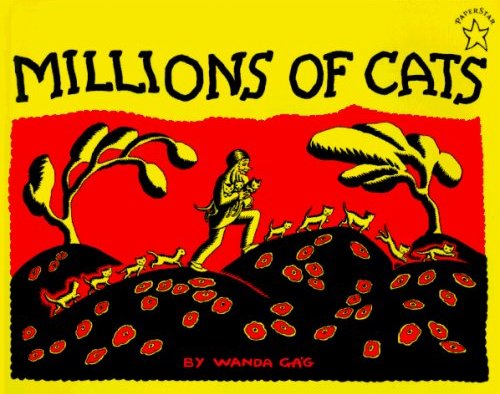
1. Wanda Ga’g, Millions of Cats. “Cats here, cats there, cats and kittens everywhere. Hundreds of cats, thousands of cats, Millions and billions and trillions of cats. . . . and not one was as prety as this one.” This one was a childhood favorite of my own. Maybe it’s the reason I wanted a cat so badly! (I finally got one, and indeed, mine was the prettiest cat of all.)

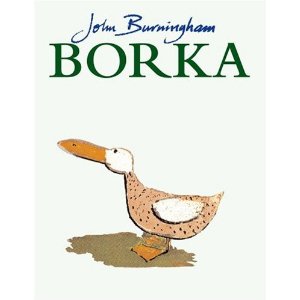
2. John Burningham, Borka. It’s hard to choose which John Burningham book is my favorite, but in the end, the nod has to go to the ‘Adventures of a Goose with no Feathers.’ If I had gone to Kew Gardens on my trip to England last year, I would definitely have tried to find “a goose who looks somehow different from the others.” My family had a budgie named ‘Borka,’ in his honor.

3. Robert McCloskey, Blueberries for Sal. Another tough call here, with Make Way for Ducklings close competition, but I always loved the “kuplink! kuplank! kuplunk!” of the berries landing in Sal’s bucket, and the endpapers of Sal and her mother in the kitchen.

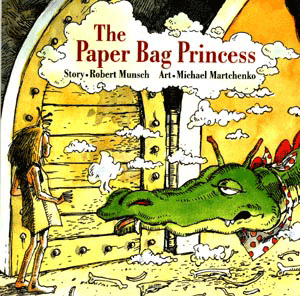
4. Robert Munsch and Michael Martchenko, The Paper Bag Princess. There are lots of revisionist princess stories now (I also like The Princess and the Dragon, and Princess Smartypants), but this is the best of them all. Every girl needs to practice Elizabeth’s parting shot: “You look like a real prince, but you are a bum.” Really, it’s a key to reading Jane Austen, all in one line.

5. David McPhail, Mole Music. The interplay between story and pictures is just lovely in this one, and I always get a bit misty as Mole puts down his violin to go to sleep, and dreams “beautiful, peaceful dreams.”

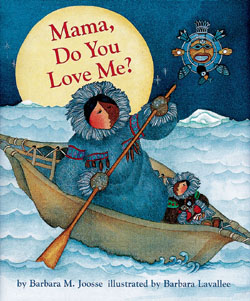
6. Barbara M. Joosse and Barbara Lavallee, Mama, Do You Love Me? Yes, dear one, “I’ll love you until the umiak flies into the darkness, till the stars turn to fish in the sky, and the puffin howls at the moon”–even if you put lemmings in my mukluks. It’s a unique, beautiful, and gently whimsical look at the universal strength of mother love.

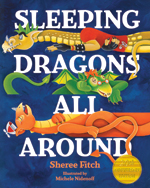
7. Sheree Fitch and Michele Nidenoff, Sleeping Dragons All Around. Another Canadian classic, enormous fun to read aloud, though it may make you hungry for Mocha Maple Chocolate Cake. Be careful not to wake the dragons as you go!

8. Quentin Blake, Fantastic Daisy Artichoke–no, Mrs Armitage on Wheels–no, wait, definitely All Join In–no, sorry, the best one is Lester at the Seaside–or, hold on: yes, that’s it, Snuff! Snuff rocks.

9. Shirley Hughes, Alfie and Annie Rose. Or Alfie’s Feet. But Alfie and Annie Rose always made me happy imagining my own children, also big brother and little sister, holding hands as they headed into the future.

10. Rick Walton and Page Miglio, So Many Bunnies: A Bedtime ABC and Counting Book. The kids, Maddie especially, just loved this one. I think it was the rhythmic combination and counting and rhyming–and the pictures (though actually a bit insipid for my taste) are very sweet. Also, I could always sympathize with that poor Mother Rabbit, who couldn’t help loving them all to pieces even when they undid all her hard work of putting them safely into their beds!

Oh dear. I’ve reached 10 and haven’t included Where the Wild Things Are, or Joseph had a Little Overcoat, or Kevin Henkes’s Owen–or Lily and the Purple Plastic Purse. Or Olivia, or Lullabye Hullaballoo, or The Library . . .

So, two questions for you. First, what are a couple of your favorite children’s books? And second, do you ever buy them for yourself, now that you’re all grown up, just because they are so enticing? I admit, I’ve already checked, and I am the Mummy Heb-Nefert is available to order. . .better yet, I might be near Woozles tomorrow. Maybe they have it!

Recent Reading: In Brief

OK, I got the review in to those taskmasters at OLM and now I can risk doing a little fresh blogging–though at this point I’m just going to play catch-up. I feel as if I’m in another of those reading slumps, which inevitably lead to blogging slumps unless I’m very disciplined: it’s not much fun to write up books you don’t like, or think are OK, and it’s even harder to face giving the full treatment to a book that has been very widely acclaimed that you are luke-warm about. The latter, in this particular case, is Marilynne Robinson’s Pulitzer Prize-winning Gilead, and though I concede that the prose is beautiful and the consciousness of the narrator beautifully rendered, there seemed to be a mushiness at its intellectual centre that I couldn’t blame on John Ames. I had a sneaking suspicion, as I read through its limpid sentences and its celebratory passages about life, interspersed with evasive passages about mysteries and the dissatisfactions of demands for proof, that it was highly acclaimed precisely because of those feel-good evasions so elegantly packaged. It’s all very affirmative and small-town nice. I know I’m not doing the novel justice: this isn’t all it has to offer. Also, I know I am influenced by interviews I’ve read and seen with Robinson, which make it impossible for me to hear any delicate irony separating her nice old man’s perspective from her own. Despite some of the blurbs insisting it is not just a book for believers, I think it is, though for the currently trendy New-Agey ones whose religion is not defined by doctrine or scripture but by personal experiences and vague spiritual ideas about God. I did relish many individual lines (for instance, “Any human face is a claim on you, because you can’t help but understand the singularity of it, the courage and loneliness of it”).

I finished Sue Grafton’s ‘U’ is for Undertow, which was OK except for the whole TMI thing I wrote about before. I’ve been trying to read The Girl who Played with Fire but I’m completely stalled in it. Do you think all the millions of people who are buying these are actually reading them all the way through? Maybe they skip along to find out what happened and don’t trouble themselves too much about how plodding the prose and plotting are. But I think my copy will go sit on the shelf now. I’d rather read the new Elizabeth George mystery, which I just got from the library–not because I really want to know about the case but because I want to catch up with Inspector Lynley and the gang. I did enjoy the first story in The Penguin Book of Crime Stories Volume II, ed. Peter Robinson, which is Reginald Hill’s “The Dog Game.”

As I only have This Body of Death from the library for another week, I’ll finish that up next. Then I think I’ll see how far I can get in Scott’s The Antiquary, which I’ve pledged to read as part of the Scottish Literature Challenge sponsored by Wuthering Expectations. And that reminds me: something else I’ve been reading recently, with pleasure and interest, are the posts at WE about my anthology The Victorian Art of Fiction. As I’d hoped and expected (unwutheringly), fresh eyes see things differently, and the posts and comments have been excellent so far.

Definitely better than not being talked about…

The book of the week at one of my favorite lit-blogs, Wuthering Expectations, will be my very own anthology The Victorian Art of Fiction: Nineteenth-Century Essays on the Novel (Broadview, 2009):

The authors range from major novelists (Eliot, Trollope, James, Stevenson) to the scintillating A. Nonymous.  The dates cover 1848 to 1884.  The essays are diverse but not comprehensive.  A story emerges, a debate takes place.  Are novels good or bad?  Meaning, novels as a whole – should one waste any time reading novels – and specific novels.  Perhaps Charlotte Brontë is bad for you and George Eliot is good for you.  Not that this debate has entirely ended, but we know which side won.  The Victorian Art of Fiction helped me see the path of the argument. . . .

The essays often work in pairs.  They are chronological, so Rohan will have to tell us how that worked. George Eliot’s sly “Silly Novels by Lady Novelists” (1856) is followed by W. R. Greg’s “False Morality of Lady Novelists” (1859), who at first sounds as bad as his title, but improves.  Anthony Trollope’s celebratory, even valedictory, “Novel-Reading” (1879) is followed by John Ruskin’s scathing, hilarious, utterly bonkers “Fiction – Fair and Foul” (1880), which functions in this anthology as the final scream of the “novels rot your brain” argument.  And we end with Henry James and Robert Louis Stevenson civilly discussing what the novel can do (anything) and how, exactly, it can do it (now there’s the difficulty), two master craftsmen who could not take the novel more seriously.  They win.

I spent such a long time deliberating over what to include in the collection (of course, it was literally impossible to survey all the possibilities!) and then laboriously, and no doubt imperfectly, editing and annotating them, that by the time the book finally appeared in print I had lost any sense of perspective about how interesting the essays were and why, so I’m really looking forward to seeing what stands out to fresh eyes. I am glad, already, to see that the selections communicate the sense of ongoing debates–and that ‘Amateur Reader’ enjoys, as I did, the remarkable variety and often wild idiosyncrasy of the voices in them.

50 Greatest Books: Pride and Prejudice

From the Novel Readings archives: In 2008, the Globe and Mail ran a series on the “50 Greatest Books.” Though, quite mysteriously, they never asked me, a complete nobody, to weigh in (no, not even on Middlemarch!), I couldn’t resist opining occasionally off in my own corner of the internet. As I’m hard at work right now on a review of Claire Harman’s Jane’s Fame: How Jane Austen Conquered the World for my hosts at Open Letters Monthly, I’ve been thinking a lot about Jane Austen, and since I don’t dare undertake a wholly new post here until I’ve met my deadline, I thought I’d dust this little piece off and put it on display in the meantime.


This week in the Globe and Mail‘s “50 Greatest Books” series, Joan Thomas weighs in on Pride and Prejudice. While I heartily endorse the choice, I felt Thomas sold Austen short in her essay, accepting as wholly unironic Austen’s famous remark about her “little bit of ivory (two inches wide)” and claiming that Austen “shoved aside” broader social and political contexts in order to focus on personal experience:

We tend to say that Jane Austen wrote about lives lived in drawing rooms because that’s all she knew. And yet … Austen’s family offered all sorts of other material: two brothers fighting in the Napoleonic wars, an aunt thrown into prison for stealing a piece of lace from a shop, a cousin’s husband guillotined in the French Revolution….Austen separated out the most poignant strand of her experience–the fact that a woman’s station in the world, her independence, her very survival, depended on the uncertain and often demeaning enterprise of attracting a man who could accept the size of her dowry. (read the rest here)

I agree entirely that “Elizabeth Bennet is a terrific heroine for any age” and that winning Mr. Darcy is, indeed, a great vindication for her insistence on acting “in that manner, which will, in [her] own opinion, constitute [her] happiness” (V. 3 Ch. 14) . I too love the “talky, civilized celebration of minds” that constitutes the Elizabeth-Darcy romance: it is, on both sides, an intellectual as well as a sensual seduction, which is no doubt the reason “this novel resonate[s] so powerfully with women who have so many other options in life.” But to describe Elizabeth’s achievement strictly in terms of “her fidelity to herself” is to forget how modern a value that is, and thus to lose much of the novel’s revolutionary charge. The line I quote above about seeking her “happiness,” for instance, is part of Elizabeth’s great confrontation with Lady Catherine de Bourgh, who represents the powerful forces arrayed against “the upstart pretensions of a young woman without family, connections, or fortune.” Class and gender politics permeate the novel, and Elizabeth’s ringing declaration that she owes no “reference” to Lady Catherine but only to her own happiness is, indeed, radical. Lady Catherine’s appalled demand “Are the shades of Pemberley to be thus polluted?” is comic in its extravagance, but especially so because behind it is a shade of truth. In a novel painted in more sombre tones, Elizabeth’s reward for so defying the class barrier might be far different: think Rose Crawley, for instance, in Vanity Fair:

Sir Pitt Crawley was a philosopher with a taste for what is called low life. His first marriage with the daughter of the noble Binkie had been made under the auspices of his parents; and as he often told Lady Crawley in her lifetime she was such a confounded quarrelsome high-bred jade that when she died he was hanged if he would ever take another of her sort, at her ladyship’s demise he kept his promise, and selected for a second wife Miss Rose Dawson, daughter of Mr. John Thomas Dawson, ironmonger, of Mudbury. What a happy woman was Rose to be my Lady Crawley!

Let us set down the items of her happiness. In the first place, she gave up Peter Butt, a young man who kept company with her, and in consequence of his disappointment in love, took to smuggling, poaching, and a thousand other bad courses. Then she quarrelled, as in duty bound, with all the friends and intimates of her youth, who, of course, could not be received by my Lady at Queen’s Crawley—nor did she find in her new rank and abode any persons who were willing to welcome her. Who ever did? Sir Huddleston Fuddleston had three daughters who all hoped to be Lady Crawley. Sir Giles Wapshot’s family were insulted that one of the Wapshot girls had not the preference in the marriage, and the remaining baronets of the county were indignant at their comrade’s misalliance. Never mind the commoners, whom we will leave to grumble anonymously.

Sir Pitt did not care, as he said, a brass farden for any one of them. He had his pretty Rose, and what more need a man require than to please himself? So he used to get drunk every night: to beat his pretty Rose sometimes: to leave her in Hampshire when he went to London for the parliamentary session, without a single friend in the wide world. Even Mrs. Bute Crawley, the Rector’s wife, refused to visit her, as she said she would never give the pass to a tradesman’s daughter.

(interest caught? read the rest here–you won’t regret it, all 90o pages of it…)

Austen’s delicious irony never conceals, though it treats lightly, the economic and moral precipice on which Elizabeth teeters. Consider, for instance the fearful compromise made by her friend Charlotte Lucas, whose pragmatic acceptance of the appalling Mr. Collins shows the proximity of respectable marriage (under the conditions Thomas alludes to) to prostitution. And only Darcy’s benevolent intervention saves Lydia from the price of her far more overt form of sexual fallenness. Is Lizzie perhaps more serious than Jane allows when she suggests her love for Darcy dates “from [her] first seeing his beautiful grounds at Pemberley” (Vol. 3 Ch. 17)? How could she not be moved by such a prospect? Even if you are inwardly persuaded (as I am) that she loves him, not because he owns Pemberley, but because he deserves Pemberley, Austen never allows you to forget that money as much as love (or, as Thomas emphasizes, talk) is an inextricable part of marriage in her heroine’s world.

“How much more interesting their life together promises to be,” Thomas says of Elizabeth and Darcy, “than the lives of lovers on those turgid 19th-century novels, where passion and mystery (i.e. sex) rise like mist off the moors.” Ah, those novels, or rather, that novel, as what novel besides Wuthering Heights fits that description? And the genius of Austen is not to leave passion out of her books but to show that desire need not be “turgid”: it can be evoked and aroused by a glance, a word, a dance. Elizabeth and Darcy’s romance is not as manifestly erotic as that of Anne Elliot and Captain Wentworth (or is it?), but it shows that intelligence can be sexy–again, surely much of the appeal of this novel to generations of book-loving young women hoping wit, spirit, and good conversation will bring them what Thomas aptly calls “payback.”

TMI

I’m still exploring options for my upcoming seminar on ‘women and detective fiction.’ Frankly, right now I’m feeling tired of the whole project and wouldn’t mind not reading any more mystery novels for a long time: after a while, the machinery just seems so creaky. Start with a prologue introducing the crime or the criminal. Sound an ominous note to create suspense (from the book nearest to hand, for instance, “If they’re the ones who killed Mary Claire, why wouldn’t they kill me?”). Introduce the detective, more or less alienated from work or partner or family or society. Start investigating. End lots of chapters with ominous notes, of the “little did she know how things would turn out” variety (“Things seldom went this swimmingly for me, which should have been a clue”). Reach putatively thrilling denouement. Fade out.  Repeat as necessary. I know, I know. The good ones are not like this, or do it well. Still, genre fiction is, inevitably, formulaic. A particular phenomenon I’ve been struck by lately, though, that actually bothers me more than the essential predictability of the form (which is, as P. D. James has argued, in some ways a strength of the genre as it establishes a firm structure within which the author is free to explore themes and characters as desired): there seems to be a trend towards overwriting, providing lots of unnecessary literal detail that contributes little to either plot or atmosphere but is just there. Now, I’m a Victorianist, and I like details: I’m not one to argue in favor of brevity for its own sake. But I like the details to be somehow resonant, whether with thematic or symbolic significance or with literary interest or pleasure. Dickens’s details, for instance, hum with life. But I don’t feel any life in this kind of writing:

I dropped my shoulder bag near the copy machine and crossed to the shelves where the yearbooks were lined up. The 1967 edition was there and I toted it with me, riffling through pages while I activated the On button and waited for the machine to warm up. The first twenty-five-plus pages were devoted to the graduating seniors, half-page color head shots with a column beside each photograph, indicating countless awards, honors, offices, interests. The juniors occupied the next fifteen pages, smaller photographs in blocks of four.

I flipped over to the last few pages, where I found the lower school, which included kindergarten through fourth grade. There were three sections for each grade, fifteen students per section. The little girls wore soft red-and-gray plaid jumpers over white shirts. The boys wore dark pants and white shirts with red sweater vests. By the time these kids reached the upper school, the uniforms would be gone, but the wholesome look would remain.

I turned the pages until I found the kindergartners. I checked the names listed in small print under each photograph. Michael Sutton was in the third grouping, front row, second from the right.

I’m no best-selling author, but I can’t see why a reader needs to know most of this. We’ve seen yearbooks, after all. The uniforms are, I suppose, period details and class markers, but the number of pages, or rows, or photographs per row, seems tediously irrelevant. How about this, instead:

I dropped my shoulder bag near the copy machine and crossed to the shelves where the yearbooks were lined up. I found Michael Sutton’s kindergarten picture in the 1967 edition . . .

The whole book is padded with this kind of excessive, and excessively literal, description of mundane objects and activities:

As long as I was downtown, I covered the seven blocks to Chapel, where I hung a left and drove eight blocks up, then crossed State Street and took a right onto Anaconda. Half a block later, I turned into the entrance of the parking facility adjacent to the public library. I waited by the machine until the time-stamped parking voucher slid into my hand and then cruised up three levels until I found a slot. The elevator was too slow to bother with so I crossed to the stairwell and walked down. I emerged from the parking structure, crossed the entrance lane, and went into the library.

I’m sure you’ll be interested to know that once she is actually in the library and has spent a couple of paragraphs explaining about the directories she’ll consult, she reaches into her bag and “remove[s] a notebook and a ballpoint pen.” The blow-by-blow description slows down the action without developing anything else–not atmosphere, character, or theme. In other ways, this particular book is well built: Grafton is clearly interested in experimenting with form beyond the journal-like first-person narration she has used in most of her novels, and here she varies her point of view and alternates between past and present events in a fairly effective way. Still, the novel  could have been much shorter and not lost anything valuable if someone had edited it more strenuously. I’m reading The Girl who Played with Fire and feel very much the same way about it: it just goes on and on and on.