
How’s that for a vague title for a blog post? But it is accurate, really: for the past couple of weeks my attention and energy have been focused on a range of different things. I haven’t felt inspired to write a sabbatical update for a while precisely because my activities seemed so miscellaneous, and not that variable, either, from week to week. But it seems like time to round things up.
First, some good news! One of the questions Jo asks us at each ‘Meeting With Your Writing‘ session is how we’d like to feel while we’re working. At the top of each new entry in my MWYW notebook is my answer, which has become a kind of mantra for me this term: “engaged, optimistic, productive.” It’s optimism that has given me the most trouble, what with winter and all, but sometimes it has also been hard to tell if I’m being productive because I haven’t been quite clear on my goals. The past week has been a particularly good one in all these respects, though, because I decided on a concrete task I wanted to accomplish that turned out to be really fun to work on. Imagine that: I have been enjoying writing! In fact, it came so (relatively) easily and has caused, so far, so little hair-tearing and second-guessing that I’m starting to think I must have gone horribly astray. It’s a subset of the larger plans I have been following for the George Eliot book project, something I thought would work well at essay-length. It’s now in a reasonably clean draft awaiting a final round of editing and revision. We’ll see what becomes of it, but right now I’m just happy and energized by the experience of pulling it together.
In other good news, the May issue of Open Letters Monthly went up on schedule; if you haven’t already checked it out, I hope you will! As always, the pieces range very widely — more widely, we think, than in most other literary journals. Books reviewed include Ishiguro’s The Buried Giant, Ian Bostridge’s Schubert’s Winter Journey, Han Kang’s The Vegetarian, and Helen Vendler’s The Ocean, The Bird, and the Scholar; John Cotter contributed a thought-provoking essay on the possibility that the gigantic glass atrium at Boston’s MFA is a symptom of our changing relationship with art; Steve Donoghue tests (as only he can) the claims of a new translation of the Iliad to be “declaimable”; and I offer a “Second Glance” at Braddon’s Lady Audley’s Secret. I thought about Open Letters today when I read this piece on the effects of Britain’s REF: “Taking on a journal editorship? That means you’ll be helping other scholars publish their REF research, but what about yours? Can you spare that kind of time?” I realize that Open Letters is not necessarily the kind of journal editorship she has in mind (though I have had British scholars tell me that writing for it is something that they think works in their favor), but I have often felt particularly pleased that one thing I’ve been able to do there is show off how smart and interesting my academic colleagues and connections are. I don’t know if that kind of editorial role will count in my favor if I ever go up for promotion, but I think (I hope) that we are still clinging to more generous and collegial models of scholarship on our side of the pond — for now, and maybe just barely, as that piece emphasizes.
 The other writing I’ve done has already shown up here, in my posts on my recent reading. I’m currently completing my “war in the Pacific” unit with Laura Hillenbrand’s Unbroken, which I gave my husband for Christmas. I rarely risk buying him books, but he likes good nonfiction, and this one seemed ready-made for him, as he’s a long-time track and field enthusiast and his father piloted a B-24 during WWII. He really enjoyed it, and I’m enjoying it too — though “enjoy” probably isn’t quite the right word for either of us, since it’s rather a grim story! A lot of it is, naturally, very reminiscent of elements of both The Narrow Road to the Deep North (particularly the treatment of the Allied POWs in the Japanese camps) and Shame and the Captives (especially the context and commentary Hillenbrand provides on the aspects of Japanese culture that contributed to the extreme brutality of the camps). I find Hillenbrand’s narrative a bit clunky or heavy-handed at times: it has that “one damn thing after another” rhythm that is perhaps inevitable when you’re putting together a lot of material into a fairly straightforward chronological account. I suspect that images from the novels will stick with me longer than anything from her book except the outline of Zamperini’s undeniably astonishing story.
Once I’m done with Unbroken I think I’ll be happy to read something that doesn’t involve beatings, excrement, or hungry sharks. I picked out Nicola Griffith’s Hild and Sybille Bedford’s A Legacy with my birthday gift card to Bookmark, so one of them will likely be next, though I also got Aislinn Hunter’s The World Before Us from the library today because a friend highly recommended it. I’m starting to be more aware of the luxury it is to be choosing my reading material this freely: it won’t be long before my sabbatical is officially over (June 30 suddenly doesn’t seem so far away!), and I’ve already started thinking a bit about fall classes, as book orders were already due. I’m second reader on an MA thesis that should get to me in early June, and I’m also participating in a PhD comprehensive exam coming up in just a couple of weeks, for which I’ve been having semi-regular meetings with the student. A sabbatical is not, in fact, ever a period of complete isolation or exemption from one’s regular duties! But come September I’ll be doing required reading again.




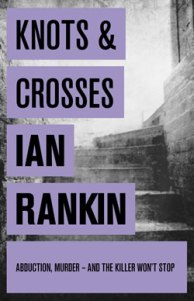 I spend a lot of time fretting about which books I assign in my Mystery and Detective Fiction course — because once you get past the few absolute “must haves” (something by Poe, some Sherlock Holmes, The Moonstone, something to represent the Golden Age, one of the hard-boiled essentials) there are many good reasons but no real imperatives to help me choose from the tens of thousands of possibilities. My guiding principles are coverage (of the major subgenres, such as the police procedural) and diversity (of voice or point of view), but that doesn’t really narrow things down that much. I’ve asked for suggestions quite a few times here, with great results: I have readers like Dorian to thank, for instance, for prodding me to read Sjöwall and Wahlöö, whose The Terrorists is currently a staple of my course reading list.
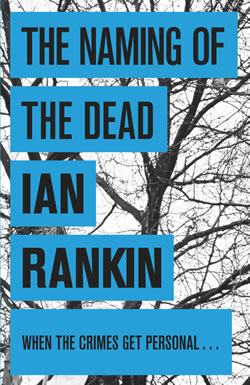 And yet … I am not convinced that I should replace Knots and Crosses after all! Much as I’m enjoying rereading it, I’m not sure it would be as teachable as Knots and Crosses, and my hesitation over this has had me wondering: what do I mean by “teachable”? It’s not something I ever really consider about Victorian novels when choosing among them for my 19th-century fiction classes, but when I’m scouting for mystery novels to assign — or contemplating assigning some new (or new to me) novel for an intro course — “How would this work in the classroom?” is always a concern. And for the majority of mystery novels I read, the (usually unarticulated) response to this question is “it wouldn’t”: I put most of them aside without seriously considering them for my syllabus, which strikes me as interesting. Why would that be? Might it (she says a little nervously) have something to do with the “literary” vs. “genre” fiction distinction? Or, to be more precise, with the ways that methods for “teaching” a novel (at least for me) align with qualities that are more likely to occur in “literary” fiction?
 Then there are other constraints on teachability: more pragmatic ones. Again, with Victorian novels I mostly don’t worry too much about these, though I am wise, or cautious, or jaded, enough never to assign two genuine door-stoppers in the same term (say, Bleak House and Middlemarch). Students who sign up for “The 19th-Century Novel from Dickens to Hardy” have to know what they are getting into! But the mystery class is a lower-level course that is purely an elective for everybody in it. I can barely get them all through The Moonstone (and in fact I am confident there are always some who never make it to the end) — and that’s a book that’s so interesting I can barely stop talking about it myself! It earns its two weeks of class time by being not just important but really complex and (for the class) quite challenging. This is actually where I fear The Naming of the Dead falls apart as an option (though I’m not 100% sure yet). Its nearly 500 pages are not nearly as dense as The Moonstone‘s, but in a way that’s just the problem: it goes on for almost as long a time without actually being as complex. It is broad, I might say, and it’s smart, but it’s not particularly deep. I’m not sure about this, because I haven’t tried to map out any lecture topics, but it would be a bad idea to assign 500 pages and then end up feeling like we were spinning our wheels in class.
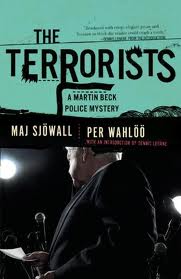 I think things are going reasonably well in both my classes right now. In Mystery and Detective Fiction we’ve just finished working through Sjöwall and Wahlöö’s The Terrorists, which provoked quite a lot of discussion this time around. As always, I’ve been meditating on how to change up the reading list for the course’s next incarnation; I think The Terrorists is a keeper, precisely because it gives us a lot to talk about. It is, arguably, somewhat tendentious — I’ve been wondering if I should hold the authors’ Marxism in reserve next time (rather than emphasizing it in my opening lecture) and let the novel’s politics reveal themselves inductively. I don’t find the novel too doctrinaire to be humanly interesting and dramatic, though: I think Sjöwall and Wahlöö successfully walk the line between the picture and the diagram, with Martin Beck himself especially standing between us and a narrow didacticism. Rhea may have a portrait of Mao on her wall, but Beck remains committed to (if ambivalent about) the flawed system he polices. Today we started Ian Rankin’s Knots and Crosses — time for my annual comment that I’d love to try one of his longer, richer novels, except that this one (like The Terrorists) is always really good for discussion, and always gets singled out in student evaluations as a general favorite.

 I’m sure you have all been wondering whether I have managed to get my
 Novel Readings