Last week I cancelled two regular class meetings for my Introduction to Literature Class and instead set up individual conferences, 15 minutes per students. (If you want to do the math, of the 26 registered students 24 ended up meeting with me, so that was six actual contact hours in place of two, and since it wasn’t possible to run the meetings entirely consecutively, overall I had about eight hours of my schedule taken up with this exercise.)
In a previous post I wrote quite a bit about my motivations and goals for these conferences. It will be a while before I can tell if they made much difference in terms of how students respond in the classroom. Many of them set as one of their goals that they would like to participate more in discussion — yet on Monday things were not especially lively, even though I thought the readings (Randall’s “Ballad of Birmingham” and Hughes’s “A Dream Deferred”) were reasonably provocative. Whatever happens, I think the process had value for them, because it prompted them to reflect on their work for last term and to consider what role they might have in making this term successful. All of them seemed to take the exercise seriously, and some of them realized important things about their work habits or about relationships between different course requirements (such as reading journals) and outcomes (such as understanding of material or grades on papers). So that’s good!
And the process had value for me too, not least because meeting with them face to face renewed my conviction that teaching is a very personal activity. “Content delivery” is not nothing, but it’s far from everything; skills development is also something, but it too is not sufficient. Education is an internal process as much as anything: something has to change within, and while no avid reader is going to say face to face interaction is the only route to inner transformation, I really believe that there’s something special about speaking directly to another human being who takes a sincere interest in you. I was at a faculty meeting today where we were invited by our university’s president to imagine the program we would create if we could do anything we wanted, without constraints. It was an ironic suggestion, really, as the meeting was about dealing with a looming budget crisis–it was all about constraints! The problem is that what I imagine is a program in which that kind of personal interaction is routine–if not throughout a student’s entire degree, at least at key moments, and I’d consider their first year just such a moment. My “blue sky thinking” always brings me back to something like a “freshman seminar” model, with maybe 15 students around a table with a dedicated, experienced instructor with plenty of time and attention for them. But I can’t figure out how such a dream is compatible with our need to (as our Dean put it) “do less with less,” especially when the only recipe for financial flourishing appears to be more students and fewer faculty.
Anyway, I’m glad I worked these meetings into my plans for this term. If nothing else, they know there’s one person on campus who’s really paying attention to them! And it’s a rarity for me to have any class, much less an intro class, small enough to make this logistically feasible.
Now we’re back to our regularly scheduled programming, with another week of poetry before beginning Elie Wiesel’s Night next week. This week’s poem are something of a build-up to Night, in that they all deal with difficult realities, from Randall and Hughes yesterday to the horrors of trench warfare on Friday, with Owen’s “Dulce et decorum est.” One thing we’ll talk a lot about with Night is how (and even whether) to transform suffering into art, and how choices of literary form and representation are also choices about the meaning of real events. After that we’ll move on to The Road — so basically we’ll all be depressed for about the next month.
In 19thC Fiction I won’t be having conferences, but I am having the students write regular reading journals, and that gives me at least a little sense of them individually to add to what I can glean from class discussion. I’ve had just a few submitted so far but I like reading them: they seem to be just formal enough that the students have put some thought into them, but not so high stakes that they (or I) need to stress out over them. That said, I’m going to be reading a lot of them this term: if every student submits the three required entries for every novel, that’s 630 journal postings at approximately 150 words each, for a grand total of … eek, about 94,500 words. Will I end up regretting not just assigning more standard essays? But these have other purposes, and they come in small and so far quite tasty doses. And if any students in this class want to meet with me one on one (which I will emphatically encourage them to do when they are working on their longer papers), they’ll be welcome — and, in case they need any extra incentive, I’ll let them know that I have a stash of extraneous books in my office from which visiting students are always welcome to help themselves…
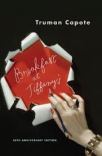 Breakfast at Tiffany’ s is the January read for my Halifax book group: we’re meeting next Saturday at
  For some reason this phrase has been running through my head to the tune of “The Last Time I Saw Paris.” I don’t know why I would be feeling nostalgic about teaching Bleak House, though it was rather a while ago–it was Fall 2008, to be precise. Because we’ve started work on it in my 19th-century fiction class this week, I’ve been reviewing old notes and also old blog posts, which prove (among other things) to be a valuable archive. Because (so far at least) my ideas about the novel haven’t really changed in the meantime, and because a lot of people who might stop by and read this post almost certainly never read my earlier ones, I thought I’d repost a couple of them, starting with this one about the beginning of the novel and the beginning of my class discussions of it.
 The past week has been all about getting organized: packing and cleaning up from Christmas, sorting the kids out to get back to school, and sorting myself out to be ready for the start of winter term classes tomorrow. I wasn’t starting from scratch, happily, but I made some adjustments to my plans for my Introduction to Literature class, which continues from last term, and finalized the plans for The 19th-Century British Novel from Dickens to Hardy, which is just beginning.
 Book of the Year: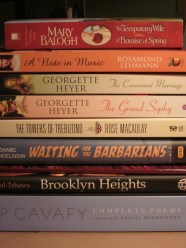
 If Anna represents the futility of material striving–of seeking lasting happiness through pursuing her own immediate needs–perhaps Levin represents spiritual striving. At any rate, that’s the best I’ve come up with so far as I ponder the relationship between the two major plots of Anna Karenina. In Levin’s epiphanic musings towards the end of the novel, he repeats the words of the peasant Theodore:
 I finished Anna Karenina yesterday–or, I should say, I finished Anna Karenina for the first time: it’s so large and complicated, and also so alien, so unfamiliar, to me that I hardly feel I’ve really read it yet. It was an odd, engrossing, and somewhat frustrating experience working my way through it. Despite its sprawl and its episodic character, it felt well built to me, with the two major plots running sometimes in parallel, sometimes intersecting, and always provoking questions about the significance of their juxtaposition. But I felt morally and thematically adrift much of the time, partly (presumably) because I’m new to the novel and there’s a lot of it to take in, and partly (perhaps) because the novel doesn’t work quite the way the big novels I know best work, which is to say, it sets out its characters and its problems without also providing a readerly guide in the form of, say, an intrusive narrator. There’s no friendly companion, no wry moralist, no philosophical or historical commentator–in other words, this is not a novel by Trollope, or Thackeray, or George Eliot. The unifying perspective–the set of ideas that make all the different parts of the novel into a whole–emerges only implicitly, and to me, so far, remains somewhat elusive.
 I began my annual look back at 2012 with my small contribution to the Open Letters