 The George Eliot Bicentenary Conference was the main reason for my recent trip to England, but of course I took advantage of having crossed the pond to do a bit of sightseeing. I spent a couple of days in London on either side of the conference, and I also traveled to Leicester a day ahead of time so I could visit the Richard III Visitor Center and Richard’s new tomb in Leicester Cathedral.
My 2012 essay “All the World to Nothing” in Open Letters Monthly explains my longstanding fascination with Richard III and includes a delightfully (or mortifyingly) geeky photograph of a much younger me beside his statue in 1986. I could not quite recreate that picture on this trip, but I did take a selfie next to the model of his head made by experts in facial reconstruction after his skeleton was discovered under a parking lot and then confirmed as his. (It’s a remarkable story; the documentary about it is available here if you’re interested.) The excavation site was protected when the parking lot was repaved and you can see where he was actually found, under the floor of the long-gone Grey Friars Church. Even the intrusively chatty volunteer stationed by it could not completely dispel the haunting feeling of actually standing where his ruined body had lain for 500 years. (Bless her heart, she was just enthusiastic, but she would keep telling me things I already knew!)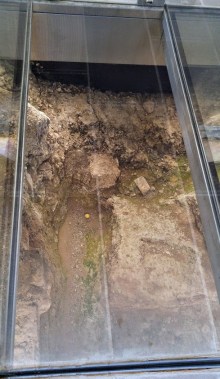
I expected to be moved by seeing Richard’s grave, and I was. It has been a long time since I felt the warm partisanship on his behalf that Tey’s The Daughter of Time once sparked: it wasn’t fervent Ricardianism in real time that made this visit emotional so much as being reminded of how ardently I was once involved in it all and feeling connected, through these remarkably concrete (no pun intended!) links between past and present, to my own history. Walking through the exhibit, viewing the burial site, visiting the Cathedral–I was paying my respects to Richard’s memory but also to the person I used to be. It renewed a kind of personal continuity that can seem, living as I do far from my family, away from the sites and landmarks of my own past, disconcertingly fractured. “Where did she go, that girl?” I sometimes wonder; perhaps oddly, there among the stones and relics of a place even further from my old home, I felt sure she was still there.
 That sense of reconnecting with my former self is part of what always makes time in London feel so special to me. After my trip there in 2009, I also remarked that I felt “renewed” by the experience. This time too I was, as I wrote then,
most moved by those [sights] that most vividly reminded me of Carlyle’s words about Scott, that he had “taught all men this truth … that the bygone ages of the world were actually filled by living men, not by protocols, state papers, controversies and abstractions of men.”
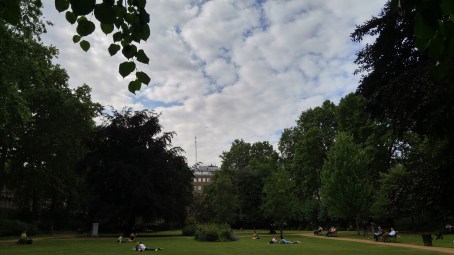
On this visit I returned to some of the same places I went to in 2009 and also in 2011, when I was in England for a conference in Birmingham–including (of course!) most of the same bookstores. I especially enjoy wandering the streets and squares of Bloomsbury, which in their shabby elegance feel strangely homey to me: it’s easy to imagine not just Woolf and her cohort but Brittain and Holtby striding along or settling on a shady bench deep in conversation. I visited Windsor Castle for the first time on this trip, and it is grandiose and impressive; it was thrilling to walk between the towering walls that housed so many historical icons and breathtaking to look down in St. George’s Chapel and see that Henry VIII was buried below my feet. But it felt more personally meaningful just to sit in Gordon Square and be myself for a while, temporarily unencumbered by external obligations or expectations about who I am or what I should be doing, now or next. That freedom is one of the great luxuries of any holiday, of course, and it’s as risky as it is easy to fall into the fantasy that if you could only stay somewhere else, you could magically be someone else, someone you might like a little better, someone who lives (and writes) better than the person you are when you’re at home.
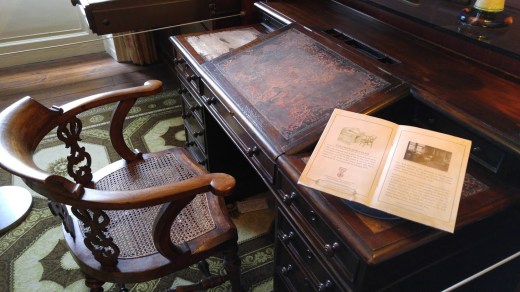
One of the repeat visits I made on this trip was to the Dickens Museum, which I had visited with my mother in 2009 but not since. I wanted to go back because in the intervening decade I have spent so much more time reading and thinking about Dickens’s novels. In the meantime, too, the museum has acquired the writing desk Dickens used in his house at Gad’s Hill Place:
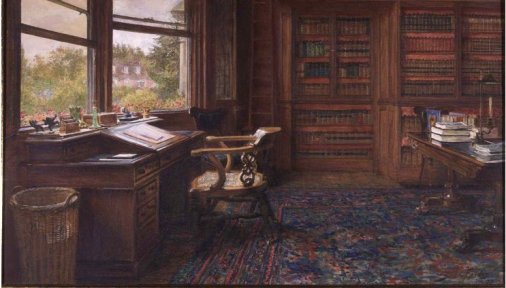
To many of us, this desk and chair are familiar from Luke Fildes’ “The Empty Chair,” painted in 1870 after Dickens’s death:
Seeing this desk was the first of what turned out to be several occasions when I found myself unexpectedly tearing up. Another was when I stumbled across some original monthly issues of Bleak House at the V&A:
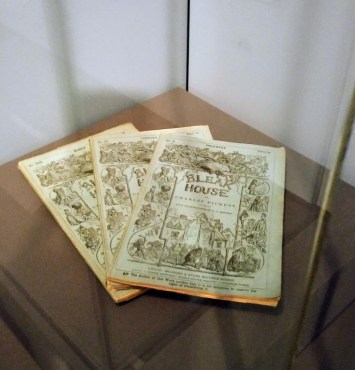
Another was as I strolled the lovely grounds of Arbury Hall, the manor house on the estate George Eliot’s father Robert Evans managed:

We visited other places on our George Eliot tour–a highlight of my trip overall–but for some reason this was the one I responded to most emotionally.
 But why? Not just why did seeing Arbury Hall move me so much but why was I so emotionally susceptible to seeing those bits of Bleak House or standing next to Dickens’s desk? I am used to feeling excited when I see things or visit places that are real parts of the historical stories I have known for so long, but I have not previously been startled into poignancy in quite the same way. Is it just age? I do seem, now that I’m into my fifties, to be more readily tearful, which is no doubt partly hormones but which I think is also because of the keen awareness of time passing that has come with other changes in my life, such as my children both graduating from high school and moving out of the house–an ongoing process at this point but still a significant transition for all of us. Also, as I approach twenty-five years of working at Dalhousie, and as so many of my senior colleagues retire and disappear from my day-to-day life, I have had to acknowledge that I am now “senior” here, and that my own next big professional milestone will also be retirement–it’s not imminent, but it’s certainly visible on the horizon.
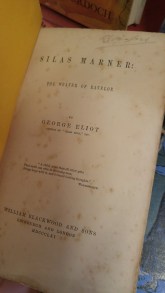 Perhaps it’s these contexts that gave greater resonance to seeing these tangible pieces of other people’s lives, especially people who have made such a mark on mine. Though I have usually considered writers’ biographies of secondary interest to their work, there was something powerful for me this time in being reminded that Dickens and Eliot were both very real people who had, and whose books had, a real physical presence in the world. People sometimes talk dismissively about fiction as if it is insubstantial, inessential, peripheral to to the “real world” (a term often deployed to mean utilitarian business of some kind). But words and ideas and books are very real things, and they make a very real difference in the world: they make us think and feel differently about it and thus act differently in it. Another of my London stops this time was at The Second Shelf , where I held first editions of Silas Marner and North and South in my hands (very carefully!). I described this on Twitter only slightly hyperbolically as the closest thing I could have to a religious experience. In the presentation I gave at the conference, I quoted from George Eliot’s poem “O, may I join the choir invisible”:
O, may I join the choir invisible
Of those immortal dead who live again
In minds made better by their presence …
There’s no question that she lived up to this wish. It’s hard for me not to feel a bit as Dorothea does, though with a more deserving object: “what a work to be in any way present at, to assist in, though only as a lamp-holder!”
Even so, I’m still not entirely sure why it kept making me cry to be in proximity to what one person I spoke with about it aptly called the “materiality” of these writers’ lives. But it seems right to give Dickens the last word on this: “Heaven knows we need never be ashamed of our tears, for they are rain upon the blinding dust of earth, overlying our hard hearts.”

George Eliot was born in the upstairs room
November 22 1819
 Although Ernest’s murder and the subsequent trial are the novel’s central plot points, however, or at least its most dramatic ones, it’s interesting how easily subsumed their effects are in the novel’s quieter undercurrents. Surely an act as significant as murder should turn the novel itself into melodrama, should in some way transform our perspective on its characters. How can a woman dubbed “the weedkiller killer” by the tabloids seem so harmless–seem almost, even more provocatively, like a victim herself? Ernest, though abhorrent, is surely not so evil that he deserves his fate, and Elsie and Rene are hardly heroic figures of resistance, to patriarchy or to anything else. Yet all they ever wanted was to live quietly and honestly, and together, and as the lawyers and journalists gather and gawk, Ernest starts to seem in retrospect like a graceless embodiment of all the social forces that try to make something strange and ugly out of their intimacy. The glare of publicity exposes them to all the prurience the novel itself scrupulously avoids:
 In retrospect, I’m glad my pitch for a article reporting back on the George Eliot Bicentenary Conference was rejected: the cognitive dissonance I struggled with during the conference was strong enough that I have been puzzling over how or whether to write about it even here, in relative obscurity and without being answerable to anyone else for whatever it is that I come up with to say.
 Each of the presenters on our panel addressed quite a different “application” for George Eliot. I spoke about what I see as reasons for but also the difficulties with “pitching” her work to the kind of bookish public I have been trying to write for–at left is my design for a George Eliot tote bag meant to illustrate the case I made that her books are not, as too often assumed,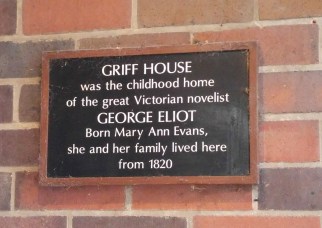


 It isn’t exactly that I want no part of it, though. As I hope I have also made clear here over the years, my own intellectual life has been shaped and enriched by many kinds of academic scholarship (though
  She was entering by degrees exactly that condition which Joseph had predicted. She was being educated to tragedy, and the tragedy absolved her of the need to explain herself. She was a blinkered rider, being conveyed through events and emotions too great for her to encompass, into a land where merely to be present was to be part of a monstrous injustice. She had joined the victims and was finally reconciled to her deceit.
 Talking about our sympathies seems almost out of place, though, which is something else I found interesting about The Little Drummer Girl. It seems to me to be fairly careful about laying out the arguments for both sides, allowing neither Israel nor the Palestinians the moral high ground. Joseph is a crucial device in this respect, for us and for Charlie. As he lays out the case for Palestinian resistance, building the elaborate fiction that she will inhabit as a double-agent, she marvels “at the paradoxes of a man who could dance with so many of his own conflicting shadows, and still stand up.” Later, playing the part he has written for her, it is Joseph who begins to feel to her like the fiction, while the role he created becomes her reality:
 Given the ruthless and destructive behavior the novel shows by both “peoples” in pursuit of the justice they claim, is the novel’s message about the Israel-Palestine conflict “a plague on both their houses”? That angry impatience doesn’t seem to fit with the tone of the novel, which is relentlessly grim but also (and in this it definitely reminded me of the other Le Carré novels I’ve read so far) almost clinical. The characters frequently get heated but the novel remains coolly descriptive, not moralizing or judgmental. Everyone running Charlie, Israeli or Palestinian, is just doing what they think must be done: if there’s some other way forward, some better ought arising from the is of both recent history and current circumstances, nobody in the novel is talking about it. There’s certainly no thread of wistful “can’t we all just get along” idealism: this is not the kind of novel that “puts a human face” on a political problem in order to urge reconciliation. At most, it does this through negative example and by proxy, through Charlie–but I’m not sure we can take her case as a lesson about how innocents suffer: “And you are the same English,” Khalil says quietly, when the crisis has come, “who gave away my country.”
 The enemy here is once again the shadowy figure known as “Karla.” For Smiley, as Le Carré makes very clear, the pursuit is as much personal as political. “It’s to do with the people who ruined Bill Haydon,” he tells Ann in a scene full of devastatingly understated emotional pain–but he is thinking, “who ruined you.” Later, waiting to see if Karla will take “the last step,” Smiley rehearses the case against him:
 Every element of the case is shot through with moral and emotional ambivalence. The high point of the novel–the turning of one of Karla’s agents–wins Smiley the admiration of his people, reported to us in elegiac retrospection:
 As Smiley awaits the resolution of his quest, which he has undertaken in defiance of changed policies and protocols, under the shadow of “complete deniability” from the higher-ups, because this, this, is what they had once staked everything on, because this is the man against whom he has defined himself–as he stands in the shadows of the Berlin Wall, that relentless symbol of everything that divides his side from the other side–Smiley knows that if he wins this game he has made the difference between them irrelevant. “I have destroyed him with the weapons I abhorred,” he reflects, “and they are his. We have crossed each other’s frontiers, we are the no-men of this no-man’s-land.” And so he finds himself, against all odds, perhaps against all reason, hoping that Karla will not cross, or will not make it: “Don’t come, thought Smiley. Shoot, Smiley thought, talking to Karla’s people, not his own.”
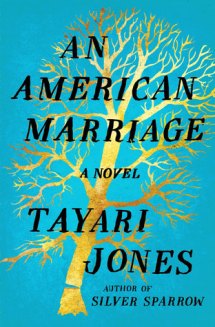
 There was also something uncomfortable for me in the way gender roles were defined in the novel, especially by Roy. It’s tricky, of course, with first-person narratives, to figure out how or if a book is asking us to step back from a character’s attitudes. I didn’t think, though, that Roy’s view of women as men’s saviors was set up as clearly problematic, though it certainly struck me that way. “The vast generosity of women is a mysterious tunnel, and nobody knows where it leads,” Roy says near the end. “Sometimes,” he also remarks, “the only thing that can cure a man is the inside of a woman, the right woman who does things the right way”; he credits the woman he sleeps with right after his release from prison as having “showed me how to be myself again.” “It wasn’t purely sexual,” he insists, but that’s about all we’ve seen of it. Like marriage, sex seems to be given some kind of prevailing power to define or assert character and value.
 The ending of the novel backs away from this tangled web of private and personal claims and answers Celestial’s question in a better way. Arguably, it repudiates the claims Roy made on her as well as her belief that love and marriage create not just ties but debts, and perhaps also asserts the primacy of the individual life as the right measure of ethical standards. (I’m not sure about these interpretations, though.) Overall the resolution seemed right to me; less so, the terms of the preceding debate itself. And that debate seemed to me the most interesting thing about the novel: it is artfully constructed, but the different narrators didn’t sound markedly different from each other and there didn’t seem to be a strong artistic reason to do the prison term through letters, though I’d be interested to know if anyone else saw something thematically resonant in that formal choice. It’s a very readable novel, perfectly pitched and crafted to provoke discussion about Celestial’s choice. (Presumably that’s some of what made it a perfect Oprah choice.) But by the end I thought the whole was, somehow, less than the sum of its parts.
 It certainly is easy to fall out of the habit of blogging–and this in spite of the fact that the most fun I’ve had in the last little while was writing my two previous posts. I enjoyed doing them so much! I felt more engaged and productive than I had in a long time, not because I was fulfilling any external obligation but because I was sorting out my ideas and putting them into words. To be honest, though, in both cases I was also a bit disappointed that the posts didn’t spark more discussion in the comments, and that set me back a bit, as it made me wonder what exactly I thought I was doing here–not a new question, and one every blogger comes back to at intervals, I’m sure. I appreciate the comments I did get, of course, and there was some Twitter discussion around the Odyssey post, which as I know has been remarked before is a common pattern now–though I can’t help but notice that there are other blogs that routinely do still get a steady flow of comments. Anyway, for a while I felt somewhat deflated about blogging and that sapped my motivation for posting. I know, I know: it’s about the intrinsic value of the writing itself, which my experience of actually writing the Woolf and Homer posts more than proved–except it isn’t quite, because if that was all, we’d write offline, right?
 It hasn’t helped my blogging motivation that not much has been going on that seems very interesting. I certainly haven’t read anything since the Odyssey that was particularly memorable. I’ve puttered through some romance novels that proved entertaining enough but aren’t likely candidates for my “Frequent Rereads” club. Two were by Helena Hunting, a new-to-me author–Meet Cute and Lucky Charm, both of which were pretty good; one was Olivia Dade’s Teach Me, which had good ingredients but seemed just too careful to me, too self-consciously aware of hitting all the ‘right’ notes; and finally Christina Lauren’s Roomies, which was diverting enough until the heroine breaks out of her career funk by writing her first (ever!) feature essay, submitting it (not pitching it, submitting it) to the New Yorker, and learning in THREE WEEKS that it has been accepted. I’m not sure which struck me as more clearly a fantasy: the acceptance itself or the timeline.
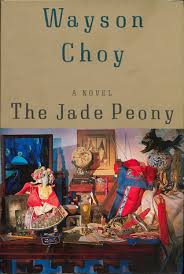 The other book I finished recently is Wayson Choy’s The Jade Peony, for my book club. I wanted to like this one more than I did. It certainly illuminates a lot about the Chinese community in Vancouver in the time it is set (the 1930s and 1940s): one thing our discussion made me appreciate more than I did at first is how deftly telling the story from the children’s perspectives lets Choy handle the historical and political contexts, as they often don’t quite understand what is happening and so our main focus is on the young characters’ emotional experiences in the midst of them. The book reads more like linked short stories than a novel, and for me it lacked both momentum and continuity as a result (that’s not my favorite genre), but many of the specific scenes have a lot of intensity and I think they will linger with me more than I initially thought.
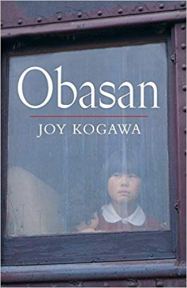 We chose Joy Kogawa’s Obasan for our next read. I’ve been trying to sort out why I’m not entirely happy about this. It makes perfect sense given our policy of following threads from one book to the next, and also Obasan is widely considered a CanLit classic, so it’s not that I don’t expect it to be a good book. I was mildly frustrated, though, that one of the arguments made in its favor was that The Jade Peony was very educational (about a time and place and culture not well-known to the group members) and Obasan would be more of the same. It will be, I’m sure, and in some ways this is an excellent reason for us to read and discuss it. But at the same time this “literature as beneficent medicine for well-intentioned consumers” approach is what turns me off
  My recent viewing has actually been more engrossing than my recent reading: we just finished watching Rectify, which I thought was superb–it is intense, thoughtful, and full of turns that surprise without seeming like cheap twists. It is very much character- rather than plot-driven, and it works because every performance is entirely believable. I hadn’t even heard of Rectify before I noticed it on a list of ‘best TV dramas’ and decided we should give it a try. It is not at all what I expected from the premise (a man is released after 19 years on death row): it is much more about how he and his family and community deal with this unthinkable change in circumstances then about the case and his guilt or innocence–though what they do with that question is also very interesting.
 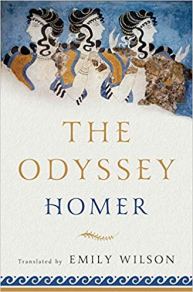 I have finally read Homer’s Odyssey. More precisely, I have read Emily Wilson’s Odyssey, which has been widely praised for its immediacy, accessibility, energy, and contemporaneity. These qualities–particularly the last–made it, I think, at once the best and the worst translation for my first experience with this classic text.
 Yet actually reading Homer for myself never felt like a powerful imperative. Perhaps it should have. I was part ashamed, part irritated when I saw this comment on Daniel Mendelsohn’s Facebook page, when he had kindly shared a link to
 Another example, less jarring rhetorically but more disorienting emotionally, came after the appalling violence of Book 22, which Wilson’s bluntness made remarkably vivid. Here is a bit of that, to show how powerful the translation can be–this is Telemachus overseeing the deaths of the women who “lay beside the suitors”:
 I commented on Twitter that reading this translation made me think of Wilde’s quip “Meredith is a prose Browning, and so is Browning.” I also noted that as an admirer of Elizabeth Barrett Browning’s self-consciously contemporary epic Aurora Leigh I am on shaky ground when it comes to complaining that poetry is too prosaic. “There are cases,” noted an early reviewer of Aurora Leigh with some acerbity, “in which Mrs. Browning has broken loose altogether from the meshes of versification, and run riot in prose cut up into lines of ten syllables.” “Is that poetry?” demanded another; “Assuredly not. Is it prose? If so, it is as poor and faulty a specimen as ever was presented to our notice.” EBB’s mission statement for her own epic comes in Book V of Aurora Leigh. “If there’s room for poets in this world,” she declares (“I think there is”),
 I’m about three quarters of the way through my second reading of Woolf’s The Years. It is still pretty slow going for me, slower than before even, because instead of wondering what the heck is happening (or, as more often seems to be the case in the novel, not happening) I am trying to figure it out with the help of the various sources I’ve been reading around in and also the amply introduced and copiously annotated Cambridge edition–of its 870 pages, only 388 are actually The Years. That’s not really a sufficient excuse for my not having read once more to the end, though: the truth is that The Years engages me much more in theory than in practice. I quite like reading about it, but
  I would explain the novel’s failure on similar terms as Lee but with less subtlety: The Years is a failure because (deliberately or not) Woolf’s theory of the novel (including “her feeling that art should subsume politics”) was genuinely incompatible with her aims for this particular novel. She wanted (and this is pretty clear from what I’ve read of her diaries around this period) to write a “novel of purpose” (defined by Amanda Claybaugh in The Novel of Purpose as a novel “that sought to intervene in the contemporary world”). It seems plausible, and some scholars make this connection explicitly, that she was motivated to breach the wall between art and politics because of
  I’m not saying anything original about that process, which is well known. I’m just trying to clarify why I think (and why I think Woolf thinks) the result is a failure. “How to do that will be one of the problems,” she comments in her diary early in the writing process; “I mean the intellectual argument in the form of art: I mean how give ordinary waking Arnold Bennett life the form of art? These are rich hard problems for my four months ahead.” My take is simply that she did not solve these problems, or she refused to solve them, because she could not reconcile her means with her end. To put it bluntly, she could not bring herself to write the kind of fiction that would get the job done. Fiction can’t intervene effectively in contemporary life if nobody knows what you mean by it. Burying the meaning, as she did (“the rest under water”), however artistically consistent, is polemically (politically) stifling, or at least muffling. Obscurity is incompatible with activism.
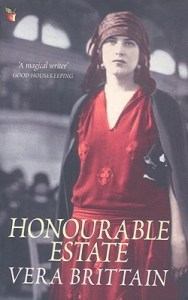 Though Holtby may be the pivot on which Woolf’s failure turns, it’s Vera Brittain’s Honourable Estate, not Holtby’s South Riding, that provides the most illuminating comparison to The Years, because it illustrates the perils of doing just what Woolf wouldn’t do: explaining everything. Where The Years (as many critics have noted) takes but subverts the form of the family saga, Honourable Estate embraces it. It covers nearly the same span of time as The Years and many of the same issues (the suffrage movement, the war, challenges to patriarchal dominance in the family, the hazards of sexuality, especially for young women, etc.). I wrote about Honourable Estate here before (
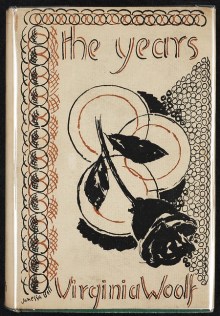 Here’s just one of many potential examples showing how differently these novels approach the same material. Both include sections that take place in 1908, the year of the great “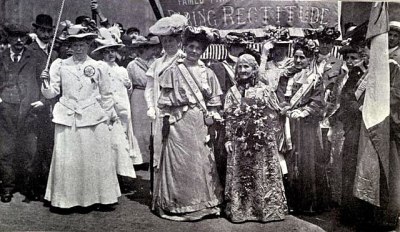
 In that earlier post on Honourable Estate I discussed Marion Shaw’s essay “Feminism and Fiction between the Wars: Winifred Holtby and Virginia Woolf,” saying that it “cautions us (me!) against underestimating the art of a novel like Honourable Estate.” Throwing that caution to the wind, I will say frankly that I think Honourable Estate is not a good novel (see, I knew we’d work our way back to the problem of measuring literary quality). It just seems so painfully obvious from start to finish! On its own terms, though, I’m not sure it is actually a failure. Unlike Woolf, Brittain had an uncompromised mission as a novelist. In her own foreword to Honourable Estate, Brittain explains,
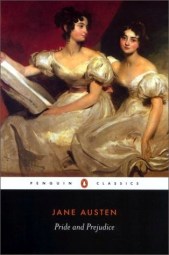
 What an uncomfortable conclusion, though: even if I’m reluctant to let Woolf (or Austen) set the evaluative terms, I find it hard to concede that literary merit consists solely of doing whatever it is that you set out to do. I have argued (at some length!)
  Novel Readings