Some Boston Highlights

Why did I not know what a beautiful city Boston is? As I prepared for my trip, I realized that I had no particular mental picture of Boston. Not only had I never been there in person, but I know hardly any books set there, or movies or TV shows set (much less filmed) there : there’s Cheers, of course, but we almost never get any shots of the city, and there’s Robert B. Parker’s Spenser series, and The Bostonians, and Death in a Tenured Position for Harvard…and as far as my own reference points go, that’s about it. Of course, now that I’ve said that you’ll probably all be able to point out other obvious examples, including ones I do know but have forgotten! But compared to New York, Boston was unfamiliar territory for me, so I approached it with a real sense of discovery and enjoyed it thoroughly. This is not the place for a detailed travelogue (and I have no Eat, Pray, Love-style revelations to make!), but here are a few of the highlights.
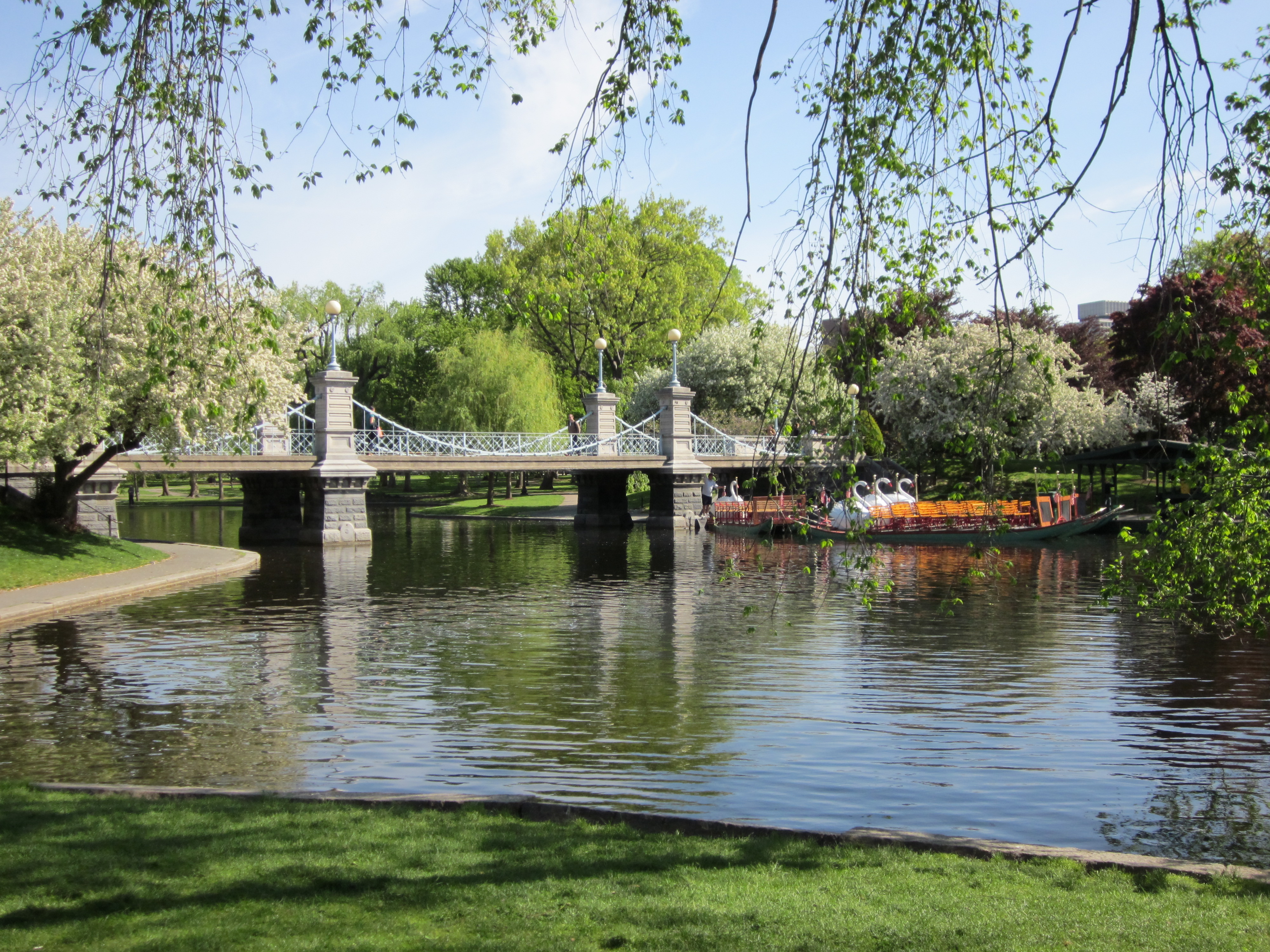
My favorite place was definitely the Public Garden. We have a Public Gardens here in Halifax, which is smaller but also more formal and ornate than Boston’s. Both are lovely oases in the middle of the city bustle. My B&B was just down Commonwealth Avenue from the gates, so I was able to visit the Garden often; if only the weather had been a bit less drizzly, I would have spent even more time roaming around enjoying green thoughts in the green shade. Of course, I had to pay my respects to my oldest Boston literary friends:

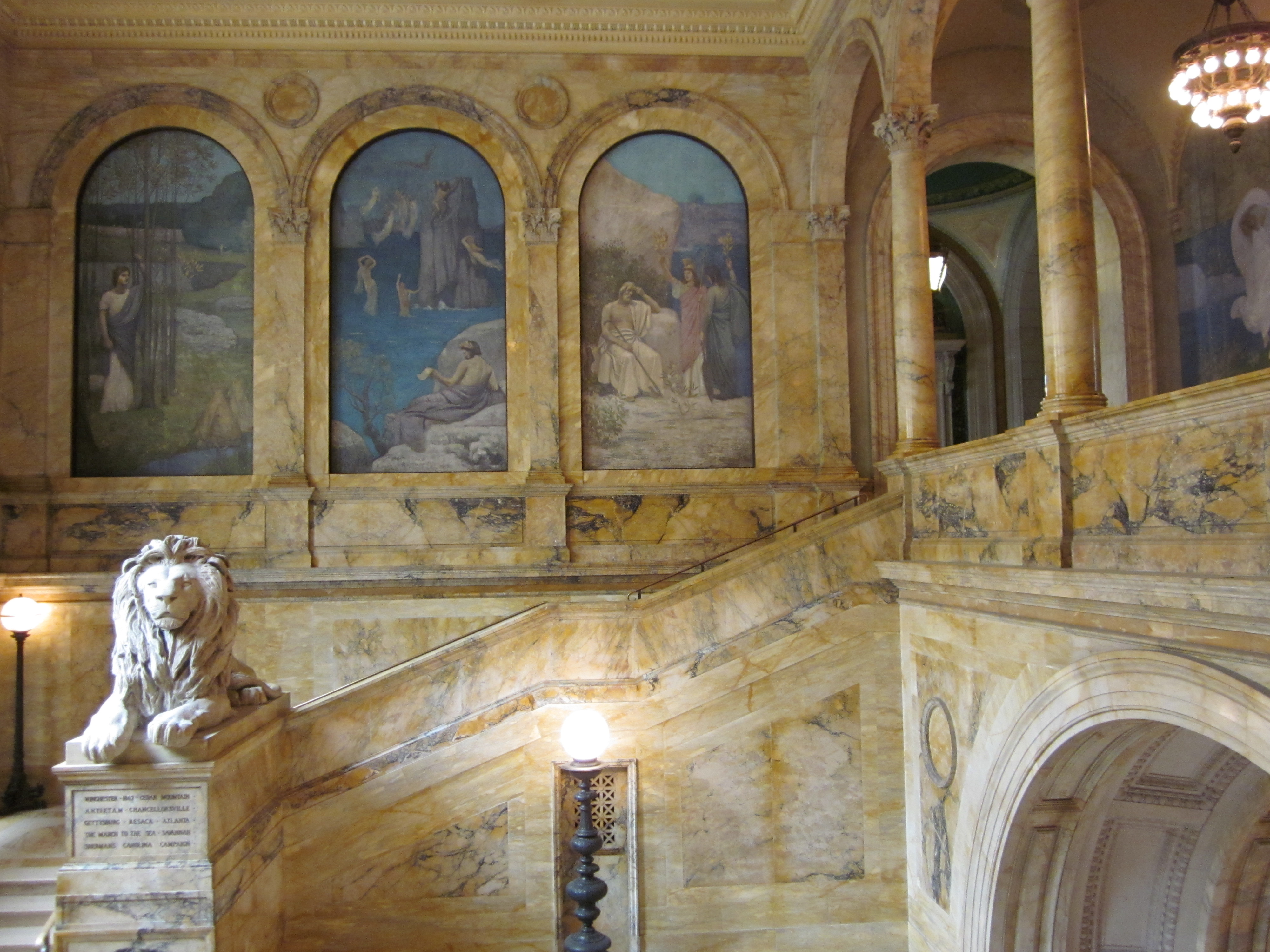
Another thoroughly delightful place, one that I might not have thought to visit if it weren’t for my host, is the Boston Public Library. Completed in 1895, it is a monument (as all public libraries should be) to the value of reading, with an elegant marble vestibule opening into this spectacular entrance hall:

The main staircase is “ivory gray Echaillon marble,” my flyer tells me, and the walls are “richly variegated yellow Siena”:
Here’s the beautiful reading room, Bates Hall:

Shouldn’t being in a library always be this much like being in a temple? The library also has a pretty courtyard with a fountain, a peaceful spot to enjoy your coffee and your book.

Of course, I had to visit Harvard. I kind of wished I had worn my Cornell sweatshirt, as a small gesture of resistance to the overwhelming, well, Harvardness of it. But Harvard Yard was very leafy and pretty in the sun:

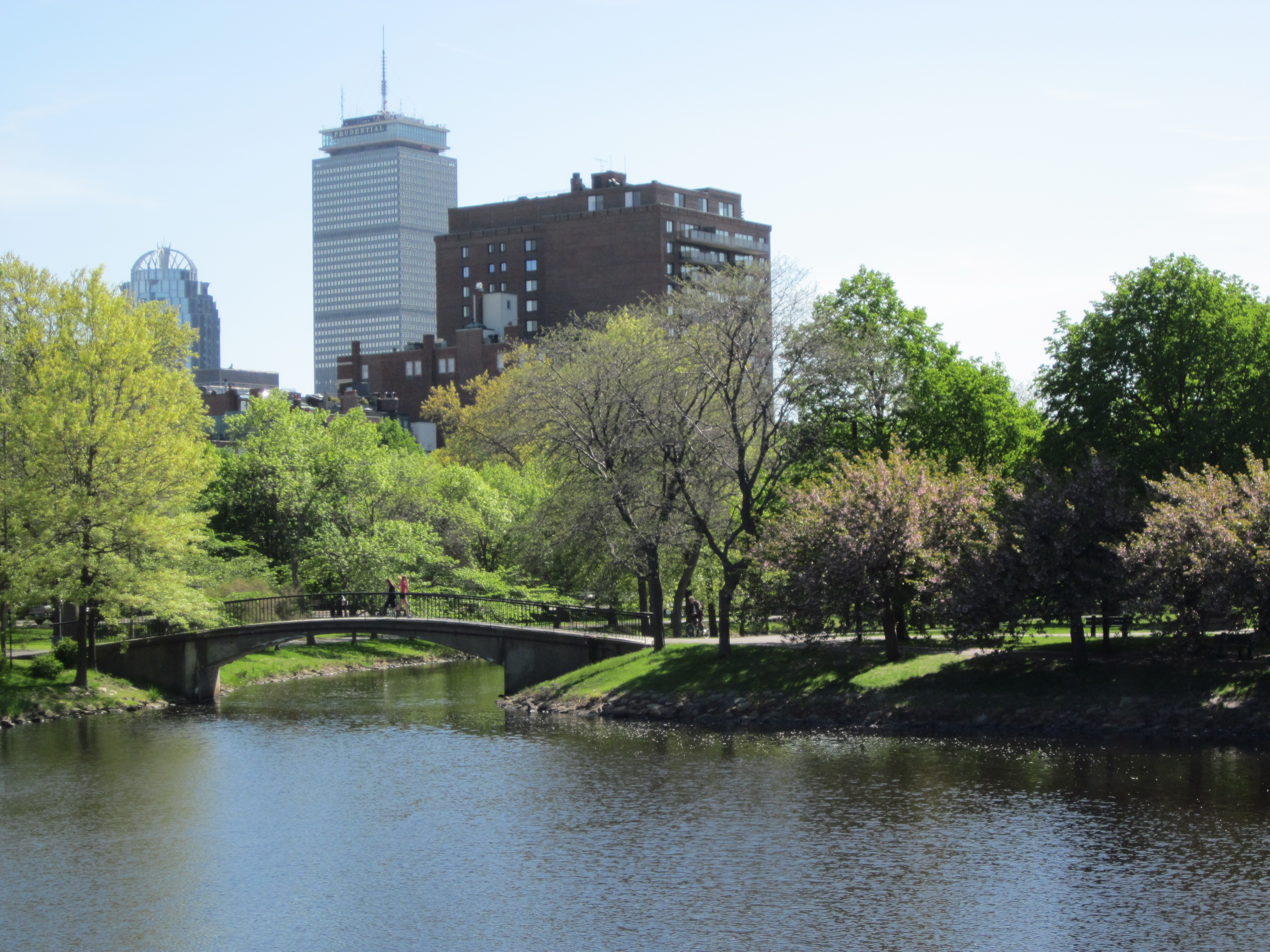
Even prettier, though, was the Esplanade along the Charles River, the perfect place to spend the one really bright sunny afternoon I had on the trip:

Other places I enjoyed (besides the bookstores mentioned in my previous post) included the Isabella Stewart Gardner Museum and the Museum of Fine Arts, two very different museum experiences, the first a glut of beautiful things, the second more orderly and managed but just as full of provocation and beauty. At the Gardner, the building itself is nearly as remarkable as what it houses. At the MFA, I was particularly compelled (and, in part, repelled) by Turner’s Slave Ship, which is grimly spectacular–and also smaller than I somehow imagined it would be. I enjoyed the Mary Cassatt paintings at the MFA but sadly Mrs Duffee Seated on a Striped Sofa, Reading (see blog banner, above), though in the collection, did not seem to be on display. I am always especially interested in any needlework on display; there was a spectacular example of needlepoint, as big as a tapestry, inthe Dutch room at the Gardner, which I would in fact have mistaken for a tapestry if I hadn’t mentioned my fondness for embroidery to one of the attendants, who then pointed it out to me. At the MFA, one of my favorite items was also pointed out to me by a helpful guide, who understandably identified this serene couple as two of his most cherished friends in the collection:

As many people told me before my trip, Boston is a very walkable city, and I had fun puttering around Back Bay and Beacon Hill, as well as taking a soul-soothing stroll through parts of Forest Hill Cemetery. Of course, I stopped at the corner of Boylston and Berkeley where Spenser has his office, and I took a classic tacky photo of the entrance to Cheers. Finally, on my last day, after a deliciously over-indulgent brunch at Amrheins and a quick tour of the North End, I played tourist at Quincy Market.  With all this and the important Open Letters Monthly summit meetings that were the occasion for the trip in the first place, it was a full five days, and though I certainly didn’t see or do everything, now I feel I know at least something about this lovely historic city.

One final trip-advisorish note for anyone who might be headed to Boston themselves any time soon. I stayed at the College Club of Boston, on Commonwealth Avenue. It’s a charming old building and the rooms are decorated to suit (if a little shabbier than they look in the photos–in my little quarters, I felt a bit like a Victorian gentlewoman fallen on hard times but keeping up appearances, like one of the older Madden sisters in The Odd Women). The location is amazing, and the prices are reasonable, especially if you’re willing to share a (nicely renovated) bathroom. However, I have never experienced such creaky floors in all my life, and every door stuck and therefore had to be tugged open and slammed shut. It’s not a good place to come back to if you’ve been out a bit late (say, drinking wine and talking books in Jamaica Plain, just hypothetically)–not, at least, if you’re the type to feel awkward about waking everyone else up. And it’s a terrible place to stay if it’s really important to you to sleep well–for the same reason. That said, I might well stay there next time. After all, sleep is hardly a top priority when travelling, right? And being a stone’s throw from the Public Garden and walking distance to the Brattle Book Shop is awfully nice.

Boston by the Books

I’m back from a wonderful five days in Boston and it seems only fitting to post first (as I did following last year’s jaunt to New York) about the books that came home with me. It was a great bookish trip, thanks to the guidance but also the company of my co-editors at Open Letters Monthly, who were all (but especially Steve Donoghue) attentive and entertaining hosts.

We made two trips to Steve’s beloved Brattle Book Shop. The first day it was drizzly so the carts were not out and our browsing was all inside–which is not a complaint, as you could browse for hours inside and still feel there were tempting treasures you hadn’t found yet. I realized only belatedly, for instance, that most of the shelves are filled two rows deep, which means I explored only one layer. That day I settled on two novels by Ivy Compton-Burnett: A House and Its Head, in the typically elegant NYRB edition, and a Penguin of A Family and a Fortune. I’ve never read any Compton-Burnett before; my interest was piqued because she is the first author chosen by Her Majesty in The Uncommon Reader. At first she’s not a hit, but after Her Majesty becomes a more experienced reader, “the novel she had once found slow now seemed refreshingly brisk, dry still, but astringently so”:

And it occurred to her … that reading was, among other things, a muscle, and one that she had seemingly developed.  She could read the novel with ease and pleasure, laughing at remarks, they were hardly jokes, that she had not even noticed before. And through it all she could hear the voice of Ivy Compton-Burnett, unsentimental, severe and wise.

On our second visit to the Brattle we browsed the dollar carts, which are filled quite miscellaneously so that you never know what might pop out at you and seem too good to resist for the price. I found Barbara Reynold’s biography of Dorothy L. Sayers (not pictured here, as it is following by steve-post). I also picked up John Updike’s collected golf writings for my husband, figuring he likes both Updike and golf so this might well be a winner! And inside again, I found The Godwulf Manuscript, which is the first of Parker’s Spenser series (I also made a pilgrimage to the corner of Boylston and Berkeley, where Spenser’s office is), and Woolf’s The Common Reader, which I owned but lent out many years ago and have never gotten back. I think I was pretty restrained, really: it’s just as well the Brattle is closed Sundays as I was right in the neighborhood and would certainly have found more. My only disappointment was that this seemed the kind of shop likely to have a copy of Testament of a Generation: The Collected Journalism of Vera Brittain and Winifred Holtby–but no luck.

We went en masse to the Harvard Book Store on Thursday night. Time was limited, so all my finds come from the used section downstairs. One I was particularly glad to find was W. Somerset Maugham’s Cakes and Ale, which is the next reading for the Slaves of Golconda book group. I also found Salley Vicker’s The Other Side of You, which some of you recommended after I wrote up Dancing Backwards. And a bit more impulsively I chose Jane Gardam’s The Queen of the Tambourine: I’ve been interested in Old Filth for a while but haven’t come across it anywhere, and this one, which I see won the Whitbread Prize, looked appealingly dark and funny.

I was back in Cambridge on Friday but did all my browsing at the Coop, mostly because I had worn myself out walking all down Newbury Street earlier that day and then all around Harvard Yard (and all over Boston the two days before!). I was trying to pick books that I haven’t been able to find on the shelf up here, and one on my most-wanted list was Laila Lalami’s Secret Son which I was happy to find there. I have followed Lalami’s blog and journalism for some time, and I got Hope and Other Dangerous Pursuits in New York last summer and was impressed and moved by it. I’m really interested to see what she does working on a larger canvas.

Finally, I had a pleasant browse in the big Barnes & Noble in the Prudential Center, which is an important landmark because most of the OLM team has worked there (or in another B&N location) at some time. Though it lacks the deep bookish personality of the Brattle or the Harvard Book Store, it’s still a lovely bright store for exploring. I thought since I’d been collecting so much fiction I would go a different way with my selection there; I came away with Terry Castle’s The Professor. In one of those moments that make you wonder if there isn’t a larger force organizing your “random” reading choices, I discovered that the very first essay includes a long discussion of Testament of Youth. On her first reading, Castle had not liked the book much, finding Brittain “abrasive and conceited.” She quotes Virginia Woolf’s diary entry, which she had “tended to agree with”:

I am reading with extreme greed a book by Vera Brittain. Not that I much like her. A stringy metallic mind, with I suppose, the sort of taste I should dislike in life. But her story, told in detail, without reserve, of the war, and how she lost lover and brother, and dabbled her hands in entrails, and was forever seeing the dead, and eating scraps, and stting five on one WC, runs rapidly, vividly, across my eyes.

As she then explains at some length, Castle found her rereading of Testament of Youth quite a different experience, coming to appreciate how “phobic and self-critical” Brittain is,and especially  how she struggles against her fears (which Castle too was doing, post-9/11). She finds in Brittain a rare model of a woman who fought against the way women are “imprinted” with cowardice:

By coddling and patronizing its female members, society enforced in them a kind of physical timidity; then, with infuriating circularity, defined such timidity as effeminate and despicable. Both practically and philosophically, Brittain rebelled against the linkage. . . . Had I resisted her for so long–cast her off as an important Not-Me–precisely because, deep down, I felt so much like her? I found out now, with a sudden embarrassed poignancy, precisely how much I sympathized, both with her anxiety and with the florid hope that the men she knew might infect her, so to speak, with physical courage. Not very butch of me, I know. Not very feminist. But I had to confess it: I admired and coveted–quite desperately at times–the insane, uncomplaining, relentless bravery of men.

That’s not where I expected her to take the discussion, but it’s interesting and certainly provocative, as I expect the rest of the book to be.

Also pictured above is a handy little book about the MFA collection. This comes from a particularly rich but obscure book source in leafy Jamaica Plain. It was a special privilege to scavenge in the collection there! More about my experience at the MFA itself, as well as other touristy impressions of Boston, when I’ve caught up on some of the work that has been waiting for my return.

Tuesday Miscellany & Links

That last post on my grandmother turned out to be a bigger project than I anticipated when it crossed my mind to do it–rounding up the scrapbook and letters, then scanning some of the old pictures. It was fun, though fun of the inevitably bittersweet kind that comes from remembering someone very dear. Once it was finally ready to post on Thursday, I had run myself out of time for that night, and then came a run of other distractions so that really all weekend I hardly got any reading done: Friday I spent doing some spring cleaning and cooking in preparation for having a few friends over, then I hauled myself out of bed on Saturday earlier than was entirely desirable (not that we’d been drinking wine or anything…) because Owen had to report by 8:30 for the Math Olympiad (where he and his partner handily came first in Grade 8). Saturday night my husband and Maddie arrived home from a week in Florida, so there was a lot of catching up to do–including the shows saved up on the DVR! More miscellaneous activity on Sunday, including various errands in preparation for my own trip this week, to Boston–so still not much reading. Not last night either, as Owen was performing in the Kiwanis Festival Gala Concert–where his newest piano composition, “Hypnotic Suggestion,” had its world premiere.

Yesterday I was back in the office for a few hours, though, and I finished up The Locked Room, which was the last of the Martin Beck books I hadn’t yet read. I’m working on a short piece about these books for another purpose, so I won’t go into detail about it here except to say that this one is particularly clever in its engagement with one of the classic mystery puzzles–you could do a whole paper, or at least a lengthy riff, on the significant differences between this particular locked room case and those in other kinds of detective stories. The other thing of particular note is that The Locked Room contains by far the funniest chapter in all 10 books, a unique combination of slapstick comedy and violent mayhem. Are there any laugh-out-loud funny chapters in Henning Mankell’s books? Not in the two I’ve read. I’ve set myself a perverse little challenge for the piece I’m writing on the Beck books, which is to see if I can write the whole piece without any references to either Mankell or Stieg Larsson–or, for that matter, to “Scandinavian” or Nordic crime fiction as a general category. Sure, there’s a bandwagon right there, but that doesn’t mean I have to jump on it! I want to see if I can talk about the books looking straight at them instead of treating them as antecedents or precedents. [That said, if you want  a great link round-up for recent reviews in or on this territory, check out the Scandinavian Crime Fiction blog.]

I’m about half way through Vera Brittain’s A Testament of Friendship and, primed by Carolyn Heilbrun’s introduction as well as a lot of Brittain’s own remarks, finding it really engaging as a portrait of women’s friendship that has no truck with the cliches about competition, cattiness, or jealousy that make up the usual tropes for such stories. I was interested to find Brittain opening it by invoking Gaskell’s biography of Charlotte Brontë. That relationship, and that biography, are now seen as more problematic than they clearly seemed to  Brittain: some have read Gaskell as (accidentally) revealing antagonism or rivalry towards Brontë, for instance, and even if you take her to be sincerely defending her friend, there are moments when you wonder if she’s really doing Charlotte any favours by contextualizing her ‘coarseness’ in order to excuse it, rather than rejecting that entire conversation as inappropriate. I wonder if anyone has reread Brittain’s account of Holtby as being not altogether friendly after all. After I finish the book, I will peer around. I don’t see any reason to bring a hermeneutics of suspicion to it, myself: so far, certainly the aspect of it that I like most is what appears to be a wholly sincere and generous spirit of admiration. Thinking about the rarity of representing female friendship has also prompted me to think more about my own friends and what they have meant to me, which is a lot.

The other book I have on the go is Jennifer Egan’s A Visit from the Goon Squad. I wasn’t sure I wanted to read it, despite all the positive press and awards and so forth, but I was peering at it in the store and had a gift card in my pocket, and you can predict the rest. A couple of chapters in, I’m liking it fine, though I have yet to discover why people think it is quite so special–but two chapters is hardly decisive. It will be my airplane reading en route to Boston. No point packing any more books, though, because one of the first places I’ve been promised by my cruise director for this trip is the Brattle Bookshop–which sounds like the sort of place I will be lucky to escape with fewer than five additions to my TBR pile. I believe we are also stopping in at the Barnes and Noble at the Prudential Center, and there may be an expedition to the Trident Booksellers and Cafe as well.

Clearly, I’m in a kind of limbo period here with my reading and writing. Luckily, there are others who can offer you more substance and provocation than I can right now. For instance, over at Wuthering Expectations, Amateur Reader finally got around to Gaskell’s North and South. There’s a little grumbling at first, but as always, he has astute and unexpected ideas about what makes the novel interesting and sometimes even excellent as well. At Tales from the Reading Room, litlove convinces me I should give Willa Cather a try, writes thoughtfully about what critics do all day, and responds to Stephanie Staal’s Reading Women:

I was sorry to see Staal’s tendency to dismiss the latter stages of her course because they were more theoretically demanding, less obviously relevant to her own experience. I’ve always found them some of the most compelling parts. And come on, girls! Are we really going to wimp out here just because something is hard? Absolutely not. If feminism is going to come good on all its hopes, there is still tough work to be done deep in the hearts and minds of women, where perfectionism, compulsive compliance, guilt, responsibility and self-esteem create some pretty toxic combinations. That’s a feminism course I’d love to teach myself. But in the meantime, to catch up on the history of feminism to this point, I thoroughly recommend Stephanie Staal’s book.

Teresa at Shelf Love writes about writing about books, including a number of links worth following up; Annie at Senior Common Room has a very interesting post on the Royal Shakespeare Company’s Macbeth; at the New Yorker’s Book Bench, the ‘Ask an Academic’ feature addresses boredom (the work under discussion as well as its author’s anticipated next project, on sentimentality, reflects a trend I have observed to do studies, not of things or substances, which were trendy for a while, but abstractions or concepts–I have a colleague working on a book about ‘grace,’ for instance).  There are lots more interesting posts out there but I have to get back to organizing for my trip! I don’t expect to be posting here while I’m away, but there may be the occasional Twitter update.

‘Baking Has Assumed a Sinister Character’: My Grandmother the Writer

My grandmother (right), c. 1929 (click to see full size)

My grandmother was a remarkable woman–energetic, vivacious, difficult, independent. Above all, she was what she called a “word person”: she loved to read, and nearly half way through her life she discovered that she also loved to write. In 1955, after staying home for years to raise my father (her only child), she launched a new career for herself by offering to do a gardening column for the local paper, the Lions Gate Times. As she tells it, the editor learned she had once trained as an accountant and asked her to help with the books. Eventually she was sent on her first assignment, to cover a municipal council meeting. She had no training as either a writer or a reporter.  She recalls,

I carefully wrote down every word, shaking with insecurity and fright, and filled the front page on press day. The mayor commented, “the best coverage we have ever had.” That was the beginning of my writing career. . . . The writing was easy. My drive came from an insatiable curiosity and an unquenchable urge to tell everyone what I found interesting.

Everyone who knew her would agree that she never lost either that curiosity or that urge to share her enthusiasms, which is one reason her letters were always such fun.

Editor, Lions Gate Times, c. 1965 (click to see full size)

In 1959, she became editor of the paper, which under her management was named “best community service paper” by the Canadian Weekly Newspaper Association,  and her features on local issues won awards–including the MacMillan-Bloedel journalism award in 1966. She also did travel features, including several pieces on a trip to Germany in 1964. This anecdote, sadly, was not in the published version, but she wrote it up for a scrapbook she made for me about her work. It gives a great sense of her indomitable spirit, headlong writing style, and sense of humor:

My first trip to Germany was done in style–six people on Air Canada’s biggest jet; champagne all the way; playing bridge with the crew and ending up with a police escort to our destination in Hamburg.

It was a heady experience. The reporter from Sports Illustrated, NY, Tom (the CBC engineer from Montreal) and myself stayed at the same hotel for the ten days we were there. Near the end, the New Yorker went off to Denmark and I wanted to see West Berlin so Tom crept along. Tom was about my age, very tall with a small moustache. He was not an outgoing person, sort of mentally huddled, but pleasant enough to drag around with. He was drawn to the beer halls and me to the opera. Neither of us could understand the other’s tastes.

We had a small crisis in Berlin. We sought out the efficient hotel advice expert at the airport when we landed to find the city crawling with conventions. Not a hotel room to be found. I cried out in despair. What would we do? More phoning brought up a room in a pension with a double bed.

Tom had been lounging at the door but at this good news he turned linen white and seemed about to faint. However, I had no urge to sleep on a bench in the park all night and briskly took the room, feeling we could cope with the facilities later that night. . . .

Tom was inside our room reading when I got back and I decided on strategy. I had no illusions that my elderly presence and pinched face would set his blood boiling, so I just said, “Tom, you put the paper over your head while I get undressed, then it will be your turn.” He uttered not a sound and promptly obeyed.

I got into bed, he mumbled he was going to read, and I lay, stiff and uncomfortable, on the edge of the mattress. But I had forgotten the toll on a body of an early flight, incessant sightseeing, the Mexican show, and the tension of one bed. The next thing I knew it was 8 a.m. and Tom was snoring merrily beside me. We had a big laugh, launched into the trip to East Berlin and then flew back to Hamburg.

The newspaper stories themselves are wonderful time capsule pieces. “West Berlin is one city in the world where a tourist will never see a ‘Yankee Go Home sign,'” one of them opens,

Why? Because this free city, in an unfree, Russian-occupied East German zone, owes its very life to the benevolent protection of the United States.

It is true that the three western allies are committed to defend Berlin. But a traveller quickly learns it is to strong and democratic America that Berliners have given their hearts.

The flight from Hamburg to Berlin–it only takes an hour–is an eerie one along the 20-mile-wide corridor paced off by the Russians. . . .The Wall, an unbelievable object, runs 30 miles through the heart of this beautiful city. A German businessman told me passionately that it was not a wall but a wound cut across the body of Berlin, with the flesh dying on either side of it.

She loved politics (“I found I was what is called ‘a political animal,'” she says), and in 1968 she took a position as Special Assistant to Jack Davis, the federal minister of Fisheries and Forestry. After her ‘retirement’ in 1974 she continued to do freelance writing and editing projects, the biggest of which was the 1980 West Vancouver Community Plan, a project which reflected her deep love for local history and for the community where she lived.

At my UBC graduation, 1990

I wish I had more of the letters she sent me over the years. We used to have long phone conversations too, but she always loved to rattle off her correspondence on her trusty manual typewriter, full of anecdotes and excerpts from her current reading. An ardent natural history enthusiast, she had a particular fondness for earthworms and often wrote about their contributions to our world (she would have loved George Levine’s podcast on ‘worm excrement,’ I know). In one of the letters I do have still in my box of family papers she has been reading a Carl Sagan book we’d sent her for Christmas–it was 1992, so I think the book may have been Shadows of Our Forgotten Ancestors–and after several paragraphs of excited summary there’s this:

I’ve come to the part where Sagan says, “It seems clear there is only one hereditary line leading to all life now on earth. Every organism is a relative, a distant cousin of every other. This is manifest when we compare how all organisms on earth do business, what genetic language they speak. All life is kin.”

I love that. Rohan, we are brethren of our worms that so fascinated us.

She was always so confident that her fascination would be contagious–and usually it was. She also could not resist making a story out of everything that happened, a trait that could sometimes be tiresome if you happened to be a character in one of them and weren’t sure her version represented your truth, never mind the truth. Here’s one that made me laugh and then cry a little bit, because it brings her back so vividly. It features her very best friend of many years and his long-suffering wife, who patiently tolerated their great closeness.

My news is all wrapped up with Stewart. He and Joan went to Hawaii for 2 weeks and arrived home Monday. It was the day I decided to make muffins. Baking has assumed a sinister character in my life. I hate it now and am glad my feelings parallel Dorothy’s so I know it is endemic with the elderly. Anything to put off even boiling an egg. But I decided to make bran muffins for health’s sake and my doctor’s orders and instead of getting dressed and clearing off the sink and lining up the ingredients like sensible people do I rushed into it in my usual sloppy fashion with my old dressing gown with its floppy sleeves in the act as well. I became depressed when I forgot if I had put 2 cups or 1 of brown sugar into what I was blending then hand beat up the eggs and when the handle got caught in my sleeve and whipped the eggs onto the carpet I was ready to throw everything into the garbage. But I pressed on which turned out to be a bad decision. I floundered along with the huge recipe — it makes 30 muffins — and flour and bran and chopped dates were all over the place as I got sick of the act and dumped everything in one huge bowl instead of folding and delicately coupling wet with dry as the recipe says. I then got the muffin cases in the pans, all 30 of them, and started to ladle out the sticky dough. By now it was over my fingers and I was wiping them on my dressing gown when the phone rang and I rushed to answer it. WHY? Don’t ask. Over the wire came the thrilling, sonorous voice — “greetings from Aloha!” It was Stewart, fresh off the plane and full of joy and good will. My eyes looked at the mess of dough and the 30 little beds awaiting it and decided it was not the time to have one of our long visits so cried that I was muffining and would call him back. He did not understand and waited 5 minutes with phone in hand for the sound of my voice. We finally got connected again and well into the news of Hawaii. . . . By this time my muffins were busy in the oven and a nice fragrance came into the office, followed by a darkening overtone. I searched my soul to cut my friend of 35 years short in his high-spirited saga of lotus land and felt the damn muffins were not worth such a long friendship. . . . We finished our talk on a high note and I drew the muffins out — burned thoroughly at the bottom and around the edges, and so well-cooked they fell apart when I tasted one. I stuffed the 29 in a plastic bag and threw them in the freezer and cleaned up the joint. Well, I had to, as Stewart was on his way, “with a gift,” he says.

Next time I’ll carry on with the story of Stewart and Joan and the silver spoons.

This Month in My Sabbatical: Reading and Writing

Though nothing especially momentous marks this month in my sabbatical, I am pleased that I have continued to move fairly steadily through the various projects I set for myself back in January. Though I appreciate having the time to read, reflect and reconsider, though, I have to say that this month I have felt particularly isolated, because it’s the two aspects of this job that you are relieved of on sabbatical (administration and teaching) that actually bring you into regular contact with other people. Without classes and meetings, much of what we do is strictly solitary, and during a regular term that quiet can be very welcome, precisely because teaching and committee work are hectic, demanding, and often as annoying as they are stimulating. At first, it was just a relief to be free of the incessant demands on my time and attention. But after a while, it’s lonely, even a bit depressing, puttering away by myself. That’s one reason this post on academic blogging (thanks to Jo VanEvery for the link) resonated with me, especially this bit:

a college of one’s own is essential to scholarship. Sometimes we get lucky and our collaborators are able to participate in that world, but more often they need us for narrower purposes: our technique, students, or grants. Who then to bump ideas off of? Who to share our latest little discovery or epiphany? How to communicate the interest of an article or book? Where to find a reader? Who will forgive us our latest and dumbest ideas? How to feel that slight flare of getting the last word in a debate among learned colleagues?

It’s true, as the author continues, that “a blog can provide those things, and more besides,” and I’ve been grateful for the interest and input I receive from so many of you on my posts here. (The post I link to also gives a thoughtful account of changes in the culture of academic life that have made that collegial interaction more difficult to achieve–if anything, I think he underestimates the role played by sheer day to day busy-ness.) I was thinking that it’s no accident I first began blogging on my previous sabbatical: without really knowing much about it, I was looking for more ways to communicate with other people, and it was exhilirating to discover the conversations going on online and then to become part of them myself. I wonder sometimes why I feel this lack, even when I’m not on sabbatical, and (as far as I can tell) most of my colleagues don’t. It’s true I’ve always been a chatty type (if my parents are reading this, they are muttering “no kidding” and recalling their coinage “talkit” … ) so there’s that; some of my colleagues are just more reclusive or scholarly by instinct, happy to burrow away in their research; some, I think, for whatever reason have a better network of peers and collaborators that provide input, support and energy; others might enjoy blogging but haven’t tried it, or think it would be a distraction from their “real” reading and writing. In any case, the solitude of sabbatical work has made me appreciate my online network more than ever. And it has also made me realize how much of the return I get for my investment in this career comes from my students, from the challenge and the fun of getting them involved in our readings, from their curiosity and energy and enthusiasm. I miss students! (Remind me I said this when I’m whining about grading their assignments in the fall, would you?) I miss my colleagues, too, a little bit … but it’s not like we do spend much time on the kinds of conversations evoked above. When we do talk about work-related topics, it’s more often griping conferring about workload, curriculum, or policy issues, about pedagogical problems–or about each other! Well, it’s a workplace, after all. (Those colleagues who are also personal friends are another matter, of course.)

So: what have I done? I’ve read and commented on more thesis material–and another 120+ pages sit in my inbox at this minute. I’ve read, or scrolled through, a large number of the nearly 100 reviews and articles I downloaded, getting “caught up” on–or at least refreshing my sense of–recent work in Victorian studies. That has not been as disheartening as I frankly expected it to be. The sheer quantity of scholarship in this field is potentially overwhelming if the idea really is to internalize all of it. It quickly becomes apparent, though, that most of it is of peripheral signifiance: the accumulation of it, trends and directions, are more revealing than any particular arguments, and even at that level I haven’t seen anything that suggests a paradigm shift on the scale of, say, feminist criticism or post-colonial criticsm: I haven’t seen anything that makes me think I need to fundamentally change what I think about or say about the material I teach. It’s possible to acquire lots of little insights, or to file things away in case they become relevant to some future class or project, but most of what I’ve read has left me unmoved. This result, in turn, has me reflecting on the pleasures of learning new topics. I have one colleague whose list of teaching interests struck me, back when I was first interviewing for my job here, as astonishingly diverse–but there’s an intellectual buzz that comes from discovery, and it’s hard to get that feeling at the level of highly specialized research. On the other hand, it is easy to get it when you don’t already know the central problems and paradigms of a field you are just starting to explore for yourself, so I can see the appeal of turning to new things, like a kind of learning junkie who can’t be satisfied anymore with yet another way to read the economics of Bleak House or the poetics of Goblin Market!

I’ve read more books that I thought might be appropriate for my classes, including Walter Mosley’s Devil in a Blue Dress and more of the Martin Beck mysteries–and in the last week or so I’ve drafted up a schedule for the course that actually includes Devil in a Blue Dress and The Terrorists. Other course-related reading included most of Rhoda Broughton’s Cometh Up as a Flower (which I ultimately decided not to assign),  a text book called Close Reading and the TOCs of numerous anthologies of crime fiction. I haven’t made the call yet about Close Reading but I did finally discover a Dover anthology of crime fiction that includes all the authors I wanted and is economical too–this is one more small testimony to the value of a sabbatical, because it took me ages to find and consider the alternatives here and if I had been in the midst of teaching, I would have given up and stuck with one of the books I’ve used before, even though for various reasons I wasn’t happy with them. (I have now ordered almost all the books for my fall classes and set up preliminary websites for them.)

I’ve also read a lot that wasn’t strictly for teaching or research, but then, as I say so often, in this job you never really know what reading will end up affecting your work, and I’ve been finding Vera Brittain and Winifred Holtby so interesting I am now wondering if at some point I could put together a course on the “Somerville Novelists”–not least because we have no in-house specialist in 20th-century British literature (crazy, I know) so I’d actually be helping round out our curriculum a bit if I did so. Just think: another excuse to assign Gaudy Night! (There’s that lure of the new, again: this would involve a whole process of learning and discovery.) Coming up for my two reading groups I have Somerset Maugham and Elizabeth Bowen–so more 20thC British fiction there too.

As for writing, well, there’s the blogging that goes along with all that reading, and I also decided to review Marjorie Garber’s The Use and Abuse of Literature after all. Following on my meditation about “giving myself permission,” I thought it might help overcome my writer’s block if I worked in a form I am very familiar with, so I did the review as a kind of feedback form. I thought it suited, because the book, though full of interesting and provocative threads, really read to me like something unfinished. I don’t understand why it got published without further revision, to be honest: what editor would be satisfied with something so amorphous? Despite my anxiety that it would seem unforgivably snarky to treat the book as I did, I did find it freeing to write it that way: for better or for worse, that is who I am, after all. And just as I do when responding to student work, I made sure to give credit for strengths as well as weaknesses, and to try to be constructive in my criticisms…

Salley Vickers, Dancing Backwards

dancing_backwardsWhen I posted about Rosy Thornton’s Tapestry of Love a few weeks ago, I put it in the context of “comfort reads,” “books that I reread when I want to wander mentally away from home without feeling adrift, to be distracted without being distraught or dismayed.” (Other writers with books this category are Anne Tyler and Joanna Trollope.) In the comments, I was pointed to Salley Vickers, who sounded like someone whose books I would also enjoy, so when I happened across a copy of Dancing Backwards at The Jade *W* on Friday I picked it right up. It turned out to be just right for weekend reading: like Tyler, Trollope, and Thornton, Vickers writes with understated care, her focus primarily on characters in situations requiring more reflection than action. Dancing Backwards is not demanding reading, but it’s intelligent, particularly in its development of the main character, recently widowed Violet Hetherington. She is taking a cruise across the Atlantic to New York that is at once a literal journey and (of course) a mental voyage, in her case through her past. She is on her way to visit an old friend; her separation from him took place under circumstances that have haunted her conscience, and in fact for “comfort” reading, the story of Violet’s past is actually fairly uncomfortable, as Vickers quite grippingly portrays the emotional bullying and abuse that destroyed this friendship and left Violet unable to continue writing poetry. There’s a particularly painful scene in which Violet’s fiancé, himself an aspiring (but, Violet thinks, not very talented) poet lambastes her for winning a prize for her book. “I don’t know how you could have done this,” he leads off;

“How could you enter for a poetry prize and not tell me? Unless it was that you didn’t want me to compete.”

This was dreadful. She did not say, You couldn’t have entered, or been entered (for it was not her idea after all but the publisher’s), you’ve not published a collection of poems, because now, suddenly, the greater terror was not what she might have done to him but that he might recognise that he was not a poet and never could be one.

“I hadn’t realized you were so competitive,” he continued.

They carried on down the hill in single file, tears like acid channeling Vi’s cheeks.

On reflection, I’m not sure that Vickers does enough to explain why Vi would accept this psychological abuse, but she does well showing its lingering effects. The novel is simply but effectively structured, with flashbacks to Violet’s early history intercut with wry, sometimes poignant, sometimes funny encounters with her fellow passengers. The reunion in New York is handled well–again, the best word to describe it is “understated,” and overall I think that’s what I appreciated most about the novel, that Vickers keeps the tone controlled in a way that suits Violet’s self-contained personality. Like Tyler’s novels, this one is character-driven, with no formal complexities, and works on a very small scale. But it’s important not to underestimate how interesting that kind of careful attention to people can be, and how morally significant small individual problems and choices can be when taken seriously. So Vickers was a good recommendation; I’ll definitely look for her other novels.

As a side note, I’ve always wondered about cruises. I worry that I’d feel a bit claustrophobic, and also that I’d have trouble going to sleep with the thought of all that water underneath me. I also don’t much like being organized by other people, and I’m not inclined to join in group activities. Still, maybe it’s just all those episodes of The Love Boat when I was a child, but there’s something alluring about the idea. Maybe one day I’ll do one of those river cruises along the Rhine or the Danube…

Alan Bennett, The Uncommon Reader

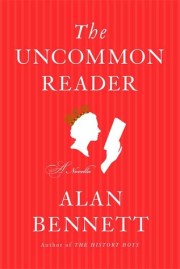
bennettI can’t imagine why (!) but it seemed like a good week to pluck Alan Bennett’s novella The Uncommon Reader off my shelf. I eyed it skeptically when I first acquired it, but I should have trusted the discerning reader who sent it my way: it turns out to be a gently whimsical little fable about the beneficially disruptive effects of reading. For those of you who don’t know the premise, the reader in question is HRH Queen Elizabeth II,* who, in pursuit of straying corgis, ends up at the City of Westminster “travelling library” (what we would call a “bookmobile” out this way) and borrows a book to get herself gracefully out of an awkward moment.
“One” doesn’t usually have time to read (Her Majesty’s habit of referring to herself as “one” turns out to anticipate, deftly, her eventual realization that she lacks a distinct voice of her own) but once begun, she finds herself enjoying the unaccustomed experience and eventually can hardly be trusted to show up on time for state occasions, so much more interesting are her books than the canned speeches she is required to deliver. She begins handing out books, asking literary questions on walkabouts, and developing a new interest in the perspectives of those around her. So changed is she that she is suspected, not of emerging sensibility, but of encroaching senility…and things go on from there, but it’s such a tiny and delicious confection of a book that I won’t give out any further details here.

It’s unapologetically middle-to-highbrow (Her Majesty learns to appreciate Henry James and disdains Harry Potter) and wholly in service to the nice liberal idea that reading (at least, reading the right books) is morally as well as intellectually beneficial, not to mention inherently democratic. But that’s OK: it’s just a reader’s fairy tale, a happily-ever-after for the bookworm set. That’s as nice a use of the charming anachronism that is the royal family as I could want. And at the same time, it’s oddly convincing: watching the Queen arrive at her grandson’s wedding, I half expected to see her tuck a novel into her handbag on her way into Westminster Abbey, or to see Howards End peeking out from behind the program.

*The same discerning reader who sent me the book points out that the queen of the book is never explicitly identified as Queen Elizabeth, though it’s perfectly obvious (the profile on the cover of my edition is also perfectly recognizable from our currency).

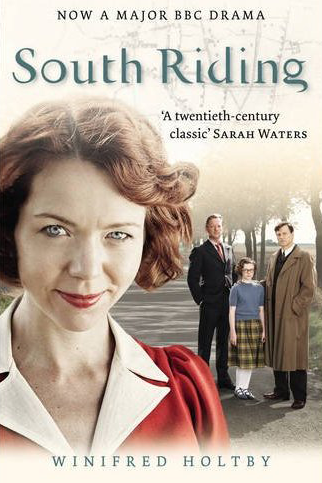
Winifred Holtby, South Riding

I finished up South Riding yesterday and enjoyed it right up to the end–though overall I’m not as impressed by it as I expected to be. It didn’t seem quite balanced, somehow. One thing that really threw me off was Sarah Burton’s falling in love so precipitously with Robert Carne. I knew something of the sort was coming, not just by fictional convention (and I would have been glad to have that expectation disappointed), but because the back of my edition says she “finds she is drawn to him.” Still, when the moment of revelation arrived, it felt much too sudden. Where was it prepared for? What motivated it? Even she acknowledges she hardly knows the man. And yet we get this:

“I love him!” she cried aloud, as though struck by sudden anguish. Immediately she felt that she understood everything. All her past slid into an inevitable and discernible pattern; all her future lay before her, doomed to inevitable pain.

She knew love; she knew its aspect, its substance and its power. She knew that she faced no possible hope, no promise, no relief.

I didn’t like it! More to the point, I didn’t believe it! Where does this melodramatic posturing come from? Is it actually ironic, at Sarah’s expense? A bit, I think, at least at a metafictional level, given how things turn out, but overall her passion is given full credit as sincere. What is the source of these sudden strong feelings? Why are they nearly allowed to derail her characterization, so vivid and sparky to this point, by giving her a tendency to mope as well as a predilection for self-loathing, for her failure (as she believes) to win his love in return? I know, I know: how can I complain when I enjoy so much the burst of melodrama that carries Dorothea into Will Ladislaw’s arms at the end of Middlemarch? But that moment is anticipated by all kinds of hints and indications of Dorothea’s needs and feelings, not to mention by their much closer relationship (unlike Sarah and Carne, Dorothea and Will have had numerous long conversations, for one thing), and by thematic pressures such as … well, I won’t go into this since I’m writing about South Riding, not Middlemarch, but I don’t quite see the thematic necessity or satisfaction of Sarah’s love, and as a plot development, it felt contrived, though after that jarring moment its effects and implications are worked out in very interesting ways.

I really liked the diffuse attention of the novel, the way it held true to an idea of community, giving pretty much equal time to all of its diverse range of characters. The emphasis on Sarah as a central protagonist–not just in the cover blurb, but in the small amount of criticism I’ve looked into–seems misleading to me, insisted on almost as if we don’t know what to do with a novel that doesn’t really have one main character. Though Sarah’s work at the school is significant, and the school itself is a useful organizing point for some of the intersecting plot lines, the novel does not spend a lot of time there or focus conspicuously on Sarah as a newcomer or force for change–she’s not a female version of Dr. Lydgate, for example, just to keep up the Middlemarch comparisons. Am I underestimating her centrality to the novel’s larger concerns? Because I felt she was really just one element among many, it seemed odd that she takes up so much of the novel’s conclusion, and yet the values she articulates do seem to represent what the novel is itself trying to show us.  Again, something felt not quite balanced–straining, almost–about the conclusion. And yet it is rousing nonetheless. (I wonder if this is what Lauren Elkin means when she says Holtby is more interested in the possibilities of message than of form.)

Because the novel kept making me think of Middlemarch, I was struck by the difference between its ending and that novel’s Finale. George Eliot emphasizes the importance of honoring the individual contribution to the ‘growing good of the world,’ insignificant as it may seem at first glance or when measured against more grandiose forms of heroism. In contrast, Holtby celebrates the participation of the individual in a communal enterprise, almost to the point of submerging the one in the many:

She was one with the people round her, who had suffered shame, illness, bereavement, grief and fear. She belonged to them. Those things which were done for them–that battle against poverty, madness, sickness and old age, the battle which Mrs Beddows had called local government–was fought for her as well. She was not outside it.

Local government is the structuring idea of this “English landscape” (geez, even the subtitle provokes Middlemarch comparisons!) so the horizontal structuring makes sense. What makes less sense to me is why Sarah needs to go through the crucible of love and loss to realize her place in this landscape. That said, there is something surprising about her standing alone at the end, though I’m still thinking about Susan Leonardi’s argument (in The Somerville Novelists):

That Holtby’s heroines triumph convincingly and unequivocally attests to the success of her strategy for telling in a traditional narrative the story of the educated woman: the systematic elimination of men from the lives of her heroines and from her texts.

I haven’t read any of Holtby’s other novels, but I didn’t see men being eliminated from South Riding, just from Sarah’s immediate (romantic) future. If Sarah triumphs, what is it over, and how unequivocal is it?

I liked South Riding best, as it turned out, at the level of its sentences, which are constantly strong, frequently funny, and often surprising. Of Mrs Beddows, for instance, we’re told, “Her clothes were a compromise between her spiritual and chronological ages”; of Carne, “His unfeigned pleasure in killing the correct animals at their orthodox seasons made him an affectionately respected neighbour.” These fondly acerbic epigrammatic lines remind me (you guessed it) of Middlemarch.

Monday Miscellany: Friday Night Lights, South Riding, Ian McEwan, & a Musical Bonus

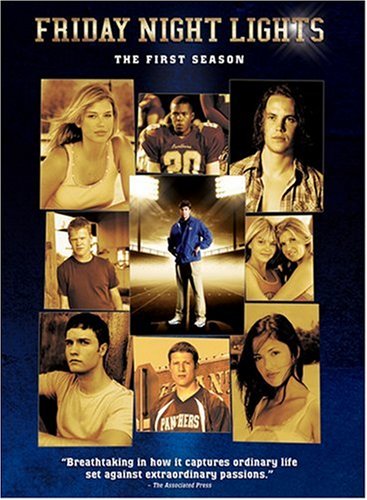
We’re finishing out a four-day weekend here based on a holiday we don’t even celebrate in its hopelessly commercial secular form–Maddie is the only one of us who’d really appreciate Easter Bunny stuff but she’s allergic to both eggs and nuts, so never mind, and just as well too, really. It doesn’t seem like much really went on or got done, but the grown-ups did finish up the first season of Friday Night Lights, which I’d heard buzz about on Twitter from folks including Maud Newton (and Daniel Mendelsohn held it up as a counter-example in his recent smackdown of Mad Men, as well). I was finally motivated to get going on it by Sonya Chung’s post on it at The Millions. We both enjoyed it, which is no small thing considering that I wouldn’t ordinarily ever watch that much football. The characters are engaging and brought to life very convincingly, and there’s plenty of interest in the storylines. But we weren’t swept away by it: it already seems to be falling into the usual TV drama pattern of just one damn plot twist after another–when in doubt, throw in a crisis!–with the additional fairly melodramatic use of the football games to bring things to fever pitch (my husband, who does watch football, was amused that nearly every game was won or lost on the last play, in the final seconds). So far, there’s no sense of a larger project or developing insight of the kind that you get with The Wire or Deadwood, and the premise itself is not as breathtakingly stark and unexpected as In Treatment. I appreciate good storytelling, and I share Chung’s appreciation for the show’s commitment to heartfelt emotion, even to sentimentality.  It’s just that now we know it’s possible to do something more ambitious within the same basic structure. I’ll probably watch at least the second season (though I think my husband won’t), to see if it builds over time into something more, or at least to see if my initial attachment to the characters keeps me hooked, wanting to know what happens next.

In the meantime, I’m about 2/3 throug Winifred Holtby’s South Riding and enjoying it a lot–for some of the same reasons I liked Friday Night Lights, actually, including its straightforward commitment to character development and its interest in the dynamics of a tight knit community under pressure. I particularly like Holtby’s narrative voice, which is smart and analytical without being pedantic. The introduction to my (badly proofread) BBC Books edition promptly and plausibly compares it to Middlemarch. If I were writing one of those annoying “X meets Y” jacket blurbs for it I might call it “a post-war Middlemarch written by a socialist Anthony Trollope,” because while it has the wide range of Middlemarch and the sensitivity to the ways multiple stories can be interconnected, it has none of the formal sophistication of the earlier novel: in fact, it is structured very much like Friday Night Lights or any other conventional multiplot fiction, simply moving from focus to focus while progressing more or less linearly towards its conclusion. Not that there’s anything wrong with that! And in fact it’s a more interesting choice in 1940 than it was in 1860, if only because by then other alternatives had been so abundantly demonstrated, and Holtby’s own awareness of her more immediate literary context is pointed to by conversations within the novel itself about writers including Virginia Woolf. Lauren Elkin has some thought-provoking comments about this at Maitresse, comparing Holtby to Elizabeth Bowen (whom I’ll be reading for one of my book clubs soon, making Lauren’s post doubly relevant!):

It would be a stretch to classify South Riding within the category of modernism.  Although they share thematic concerns, Bowen seems more interested in the possibilities of form, whereas Holtby seems more interested in the possibilities of message. “We are members of one another,” Holtby writes in her prefatory letter to her mother, quoting Paul’s letter to the Romans (Romans 12:3-8). She is not only referring to members of the same community, of course, but to the community of humanity. Bowen’s citydwellers, on the other hand, feel more alienated than ever, and have an awareness of themselves as estranged from anything as conventional as a community. Communities, for Bowen, are in the process of being dissolved, and there is not much that can be done about it. Bowen’s novels and essays constantly interrogate and ironize concepts like “community,” and “humanity.”  Her novels interpret themselves for the reader, her sentences twist in syntax to avoid banality, her young heroines are intensely aware of themselves as young heroines, her novelistic forms double back on themselves. Andrew Bennett and Nicholas Royle call this aspect of Bowen’s work the “dissolution of the modern novel.”

I’m intrigued by the phrase “the possibilities of message,” and I’ll think more about how or whether Holtby’s form is or is not integral to the “message” of her novel as I finish it up–tonight, perhaps!

On a completely different topic–or maybe not, since it’s also about novels and what ideas inform them–I found this discussion with Ian McEwan about books that have influenced his fiction very interesting. Not surprisingly, he emphasizes books about science. An excerpt:

I don’t need to ask what the influence on your novels is here, as science plays a big part in many of them – most noticeably in Solar, but also in Saturday and Enduring Love. What is the nature of your individual relationship, as a writer, with science?

I would like to inhabit a glorious mental space in which books like Slingerland’s would not need to be written. In other words – and this comes back to the notion of mental freedom – your average literary intellectual, just as much as your average research scientist, would take for granted a field of study in which the humanities and sciences were fluid, or lay along a spectrum of enquiry. This is the grand enlightenment dream of unified knowledge. If you think of the novel as an exploration or investigation into human nature, well, science undertakes a parallel pursuit. Of course, much science is concerned with the natural world, but increasingly it has invaded the territory of the novelist. Neuroscience routinely deals with issues not only of consciousness, but of memory, love, sorrow, and the nature of pain. I went to a fascinating lecture on revenge and the reward system by a German neuroscientist a few years ago.

I’m sometimes asked by a literary intellectual in an on-stage discussion – often through the medium of a puzzled frown – why I’m interested in science. As if I was being asked why I had a particular fascination for designs of differential gears in old Volkswagens, or car-parking regulations in Chicago in the 1940s. Science is simply organised human curiosity and we should all take part. It’s a matter of beauty. Just as we treasure beauty in our music and literature, so there’s beauty to be found in the exuberant invention of science.

Finally, once before I posted a sample of one of Owen’s original compositions. If you’re interested, you can follow this link to another, this time the slow movement of the Sonatina for Piano and Violin that was his entry in the composition category at this year’s Kiwanis Festival. It’s an amateur recording of a live performance, so not studio quality, but I think it’s beautiful…

Giving Myself Permission

Among the many thoughtful comments on my post about the “PhD Conundrum,” one that really struck a chord with me is a remark by Joanna Scutts about “typical grad-student behaviors,” which she notes include asking for permission and working for praise. I would say that these are not grad-student behaviors only but good-student behaviors, in that they are typical among academically high-performing undergraduates as well: it makes sense that they appear in exaggerated form among graduate students (who were all strong undergrads to begin with) and are exacerbated by the grad school experience. I am surprised at how much I am still affected by the habits of asking for permission, the key difference at this level being that the person I really need to ask is myself. I’m also distressed at how much I seek praise for my work and feel disappointed in myself when it is not forthcoming: though I realize that my ongoing craving for external validation is inappropriate to my status as a qualified professional, that sense that if you do your work right you will get an A has never quite gone away. (I suspect that the years of being graded for our efforts set us up for the anxiety with which most of us look at our course evaluations.)

It’s the whole asking for permission thing that is most bothersome to me these days, particularly in the context of my writing. One of the payoffs I expected from my blogging is that I would shake off that nagging, doubting voice that tells me I’m not qualified or ready to write about something: that I haven’t read enough or done enough research, that my own opinion doesn’t count for anything unless it’s backed up and depersonalized and abstracted, that I haven’t justified or adequately theorized my approach. As a student, I found deadlines eventually forced me to write what I could, though I was often wracked with despair as I handed something in or presented it in seminar, sure it was a disastrous misfire. The feedback I got almost never (though not quite never) confirmed my worst fears, but somehow my confidence was never boosted. Since graduate school, I have hardly been the world’s most prolific scholar, but I’ve placed my pieces well and in general I’m satisfied that they are good work. Still, I usually declare something finished with a strange mixture of defiance and resignation, rather than satisfaction, and I have a terrible time starting to write something, because to do so I have to silence that voice. (Sometimes I try to drown it out with music!)

By and large I don’t hear that voice when I’m blogging, though, and that has been wonderfully liberating. It helped that I started my blog with no particular goals except to keep track of my reading: it was my space, and it was a kind of space outside the usual parameters of academic judgment. Also, blog posts don’t claim to be definitive or authoritative, the way academic writing does: when blogging, it’s OK (maybe even preferable) to show that you’re still thinking things through, that intellectual life is an ongoing process prone to discoveries, reversals, and confusions. By the time anyone besides my immediate family and friends was reading it, I was comfortable enough to just keep going as I had begun. Some early controversies in the comments set me back and made me more cautious in some respects (which is probably good, though I worry sometimes that the self-censorship I practice keeps my blogging blander than I am in other contexts). Overall, though, I have no inhibitions as a blogger that compare to the insecurities that slow me down when I write anywhere besides here in this WordPress box. My frustration is that the increased confidence I have found in my own voice and views as expressed here has not made a noticeable difference to my other writing. It feels as if I have given myself permission to write as myself, but only within this specific framework. Everywhere else, the old rules still apply! I notice this particularly when writing for Open Letters, where I have been encouraged to write more like I blog (this is not the only feedback I’ve gotten, and I think my co-editors are happy with the pieces I’ve done for OLM–but there I go again, worrying about external validation!). Even though OLM pieces specifically and deliberately are not supposed to sound academic, the minute I know I’m writing something official for publication, I get all serious and anxious again, laboring over every word. It’s nuts!

Yesterday I tried an experiment. When I decide to post on something here, my rule is: write it (online), tidy it, post it. No second-guessing, no (major) rewriting.  I think the longest I’ve spent on a post is 4 hours (oddly, that was the Sex and the City 2 post), but more often I write for an hour or two at most, and usually I’m pretty satisfied with the results–not that there’s nothing more to be said, or nothing that could be said any better, but I have said what seemed important to say, said it pretty clearly, and been myself. What if (I wondered) I wrote the review I’m currently working on right here in WordPress, pretending it was a blog post? Maybe at the very least in a couple of hours I’d have a draft I could work with.

Sadly, as my daughter pointed out, it’s hard to pretend to yourself, because you know too well what you are really doing. An hour or so in, I was not reviewing (as I would have been if I’d known it was really a blog post) but still taking notes. I gave up and pasted what I had into a Word document. What I need is not to fool myself into thinking I have permission to write: somehow, I need to believe it.