Madame Bovary I: “in all of Flaubert there is not a single beautiful metaphor”

It’s odd reading a very famous novel for the first time. It’s like meeting a celebrity in person (or so I imagine). It is intensely familiar and yet strange at the same time: it is exactly what it always appeared to be, and yet it is no longer an idea of something but the thing itself. And so it has been for me with Madame Bovary–it is exactly what I thought it would be, and yet it is more than that, and also, less than that.

What did I know about Madame Bovary before I read it? Well, the basic plot, of course. So, no surprises there. And that it is celebrated as the perfection of a very particular idea of what a novel should be. I’m tempted to say that the idea is for a novel to be nothing like Middlemarch, except that would be anachronistic, and also, much as Madame Bovary is not like Middlemarch, it is also very similar to Middlemarch (or at least to particular subplots in Middlemarch) in ways that inevitably provoke me to comparison. But I’m going to save that for my next post on Madame Bovary (provisionally entitled “The Doctors’ Wives”). Tonight I have a more modest agenda, which is simply to remark on and quote some of Flaubert’s metaphors. Overall, you see, I didn’t like Madame Bovary very much at all. The pending comparative post will go into my reasons for that, and it will all get very thorny. But I was delighted with Flaubert’s language. (I am relying on Lydia Davis’s translation of Flaubert, but, and I am sure someone will correct me if I’m wrong, details so concrete and specific seem likely to translate quite precisely.)

I should qualify that statement: I was delighted with Flaubert’s figurative language. “Flaubert’s aim,” Davis writes in her introduction, “was to write the novel ‘objectively,’ leaving the author out of it. . . . his technique is to present the material without comment, though occasionally a comment does slip in. To report the facts objectively, to give a painstaking objective description . . . should be comment enough.” Davis goes on to note that “in keeping with his plain, almost clinical approach to the material, he schooled himself to be very sparing with his metaphors,” and indeed he is. Davis cites Proust regretting the consequences and complaining “that in all of Flaubert there is not a single beautiful metaphor”–which Davis promptly rebuts with a very beautiful metaphor indeed. There’s not much beautiful about Madame Bovary or its language most of the time, though: Flaubert is both unsentimental and unsparing. “They had to lift her head a little,” he tells us, as the women dress Emma’s corpse for her funeral, “and at that a stream of black liquid ran out of her mouth like vomit.” An extreme example? Maybe, but it epitomizes Flaubert’s ruthlessness. (The entire death scene, in fact, is unrelentingly awful, and then as if the bile isn’t bad enough, Homais punctures her temples several times while cutting Bovary a lock of her hair. That detail, surely, is gratuitous! It’s a cruel book, to us as well as to its characters.)

Apparently, though, for Flaubert, part of being painstakingly objective is finding just the right metaphor to make sure we see (or feel, or hear) the novel’s details exactly. “Beautiful metaphors” are not really the point: his metaphors aren’t decorative but informative. But they are also little spaces for Flaubert to have some fun, to play. Davis tells us Flaubert had a “tendency to wax lyrical and effusive” and that in writing Madame Bovary he very deliberately wrote “against his own natural inclinations.” It is certainly an astonishingly controlled book, claustrophobic and oppressive (qualities that not only suit his aesthetic agenda but reflect his social critique). I think that’s why it was such a relief every time he let loose just a little bit. Sometimes his images are ironic, sometimes poetic, sometimes comical, sometimes just so apt they induce a tiny shiver of appreciation. They tend to reflect the tone or attitude of a particular character, as Flaubert (like George Eliot, though to different ends) relies heavily on free indirect discourse. Emma, unsurprisingly, tends to think in the romantic clichés of sentimental fiction.

A few examples:

he would ride along ruminating on his happiness, like a man continuing to chew, after dinner, the taste of the truffles he is digesting.

the incendiary glow that had reddened her pale sky was covered over in shadow and by degrees faded away . . . her passion burned itself to ashes . . . and she remained lost in a terrible, piercing cold.

It was the first time Emma had heard such things said to her; and her pride, like a person relaxing in a steam bath, stretched out languidly in the warmth of the words.

She recalled all her natural fondness for luxury, all the privations of her soul, the sordid details of marriage, housekeeping, her dreams falling in the mud like wounded swallows . . .

Emma was like all other mistresses; and the charm of novelty, slipping off gradually like a piece of clothing, revealed in its nakedness the eternal monotony of passion, which always assumes the same forms and uses the same language.

Hers was a sort of idiotic attachment full of admiration for him, of sensual pleasure for her, a bliss that numbed her; and her soul sank into this intoxication and drowned in it, shriveled like the Duke of Clarence in his butt of malmsey.

She would undress roughly, tearing the thin string of her corset, which would whistle around her hips like a slithering snake.

All that her mind contained of memories and thoughts was pouring out at once, in a single burst, like the thousand parts of a firework.

Virginia Woolf, Three Guineas

It’s hard to spot similarities between Virginia Woolf and the Somerville novelists I’ve been looking at if you focus on Woolf’s fiction. Winifred Holtby wrote a book about Woolf, and as I noted in my post about Testament of Friendship, she did so deliberately because she knew Woolf was such a different novelist: “I took my courage and curiosity in both hands and chose the writer whose art seemed most of all removed from anything I could ever attempt, and whose experience was most alien to my own.”

A Room of One’s Own, with its framing focus on women’s education and particularly on the material differences between women’s colleges and their male counterparts, brings out an important point of convergence, if also another distinction, as unlike Holtby and Brittain and Kennedy and Sayers, Woolf did not go to university herself. It’s in Three Guineas, though, as I have just (belatedly, I know) discovered, that Woolf really shows herself their contemporary, as the issues she focuses on are very much those that dominate their non-fiction as well. Woolf’s arguments offer nothing like the sharp direct hits of Holtby and Brittain’s social and political journalism: as in A Room of One’s Own, she is indirect, circuitous, ironic; she ventriloquizes both questioners and audiences, sets up targets only to slyly destroy them, hypothesizes, imagines, projects. Her conclusions are not single and direct but layered and proliferating. I have taught A Room of One’s Own several times. Once, in a course evaluation, a student raged that it made her “want to gouge [her] eyes out with an ice pick.” Ridiculous! A Room of One’s Own  is a (arguably, the) great work of non-fiction prose. But at the same time, if you go to books like these expecting the orderly presentation of an argument that proposes and then supports a straightforward thesis, well, I can see how you  might end up a little frustrated. But what a trip it is when you follow her along those byways of her thought–not as exhilarating, perhaps, as her literary essays, but with the same effect of provoking surprise and argument and active thought as you go.

In this case what I tripped across most often was her careful restriction of her arguments to “the daughters of educated men,” a class specificity for which she makes some careful arguments (mostly in the notes) but which I think raises a lot of questions about the economics of the ideals she holds out in the book. She is ruthless about the moral corruption of writing for money, for instance (poor Mrs. Oliphant, who “sold her brain, her very admirable brain, prostituted her culture and enslaved her intellectual liberty in order that she might earn her living and educate her children” – the underlying point is that she ought not to have to sell herself in this way, but isn’t there another version of this story by which writing is a good enough way to make a living? and in Mrs. Oliphant’s case at least, do we really imagine that freed of the need to make money she would have turned her “intellectual liberty” in some particularly brilliant direction?). By and large Woolf seems to characterize money as weakening to the moral fiber–though at the same time she is passionate about the need, the right, to be economically independent. You should want enough to sustain yourself, I think is the idea, but not otherwise pursue financial reward, as all too quickly then you will interest yourself in what pays best rather than what is best.

There’s lot more to be considered about the economics of Three Guineas (its whole conceit, after all, is “where shall I bestow these three precious coins?”). Given that I’m reading it as part of my “Summer of Sommerville,” though, I am particularly interested in ways it resonates with the other things I’ve been reading. On women’s education, she offers a curt history but also a trenchant commentary on the investment women across the centuries have made in the education of their brothers:

For have not the daughters of educated men paid into Arthur’s Education Fund* from the year 1262 to the year 1870 all the money that was needed to educate themselves…? Have they not paid with their own education for Eton and Harrow, Oxford and Cambridge, and all the great schools and universities on the continenent…? Have they not paid so generously and lavishly if so indirectly, that when at last, in the nineteenth century, they won the right to some paid-for education for themselves, there was not a single woman who had received enough  paid-for education to be able to teach them?

She is similarly pointed on women’s enthusiasm for the first World War:

So profound was her unconscious loathing for the education of the private house with its cruelty, its poverty, its hypocrisy, its immorality, its inanity that she would undertake any task however menial, exercise any fascination however fatal that enabled her to escape. Thus consciously she desired ‘our splendid Empire’; unconsciously she desired our splendid war.

The support rests, then, not on patriotism, but on rebellion, and in fact a continuing theme of the book is women’s very different relationship to the country that expects their loyalty and service:

She will find that she has no good reason to ask her brother to fight on her behalf to protect ‘our’ country. ‘ “Our country,” ‘ she will say, ‘throughout the greater part of its history has treated me as a slave; it has denied me education or any share in its possessions. “Our” country still ceases to be mine if I marry a foreigner. “Our” country denies me the means of protecting myself, forces me to pay others a very large sum annually to protect me, and is so little able, even so, to protect me that Air Raid precautions are written on the wall. Therefore if you [men] insist on fighting to protect me, or “our” country, let it be understood, soberly and rationally between us, that you are fighting to gratify a sex instinct which I cannot share; to procure benefits which I have not shared and probably will not share; but not to gratify my instincts, or to protect either myself of my country. For,’ the outsider will say, ‘in fact, as a woman, I have no country. As a woman I want no country. As a woman my country is the whole world.’

For Woolf, as for Holtby, it’s not so much the military-industrial complex that is a threat to her freedom as the military-patriarchy complex: both writers make a strenuous case for recognizing the links between the masculine will to power (which Woolf analyzes in one section of Three Guineas, with stinging condescension, as “infantile fixation”) with Fascism. In Holtby’s 1934 essay “Black Words for Women Only” she observes that Nazism has rolled back all the progress made by women between 1918 and 1933:

There is little hope for ambitious young women in Nazi Germany, where the brightest contribution of constructive economic thought towards the solution of the unemployment problem appears to have been the expulsion of large sections of the community from paid work, as a penalty for being women, Socialists or Jews, and their replacement by unobjectionable loyal male Aryans. Individual women have protested against this mass campaign to restore their economic dependence and drive them back to the kitchen. . . .

Throughout history, whenever society has tried to curtail the opportunities, interests and powers of women, it has done so in the sacred names of marriage and maternity. Exalting women’s sex until it dominated her whole life, the State then used it as an excuse for political or economic disability. . . . Today, whenever women hear political leaders call their sex important, they grow suspicious. In the importance of the sex too often has lain the unimportance of the citizen, the worker and the human being. The ‘normal’ woman knows that, given freedom and equality before the law, she can be trusted to safeguard her own interests as wife, mother, daughter, or what you will.

Pondering the contaminated “atmosphere” created by the unwanted intrusion of women into professional life (“it is likely that a name to which ‘Miss’ is attached will, because of this odour, circle in the lower spheres where the salaries are small rather than mount to the higher spheres where the salaries are substantial”) Woolf demands, in her turn, “is not the woman who has to breathe that poison and to fight that insect, secretly and without arms, in her office, fighting the Fascist or the Nazi as surely as those who fight him with arms in the limelight of publicity?” The Fascist dictator is simply the oppressive patriarch gone national:

He has widened his scope. He is interfering now with your liberty; he is dictating how you shall live; he is making distinctions not merely between the sexes but between the races. You are feeling in your own persons what your mothers felt when they were shut out, when they were shut up, because they were women. Now you are being shut out, you are being shut up, because you are Jews, because you are democrats, because of race, because of religion. It is not a photograph that you look upon any longer; there you go, trapesing along in the procession yourself. And that makes a difference. The whole iniquity of dictatorship, whether in Oxford or Cambridge, in Whitehall or Downing Street, against Jews or against women, in England, or in Germany, in Italy or in Spain is now apparent to you.

The dictator is only the extreme version of “Man himself, the quintessence of virility, the perfect type of which all the others are imperfect adumbrations”: “He is called in German and Italian Führer or Duce; in our own language Tyrant or Dictator. And behind him lie ruined houses and dead bodies – men, women, and children.”

The key lesson of Three Guineas is “that the public and the private worlds are inseparably connected; that the tyrannies and servilities of the one are the tyrannies and servilities of the other.” But from this connection Woolf draws hope, and a recipe for social and political transformation:

It suggests that we cannot dissociate ourselves from that figure but are ourselves that figure. It suggests that we are not passive spectators doomed to unresisting obedience but by our thoughts and actions can ourselves change that figure. A common interest unites us; it is one world, one life. How essential it is that we should realize that unity the dead bodies, the ruined houses prove. For such will be our ruin if you, in the immensity of your public abstrations forget the private figure, or if we in the intensity of our private emotions forget the public world. Both houses will be ruined, the public and the private, the material and the spiritual world, for they are inseparably connected.

I think that this desire for men and women to recognize and stand together in a united front (“now we are fighting together. The daughters and sons of educated men are fighting side by side”) lies behind her rejection of the word “feminism” (“a vicious and corrupt word that has done much harm in its day and is now obsolete”), though this was another of the things I stumbled against, reading along. Given her insistence precisely on women’s “outsider” status, and on the particularities of their experiences and perspectives, why oppose language that identifies their cause as sex-specific? “They [those called ‘feminists’] were fighting the same enemy that you are fighting and for the same reasons,” she says; “They were fighting the tyranny of the Fascist state.” But that rather erases that until the rise of the Fascist state, and indeed for those not living in a Fascist state, different groups in fact have different antagonists. She wants to make a distinction between men as private people (she is eloquent, for instance, about the excellent relationships of brothers and sisters in private life) and men as social beings: “we look upon societies as conspiracies that sink the private brother, whom many of us have reason to respect, and inflate in his stead a monstrous male, loud of voice, hard of fist . . . [who] enjoys the dubious pleasures of powers and dominion.” But men and brothers, and societies, do not exist in the abstract, and as her own examples of the ‘infantile fixation” of fathers with controlling their daughters show, the tyranny actual individual women fought was very much the tyranny of their own families, a fact that no analogy or extension to Hitler and Mussolini should erase.

But that’s what Woolf does: she provokes argument even as she compells you with the intelligence and elegance of her writing. I know she met Holtby but did not warm to her (actually, she was quite snooty about her in her letters), but I don’t know if she met Brittain (she read Testament of Youth “with extreme greed”). Do you remember the old TV show “Meeting of Minds,” hosted by Steve Allen? An episode featuring these three would absolutely bristle with intellectual excitement, political commitment, and aesthetic contrasts.

*The explanation for this is in my favorite line of the book: “You, who have read Pendennis, will remember how the mysterious letters A.E.F. figured in the household ledger.” OK, fine, Virginia, I will read Pendennis this summer!

Recent Reading Round-Up: Cohen, Donoghue, Knox

I  have some serious reading to do for my two book clubs this month — Madame Bovary for the local one and The Yacoubian Building for Slaves of Golconda. I’ve actually started both of them, though I started The Yacoubian Building so long ago that I think I’ll just start it over again. But at the same time I’ve been flitting around among a lot of different books for my light reading, so I thought I’d catch up on some of them here.

On the advice of Amateur Reader, I looked up Paula Marantz Cohen’s Jane Austen spin-offs, Jane Austen in Boca and Jane Austen in Scarsdale; or, Love, Death, and the S.A.T.s. Both are intelligent, entertaining, satirical, and romantic without being sentimental. I thought  Jane Austen in Boca was unevenly constructed: the set-up was too long and the resolution too quick. I also thought the introduction of the college film crew was extraneous to the novel’s needs: it wasn’t even used as a device to resolve the romantic conflict. But that was OK: I enjoyed the quirky people and the milieu (both of which I envisioned looking exactly like the retirement community part of In Her Shoes) and the literary chit-chat, and especially the Austen seminar, from which AR has already quoted the best bits. I liked Jane Austen in Scarsdale better overall, and not just because it’s based on Persuasion rather than Pride and Prejudice. I thought the shifting of the Elliots’ class anxiety from Austen’s context to the context of status-obsessed parents angling to get their kids into the “best” colleges was really smart, and though I can imagine Cohen’s extended satire on the whole process seeming too extended to some readers, I found it very funny. Changing the Wentworth figure from a naval hero to a travel writer was also clever: how else could he have travelled the world and come back, not broke, but rich, after all? The bit that didn’t work as well, I thought, was the “giving him up on the advice of family” part, which just seemed really unlikely for modern characters. But maybe I just move in the wrong (or right!) circles.

Following the enthusiastic recommendations of Jessica at Read React Review and Liz at Something More, I picked up Ride with Me (continuing my intrepid explorations of Romance-land!) and, like both of them, quite enjoyed it. I’m not a biker, but I liked the premise because of the excuse it gave for lots of descriptions of the landscape, and also because travel narratives are always effective devices for character development and (in this case at least) relationships. I got a bit tired of the appreciative voyeurism–how interesting can it be for us to be told repeatedly how great someone looks, after all? And the really, really rich guy trope (experts: does this count as a trope?) is a bit annoying because it’s kind of like waving a magic wand over the story: I prefer an HEA that isn’t so imbalanced. I had lunch today with Sycorax Pine and we talked a bit about ideology and contemporary romance, and particularly about whether period romances may sometimes do a better job complicating things like gender roles and economic issues precisely because in looking back, we are able or willing to see more critically. No doubt, as a beginner, I should not generalize, but in this specific case and a couple of other romances I’ve read recently (like Julie James’s About That Night), it has bothered me that part of the happy ending is the implication that “money perfects everything.” But overall Ride with Me was a lot of fun, and even funny (like Jessica, I particularly enjoyed the hot sauce contest).

I guess it isn’t right to include Emma Donoghue’s Room as light reading, though it was certainly a very fast read. I avoided it for a long time: the premise made me uncomfortable, and I didn’t particularly love the other Donoghue novels I read. But it was hard not to be curious, given how much hype and acclaim it got, so when the e-book went on sale for $5 I couldn’t resist. For the first 50 or so pages I was captivated and really impressed: Jack’s voice is pitch-perfect given the concept, and Donoghue very effectively balances us on a knife-edge between innocence and evil because we can’t help but understand everything so very differently from Jack. Though the narrative conceit started to wear on me after a while, I also got very caught up in the suspense of their escape attempts. Unlike litlove, though (whose reading of the novel is wonderful), I tired quickly of the second half. After the initial shock of being introduced to the rest of the world, Jack began to seem to me too much of a device to show us the world as it seems to an outsider. His voice faltered too, I thought: though we were set up for his advanced vocabulary by the ‘parrot’ game he and his mother play and his otherwise hyper-developed skills, still, some of the comments he made seemed artificially pointed while at other times he seemed much more babyish than he ever did while in “Room.” The setting up of his new life felt laborious, too. Clearly, readers differ on this!  I’m very interested in litlove’s proposal that something more generalized comes out of the novel about childhood innocence and the difficulties we all have growing out of it, but I’m not comfortable reading the novel in a way that conflates Jack’s childhood, founded in trauma and built through artifice, with childhood in general–unless we want his mother’s relationship with Old Nick to stand in for marriage generally too, but nothing about Room gave me the sense that Donoghue intended it as an allegory overall. So for me, the novel works best at the more specific level, an experiment in perspective and psychology. I think the strengths of sticking to Jack’s point of view–including that it’s unexpected and often very poignant seeing as he sees–also become the novel’s weakness; I would have liked to switch to his mother’s point of view for the second half, perhaps, because it’s not that hard to get the idea that everything seems very strange to Jack, so instead of giving us a tour of everything as he gets around to it (a coffee shop! a toy store! a playground!) some of the realities of their captivity as well as of their re-adjustment could have been explored from a more sophisticated point of view.

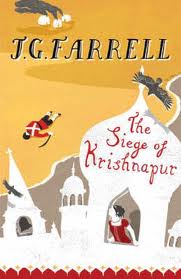
J. G. Farrell, The Siege of Krishnapur

The Siege of Krishnapur is the second in Farrell’s ‘Empire trilogy’ – the first is Troubles, which I read last summer. Because I had read Troubles, I wasn’t as taken by surprise by The Siege of Krishnapur as I might have been: I anticipated going in that it would be both horrifying and funny, and it was. Siege is set during the 1857 Sepoy Mutiny, and it tells the story of one particular British garrison town, “the center of administration for a large district.” As if hindsight isn’t enough for us to know that this center cannot hold, the novel begins by walking us through what a contemporary traveler would see – the deserted town “merely a melancholy cluster of white domes and planes,” only “the creaking of loose shutters and the sighing of the wind in the tall grass.” This Krishnapur is a ghost town, so when we meet its inhabitants in 1857 they already have the surreal quality of animated corpses or figments of a creepy imagination.

And yet the Krishnapur of 1857 is a bustling place at first, with poetry readings and dinners and dances as well as the extensive bureaucratic business of empire. The one sign of trouble is (and I long to know if this detail is fact or just a sign of Farrell’s bizarre genius) “a mysterious distribution of chapatis” which start appearing in dispatch boxes and doorways, or on the Collector’s desk “neatly arranged beside some papers.” How can chapatis be ominous? What can they mean? The absurdity of chapatis as harbingers of doom is exactly the right starting point for this book, which makes empire itself, ultimately, seem absurd. The things people have done (the things people do!) in the name of “civilization”! Among the most cherished possessions of Mr. Hopkins, the Collector, is The Spirit of Science Conquers Ignorance and Prejudice: this “bas-relief in marble” epitomizes the perverse blend of violence and idealism that in this novel defines British imperialism:

it was here [by the window] that the angle of the light gave most life to the brutish expression of Ignorance at the moment of being disembowelled by Truth’s sabre, and yet emphasized at the same time how hopelessly Prejudice, on the point of throwing a net over Truth, had become enmeshed in its own toils.

One of the most memorable and suggestive images of the siege is of the giant marble heads of Plato and Socrates, once crowning ornaments of the great banqueting hall, prised off the roof to serve as shelters for the British gunners. The attacking sepoys are startled to see, through the chaos and dust, “two vast, white faces, calmly gazing towards them with expressions of perfect wisdom, understanding, and compassion.” Much later, when conventional ammunition has run out, marble fragments from The Spirit of Science Conquers Ignorance and Prejudice replace cannon shot, and later still, the heads of the Collector’s prized “electro-metal figures”:

of the heads, perhaps not surprisingly, the most effective of all had been Shakespeare’s; it had scythed its way through a whole astonished platoon of sepoys advancing in single file through the jungle. The Collector suspected that the Bard’s success in this respect might have a great deal to do with the ballistic advantages stemming from his baldness. The head of Keats, for example, wildly festooned with metal locks which it had proved impossible to file smooth had flown very erratically indeed, killing only a fat money-lender and a camel standing at some distance from the field of action.

You can’t really get any more literal about imposing your culture on another than shooting people dead with the heads of your most famous poets! So much for the Collector’s belief in “the ennobling powers of literature.”

But Siege wouldn’t be as complicated and interesting as it is if it were nothing more than an indictment of imperialism. Didactic moralizing is really not Farrell’s game. For one thing, in some respects the British really do have the ‘spirit of science’ on their side. A key example is the flooding plains, which the native landowners are convinced can be protected “by the sacrifice of a black goat” on the banks of the rivers. ‘But that doesn’t work,’ remonstrates the Magistrate, Mr. Willoughby;

‘You’ve tried it before. Every year the floods are worse.’

The landowners remained silent out of polite amazement that anybody could be so stupid as to doubt the efficacy of a sacrifice when properly performed by Brahmins. They were torn between amusement and distress at such obtuseness.

As the great cholera debate shows, though, neither side has a monopoly on obtuseness or unscientific thinking, or, as we discover, on superstition (or, as some characters consider it, religion). The British are, by and large, racist, xenophobic, and self-satisfied, but the attacking Sepoys are hardly depicted as heroic freedom fighters–though we do see them exclusively from a British point of view, so the way they appear reflects at least as much on the observers than it does on them. There are pro-British Indians, too, who are as absurd in their pomposity and pretension as the British themselves – the Maharajah’s son Hari, for instance, whom we first encounter sitting “on a chair constructed entirely of antlers, eating a boiled egg and reading Blackwood’s Magazine.” I think my favorite detail about Hari (who, sadly, is treated as badly by the British during the siege as if he’d never read a page of Blackwood’s Magazine) is that whenever he meets Mr. Hopkins without Mrs. Hopkins along, he calls him “Mr. Hopkin” – singular, you see!

As in Troubles the collapsing hotel becomes symbolic of the collapse of British control over Ireland (as well as of the rotten foundations of that control), so the the besieged British of Krishnapur become symbolic of Britain’s faltering grip on its empire there. The Collector directs the construction of earthworks as defenses, but when the rains come they turn to mud and dissolve; the Collector’s single-minded efforts to build them up again are an absurd microcosmic example of the way control becomes an end in itself. Like a weird reversal of the Great Exhibition, which Mr. Hopkins has idealized as the ultimate demonstration of human ingenuity and accomplishment, he orders the emptying out of Krishnapur:

The furniture was the first to go. He strode about the Residency and the banqueting hall, followed by those men who were still strong enough to lift heavy objects. Every now and again, without a word, he would point at some object, a chair perhaps, or a sideboard or a marquetry table . . . More than one unwary member of the garrison found that his bed had vanished while he had been defending the rampart against a sepoy assault. Sometimes a person would arrive just as the divan on which he had been sleeping was dragged away.

Sofas and tables, beds, chests, dressers and hatstands were thrown on to, or upended along, the ramparts, but still their strange haemophilia continued. Now the Collector’s finger was pointing at other objects, including even those belonging to himself. Statues were pointed at and the shattered grand piano from the drawing room in the hope that they might help, if only a little, to shore up the weakest banks of soil. . . .

But although a great deal of solid matter had soon accumulated on one or other side of the ramparts and sometimes on both, it had little or no effect. It was like trying to shore up a wall of quicksand. . . . So in the end he took to pointing at the last and most precious of ‘the possessions’ . . . tiger-skins, bookcases full of elevating and instructional volumes, embroidered samplers, teasets of bone china, humidors and candlesticks, mounted elephants’ feet, and rowing-oars with names of college eights inscribed in gilt paint.

Eventually even Mr. Hopkins has “come to entertain serious doubts” about the Exhibition – “he should have thought a great deal more about what lay behind the exhibits.” I think that curiosity about what lies behind things is what makes Farrell such an unusual historical novelist. Siege is very much a novel of ideas, and a novel about ideas and what people do because of them. It’s full of people arguing about ideas, too. The Sepoy Mutiny wasn’t the end of British India, but Farrell sets it up as exemplary of something beyond that particular story: it’s an opportunity for him to interrogate the whole concept of progress, the very meaning of ‘civilization.’ Yet the novel is intensely historically specific.

I wasn’t surprised to see Siege on the list of Hilary Mantel’s ‘five favorite historical fictions.’ It has the total lack of sentimentality shown in both Wolf Hall and A Place of Greater Safety (quite unlike the surfeit of sentiment to be found in my collection of Richard III novels!) and, also like Mantel’s historical fiction, it is grimly violent. But Farrell’s humor is like nothing else I’m familiar with. It’s quite disturbing, actually, how funny the battle scenes are, right up to the horrific last stand of the defenders inside the Residency itself. And grave-digging: hilarious! It’s often not so much the situation itself as Farrell’s wry, unexpected style that startled me into laughter:

[The Collector] realized with a shock how much his own faith in the Church’s authority, or in the Christian view of the world in which he had hitherto lived his life, had diminished since he last inspected them. From the farmyard in which his certitudes perched like fat chickens, every night of the siege, one or two were carried off in the jaws of rationalism and despair.


What We Talk About When We Talk About Academic Blogging

Logistics and institutional issues: how do you find time for it, where (if anywhere) should it go on your c.v., and how should tenure and promotion committees evaluate it?

At least, this is what the audience questions were almost exclusively about when I spoke about blogging at my faculty’s “research retreat” on Friday. Here’s a link to the Prezi I used, which is basically a condensed version of the one I prepared for the British Association of Victorian Studies conference in August. I was supposed to speak for only 8-10 minutes, so I just highlighted the arguments for and against blogging as I see them and quickly pointed out what the illustrative quotations were, on the principle that interested parties can easily find the Prezi and read them (and follow the links) themselves. What I really tried to emphasize in my own remarks is that if we think about why we do research and publish it in the first place–to advance or improve a conversation–then writing online makes perfect sense. I also stressed that for me, the real benefits are intellectual. I specifically invited follow-up questions about ways my blogging had affected my teaching, my research, my writing, and/or my intellectual life. I didn’t get any questions about that at all, leading me to think that the single most important quotation in the presentation is the one from Jo VanEvery: “Scholars lose sight of the fact that academic publishing is about communication. Or, perhaps more accurately, communication appears disconnected from the validation process.” What people wanted to talk about was “validation.” As I said at the close of the discussion, I think that preoccupation in itself is worth reflecting on. It’s inevitable, perhaps, because we are professionals trying to get and keep jobs and build careers, but I think concern about bureaucratic processes should follow on reaching a better understanding of the value of the activity, to the individual scholar, to the university, and to the broader community. Maybe people were taking for granted that blogging could be beneficial in the ways I was describing and so didn’t need to ask about it, but the impression I got (perhaps unfairly) was that they couldn’t quite imagine those benefits trumping the low likelihood of professional rewards for the time spent. The one specific positive benefit someone raised from the floor was that blogging might help lay the groundwork for a grant application–but as I noted, that assumes that getting grants is itself a priority. What if we don’t need them to do the work we think is important? (You certainly don’t need a grant to keep a blog.)

And my responses to the questions that were asked? Well, the “how do you find time” question is not one that gets asked about activities that we do not perceive as “extra” to our “real” work, so the answer to that would depend on how you find time for anything you think should be among your priorities. I don’t have a strong opinion about what heading the blog should be under on a c.v. except that I think it should in some way be treated as a research, writing, and publishing project, not as “service.” And I think tenure and promotion committees should evaluate it by reading it — not one post, or even a few posts at once, but ideally by following it for a while as well as exploring the archives. I think bloggers (and academics involved in any non-traditional kinds of work) need to help by explaining clearly what they are up to and contextualizing it so that people who have never read a blog before (and there are still many of these people in academia) have some appropriate frameworks for what they are looking at, and they should also help by thinking about how to curate their blogs so that newcomers can easily grasp their range as well as follow key examples. In my own case, I think (I hope!) the index pages I’ve built are useful in this way. As indicated in the new MLA guidelines for evaluating digital scholarship, I also think that tenure and promotion committees need to include people who understand new forms of scholarly communication, including as external reviewers. Someone who is also a blogger, for instance, is more likely to appreciate and fairly assess the quality and contribution of another blogger’s site than someone who reads only conventional scholarship.

The other panelists  were talking primarily about newspaper op-eds and letters to the editors. It was interesting to me that in general, they expressed more discomfort or dislike for the experience of being exposed to the unfiltered world of the internet. Being social scientists and historians, though, they were talking about writing on political topics, so they are engaging in conversations where stupid virulent attacks are more likely, not just because a national newspaper is much higher profile than my own quiet corner here, but also because politics rile people up more than whatever someone happens to think about The Good Soldier or Lightning Rods.* I can understand why one piece of advice they had, then, was simply not to read the comment threads that follow but to wait for the wave of attention to pass and hope to have made a small difference to the public conversation and perhaps to create further networking or writing opportunities for yourself by the exposure. I felt lucky, really, that though I am not Utopian or idealistic about the openness of the internet, my own experience of it has been, by and large, really positive and rewarding.

*Though it is possible to rile people up a bit on these topics, if you have the right audience!

The Summer of Somerville

Now that the dust has mostly settled from the teaching term, I’ve begun organizing my plans for the summer. One of my top priorities is preparing for my new seminar on ‘The Somerville Novelists,’ which is the first official academic manifestation of the reading I’ve been doing about Vera Brittain, Winifred Holtby, and Margaret Kennedy. Oh, and Dorothy Sayers, except that my interest in her goes back longer and I’ve taught Gaudy Night several times before, so there I don’t feel I am starting so much from scratch.

As I wrote in a previous post about the way reading changes when it becomes research, I am having to think now not just about what I’m interested in but also about what I need to know to do the job. But since there’s no pre-existing definition of “the job,” this early phase has to be both open-ended and creative: ‘there’s the whole “tempting range of relevancies called the universe,” and then there’s your part of it, but where that begins and ends, and why, is something that, in literary research at least, is rarely self-evident.’

I’ve actually been thinking that I’d like to preserve that lack of definition going into the course, rather than trying to get everything under control according to a template of my own. I’m enjoying the sense of discovery as I read in this new (to me) material, and ideally that’s something the students will feel too: that together we are finding things out, rather than that they are trying to catch up with my expertise. I don’t think my seminars are usually stifling, but they do often focus on material I know very well and have gone through often with students. This has the advantage that I can steer our discussions in what I know will be significant directions and give guidance on research and assignments that I feel confident about, but it has disadvantages too, not least of which is that there aren’t a lot of surprises, and the level of personal commitment from students isn’t that high. I don’t mean that students don’t work hard and aren’t often very engaged, because I’ve had some great seminar groups and usually the students are enthusiastic about them (at least judging from their course evaluations). But I’d like to see them working together on something they think is important–on something they feel collectively responsible for, rather than accountable to me for.

I’m going to be thinking through the summer about how to organize the course to create this kind of atmosphere, and especially about what kinds of assignments and course requirements to include. I’ve been thinking in terms of class projects – a wiki, perhaps, to go public at the end of term, or a collaborative Prezi (I’ve seen some that cover an enormous amount of content in really interesting ways). I’m also thinking less about critical essays or research papers of the conventional academic kind and more about writing projects that show off the class material for a general audience. If anyone has suggestions, especially of assignment sequences that have worked well when exploring non-canonical material for which there simply aren’t a lot of academic resources, I’d be very interested!

In the meantime, I’m brainstorming lists of things I need to know about that will probably become part of our class discussion, including historical, biographical, and literary contexts and connections. Here’s the list so far, in all its unpolished open-endedness:

  • Individual writers from our list (Brittain, Holtby, Sayers, Kennedy)
  • Core readings (Testament of Youth, South Riding, Gaudy Night, The Constant Nymph)
  • Other books by them not officially assigned to class (perhaps for student projects or presentations)
  • critical / theoretical approaches and contexts
  • History of Somerville / women at Oxford (perhaps women in Canadian universities?)
  • Boer War
  • WWI, especially women in the war (nursing)
  • Suffragist movement
  • Women’s / feminist press, e.g. Time and Tide
  • Other contemporary writers–Olive Schreiner, Rebecca West, Virginia Woolf, Robert Graves, maybe D H Lawrence?
  • Genres, e.g. autobiography
  • Literary movements, e.g. modernism, in relation to our writers
  • Virago Press

I’m thinking in terms of a giant Venn diagram, with all these topics overlapping in different ways. The central artifice of the course is that there’s something coherent about our group of four, but part of what’s so interesting is that there isn’t, really, except that they all went to Somerville at roughly the same time and all became novelists. I’m used to organizing courses that are much more strongly unified by some kind of internal logic, usually thematic (the one I’ve offered most often is ‘The Victorian “Woman Question,”” for instance). Probably (though it’s too early to be sure) we will return regularly to the question of whether we’re doing something that makes any sense, and whether that matters. The diffusion of topics could lead to confusion in the course, so one of my jobs this summer is to bring it under control without spoiling the fun. You can expect lots of updates as I explore.

I’ve started, because it seemed pretty fundamental, with the history of women at Oxford, which has been really interesting to learn about. One of the first things I realized was that this aspect of the new class actually follows much more closely than I had realized from my usual teaching, including the  ‘Woman Question’ seminar, because an instigating factor in the movement of women into Oxford was the pressure to educational reform stimulated by the difficult situation of governesses in the mid-Victorian period (Jane Eyre!) and the statistical imbalance between men and women highlighted in the 1851 census and of increasing concern towards the end of the century (The Odd Women!). Many of the names of early advocates for women’s education are moderately familiar to me from my 19th-century studies: Emily Davis, Barbara Leigh Smith (later Bodichon), Matthew and Thomas Arnold, Mary (Mrs. Humphrey Humphry) Ward. George Eliot donated to the founding of Girton College, Cambridge — a modest £50 only, but evidence of the precedence she gave to education over political rights.

And on that note, it’s back to the Oxford History of Oxford!

We did it again! Another issue of Open Letters Monthly goes live!

The May 2012 issue of Open Letters Monthly went live yesterday. As usual, it is about as eclectic and, we fondly believe, substantial as any literary review you’ll find on the internet. Now, if only we could find the magic button to make it one of the most widely read literary reviews on the internet … so please, tell two friends about it, and if they tell two friends, and they tell two friends, and so on and so on, well, that would be nice! And also, if you are interested in writing for us, email us (openlettersmonthly at gmail dot com) with your interests and ideas. I speak from experience when I say that our editorial process is at once rigorous, passionate, and unfailingly constructive.

So! What’s in this latest issue? You should click on over and take a look for yourself at the whole table of contents. Highlights for me this time include a thoughtful and thought-provoking essay on the provocative poetry of Sylvia Plath; an in-depth commentary on Derek Walcott’s Omeros; my fellow-editor Greg Waldmann’s take-down of Rachel Maddow’s Drift; and the one-two punch of my own essay on a life-long infatuation with Richard III and Steve Donoghue’s brilliant review of a new biography of the man who stole his crown, Henry VII. I had fun with the Richard III essay because I got to work in so many different interests of mine, including detective fiction (via Josephine Tey’s The Daughter of Time), historical romance, and historiography, even including a bit of obscure 19th-century material. The essay as a whole is underwritten by ideas arising from my academic research first for my thesis and then for my book: like my Gone with the Wind essay, which put to use the time I’d spent working on ethical criticism, this one is an experiment in loosening up what expertise I have and trying to make it interesting and useful for more people than will ever work their way through Gender, Genre, and Victorian Historical Writing. Unlike the Gone with the Wind essay, however, this new one includes a rare archival photograph of me in full geeky 1980s splendor, complete with big glasses and embarrassing (but very practical) rubber boots–so get on over and check it out before I have second thoughts about that!

Good Exposition is Hard to Find

People often sound off about the value of showing over telling in fiction. I think this is a pretty stupid contest to set up: what’s important is finding the right technique to get the work done. As I emphasize in my class on close reading, you can do some things by telling that you can’t do otherwise–establishing historical context, for instance, or philosophizing or otherwise commenting on the action of the story. Huge swathes of brilliant writing from the nineteenth century is basically telling: I could never embrace any putative standard of excellence in fiction that doesn’t put Chapter XV of Middlemarch pretty high up the list. It’s not as if telling is the easy way out, either. It’s hard to manage information in a compelling and elegant way, as I was reminded by some joltingly awkward moments in a book I just finished, Julie James’s About That Night. Here’s an example:

She had a week off before her summer job started, during which she planned to do nothing more strenuous than roll herself out of bed every day by noon and mosey over to the university’s outdoor pool, which was open to students.

‘I hate to burst the bubble on your daydream, but I’m pretty sure they don’t allow alcoholic drinks at IMPE,’ Rae said, referring to the university’s Intramural Physical Education building, which housed said pool.

James’s challenge here is that Rae, who’s familiar with the campus, would naturally use the acronym, but the reader, who isn’t, needs it glossed. She is right, then, to gloss it, but it feels like an awkward afterthought when the explanation is tacked on like that. Why didn’t James’s editor work with her on this bit? What is the solution, anyway? My first thought is that it would help to put the details in sooner, maybe here: “mosey over to the university’s Intramural Physical Education building, where the pool was open to students.” Then we’d recognize the source of the acronym when Rae uses it, wouldn’t we? And then the awful phrase “housed said pool” could go too.

Here’s another bit of awkward explaining:

Dex smiled at Rae, then turned to Rylann with a curious expression. ‘Oh, Ry-linn,’ he said, pronouncing her name. ‘I’d been saying it wrong after I saw the picture of you and Kyle in the paper.’ He cocked his head. ‘Not a very common name, is it?’

I’d been saying her name wrong since page 1, and this is page 149. Obviously this is something James knows is a likely problem. To me, it makes more sense to address it sooner, though admittedly I may just be sensitive on this point because my own name is not very common and often mispronounced and I’ve had to explain or correct it for 40-something years. Why not include the pronunciation and provenance of the name in an early bit of characterization? We hear all about her hair colour and amber eyes right away, after all. But it’s the ‘pronouncing her name’ bit that’s really an editorial wobble. What else could he possibly be doing?

Another one, still later:

With a smile curling at the edges of his lips, Kyle held up a Starbucks cup. ‘Drink this. My mother used to get migraines. I remember her saying something about caffeine helping.’

‘Sweet Jesus, you are a god,’ Rylann said, taking the cup gratefully. She’d had luck with caffeine before but hadn’t had the energy to stop at a Starbucks on her way home from work.

This is the first we’ve heard about her even contemplating a stop at Starbucks. It makes sense that a regular migraine sufferer would know about and have tried various fixes (though this is also the first time in the novel that she’s had a headache at all), so I can see why it felt necessary to say something to fill that in–but again, I think it makes more sense to integrate her previous experience as well as her idea to stop for coffee into the actual description of her coming home from work–‘By the time she left work at six thirty, her head was throbbing, she felt nauseous, and even the hazy pre-sunset light outside made her eyes hurt so much that even stopping at Starbucks for the caffeine that had helped her headaches before was intolerable’–or something like that. Then Kyle arrives bearing his Starbucks cup and the scene can just go on.

These are not fatal flaws, though there are other similarly graceless moments in the book–more of the same after-the-fact fillers as in these examples (after a comment about ‘Keith, Kellie, Dan, and Claire’ in conversation, we get ‘Keith, Kellie, Dan, and Claire had been their “couple friends”‘), or the occasional info-dump (as when Kyle arrives at his old campus and we get a whole paragraph describing the computer science building), or problems with modifiers (‘Now in his late fifties, there was gray in Sharma’s black hair’). Not fatal–but at the same time, they send the signal that this book has relatively low standards when it comes to its prose and its craft: not just the writer but the editor either didn’t see or didn’t care that it could be better written. It’s not that my ideas for tweaks would move the novel any closer to the depth and richness of the exposition in Middlemarch, but there’s no need to give telling a worse reputation than it already has by doing it so clumsily.

In fairness, I should add that the book overall is not so bad.

Sandra Beasley, Don’t Kill the Birthday Girl

My daughter has a severe peanut and tree nut allergy and a fairly serious egg allergy. I’m a worry-wart by nature (just ask my kids!) but worrying about her allergies has added a whole different dimension to worry-warting. I am working hard, though, to be realistic and constructive, and to train her to navigate as safely as possible in a world that is not and should not be nut and egg free. The biggest challenge is finding the right line between taking precautions and being prepared–and figuring out what’s reasonable to hope for or expect in terms of accommodation. I have never seen a topic attract as much vitriol as this one on comment threads: I get really depressed about the people who feel there’s no sacrifice to their convenience worth making to help protect someone vulnerable in this way. I can understanding wanting to balance everyone’s rights and interests, and to decide based on fact rather than paranoia, but people are both callous and self-righteous about it, which is painful when it’s your beautiful child they are talking about. Happily, in real life I have found pretty much everybody would rather be helpful than not. We don’t try to create a safe bubble for our daughter, but it sure makes her life more fun and ours more relaxing if, just for instance, the cake at a birthday party is not laced with peanut butter. We always send along safe alternatives for her, though, and she brings benadryl and her epipen along at all times. Now that she’s older, she takes more responsibility herself, including reading lists of ingredients and declining food if someone can’t show her that list. “Don’t assume,” is our number one safely rule, and “no epi-pen, no food” is the other.

But it’s one thing to convince yourself (and her) that she’ll be OK if she’s sensible and prepared, and another to control the anxiety. So there’s lots to appreciate about this memoir, including the author’s frank descriptions of how difficult her allergies made her life, and her parents’. She has a much wider range of allergies than my daughter, and reading her story I felt selfishly grateful that my daughter’s are fewer and more or less easier to control for. The technical stuff about allergies was not that interesting because we’re reasonably familiar with it. The author is rightly emphatic that people who claim to have allergies but don’t aren’t helping people with life-threatening ones get taken seriously. At the same time, she makes some good arguments about problems with attempts to create allergen-free zones–she is, or at least positions herself as, an advocate for good information and sensible policies, a moderate (despite the severity of her own allergies) amidst extremists on both sides.

This all seems like a good way to go forward, except that I felt, reading along, that her repeated insistence that she knows the world does not revolve around her allergies (e.g. she can’t and shouldn’t try to control other people’s choices, homes, air plane snacks, lunch boxes, etc.) is undermined by her many, many stories of derailing outings, vacations, parties, and so on by having reactions severe enough to require trips to the hospital. Her determination to get out there and live with everybody else has clearly had consequences for everybody else and I wondered if eating out a lot (she spends a lot of time talking about restaurant food) and either having reactions or sending plates back that weren’t prepared quite as specified is really as non-confrontational as all that. Is it really better to end up curled on the floor ill and needing rescue from parties than to negotiate safer food choices with your friends? In her case, given the range of her allergies, maybe there’s just no degree of compromise possible and I can see resolving that it’s worth some risks not to live like a hermit. But couldn’t you ask your boyfriend to give up milk if the option is not kissing you? Which would he really prefer? Live and let live sounds like a good policy but it doesn’t really operate as ‘let live’ in practice. But these are really tough choices and negotiations.

A Meta-Blogging Moment

There seems to be a touch of meta-blogging going around. Some of it’s implicit and seems to have resolved (for instance, Bookphilia‘s transmogrification into Jam and Idleness). But an extensive conversation broke out around Dr. Crazy’s “what is the point” post at Reassigned Time 2.o, a post that clearly struck a chord with a lot of people who have been blogging for a while, including with Miriam Burstein, who wrote her own follow-up at The Little Professor. For a lot of people, changes in their situation have affected their time for writing, or their freedom to write, or their urge to write–some folks who were job-hunting or untenured are now tenured, for instance, and preoccupied in different ways. Changes in technology have made a difference: between Facebook and Twitter and Tumblr there are more ways to communicate online than were once dreamt of in our philosophies. For some, there’s also a fatigue factor, too, or discomfort with something that once felt liberating and expansive becoming routine or obligatory. Or, perhaps most simply of all, doing anything for a long time prompts reflection on the value of continuing the same way, or continuing at all.

I haven’t been blogging as long as some of these others (Miriam notes that The Little Professor has been around in some form for about a decade!). Novel Readings just turned five in January, and I’m not really in the mood for deep reflection or reevaluation. I’m doing more or less what I’ve always done, and I’m basically still fine with it: I post about books I’ve read, I post about my teaching, I post about academic issues that interest or vex me, I post once in a while about personal things.

That said, I am aware of some changes in my blogging habits. I used to write more short posts, for one thing. I also used to write more posts that jumped off from something someone else had posted, whether in the “MSM” or at another blog. And I used to do more round-up posts of links to other things to read.

I’m not sure why my book posts have gotten longer, but I don’t really worry about that. I write what I’ve thought of to say, in as much detail as I feel like writing! For some books, that’s a lot. For a smaller number of books, that’s not much. Lately, sometimes, it’s nothing at all. I like writing the longer posts better, by and large, because they are more satisfying to work on and to look back on. They do take time, though, and that’s probably why I don’t post as often as a number of the other book bloggers I follow, who seem to manage a post every couple of days at least. Though I have friends who say I must read very fast and all the time, I also feel, reading other book bloggers, that I actually read slowly and not nearly as much as they do!  I also used to post about pretty much every book I read–in fact, for the first couple of years that was kind of a principle of mine, as it kept me posting and prevented internal debates about which books were or were not worth posting about. When I finished a book, it went in the “to be blogged pile” and stayed there until it was done! If I thought I had nothing to say, I still had to give it a go–and it was surprising how often I found I did, after all, have at least something to say. That would probably be a good practice to revive, not least because it was good for me intellectually to be surprised in that way.

I never made a deliberate choice not to write more response posts. Since in theory that kind of cross-blog conversation is a big part of what I like about blogging, I wonder what happened. Perhaps it’s that reading blog posts by lots of different bloggers over the past five years tired me out a bit, especially because conversations come in waves–fads, even. Do I really want to have another exchange about the sorry state of contemporary book reviewing or the off-hand assumption that academics contribute nothing of interest to it? Or if a conversation is going on vigorously on something I am interested in, I don’t feel very motivated to add my two-cents’ worth just to be in the game. Right now, for instance, Jonathan Rees is writing all kinds of great posts about the wrong-headed embrace of technology, including Blackboard, on our campuses. I’m not anti-technology but I’m anti-Blackboard and skeptical about lots of other things getting a lot of hype from corporate-ed types. But Jonathan Rees is covering these topics just fine and I don’t really expect anyone is aching to get my perspective on the same issues, at least not in more depth than I can offer in a comment on his posts–so commenting makes more sense. Still, I do think conversations are one of  the great things about blogging, so I’m going to be more self-conscious about my decisions to blog or not to blog about something seen elsewhere, and try to make more decisions to blog rather than not. Just blogging about my own thing all the time does not exemplify the ethos of generosity and expansiveness that drew me to blogging in the first place.

The same goes for linking to and commenting on other people’s blogs, which I have been doing far too little of. Link posts don’t need to be as overwhelming as zunguzungu’s Sunday Reading lists (which leave me feeling that I don’t spend enough time on the internet–not a feeling I get very often!): they can be a nice way to point anyone who stops by my place to  some of the good stuff I’ve enjoyed, and they are a way, too, of acknowledging the pleasure I get from the efforts of other bloggers. As for commenting, well, I blame Google Reader, actually, for a decline in my commenting: I faithfully  read everyone on my blogroll and then some, but because I read them all handily aggregated, I’m not actually there at the other site, which means commenting requires a little extra effort. But it’s not much, and I should do it more. Again, conversation is a big part of the point, and I really appreciate it when someone comments here. Mind you, some of the sites I’d comment on already get a healthy dose of comments, and again it sometimes seems pointless to join the chorus if I don’t have much really specific to say. But when I do, I should say it, even if it’s just a little thing, because it’s good to make connections as tangible (and as generously) as possible.

I guess if I do have a concern about Novel Readings, then, it’s that it has become a bit hermetic. I don’t want to perform blogging and hope people do me the favor of reading: I want to be involved in blogging as an activity. I still am, but not as much as I once was. We’ll see what happens about that. My overall interests as a blogger haven’t changed, though, and my experiences on other forms of social media haven’t really affected the way I feel about this space, though they do let very welcome air and light into it.