End of Term Decompression

I wrapped up my winter term courses last week. It’s always a bit discombobulating after the final grades are submitted and I look around and realize the pressure is off. It hasn’t been my busiest term ever–fall was much busier, for instance–but even so there’s that constant awareness of something to get done, those weekends with Monday’s 9:30 class looming over the horizon, the steady of hum of guilt in the background when reading ‘for fun’–and all those odds and ends of bureaucratic business: things to post to Blackboard, doctor’s notes to collate with attendance records, reading responses to alphabetize, record, and return… And then there’s not! Hooray! And, now what?

Well, for starters, I usually treat myself to two things at the end of term: some housecleaning in my office, and some guilt-free down time. This time, that included breezing through some books by long-time favorites Dick Francis and Robert B. Parker. My public library has got quite a good selection of both authors now in their e-books, so all I have to do is point and click and I can load them up on my Sony Reader. I finally got God Save the Child, which I haven’t reread in ages–it’s the second one, right after The Godwulf Manuscript. Just one book later, it’s already more like the Spenser series I came to know and love, but most important, it’s where we first meet Susan Silverman. Spenser does a lot of cooking, and everyone wears fab seventies clothes described in tedious and inexplicable detail. I’m glad Parker started paring things down. Now I’m reading Sixkill, the last Spenser novel Parker finished before he died. The Dick Francis novels I read through were Reflex, Banker, and Decider–all good ones, but of these I think I liked Decider the best. Like Parker, Francis has a formula, but another way to think of a formula is as a recipe: if it works, why not make it again? I like the later Dick Francis books better than the earlier ones that were more closely focused on racing. Though horses are still always involved somehow, the protagonist usually has some interesting job that we get to learn all about: he may be a chef (Dead Heat) or a painter (To the Hilt, one of my favorites) or a glass blower (Shattered, another favorite). As a character, he’s pretty much the same every time: an everyday guy of relentless integrity who rises to the occasion and proves himself, not exactly a hero, but certainly heroic. Best of all, he always admires and usually falls in love with strong, intelligent, independent women. It’s true that, as in the Spenser books, it’s a man’s game overall, but that’s OK because if I get tired of looking at the world from that direction I can always skip over to my collection of Sara Paretsky or Sue Grafton mysteries!

I mentioned on Twitter that I enjoyed Francis’s incorporation of various exotic (to me) professions and my Romance-Land buddies suggested I might find something similar in some of Nora Roberts’s novels. So another book I downloaded was Vision in White, featuring a leading lady who’s a wedding photographer (side note: Nora Roberts is sure popular! pretty much all of her many, many books are checked out from the library’s e-book collection, most with multiple holds on them! I had to wait a few days for Vision in White too). I did enjoy the technical stuff, and I confess that though I’ve never been much of a wedding junkie, the wedding planner business was also entertainingly presented, though I don’t think I could stay interested in it for a whole series. My favorite part of Vision in White was definitely the cute English teacher, though as usual when anyone or anything remotely academic is presented I find it equal parts funny and annoying that the details are usually so inaccurate (not only does this guy enjoy marking student papers, but no distinction is drawn between being a literary scholar and being a creative writer–he has a Ph.D. but “of course” has a short story on the go, just for instance). Hmmm. Maybe all the glass blowing and haute cuisine and banking and architecture stuff in Dick Francis looks just as lame to professionals in those fields! No. Impossible–heresy!

I have been doing some work, including working through some of a revised thesis chapter on which I owe comments and also warming up (but definitely not warming up to) our latest installation of Blackboard. And I’ve had several hours of meetings, including a three-hour appeal hearing this morning, and I’ve had some reference letters to do, all for students I think very highly of and all for the same position–that’s a rhetorically tricky situation, I must say. Now it’s time to adjust to the new reality and start making up to-do lists and setting goals for the time between now and when classes start again. I’m not very good at summers, so I’m going to try and set up some structure for myself…starting tomorrow!

Vera Brittain, Honourable Estate Part I

Vera Brittain’s Honourable Estate turns out to be a bit hard to get out here. I’ve been reading a copy that came (via “document delivery” or interlibrary loan) from the Winnipeg Public Library–who knew. It said it wasn’t renewable: the good folks at our library managed to wangle one renewal for me, but its revised due date is today, so I’ve missed the window to try for a couple more weeks. Whose bright idea was it, anyway, to order in a 500-page novel right at the end of term? However, I found what looks like a decent copy at AbeBooks, so I should be able to finish it up at my leisure.

In the meantime, I have read the whole of the first part. The novel is structured in three volumes. Parts I and II both cover approximately the same stretch of time–Part I is 1894 to 1919, and Part II is 1906-1919. Part III picks up in 1920 and carries us on to 1930. It’s a rather clever structure, if I understand how it’s going to work out: Parts I and II take us through the story of two different families who are problematically interconnected–exactly how, Part I doesn’t say, except to recount that its main characters, after settling near the family featured in Part II, have to make a sudden departure after some sort of crisis. So I expect Part II will fill us in.

Part I, though not particularly artful in its style or form (it’s pretty much just one thing after another, in relentless succession), is emotionally quite intense and (to me) also quite depressing. It centers on Janet Harding, the discontented young wife of a country clergyman whose autocratic preferences intensify in reaction to her increasingly militant feminism. Janet is quite an unusual character. She marries ignorant of the facts of life and is not impressed (to put it mildly) when she learns them; she is particularly upset to find herself pregnant, as she feels no maternal urges at all. When the novel opens, she’s actually in labour, and her husband is struggling with his anger and abhorrence after reading in her diary about her revulsion from the whole situation: “I see nothing before me,” she has written, “but the sacrifice and the pain and the lasting cares and the cruelty of it all. I suppose it sounds inhuman, but my great hope now is that the child may not be born alive.” It’s understandable that Thomas is is upset, but it’s also made perfectly understandable that Janet would resent being cornered, which is how she feels, by a combination of biology and patriarchy. She suffers physically during the birth and blames indifferent medical care. The record in her diary for the date of her son’s birth is “the terse, unembroidered entry: ‘Women doctors? YES!!'”

Things don’t get any better for Janet and Thomas. Janet hates being a mother and finds her only fulfillment in her suffragist activism. She gets pregnant a second time and deliberately terminates the pregnancy. The means are not very clear but I gathered that abortifacents were involved–“I am acting on the assumption that I have a child,” she writes to her only confidante, “and I am doing my best to destroy its life.” When Thomas finds out, he’s practically hysterical (he’s not the most stable man to begin with–he reminds me a bit of Louis Trevelyan in He Knew He Was Right, and in both cases, interestingly, the authors link frantic attempts to control wives to insanity). He eventually coerces her into confessing and repenting, and then to submitting to him sexually (“she lay still and passive, shivering a little as he came towards her”). So much for marriage as an ‘honourable estate.’

The rest of the volume follows this miserable couple as the tensions between them worsen. Thomas considers Janet’s feminism a disease, a corruption, while she finds in it and in her friendship with a successful playwright Ellison Campbell some reason for living and even, occasionally, some transcendent sense of purpose to her unhappy life. Brittain really pits political commitment against family obligations here, though by making the family deeply dysfunctional she can be seen, not as rejecting marriage and motherhood altogether (and after all, she herself was married and a mother), but as showing the need for families in general and husbands in particular to reform in order to accommodate women who rightly have other occupations. Janet pays a high price for her activism: not only does she finally walk out on her marriage, but she loses Ellison’s friendship too when she chooses to attend the funeral procession for Emily Davison (the suffragist who threw herself in front of King Edward’s horse ) instead of celebrating Ellison’s latest theatrical success. She persists, however, and Thomas gets crazier and crazier–and poor Dennis, their unwanted son, grows up in the midst of all this and turns out not badly. He makes his way eventually to Oxford, and as he becomes more independent and self-aware, he defends and supports his mother’s cause. When Part I ends, he has finally overcome medical obstacles to enlistment, but the Armistice is declared before he ever gets to France.

I was surprised over and over by the dark brutality of the story and its main characters. Brittain makes none of the concessions to convention that many 19th-century advocates for women make: I’m thinking, for instance, of Anne Brontë’s The Tenant of Wildfell Hall, which makes a powerful case for the need to improve women’s position in marriage but does so by way of a heroine, Helen, who exemplifies crucial ideals of femininity and demands change in order to realize, not transform, the promised balance of power and influence between the sexes. Helen’s cause is not herself but her son: it’s unthinkable that she would wish he not be born alive, much less abort a potential sibling. Janet fails all the ‘relatability’ tests imaginable. I find this a strategically interesting decision: Brittain’s work would surely have been easier if Janet were nicer, even if she still had no interest in keeping house or looking after Dennis. She risks confirming misogynist prejudices about feminism as an outlet for ‘unwomanly women’–as if, of course, there is any definition of ‘womanly’ besides what women themselves are individually. Maybe the idea is to focus us on the principle of the thing: no matter whether we like her or not, we have to see Thomas’s treatment of her as unjust and repellant.

I’m genuinely interested in seeing what Parts II and III do. For now, though, it’s back to the library with this one.

Not Blogging But Drowning

OK, I’m not really drowning, as this is my ‘light’ term and I’m also lucky enough to have a TA to share the essays with in my larger class. But working through papers and exams is really sapping my psychic energy right now. I hope–no, plan!–to have the last of the essays done tomorrow. Then I’ll be back! There’s nothing like being immersed in student writing to make you question your teaching and assignment strategies, and so Mark Bauerlein’s provocative post on his own decision to assign “all summary, no critical thinking” in his freshman comp class next time is timely and may provoke me all the way to a post of my own. I’m certainly wondering if the ‘critical essay’ will continue to be a standard part of my assignment sequences, even for upper-level classes. Marc Bousquet’s equally provocative post “Robots are Grading Your Papers!” is also timely: though I’m not (happily) teaching in anything like the kind of mechanical context he describes, and I’m not sure that working with students to produce writing that is more academic is what I want to do, I will be thinking about how to change my assignments to increase the amount of genuine engagement, not just between the students and the material, but between me and the students. I have the very strong feeling this term that I was asking students to do too many things at once that were new, difficult, and poorly understood, and that my own expectations about how they should prepare for and accomplish these things were not congruent with their own habits and expectations. This may be just the usual slump that comes from working through a large pile of assignments in a short period of time, but at this point my own level of dissatisfaction is high enough that I’m pretty motivated to think about how else to proceed next time.

First, though, I have ten more essays to mark. And one revised thesis chapter to attend to.

‘You were made men’: Primo Levi, Survival in Auschwitz

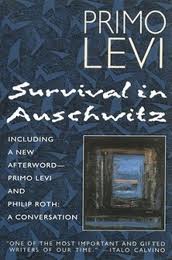
In a recent post about choosing The Road as one of the texts for my Introduction to Literature class next year, I mentioned that I’m also assigning Eli Wiesel’s Night. In the comments, Dorian said that he considered Levi’s Survival in Auschwitz “the more compelling text, both formally and conceptually.” As I said to him then, I’ve known for a while that I should read Levi, and his remark  was just the instigation I needed to make it a priority.

I finished reading Survival in Auschwitz this afternoon, so it’s too soon for me to say whether I think it is better or greater than Night. It is certainly a very different book, and as I work up my notes on Night again in the fall I know I’ll be thinking a lot about the contrasts. My first impression is that it is a much less overtly literary book than NightNight is heavily symbolic, organized around motifs and vignettes and characterized (at least in the translation I’m familiar with) by striking images and words freighted with significance. Levi’s approach is more indirect, his vignettes or episodes more elusive or ambiguous. In some ways, I think Night is more artful, but also, as a result, it feels more artificial. There’s a raw quality to Levi’s book: it’s not sleek, he’s honest about things he forgets, there are awkward but heartfelt gestures towards people he remembers. The book is unified in a different way than Night  is–not emotionally or symbolically but associatively, conceptually, a section at a time. It does not conclude but ends, again awkwardly, without flourish. Though both books immerse us in the horror of Auschwitz, Levi’s account seems somehow less visceral, more appalled than angry, more inquisitive than despairing. It is not any less devastating. It is, perhaps, more morally challenging: where Wiesel deals in searing absolutes, Levi puzzles us, as he was puzzled: “We now invite the reader to contemplate the possible meaning in the Lager of the words ‘good’ and ‘evil’, ‘just’ and ‘unjust’; let everybody judge, on the basis of the picture we have outlined and of the examples given above, how much of our ordinary moral world could survive on this side of the barbed wire.”

The differences between the books are not superficial, but at the same time I don’t think they are fundamental: both books are ultimately preoccupied with the loss or preservation of humanity under conditions that deliberately seek to exterminate it, conditions so psychically brutalizing that physical death seems little more than a bureaucratic afterthought. The original English title of Survival in Auschwitz was If This Is a Man, which is a direct translation of the Italian title. The current title seems apt to the book’s attention to literal survival: a lot of Levi’s attention is given to the complex economy of the camp, driven by desperation but also fueled by people’s endless ingenuity: spoons, shoes, bowls, bread–the things that mean, for just a little longer, endurance. The title has another dimension, though, more consonant with the Italian title, which is the survival of the person: memories, dreams, knowledge. For Levi, his knowledge of chemistry, which helps define him, to himself, as a man (“Yet I am he, the B. Sc. of Turin, in fact, at this particular moment it is impossible to doubt my identity with him”) also contributes to his physical survival, as his job in the laboratory protects him from a second winter of hard labor. But one of the most profound and moving sections of the book for me was section 11, “The Canto of Ulysses,” in which Levi tries to teach a fellow prisoner Italian by reciting and translating some of the Divine Comedy:

Here, listen Pikolo, open your ears and your mind, you have to understand, for my sake:

Think of your breed; for brutish ignorance
Your mettle was not made; you were made men,
To follow after knowledge and excellence.’

As if I also was hearing it for the first time: like the blast of a trumpet, like the voice of God. For a moment I forget who I am and where I am.

Pikolo begs me to repeat it. How good Pikolo is, he is aware that it is doing me good. Or perhaps it is something more: perhaps, despite the wan translation and the pedestrian, rushed commentary, he has received the message, he has felt that it has to do with him, that it has to do with all men who toil, and with us in particular; and that it has to do with us two, who dare to reason of these things with the poles for the soup on our shoulders.

Levi’s urgency increases as their time runs out and he can’t remember the lines, can’t bridge the gaps in his memory, can’t explain, can’t hold on. The poetry is unbearable because it awakens what the camp refuses–what you too must refuse to survive the camp (“oh, Pikolo, Pikolo, say something, speak, do not let me think of my mountains which used to show up against the dusk of evening as I returned by train from Milan to Turin”). But the loss of the poetry is also unbearable, because it is the negation of the camp. It is the antidote, not to the regimented brutality, the beatings and murders, the starvation, but to what Levi calls early in the book “the demolition of a man.”

Black Lamb and Grey Falcon II: Easter in Zagreb

Over the long weekend I made a little more progress on Black Lamb and Grey Falcon. I’m going to keep at it in deliberately small increments so that I can stop and stare at the sentences. As it happens, one of the chapters I was just reading describes a visit to the Cathedral in Zagreb on “Easter Eve”:

It has been cut about as by a country dressmaker, but it has kept the meditative integrity of darkness considering light, the mathematical aspiration for something above mathematics, which had been the core of its original design, and at that moment it housed the same intense faith that had built it. This was Easter Eve; the great cross had been taken down from the altar and lay propped up before the stop, the livid and wounded Christ  wincing in the light of the candles set at His feet. It was guarded by two soldiers in the olive uniform of the Yugoslavian Army, who leaned on their rifles as if this was a dead king of earth lying in state. As I looked at them, admiring the unity enjoyed by a state which fights and believes it has a moral right to fight, and would give up either fighting or religion if it felt the two inconsistent, I saw that they were moved by a deep emotion. Their lips were drawn outward from their clenched teeth, they were green as if they were seasick. ‘Are they tired? Do they have to guard the cross for a long time?’ I asked curiously. ‘No,’ said Constantine, ‘not for more than an hour or two. Then others come.’ ‘Then they are really looking like that,’ I pressed, ‘because it is a great thing for them to guard the dead Christ?’ ‘Certainly,’ he replied. ‘The Croats are such Catholics as you never did see, not in France, not in Italy; and I think you ask that question because you do not understand the Slavs. If we did not feel intensely about guarding the dead Christ we should not put our soldiers to do it, and indeed they would not do it if we put them there, they would go away and do something else. The custom would have died if it had not meant a great deal to us.’ For a long time we watched the wincing Christ and the two boys with bowed  heads, who swayed very slightly backwards and forwards, backwards and forwards, like candle-flame in a room where the air is nearly still. I had not been wrong. In Yugoslavia there was an intensity of feeling that was not only of immense and exhilarating force, but had an honourable origin, proceeding from realist passion, from whole belief.

It felt odd reading this passage about “whole belief” after days when it seemed I couldn’t turn around without seeing garish rabbit cut-outs and hokey pastel-colored baskets full of cheap chocolate in every imaginable shape. Our customs continue even though they mean  almost nothing to most of us anymore, and the resulting hollow commercialism gets pretty depressing. At the same time, as an atheist as well as someone anxious about nationalism and other ways of marking off identities worth fighting for (“you do not understand the Slavs”), I recoil from this scene, evocative as it is, more than I am exhilarated by it. Something else I did over the long weekend was watch a lecture (which I did find exhilarating) about “Jesus, the Easter Bunny, and Other Delusions: Just Say No!.” The soldiers with their clenched teeth don’t look to me like people willing to change their minds, which (I agree with Dr. Boghossian) is an essential characteristic of rational thought. The problem with “intensity of feeling” is that it is no guarantee of “moral right,” much less of more mundane kinds of “right” or truth. I wonder if West really regrets (as her rhetoric often implies) the more anemic faith of her own country. It may be less exhilarating, but there’s something unseemly about someone who is buffered by it, herself, from the hazards of extremism describing this scene as if it’s an attractively exotic spectacle.

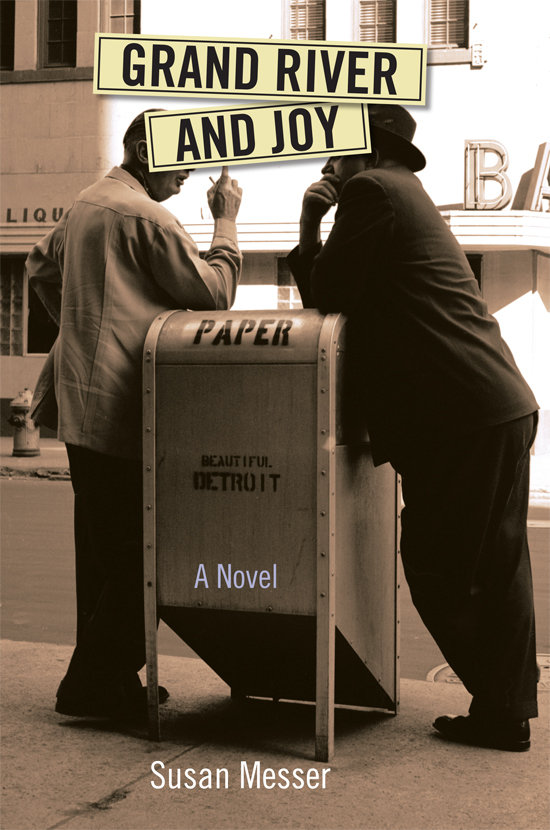
“Moving in Tandem Across the City”: Susan Messer, Grand River and Joy

I have posted here a couple of times before about books by people I know. It always feels a bit risky, though I don’t know why it is, really: it isn’t as if authors I don’t know personally aren’t also actual people with their own ideas and feelings! Perhaps it’s because people I know are more likely to read what I say and also, maybe, more likely to care if I’m not seeing the book as they did or hoped–more likely to take my blind spots or criticisms personally.

In one sense, I don’t know Susan Messer: we have never met face to face. But Susan has read and commented here for some time, and through the exchanges we’ve had, I do feel as if we know each other at least as readers and thinkers. I have found her comments always very thoughtful and engaged and encouraging. Naturally, I was interested in knowing more about her!  So I snooped, of course, like any good citizen of the internet era, and one of the first things I found out was that she had published a novel, Grand River and Joy, which I have now finally read. I didn’t tell Susan ahead of time that I was going to–I figured that was better in case of the awkward, if unlikely, event that I didn’t much appreciate it. But I did like it–a lot–and so I’m going to go ahead and post some thoughts about it. I gave Susan a heads-up once I knew I would be writing about it, so she wouldn’t feel snuck up on.

I came to Grand River and Joy as an outsider to its particular contexts. It is a historical novel–more specifically, as we Victorianist types say, it’s a novel of the recent past: it’s set in Detroit just before, during, and after the 1967 riot (which, as one of her chapter headings points out, could also be interpreted as a rebellion). Though of course I know a few general things about American history during this period, I’m no expert on it, and I’m certainly no expert on Detroit, which is not a city that has previously figured at all in my imaginative landscape of America. One of the aspects of Grant River and Joy that I liked the most was the intensely local detail, which is really evocative of both time and place. The novel opens as Henry Levine drives downtown to the building that houses his shoe wholesale business as well as his black tenant, Curtis, and Curtis’s teenage son, Alvin:

It was Detroit, and by 1966, Grand River south of Joy was all concrete and brick, with barely a tree or shrub, barely a patch of grass.

Joy Road – now there was a misnomer. That stretch had broken windows and traffic snarls, and grown men with nothing to do during the day. Up and down these broad streets, buses belched clouds of black smoke as they roared past the metal-grated building faces. And as if inviting trouble, Levine’s was the only business along the stretch that lacked one of those grates.

That first day in the novel, Hallowe’en 1966, Harry opens the business to find that trouble has accepted the invitation: scrawled in soap across his front windows are the words “Honky Jew boy“. Looking for the supplies to clean away the slur, Harry discovers that a room in his basement has been turned into a kind of clubhouse, with chairs, ashtrays, a phone, and a stash of books and papers including “a narrow pamphlet with big hand-lettered words. ‘Black Panther Party Platform: What We Want; What We Believe.'” Harry rightly guesses that it’s Alvin who has been using the space: “these were his things, and this was what he read.” He also suspects that Alvin and his friends Otis and Wendell are responsible for the slur, but he intervenes (to the disgust of his fellow Jewish business owners) when the cops start hassling them.

This near-confrontation and Harry’s well-meaning attempts at appeasement presents in microcosm the novel’s central tensions, which are not just between blacks and Jews but between individual identities and group allegiances, between narrowly-defined protective self-interest and the desire to reach out and make connections, and, crucially, between staying put and moving away. The times, and the neighborhoods, are changing, and the novel delicately but sharply scrutinizes the discomfort of a community well aware of its own legacy of discrimination and suffering as it rationalizes its own prejudices. ” ‘I don’t think it’s the skin color,'” says a young woman at the meeting of the Detroit Council of Jewish Women where Harry’s wife Ruth makes a presentation on “white flight:”

‘It’s the class differences, the worry that schools will be compromised if people don’t have the same values. The schools are the key for most families. They are for me.’ Her friends nodded.

But of course it’s about skin color: out on the street, when the neighbors talk, “[e]veryone had stories about the schwarze.”

It’s both a tense time and a dishonest time, and in this context conciliatory gestures are hardly guaranteed to be either welcome or successful: admirably, the novel offers no simplistic idealism about what it might take for everyone just to get along, no neat parable of cooperation. Suspicion and hostility are not just individual habits or traits, after all: they have historical, systemic causes, and good intentions are as likely to reveal as to heal fissures. “Leave the boys alone,” Harry tells the officer who’s hassling Alvin and his friends. “We’re not boys,” says Wendell  after the cop car drives away.

As this awkward, necessary correction emphasizes, Harry’s no hero: he is not a moral benchmark, not a visionary. He’s just a well-meaning guy, unhappy about the hostilities intensifying around him, uncomfortably aware of his own suppressed racist reactions, wishing he could somehow say or do the right thing to create a little more trust, a little less suspicion. One idea he gets is to donate the collection of bicycles that he and his daughter Joanna have salvaged and restored to the children in “the projects.” They borrow a truck, load up the bikes, and drive to “the stretch on Eight Mile, not far from their own home, which had once been an army barracks, and was now one of the few places on the north-west side where Negroes lived, represented as a solid black band on the census maps, and recently the focus of the urban renewal movement. The projects.” They have driven past often before, but never pulled over. Now they arrive on this errand of … what? charity? generosity? patronage? friendship? Is it a nice thing to do, or an insulting one? “To have some white guy drive in and stand on a corner, giving stuff away?” asks his daughter Lena skeptically, hearing his plan. “And something valuable, like a bike? Wouldn’t you wonder what the trick was?” “There’s no trick,” Harry replies, and there isn’t, but it is an odd gesture nonetheless, and as Lena expects, it’s met with something besides the simple happiness Harry seems to imagine. “What are you? Santa Claus or something?” he’s asked. It’s not easy, as it turns out, to give bikes way, not as simple as Joanna tells herself as she tries to get over her discomfort and get out of the truck: “Bikes were for riding,” she thinks, but it’s not just about that, and the mixed responses they get to their gifts refuse easy answers to what you should or can give, what you should or can take. You certainly can’t do much, single-handedly, about a long history of misunderstanding and injustice and anger. Does that mean you shouldn’t try?

The closest we get to an answer about what might be constructive arises from a long conversation between Harry and Curtis as they watch over the building’s malfunctioning boiler–a nicely handled symbol for the simmering conflict in the city around them. It starts out badly, with tension and resentment, and in fact Harry almost leaves, almost gives up on understanding or caring: “They wanted to determine their own destiny, or whatever that first point on the Black Panther program was, let them start with the heat in their own home.” But he goes back, and he and Curtis talk all night, first exchanging stories, “the kind men tell, about things they’ve done, and things that have happened.” Then, as they start drinking, they get looser and more daringly honest, until it becomes, Harry observes, a kind of “teach-in,” about racial attitudes and slurs and suspicions and jokes, the things that usually are said only about, not to, the other. “No one knows what to call your people anymore,” Harry says to Curtis. “Negro, black, colored?” “You only need the label when you’re talking about me,” Curtis responds. “It’s the talking to me that matters.Curtis and Harry don’t reach any epiphanies –for one thing, by the time morning comes they’re too drunk to make much sense, and Alvin, making his way down to the boiler room to see what’s happened, finds them (to his disgust and anger) wrestling in sodden hilarity on the floor. That’s hardly the high road to racial harmony, and yet it seems a lot better than the alternatives we see, from hostility politely masked to combustible violence. Man to man, face to face, talking to each other: what else is there, really, that two individual men can do?

After the riots Harry returns to his building at Grand River and Joy and (in an elegant parallel to the opening scene) finds writing, once again, on his window, but this time, it says “Soul brother.” On the one hand, this message is the encouraging fruit of Harry’s good will, a tangible marker of some hoped-for reconciliation. Because of it, we infer, Harry’s building still stands, the front window unbroken, though “a whole stretch of charred buildings lay in ruins – Bernie’s place, Stan’s.” But again, good will does not make everything come right: though in the post-riot chaos he has no market for his inventory and the business is doomed, he can’t make an insurance claim as “he had no ‘quantifiable loss,’ no police or fire report to attach, no photos of gaping holes in walls, of inventory strewn in streets. No smoldering ruins for the insurance examiner to survey, shaking his head, making notes.” “How is it,” Ruth asks, “that all the business owners we know are coming out of this with something?” But for Harry, there’s nothing.

Or, rather, not nothing, because for him too, the riot has been a cataclysm and, in an unexpected way, a catalyst for change. Trying to get to his building before normalcy has been restored, Harry ends up accidentally at an orthodox shul, where during the prayers, he reflects on his life and wishes to be free of the business, which was never his vocation but his inheritance from his father:

Deep within the privacy of his tallis tent, he saw that the horror that had seized the city could release him. It could open his life, push him out, tell him go, be, do.

He hoped, not that it would survive, but that it would burn–which is why when it doesn’t, it doesn’t feel quite like a blessing. When the business collapses, it feels freeing, rather than sad, as he is finally liberated to go, be, do something else, to be who he is.

I was surprised to learn, in the final section, that he and Ruth move to the suburbs after all.

There are other aspects to the novel, other incidents, worth discussing (Ruth’s session with the Detroit Council of Jewish Women, for instance, which is a great microcosmic survey of the situation as well as a bit of keen satire, or the section on the “riot/rebellion” itself, which incorporates Alvin’s experiences in the midst of the turbulence). But I think this post has gotten long enough. Susan, I hope you think I’ve read your book reasonably well! I learned a lot from it, and really enjoyed it too.
 

Teaching Texts: Taking The Road into 2012-13

Book orders for the fall term were due April 1. Apparently this early deadline helps the bookstore know which books are being re-used and thus which books they can buy back from students to re-sell next year–which makes sense and is a good thing to do for students! But April 1 is still very early to have worked out what you want to do next year, unless you are happy to just do exactly what you’ve done before and aren’t teaching any new classes. You know those legends about professors who show up with the same yellowed teaching notes they have used for 100 years? None of us wants to be that professor, honest! But this is the kind of bureaucratic thing that discourages innovation. When you are in the thick of one term, the easiest way to meet this deadline is by repetition. Not that there’s anything necessarily wrong with that! You can in fact teach the same books over and over (cough *Middlemarch* cough) and never feel you are just going through a tired routine. There’s always something new to learn, new to say–or a new way to say it, or to try to engage students with it. But I do try to shake up every reading list every time, if just by a book or two, so that the new juxtapositions will keep me fresh.

Anyway, April 1 has come and gone and I’ve only submitted two of my three fall term orders. Sorry, bookstore! The course I haven’t ordered for yet, English 1000 (Introduction to Literature)  is not a repeat for me, though: the books I’ll be probably be ordering have not, to my knowledge, been assigned by anyone else this year, and I haven’t taught the class myself since 2000-2001 in its full-year version, though I have taught a half-year introductory class three times in the past decade. It’s really the shift back to a full-year version that has slowed down my ordering: you can do so much in full-year classes, and they have become such rare creatures. I haven’t in fact taught a full-year class of any description in many years: I’m almost giddy with excitement about the increased chances of my learning every student’s name well before the class is over. And it’s equally dizzying to think of all the many, many different books I could conceivably assign…which, of course, is why it has taken me too long to make up my mind. Our intro classes are, deliberately, not historical surveys (we offer those at the 2nd-year level) but introductions to genre, to university-level writing, and to literary critical terms and skills. The genres we are supposed to cover are non-fiction prose, poetry, fiction, and drama–but it is entirely up to us how to do this. The range of different reading lists that results is supposed to be a strength of our first-year program: in theory, students can peruse the different offerings and choose a section they like the looks of. This almost never works in practice, as despite our efforts to publicize the variation, students (and advisers) usually assume all the sections are the same, and they choose based on timetable more than anything else. As a result, it is not uncommon to have a conversation that begins with a student saying things like “But my friend in Dr. Flumberly’s section of English 1000 isn’t reading any novels, only short stories. It isn’t fair that we have to read this long book.”

I don’t actually think there are any sections of English 1000 that assign no novels at all (possibly, just possibly, students’ reports of what goes on elsewhere may not be 100% accurate). But absent any particular principle about which novels to assign, it’s always hard for me to decide which ones to go with. Over the years I have assigned Hard Times, The Wars, A Christmas Carol, A Room with a View, Saturday, and The Remains of the Day – always along with an array of shorter texts. I was thinking of going with A Christmas Carol again this year (it’s fun to teach it in December just as holiday madness is breaking out) but I wanted to do a more contemporary novel as well, since I do have a whole year. English 1000 is the teaching assignment that gives me the most latitude, so it’s a great chance to get outside my comfort zone. I mentioned this on Twitter and within about 10 minutes I had a whole array of tempting suggestions, most of which I had heard of but not read. I couldn’t possibly consider them all by April 1!

As the tweets were flying back and forth, Mark Athitakis asked an important question: what makes a novel a good choice for teaching?’ This is obviously a key issue: you can love reading a book but still conclude that for one reason or another, it would not work in the classroom, or at least in a particular class. For an intro class, what are the desiderata? It will vary for individual instructors, I know. Those of you who also teach similar classes, what are the factors for you? For me, one issue is length–shallow, maybe, but I think realistic. 200-300 pages seems to me about right, though I have colleagues who regularly teach Jane Eyre or Wuthering Heights in their intro sections and it seems to go fine. Then there’s significance. It makes some sense to me that you would pick a book that either has some standing (why? is something you’ll want to talk about) or that you think deserves some standing — this helps you begin what you can hope will be a life-long engagement on their part with the puzzle of literary merit and reputation, and it gets them into an ongoing literary conversation. Merit itself is also a factor — I can’t see teaching a book you can’t in some sense get behind, as you are going to have to bring a lot of enthusiasm and energy to the classroom day after day, and it’s hard to do that for material you don’t think is any good. Sometimes it’s still important to do it, mind you: I teach novels I don’t think are great qua novels all the time, but in courses where coverage is a requirement in a way it is not for our intro classes. Then it has to be a book that gives us something to talk about and then something to write about — it needs to require and reward interpretation. Doesn’t every book? Well, no, at least not in isolation. Some very formulaic novels are much more interesting collectively than they are individually (from variations on repetitive patterns and tropes as in [some] romance or mystery novels, for instance). But I think that a certain level of complexity (thematic as well as aesthetic) makes for the best teaching texts. You want the feeling that the book is about something, and not just a simplistic, obvious single something but a problem, a crux. And you want the language and form to be related to that problem or crux in an interesting (and, again, not simplistic or obvious) way. Finally, it helps if you can see ways the book will create interesting conversations with the other texts you’re teaching in the course.

I looked up a number of new (to me) books, online and in the library. I started a couple and read two all the way through. One of these, The Talk-Funny Girl (recommended by D. G. Myers) was extremely interesting and gripping, but I felt in the end that not only was it a bit too alien for my purposes but it wasn’t as good as it could have been. The other one I read in its entirety was Cormac McCarthy’s The Road. This is a book I have deliberately avoided until now. Not only did it sound very depressing but it sounded gimmicky, cheesy even. Well, as those of you who have read it will know, it certainly is depressing! I was teaching Jude the Obscure the week I read it and I announced with some perturbation to my class that I had finally found a novel that made Jude look optimistic! But gimmicky? I don’t think so. From the beginning, it interested me, and though it horrified me, it also moved and surprised me. The father-son relationship is intense but stripped bare of sentiment, as is everything in the novel’s landscape: we’re left with just the essentials, and that simple idea is what makes the novel so powerful. What does matter? Why – how – do we keep going? The language put me off a bit at first, as it seemed unduly self-displaying, but ultimately I thought it provided the art, the artifice, that made the story bearable. It also highlights its literariness: we are clearly in allegorical territory here. I couldn’t stop reading

When I finished the novel, I was struck by the glimmer of optimism it offers at the last minute  (I don’t know yet if I think the ending undermines the novel) and I found myself thinking about it a lot. At first I thought there was no way I would assign it. I couldn’t imagine spending hours and days in that world — or making my students come along with me. Poor things! Isn’t their first term at university hard enough? But then I began to reconsider. At the heart of the novel there is something that is anything but depressing, isn’t there? The father and son talk a lot about “the light” they are carrying. It’s a metaphorical or symbolic light, and it’s something the novel carries too. Then I thought about one of the non-fiction texts I’m assigning, Eli Wiesel’s Night. Night is also about surviving devastation, hanging on to shreds of humanity. One of the moments in Night that is particularly haunting and terrible is the selection scene:

‘Men to the left! Women to the right!’

Eight words spoken quietly, indifferently, without emotion. Eight simple, short words. Yet that was the moment when I left my mother. There was no time to think, and I already felt my father’s hand press against mine: we were alone. In a fraction of a second I could see my mother, my sisters, move to the right. Tzipora was holding Mother’s hand. I saw them walking farther and farther away; Mother was stroking my sister’s blond hair, as if to protect her. And I walked on with my father, with the men. I didn’t know that this was the moment in time and the place where I was leaving my mother and Tzipora forever. I kept walking, my father holding my hand.

This scene breaks my heart. I expect every parent has felt the magic of a little hand in theirs, realized the awesome, beautiful, devastating weight of the innocent belief that if we say it’s OK, if we go there, if we hold hands, it is OK.  “It’s OK,” the father in The Road tells his son over and over. “It’s OK.” And the son goes along.  Now I can’t stop thinking about that resonance between the two texts. The underlying theme of my sections of Introduction to Literature is usually something as simple as “words matter.” One way I think I can show this and make it meaningful and alive to our students is to work with texts that are about things that really matter. I’m not sure yet how the pieces will fit together or what exactly we’ll talk about, but at any rate I’ve decided to order The Road and see where it takes us.

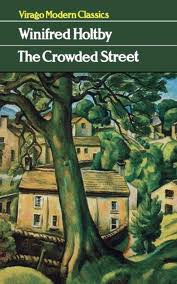
“The Awfulness of a Life Where Nothing Ever Happens”: Winifred Holtby, The Crowded Street:

Only the last section of The Crowded Street – a mere 16.5 pages – is named for the novel’s protagonist, Muriel Hammond. Each of the other sections is named for another woman whose life preoccupies and dominates Muriel’s: first her schoolmate Clare, then Muriel’s mother, then her sister Connie, then her friend Delia. Structurally, then, The Crowded Street reflects the central problem of Muriel’s life: that she has never been its main character, never lived according to her own values, never pursued-much less fulfilled-her own dreams, never known-much less got-what she wanted.

It’s a risky premise and a risky structure. It’s not, in practice, very interesting to read about someone whose life is so lacking in individual motivation and agency. “All books are the same,” Muriel reflects bitterly, late in the novel; “In books things always happen to people. Why doesn’t somebody write a book about someone to whom nothing ever happens–like me?” If we hadn’t already seen it, this assures us that Holtby has made a deliberate choice to write just such a book. She has risked boring us, alienating us, in order to drive home the point, not that there is something redemptive about a life in which nothing of note happens, but that young women should be liberated from the conventions and expectations that trap them in such a meaningless existence.

The Crowded Street is relentlessly, satirically critical about the stultifying provincial society in which Muriel is raised. Though as a young girl she dreams of studying “Higher Mathematics and the Stars,” such radical ideas are promptly crushed:

Mrs Hancock [her teacher] explained how there were some things that it was not suitable for girls to learn. Astronomy, the science of the stars, was a very instructive pursuit for astronomers [I love the circular logic!], and professors (these latter evidently being a race apart), but it was not one of those things necessary for a girl to learn. ‘How will it help you, dear, when you, in your future life, have, as I hope, a house to look after?’

“Her initial failure sapped her courage,” and Muriel never really tries again. Her passivity in the face of discouragement is frustrating (if, as seems plausible, Holtby had The Mill on the Floss in mind, we get none of Maggie’s rebellion against these gender-specific barriers to knowledge). But Muriel’s passivity is part of her character and stems, sadly, from her better qualities, including a strong sense of duty and loyalty to her family and a desire to help others. Though her grown-up life offers her no personal fulfillment, as long as she feels useful she can at least accept it.

In Muriel’s home community of Marshington, the only recognized option for women is marriage (or “sex success,” as the vicar’s outspoken daughter Delia calls it). Holtby chronicles with painful acuteness the maneuverings of Muriel’s mother (who herself made a questionable marriage) to get her girls accepted into the highest levels of Marshington society and land suitable husbands. Holtby balances satire with poignancy in some of the scenes of Mrs Hammond’s disappointments: the trick, when hearing another girl has caught the young man she thought might choose Connie or Muriel, is to rejoice in her good fortune and wish the new couple every happiness, to regroup, and to try, try again. But as the years go by her desperation increases.

Her daughters react somewhat differently to the pressure. Connie, the wild one, goes off to work as a “land girl” during the war, takes the risk (fairly calculated, it seems) of getting pregnant, and ends up in a loveless marriage when her parents coerce the child’s presumed father into agreeing. Muriel goes to live with her and tries to help her improve her situation a bit, but Muriel is ineffectual and Connie’s story ends miserably. It’s hard not to think that at least Connie screams and fights and runs, but there’s really nothing admirable about her except that emotional rebellion, and that’s not much, especially when she pays for it with her life. This is the price, we see, of respectability, which is the only value recognized by Marshington society.

The price Muriel pays is almost as high, though less literal. As the years go on, it starts to seem inevitable to her that she will never achieve that “sex success” but dwindle into the life of an unappreciated spinster. Her aunt gives her a chilling picture of what lies ahead:

‘Marriage is the–the crown and joy of woman’s life–what we were born for–to have a husband and children, and a little home of her own. Of course there are some of us to whom the Lord has not pleased to give this. I’m sure I’m not complaining. There may be many compensations, and of course He knows best. But–it’s all right when you’re young, Muriel, and there’s always a chance–and when my dear mother was alive and I had someone to look after I am sure no girl could have been happier. It’s when you grow older and the people who needed you are dead. And you haven’t a home nor anyone who wants you–and you hate to stay too long in a house in case someone else should want to come–and of course it’s quite right. Somebody had to look after Mother. Everybody can’t marry. I’m not complaining. I’m sure they’re very kind to me, but I sometimes pray that the good Lord won’t make me wait here very long–that I can die before everyone gets tired of me, and of having me stay around–‘

Now that’s a fate worse than death, isn’t it? And it’s hard to see any alternative, in Marshington. Muriel thought she might have a way out, once: for years she has loved (or at least admired and yearned after) Godfrey Neale, handsome, popular, endearingly stuttering, and once, in the dark, under the impetus of a war-time crisis, Godfrey kissed her. Does the kiss mean nothing or everything? Her answer finally comes with the news of his engagement to the flamboyant Clare. No other prospective suitor appears, and Muriel’s resignation becomes bitter passivity.

But marriage is not the only alternative; other people are not the only means to the end of self-actualization and worth. Muriel finally learns this lesson from Delia, who has left Marshington for London where she work for the Twentieth Century Reform League. “Things happen against our will,” Muriel says to her morosely, when Delia is back visiting Marshington.

We listen, we think, that we are moving on towards some strange, rich carnival, and follow, follow, follow. Then suddenly we find ourselves left alone in a dull crowded street with no one caring and our lives unneeded, and all the fine things that we meant to do, like toys that a child has laid aside.

Delia is impatient with this renunciation of agency. “You can’t wriggle out of responsibility with a metaphor,” she tells Muriel; “Your life is your own, Muriel, nobody can take it from you.” She insists that Muriel recognize that she has been making choices, that society and other people’s expectations are not, in themselves, determining factors. She invites Muriel to move with her to London–which, somewhat unexpectedly, Muriel finds the courage to do. In her new independent life, she begins to discover and use her own strengths and to define her self-worth on her own terms.

Muriel flourishes, but the portion of the novel dedicated to that flourishing is tiny. Did we need to see so clearly, in so much detail, how dull and destructive the world of Marshington (and everything it stands for) is, in order to welcome the alternative? Does that world really need such a long exposé? Not now, but maybe in 1924, when The Crowded Street was first published, it was harder to explain what was wrong with it, or harder to justify  Delia and Muriel’s new life (which was very close to Brittain and Holtby’s, of course). Maybe, too, it was important to thoroughly defamiliarize that world, to take its perfectly ordinary tennis parties and dances and committee meetings and visits for tea and wear us out with them so that we would end up unable to accept them as ordinary, unable to stand it for one more minute. “If ever I had a child,” Muriel tells Delia before her rescue, “and it was born a girl and not beautiful, I believe I’d strangle it rather than think  that it should suffer as I’ve suffered!” To understand that shocking statement as anything but hyperbole, we have to have felt the weight and especially the duration of Muriel’s suffering through “the awfulness of a life where nothing ever happens.”

The first graphic is the elegant endpaper from the handsome Persephone edition of The Crowded Street.

Willa Cather, My Mortal Enemy

My Mortal Enemy is an unlikely choice for my first experience of Willa Cather – it’s obscure enough that the Americanist colleague I hit up for a copy to borrow not only didn’t have it and hadn’t read it, but hadn’t even heard of it, and the only copy in our university library is a 1926 edition so old and fragile it is stored in a box because it is considered too flimsy even to restore. Apparently, then, My Mortal Enemy is not the go-to Cather text.

Because I haven’t read any other Cather, I’m not in a position to say whether that’s because it’s anomalous or in some way not up to her usual standards. The introduction to the Vintage edition I finally opted for as an e-book has a long introduction that holds it up as exemplary, particularly of her prose style, which has, says its author, ‘a relentless purity of style’ which is ‘never so pure and never so relentless as in My Mortal Enemy … the novel makes a raid on all amplitudes, all mere pleasantness, and all sloppiness.’

As I was reading it, I can’t say that I was noticing any particular purity of style, but I did feel the absence of pleasantness. The novella tells the story of Myra Henshawe, an heiress who abandons her father’s fortune to marry for love. Her elopement has taken on an almost mythical quality in her home town, where the narrator, Nellie, grows up hearing about her. When Nellie finally meets her, she feels ‘quite overpowered’ by her, and Nellie is indeed overpowered by Myra throughout the novella – she is a narrator of almost no interest herself, as far as I can tell, serving only as a device to present and contrast with Myra’s more showy and emotionally intense character. Myra lives life loud, but her sacrifice for love has not brought her happiness, and the love itself has not proved lasting: when Nellie goes to stay with Myra and her husband Oswald in New York, she eventually sees that despite their superficial displays of unity and affection, the reality is more complex and even sinister. The realization appalls Nellie in a way that would seem disproportionate if it weren’t for the status marvellous Myra and her magical marriage have had in Nellie’s youthful imagination:

This delightful room had seemed to me a place where lightheartedness and charming manners lived–housed there just as the purple curtains and the Kiva rugs and the gay water-colours were. And now everything was in ruins. The air was still and cold like the air in a refrigerating-room. What I felt was fear; I was afraid to look or speak or move. Everything about me seemed evil. When kindness has left people, even for a few moments, we become afraid of them, as if their reason had left them. When it has left a place where we have always found it, it is like shipwreck; we drop from security into something malevolent and bottomless.

 When Nellie next meets Oswald and Myra, they are living in a dingy apartment-hotel where she, having fallen on unspecified hard times, has also taken up residence. Myra is an invalid tortured beyond reason by the clattering and thumping and shrieking of their unsympathetic upstairs neighbours (actually, having lived in basement apartments, I understand how crazy this can make you!). There’s nothing left of even superficial glamour in their lives, only bitterness and defeat. Is it tempered at all by the Henshawes’ love for each other? Oswald waits on Myra faithfully, even devotedly, and she responds with occasional tenderness, but seeing them now and knowing what she knows, too, Nellie cannot see this as the last phase of a great passion.

Myra’s death is clearly meant to be climactic, but I had trouble discerning the precise nature of the conflict to which it is the crisis. “Why must I die like this, alone with my mortal enemy?” cries out Myra. But I didn’t understand what she meant or why (or whether) I was supposed to rebel with her or judge her. I wasn’t enthralled by Myra’s character, and I don’t think we are meant to be: there’s nothing truly grand or heroic about it, and there’s something unpleasantly melodramatic about the way she plays her own part. She’s more interesting than anyone else in the novella, though, which I suppose is, indirectly, a critical reflection on the roles people usually play. She’s not a tragic heroine–if there’s any tragedy, I think it’s in the gap between our (or at least Nellie’s) expectation that love is worth everything else and the sordid culmination of Myra’s life story, in which her grand gesture has done nobody any good.

After finishing the novella I turned to the introduction for ideas, and its author argues that Myra’s enemy is ‘friendship and love, human relationship itself.’ He reads her angry cry as a pun that refers also to her husband, who is ‘her enemy because he is the source for her of human relationship, of that which passes without fulfillment, of mortality.’ That is, I guess, her husband is standing in for all the false hopes and promises that human relationships bring meaning, and for the inevitable collapse of that beautiful dream in the face of mortality. That sounds plausible enough when he explains it, though it seems to me to take quite a bit of reading into – perhaps, quite a bit of bringing to – the novel what isn’t obvious to someone encountering Cather’s ethos for the first time. I didn’t feel like I was reading My Mortal Enemy very well: I couldn’t seem to get oriented in it, and then it was already over. What I’m left with is an interest in reading something more expansive of Cather’s, something that gives me a better chance at understanding her for myself.

My Mortal Enemy is this month’s choice for the Slaves of Golconda reading group. More comments and discussion can be found at the Slaves blog.

Black Lamb and Grey Falcon I: Sentences

One reason it is going to take me a long time to read Black Lamb and Grey Falcon is that so many of its individual sentences stop me in my tracks. I’ve been trying to figure out what it is about them that is so startling (in a good way).  Here are some examples of sentences that I’ve marked in the first 50 or so pages:

She was always thrusting the blunt muzzle of her stupidity into conclaves of state, treading down intelligent debate as a beast treads down the grass at a gate into mud.

All her life her corsets had deformed and impeded her beautiful body, but they did not protect her from the assassin’s stiletto. That cut clean through to her heart. Even so her imperial rank had insulated her from emotional and intellectual achievement, but freely admitted sorrow.

 But now I realize that when Alexander and Draga fell from that balcony the whole of the modern world fell with them.

 It is certain that he is dying, because he is the centre of a manifestation which would not happen unless the living had been shocked out of their reserve by the presence of death.

 I reflected that if a train were filled with the citizens of the Western Roman Empire in the fourth century they would have made much the same complaints.

 They are standing in the rain, and they are all different and they are all the same. They greet us warmly, and in their hearts they cannot greet each other, and they dislike us a little because it is to meet us that they are standing beside their enemies in the rain.

It takes the whole of Croatian history to solve the mystery.

[The Habsburgs] were bent on procuring the dissolution of their Empire, on raping time and begetting on her the Sarajevo assassination.

What quality is it in these sentences that makes them so impressive, so exciting? They certainly aren’t poetic, if by that we mean something like mellifluous or musical or beautiful–though they are rhythmic and sometimes startlingly metaphorical. I’ve been thinking that their excitement lies  in their intellectual daring: in West’s fearless reach from the particular to the historical, from the personal to the philosophical. Though they are eloquent, memorable, dramatic, I don’t admire these sentences as examples of rhetorical display–I don’t read them and wish I could write like that. Rather, they make me wish I could think like that…and then the writing, perhaps, would follow. It’s the voice of someone who has (or at least believes she has) not just the whole of European history at her disposal but the whole of human nature in her sights. ‘You can’t say that,’ they make me exclaim; ‘you can’t know that.’ But she does know it; she does say it.