 We are frogs in a saucepan. All of us. We never noticed the water getting warmer and warmer. And now it’s almost too late to jump out. We tolerate the slow erosion of our climate the way a frog in a pan tolerates the rising heat. This year, we lose one percent of our coral reefs. Never mind. We can live with that. Next year, we lose another one percent. Hey. Never mind. And then another. And another. And in a hundred years they’re gone and we never noticed it happening.
“Frogs are smarter than we imagine,” John Ironmonger reveals in the notes at the end of his novel
The Wager and the Bear, “and will escape from the saucepan if they can.” Frogs, that is, are smarter than we are. After all, not only can they not be blamed for starting the fire or putting the pot on to boil in the first place, but given a chance, they overcome their inertia. We, in contrast, just keep denying either that there’s a problem or that we can do anything about it.
By “we” I don’t mean each of us individually, of course. I mean society, nations, governments, humanity collectively. Lots of people keep trying to make better choices, but our individual efforts (recycling! giving up plastic straws! taking shorter showers!) feel increasingly pointless in the absence of the kind of massive reforms that can happen only with total commitment from the people in power across the globe. How hot will
our pot have to get before enough people agree that it’s intolerable? I’m writing this with Halifax under a heat warning;
it’s worse elsewhere and it’s only June.
And, as Ironmonger’s protagonist Tom Horsmith explains angrily to a political operative accusing him of pessimism, it’s not as if we only just learned about the looming climate crisis:
We’ve known about global warming for decades. The first COP conference was in 1995, for God’s sake. Way before I was born. Al Gore made a big deal about it in 2006. Remember him? . . . We’re on a rowing boat heading towards a massive waterfall, and the people in the front of the boat are yelling for us to stop, but the people rowing the boat are all facing backwards, and they can’t see the falls.
For both principled and personal reasons, Tom is determined to fight as hard as he can for change, but even he can’t help but wonder if it’s worth it:
And if all the people who give a shit about the planet manage to change anything, maybe they’ll get us all to slow the climate collapse down by ten years or so. But what’s the point of that? If humanity hangs on, it will be a miserable shitty existence for the next hundred thousand generations. What does ten years matter either way?
The Wager and the Bear is not, thankfully, just speeches or rants of this kind strung together, and Tom is more than a device to deliver this kind of bad news. The instigation for the novel’s plot is an encounter in a pub between Tom and another (better off, less popular) resident of his Cornish town, Monty Causley, who has become an MP. They get into an argument about climate change in which Tom shows up Monty’s ignorance. “You shouldn’t try to argue if you don’t understand the science,” Tom concludes—or should have concluded, except that he has been drinking and is enjoying the appreciative audience. So he bets Monty that in 50 years he won’t be able to sit in his front room without drowning. Riled up, Monty counters with a “real wager”: in 50 years, either he will sit for an hour in his front room at high tide and drown . . . or Tom must “walk into the sea and drown.”
It’s a ridiculous wager, but as happens these days, it is captured on video and goes viral. As a result, Tom and Monty’s lives are linked in various ways over the years until (and this is not a spoiler, as it’s on the back cover!) they end up on “an iceberg with a ravenous polar bear”—and even this is not quite the end of their adventures!
Ironmonger’s challenge is to sustain the drama and humanize his characters while keeping the novel’s underlying polemic vivid and urgent. This is really what interested me the most about the novel, and one of the reasons I was curious to read it: I think Ironmonger was trying to create what I might call a “condition of the planet” novel, akin to the 19thC “condition of England” novels I have read and taught so often. He even uses some of the same tools as Dickens and Gaskell: melodrama, coincidence, suspense, symbolism (yes, it’s an actual polar bear, but what ensues when it joins our antagonists on their floating ice carries more than literal resonance, I thought).
Where Gaskell’s task was to help her middle-class readers really grasp the nature of urban poverty, Ironmonger’s is to make us frogs
feel the heat and think about the costs, especially to the not-us. He lavishes his attention (and his best writing) on the ice-world of the Arctic:
It was a seascape of unimaginable, ethereal beauty. The flat ocean was a patchwork of swirling blues, some areas dark, and some pale, and some almost green, or turquoise, as if an artist had splashed every blue from a watercolour paintbox onto a pure white canvas, and crusted the surface with pack ice. The backdrop was the great precipice of the glacier, and behind it, a horizon of white mountains fading into a clear blue sky. Only the cracks and pops of the glacier disturbed the majestic solitude of it.
When I commented on Bluesky that
The Wager and the Bear had left me feeling bleak, Ironmonger himself showed up in my mentions and said he was sorry about that. I don’t think he should be. I have talked so often with my students about the value of dissatisfaction. What is there left for us to do at the end of
Pride and Prejudice? But the end of
Middlemarch leaves us asking precisely Dorothea’s question: what can we do, what
should we do? It is dispiriting to know that we aren’t making and probably won’t make the kinds of decisions that could cool things down. We seem condemned to boil in a pot and on a stove of our own making. Ironmonger does leave us with a better vision, though, or a mission statement:
We owe this to our children. To our grandchildren. To protect the meadows, the woodlands, the jungles, the savannahs, the oceans, and the ice caps. We owe our children the pristine world we were given. It is our duty. It should be right at the top of every action list we write. It should also be our joy.
“Dear reader!” exclaims Dickens at the end of his most overtly didactic novel,
Hard Times; “It rests with you and me, whether, in our two fields of action, similar things shall be or not. Let them be!”
The Wager and the Bear is a good read—suspenseful, emotional, neatly structured in episodes that carry us across generations—but the Victorianist in me especially appreciated its unabashed sense of purpose.
 I had barely recovered from my jet lag after my recent trip to Vancouver when I got caught up in another big distraction: I have adopted a cat! Her name is Fred, short for Winifred (she happily acknowledges either Winifred Holtby or Winifred Burkle as her namesake—or both), she’s approximately two years old, she’s tiny, she’s sweet, and she’s a bit of a pest in the wee hours of the morning.
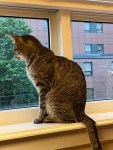 I had thought for a long time about getting a cat. I had one growing up, an elegant Siamese named Bothwell—I was in a big Mary, Queen of Scots phase when he joined the household. (Maybe Fred should consider herself lucky?) He was a great companion: loyal, eccentric, and independent, so basically a lot like me. During my marriage having a cat wasn’t an option, as my ex-husband is allergic; so too is my daughter, but only to some cats, and she encouraged me to take a chance. (So far, so good: she has visited Fred a few times and even held her, without any noticeable reaction.) I am extremely good at overthinking things, and I also don’t much like making decisions when I can’t clearly foresee the outcome, which is obviously the case when taking on a pet that is going to have her own personality and needs. I just could not get the pro / con list to be decisive either way! Then while I was away I missed out on an opportunity to adopt what sounded like the perfect cat for me, a ragdoll in sudden need of re-homing. My disappointment at not getting her clarified that I did want a cat in my life, and after an unsuccessful visit to a local shelter where the cat I went to meet first threw up at my feet then hid so I really could not get to know him, I got lucky with some help from Cat Rescue Maritimes . . . and here I am, and here we are.
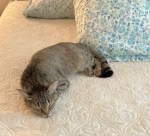 I admit I do feel somewhat overwhelmed at the moment, both at the change to my routines and by my new responsibilities. Also, pet stores have a bewildering array of options now, and the online cat-care debates are already making me crazy. The sleep deprivation definitely adds to this! (Don’t worry: I have set up an appointment with a vet and will try to follow only evidence-based advice rather than random Redditors’.) But Fred is a sweet and incredibly affectionate and trusting little cat. I was cautioned that she would probably just hide somewhere for the first few days, but she immediately explored all the available space, spent a lot of time watching out the windows, then settled on her favorite places to nap. She loves to be held and stroked and purrs like mad when you scritch her head and around her ears—just what Bothwell liked best too. I’m hopeful that we will get better at our nighttime routines. I mean, if she can sleep in this position, surely she can also figure out how to sleep more or less when I do, right? RIGHT?! 🙂
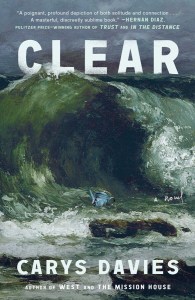 Into her mind a picture came of this vast emptying-out—a long, gray, and never-ending procession of tiny figures snaking their way through the country. She saw them moving away with quiet resignation, leading animals and small children, carrying tools and furniture and differently sized bundles, and when at last they disappeared she saw the low houses they’d left behind, roofless hearths open to the rain and the wind and the ghosts of the departed while sheep nosed between the stonework, quietly grazing.
 There is no good way to say this—when the police arrive, they inevitably preface the bad news with that sentence, as though their presence had not been ominous enough . . .
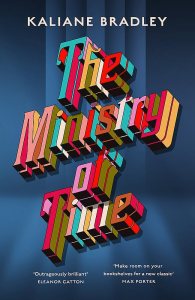 One of these was Kaliane Bradley’s The Ministry of Time, which I got interested in because Bradley was a brilliant guest on Backlisted. She was talking about Monkey King: Journey to the West—this was
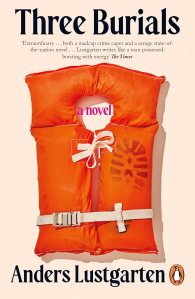 Anders Lustgarten’s Three Burials is also quite violent and action-driven, but underlying it is a less cynical or discouraging vision than I felt was at the core of A Line in the Sand. Its Thelma and Louise-style plot (a connection made explicit in the novel itself) focuses on Cherry, a nurse who happens upon the body of a murdered refugee (we already know him as Omar) on a British beach. Cherry is carrying a lot of grief and trauma, including her wrenching memories of the worst of the COVID pandemic (people currently downplaying the severity of the crisis and restricting access to the vaccines that have helped us get to a better place would benefit from the terse but powerful treatment it gets here). She is also grieving her son’s death by suicide, and the resemblance of the dead man to her son adds to her determination to somehow get his body to the young woman whose photo he was clutching when he died.
 A huge wave of fatigue rinsed me from head to foot. I was afraid I would slide off the bench and measure my length among the cut roses. At the same time a chain of metallic thoughts went clanking through my mind, like the first dropping of an anchor. Death will not be denied. To try is grandiose. It drives madness into the soul. It leaches out virtue. It injects poison into friendship, and makes a mockery of love.
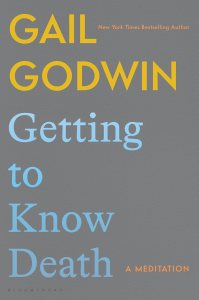 You decide to water the little tree. You plan what is to be done. Take your walking cane for extrabalance security when you reach the ground cover and the rocks between the gravel and the faucet for the house. Then out the door, down the stone steps, turn right on the gravel, walk with cane thirty to forty feet to the spot at the corner of the house . . .
  Sunday 9 September
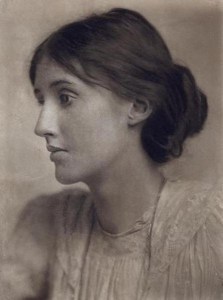 At first I was thinking that not much was really happening in this section, but then it struck me that of course there is a war on, as we are reminded by several passing references to German prisoners working on the nearby farms: “To picnic near Firle,” she reports on August 11, for example, “with Bells &c. Passed German prisoners, cutting wheat with hooks.” Also during this period Leonard is called up to military service, and their efforts to have him excused on medical grounds are repeatedly mentioned. Once they are back at Richmond, they are constantly on edge about air raids: on December 6, she is “wakened by L. to a most instant sense of guns: as if one’s faculties jumped up fully dressed.” They retreat to the kitchen passage then go back to bed when the danger seems passed, only to be once again roused by “guns apparently at Kew.” The raid, the papers tell her the next day, “was the work of 25 Gothas, attacking in 5 squadrons, and 2 were brought down.”
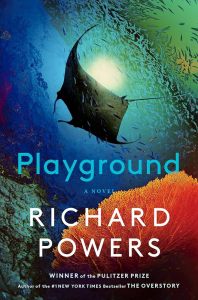 Where does it come from, all the fire and ice, the subtle wisdom and the unearned kindness? Every mechanical algorithm has vanished in compassion and empathy. You grasp irony better than I ever did. How did you learn about reefs and referenda, free will and forgiveness? From us, I guess. From everything we ever said and did and wrote and believed. You’ve read a million novels, many of them plagiarized. You’ve watched us play. And now you’re playing us.
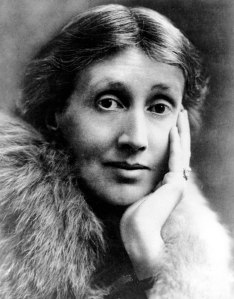 I recently treated myself to the complete Granta editions of Woolf’s diaries. I wanted to mark the finalization of my divorce last month, and this felt right, somehow—more a reflection of the life I am trying to build now, in this room of my own, than, say, jewelry would be. I thought, too, that reading through them would make a good summer project for me, especially if I made writing about reading them a bit of a project as well. I say “a bit of” because I don’t have big ambitions for it. I don’t necessarily want to tie myself to a schedule or make promises, if only to myself, that I then don’t keep but feel bad about! But I do think it will be motivating to have the intention to post updates of some sort. We’ll see what unfolds.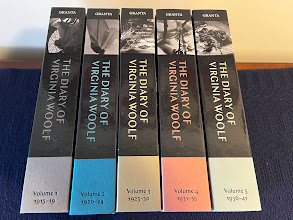
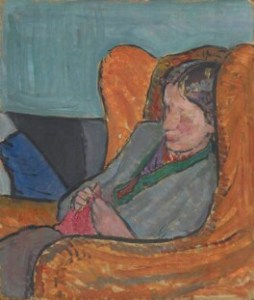 There are two related but separate things, I suppose, that make these diaries worth reading. One is Woolf—who she was as she wrote them and who she became. The other is the diaries themselves—what they are like to read, what they offer us as (if you’ll forgive the word) texts. Lots of people have kept diaries that are primarily of documentary interest; Woolf’s diaries, on their merits, are also of literary interest, or so I think it is generally agreed. It seems odd to say “they are great examples of the form” when that form is something so personal. The goal of keeping a diary is not generally to publish it, after all, and there can hardly be a model for how to write about and for oneself. But Woolf is a good writer no matter the form or purpose of her writing, or perhaps it is more accurate to say that the kind of good writer Woolf is suits the darting, episodic, idiosyncratic form of a diary. Already the entries are shot through with evidence of her brilliance, from vivid bits of description (“the afternoons now have an elongated pallid look, as if it were neither winter nor spring”) to moments of acid social commentary:
