 Phonse Jessome’s grim, violent crime novel Disposable Souls is set in the city where I live, and in a city I’ve never seen. Reading it was a constant reminder of the point Ian Rankin has often made about his Edinburgh-set novels: they show a side of Edinburgh that tourists never see — and neither do most residents, even though it is around them every day. The physical landscape is the same, but the shadow city of his crime stories has a different population and runs on different rules. Similarly, the Halifax depicted in Disposable Souls has the same geography as my Halifax, but it’s not at all the same place.
Of course, the reality is that these two cities are one city: I am just, in my own everyday life, ignorant of and sheltered from the one Jessome describes, so much so that even his vivid commentaries on very familiar places were disorienting. His description of downtown’s Spring Garden Road highlights just this duality:
In the bright sunshine of the day, the sidewalks on both sides of the road are crammed with beautiful people buying beautiful things. Trendy office workers lug six-dollar lattes past panhandlers who stand invisible at the curb, empty cups in hand. The homeless sit huddled against fire hydrants and utility poles. Halifax doesn’t have a trendy Main Street or a Skid Row. Spring Garden is a little of both.
At night, the tide shifts, and Spring Garden is taken over by angry, young rich kids in torn jeans and baggy black hoodies. They scowl and bluster at anyone who walks past and then tweet about it on seven-hundred-dollar phones. The real thugs roll past in Escalades, looking for someone to shoot. Even they wouldn’t waste real lead on wannabe hoods.
 For readers who don’t know Halifax at all, Jessome provides not just vivid description but a lot of context about the city’s history. That it never feels like info-dumping is because much of it is provided by his protagonist, Detective Constable Cam Neville, a former army sniper and escaped POW, who in his new role as a cop struggles to overcome both PTSD and his past as a member of the biker’s club Satan’s Stallions. Cam views his home town with merciless clarity and an unhealthy dose of cynicism. “Halifax is a navy town,” he explains;
A military moron named Cornwallis was the first to claim it. He started his career as a bedchamber servant for King Edward over in England. He managed to sneak out of the royal bedroom long enough to slaughter hordes of unarmed Scots. The blood lust impressed the King who, although reluctant to lose a man good with a bedpan, realized he had a new bully ready for battle. With no one left to kill in Scotland, the good King sent him off to clean up the royal mess here. Cornwallis built a fort on the hill overlooking Halifax Harbour and headed off into the woods to make war. He couldn’t find the French, so he drew [Cam’s Mi’kmak partner] Blair’s ancestors into a little game called genocide. The British say he won. Cornwallis didn’t procreate; Blair is here. I call that victory.
He’s similarly blunt about the shameful story of Africville:
For 125 years, the descendants of African slaves lived along the shoreline here. They built a tightknit and proud community in isolation and poverty. Africville was part of Halifax, but the city didn’t want it, wouldn’t provide sewer, water, or even police protection. As far as the good people of Halifax were concerned, Africville was a shantytown to be ignored. The city put the open-pit dump beside it and set up sewage lagoons nearby to drive home the point.
Then, one day, Africville mattered more than it wanted to. The people were evicted, and late one cold night in 1969 heavy equipment swept in and demolished the church. The last house was flattened within a month. The city called it urban renewal. Halifax needed a new bridge, and Africville was in the way. The suddenly homeless people were jammed into inner-city slums and ignored for decades. Some of the toughest gangs in the city came out of those inner-city kitchens where bitterness and frustration still simmer.
 We learn almost as much about Cam from these accounts as about Halifax, and, again like Rankin, Jessome also uses this contextual material to emphasize the relationship between social and historical conditions and the city’s distinctive patterns of crime and violence.
Disposable Souls alternates between Cam’s first-person narration and third-person narration that moves around among other characters in the tense unfolding drama. Cam is a well-realized character: tough, angry, brave, loyal. His voice is dominated by the anger and the toughness, and after a while I did find myself wishing for more nuance: not just Cam but the book as a whole seemed too much all in one key, and that a particularly rough, grating one. Disposable Souls is a little bit too hard-boiled for my own taste: I didn’t particularly enjoy it. On the other hand, it’s perverse to expect a story about murder, child pornography, and biker gangs to be “enjoyable” — this is the paradox of all crime fiction, of course, that it offers up horrors as entertainment. In my detective fiction class I often raise questions about this ethical problem, especially when we read Agatha Christie or other writers of Golden Age or puzzle mysteries. The writers of hard-boiled detective fiction and police procedurals are generally credited with making mystery fiction both more literary and more morally weighty by infusing it with realism, and on those grounds, Disposable Souls is definitely a success. There’s nothing amusing at all about its crimes, and Jessome effectively immerses us in the entirely unpleasant world where they take place. That I prefer my Halifax is a reflection on me more than on the novel!
Disposable Souls is well-told and skilfully plotted. I finished it, however, wondering what else it was, if anything. If I were to assign it in my detective fiction class, for instance, what (besides local color) would it bring to our discussions? I’m not sure what its deeper thematic burden is: I couldn’t see how its particular case stood, for instance, as symptomatic of anything more general, rather than as a case study of a hypothetical but sadly plausible scenario. There’s a lot of talk about rivalries between the regional police and the Mounties, but that felt either personal or bureaucratic, not especially political. The contrasting ethos of the police and the Stallions might be a fruitful avenue to explore, particularly in a course where we will already have talked about the dangerous appeal of vigilantism; I think Cam’s military background and its psychological aftermath would also make for an interesting comparison to Knots and Crosses, where Rebus’s SAS training is a crucial part of both his character and the case. I also don’t want to underestimate the interest and value of thinking about crime as a local issue. Certainly Disposable Souls has already made me think differently about this place where I’ve lived for over twenty years — about aspects of the city I’ve otherwise confronted only through newspaper headlines — and there’s something to be said for bringing our classroom discussions of justice close to home.
Regardless of whether I decide to teach it (and I’m very tempted to), I am glad I’ve read it: it’s the first Canadian crime novel I’ve read in a long time that has really made me sit up and take notice, and I’m grateful to Nimbus for sending me a review copy.

 My initial thought at this point is that overall, while I like Buffy the series better than Buffy the character, I like Angel the character more than Angel the series. I would happily watch another two or three (or more!) seasons about Angel, despite how dreadful Angel occasionally was, because I find him complicated and fascinating, whereas Buffy (though she does develop over the course of her series) always seems somewhat two-dimensional to me. I suppose this is a version of the age-old artistic problem that virtue is intrinsically less interesting than vice, except that of course with Angel we’ve got the best of both worlds: good and evil in unending tension, Angel and Angelus distinct but never entirely separable. Buffy, on the other hand, has a clear and singular role to play: while she sometimes rebels against it, when things turn bad she always, always, rises to the occasion — which is great and inspiring, because she’s strong and principled and brave and autonomous, but also somewhat predictable.

 I didn’t like the Angel ensemble as much as the Scoobies in Buffy, but another thing Angel and Buffy have in common is that they both show individual characters transforming in ways that leave them astonishingly far from where they started but that somehow happen in utterly believable ways. Other long-running shows I’m familiar with put fairly consistent characters into lots of new situations, but what happens with Spike in Buffy happens with both Cordelia and Wesley in Angel. If you’d told me while I was watching Buffy that one day Wesley would make me cry, I would not have believed you! As for Cordelia, I couldn’t possibly do better than
 Earlier this year there was a lot of buzz when a Princeton professor published a “
 I have been thinking about the question of failure in academia again since my promotion was denied. The appeal is ongoing, so I don’t yet know how the story will finally turn out, but no matter how it does, the fact will always remain that I was not successful in this process.** It has recently occurred to me that one reason last year was so difficult for me is that when things took a turn for the worse, one of my most intense reactions was humiliation. I felt profoundly embarrassed, because I had been held up for scrutiny and found wanting: I had not passed the test, and in this world, that feels not just like a professional evaluation but also like a very personal and all-too-public shaming. I know that this is not an entirely rational response, but I bet it also isn’t unusual for academics who fail in this way, especially when you add in
  What I have been thinking about more recently, though, is how much worse this cringing attitude made the whole experience for me, because it led me to be not just discreet but downright secretive about what was going on. I’m not saying that I should have made all aspects of the case public (and I don’t plan to now, either): I have some doubts about the advice on
  I don’t rule out that some of the intensity of my own reactions might be idiosyncratic: I myself was surprised that I took it all so hard, and that has been cause for some self-reflection. (Indeed, I have experienced fits of meta-failure in which I have been thoroughly unimpressed with myself for not handling everything better!) That’s what got me thinking again about the general context, though — about what failure means and how failure is treated in the academic world. And it also got me thinking about other failures in my own life, along the lines of the ‘CV of Failures.’ It isn’t, after all, as if this is the first time I have swung at something and missed. So in the spirit of Johannes Haushofer, here are a few more of my own failures. I’ll restrict the list to things that quantify more easily than, for instance, my general failure to thrive during my graduate coursework, and that are on a larger scale than, say, the many books I have failed to understand.
 High Rising is the first of Angela Thirkell’s Barsetshire novels. I read the second, Wild Strawberries, a few years ago — that I barely remember it and also apparently didn’t write about it hints at what to me is both the appeal and the limitation of Thirkell (so far, since this is a pretty small sample): she offers charm without much substance, so the reading experience is light and enjoyable but not particularly memorable.
 The series clearly aims to be associated with Trollope’s Chronicles of Barsetshire, and my edition even includes a map with Barchester at the center. Based on the two novels I’ve read, Thirkell doesn’t really deserve to stand as Trollope’s equal: for all their similarly companionable charm, his novels are both more subtle and more profound. (Jenny at Shelf Love is further along in the series; from her review of
  In Close Reading I always start with poetry, partly because it’s just easier to model and practice mining details for meaning when working with shorter, denser texts. Even in Middlemarch (don’t tell anyone I said this!) there are places it’s probably okay not to scrutinize every word, but a sonnet such as Robert Frost’s “Design” demands our unrelenting attention. I reviewed some key terminology on Monday, and then Wednesday and Friday were all about scansion, something I think is not just vital (who can talk well about poetry without considering rhythm?) but kind of fun. However, despite my best efforts, I am almost never able to convince the majority of my students that it is anything but aggravating: the stress was palpable in both tutorials on Friday!
 I almost always end up using lines from Donne’s Holy Sonnet X (“Death, Be Not Proud”) to illustrate just how interesting, important, and even exciting scanning poetry can be. For one thing, it’s a poem that quickly teaches you not to read it in anything like mechanical iambic pentameter: “Death, BE not PROUD, though SOME have CALLed THEE / mighTY and DREADful, FOR thou ART not SO”? You wouldn’t. You mustn’t. And not just because that’s not how you pronounce “mighty.” You’re standing up to Death! At the very least, you have to call him out in that first syllable: “DEATH, BE not PROUD.” You might even do four stresses in a row — “DEATH, BE NOT PROUD” — or maybe that’s too much. I’m tempted to do “for THOU ART NOT SO” as well, but my reading of the poem may be more confrontational than others would like. At any rate, you have to say it as if you mean it, which makes scanning the poem actually quite a profound exercise:
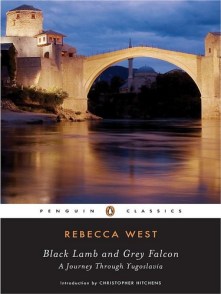 I started reading Rebecca West’s Black Lamb and Grey Falcon four years ago. I’m still reading it – or, more accurately, I am reading it again. I didn’t stop reading it then because it was no good or I wasn’t interested. On the contrary, I was fascinated and endlessly impressed. But the very thing that so fascinated and impressed me – the astonishing density and rhetorical brilliance of
  Now that I’m almost half way through the book, I am still impressed above all by West’s writing. In his introduction, Christopher Hitchens (after acknowledging some of the idiosyncrasies and problems of West’s commentary on the world she was exploring) concludes that “writing on this level must be esteemed and shown to later generations, no matter what the subject.” I’m not sure that quality of prose (even if we had a 100% reliable and universal measure for it) is or should always be a sufficient condition for reading something. One of the challenges of Black Lamb and Grey Falcon for me is that it is so vast and complex that I doubt my own ability, even when I finally finish it, to evaluate its worth on other grounds, though. At this point I do feel some frustration, in fact, at being so immersed in details and yet still so unable to perceive, never mind assess, larger patterns.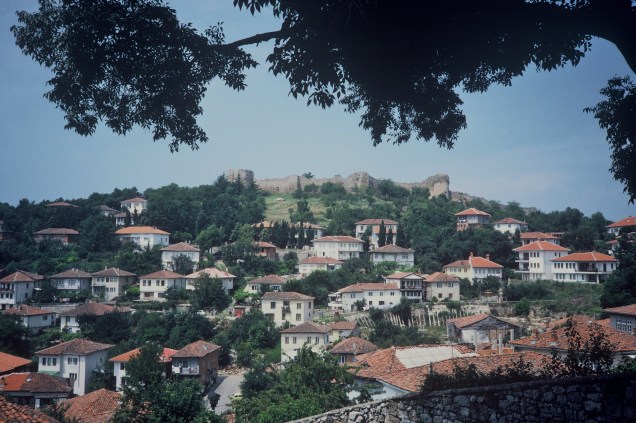
 I was struggling over what to write about in this post, which begins the 10th season of my
  I opened Close Reading on Wednesday with a lecture focused primarily on choices: first ours, in the department, to include the course among our suite of requirements; then theirs to take it, which includes their choice to major in English (not something I’ve ever heard of anyone being pressured into); then, moving into the course materials, the choices writers make, from the biggest (to write anything at all) to the smallest (to use this word or that one). My broader pitch is for the connection between aesthetics and ethics; I quote Wayne Booth, which won’t surprise regular visitors here:
 In today’s tutorials we looked at one writer’s specific choices, comparing Robert Frost’s “In White” to the later, much more famous version, “Design.” You can see the two poems side by side
  For a somewhat different perspective, we’re also reading Margaret Oliphant’s essay “The Condition of Women.” (Both are in Susan Hamilton’s excellent
  I decided to ease out of the summer with some light reading on this long weekend — first
  The novels of
 The case itself is cleverly contrived but not, I think, particularly meaningful. On a completely personal and thus mostly irrelevant note, I enjoyed that it turned on the victim’s fondness for retsina: retsina is actually the first wine I ever drank, back when I was a regular in a Greek dance performing group, so for some time I didn’t realize just how distinctive (many would say, just how disgusting) it actually is. I haven’t had any in years, but now I’m tempted to see if our local wine store carries any. As I recall, it certainly goes well with the robust flavors of Greek cooking — garlic, lemon, and lamb especially. It isn’t really key to the crime, though, except that because nobody likes it but the victim, it proves a useful vehicle for delivering the fatal poison. (This is not a spoiler, as the method of the murder is one of the first things we find out!)
 I finished Honest Doubt thinking that, though I didn’t love it this time either, I should reread more of the series. Even 2000 was a long time ago in my own academic career, and for all that aspects of Honest Doubt seemed faintly archaic already, some of its truths hit home in a way they didn’t before. Even its title, in fact, has new resonance to me, taken as it is from Tennyson’s lines (from In Memoriam) “There lives more faith in honest doubt / Believe me, than in half the creeds.” My own doubts about a range of academic values and practices have made me seem to some, I think, like a negative force, maybe even a threat (or, and I’m not sure if this is better or worse, like an irrelevance). I’ve described myself as feeling sometimes like “a nonbeliever in church”: to me, though, my doubts have always been indications of my faith that what we do not only is valuable but can be even more so.
