 September is here, which means that even though technically it’s still summer, it feels like fall. From now on, every nice day is to be cherished and even the sunniest Sunday will be under the shadow of Monday’s impending classes — though not quite yet, because my first class meetings of the new term aren’t until Wednesday. And as it happens, I will be able to wind up my summer without too much angst: yesterday I realized that right now, though as always there are plenty of things I could be doing, there’s really nothing I must be doing. All the writing I’d promised has been sent along to editors; my courses are prepped, including handouts, lecture notes, and slides for the first day(s); other odds and ends of administrative tasks have been completed. I suppose this is my reward for not really taking a vacation: though I did take it easy when I could, I didn’t travel, and I was in my office almost every weekday getting things done. As a result, I will head into the last long weekend of the summer without either the ambition or the pressure to be working.
This seems like a good opportunity to take stock of how the summer went. I had a number of plans when it started, some of which I fulfilled and some of which got revised. One of my main goals was to learn how to create publishable ebooks. This is a skill I hope to use for a range of projects down the road, including for creating some themed collections of posts and essays. To start with, though, I focused on converting the materials for the Middlemarch for Book Clubs site into book form, which I did — you can now “buy” the book version (it’s free) from both Kobo and Amazon. The process turned out to be extremely tedious but not difficult. Probably the hardest part for me was figuring out GIMP well enough to create a cover — but that too was challenging more because of how picky it was than because anything about it was really challenging. I do feel quite proud of myself for mastering these new, if dull, skills. Now that I’ve gone through this process once, I will be less intimidated about doing it again, for myself and potentially also for Open Letters.
 I had intended to create another book club site, probably for The Mill on the Floss, but in the end the time that would have gone into this project went instead into doing more book reviews than I had anticipated. One of my more general goals has been to get more experience and also more recognition for my criticism by writing for a wider range of venues. Because reviews are usually commissioned rather than pitched, I wasn’t sure quite how to do this, but I reached out to a couple of editors and was contacted by a couple of others, and in the end I was kept fairly busy! I consider this time very well spent for a number of reasons. First, I read and thought about a lot of books, some of them ones I would probably not have sought out if left entirely to my own devices. Then, in addition to the intellectual and literary benefits of engaging with a wide range of books, I had to work to deadlines and within space constraints set by other people, and also work with their editorial feedback. I cherish the freedom I have at Open Letters, but sometimes it paralyzes me a bit as I look for “just the right book” to review. I also think my colleagues there are among the very best editors around, but it’s bracing to venture outside, if only to find out what else I might learn. And I do feel that I’ve learned a lot this summer, partly about the genre of reviewing, and partly about my own writing process. I had hoped that writing more and faster would make me, ultimately, a more confident as well as a more widely competent writer, and I think it has.
 Here’s the tally of my summer reviewing, meaning books read and written about since classes got out in April:
For Open Letters, I wrote about Tracy Chevalier’s Reader, I Married Him, Mary Balogh’s Only Beloved, and Jhumpa Lahiri’s In Other Words.
For Quill & Quire, I reviewed Dan Vyleta’s Smoke, Steven Price’s By Gaslight, and Ami McKay’s The Witches of New York (forthcoming in the November issue).
For 3:AM Magazine, I covered Maurizio de Giovanni’s The Bastards of Pizzofalcone and Darkness for the Bastards of Pizzofalcone.
For the Times Literary Supplement, I reviewed Emma Donoghue’s The Wonder (forthcoming). (A couple of other reviews of mine appeared in the TLS this summer, but they were written much earlier.)
For the Quarterly Conversation, I reviewed David Constantine’s In Another Country and The Life-Writer (forthcoming in the fall issue).
For the Kenyon Review Online, I reviewed Yasmine El Rashidi’s Chronicle of a Last Summer (forthcoming).
I know there are people who review two or three (or more!) books a week. I’ve always wondered how they manage that, since just reading the books takes me a few days usually. But I have discovered that I can both read and write faster than I thought and still come out of it with something I am satisfied with, even at shorter lengths. I do sometimes find it frustrating having to leave out a lot, but it’s a great mental exercise deciding what to put in when your space is limited while still trying to convey a nuanced sense of the whole book.
In some ways book reviewing is not quite the kind of writing I’m most interested in doing. But I think you have to earn your way into more essayistic assignments, and I also think that the greater skill and confidence I’m gaining at this kind of criticism will make me better at other kinds of book writing too. It was exactly a year ago that I wrote a short-ish review that ended up, despite a lot of editorial back-and-forth and revision, being judged unpublishable. That experience was a real blow to my confidence: I feel better now! (Also, I recently reread my effort for that assignment, just to see how it looked in retrospect, and really, I still don’t see what was so wrong with it!)
I’ve done a fair amount of reading and writing for this blog too over the summer; I’ll round that up in another post. Plus, of course, I’ve been working on class preparation, including pragmatic things to be ready for my fall courses and more open-ended research in anticipation of the new (to me) Pulp Fiction class in the winter. About all of that, you can expect more as another season of ‘This Week In My Classes’ gets underway.
 It happens so gradually at first: there’s a slight chill in the evening air, the sky is a little darker on my morning run, the leaves look just a little less green. Then a faint hum begins on campus: more people are in their offices, the sidewalks are a bit more crowded, signs of arrivals and departures — abandoned sofas and mattresses, extra trash bags, boxes for recycling — appear in the neighborhood. It’s at once depressing and enlivening: summer is over, and soon we’ll be back at school.
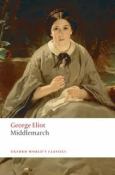 So, what will I be busy with this term? I have just two classes, both ones I usually enjoy teaching very much and both of which I haven’t taught since 2011-12. The first is English 3000, Close Reading, which is part of our suite of required classes for majors and honours students. They don’t have to take English 3000 in particular: they have to chose one of our ‘theory and methods’ courses, which also include The History of Criticism and Contemporary Critical Theory. The first time I taught English 3000, in 2003, that wasn’t the case: then, it was one of two classes we’d introduced that were to be core requirements for every student in our program (the other was a survey, Literary Landmarks). Then, it had an enrollment of 120; this year, it is capped at 60 and right now has 42 students in it — so, quite a different undertaking. Still, my approach to the class was shaped by thinking about it as something that should be as useful and as engaging as possible to every English student — to every reader, in fact. It is actually the most conceptually interesting class I’ve ever developed (for me, at least) because it isn’t organized around content, the way my classes usually are, but around a method, a habit, a practice.
 In addition to working on how to read attentively (including learning precise vocabulary for explaining what we read), I try to focus our attention on why it matters to read carefully, not just for class but for life. In working out my approach, I drew especially on Wayne Booth’s The Company We Keep and on the ways he links aesthetics to ethics. My hope is that this connection motivates students to see our work, not as an intellectual parlor game, but as something with vital implications for living an examined life. We’ll be reading a selection of poetry and short fiction, and then really digging into Middlemarch and The Remains of the Day. The juxtaposition of these two very different novels has proven extremely fruitful in past iterations of the course. There is always some grumbling about Middlemarch (“it’s TOO LONG to read in a one-term course,” a student once exclaimed in her course evaluation — which amuses me because of course I always teach it in one-term courses, which are all we offer now, and usually with four other fairly long books). My justification is that if we’re going to pay really close attention to a novel, it should be a novel that I am confident will reward that attention. And we take five whole weeks to read it, so we don’t exactly rush through it.
 My other fall class is an upper-level seminar, The Victorian ‘Woman Question.’ It has 23 students in it, which is actually pretty big for a seminar — it’s going to be a tight fit, for instance, getting in all the student presentations. But if past years are any indication, the discussion should be fairly robust. I’ve done this class with an exclusive focus on fiction, but this year I’m doing my more standard mix of genres. We’ll start with some non-fiction, including Mill’s The Subjection of Women and essays by Frances Power Cobbe and Margaret Oliphant (included in Susan Hamilton’s excellent Broadview anthology Criminals, Idiots, Women, and Minors), then we’ll read The Tenant of Wildfell Hall, The Mill on the Floss, Aurora Leigh (all of it, hooray!), The Odd Women, and an array of other short poems and stories. From the outset I emphasize that there wasn’t just one ‘question’ about women’s roles, and there certainly, too, wasn’t just one ‘answer.’ I provide some historical context at the outset, including information about women’s legal, economic, political, and educational realities, and then we approach each of our readings to see what terms it sets for the debate: how it poses and answers the ‘woman question.’
 I had hoped that
 But to me that same art sometimes felt just a bit too conspicuous: I often thought about how well-crafted the novel was, structurally as well as at the sentence level. Is that even a fair thing to say, I wonder? That a a book is too clearly well-written, that a writer’s sentences are a little too good? Here’s the novel’s opening line, for example: “On the morning after the Feds burned down her house and took her father, Havaa woke from dreams of sea anemones.” I bet you didn’t see those sea anemones coming! That surprise is excellent: right away, I’m intrigued, and it turns out, too, that sea anemones aren’t an incidental choice. Here’s another sentence from quite a bit further along, though: “The silver Makarov pistol was all Ramzan thought about for the two weeks preceding Dokka’s disappearance, in which he failed to produce a single bowel movement.” Surprise again! And maybe now you see what I mean. This is an effect Marra likes. He is good at producing it, but it risks being gimmicky, and these lines, to me, smack of the journalistic imperative to have a good “lede.” There’s something a bit self-conscious about it: there’s a bit of self-display.
 Al Aswany avoids a simplistic “us vs. them” account: some of his English characters are intensely sympathetic to and involved in the nationalist movement, and some of the Egyptian staff at the Automobile Club collude in their own subjugation, partly through need and fear, but also partly through habits ingrained through a long cultural history of deference to authority. The cruelties of the Egyptian characters to each other is often more overt than the evils of colonialism, but it’s also always clear that the systemic injustice of occupation undermines all efforts for progress and moral improvement. Though the novel is pointedly political, it manages never to be didactic: instead, Al Aswany’s quietly persistent differentiation of his cast of characters just keeps undermining the insulting abstractions on which people’s prejudices depend.
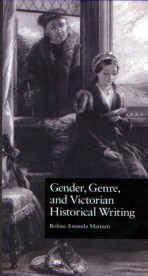 I mentioned in my last post that I had recently read a new academic book that I ultimately decided not to review, partly because I didn’t want to scapegoat the author for my alienation from the genre it belongs to. I’m still not going to name it (and that’s my own book pictured at left, just so there’s no confusion), not just because I’ve made that ungenerous mistake before but because I have had the same question about a lot of academic books lately. This is just the most recent one to leave me wondering: what is this book worth?
 If there were such an expectation and people routinely met it or else paid a professional price,
  My light reading has included some good contemporary romances: Ruthie Knox’s Truly, which I really enjoyed, and two of Molly O’Keefe’s ‘Boys of Bishop’ novels — Between the Sheets and Never Been Kissed. O’Keefe’s are just a tiny bit too angst-ridden to become real favorites of mine: I like my romance with a bit more comedy and a lot less suffering. But both of these authors write well and create convincing characters, and Truly had some really excellent “neepery” about urban bee-keeping. I’ve started several historical romances but tired of them all before the half-way point — including Julia Quinn’s Because of Miss Bridgerton and a forthcoming Mary Balogh, Someone to Love. Not too long ago I read Sarah MacLean’s The Rogue Not Taken, and I did really like that; I think it’s just that for me right now, I’ve had enough of that particular flavor and none of the ones I tried seemed novel enough. I also just finished Sue Grafton’s X, which some of you may have seen me griping about on Twitter. When I say “finished” I mean that once I realized it wasn’t going to pick up, I skipped along hastily until I finally reached its big climactic scene, about 5 pages before the last of its nearly 500. Grafton assembles her pieces competently, and Kinsey’s still a pretty good character, but that book was way too long to be so completely lacking in interest or suspense.
 A book that deserves better than I can give it is
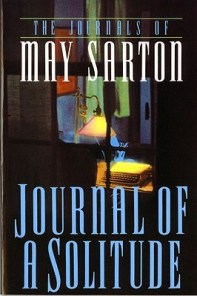 Of course, I’m not sure I would like that much solitude in practice (any more than Sarton’s friend
 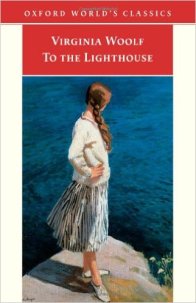 I’m reading To the Lighthouse for the first time. I know, I know. I also know that I should love it, because it is beautiful and moving and brilliant and original — and I sort of do, so far, except when I don’t. I am not a particularly good reader of Woolf’s fiction: it was only a few years ago that I finally read
  “Time passes.” It’s such a neutral-sounding phrase, almost like a stage direction, one that requires all the director’s ingenuity to show us its truth without taking us through the whole chronology. It’s an obvious truth, one we’re all perfectly well aware of, but we feel it deeply only during what George Eliot calls “one of those rare moments of experience when we feel the truth of a commonplace,”
 You see, I’ve been working on these off and on since 1993. I was newly married then and still not quite accustomed to the amount of golf my husband likes to watch on TV every weekend. Since it was hard to get away from the TV in our small apartment, and it didn’t seem very friendly (or very practical) to absent myself from home altogether, I decided to take up some hobbies that would keep my hands busy and give me a sense of accomplishment while I watched golf with him. A long-time reader of Tudor fiction, I was also working on a dissertation about Victorian historical writing, including Agnes Strickland’s Lives of the Queens of England— one way or another, Henry VIII and his wives had been in my life a long time. My thesis also included a chapter on the symbolic significance of needlework in Victorian historiography! So I was pretty excited when I chanced on a pattern in New Stitches magazine for Katherine Howard (wife #5, beheaded, in case you can’t keep them all straight). and even more excited when I realized it was part of a series and I could order the back issues, which I did. Over the next few years I completed four of the queens (Katherine Howard, Anne of Cleves, Katherine of Aragon, and Anne Boleyn). Just two wives were left, plus Henry himself.
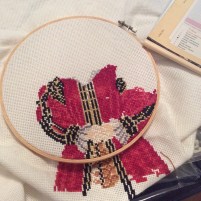 What inspired me to take her out? Mostly that I’ve been experimenting with


 It’s an aesthetic effect that, when it works, perfectly suits the kind of man Spenser is: a man whose actions, as he says to Susan in Promised Land, speak for themselves. This doesn’t mean he isn’t introspective or capable of nuanced insight. He’d just rather act on what he discerns than spell it out. It’s primarily Susan who encourages him to articulate his life, which I’ve always thought was her primary role in the series — that and providing psychological and emotional support to people caught up in Spenser’s cases who aren’t well served, or sufficiently served, by his decisive but often unconsoling minimalism.
 The case Spenser is involved with here involves a woman, Pamela Sheppard, who leaves her husband for no stronger reason than general dissatisfaction with her marriage. (There turns out to be more awry with her husband than that he doesn’t really see her for who she is, but that’s where she starts.) She ends up falling in with a group of women keen to start a revolution against the patriarchy, and as a result she ends up an unwilling participant in a bank robbery that goes horribly wrong. Spenser is entirely unmoved by her distress:
