 It comes back to the geese, in the end. I hoped it would, because of all the marvellous episodes in Wart’s education (the tyrannical pike, the totalitarian ants, the philosophical badger), his time with the geese is the most sublime. It’s beautifully written, for one thing, detailed and evocative, freely fanciful:
The sun, as it rose, tinged the quick-silver of the creeks and the gleaming slime itself with flame. The curlew, who had been piping their mournful plaints since long before the light, flew now from weed-bank to weed-bank. The widgeon, who had slept on water, came whistling their double notes, like whistles from a Christmas cracker. The mallard toiled from land, against the wind. The redshanks scuttled and prodded like mice. A cloud of tiny dunlin, more compact than starlings, turned in the air with the noise of a train. The black-guard of crows rose from the pine trees on the dune with merry cheers. Shore birds of every sort populated the tide line, filling it with business and beauty.
The dawn, the sea-dawn and the mastery of ordered flight, were of such intense beauty that the boy was moved to sing. He wanted to cry a chorus to life, and, since a thousand geese were on the wing about him, he had not long to wait. The lines of these creatures, wavering like smoke upon the sky as they breasted the sunrise, were all at once in music and in laughter. Each squadron of them was in different voice, some larking, some triumphant, some in sentiment or glee.
Like the lengthy excursus on the Middle Ages much later on in the book, these expeditions into natural history speak above all of the writer’s joy in his subject–and what writing is more delightful, more uplifting, to read than joyful writing?
But the flight of the geese is not just natural history: it’s also, like Merlyn’s other lessons (like the whole novel), an embodied class in political theory. “Are we at war,” asks Wart. The goose Lyo-lyok does not understand the question. “There are no boundaries among the geese,” she eventually explains to him. “How can you have boundaries if you fly? Those ants of yours–and the humans too–would have to stop fighting in the end, if they took to the air.” “I like fighting,” replies Wart. “It is knightly.” “Because you are a baby,” replies Lyo-Lyok.
At the end of The Once and Future King, Wart is no longer a baby. Now he’s an old, exhausted king staring in near despair on the failure of his experiment to reconcile might and right. Why do men fight, he wonders? “Suspicion and fear: possessiveness and greed: resentment for ancestral wrong: all these seemed to be a part of it”:
Yet they were not the solution. He could not see the real solution. He was too old and tired and miserable to think constructively. He was only a man who had meant well, who had been spurred along that course of thinking by an eccentric necromancer with a weakness for humanity. Justice had been his last attempt–to do nothing which was not just. But it had ended in failure. To do at all had proved too difficult. He was done himself.
But he isn’t quite done: there’s a bit of thinking in him yet, not to mention “something invincible in his heart, a tincture of grandness in simplicity,” and he uses his last bit of hope and strength to tell his story to young Tom (“his surcoat, with the Malory bearings, looking absurdly new”), and then “to think again,” and what he thinks of is Lyo-lyok–and there it is, “the problem before him as plain as a map”:
The fantastic thing about war was that it was fought about nothing–literally nothing. Frontiers were imaginary lines. There was no visible line between Scotland and England, although Flodden and Bannockburn had been fought about it. It was geography which was the cause, political geography. It was nothing else. . . . The imaginary lines on the earth’s surface only needed to be unimagined. The airborne birds skipped them by nature. How mad the frontiers had seemed to Lyo-lyok, and would to Man if he could learn to fly.
Imagine there’s no countries…it isn’t hard to imagine it. But to realize it? The Once and Future King isn’t that kind of fantasy. Ideas are only as good, as strong, as tenable as principles, as the people who try to live up to them, or to subvert or destroy them. And people, the novel shows over and over, are mixed, complicated, contradictory, creatures.
There’s Arthur himself, for instance. He’s such an ordinary fellow for a legendary hero! As the Orkneys gather to force Arthur’s hand with an open accusation against Lancelot and Guenever, Gareth sees him “as he was … a plain man who had done his best–not a leader of chivalry, but the pupil who had tried to be faithful to his curious master, the magician, by thinking all the time–not Arthur of England, but a lonely old gentleman who had worn his crown for half a lifetime in the teeth of fate.” Because we first meet him as Wart, we carry with us throughout the novel a sense of his childish innocence and his simple desire to do his best. “He was sadly unfitted for hating his best friend or for torturing his wife,” says the narrator; “He had been given too much love and trust to be good at these things.” Such innocence and simplicity should surely be strengths, but for Arthur they are weaknesses. If he were more suspicious, more wily, less scrupulously loyal and just, he would not have been there in that room, “hoist,” as the vengeful Agravaine exults, “with his own petard”–“trapped by his enemies into crushing his friends,” as Steve Donoghue nicely puts it, “using the very structure of law and order he worked so hard to champion.” But “it seems, in tragedy, that innocence is not enough.”
Lancelot and Guenever, too, are painfully ordinary, which is not to say that they are dull or commonplace but that they are flawed and mistaken and loving and loyal and treacherous all at the same time. If they were worse people than they are, they could have simplified the situation, as we would handle it today “when everybody is so free from superstitions and prejudice that it is only necessary for all of us to do as we please.” But they have other values, and they love Arthur as well as each other. Their love (the love of all three of them for the others) is a beautiful, fragile thing, more so as they get older and become “seasoned people, who knew what they were about.” Here they are late in the story, poised on the very threshold of disaster:
The room glowed into colour round the lovers, who had released each other quickly. It began to show the splendour of its hangings as the boy put fire to the wicks. The flower meads and bird-fruitful spinneys of the Arras teemed and rippled over the four walls. The door curtain lifted again, and the King was in the room.
He looked old, older than either of them. But it was the noble oldness of self-respect. Sometimes even nowadays you can meet a man of sixty or more who holds himself as straight as a rush, and whose hair is black. They were in that class. Lancelot, now that you could see him clearly, was an erect refinement of humanity–a fanatic for human responsibility. Guenever, and this might have been surprising to a person who had known her in her days of tempest, looked sweet and pretty. You could almost have protected her. But Arthur was the touching one of the three. He was so plainly dressed, so gentle and patient of his simple things. Often, when the Queen was entertaining distinguished company under the flambeaux of the Great Hall, Lancelot had found him sitting by himself in a small room, mending stockings. Now, in his homely blue gown…he paused on the threshold of the gleaming room, and smiled.
‘Well, Lance. Well, Gwen.’
Such a homely greeting, from this simple man to the two people he loves most in the world. Doesn’t this scene make you yearn for their safety? It’s terrible watching the calamity descend on them that you know all along is coming–for inevitably, the novel is governed by dramatic irony, not just for us, who can’t help but know the story already, but for Arthur too, who is warned at the outset by Merlyn. If only, if only, if only… but there’s no way out for any of us: “before she was quite certain of what had happened, Guenever was laughing or weeping, unfaithful to her husband, as she had always known she would be.” And the rest, after that, is as foreseen and foretold.
For such a tragic story, the telling is surprisingly lighthearted–or light, at least. I was equal parts enchanted and puzzled by the novel’s tone. How can something so sad also be so funny? How can something so elevated also be so colloquial? If it’s not that serious, why am I crying? In the end, though, what I came to see was that the sadness lay precisely in the lightness of it all, in the way the joyousness I already remarked–the bursting excitement about nature and creativity, about “the age of fullness, the age of wading into everything up to the neck”–is undermined so steadily by the awareness of its eventual destruction. The story would not be so sad, also, if it were kept at more of a distance from us. The novel’s most ridiculous, delicious flights of fancy (the thwarted romance of the Questing Beast, for instance) are narrated in the same down-to-earth way as the most extreme moments of betrayal or grief or psychic torment (“Do you think it would be fine to be the best knight in the world? Think, then, also, how you would have to defend the title. Think of the tests, such repeated, remorseless, scandal-breathing tests, which day after day would be applied to you–until the last and certain day, when you would fail.”) and so we experience them both as part of the same world of people who may transform into animals, trap unicorns, and perform miracles, but are somehow, bizarrely, wonderfully, just like us. White’s casual references to Malory and Tennyson, rather than making his version seem coolly metafictional or presciently postmodern, make it seem natural, real, sincere: “Tennyson and the Pre-Raphaelites would have found it difficult to recognize this rather sullen and unsatisfactory child, with the ugly face,” he says of Lancelot; “An observer of the present day, who knew the Arthurian legend only from Tennyson and people of that sort, would have been startled to see that the famous lovers were past their prime.”
It’s sad because even though it’s a myth, it’s also a true story, one that ought to be told in as direct and simple a way as possible so that we’ll understand it. It’s a sad story because it’s the story of our failure, of our inability to solve King Arthur’s dilemma: to build a just world in which such joy can flourish. Merlyn’s lessons were based on the premise “that man was perfectible: that he was on the whole more decent than beastly.” At the end of his reign, Arthur finds this “central tenet of his heart” undone, “ravaged.” If anything, man is worse than beastly–Mordred’s scheming, the blood feuds, the fatal seductions are all calculated and so beyond the capacity of animals. “What creature could be so low,” wonders Lyo-lyok, “as to go about in bands, to murder others of its own blood?” Taught by Merlyn, Arthur had dreamed of a world in which these evils could come to an end. To read The Once and Future King is both to participate in his dream (just as he hopes young Tom will “tell everybody who would listen about this ancient idea, which both of them had once thought good”) and to experience its failure. Can we, perhaps, create the future he dreams of, a day ready for his return? “The hope of making it would lie in culture,” he thinks:
If people could be persuaded to read and write, not just to eat and make love, there was still a chance that they might come to reason.
That must have seemed like a pretty slim chance when the novel was first published in 1939. It still seems like something only a dreamer would imagine.
Sometimes I like to highlight a favorite post from my blog archives, both to share it with readers who might have missed it the first time and, as in this case, to remind myself of the pleasure I have found in writing here about my reading. This post was originally published June 27, 2012.
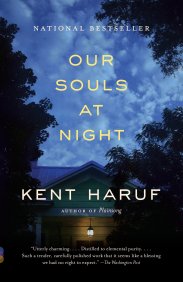 Our Souls at Night is the last of Kent Haruf’s Holt novels — he died not long before its publication. It seems fitting then, I suppose, that it is a bit bleaker than
 But across this strange commonplace idyll comes a destructive shadow: Addie’s son can’t accept his mother’s new friendship, finding the idea of a man in her bed disgusting and interpreting Louis’s motives in coarsely suspicious ways. Instead of rescue or salvation, then (the promise of which dominates both Plainsong and Benediction), Our Souls at Night highlights the possibility of ruin — again, on a very small scale, but in a way that feels larger, more significant, as if Gene’s small-mindedness represents in miniature the threat to all forms of grace. Happiness is made of such fragile things — trust, tolerance, affection, moments of talk and laughter — that it’s always vulnerable to blight. And as Addie and Louis find, resisting may in itself damage the very thing you hoped to protect.
 The choices he finally makes reflect–perfect, maybe–the choices he had made throughout his life. He returns to work for as long as he can, finding purpose in his “calling,” and he wrote this book, which his wife tells us in her Epilogue he “wrote relentlessly,” committed to “help[ing] people understand death and face their mortality” in a different way than he had done so often as a surgeon.
 On university campuses we hear a lot about innovation these days, from hype about the latest ed-tech fad to proclamations by institutions like my own about fostering a “culture of innovation.” This has got me reflecting on how we define or recognize innovation — something that is not as obvious, I think, as its champions, or as those who insist on it as a measure of academic success, typically seem to assume. In some fields, of course, it’s easy enough to tell when something is new, if it shifts or breaks a paradigm. But in others, context makes all the difference, as my own chequered career as a “thought leader” demonstrates.
 Today, of course, an interdisciplinary degree is wholly unremarkable; Dalhousie even has an entire
  But when I got to Cornell, I discovered that far from being a radical, I was actually a conservative! It turned out that there were some kinds of questions you couldn’t safely ask there, arguments you couldn’t seriously entertain, without undermining your feminist credentials. My first big mistake was giving a seminar paper called “The Madwoman in the Closet”: it queried some then-dominant trends in feminist criticism, particularly in 19th-century studies, and tried (perhaps crudely, but I was a beginner at all of this — and frankly, my somewhat old-fashioned training at UBC had not prepared me well for it) to figure out how politics and aesthetics were getting balanced (unbalanced, I thought, maybe, possibly) in the debates. My professor was keen to have these discussions, but said to me quite frankly that he felt that as a male professor, he couldn’t raise these questions. So I blundered in, and paid the price. I also wrote a more or less positive review of Christina Hoff Sommers’
  Exhibit C: my critical writing. There are many possible angles to consider here, but I’ll focus on my recent work outside of academic publishing, because its status has been much on my mind lately. In a way, the kind of criticism I’ve been doing recently — from book reviews to literary essays — is not innovative at all: it’s the same kind of work everyone else is doing who also writes for newspapers and magazines and literary journals. But from an academic perspective, to be writing for those venues instead of for academic journals is itself innovative: it’s the kind of thing that gets called “knowledge mobilization” or “knowledge dissemination” or “public humanities.” Except that some of these publishing ventures resemble (in style, not necessarily in content) an older kind of literary criticism — a kind some might call belles lettres — which is now considered passé in academic circles. So my recent work could be considered retrograde, not innovative. Except that to break from the conventions of academic writing and try to replicate the best qualities of belles lettres (fine, smart, accessible writing, with its own literary elegance) while still doing criticism informed by decades of academic scholarship … couldn’t that combination of new insights and old forms itself be innovative? Then, what about the content of the reviews and essays? Every new interpretation of a literary text is a critical innovation, isn’t it? So every review of a new book, representing a new intellectual encounter, is intrinsically ground-breaking, even if book reviewing as a form is the oldest kind of literary criticism. What if you make a new critical argument, based on original research, but in an essay outside the norms of academic publishing — if that argument falls in the forest, can anybody hear the innovation? Or what if the argument of an essay is new to one audience but not to another? What is going on then?? Am I doing original work or not???
 I’m so glad Emma Claire Sweeney put me on the list to receive a review copy of her new novel Owl Song at Dawn. A heartfelt story about love and acceptance, it is also an evocative look at a time and place — northern England in the 1950s — in which, for families like those Sweeney focuses on, these feelings had to be fought for and protected, not just against the callous or prejudiced but against earnest but wrongheaded well-wishers.
 Is there a name for books structured as backward explorations — books like
  Still, Ruth and Joe seem likely to putter on, if not in perfect amity, at least in stolid companionship, without any new crises, until a postcard arrives from an old friend that prompts Joe to dig up his decades-old journals, which Ruth then encourages him to read aloud. They both know, it turns out, that the journals tell the story of a trip to Denmark that became a turning point in their relationship, one that has long gone unacknowledged but that has been a small irritation in their consciousness for decades. “You wanted the pebble out of the shoe,” says Joe to Ruth after she has forced a long-deferred confession; “I suppose,” she replies.
 It’s tempting, perhaps, to look back with regret on a life that hasn’t turned out to be particularly memorable to anyone but the person who lived it. Early in the novel, Joe casts himself as a secondary character, a kind of Rosencrantz or Guildenstern, someone who watched other people live instead of really living himself:
 “The crib scene kills me,” Mark Athitakis
  Nature is not romanticized in this world: the McPheron brothers, for instance, are cattle farmers, and there’s too much birth, blood, and slaughter in their daily routine to make them sentimental. Haruf connects his characters to nature’s harsh realities, emphasizing their common cycles of life and hunger and survival. “I started thinking about it the other day,” Harold McPheron says to his brother Raymond, as they fret over Victoria’s pregnancy: “the similarities amongst em.” “I don’t appreciate you saying she’s a heifer,” says Raymond, horrified, but later, after they deliver a calf, with difficulty, from a heifer in distress, they both move seamlessly into discussing, not the heifer’s health, but Victoria’s:

 I love that, but I’ve also seen it before, or very nearly. This time it’s Cyprus, but before it has been Bruges, or Venice, or Trebizond. The particulars vary, but the effect doesn’t, really. And we also get many examples of another kind of passage that to me is a lot less inviting — the kind that traces out the loyalties and lineages and special interests that are the warp and woof of Dunnett’s plots. I’ve admitted more than once that these very complicated plots are hard for me to follow. In the Lymond books, that has never bothered me much because the melodrama carries me along and because they are dominated by a few highly charismatic figures: Lymond himself, of course, Margaret Lennox, Gabriel, Philippa, Sybilla, Guzel. The supporting cast in Nicholas’s life is appealing, but not one of them really stands out to me at this point. (Greater familiarity with the series would probably change this perspective, as, perhaps, would reading the books closer together. I had trouble recalling who everybody was when I began Race of Scorpions, never mind what exactly they had been up to before.) By the end of this book, I had stopped even trying to grasp what exactly Nicholas is up to and why, besides whatever was immediate and obvious in the moment.
 This is not to say there weren’t some great, even thrilling moments in Race of Scorpions: Katelina and the moths, for example, which is a scene I’ll remember for a long time, or, in a more violent register, the long-deferred confrontation with Tzani-Bey (who did what, exactly, to Nicholas, by the way? am I right to infer that his “mistreatment” was sexual?). I was also struck — not for the first time — by the ease with which Dunnett’s world incorporates a range of sexualities. This is something that’s very prominent in Race of Scorpions, because of Zacco, but the variety and fluidity of desire is a feature of the Lymond books too. It’s certainly not typical of other mainstream historical novels I’ve read set in the Renaissance: they tend, overwhelmingly, to be organized around heterosexual romance plots, without even a hint of other possibilities. And something else that Race of Scorpions has in common with the Lymond series is an emphasis on powerful women — here, Marietta of Patras or, as she is less elegantly called, “Cropnose” (because hers has been bitten off), and her foil, at least in beauty, Primaflora. So often in Dunnett’s books, while it’s the men out in front taking action, seemingly in charge, it turns out to be the women who, behind the scenes, are pulling the strings, plotting — like Dunnett herself.
 I’ve been roughing out schedules for my 2016-17 courses — even the winter term ones, because before I can order books for them I need some idea of how the readings will fit in. As I consider how best to allocate class time, especially for my first-year class, I’ve also been thinking about a very interesting conversation I had recently with a former student who now works in a Dalhousie office concerned, among other things, with understanding student retention.
 Novel Readings