In All Things: Victoria MacKenzie, For Thy Great Pain Have Mercy On My Little Pain

I remembered being a wife and mother, rinsing the herring for dinner, using a sharp knife to scrape away the scales before hanging the fish above the fire. Days later I’d find scales between the stone flags of the floor, stuck to the wall, caught in my woollen shawl. Now, when I remembered how they were everywhere, I saw that it was just the same with God’s love. God is not a being on high, to whom we must raise our eyes. God is everywhere, in all things, including us.

Victoria MacKenzie’s For Thy Great Pain Have Mercy On My Little Pain is perhaps an odd reading choice for an atheist, or at any rate, this atheist found it odd to read. It’s not that because I am not religious myself I take no interest in religion, or that I find no beauty in religious art or music or thought because I do not share the underlying belief or inspiration. I am often deeply moved by representations of faith, though I am more moved by doubt and by expressions of humanity, and more interested in skepticism. I am stirred by the religious ecstasy of Hopkins’s “God’s Grandeur,” and by the blending of romantic and spiritual love in Elizabeth Barrett Browning’s “How Do I Love Thee?”—but the world I personally live in is more like that of “Dover Beach,” though not always or necessarily so bleak. In fact, a guiding principle of my own life is that a world without God is plenty inspiring and that accepting our own responsibility for “the growing good of the world” is uplifting as well as chastening. (I’ve written quite a bit about these topics over the years, from posts about Christmas to essays about Middlemarch.)

So what was different about For Thy Great Pain? Why did I find it hard to enter into the lives and minds, or more accurately, the experiences and feelings, of its two protagonists, Margery Kempe and Julian of Norwich? Why did their eventual meeting have no electricity for me, though it was clearly devised as the climax of this immaculate little novel? Or was the absence of that quality—the meticulously prosaic quality of both voices—deliberate?

There are some moments of transcendence in the novel, as you would hope or expect from an account of two lives transformed by visions. After the birth of her first child, for example, Margery is “frenzied,” believing she will die and struggling to tell her sins to her impatient confessor. “It was after this,” she tells us,

that Jesus Christ appeared, sitting on the edge of my bed, very handsome and clad in a mantle of purple silk. He looked at me with so blessed a countenance that I felt my spirit strengthen. He said, ‘Daughter, why have you forsaken me, when I never forsook you?’

As soon as he said this, the air in my chamber became bright as if lit by lightning and he ascended to heaven, not rushing, but beautifully and slowly, until the air closed up again and I was restored to myself.

As she becomes accustomed to the small scale of life in her anchoress’s cell, Julian becomes “a great watcher of light and dark”:

Once the golden light of the sun sinks away, the colour is taken out of things, and the world fades one object at a time . . . In the morning, I watch the world coming into being, leaf by leaf, brick by brick, cloud by cloud, as if every day God says Let there be light and creates the world afresh.

That’s lovely, isn’t it?

But a lot more of the novel is just the two women recounting what happened to them, what it was like to have these “shewings” and then to figure out what to do about them in a world where women’s speech of any kind is not encouraged and women’s religious attestations are not just unwelcome but offensive to almost everyone. When Margery asks to speak with her priest about her visions, “He raised his hands and said, ‘Bless us! What could a woman have to say about the Lord that could take so long?'” Before she becomes an Anchoress, Julian (which was not yet her name) knows “not to confide” in her priest, “no matter that I was sure my shewings had come from God.”

MacKenzie does a good job evoking the character of the times with the kind of glancing precision that we get in other self-consciously literary historical fiction these days—I’m thinking, for example, of Maggie O’Farrell’s Hamnet or Danielle Dutton’s Margaret the First. The plague scenes inevitably provoked comparison with Connie Willis’s Doomsday Book, as that is still quite fresh in my mind, but MacKenzie gives us only a sentence or two, only a few quick (if still heartbreaking) losses. That grief is an essential element of Julian’s turn to God does seem evident: “Grief marks a person,” as she says,

changing them for ever, like a tree struck by lightning. The tree may keep growing, but never in the same way.

Yes, that seems true: I have often made similar analogies in my own mind, about my own grief, to the hurricane-damaged trees in Point Pleasant Park, where I walked (and walked and walked and walked) after Owen’s death. But for Julian grief is not an explanation, or at least not the explanation, for her turning more and more away from the world towards God.

I wonder if what MacKenzie wanted to do is depict faith itself as a fact, which is not the same as granting factual status to the beliefs, or taking the womens’ “shewings” as actual divine visitations. What might it have really been like to believe in that way? I remember studying The Heart of Midlothian years ago and my professor saying, with the kind of earnestness I too bring to class when I trying to really make a point, that what’s amazing about Jeanie Deans that is too easily lost on us moderns is that she really believes she is going out to meet the devil. The devil! The real, actual devil! Thus her courage, her heroism, is on a scale we can hardly fathom. Margery and Julian feel and see with great intensity things I do not believe in but that they believe in; they frame their experiences accordingly and risk everything as a result, as we are frequently reminded by their anxiety about being considered heretics and burned alive. And yet MacKenzie presents them with no melodrama; they speak, by and large, flatly, or that is how their voices mostly sounded to me as I read—especially (and this was disappointing) in the dialogue between them when they finally meet, which I found almost comically stilted. (It didn’t help that it is presented as dialogue, line by individual line.) This is not a particularly eloquent book, though it does, as noted above, have moments of grace and beauty.

You’d think I would prefer that, as a non-believer—that I would appreciate that For Thy Great Pain trades more in historical specificity than in the meaning or power of faith itself. That’s why I find my muted response to it odd. It turned out that I wanted it to be more ecstatic. Where is its “ah, bright wings!” moment? But why is that what I like, in my religious art, or my art about religion? Do I prefer faith to be aestheticized, because as fact it is, to me, so implausible and thus ultimately meaningless? Give it beauty or give it up? I was interested in the stories of both Margery and Julian, as I know next to nothing about them both otherwise, but interest seems a low bar, and my interest would also have been greatly enhanced for me by context and exposition, maybe not quite as much as we get in Romola, but more like that. That would be a very different kind of book, though, not just a much longer one: to want these women, their voices, their stories, embedded in a narrative about faith in the 15th century the way George Eliot’s account of Savonarola is would change the terms of our encounter with them completely. 

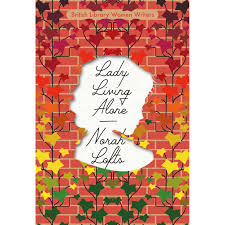
“Something in Penelope”: Norah Lofts, Lady Living Alone

And now, in this low and critical moment, something in Penelope, something which had understood courage and resource and action, though she herself had never been brave or resourceful or active, stirred and shook itself. The pirate woman, Jane Moore, the Aztec girl, Xhalama, the misunderstood Tudor stateswoman and others of their blood, stood by her bed, urging her to save herself . . . and to justify them.
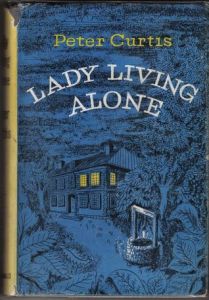
In his excellent ‘Afterword’ to the British Library Women Writers edition of Lady Living Alone, Simon Thomas (known to many of us from his excellent blog Stuck in a Book) highlights the genre trickery that makes this little novel so slyly surprising. Initially it conforms to the tropes, tone, and expectations of “comic, domestic fiction.” It centers on Penelope Shadow, an awkward, unobtrusive, and largely ineffectual woman with an overpowering fear of being alone in the house. One day Penelope buys a typewriter, shuts herself in her room, and rattles away at it day and night until she produces what becomes the first in series of historical novels. “Miss Shadow,” we’re told, “had at last found the job for which she was suited, a job which did not demand regular hours, spurious politeness nor the soul-jarring contact with people; so, through good years and bad, she persevered with it” until one of her books, Mexican Flower, is a big success and makes her enough money to move out of her half-sister’s house into one of her very own.

Hooray! you might well think: she has written her way to independence. But this is where her difficulty with being alone becomes not just a quirky character trait but an obstacle to her contentment. Driving home one night in a snowstorm, Penelope realizes that because the latest in her series of housekeepers is gone, she would have to be alone, so instead she pulls up at the Plantation Guest House. There, during the course of a generally uncomfortable stay, she meets “the boy,” a handsome young man named Terry Munce, who looks after her so readily and ably that she ends up offering him  the job as housekeeper.

Terry is a great addition to Penelope’s household and her life: he takes excellent care of her, even giving her massages when she is stiff and tired from typing. Once again things seem to be going well for Penelope, but Terry’s presence kindles gossip. When he confronts her about it, he shocks her by adding “I happen to be terribly in love with you.” He kisses her, “and Penelope was lost.” She agrees that they should marry. Hooray! you might think: our mousy heroine has found love. But before the chapter closes, the novel shifts gears, giving us a glimpse of the real Terry in his “expression of calculating triumph”: “After all, one likes six months of hard labour to bear some result.”
Lady Living Alone does not shift immediately from domestic comedy to domestic suspense: the next phase of the novel traces the rifts that emerge in Terry and Penelope’s relationship. He behaves badly, but he is not overtly sinister, and for some time Penelope’s position seems more pathetic than perilous. But then things take a turn, and Penelope has to wonder if it is possible that this young man she has befriended, trusted, and loved might in fact be trying to do away with her . . . 

I don’t want to spoil the fun of your finding out for yourself how things turn out. Something I found particularly interesting about the novel’s conclusion that doesn’t bear directly on plot revelations is its connection to Penelope’s writing. It is generally seen as eccentricity by those around her—”If she think you can keep a husband by hitting a typewriter all day and all night,” she overhears one of her servants muttering at one point, “let her find out different for herself”—and no particular merits are ever ascribed to her novels. Her subjects are strong women, though, including Queen Elizabeth. “I know why she never married,” she scribbles in her notebook when she turns back to writing after her marriage: 

Oh, she was as certain as though she had been there, that Elizabeth Tudor had never taken Leicester or Essex to her bed. Because if she had done she too, being human, would then have owned a master.

How does that happen, she wonders; “the balance swung so gently that it was not until one scale bumped heavily that you realised that there had been a disturbance.” She too is mastered in her marriage, not so much (at first) through overbearing conduct on Terry’s part but through her own love of him and her desire to be loved herself, to believe in what she thinks they have. When she finally realizes that he is a threat, that she is going to have to defend herself or die, her situation seems hopeless:

A poor little ageing creature, sick, doubting her own sanity, and broken in spirit. A pitiable little object to any observer, had there been one who could see and understand.

But there is more to Penelope Shadow than that: she has “made and known and understood some remarkable, courageous, fiery, indomitable women,” and from them she takes courage—and gets ideas. “If we are part of all we have been,” comments the narrator, “how much more are we part of all we have made?” I loved this moment, which picks up on an idea that has been central to a lot of my own work on women’s writing. “Lives do not serve as models,” Carolyn Heilbrun wrote in Writing A Woman’s Life; “only stories do that.” For Penelope, the stories she has written quite literally empower her—and then it is “over and done with, and Penelope was no more a clever, cunning, ruthless creature, but a gentle little woman with a conscience.” 

I read some of Norah Lofts’s own historical novels long ago: the one I particularly remember is The Concubine, about Anne Boleyn, though I am sure there were more in our nearby public library, where I used to sign out stacks of Tudor (and Ricardian) fiction every week. It is hard not to read some justification of her own work and heroines in the strength Penelope Shadow gets from hers. Lofts published Lady Living Alone under a pseudonym, Peter Curtis; perhaps she thought the message, that women’s ‘romantic fiction’ was more subversive than it seemed, would be more memorable coming from a ‘man.’

Uncategorized

This Week In My Classes: Gaskell & Holmes

It has been a long time since I worked through Elizabeth Gaskell’s Life of Charlotte Brontë with a class. In fact, the last time I did so was the first year I began this blog series, in the fall term of 2007! In the intervening years, when I have put in to teach a graduate seminar (which is what Victorian Women Writers used to exclusively be) it has been one focused just on George Eliot—which is the course I will be revising next year for this new undergraduate / graduate format.

It is interesting reading through that old post: in its broad outlines, it describes pretty much exactly the same topics we’ve been covering. It is quite broad, and that class is so long ago that I really don’t recall how closely our specific discussions matched what we have been talking about this year. It seems as if we have ranged more widely—but we probably touched on a lot of things then too that aren’t captured in that summary. My sense is that this time around we are paying more attention to the variety of genres and layers in Gaskell’s text, to things like her reliance on extensive quotations from Brontë’s letters, for example, which, as we talked about today, don’t always self-evidently support the characterization of Brontë that Gaskell sets up. For one thing, the Brontë of the letters is bolder, friendlier, and funnier than the timid, shy, sickly little person Gaskell usually shows us in her own narrative. Today we talked about (among other things) what nature means, to Brontë and in Gaskell’s story of her and her family, as in moments like this, in one of Brontë’s letters to a friend:

For my part, I am free to walk on the moors; but when I go out there alone, everything reminds me of the times when others were with me, and then the moors seem a wilderness, featureless, solitary, saddening. My sister Emily had a particular love for them, and there is not a knoll of heather, not a branch of fern, not a young bilberry-leave, not a fluttering lark or linnet, but reminds me of her. The distant prospects were Anne’s delight, and when I look round, she is in the blue tints, the pale mists, the waves and shadows of the horizon.

Copying out that passage, I am struck by its power just as a bit of prose: how delicately infused it is with both the beauty of the moors and the pathos of Charlotte’s grief.

Read right after Oliphant’s Autobiography, with its heartbroken lamentations for her lost children, Brontë’s life story feels like an extension of those lessons in loss, though Oliphant’s narrative itself is fragmented, broken into pieces by each new blow, while Gaskell carries us through the relentless sequence of deaths at Haworth with her own storyteller’s skill. And after they are all gone, each with an ending portrayed as intensely, almost unbelievably, characteristic—Emily fiercely resisting death to the very last, Anne leaving “calmly and without a sigh”—Charlotte (like Oliphant) is left alone with her writing:

She went on with her work steadily. But it was dreary to write without anyone to listen to the progress of her tale,—to find fault or to sympathize,—while pacing the length of the parlour in the evenings, as in the days that were no more. Three sisters had done this,—then two, the other sister dropping off from the walk,—and now one was left desolate, to listen for echoing steps that never came,—and to hear the wind sobbing at the windows, with an almost articulate sound.

“No one on earth,” Gaskell observes, “can even imagine what those hours were to her.” Maybe, but also, maybe not, as there is much that will be sadly familiar about that desolation to anyone who also grieves “the days that are no more.” Honestly, I think it will be a relief, not just to me but to the class, to move on to Villette next week. Not that Villette is a joyful romp! But at least it puts us back in the more familiar analytical territory of fiction, and if we like we can choose to believe that it has a happy ending: as Brontë says, “let sunny imaginations hope”!

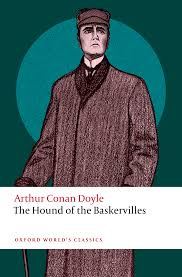
We started with Sherlock Holmes in Mystery & Detective Fiction this week. I’m not the world’s biggest Holmes enthusiast, but as I have documented here often enough over the years, I greatly appreciate The Hound of the Baskervilles, which we will get to on Wednesday. Today was “The Adventure of the Blue Carbuncle,” with its famous “interpret everything about a man from his hat” set piece, and “A Scandal in Bohemia,” with Irene Adler (“To Sherlock Holmes, she was always the woman”). These are good ones: I enjoy them. I think the class is going fine so far: it ought to be, considering how often I’ve taught it now! One thing I’m noticing is spotty attendance. It isn’t making me rethink my long-ago decision not to give grades for attendance, but it gives me food for thought in other ways, as this seems to be a trend in this class in recent years. Perhaps it’s because the course is an elective for pretty much everyone taking it, so they give it lower priority than their other obligations? Is it that students who don’t take a lot of English classes assume the pertinent course content is exclusively in the “textbooks” (what we call the “readings”!) and don’t expect our class time to offer much “value added”? I know that in some subjects lectures often do simply reiterate content in that way, but of course I’m not standing there rehearsing the plot of The Moonstone. Anyway, I try not to take it personally but it rather baffles me: what is the point in signing up to “take” a class but then not really “taking” it? Sure, you can read on your own (or, sigh, just search online summaries and call that “keeping up”), but unless all you are after is the course credit, aren’t you skipping the good part, not to mention the part you are actually paying for?
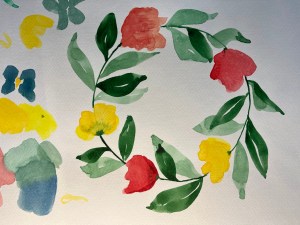
Speaking of taking classes, there’s one more class in my weekly schedule now: it’s the online one I am taking myself, Introductory Watercolour Painting. We met (via Zoom) for the first time last week and I have been diligently practicing colour gradients and one- and two-stroke leaves for my homework. Also (keener that I am!) I looked ahead a bit in our Brightspace site (yes, I have to use Brightspace now as a student as well as an instructor) and saw some examples of “loose floral wreaths,” which are on our lesson plan for this week, and I couldn’t resist giving it a try. This will be my “before” example, for comparison with the one(s) I make after I learn more about how to make the flowers and leaves fuller and looser, and also more layered and translucent, like the models.

Always Saying Goodbye: Anne de Marcken, It Lasts Forever And Then It’s Over

I pretended everything would be okay because it seemed impossible to always be saying goodbye. To blueberries. To the ocean. To ravens. To pelicans and plovers. To the cormorants. To the sunlight on the living room wall at four o’clock. To the sound of you in the next room.

Anne de Marcken’s It Lasts Forever and Then It’s Over is at once one of the most absurd and one of the most devastating novels I’ve ever read. It is absurd in the way any story about zombies (or vampires) surely has to be: the minute you stop to ponder how this is all supposed to actually work (the head is cut off but the legs are still walking how exactly? vampires have no breath but can still talk?) it falls apart and so if you forget to suspend your disbelief, even for a moment, you might start laughing and not be able to return to it. It is devastating because it is a novel about loss and grief—personal, but also planetary, existential—and the cavernous hunger that comes from wanting and mourning and finding (and expecting) no consolation. “I find I have stopped,” our narrator says at one point on her strange post-apocalyptic road trip;

I am standing in the road. The sky is light in the east. The moon is in the west. It is perfectly round. I am not really thinking anything. I am just looking at the moon. It is silver and flat and serious. A wind comes up to me in the empty morning like someone I’ve met before or seen before but don’t know, and a feeling comes over me. It is sadness. Not a sadness, but sadness. All of it. The whole history of sadness. Everything in me is sad and everything around me is a part of it. The cracked pavement, the moon, the abandoned cars, the gravity that holds them to the road. It is total. I am taken, or taken down. I drop to my knees.

How much can you lose of yourself before you lose yourself? How much can you bear to part with, of yourself, of your world? How long (and why) would you persist in a world without whatever it means to be alive? de Marcken’s novel (novella? at 122 pages it is in a grey area, I think) is clearly using her zombie apocalypse as a device to literalize these questions. “I lost my left arm today,” is its arresting opening line; “It came off clean at the shoulder.” This, and all of it, is metaphorical, allegorical.

It seems fair to wonder: do we need a story like this told in this way? Does the zombie premise help? or is it a distraction? Probably this is the wrong kind of question, a category mistake, as at its heart it is a question about genre. There are other stories about grief and other stories about the end of the world that are not, or not quite, so figurative. As I read It Lasts Forever and Then It’s Over I imagined pitching it as “Grief is the Thing With Feathers meets The Road.” (There’s a crow in it, and the narrator is, eventually, walking to the ocean. Has someone already commented on this unlikely pairing as its literary genealogy?) I did sometimes find the zombie aspect off-putting, and slightly comical. “We take my head out of the sack,” the narrator reports,

and prop it upside down at a good angle. I hold it steady and on the count of three the old woman plunges the stake into it with a single unflinching grunt. The point goes true through the soft triangle of my throat and into the firm mud of my brain . . .

I tilt the stake upright and stand with it in my grip. The length is perfect, my head just above shoulder height. I pivot it one way, the other. Realize I can spin it all the way around to see behind me.

And yet. There are scenes in this little book of such unbearable desolation that I sometimes had to put it down and collect myself before I could read on. It also made me think, a lot, especially about whatever it is that we consider the essential thing, or the essence of things, or of people. “When you have arrived at the thing itself,” our narrator reflects, reduced by that point to what is surely the barest minimum of herself,

then all you can do is compare it to something else you don’t understand. A rock. A crow. The only things that remain themselves are the ones you can never reach. The things that are too big or too far away or move too slowly to detect. Smooth. Feathered. Loved. Already lost. They will always be only what they really are, and you will never know what name to call out to them.

Loved. Already lost.

This Week in My Classes: Mourning& The Moonstone

I want to get back in the habit of low-fuss but (potentially, for me) high yield posting about my teaching this term. So without further ado, here’s what’s up this week.

In my Victorian Women Writers seminar, we are discussing Margaret Oliphant’s Autobiography. When I was drawing up the syllabus for this version of the course, I included this book without much reflection, as it has always been a staple of the reading list. Preparing for class over the past few days has been a bit rough, though, as the last time I had actually read it was soon after Owen’s death, and Oliphant’s outpourings of grief about the loss of her “dear bright child” Maggie and then her sons Tiddy and Cecco remain unhappily resonant. Students have already commented in class that these are the most compelling sections of the autobiography, sometimes picking out exactly the passages that I quoted in my post about it. I am pretty good at compartmentalizing, and of course it would not be appropriate for me to say in class “yes, that’s exactly how I felt and thought after losing my own beloved child,” so I have managed to keep my own personal feelings in check in that context, but it is definitely a harder job doing that than it was when my relationship to her grief was purely theoretical or vicarious.

It’s such an odd and interesting memoir in so many ways. I’ve always been particularly struck by the conspicuous tension in it between two kinds of stories, one a fairly conventional account of Oliphant’s life and her experiences as a highly prolific writer, the other an intensely personal outpouring of her most private feelings. Her comments about her writing life themselves often signal a further tension between her identity as an “ordinary” woman (a point she makes repeatedly, and perhaps strategically) and her identity as a woman writer and thus a kind of anomaly. They are also interesting for her frequent comparisons of herself with other, more famous or highly praised, writers, especially George Eliot: she often tries to shrug off her sense of inferiority, or to excuse or justify her “lesser” standing on the grounds that she only ever wrote because she liked to and because she needed the money, disavowing ambition or serious literary aspirations—”I am afraid I can’t take the books au grand sérieux,” she says at one point, calling them “my perfectly artless art”—but it’s also clear that she feels both defensive and envious of the writers with higher reputations, making her self-deprecation seem disingenuous.

Critics have often analyzed the fragments and contradictions of the Autobiography as meaningful aspects of its literary form, reflecting the paradoxes and contradictions of Oliphant’s life and, more broadly, of the situation of every Victorian woman writer. That seems reasonable in a way, but Oliphant left her text unfinished, so the fragments are not themselves deliberate formal choices—we are actually reading the raw material of what for all we know might have been a very different, more integrated or unified memoir. This is not to say that this unity would not have come at a cost, particularly of authenticity. I found myself thinking as I was rereading our current installment this morning about the genre of the “grief memoir,” which seems from what I know of it to lean pretty hard into “a journey of discovery / recovery” as its narrative arc, ending with some version of acceptance. Of course that may be true to the authors’ experiences, but it’s hard not to suspect it is also more marketable than the devastating non-ending Oliphant’s memoir offers: “And now here I am all alone. I cannot write any more.” Denise Riley’s Time Lived, Without Its Flow, also stops rather than concluding: “And by now I’ve stopped making these notes.”

In Mystery & Detective Fiction, we have begun our work on The Moonstone. I usually really enjoy teaching this novel as I know it well enough now and am confident enough in my own ideas about it that, while I do always reread it and update my notes, I can lead a fairly fluid discussion without worrying that we won’t get where I want us to go. Tomorrow is mostly “talk about Betteredge” day: I’ll start by just gathering up observations about what kind of fellow he is, considering both the things he explicitly says and how he says them—which is at least as important, given the novel’s emphasis on first-person testimony and the way eye-witnesses see according to their assumptions and prejudices. We can build out from there into a sense of the novel’s setting: what kind of world does Betteredge serve, what are the threats to or problems with that world, who in the novel begins to counter his point of view, and so on, which should lead us into Sergeant Cuff and what he brings to the investigation—and then the sources of his failures to solve the crime.

As my teaching posts over the year repeatedly remark, the first part of term is always a bit chaotic as we adjust and class lists are in flux and so on. By the end of this, our second week of classes, we should all have settled into more of a routine, although this is also the point at which the workload picks up as assignments and deadlines begin to arrive. The biggest change I’m noticing this term so far is the physical toll class meetings take on me, something that was already becoming apparent to me last term. I’m just more tired than I used to be when the session is done. It takes a lot of energy to keep the attention of a room full of people and, especially, to give them my full attention so that our back-and-forth is always clear and meaningful. You never know what someone who puts their hand up is going to say, and you are constantly figuring out how best to reply to it, which is precisely what I enjoy about teaching, because it means it is never truly repetitive, but it is also what makes it hard work. (Yes, mental effort is real work too!) And in lecture classes I pace around a fair amount once we get into discussion. When I get back to my office after class I’m not good for much else for a while—this in spite of my increased diligence about going to the gym. It’s a different kind of exertion, I guess.

The broader context of my teaching term is not very encouraging: budget cuts, a hiring freeze, ongoing pressure to do more with less, and over it all the worry that if we can’t somehow get in its way, generative AI is going to be allowed, even encouraged, to overwhelm us (meaning both professors and students). I find I don’t think or care much about any of this when I’m actually in the classroom. Plenty of students still seem pretty engaged, eager to read and ready to talk. As long as they keep on showing up in that spirit, I’m going to keep doing my best for them.

Frightened and Brave: Connie Willis, Doomsday Book

I don’t want you to blame yourself for what happened. I know you would have come to get me if you could, but I couldn’t have gone anyway, not with Agnes ill.

I wanted to come, and if I hadn’t, they would have been all alone, and nobody would have ever known how frightened and brave and irreplaceable they were.

Connie Willis’s To Say Nothing of the Dog did not really prepare me for Doomsday Book, even though they are in the same series and are structurally very similar: both belong to her “Oxford time Travel” series and involve “historians” sent back in time as part of current-day (actually futuristic) research. In both of them, the novel’s present is marked by bureaucratic stuffiness, mostly well-meaning incompetence, and crises more or less of the “stuff that goes on at work” variety—dealing with annoying colleagues, for example. But in To Say Nothing of the Dog it all stays essentially comic, and the trip to the Victorian period is an affectionate pastiche, full of clichés and peppered with literary allusions, many of them to the Golden Age crime fiction to which the intricate puzzle plot is overtly paying homage.

To say that Doomsday Book is darker is an understatement. In this one, both historical layers deal with unfolding pandemics (linked, we eventually learn, through an archeological dig). While the present-day storyline retains some comic aspects, the humor recedes as the crisis mounts; the bureaucratic rigidity that prevents a more nimble and effective response also felt less funny because it was a bit too real. As the infection spreads and characters become ill and even die, well, that’s not funny at all, of course. I’m going to avoid making a lot of COVID connections, but I do feel as if it would be salutary for some segments of our society to remember how virulent and scary our virus was—and how prevalent it still is.

Along those lines, the atmosphere of mounting dread in Doomsday Book felt pretty familiar to me—and though in the novel’s present the characters have all kinds of highly effective responses, it still takes them a while to figure out what exactly they are dealing with and actually enact the right measures. Even so, things are much worse in the other timeline, where the modern researcher, Kivrin, has been erroneously transported, not to the relative benignity of 1320, as intended, but to 1348 just as the bubonic plague is beginning its deadly spread across England.

The 14th-century part of Doomsday Book would have been a completely gripping historical novel all on its own. Willis gives us a detailed picture of the setting, from the pristine forests and the astonishingly starry skies of the pre-modern landscape to the cold, grime, and stench of medieval peasants’ huts—and, for that matter, of a manor house of the same period. Before the plague arrives (and before Kivrin realizes the mistake made in her “drop”) she is ill herself, so her first impressions combine the disorientation of temporal relocation with her feverish confusions. Eventually her ‘translator’ begins working and bit by bit she gets to know the people whose lives she has landed in the midst of, with their aspirations and jealousies and forbidden loves. She becomes especially close to Agnes, the younger daughter of the house.  These personal connections make the onset of the plague something Kivrin bears witness to in a way that is in one sense entirely out of keeping with her role as a historian, but in another sense fundamental to it. In other contexts I have often quoted what Carlyle said about Scott’s fiction: that his historical novels

 taught all men this truth, which looks like a truism, and yet was as good as unknown to writers of history and others, till so taught: that the bygone ages of the world were actually filled by living men, not by protocols, state-papers, controversies and abstractions of men. Not abstractions were they, not diagrams and theorems; but men, in buff or other coats and breeches, with colour in their cheeks, with passions in their stomach, and the idioms, features and vitalities of very men. It is a little word this; inclusive of great meaning! History will henceforth have to take thought of it.

This is very much Kivrin’s experience, and thus ours, as we read both Willis’s conventional narration of Kivrin’s time in 1348 and the more fragmentary bulletins Kivrin records for those back home in her own time, which gradually take on more and more the character of the few remaining testaments of those who actually lived through the plague years, documents which had once seemed to Kivrin melodramatic and implausible. Where the archive is scant, as it must be in such dire circumstances, we rely on our imaginations to fill in the blanks and to fully humanize it. I don’t think anyone could read Doomsday Book and not be overcome with horror and pity for those who faced what they understandably believed was the end of the world.

But Doomsday Book is not just a historical novel, and though at times I wondered about the value of the time-travel framing, by the end I appreciated the layers Willis had added through it. The most obvious one was just the point that, for all our advances in science and medicine, we are not immune from catastrophes, including ones caused by mutating viruses. A more subtle and thought-provoking one was the interplay between the science fiction aspects of time travel and the religious beliefs of the 14th-century people Kivrin encounters, especially the priest, Father Roche, who tends Kivrin in her initial illness and then labours beside her as one by one the others around them fall victim to the plague—until his turn comes as well. It turns out that Father Roche sees Kivrin’s arrival as literally miraculous, her presence among them a kind of gift or grace from God, whose love and mercy he never doubts, in spite of everything he sees and experiences. For Kivrin, fighting against a malicious, invisible enemy, and always thinking of those who care for her and especially of her tutor, Mr. Dunworthy, whom she believes to the very end will come to her rescue, the line between science and religion starts to blur. Who is Mr. Dunworthy to Kivrin, after all, but an unseen presence—the thought of whom gives her hope and strength in her darkest hours—and an audience for her testimony, which is spoken into a recording device which it had seemed so clever to place in her wrist, so that she would appear to be praying? “It’s strange,” she says in one of her final such messages to someone who may or may not ever receive it;

When I couldn’t find the drop and the plague came, you seemed so far away I would not ever be able to find you again. But I know now that you were here all along, and that nothing, not the Black Death nor seven hundred years, nor death nor things to come nor any other creature could ever separate me from your caring and concern. It was with me every minute.

Village Life: John Bowen, The Girls

In summer, and particularly when the wind blows from the south-west across the lawn, the septic tank gives out a strong stench, and guests move uneasily nearer the house. ‘Oh, it is a body,’ the girls say. ‘We have a body in there, no one you know. It decomposes, of course, but so slowly one quite despairs.’

John Bowen’s The Girls is subtitled ‘A Story of Village Life’ and if it weren’t for the macabre note struck by its first chapter, “The Septic Tank,” you might read quite far in it and think it was exactly that: whimsical, often comical, sketches of life in the country, the sort of thing its second chapter, “The Day the Pig Escaped,” both promises and, hilariously, delivers.

“The girls” are Janet and Susan, who live quite happily together in their cottage producing and creating most of what they sell in their village shop and at local craft fairs: honey, elderflower wine, embroidered smocks:

So it had gone for seven years. Consciously or unconsciously, the girls had fashioned a way of life which was as intricate as the web of any spider, the nest of any wren, and of which the purpose was not much to do with self-sufficiency of sweeping a room for anyone’s laws, but was a framework which would allow them to live together without hindrance and without being bored.

It’s all very wholesome and joyful—until one day Susan starts to wonder “What am I doing?” She needs something more, or at least she needs to try something else. She decides to take a solo vacation to Crete.

Left behind, Jan falls into a spiral of doubt, becoming increasingly convinced that one thing Susan is definitely trying out in Crete is being with a man. She pictures “Susan dancing, Susan laughing, Susan frolicking in waves with others, windsurfing with others, held closely with others.” “Jealousy!” remarks the narrator. “Which of us has not at some time felt it, and been damaged and diminished by it?” In this “damaged” condition, Jan goes off to a craft fair where she and Susan have traditionally gone together to sell their wares, and there she is the one who takes up with a man, Alan, a rabbity (her word!) young maker of early musical instruments. They have sex, which is “a new experience” for Jan:

It was not unpleasant. When she thought of it, it was not all that new. The penis was new, but really it was only another piece of throbbing anatomy, to be felt and stroked.

They part as friends and once Susan is back, she and Janet settle happily back into their routines. And then Janet discovers she is pregnant, and then the girls have a baby, “Butch,” and then Alan comes back . . .

I’m not going to give away any more details of the plot, although it’s really the tone of the novel that makes it so disturbingly delightful, as well as its pleasurably disorienting combination of lovely descriptions of nature, wryly funny accounts of people’s idiosyncrasies, and grim, even grotesque, moments of violence and horror. I don’t think I’ve ever read a book that combines quite these ingredients in quite this way. It even, at the very end, allows a moment of pathos, a bit of touching sincerity that makes the insouciance of its previous approach to some pretty morally execrable behavior seem a bit less funny. All this and an Edward Gorey cover! What a treat.

Last Term In My Classes

Before this term picks up much steam (today was the first day of classes, so we are still in the warming-up phase, with its illusions of ease), I thought I’d catch up a bit on last term. I had good intentions to post at least more regularly, if not weekly, as I once did. Maybe it’s boldly declaring such intentions that fatally undermines them! Just in case, I won’t make that mistake here.

Overall, I think last term was a pretty good one. I had my standard assignment of two courses a term, something we “achieved” (if that’s the right word) years ago by increasing class sizes. (Class sizes have gone up pretty steadily since then, and since numbers are the only case we can apparently make any more for our value, that’s a trend that seems likely to continue.) One of them was yet another iteration of “Literature: How It Works,” one of our core first-year writing requirement classes. I initially designed my current version of this course for online teaching in 2020, during the first COVID lockdown term. I put an enormous amount of effort into it, and especially into its specifications grading system. I taught it online three times and then moved to teaching it in person last fall, after a disastrous term in which 1 in 5 of the students in the class ended up in an academic integrity hearing. This was pre-Chat GPT, so it was all the old-fashioned (!!) “cut and pasted from the internet” variety of plagiarism. I admit I’m a bit nostalgic for those days, and even more for the era of “copied something from a book in the library,” when  the student was suddenly using terms like “hermeneutics” or “ekphrasis” and then, when challenged, was unable to explain what they meant. At least they had to go to the library to do that! I remember distinctly showing a suspicious essay on Elizabeth Barrett Browning to my former colleague Marjorie Stone, who took one look at it and said “Oh, that’s from so-and-so’s book,” and of course it was.

How much of a shadow did AI cast over my term? It’s actually a bit hard to say. I tried not to be preoccupied with it. I had just two cases of clear use, both evident from their hallucinations. There were many other submissions that made me wonder. I hated that. I don’t want to be suspicious about my students; I certainly don’t want fluency to become grounds for accusations. I’ve seen a lot of professors confidently declaring that they can spot AI usage. Maybe I’m naïve, or maybe I don’t assign tricky enough questions, or maybe my general expectations are too low, but I’m not nearly so confident. I know what they mean when they talk about the vacuity of AI responses and the other (likely) “tells”—previously rare (for students) words like “delve,” everything coming in threes, too-rapid turns to universalizing proclamations. I caught what I considered a whiff of AI from a lot of students’ assignments. But many of these things used to show up before there was Chat GPT, sometimes because of high school teachers who taught them that’s what good writing or literary analysis should look like, or because some students are authentically fluent, even glib, and nobody has pulled them up short before and demanded they say things that have substance, not just style. I honestly don’t really know how to proceed, pedagogically, beyond continuing to make the best case I can for the reasons to do your own reading, writing and thinking. I do know that I wish we could slow the infiltration of AI into all of the tools we and our students routinely use. I also believe that there are many students still conscientiously doing their own work, and they deserve to have teachers who trust them. I try hard to be that teacher unless evidence to the contrary really stares me in the face.

Anyway. The first-year course went fine, I thought. I wish it didn’t have to be a lecture class, but with 90 students (next year we will all have 120), there’s really no other option. I always try to get some class discussion going, and we meet in tutorial groups of “only” 30 once a week as well, but the real answer to “what to do about AI” is the same as the answer to most pedagogical problems we have: smaller classes, closer relationships, more individual attention, especially to their writing. I probably won’t be teaching a first-year class next year, for the first time in a long time, because I will have a course release for serving as our undergraduate program coordinator. In part but not just because of AI, I am glad for the chance to give the course a refresh, maybe even a complete redesign. I want to keep using specifications grading but I’d like to reconsider the components and bundles I devised. I want to think about the readings again, too, maybe moving towards more deliberate thematic groupings, or including some full-length novels again. When you teach a course for several years in a row the easiest thing to do is repeat what you just did, because the deadlines for course proposals and timetabling and book orders come earlier and earlier. I’ve done a lot of different first-year classes since I started at Dalhousie in 1995. Who knows: the next version I develop might be my last! And maybe by the time I am offering it, probably in Fall 2026, the AI bubble will have burst. I mean, surely at some point the fact that it is no good—that it spews bullshit and destroys the environment and relies on theft—will matter, right? RIGHT?

My other class was The 19th-Century British Novel from Dickens to Hardy. I enjoyed it so much! The reading list was one I haven’t done since 2017: Bleak HouseAdam BedeLady Audley’s Secret, and Tess of the d’Urbervilles. It was particularly lovely to hear so many students say they had no fears about Bleak House because they had enjoyed David Copperfield so much last year in the Austen to Dickens course. I think I have mentioned before in these posts that in recent years I have been making a conscious effort to wean myself from my teaching notes. I still prepare and bring quite a lot of notes, but I try to let that preparation sit in the background and set up topics and examples for discussion that then proceeds in a looser way. The notes are always there if I think we are losing focus or running out of steam, but I don’t worry about whether I’m following the plan I came with. It was interesting, then, to dip into my notes from that 2017 version, because I realized how much my approach has in fact changed since then. I was very glad to have them to draw on and adapt, but although if you’d asked me in 2017 whether I did much “formal” lecturing I would have said I did not, in fact they show that I did run much more scripted classes than I do now. The things I want to talk about have not changed that much, although of course I do browse recent criticism and introduce new angles or approaches that interest me. Basically,  though, I guess my attitude to this class (and the Austen to Dickens one) is “if it ain’t broke, don’t fix it”: I believe them to be rigorous, stimulating, and fun, and students seem to agree. Unlike the first-year course, then, these ones are likely to stay more or less the same until I retire. More or less, not exactly! They have evolved a lot already, in more ways than my own teaching style, and I will not let them go stale. I wouldn’t want that for my own sake, never mind for my students’.

This is all very general, without the kind of “here’s what we talked about today” specificity that I used to incorporate when I really did post nearly every week about my classes. (There are 318 posts in that ‘category,’ can you believe it?!) The best reason I have for wanting to get back to that kind of routine posting is that I miss it: I think, too, that it helped my teaching evolve, that the writing both prompted and supported me as I tried to become a better—more reflective, more responsive, more effective—teacher. So without making a bold pronouncement, a promise I maybe won’t be able to keep, I will say that I would like to post more regularly about teaching in 2025. I said a little while ago that, after the past few very difficult and disruptive years, I wanted to be genuinely and meaningfully present for the last stage of my professional life. Odd as it may seem, blogging about it seems to me one way to live up to that aspiration.

OK, onward! This term I’m teaching a seminar on Victorian women writers and the mystery fiction class. I’m genuinely enthusiastic about both of them. Wednesday is “orientation day,” with overview lectures in both classes. Then on Friday it’s a selection of Victorian writing on women writers in the seminar, including George Eliot’s scathing and hilarious and, perhaps, inspirational “Silly Novels by Lady Novelists” and George Henry Lewes’s “The Lady Novelists” (don’t you wish you could overhear their dinner table conversations about this?); and in the mystery class it’s Poe’s delightfully gruesome “The Murders in the Rue Morgue” . . . and that’s what’s up this week in my classes!

Novel Readings 2024: Part II

What a nice conversation unfolded under my previous post! I suppose it isn’t surprising that those of us who gather online to share our love of books also share a lot of experiences with books, including making often difficult decisions about what to keep. Acquiring books is the easy part, as we all know, especially because our various social channels are constantly alerting us to tempting new ones. I have really appreciated everyone’s comments.

Now, about the books I actually read and wrote about in 2024!

My Year in Reading

When Trevor and Paul once again invited me to share my ‘book of the year’ with them for their year-end episode, it took me no time at all to decide on J. L. Carr’s A Month in the Country. I haven’t had any second thoughts about that choice—it is, as I said to them, pretty much a perfect book. But I think there was some recency bias in my selection: going back through my notes and posts, I see two other books that I loved every bit as much. The first of them, Samantha Harvey’s Orbital, was one of the first books I read in 2024 and I thought it was completely marvelous, so I was thrilled to see it go on to win the Booker Prize. The second, Patrick Bringley’s All the Beauty in the World, is a thoughtful and wide-ranging and sensitive and thought-provoking meditation on art and life: I read it in a library copy, but I keep thinking (after all that talk about pruning and purging!) that I’d like to have my own copy so that I can go back to it whenever I want. I do wish there was a fully illustrated edition—it would have to be very expensive, I suppose, but it would be worth it.

There are another dozen or so titles that stand out to me as particularly rich reading experiences. My blogging was a bit fitful in 2024, but usually when a book really excited me (for better or for worse) it got its own post, instead of being included in a hastier round-up, so it wouldn’t be hard to find out which ones they were by just scrolling back through my year’s posts! But I will highlight a few. One absolute delight, which I did not in fact write up individually (but I read it in February, the month I actually moved, so it’s amazing that I wrote anything at all!) was Herbert Clyde Lewis’s Gentleman Overboard. I can’t recommend this book highly enough. Its premise is so simple (it’s about a man who falls overboard—surprise!) but between his thoughts as he tries to stay afloat and the reactions of those left behind on the ship, the little episode takes on real philosophical, even existential, weight without every becoming ponderous. Another book, in a completely different style, that also takes on Big Issues is Joan Barfoot’s Exit Lines, a darkly comic novel about what makes life worth living, and who has the right to decide what those reasons have run out. Sarah Perry’s Enlightenment, which I reviewed for the TLS, also takes into questions about the meaning of life, but with such delicacy and tenderness; it is my favorite of Perry’s novels to date (although if your tastes are more Gothic, I highly recommend Melmoth, which I thoroughly enjoyed). I suppose it stands to reason that someone whose favorite novelist overall is George Eliot would appreciate novels with a philosophical dimension. The challenge, as Eliot herself noted, is never to “lapse from the picture to the diagram,” and I think each of these novels in its own way invites us to contemplate important questions without becoming programmatic.

I read two fabulous memoirs in 2024: Mark Bostridge’s In Pursuit of Love (which deserved but did not get its own post) and Sarah Moss’s My Good Bright Wolf (which did). Bostridge’s book is actually a hybrid of biography and autobiography. It is mostly about the sad life of Adele Hugo, Victor Hugo’s younger daughter, who broke away from her father’s overbearing presence and confining household to follow the soldier she’d fallen in love with all the way to Halifax and then to Jamaica. Unfortunately, he was not in love with her, which makes the whole saga both more dramatic—imagine the daring it took, in the mid 19th century, for a young woman to cross the oceans to get what she wanted—and more tragic. Bostridge weaves into this reflections on his own relationship with his father and his own pursuits of love. It’s a compelling narrative on both counts, and the local colour added to its interest, as Bostridge retraced Adele’s journey to Halifax and explored her haunts here (and had dinner with me, incidentally).

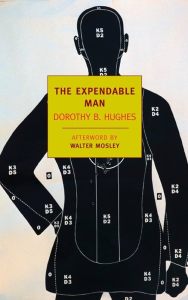
Ann Schlee’s Rhine Journey has been highlighted by many others in their ‘best of’ lists; I was very impressed by it too, as I was by Dorothy Baker’s Cassandra at the Wedding. Neither of these is exactly a feel-good read! Another book that has consistently had a lot of buzz in my reading circles is Dorothy B. Hughes’s The Expendable Man; I finally read it and yes, it is indeed excellent. I think I consider In a Lonely Place a slightly better novel (more subtle, more artful) but The Expendable Man is so clever and does such important things within its noir-ish form that I couldn’t resist adding it to the reading list for my Mystery & Detective Fiction class this coming term.  I was not so enthralled by Claudia Piñeiro’s Time of the Flies, which was the least intelligible and satisfying of her novels for me so far. I got a lot out of reading and thinking about Denise Mina’s The Long Drop, but I’m still not entirely on board with true crime as a genre—although, perhaps inconsistently, I am not bothered by historical true crime, and along those lines I quite enjoyed my King’s colleague Dean Jobb’s A Gentleman and a Thief, about the jazz-age jewel thief Arthur Barry. 

In lighter reading, I loved David Nicholls’s You Are Herehe seems to be a really reliable sort of writer, one whose fiction is accessible without being hasty or flimsy. I still think often about Us, which I read well before my own separation, not because its protagonists are like my own family at all, but because it shows them grappling with changing needs, and just with change, in really perceptive but not melodramatic ways. I discovered (belatedly!) Katherine Center and found much to enjoy in her intelligent romances; I read several of Abby Jimenez’s novels and then decided I’d had enough.

My book club got on a French kick that began with Diane Johnson and took us through de Maupassant, Colette, and Dumas (fils). (I also read Zola’s La Bête Humainethe One Bright Book people made me do it! Ok, they didn’t make me, but I was inspired to read it so I could properly appreciate their episode. The novel is . . . a lot! And Sarah Turnbull’s astute and lively Almost French was an unanticipated connection between these French books and the other memoirs I read.) We chose Elizabeth von Arnim’s Vera for our last book of the year and it is another I highly recommend, especially if you read and liked Daphne du Maurier’s RebeccaVera has a lot in common with Rebecca—the whole plot, really—but the tone is quite different, darker, I would say, because the shadows in Rebecca are Gothic ones and so can be shaken off more easily than the more chillingly realistic menace von Arnim offers up.

If I had to identify a low point of my reading year, it would probably be Noémi Kiss-Deáki’s Mary and the Rabbit Dream, though I’m a bit reluctant to characterize it that way. There is so much that’s interesting about it, and its style (while off-putting to me) does have an idiosyncratic kind of freshness to it:  it doesn’t sound like any other book I’ve read, not just in 2024 but maybe ever! Was the author being innovative, taking an artistic risk in writing it this way? or is she just not a very good writer? If you read it, I’d be interested to know what you decided!

These are not all the books I read in 2024, of course, but they’re the ones that stand out when I look over my notes and posts. One other change in my book habits seems worth mentioning: I experimented quite a bit with audiobooks this year, partly because of all those extra hours I’ve found in the day, which have meant more time on things like crafts and puzzles. In the past I have not had much success with listening to books, but some of them were great. I would especially highlight Dan Stevens’s wonderful reading of Agatha Christie’s And Then There Were None; Naomi Klein’s reading of her own (exceptionally thought-provoking) Doppelganger, which is really worth reading (or listening to) as we head into the second (sigh) Trump presidency; and David Grann’s The Wager, read by Dion Graham, which kept me spellbound.

My Year in Writing

I’m a bit disappointed in how much (or, I should say, how little) writing I got done in 2024. It was my slowest year yet for reviews at the TLS, with just two, of Perry’s Enlightenment and, “in brief,” Sara Maitland’s True North. (I am working now on a review of Anne Tyler’s Three Days in June, so they haven’t quite forgotten me!) I reviewed three novels for Quill and Quire in 2024: Elaine McCluskey’s The Gift Child, Jenny Haysom’s Keep, and Ayelet Tsabari’s Songs for the Brokenhearted. And I did my second review for the Literary Review of Canada, this time of Tammy Armstrong’s Pearly  Everlasting, about a girl whose brother is a bear. (What is it with CanLit and bears?) I worked quite a bit on my “project” (I hate that word, but what else is there?) on Woolf’s The Years as a failed ‘novel of purpose’; I kept myself motivated by putting myself on the list for our department’s Speaker Series. I think the presentation went fine. As always, the tough questions I anticipated and fretted about greatly beforehand were not the ones asked, and in fact I really enjoyed the Q&A.

As we head into 2025, I am thinking about how to “level up” a bit in my writing. I do really like doing reviews that have a limited scope, which I find creatively and intellectually challenging (what can I do in just 700 words?), and also comfortable, in their specificity. But I used to sometimes publish more essayistic pieces too, and I want to give some thought to what else I might do along those lines. I also don’t want all that Woolf work to stop with the presentation version, but at the same time I find it very hard to feel motivated to turn it into an academic article, even though that was my initial plan. I think I need to crack it open and reconsider it as something that might (might!) work for the kind of venue I used to dream of getting into—and did, unsuccessfully, submit to a couple of times—in the past, something like the Hudson Review, maybe. A writer’s reach must exceed her grasp, right?

My previous, somewhat paradoxical, experience has been that writing more means I write more—when I kept up my blog more faithfully, for example, I published a lot more other writing as well. Of course, a lot of other things were different in the past, and I don’t know if 2025 will be the year I get my momentum back. I hope I at least try, because I don’t feel altogether satisfied with my recent output, which is not about “productivity” but more about the kinds of things we were talking about in a more tangible context in the comments on my previous post: what matters, what lasts, what remains.

And on that note—is it sobering or uplifting, aspirational or anxious? all of the above!—I think that’s a wrap on this year-end review. It’s hard to imagine that 2025 can be even a fraction as tumultuous as any of the past three years, personally at any rate (politically, on both sides of the border, it seems likely to be a big old mess). Whatever happens, at least there will always be books, right?

Novel Readings 2024: Part I

In my year-end post last year I remarked that the final months of 2023 had been “frantic.” The reason, as I’ve since explained, is that near the end of that year my husband and I separated, one consequence of which was that we both moved out of the house we’d lived in for over 20 years—which in turn meant I dove headlong into “downsizing,” some of it as rapidly as we could manage together before he moved to North Carolina last December, and the rest on my own, before I moved into my new apartment in February. Yes, that’s a short timeline for changes this big!

As a result of all of this, in 2024 my relationship to books and reading was unusual in a couple of ways. In the first place, as I moved into a 1-bedroom apartment, I had to confront a significant reduction in shelf and storage space, which meant, one way or another, getting rid of a lot of books. I know many folks online who are really dedicated book collectors—by which I don’t at all mean that they don’t also read their books, but they have extensive and cherished libraries. I have never had quite that relationship with books, more for practical reasons than principled ones, but I have always loved owning books and feel, as I know so many of us do, that my book shelves are in some ways an expression of my self. I also have many books that mean a lot to me for personal reasons, ones inscribed by my mother or my grandmother, for example, or ones that I picked out on my travels, or ones that I have reread so often I can’t imagine who I would be without them. Still, I always tried to be reasonable about how much room I actually had on my shelves (no teetering stacks on the floor for me!), and I regularly rounded up a bag or two to donate to the big book sale that raises money for the symphony, or some nice volumes to trade in at Agricola Street Books, both of which are great ways to maintain what I like to think of as the circle of (bookish) life.

Still, this kind of incidental and largely voluntary pruning is nothing compared to the process I went through before I moved, which was often both logistically and emotionally overwhelming, especially at first. It got a lot easier as it went along, and in some ways it even started to feel good as the burden (literal and metaphorical) lifted. It involved admitting that there were books on my shelves I was never going to read again, and some I was never going to read at all, however good they might actually be (sorry, Europe Central, which took up the space of 2 or 3 other books for over a decade). It involved confronting the truth about dictionaries, desk encyclopedias, the Mayo Clinic Family Health Book, and the rest of our fine “reference” collection: nobody wants them anymore, including me, so their covers came off and their pages went into recycling. It meant carting bags of aging paperback mysteries to the Salvation Army and around 15 boxes of good quality fiction and non-fiction to the book sale depot. Hardest of all, it meant facing Owen’s books, which was particularly poignant for me because so many of them are ones I picked out for him over the years, for birthdays and Christmases. Most of his chess books went to the Dalhousie Chess Club, where he was a regular during his student years, though I kept Bobby Fischer Teaches Chess, his first and favorite book about the game. I kept all of his beloved Calvin and Hobbes collection, and many others that speak to me of the child he was and the young man he became—more than I needed to, maybe, but unlike my own books, his can never be replaced. 

In the end I brought around 22 boxes of books with me to my apartment. I still sometimes look for a title only to realize I let it go, but mostly I think I did well: I cleared a lot of space mentally as well as physically. And in fact I cleared enough shelf space that I have room now for more books! I find pruning easier after all of this: my attachment to (most) books is just lighter. Sometimes I even put a book in the ‘donate’ pile as soon as I finish it! I don’t think of those purchases as wasted money. I want bookstores to thrive and authors to make money, after all. My wise sister pointed out once that a paperback is about the same price as a bottle of wine, and we don’t think we’ve wasted that money just because we can drink the bottle up in a single dinner party! And I still keep plenty: any that really hit hard, any that aren’t readily available, any that come with extra sentimental attachments, any that I think I’ll read again, or that I might want to write about.

So I started 2024 by clearing out a lot of books. The other change since the separation has been to my reading time. I don’t quite understand why, but there seem to be a lot more hours in the day now that I live alone! I have wasted an awful lot of them watching TV, and many of them idly scrolling online, and plenty also just moping or mourning. I think (though this may be just making excuses) that I should not be too hard on myself about these bad habits, as the past few years have been pretty tough and we are all entitled to our coping strategies. I make intermittent resolutions to do better, to use my time better; I have made some of these for 2025. (Yes, blogging regularly again is one of them. We’ll see.) However! I have had more time for reading, and I have sometimes taken advantage of it. I have especially enjoyed taking time to read in the mornings. For many years—around two decades, really—mornings were my least favorite time of the day, what with all the kid stuff (breakfasts, lunches, getting dressed, remembering backpacks and permission slips and other forms, trying to get out the door on time) on top of bracing for my own work days, with the non-trivial (for me) anxiety of driving in winter weather adding a nice additional layer of stress from November through April. Things were simpler once the kids were older then out of the house, but I never felt like it was a good time for relaxing: I still had to get off to work, for one thing. Now, between habitually waking up early and living easy walking distance to work, even on weekdays I can afford to get in some peaceful reading while I have my tea and toast. We used to end most days in front of the TV; I still do that, especially on days when I’ve read a lot for work, but other days I can settle into my reading chair, put on some quiet music, and there’s nothing and nobody to interrupt me.

The combination of chaos and quiet time over this time of significant personal change has meant that overall 2024 was neither a particularly good or a particularly bad year for reading. I don’t think that in total I read a lot more books than usual, though I have never kept count, so I can’t be sure. I read a lot in some months and hardly anything in others. Since this post (which I realize is probably not of much interest—sorry!—I’m trying to recover my willingness to just sit down and write what’s on my  mind) has already gone on long enough, I’ll do my usual year-end review of highlights and low points in my next one.