 Solar is everything I expected of a new novel by Ian McEwan, who may be the smartest contemporary writer I read: clever, timely, acerbic, well-written, intensely readable. The problem is that those expectations are not, themselves, at a peak, by which I mean I had no expectation that a new novel by Ian McEwan would be humane, beautiful, or morally weighty. I believe Atonement to be all of those things; I believe Saturday to be all of those things at various points, though not as unequivocally so as Atonement. But after reading Atonement and Saturday I read some of McEwan’s other novels, and was alienated by what felt to me like intellect and skill divorced from humanity. Enduring Love fascinated but repelled me; A Child in Time puzzled me. Amsterdam left me cold, notwithstanding its Booker Prize, and then so did On Chesil Beach. Of course it is not a universal prescription for excellence that a novel satisfy both heart and head, but that’s what I want, that’s what I think takes a novel from good to great, and Solar seems quite content to leave my heart untouched. I think this is a missed opportunity for a novelist with McEwan’s gifts. Why not set against the shabby opportunism of the protagonist (who is both brilliantly drawn and wholly unsympathetic) either some idealism not undermined by the general attitude of cynicism that permeates the novel–even if only to show it up as ineffectual against the absurd realities of political and scientific institutions–or some unembodied but evocative commitment to the beauties of the planet Michael Beard only pretends to cherish? Bleak House is an unforgettable critique of the stupidities of a system that serves, at most, only those who constitute it, because we see beyond it, unrealized, an idea of human flourishing, of love and justice, worth yearning for. Thus we find the yammering of innumerable lawyers both comic and tragic. Where is Miss Flite, or Lady Dedlock, never mind Jo the crossing sweeper, in McEwan’s universe?
But then, McEwan is not a reformer; he has not taken it upon himself to be–or to target–the conscience of a nation. Is he, in fact, a skeptic about global warming? I’m sure I could find out if I read around in the innumerable interviews he has given since the novel’s publication, but then I’m not sure how relevant that question is, really, to Solar, which I think is less about climate change or solar power in particular than it is about the fallibility and foibles of a particular scientist and, more generally, the peculiarities and contexts of scientific research, which is, inevitably, both constituted and compromised by structures and inividuals bound up in many interests besides whatever lofty ones they claim to serve. Perhaps it would be more accurate to say that his skepticism is directed at our faith in science (and scientists). Both the much-cited “boot room” and Beard’s increasingly chaotic and filthy basement flat undermine our confidence that these are people who can clean up a whole planet:
Four days ago the room had started out in orderly condition, with all gear hanging on or stored below the numbered pegs. Finate resources, equally shared, in the golden age of not so long ago. Now it was a ruin. . . . How were they to save the earth — assuming it needed saving, which he doubted — when it was so much larger than the boot room?
OK, we get it (and in fact I think we would have got it even without Beard’s rather heavy-handed analogy). But we don’t get anything much beyond Beard’s perspective, and while that kind of intense ‘focalizing’ is very effective for some things (including, of course, characterization, but also, here, some comic effects) I think enough is potentially at stake, given the range of interests the novel has–science, love, marriage, the uncertainties of both guilt and innocence, even, to take the broadest possible perspective, the value (or not) of the survival of human life on earth–to contextualize Beard himself better. The open ending, similarly, felt to me like the wrong technical choice. It’s not necessarily shallow artifice to resolve the plot: if you have raised substantive questions, your conclusion is your chance to proffer answers to them. Do the solar panels work or not? Is Lordsburg illuminated? The answer to that question would, in turn, illuminate much more for us, such as whether the cynicism so much on display stems from frustrated idealism or an uncompromising realism (if it weren’t for Atonement, I’d assume the latter). I thought there was an element of cowardice in the novel’s ending as it did, a refusal to commit either way, to override Beard’s failings and force us to accept that progress may come from sources we despise, or to endorse, once and for all, the philosophy of the boot room: we came, we saw, we made a mess we couldn’t fix.
I also found the book’s architecture puzzling. Its three parts make good enough sense in a way, organized around key episodes in Beard’s development (if that’s even the right word). But I don’t understand why we get the back-story on Beard’s childhood and first marriage at the beginning of Part Three: it’s a bit late for introductions by then, after all, and in fact thinking back after that stumble it seemed to me that in each section there was some awkward coverage of information necessary to get us caught up with Beard: who he’s involved with, what project he’s on, and so forth. I wonder what kind of novel would have resulted from a more conventional chronological approach. A longer one, certainly–but might it also have been a richer one, if it had allowed itself to take on the shape of a scientific Bildungsroman? The only growth we witness is in Beard’s girth: does the episodic structure of the novel reflect a rejection of or an avoidance of the relationship between individual growth and historical, social, or moral change? Perhaps McEwan believes people in general don’t learn or change much over time (but, again, we have Atonement as a counter-example). Beard’s stunted self makes for some pretty funny bits (though the scene with the ‘crisps’ is very good, my own favorite is probably the bit on the snowmobile when he believes his penis has not just frozen, but fallen off and “nestl[ed] under the crook of his knee”), but it’s a humor untouched with either love or horror: we laugh at Beard but are never brought into human fellowship with him. Beard himself, of course, is incapable of such fellowship, but I think McEwan should not have let his character’s limits limit his novel.
(cross-posted to The Valve)

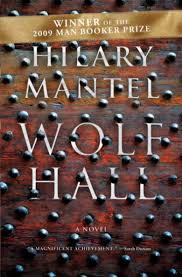
 George Eliot considered the writing of historical fiction “a task which can only be justified by the rarest concurrence of acquirement with genius,” requiring “a form of imaginative power [which] must always be among the very rarest, because it demands as much accurate and minute knowledge as creative vigour.” Novels of “the modern antique school have a ponderous, a leaden kind of fatuity,” she complained, “under which we groan.” The extraordinary difficulty of the genre is testified to by her own attempt “to reanimate the past” in Romola, the only one of her novels set back more than a couple of generations. She began writing Romola as a young woman and ended it an old one, she said herself, and having worked through the novel recently in my graduate seminar, I know that the effort it demands can make it feel as if it is having the same effect on its readers. To be sure, Romola does have its thrilling moments, and it certainly demonstrates both “accurate and minute knowledge” and “creative vigour”–just not always at the same time, or always in harmony with each other. And there’s the whole “cheese to the macaroni” moment…but I digress from my main point, which is that really good historical fiction is really hard to write, and thus really rare to read.
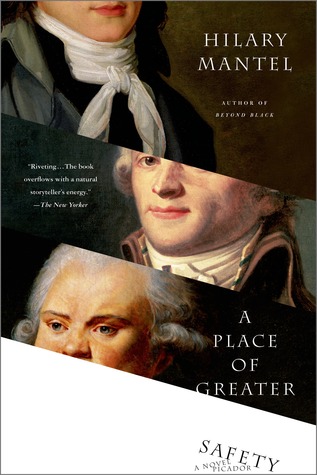
 Many of the same qualities and techniques are evident in Mantel’s earlier novel A Place of Greater Safety, particularly the lack of sentimentality and the sharpness of the writing, which is at once prolix and poignant, even uncomfortable–if, as I recently suggested, reading Ian McEwan’s prose is like getting acupuncture to your brain, I found reading A Place of Greater Safety akin to walking barefoot across a stretch of gravel towards a graveyard: you aren’t particularly enjoying the experience, but it has its own vividness and particularity, and there’s a morbid fascination in the direction you know you’re headed. (I seem to be finding my reading especially, if only metaphorically, tactile lately.) A Place of Greater Safety also, like Wolf Hall, builds momentum gradually by developing our relationship, with not just one complicated protagonist this time, but with three, the revolutionary triumverate of Georges-Jacques Danton, Camille Desmoulins, and Maximilien Robespierre. Again, there are neither heroes nor villains in this crowd, though each has his heroic, as well as his villainous, moments. (Desmoulins, beautiful, erratic, alternately effervescent and enervated, and writing, always writing, seemed to me a particularly brilliant characterization.) And just as Wolf Hall only incidentally informs its readers about the causes and contexts of the Reformation, A Place of Greater Safety eschews the potential pedagogical role of the historical novel. At the end of its 750 pages I really didn’t feel much better informed about the events or even the political and philosophical stakes of the French Revolution than I was already. Here again, Mantel adopts a slantwise approach: not altogether personal, not just the ‘human story’ of the men and women who lived it, but not abstract, theoretical, or fully contextualized either. Here’s a rare but characteristic ‘explanatory’ passage, terse and ominously proleptic:
 It’s tribute to Mantel’s peculiar gifts and strategies as a storyteller that she assembles an even less attractive crew here than in Wolf Hall and yet what matters is not how appealing they are but how compelling they are, and how intensely themselves, so that by the final chapter, as the Revolution devours its children, I didn’t care who they were, really, only that they were going to die, after my having known them for so long. Mantel manages their end (known from the novel’s beginning because, after all, it is history) without any of the tumbril sentimentality the inevitable Dickens comparisons on the jacket blurb might lead us to anticipate. None of the characters comes across as heroic or noble, but they have such great vitality (even Robespierre, with his tedious incorruptibility), that their deaths felt like great losses–losses, quite simply, of life, of the energy and lust for life, for words, and for action, that characterized them all. Again, a sample of her terse, epigrammatic style:

