Open Letters in October

The new issue of Open Letters Monthly is up and it is full of exciting stuff. First of all, October is the month for the annual Bestseller feature; this month the team takes on the NYT nonfiction bestsellers, and the results are not always pretty. Tuc MacFarland, for instance, is understandably discouraged by the #1 title, Sh*t My Dad Says, which he fears “could give hope to an entire San Fernando Valley of couch-dwelling stoners.” Greg Waldmann is similarly appalled at #2, The Obama Diaries, “a stupendously moronic and transparently racist satire,” and Rita Consalvos thinks # 5, Kendra Wilkinson’s Sliding Into Home, “may be the closest we ever get to a book written by an actual bunny, a petty, petted, fluffy, brainless, ruthlessly self-absorbed gnawing creature accustomed to being kept on display [and] used for pleasure.” There are bright spots, however, including #10, Rebecca Skloot’s The Immortal Life of Henrietta Lacks, which Maureen Thorson concludes “makes a poisonous tree a little less poisonous,” and #8, S. C. Gwynne’s Empire of the Summer Moon, described by Steve Donoghue as “both a superb work of history and a fast-paced, gripping narrative on par with the some of the smartest historical fiction on the market.”

The rest of the issue ranges as broadly as usual. Joanna Scutts writes about “The Daringly Sensible Marjorie Hillis,” author of such useful titles as Live Alone and Like It. Sarah Emsley reviews the new Annotated Pride and Prejudice, “a beautifully produced and informative guide to reading Austen’s brilliant and beloved novel in its historical context.” Anne Fernald reviews Adam Nicolson’s Sissinghurst: A Castle’s Unfinished History, a “story of land not merely owned but loved and understood.” Bartolomeo Piccolomini reports on a new biography of Machiavelli, and David Michael examines a history of English anti-Semitism. Ingrid Norton continues the series ‘A Year with Short Novels’ with Elizabeth Smart’s By Grand Central Station I Sat Down and Wept, while Irma Heldman adds to her ‘It’s a Mystery’ series with a look at S. J. Rozan’s On the Line. Elisa Gabbert appeals to our senses and our memories this time in her monthly perfume column, while Abigail Deutsch engages with Anne Carson’s form-defying Nox. I have an essay there as well, a reconsideration of one of my long-time favorites, Gone with the Wind. This is my first attempt to do book writing that’s also personal writing–my first attempt outside this blog, that is–so I’m a little apprehensive but also excited about it. And that’s not all that’s in the issue, so head on over and check it out for yourself.

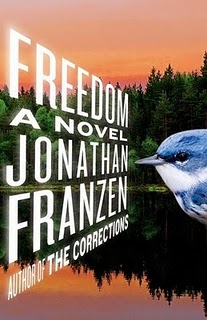
Reading Franzen’s Freedom

I’m not, actually, not on principle or anything but just because I have literally stacks of other books I want to read slightly more. But the interesting reports on it that keep coming  in from the bloggers I follow are nudging me closer to buying it, not because they all love it but because it does seem to give us plenty to talk and think about. Also, after a while it’s like being a wallflower at the dance or something!

At Like Fire, Lisa Peet judges the book good but “overweight,”

The writing is observant and intelligent about how we live and how we mess that up: parenting gone awry in small, shattering ways; political tradeoffs that make sense until they suddenly don’t; lovers and spouses caught looking over each other’s shoulders at something else in the distance. Freedom is a very moral story. Still, the novel felt like getting into a slightly drunken dinner-party political discussion with a left-leaning Libertarian—each separate argument holds, but when taken together they add up to something you wish you’d argued against more cogently when you wake up the next morning. Franzen has a lot to say, and he says it well. But although the parts all work—I couldn’t point my finger at any set piece in particular that dragged the book down—that doesn’t mean they all needed to be there.

She concludes her judicious review in the reasonable tone that seems to have eluded many commentators:

The hype surrounding Franzen will eventually die down, and what we’ll be left with is the book we deserve: sprawling and personal and deeply entrenched in its present. Whether it will endure the tests of time is mostly irrelevant—Freedom, as the title asserts, is a fun ride while it lasts.

Jeanne at Necromancy Never Pays began admiring Franzen’s writing but has some particular complaints from (as she somewhat wryly notes) a female perspective on a male writer who notoriously did not want his previous book “to get a reputation as a woman’s novel”:

Franzen is very good at presenting character. Even his female character, Patty, thinks in a way that I have to admit seems genuine. In her forties, she finally “acknowledged realities about her physical appearance which she’d been ignoring in her fantasy world…she humbled herself.” Having just done this myself, I can’t say it doesn’t ring true.

But it really rubs me the wrong way (ahem) to read that a woman’s intelligence lies in her sexual organs: “Connie had a wry, compact intelligence, a firm little clitoris of discernment and sensitivity….”

At Tales from the Reading Room, litlove is part way through and finding herself intrigued by the novel’s “emotional coldness”:

When I think of the books I’ve read recently – Sarah Water’s The Night Watch, which will rip the beating heart from your body without the tiniest shred of sentimentality involved, Austen’s Emma with its pervasive, profound compassion, Orwell’s 1984 with its nightmarish darkness, it becomes all the clearer how far away Franzen stays from the murky depths and the scintillating highs of his characters’ experience. Take for instance the character of Patty Berglund, whose autobiographical account, written as I mentioned in a gender-neutral third person, makes up a fair chunk of the narrative. Something terrible happens to Patty in her adolescence, compounding a problematic childhood as the relatively stupid, sporty one in a family of eccentric creative types. This is the toxic root to her behavioural problems, but Franzen doesn’t want to get involved in what it really means for a woman to suffer terrifically low self-esteem. The emotional punch of anxiety, anguish, passion, possessiveness, these are irrelevant to the narrator. Patty’s story is flattened out, the incident forgotten, her ‘crimes’ no worse than any woman might commit in a dissatisfactory marriage and yet she is viewed with a jaundiced eye. Patty’s a messy person, but who isn’t? Without a vital emotional aura surrounding Patty’s story, it’s hard to know what to make of it, whether we should condemn or sympathise. There are two possibilities here. One is that Franzen just can’t write women and I fear that banal explanation may be justified. . . .

The other possibility is more interesting. . .

At zunguzungu, Aaron Bady, also not quite finished, is finding the book “superbly written but sort of wrong“:

I’m particularly drawn to readings of novels and movies as exploring the breakdowns of their own interpretive matrix, and it may be that the novel is, in this way, about the failures of realism. What I do know is that, as a novel, it tells me very little that strikes me as true in the way it describes MTR activists, even as it makes quite ambitious claims to generic realism. Which is the problem: how does a “realist” novel address the fact that it might be wrong? In that vein, in fact, I can’t help but notice all the little fuck-ups I’m coming across; the character who catches shingles from someone with chicken pox, for example, was written by an author who doesn’t know what shingles is (you catch chicken pox from someone with chicken pox; shingles you catch from yourself).

At Blographia Literaria, Andrew Seal (who has finished the book), takes the comparisons between Freedom and War and Peace as his starting point:

I don’t know whether Franzen means for this allusion to War and Peace to be a red herring of sorts or not, the kind of thing which is designed to catch a critic who is on a hunt for a hook to bite down on, for something portentous to compare the year’s biggest novel to. Franzen does preface Patty’s later recounting of Natasha’s story with the comment, “And she became a better reader. At first in desperate escapism, later in search of help.” Patty’s first connection to War and Peace is escapist; she uses it to justify sleeping with the Andrei character, Richard, literally making life resemble art. Later, Patty becomes a better reader by accepting that the analogy between Tolstoy and her life is imperfect and not to be lived through, just to be consulted for truth or “help.”

This, in a nutshell, is in fact Franzen’s own ethics of reading, at least as they are articulated in the Harper’s essay: Franzen’s own autobiographic narrative there is a similar story of recognizing that the imperfect fit between life and art is the real source of its power—just as long as we recognize that art is not meant to make a perfect fit, is not meant to act directly as a model, that we’re not supposed to act like characters. Understanding characters helps us understand ourselves, yes, but we err when that understanding is of ourselves-as-characters. And the fact that War and Peace is in fact only mentioned five times in the novel—and four of those instances within twenty pages—suggests that this episode similarly is not meant to be so fundamental to our understanding of the novel: not a code or a key but a symptom, a single instance of a leitmotiv at most. To do more with War and Peace or Tolstoy is merely to fetishize allusion for its own sake—exactly the type of conflation of art and life that Franzen is (at least in my reading) trying to guard against.

He moves on to propose that “there is, perhaps, something we can recover from this comparison between Franzen and Tolstoy”–but you’ll have to read his post yourself to find out!

At American Fiction Notes, Mark Athitakis excerpts from his Chicago Sun-Times review to highlight why he things “the novel doesn’t quite come off”:

Throughout the novel are glimpses of people who are more coddled by art than inspired by it. A rock club is full of fans of a “gentler and more respectful way of being . . . more in harmony with consuming.” When Richard gives an interview saying rock “never had any subversive edge,” the provocation is subsumed into blogosphere noise. But writing can hurt, Franzen insists, and art can reshape us.

“Richard” is Richard Katz, a musician friend of the couple at the center of the novel, and something of a mouthpiece for the frustration/contempt/weltschmerz Franzen feels toward the way culture is made and consumed in America. There’s no question that Franzen is a firm believer in the power of storytelling—the whole novel is a study in how the stories we tell one another or ourselves can have a huge impact, sometimes literally wound us. Yet in nearly every scene in which Richard arrives, Franzen appears to be wringing his hands over the usefulness of pursuing art in a society that’s dead to it. It’s a valuable question, but Franzen pursues it awkwardly, and doesn’t resolve it in a satisfying way.

Not a blog, of course, but at the Wall Street Journal another writer I follow attentively, Open Letters Monthly‘s own Sam Sacks, finds Miltonic echoes in Franzen’s “situat[ing] hell wherever there is least duty and most license–”

in this case, in leafy Midwestern suburbs and East Coast townhouses. Hell’s denizens are the members of white middle-class nuclear families, the very people, one supposes, who compose Mr. Franzen’s readership. Like “The Corrections” (2001) before it, “Freedom” is an allegorical novel smuggled into the mainstream it rails against by seeming to be a work of highly polished narrative realism.

And, last but certainly not least, at stevereads Steve Donoghue is having none of it, taking Sam Tanenhaus to task for his “deeply, blandly dishonest” review of Freedom in the New York Times Book Review:

Fundamentally, this is the way a reviewer writes when he doesn’t believe what he’s writing. And in this case it’s appropriate enough, because in Freedom Franzen has written a nearly 600-page novel in which he doesn’t believe a single godforsaken word. Every particle of the book’s grotesquely self-indulgent length is pure artifice, pure hypocrisy, pure lie. Franzen started out with the idea of mocking certain things – most especially the specific kind of mindlessly opinionated and entitled suburbanites with whom he spends his every waking minute and whose ranks he himself long ago joined, if indeed he was ever outside them to begin with – but he found he actually liked them instead, viewed them as genuine civilizing forces (just for clarification: you and I, no matter who we are? We’re the ones who need civilizing). But rather than abandon the envisioned evisceration, he thought to turn it elaborately, I’m-smarter-than-you-can-even-see faux-satirical, pretending to hate the thing he loves in order to torture it a little. Call it assaultive fiction. And even that quasi-plan fell apart completely, probably after endless nights spent drinking and endless mid-mornings spent speed-writing to make page counts. What’s left – what gets published to unprecedented fanfare this week and collects a National Book Award (at least) in a few months – is nothing at all, a rote exercise in verbiage.

I sympathize with Jessa Crispin‘s annoyance about the implicit pressure to read what everyone else is reading:

The idea that as a literary person there are a certain set of books you must read because they are important parts of the literary conversation is constantly implied, yet quite ridiculous. Once you get done with the Musts — the Franzens, Mitchells, Vollmanns, Roths, Shteyngarts — and then get through the Booker long list, and the same half-dozen memoirs everyone else is reading this year (crack addiction and face blindness seem incredibly important this year), you have time for maybe two quirky choices, if you are a hardcore reader. Or a critic. And then congratulations, you have had the same conversations as everyone else in the literary world.

But sometimes, if the right people are talking, it’s a conversation you want to be part of. Still, I’ll probably wait for the paperback version. I’m in no real hurry: the book will be good or it won’t, whether I read it sooner or later, and in the meantime, I’ve got L. P. Hartley’s The Go-Between on my nightstand, a tempting pile of Virago classics on my desk, Elizabeth Hardwick’s A View of My Own by my reading chair, and I’m starting Gaudy Night with my class next week. Gaudy Night: now there is a book you must read–why? Because I love it, that’s why.

Update: Ron Hogan posted about Freedom last night too, at Beatrice. He focuses on a couple of prominent reviews in the big mags, specifically Ruth Franklin’s in the New Republic and B. R. Myer’s in the Atlantic, and on the possibility that there’s a “liberal backlash” against the novel:

The headline promised to consider the “liberal backlash” against Freedom, because it struck me that the two harshest reviews of the novel so far have come from The Atlantic and The New Republic, with the latter’s Leon Wieseltier going out of his way to offer a justification for brutal criticism (”I pride myself on this negativism… Anger at the false and the fake… is an admirable anger, because it is the heat of a cause, and our causes are the spurs of our culture”). Now, I’ve got my opinions about that line of logic, but that’s a bigger subject for another day… For now, I’m just wondering if maybe, in the same way Franzen’s prose is just “literary” enough to dazzle many readers/critics with its technical polish, his themes are just liberal enough that readers/critics of the centrist-left persuasion will see him as delivering an insightful critique, perhaps even bordering on the progressive—and, since he doesn’t excuse the flaws of his liberal-seeming characters, nor does he refrain from poking fun at things like environmentalism or immature critiques of consumer culture, right-centrists can also find plenty to appreciate. Which may leave readers/critics who consider themselves to be much more left of center with a desire to re-affirm their position by pointing out the shabbiness of Franzen’s political satire… and if they can hook that up to an aesthetic attack, all the better.

His piece made me reflect on why the mainstream coverage of Freedom did less to engage my own interest in the novel, as a reader, than the blog posts I’ve rounded up here. My tentative conclusion is that the big reviews feel the need to pronounce on the novel, while bloggers–though they make some pronouncements–have more modest goals. They’re thinking about it and talking about their thinking; they’re OK with ambivalence, with not taking sides or being definitive. That leaves room for me, in their conversation, whereas Franklin or Myers really don’t care what I think at all (not just literally, but because the form they’r working in, the ‘official’ review, is just more closed). I like a review that takes a strong stand. Sometimes I write such pieces myself! But in this case the discussion seemed offputtingly extreme until I turned my attention to a different crowd.

This Week in My Classes: Nancy Drew and Tennyson

That’s perhaps the oddest couple I’ve ever put together in the title of a post! Yet both in their own wildly disparate ways provided plenty of material for my Monday classes.

I was nervous heading into our first session on Nancy Drew in Women and Detective Fiction that The Secret of the Old Clock would not bear up well under close examination. Luckily, we didn’t head into it cold but have spent a couple of weeks already setting up some of the major themes and tropes we’ll be following as we move along through the course, from the relationship of women to the law and authority to ways women detectives and their creators manipulate conventional expectations about gender to set up their cases and provide ingenious solutions–Miss Marple, for instance, sometimes finds it advantageous to be underestimated, while her expertise in domestic ‘trivia’ repeatedly turns out to be as useful as her insights into human nature.

We started off our discussion today by reading the first two pages of Chapter 1 aloud and then going over all the information we get about Nancy from them. This exercise, which I settled on as my opening gambit partly to be sure we did focus on details and not skip too merrily along, proved more fruitful than I’d hoped, actually. We talked about her appearance, her mobility (specifically her car), her relationship to her “Dad” (who relies on her “intuition”), her quick response to a crisis, her apparent expertise as a paramedic (is there any situation she can’t handle?), her rapid adoption into the homes of strangers who immediately become her intimate friends and confidantes. We moved on to discuss the case: I usually suggest looking at the central case in a detective novel as symptomatic of what needs to be fixed in the imagined world we’re in, and then the investigation helps us see what qualities or elements are needed to resolve it. In this case, right away we are focused on problems of inheritance and the damage done by depriving good people (in this novel, particularly nice women) of the resources they need to sustain their homes and families. We talked about Nancy’s strengths–her father’s good connections, her own unexplained freedom from other duties or obligations (in the first version of the novel, she was only sixteen, so at least at her revised age of eighteen there’s no expectation that she’d be in school), her resolute niceness.

In preparation for this part of the course I read around in some of the critical literature on the Nancy Drew series; among the most interesting explanations I read of her strong and lasting appeal is that she exists in a paradoxical place, in between childhood and adulthood, enjoying the perks of both but not the drawbacks, just as she both is and is not a rebel against conventional expectations. To me she seems like a child’s idea of what it is like to be grown up, something I see in my daughter’s pretend play in which she mimics things like going to work or having children. In the imagined version, it’s all about being the one who is in control, who copes, who solves problems–with no suggestion that the control may be hard won, or temporary, that the coping sometimes takes more effort than collapsing would, that some problems are not, after all, within our power to fix. Having begun thinking through the ways in which Nancy is exemplary and inspiring, we also considered the limits on her “universal” appeal. She’s not necessarily someone every girl can “relate” to, representing as she does quite a particular ideal of the All-American girl. I think it was a good discussion overall. One additional benefit of bringing Nancy Drew into the syllabus seems to have been that she has tempted a few students to speak up who have been pretty quiet so far! I hope they keep up this momentum.

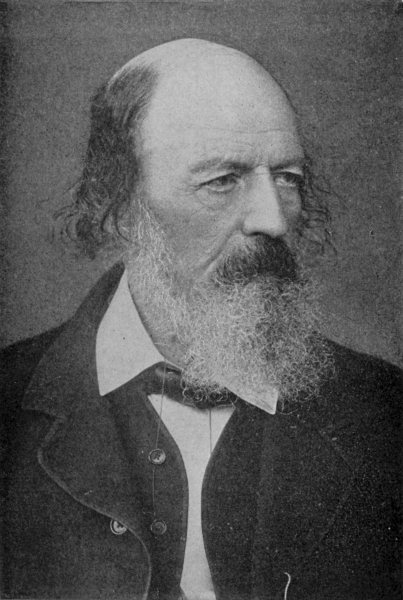
In British Literature Since 1800 it was time for an introduction to the Victorian age (yes, we’re done with the Romantics already–shocking! but in about 10 weeks we have to have made it to Ian McEwan, so onward we go, relentlessly). Just as Wordsworth does nicely for setting up Romanticism, so Tennyson–who takes up his mantle as Poet Laureate, after all–does fine as our lead-in to Victorianism. I proferred some generalizations about things like an Age of Transition, faith and doubt, science and nature, the importance of the novel, and the role of sage writing. That was fine, I think, but what really got me worked up today was trying to sell them on the importance of prosody. There’s the sort of technical issue that they are being trained to write analytically about literature and that’s a hard thing to do about poetry without the vocabulary and a sense of what form is and how meter works. But more important, because it motivates that kind of analysis, is just grasping how fundamental rhythm is to our experience of poetry–to the sound and feeling of it. We spent last Friday’s tutorial on this and it turned out (again!) that almost none of them had any idea how to scan a line, or even that there was such an exercise as scanning a line. Then, in my group at least (and yes, NYT, there are ‘actual’ professors who lead tutorials–and mark papers, too!) they tried to get the hang of it and mostly got confused–so much so that I overhead one group arguing strenuously about how to pronounce ‘hamburger’ (I start them out with ordinary words and just ask them to mark in the stressed and unstressed syllables). I’m pretty sure not one of them would go into Wendy’s and ask for a hamBURger, or a hamburGER. Anyway, I knew they were (are) going to need more than that one session, but I also can’t take a great deal of lecture time on it, and besides, it’s the sort of thing you have to learn by actually doing. So today was all about dramatizing the sound and rhythm and demonstrating how great poets work with and against their basic meter to make things exciting. I had collected a bunch of good examples but it occured to me as I reviewed ‘The Passing of Arthur’ that I might be able to make them hear what I meant if I read this passage with all the feeling I could muster, and so that’s what I did:

Nor ever yet had Arthur fought a fight
Like this last, dim, weird battle of the west.
A deathwhite mist slept over sand and sea:
Whereof the chill, to him who breathed it, drew
Down with his blood, till all his heart was cold
With formless fear; and even on Arthur fell
Confusion, since he saw not whom he fought.
For friend and foe were shadows in the mist,
And friend slew friend not knowing whom he slew;
And some had visions out of golden youth,
And some beheld the faces of old ghosts
Look in upon the battle; and in the mist
Was many a noble deed, many a base,
And chance and craft and strength in single fights,
And ever and anon with host to host
Shocks, and the splintering spear, the hard mail hewn,
Shield-breakings, and the clash of brands, the crash
Of battleaxes on shattered helms, and shrieks
After the Christ, of those who falling down
Looked up for heaven, and only saw the mist;
And shouts of heathen and the traitor knights,
Oaths, insult, filth, and monstrous blasphemies,
Sweat, writhings, anguish, labouring of the lungs
In that close mist, and cryings for the light,
Moans of the dying, and voices of the dead.

Try reading it for yourself, as if you really, really mean it. Tennyson may be a better poet than he is a thinker, but OMG, when he’s a good poet, he’s very, very good, and I think these lines are just marvellous. There’s hardly a line in there, either, that scans as ‘straight’ iambic pentameter. Then after going over a few more simple examples, I went through a few lines of Donne’s Holy Sonnet ‘Death, be not proud’:

Death, be not proud, though some have called thee
Mighty and dreadful, for thou art not so;

and
One short sleep past, we wake eternally,
And death shall be no more; Death, thou shalt die.
I’m not a wildly outgoing person by nature, so my willingness to make a fool of myself in class amazes and amuses me sometimes. There I was striding around declaiming “For THOU ART NOT SO! Death! Thou! Shalt! Die!” and asking them “So? Who’s the boss of Death here? Who’s the boss of the meter? Who’s the boss of the sonnet form?” I’m sure they were mostly wondering “Who’s the crazy lady at the front of the room?” but if just a couple of them were thinking “OK, wow, poetry really is amazing,” then it was worth it. And really, if you can’t get excited about “Death, be not proud,” you shouldn’t be an English major in the first place.
As for the rest of the week, it’s Nancy Drew again on Wednesday in Women and Detective Fiction, with a student presentation on Friday, and in the survey class it’s Browning and then Arnold.

Bloggers and Critics: Everything new is old again

My previous post on appreciating book bloggers was in progress as the discussion unfolded on Twitter about ‘book bloggers ruining everything’ (via Ron Hogan, for one, who was watching a discussion from earlier this year between Charles McGrath and Daniel Mendelsohn* that involved a fair number of pot shots at book bloggers [see here if you want to watch it for yourself]). I’ve been thinking that one of the reasons these reductive and dismissive attitudes towards bloggers have any traction at all, and come from such otherwise very smart people, is the problem of filtering.

In blogging (as in every medium) there is good stuff (even some great stuff) and bad stuff (even some really truly terrible stuff). It is probably true, just because of the lack of inhibitions on blogging and other forms of self-publication, that the bad-to-terrible stuff  outweighs the good-to-great stuff by a larger margin than in old forms of print media. It takes patience, curiosity, time and open-mindedness to trawl the vast array of blogs (even in the subset of book blogs) looking for the good stuff. Lots of us do it, because there are real rewards for lovers of books and criticism and conversation. But it’s vanishingly unlikely that someone who gets all their links from the Big Established Sites, including their blogs, will find most of the sites we write for or read, because they all seem to read and link to exclusively other Big Established Sites. The Book Bench at the New Yorker, for instance, has its own often engaging posts, but it links around pretty much exclusively to places like the Nation, or the Guardian, or the Wall Street Journal, or PEN. These are worthy sites, of course, but anybody who’s interested in the Book Bench is probably already following them, one way or another. At most, all the Book Bench is doing is letting us know which pieces in these esteemed sources were of particular interest to them, or saving us the trouble of sorting through more than a couple of our RSS feeds for the day. The blogroll at the Book Bench has 24 links–not a bad start, but all, again, high profile already (mostly other mainstream media outlets, plus Maud Newton, Sarah Weinman, and a couple of the best-known online book sites–The Millions, The Second Pass). Again, all worthy of our attention–well, there’s one on their list I’m not sure about, actually, and why it’s there and not some of the ones I admire, I have no idea.  The Guardian has a smaller and even odder selection; at the TLS, both Peter Stothard and Mary Beard have small blogrolls too, though ones that reflect a bit more idiosyncrasy, which is nice. Still, none of these sites (or a number of other blogs associated with major papers and magazines) seem genuinely bloggish, in that there’s really no sense of the reciprocity I suggested distinguishes blogging as an especially open and generous form. The major aggregator sites (I’m thinking of Arts and Letters Daily, for instance, or Three Quarks Daily) also rarely step outside the rarified world of the ‘top’ sites. It would be refreshing, and good for the general conversation about books (which we’re all passionate about–or at least amateur book bloggers are), if these Big Established Sites would participate in the remarkable opening up of the cultural conversation that the internet has enabled.  Right now, I think  followers of the big sites are bound to feel a bit claustrophobic after a while, not to mention excluded. The exercise of looking for the good stuff among the bad would be tiring and discouraging some of the time, but acknowledging the smart, articulate blogs that are more than what Mendelsohn calls “unchecked effusions”–and doing so in a forum that already has  a little credibility in the world of old media–might help people like McGrath and Mendelsohn stop conflating form and content–or just ignoring content altogether. A good place to start would be with the handful of sites I listed.

*I admit that I was particularly disappointed at the tone of Mendelsohn’s comments (though he does acknowledge that there are some good lit blogs, and his point about chasing ‘hits’ by writing what gets attention is a fair one) because I wrote what I still consider one of my best blog posts about his remarkable book The Lost. What difference does it make that I wrote this sitting in my basement fairly late at night? (I’ll spare you the detail of whether or not I was actually in my pyjamas: the blogger’s wardrobe seems to be an issue of surprising concern to some people.) It’s either good writing and analysis or not. It’s true that I wrote it without the benefit of an editor (well, besides myself–and I’m pretty tough on myself, as I am on others), but the unmediated scrutiny of online readers is another way to test the merits of the result. In my case, I was gratified to be recognized for my work by Three Quarks Daily, where the editors named this post a finalist in their arts and literature blogging contest last year (these contests, by the way, are a great step towards the kind of sorting project I wish sites like this should do–but I don’t notice 3QD linking regularly to the winners or finalists in their regular posts).

Book Bloggers: An Appreciation

Last week was Book Blogger Appreciation Week. I wasn’t involved in it at all directly. I’m not exactly a “book blogger,” I suppose–more of a blogger who often writes about books, if there is such a distinction. I haven’t really been very bloggy lately, either: I haven’t been linking around a lot, or writing posts that respond to other people’s or that intervene in debates that are circulating around the blog world. I used to do more of that kind of thing, and I kind of miss it, as you get more of a feeling of connection if you do, in fact, make connections. But it requires more immediacy than my blogging has had for a while, partly because my writing attention has been spread a little thin recently. I do like taking the time to write longer reviews, but I worry that in a blog, that kind of thing can start to seem rather self-absorbed! And I think it’s not true that, as one fellow blogger recently suggested to me (perhaps tongue-in-cheek?), blogging is all about narcissism and craving attention. Well, OK, there has to be a little of that, even though we all probably insist both to ourselves and others that we do it for the instrinsic satisfaction. We do, but if that was all we wanted, we could just use a scribbler and a pen. But the attention we crave is that of like-minded people, people who will enter into our idiosyncratic interests and share their own, people at once curious and generous enough to come into our space. And we try to get their attention by freely offering our ideas about books, which is also a pretty generous thing to do. So in the spirit of reciprocity that I think is really fundamental to blogging, I’d like to note my appreciation for some other bloggers who write about books. I appreciate in particular that in the world of these blogs, unlike in the world of mainstream book reviewing, you don’t get overwhelmed with multiple and thus inevitably repetitious reviews of the same handful of new books. This is very much the world of publishing’s long tail. It’s a world in which books published in 1798, or 1817, or 1946, or 2007 are all equally vital. It’s a world in which there’s room for personal responses, but it’s not the taste-test world of Amazon “top” reviewers: in this world, it’s expected that you’ll think about your reactions and write about them as well as you can. This is not an exhaustive list of the blogs I follow (neither is the blogroll on the right, which reminds me–I should update that), but it’s a start on acknowledging some of the sites that consistently replenish my own stock of ideas and enthusiasms about books and blogging, as well as my TBR lists.

Wuthering Expectations: ‘Amateur Reader’ has just celebrated the third anniversary of his wonderful blog. This is the site that brought us the Scottish Literature Reading Challenge (eep! I haven’t finished The Perpetual Curate! But I did read all of The Antiquary) and Sympathetic Character Week, among many other finely themed interludes. His posts are smart, entertaining, and often unexpected in the direction they go or the insight they discover. AR manages to have fun with writers from John Galt to Elizabeth Gaskell to Thomas Carlyle (and you’ve gotta love a blog that turns up 19 posts tagged ‘Thomas Carlyle’).

Tales from the Reading Room: ‘Litlove’ is another of my go-to bloggers. The tone is more introspective than at ‘Wuthering Expectations’ but the effect is just as engaging. Each post, whether personal or bookish, is patient and nuanced. You could do a lot worse than spend an hour browsing in the Reading Room archives, where you will find thoughtful encounters with writers as diverse as Orhan Pamuk and Jeanette Winterson, Steig Larsson and Henry James. At the top of the page today is a wry (and, to me, familiar) story about disagreeing over Facebook. I have litlove (and DorothyW of ‘Of Books and Bicycles,’ below) to thank for recommending Rosy Thornton, whose gently incisive academic novel Hearts and Minds I just finished.

Necromancy Never Pays: Jeanne wins the prize for most unusual blog title! (Its provenance is explained in the sidebar, if you click on over.) In addition to reviews and reflections on recent reading, lately including Franzen’s Freedom and Temple Grandin’s Animals Make Us Human,  NNP offers regular doses of poetry (often her choices are new to me) and Trivial Pursuit for Book-Lovers (discouragingly, for a supposed professional, I almost never know the answers!).

Bookphilia: Bookphilia’s Colleen is another blogger who offers not just sharp and refreshingly personal reviews of a wide range of reading material (particular interests include Japanese, French, and 19thC British literature),  but also special features, in her case including ‘Curious Creepy,’ in which she spies (for lack of a more tactful word) on what people around her are reading, and ‘I Interview Dead People’ (including Wordsworth, just for example). Her posts on George Eliot’s Romola are not only spectacularly interesting but were also well timed to show my graduate seminar last term (a) how to work well with such difficult material and (b) how to write great blog posts that invite high-level conversation.

stevereads: Is there anything Steve doesn’t read? With his inimitable energy and enviable fluency, Steve covers  everything from the weightiest historical biography to the fluffiest Harlequin Romance with equal rigor and in equal detail. Wondering which edition of Moby Dick to read? Steve’s your man. Wondering what’s new in comics? Once again… Steve keeps tabs on the ‘Penny Press‘ (those lowly competitors of OLM!), reviews Penguins on Parade, and shares the very different beauties of National Geographic and Paul Marron. He offers his original takes on classics (Green Eggs and Ham, anyone?) and illuminates corners of the book world so obscure we can all only wonder: has he, in fact, read everything?

Of Books and Bicycles: Unlike me, DorothyW has finished The Perpetual Curate, and her write-up is as clear and inviting as her book reviews usually are. She has a knack for making me feel inadequately sporty, what with the whole cycling thing (but I run! not far, not fast, but I do run!). She also writes about teaching and about a wide range of writers, from Sara Caudwell to W. G. Sebald. Like litlove, she participates in the Slaves of Golconda reading group, which has always looked like a fun thing to do. Hmmm…do you think I would want to belong to their club if they were willing to have me as a member?

Bibliographing: Nicole at bibliographing is another blogger I count on for fresh, pithy, but thoughtful perspectives in all kinds of books. She recently weighed in on a little-noticed title by some guy named Franzen, for instance, but she’s as like to write on Melville (didn’t he also write a Great American Novel?) or Roberto Bolano. (You know, as I write up these little blurbs, I start to wonder how, with all the reading going on out there, anybody actually gets any of their real work done…)

The Little Professor: Miriam Burstein’s Little Professor blog may have been the first one I started reading, and it’s still the very best place to go for detailed write-ups of completely obscure 19th-century religious novels. If that sounds dry, well, it’s a testament to Miriam’s style and savvy that while I have never finished one of these posts with any desire at all to read the book under discussion, I have never regretted reading the post itself! She exemplifies the possibilities for academics who want to bring their expertise out into the public eye. A good example is her recent post on Roger Scruton and Newman’s Idea of a University. For something completely different, but also typical of her wit and creativity, try LP in the House.

To all these bloggers, and to everyone else on my blogroll and Google subscriptions, thank you for bringing your intelligence, humor, and passion to writing about books–for free, and for everyone. It’s much appreciated!

This Week in My Classes: Agatha Christie and a Trio of Lyrical Treats

Actually, the trio of lyrical treats identified in Dorothy Parker’s delightful “Pig’s-Eye View of Literature” are Byron and Shelley and Keats, while this week in British Literature Since 1800 we’re doing Coleridge and Shelley and Keats. But Coleridge can be lyrical too, and ‘The Rime of the Ancient Mariner’ is something of a treat, though of just what kind I’m never sure. We’re still very much in the warming-up phase in this class. Building any momentum is significantly hampered, I find, by the long course add-drop period (two weeks in which at any time new faces may appear while ones you were just starting to attach names to vanish without a trace). The system is clearly designed to make things easier for the students, who can take their sweet time sorting out their courses; the pedagogical inconvenience and paperwork generated for us as we try to keep our class lists up to date and initiate the dribble of new people into the class expectations and materials don’t seem to matter to the people in charge. Yes, this is making me cranky: I’ve just updated my class lists for about the 12th time, then had to manually add and remove students from Blackboard and PBWorks in the hopes that the newbies will show enough initiative to check out all the information provided on these sites rather than just showing up this afternoon and asking “did I miss anything?” In an entire week of classes? YES! Of course you missed something. (Yes, I know the Tom Wayman poem about this.) Anyway, it’s routine business at the start of every term, but it’s absurdly inefficient.

What they missed, if it’s English 2002 they are just joining, is our introduction to the course, first of all, in which I outline not just the schedule and requirements and so forth, but also the principles and motivations behind them and the objectives I hope they’ll meet. Next was our introduction to Romanticism, via Wordsworth, and a training session on using PBWorks. I raised the stakes a bit this year to motivate better participation in the wiki projects. Last year’s results were OK, but the weak spot was the concept of “gardening,” signing in a couple of times a week just to tweak the site and make it a little better. With the project overall worth a bit more of their final grade, I hope they’ll take this responsibility more seriously. It’s not a big time commitment, but as everyone who works online knows, a few minutes every so often can make a big difference. Last year I waited for weeks to see if someone would correct a main headline that read “Woodsworth” (someone eventually did, but not until I dropped a big hint in class about embarrassing typos). This week we continue our discussion of Romanticism but complicating and even undermining some of the generalizations I offered about it as a chronological period and, more importantly, as a literary movement. Coleridge’s preoccupations are not the same as Wordsworth’s, and Keats and Shelley are different again, from the ‘first generation’ as well as from each other. I always feel that Romantic poetry is a like Impressionist art, in that it is easy to like it in a casual sort of way: the surface features are pretty and undemanding, and the first layer of ideas is easily assimilated. But both get more interesting in context, as you get a sense of what the artists were working against and for. With Wordsworth in particular, that’s what I tried to bring out in the short time I had for him: I made a pitch for how it is possible to read “I wandered lonely as a cloud,” which is about as simple and child-like a poem as you could dream up, as revolutionary precisely in its simplicity and child-like attitude, as well as its invocation of memory and nature as balms for the troubled modern soul. OK, it’s maybe a bit of a stretch, but if they can come to see daffodils as aesthetically subversive, they are on their way to appreciating some of the ways a text achieves its significance–and to realizing that its significance will not always be obvious but will often require some thought and some research to understand.

In Women and Detective Fiction, we warmed up last week with samples from some ‘classic’ authors, to get a sense of the history and conventions of the genre to which our women writers will provide a counter-tradition (or, as I suggested today, a counter-point tradition, as the intersections are many). So we read Poe’s “The Purloined Letter,” “A Scandal in Bohemia,” and Hammett’s “The House on Turk Street.” Then on Friday we looked at a couple of early examples of women writing about crime and detection, with Susan Glaspell’s great story “A Jury of Her Peers” and Mary Wilkins Freeman’s “The Long Arm.” Both press us to consider the adequacy of conventional ideas about both crime and justice; in both cases, people’s gendered expectations interfere with solving the crime. This week it’s Agatha Christie, with a selection of Miss Marple stories, and then next week we’re on to Nancy Drew. In this class the material is quite fun and the group is highly self-selecting, so in some respects things are bound to go along smoothly. The challenge becomes making sure we take the material seriously ourselves. I’m a little worried that two classes on Miss Marple is too much: it’s tricky scheduling things so that the pace of topics is reasonable, especially when the readings aren’t especially deep or complex. (There’s a reason, as others have noted as well, that close reading tactics become dominant just when there’s a significant body of literature that is quite difficult to understand at first glance, and also why certain writers are especially ‘teachable’ using these methods–Donne, say, rather than a more literal poet like Dryden, or Hammett rather than Christie, to use a more immediately relevant example.)

Dear Genius: The Letters of Ursula Nordstrom

If you ever read a book, or were a child, or read a book to a child–if your childhood was shaped in any way by the books you read–then you should buy this book and read it immediately. It’s available at the astonishingly low price of $5.36 U.S. from Amazon. Go order it. Now! Then spend a few hours in the company of a woman who helped make you who you are, and make childhood what it is, through her passion, enthusiasm, and advocacy for children’s literature. Good Night Moon, Charlotte’s Web, Harriet the Spy…these and many, many more books were published by the Department of Books for Boys and Girls at Harper’s under the guidance of Ursula Nordstrom. Until a couple of weeks ago I had never heard her name, and now I consider her one of the best friends I have that I’ve never actually met. She actually reminds me a lot of my grandmother, also an editor, also a working woman in a man’s world, also a passionate lover of the written word, and also a firm believer that you could accomplish almost anything with a great letter, especially one bursting with conviction and affection and bristling with CAPS, dashes, and exclamation points. The combination of Nordstrom’s powerful personality and lively writing style and the interest and nostalgia of the discussions of so many now classic children’s books makes this volume an enormous treat to read. Because you are all going to rush out and get your own copies, I won’t do more here than touch on some of the many highlights. Here’s Nordstrom writing to Maurice Sendak in 1963 (Nordstrom contracted Sendak as an illustrator in 1950 when he was working at F. A. O. Schwartz setting up window displays):

Maurice, before I sent the paste-up I went through it, rereading the words, and looking at the pictures again. It is MOST MAGNIFICENT, and we’re so proud to have it on our list. When you were much younger, and had done only a couple of books, I remember I used to write you letters when the books were finished, and thank you for “another beautiful” job — or some such dopiness. Now you’re rich and famous and need no words of wonder from me. But I must send them, anyhow, when I look through Where the Wild Things Are. I think it is utterly magnificent, and the words are beautiful and meaningful, and it does just what you wanted it to do. And you did just what you wanted to do.

I’ve felt sort of down in the dumps about picture books lately, (and about those who write and illustrate and buy and review them, too, to be frank!). But this bright beautiful Monday your beautiful book is exhilarating, and it reminds me that I love creative people and love to publish books for creative children.

Her conviction that children are creative, and that they and their imaginations will flourish if only plodding adults will get out of their way, is one of her most attractive qualities–it seems even more appealing and important today, actually, because a former student told me a shocking story about the preschool teacher she’s currently working with who does not allow any fiction at all in her classroom, including, explicitly and emphatically, books with such unrealistic ingredients as talking animals. No Charlotte’s Web for them, though perhaps this anecdote in one of Nordstrom’s letters to E. B. White would help to change her mind:

I went to a convention of librarians and saw a lot of good souls there and I met a lot of teachers, too. I was really amazed and pleased to discover how many of them (teachers) know and use some of the good children’s books–especially your two. One teacher told me that she’d had a principal who didn’t care what she did with her students as long as she “got them through the Cumberland Gap by Thanksgiving.” But, she said, she was trying to stand firm and trying to use books imaginatively with her students. Or scholars, as you put it. She said she had one class of “culturally deprived” you should excuse the expression youngsters, and she was supposed to “teach them Emerson’s essay on Friendship.” She said it was a lost cause so instead she read them Charlotte’s Web which, she stated, does everything Emerson could have done……She put it better, but I thought it was a good idea and wanted to tell you about it.

We long for another E. B. White book.

She boosts and encourages and promotes and hassles and celebrates and coddles and challenges her writers, determined to get the very best out of them she possibly can–for them, and for the children. (In his introduction, editor Leonard Marcus notes that her characteristic marginal note was “N.G.E.F.Y.,” or “Not Good Enough For You”–which is indeed a brilliant and highly motivating combination of praise and criticism.) It’s endlessly engaging to read her missives to them. I found the back-and-forth about illustrations particularly fascinating; here’s a little bit from a letter to Katharine White (E. B.’s wife):

You will see that in the sample drawings for Stuart Little Mr. [Garth] Williams did one picture in different techniques. We like the more detailed technique, don’t you? He was careful about lots of small but important details. For instance, in the picture of the doctor examining Stuart, Stuart is standing up. Mr. Williams had him lying down in the first sketch but changed it because he was afraid he might look like a little dead mouse if he were lying down. (That is probably a silly detail to pass on to you, but it was somehow encouraging to us.)

Garth Williams (who also did the drawings for the Little House books) was the illustrator for Charlotte’s Web as well:

On drawing marked (1) [Nordstrom writes to EBW] Charlotte has 8 eyes, which apparently she should have. Two on the top of her head, two low on the sides of her head, two where eyes usually are, and two where Garth has indicated a nose. I think that if the nose dots were made larger (as her eyes would be) and the line he has put in for her mouth were omitted, she would be still attractive but more of a spider. I put a small piece of paper over that line of her mouth and she looked better (less like a person).

Tell me you didn’t just go get your copy (of course you have one, right?) of the illustrated Charlotte’s Web to check out Charlotte’s eyes!

My favourite mode for Nordstrom, though, is advocate. She is impatient with bumbling adults who put their limited imaginations in the way of children’s more innocent, creative, and adventurous way of looking at and experiencing the world. In 1954, she rattles off a long (in this edition, nearly five full pages) letter to a Harper’s rep who was struggling with complaints about How to Make an Earthquake by Ruth Krauss, the author of A Hole is to Dig (which Sendak illustrated). “I bleed at every pore,” she tells him, “when I read your plaintive statement to the Sales Manager, ‘I wonder if the book couldn’t stand a little editing if it isn’t too late.” It is too late, she tells him, but more importantly, it would be a huge mistake, a catastrophe, to revise the book in order to placate buyers who thought it encouraged children to be messy and disrespectful. “What does Ruth have to do to convince some of your customers that she knows something about children they don’t know?” Nordstrom wonders. “Oh hell, it all boils down to: you just can’t explain this sort of wonderful stuff to some adults, Jim”:

I saw the finished book, type and pictures, yesterday, and it is really swell. The pictures are delightful. There will be a couple of ‘activities’ that some grown-ups will object to but the book as a whole is a book of freshness, imagination, love, originality, humor, pathos, and–well, take your pick of flap-copy nouns. Just look at the last line of the How to Entertain Telephone Callers–which ends “or whatever is your talent.” Believe me, that is so close to children, so exactly right, so damn warm and perfect that any little child can’t help but feel happier at the moment when it is read to him. “Happier” isn’t the right word. I guess I mean that “or whatever is your talent” can’t help but make any child feel warm and attended to and considered. And, believe me, not many children’s books make children feel considered. No child would define it that way but you’ll know what I mean.

“Krauss books,” she admits, “will not charm those sinful adults who sift their reactions through their own messy adult maladjustments.” But rather than edit the book to please them, she stands up and fights for a book that is “pure 100% Krauss.”

kitchenPerhaps her most heroic moment is her defense of Sendak’s In the Night Kitchen, which as I’m sure all of us remember, includes among its many wonderful drawings one of “a little naked 6-year old,” as Nordstrom describes it to E. B. White. “I have had several requests,” she goes on, “for a revised edition in which the little boy is clothed or covered in some graceful way.” One librarian took it upon herself to solve this problem by painting on a diaper. “Other librarians might wish to do the same,” said a letter to the School Library Journal. Nordstrom’s statement in response to this act of  “censorship by mutilation”  is a manifesto not just for children’s books but for the whole idea of creative freedom, and for the principles of openness and access that libraries in particular ought to represent:

A private individual who owns a book is free, of course, to do with it as he pleases; he may destroy his property, or cherish it, even paint clothes on any naked figures that appear in it. But it is an altogether different matter when a librarian disfigures a book purchased with public funds–thereby editing the work of the author–and then presents this distortion to the library’s patrons.

The mutilation of Sendak’s In the Night Kitchen by certain librarians must not be allowed to have an intimidating effect on creators and publishers of books for children. We, as writers, illustrators, publishers, critics, and librarians, deeply concerned with preserving the First Amendment freedoms for everyone involved in communicating ideas, vigorously protest this exercise of censorship.

452 writers, illustrators, publishers, critics, and librarians signed the letter.

Nordstrom is just as outspoken on the challenges of being a working woman in a male-dominated environment as she is on everything else; she helped later generations of women understand themselves better by supporting works like Louise Fitzhugh’s Harriet the Spy and its sequel, The Long Secret, which included the first mention of menstruation in literature for young people:

I remember clearly the day I read the manuscript of The Long Secret and came upon the part devoted to Beth Ellen’s first menstruation. I wrote in the margin, “Thank you, Louise Fitzhugh!”, for it seemed to me it was about time that this subject, of such paramount importance to little girls of Beth Ellen’s age, was mentioned naturally and accepted in a children’s book as part of life.

Here’s a moment where her efforts certainly touched my own life:

The great Shel Silverstein told Marlo Thomas the great Marlo Thomas to look me up while she is in NY making a TV special. . . She is very caught up with Women’s Lib . . . and she has been upset by some of the ‘sexist literature’ being fed to children. She had seen a couple of particularly obnoxious books called I’m Glad I’m a Girl and I’m Glad I’m a Boy. What she wants to do is make a record for Caedmon Records (very good people) that people can play to their children, and she hoped I could find her some writers who would contribute brief stories and/or poems which will in some way counteract the sexist stuff. I showed her William’s Doll

That’s right: the resulting album was Free to Be…You and Me. (When I listened to it as a child, I never fully appreciated the track “Parents are People”–now it means a lot more to me!)

The fun just goes on and on, and my appreciation for who Nordstrom was and what she accomplished just goes up and up as I look through the volume again, but I can’t go on forever here–and you need time to read the whole thing for yourself, so I’ll end by thanking SD (again!) for another unexpectedly great reading experience.

Fall 2010 Course Outlines

In the comments to my previous post, a couple of people said they’d be interested in seeing my course outlines for this fall, so I’ve prepared short versions of them (trimmed of the boilerplate stuff about attendance policies, late papers, academic integrity, accommodations for students with disabilities and so forth). Of course, if you’re particularly keen to know what my policies are on attendance or late papers, I can explain them too. There is not one right way to design or run a course; I use readings and assignments (and policies) that have seemed to me to work well over the years, and that suit the kind of teacher and person I am. (Like parenting, teaching is an activity in which I think you can only really flourish if you are yourself in it, playing to your strengths and acknowledging and, as much as possible, guarding against your weaknesses.) That said, I also learn and borrow from colleagues on campus or online: the wiki assignment I’m using in English 2002, for example, is a version of one Jason B. Jones designed and explained at the very helpful blog ProfHacker. Questions or suggestions welcome–there’s always a next time!

English 2002 Syllabus Short Version

English 4205 Syllabus Short Version


This Week in My Classes: Let the Wild Rumpus Start!

Well, it won’t be wild today, I don’t expect, but my teaching term does begin, with the first meeting of my seminar on Women and Detective Fiction. I’ve always really enjoyed teaching this seminar in the past: it usually attracts a good group of students, the readings are varied and, I think, productively juxtaposed, and the discussion as a result tends to be lively and interesting. Plus who wouldn’t like a reason to read Gaudy Night and call it working? Today is just administrative stuff, mostly, though I’ll make a few remarks about my choice of readings and some of the themes that I expect we’ll concentrate as we go forward. Then we’ll discuss the course requirements and expectations, and then sign everyone up for question sets and seminar presentations. Looking at my incredibly detailed syllabus, I am amused to remember the one page mimeographed sheets that served this purpose when I was an undergraduate. Now, if it’s not in the syllabus, good luck insisting on it! Today, students expect a very literal and precise explanation of what they are supposed to do and how they will be evaluated for their efforts. There are some good reasons for this, including transparency (it seems only fair that they should know what they are supposed to do and how they will be evaluated for it!) but at the same time the trend towards hand-holding does rather sap the student experience of what I guess I’d consider adult expectations. I worry, too, that my detailed handouts (and Blackboard sites) sometimes backfire, in that students don’t even try to infer anything or figure anything out for themselves (looking up regulations, for instance)–and then there are the students who blithely ignore all the support materials and email or corner you with tediously repetitious questions about when things are due, what the policy is on late papers, and so forth. I no longer answer these questions, except with a smiling “You’ll find all that information and more in your syllabus.” It’s that whole teach a man to fish philosophy (imagine, then, how it peeved me to see on one of my course evaluations a year or so ago, “She’s not very helpful: whenever I asked her anything, she just said “look in the syllabus”…).

Anyway, these petty annoyances aside, I’m glad to be heading into the classroom, and I expect to post regularly about it as I have been doing since Fall 2007! I still find the expectation (mine, not anybody else’s) that I’ll keep up the series a helpful kind of discipline, and I’m still frequently surprised at what I discover I have to say about the class meetings, even if it’s only some idea about what not to do next time when I cover the same material. This term is all repeat teaching, actually, except that I always tinker a little with the reading lists from year to year. In the British Literature Since 1800 survey course, for instance, I’ve put in Gaskell’s Mary Barton instead of Great Expectations, which mixes things up a bit. Much as I love Great Expectations, brilliant as it is, and sorry as I am not to be doing any Dickens, as a result, in the course–I just couldn’t go through it one more time quite so soon! And Mary Barton, while not nearly as brilliant, is in lots of ways just as interesting and representative of important things about Victorian literature. Plus it has a boat chase. I love the boat chase. In Women and Detective Fiction I didn’t succeed in really revamping the list, but then I’ve always been mostly very happy with it. But I did eventually add in Nancy Drew. And did I mention that I get to reread Gaudy Night? To my annoyance, Death in a Tenured Position (which nicely rounds out the academic focus of Gaudy Night and An Unsuitable Job for a Woman with a more contemporary perspective on feminism and universities) went out of print right after I placed my book order, but happily our bookstore has been able to round up nearly enough copies for everyone, and if the students can show a little extra initiative, they will be able to find more themselves. I didn’t want to let this book go, not just because of the academic angle (and the importance of poetry in it, which makes another interesting link to Gaudy Night) but because I definitely wanted to talk about Carolyn Heilbrun (who has also written some of the best essays around on women and detective fiction). I could have picked a different one of her novels, of course, and next time I might have to, but I’m fond of this one–and sometimes, with so many to choose from, that’s as good a reason as any!

So, off I go to class, and then this afternoon we all ‘meet and greet’ our incoming graduate students, and then we’re well underway for the year.

Summer Reading Wrap-Up: Mitchell, Genova, Paretsky, Nordstrom

September 12 is the last day for counting books towards our goals for the public library’s summer reading club. Maddie and I were aiming for 25 each. I’m not sure I’m going to get four more titles in by Sunday, what with classes starting and all. There’s hope: I’m currently reading the latest (and I guess the last, since it’s posthumous) in Robert B. Parker’s Jesse Stone series, and Parker’s books have very few words in them. I’m also about half way through a couple of others, including Reginald Hill’s latest and Isabel Coleman’s Paradise Beneath Her Feet. Actually, I suppose there’s no reason I can’t count More All-of-a-Kind Family, which I reread a couple of days ago–so if I finish all three I have already started, I’ll make my quota!

I haven’t written detailed posts about all the books on my summer tally, so I thought I’d at least put a few thoughts together about some of them, if for no other reason than that I find I remember books much more clearly once I’ve written about them (plus, of course, if my memory dims, I can amble through the archives and perk it up).

One book that I read with interest and, for a while, some real enthusiasm is David Mitchell’s Cloud Atlas. But as I mentioned before, I hit first ‘An Orison of Somni-451’ and then ‘Sloosha’s Crossin’ an’ Ev’rythin’ After,’ and my reading never recovered its momentum. Mitchell is clearly a brilliant and virtuosic writer, but after a while I found I was more aware of  his virtuosity and the ingenuity of the nesting narratives than I was actually engaged in them. The multiple genre trick is a risky one, I think, because after all, not all of us enjoy quite such a range of genres or styles, and this book rather insistently refuses to care about that. That kind of challenge to our reading habits may be good, and in fact for the first third of the book I found it invigorating to be wrenched out of one story into another, to adapt to the new style, and to puzzle over how the parts would ultimately interrelate. I’m fairly sure they do, but by the time I was finishing the book up, I wasn’t excited enough about it to figure out how or why.

I read Lisa Genova’s Still Alice on a friend’s recommendation (you know who you are, you lurker!) and while I can’t really say I enjoyed it, since it was extremely depressing, it was certainly moving and probably important, too. I thought it read a bit too much like a case study, or a novelized reenactment, especially through the first few chapters in which a number of fairly technical issues of symptoms, diagnoses, and medications need to be covered. But as Alice’s disease progresses, the tactic of recounting the story from her point of view became increasingly effective and is handled with wise understatement. After I finished it, I was pretty anxious every time I couldn’t remember something! My excuses, after all, are always the same as Alice’s: I’m busy, I’m distracted, I’m juggling multiple demands and tasks most of the time…and I’m too young to be demented–aren’t I?

I read Sara Paretsky’s next-t0-latest V. I. Warshawski novel, Hardball, with interest (her most recent, Body Work, has just come out). I liked it quite a bit. A while back I wrote a bit pettishly that I wasn’t sure my interest in this series could be sustained any further, mostly because I found it too predictable that the villains are always corporate leaders or businessmen, or corrupt politicians. Though this continues to be the case, within variations, in Hardball, I’m inclined more favorably to Paretsky’s overtly political worldview these days. One factor is just the sheer amount of time I’ve spent on my mystery and detective fiction courses, and in prowling around looking for interesting books to assign for them. I appreciate that Paretsky has a worldview, that she uses her novels quite deliberately to explore it: an awful lot of mystery novels are formulaic but without the compensations of actual ideas. I hadn’t taught Paretsky in my lecture course until this past year, when I substituted Indemnity Only for Sue Grafton’s ‘A’ is for Alibi as an example of feminist revisions of hardboiled conventions. (In my ‘Women and Detective Fiction” seminar, I’ve always done both, which allows from some productive comparative discussions.) Grafton’s book is much wittier, but Indemnity Only seems to me to have aged better in some important ways. For instance, Grafton’s detective, Kinsey Millhone, embodies a certain kind of liberal feminism that Grafton called ‘playing hardball with the boys’ (hey–I just noticed the correlation with Paretsky’s title–but I don’t think there’s any deliberate interplay there). Kinsey is strongly male-identified; she refuses to dress up (her indestructible black dress that she keeps balled up in the back of her car for emergency girlishness is a running gag in the series); she takes pleasure in pumping her own gas; and so on. I like her tomboyish character, her refusal to play nice–and in ‘A’ is for Alibi and many of the other books in the series, I think Grafton does a lot of smart things with Kinsey’s struggles to maintain her autonomy, especially in romantic relationships. But the books are only implicitly political, and then only at the individual level: Kinsey won’t put up with shit, from men or anyone else. Paretsky’s idea of feminism seems to me a more complicated one; she pays a lot of attention to systemic problems, connecting women’s efforts to achieve or use power to social structures that also disadvantage people because of race or class. She puts a lot of emphasis on women’s relationships as potentially empowering allegiances, but she also seems more positive about the potential for equity in romance, though she doesn’t pretend it comes easily. The crimes of her novels are always intricately related to this nexus of issues: in Indemnity Only, for instance, the central mystery turns on fraud and corruption among powerful men, but the climactic confrontation at the end is nearly fatal for Vic and her love interest, Ralph, because he has not been able to take her work seriously. Though Vic is very tough, she is also very feminine in some conventional ways: we had some lively discussions in my class in the winter about her emphasis on what she’s wearing, the overt pleasure she takes in nice clothes and in looking good, and about the relationship of this interest (which Kinsey Millhone vehemently rejects) to different ideas about feminism and femininity. I was a little peeved to learn V. I.’s cup size in Hardball: it figures (so to speak) that she’d be a 36C. So as far as that goes, she still conforms to certain standards of female beauty–but that’s OK, some of my best friends are curvy.

The last book I wanted to say something about is Dear Genius: The Collected Letters of Ursula Nordstrom. But you know what? It was such a great read, and has so many delicious quotable bits, that I think I’ll put that off for its own post (also, I really should be prepping class notes by now…).