Vera Brittain, Honourable Estate Part I

Vera Brittain’s Honourable Estate turns out to be a bit hard to get out here. I’ve been reading a copy that came (via “document delivery” or interlibrary loan) from the Winnipeg Public Library–who knew. It said it wasn’t renewable: the good folks at our library managed to wangle one renewal for me, but its revised due date is today, so I’ve missed the window to try for a couple more weeks. Whose bright idea was it, anyway, to order in a 500-page novel right at the end of term? However, I found what looks like a decent copy at AbeBooks, so I should be able to finish it up at my leisure.

In the meantime, I have read the whole of the first part. The novel is structured in three volumes. Parts I and II both cover approximately the same stretch of time–Part I is 1894 to 1919, and Part II is 1906-1919. Part III picks up in 1920 and carries us on to 1930. It’s a rather clever structure, if I understand how it’s going to work out: Parts I and II take us through the story of two different families who are problematically interconnected–exactly how, Part I doesn’t say, except to recount that its main characters, after settling near the family featured in Part II, have to make a sudden departure after some sort of crisis. So I expect Part II will fill us in.

Part I, though not particularly artful in its style or form (it’s pretty much just one thing after another, in relentless succession), is emotionally quite intense and (to me) also quite depressing. It centers on Janet Harding, the discontented young wife of a country clergyman whose autocratic preferences intensify in reaction to her increasingly militant feminism. Janet is quite an unusual character. She marries ignorant of the facts of life and is not impressed (to put it mildly) when she learns them; she is particularly upset to find herself pregnant, as she feels no maternal urges at all. When the novel opens, she’s actually in labour, and her husband is struggling with his anger and abhorrence after reading in her diary about her revulsion from the whole situation: “I see nothing before me,” she has written, “but the sacrifice and the pain and the lasting cares and the cruelty of it all. I suppose it sounds inhuman, but my great hope now is that the child may not be born alive.” It’s understandable that Thomas is is upset, but it’s also made perfectly understandable that Janet would resent being cornered, which is how she feels, by a combination of biology and patriarchy. She suffers physically during the birth and blames indifferent medical care. The record in her diary for the date of her son’s birth is “the terse, unembroidered entry: ‘Women doctors? YES!!'”

Things don’t get any better for Janet and Thomas. Janet hates being a mother and finds her only fulfillment in her suffragist activism. She gets pregnant a second time and deliberately terminates the pregnancy. The means are not very clear but I gathered that abortifacents were involved–“I am acting on the assumption that I have a child,” she writes to her only confidante, “and I am doing my best to destroy its life.” When Thomas finds out, he’s practically hysterical (he’s not the most stable man to begin with–he reminds me a bit of Louis Trevelyan in He Knew He Was Right, and in both cases, interestingly, the authors link frantic attempts to control wives to insanity). He eventually coerces her into confessing and repenting, and then to submitting to him sexually (“she lay still and passive, shivering a little as he came towards her”). So much for marriage as an ‘honourable estate.’

The rest of the volume follows this miserable couple as the tensions between them worsen. Thomas considers Janet’s feminism a disease, a corruption, while she finds in it and in her friendship with a successful playwright Ellison Campbell some reason for living and even, occasionally, some transcendent sense of purpose to her unhappy life. Brittain really pits political commitment against family obligations here, though by making the family deeply dysfunctional she can be seen, not as rejecting marriage and motherhood altogether (and after all, she herself was married and a mother), but as showing the need for families in general and husbands in particular to reform in order to accommodate women who rightly have other occupations. Janet pays a high price for her activism: not only does she finally walk out on her marriage, but she loses Ellison’s friendship too when she chooses to attend the funeral procession for Emily Davison (the suffragist who threw herself in front of King Edward’s horse ) instead of celebrating Ellison’s latest theatrical success. She persists, however, and Thomas gets crazier and crazier–and poor Dennis, their unwanted son, grows up in the midst of all this and turns out not badly. He makes his way eventually to Oxford, and as he becomes more independent and self-aware, he defends and supports his mother’s cause. When Part I ends, he has finally overcome medical obstacles to enlistment, but the Armistice is declared before he ever gets to France.

I was surprised over and over by the dark brutality of the story and its main characters. Brittain makes none of the concessions to convention that many 19th-century advocates for women make: I’m thinking, for instance, of Anne Brontë’s The Tenant of Wildfell Hall, which makes a powerful case for the need to improve women’s position in marriage but does so by way of a heroine, Helen, who exemplifies crucial ideals of femininity and demands change in order to realize, not transform, the promised balance of power and influence between the sexes. Helen’s cause is not herself but her son: it’s unthinkable that she would wish he not be born alive, much less abort a potential sibling. Janet fails all the ‘relatability’ tests imaginable. I find this a strategically interesting decision: Brittain’s work would surely have been easier if Janet were nicer, even if she still had no interest in keeping house or looking after Dennis. She risks confirming misogynist prejudices about feminism as an outlet for ‘unwomanly women’–as if, of course, there is any definition of ‘womanly’ besides what women themselves are individually. Maybe the idea is to focus us on the principle of the thing: no matter whether we like her or not, we have to see Thomas’s treatment of her as unjust and repellant.

I’m genuinely interested in seeing what Parts II and III do. For now, though, it’s back to the library with this one.

“It is only War in the abstract that is beautiful”: Letters from a Lost Generation

This volume is subtitled “The First World War Letters of Vera Brittain and Four Friends: Roland Leighton, Edward Brittain, Victor Richardson, Geoffrey Thurlow.” The editors, Alan Bishop and Mark Bostridge, explain in their ‘Note to the Text’ that they have abridged the letters, sometimes significantly, in order to “lay bare the vivid and moving personal stories they tell, against the historical background of a cataclysm that destroyed four of the five writers.” In their ‘Introduction,’ they sum up the story the letters tell, one of “idealism, disillusionment, and personal tragedy.” Though excerpts always make me wonder whether the material omitted might have changed the story, there’s no doubt that the letters as presented here do follow just that arc. The four young men in the correspondence are all products of the British public school system which taught them the values they lived and then died for: “traditions of chivalry,” the editors explain, “the values of self-sacrifice, fair play, selfless patriotism, honour, duty.” War, in their view, was the ultimate proving ground for these qualities as well as their defense. Remnants of what can only look to us like a narrow-minded as well as naive idealism linger on throughout their letters, especially in their poignant wish to show courage in the face of incessant horror and imminent death: “I only hope I don’t fail at the critical moment,” writes Geoffrey, in what turns out to be his last letter to Vera, “as truly I am a horrible coward: wish I could do well especially for the School’s sake.” But it doesn’t take long for the realities of the trenches to disillusion them about war itself. “I used to talk of the Beauty of War,” Vera’s fiancé Roland writes to hear early in August 1915, “but it is only War in the abstract that is beautiful.”

After Roland’s death, in late December 1915, Vera’s brother Edward writes to her that Roland “considered that in War lay our one hope of salvation as a Nation, War where all the things things that do not matter are swept rudely aside and one gets down to the rock-bottom of the elementary facts of life.” Their friend Victor, the most militaristic of them (Geoffrey, in contrast, is the least militaristic, telling Vera that “he objects to War on principle”) argues at one point to Edward that “the Allies are God’s instrument by which He will remove that spirit and doctrine which is the cause of such Wars as this one.” To Vera, Victor writes that “The thing one appreciates in the life here more than anything else is the truly charming spirit of good fellowship & freedom from pettiness that prevails everywhere.” But these theoretical, wishful, or compensatory arguments are inadequate bulwarks against passages like this one:

I have been rushing around since 4 a.m. this morning superintending the building of dug-outs, drawing up plans for the draining of trenches, doing a little digging myself as a relaxation, and accidentally coming upon dead Germans while looting timber from what was once a German fire trench. This latter was captured by the French not so long ago and is pitted with shell holes each big enough to bury a horse or two in. The dug-outs have been nearly all blown in, the wire entanglements are a wreck, and in among this chaos of twisted iron and splintered timber and shapeless earth are the fleshless, blackened bones of simple men who poured out their red sweet wine of youth unknowing, for nothing more tangible than Honour or their Country’s Glory or another’s Lust [for] Power. Let him who thinks that War is a glorious thing, who loves to roll forth stirring words of exhortation, invoking Honour and Praise and Valour and Love of Country with as thoughtless and fervid a faith as inspired the priests of Baal to call on their own slumbering deity, let him but look at a little pile of sodden grey rags that cover half a skull and a shin bone and what might have been Its ribs, or at this skeleton lying on its side, resting half crouching as it fell, supported by one arm, perfect but that it is headless and with the tattered clothing still draped around it; and let him realise how grand & glorious a thing it is to have distilled all Youth and Joy and Life into a foetid heap of hideous putrescence. Who is there who has known & seen who can say that Victory is worth the death of even one of these? (Roland to Vera, 11 September 1915)

“It seems to me now,” Vera writes back soon after, “that this War is scarcely for victory at all, for even if victory comes it will be at the cost of so much else, so many greater things, that it will be scarcely worth having. No, this War will only justify itself if it puts an end to all the horror & barbarism & retrogression of War for ever.” After Roland’s belongings are returned to his family, Vera writes to Edward,

I was glad that neither you nor Victor nor anyone else who may some day go to the front was there to see. If you had been you would have been overwhelmed by the horror of war without its glory. For though he had only worn the things when living, the smell of those clothes was the smell of graveyards & the Dead. The mud of France which covered them was not ordinary mud; it had not the usual clean pure smell of earth, but it was as though it were saturated with dead bodies – dead that had been dead a long, long time. All the sepulchres and catacombs of Rome could not make me realise mortality and corruption as vividly as did the smell of those clothes.

“Dear child,” Edward writes to Vera after the news of Geoffrey’s death, “there is no more to say; we have lost almost all there was to lose and what have we gained?”

What’s so surprising and touching about their letters is not what was gained or lost, but what was somehow retained–in spite of everything, you never lose the awareness that they are just (just!) five young people making their way forward a day at a time, in the best way they can find. They have school memories and career ambitions, favorite novels and poems, families that frustrate as well as comfort them. They worry, too, about how the war might be changing them. “I don’t think,” Roland writes to Vera, “that when one can still admire sunsets one has altogether lost the personality of pre-war days. I have been looking at a bloodred bar of sky creeping down behind the snow, and wondering whether any of the men in the trenches on the opposite hill were watching it too and thinking as I was what a waste of Life it is to spend it in a ditch.” Geoffrey’s final letter (paraphrased in Testament of Youth) includes an evocative description  of the trenches in the setting sun, a line of men “outlined against a pale yellow sky with dark purple clouds low down in the sky: over to the right tall trees astride a river also looking gold in the last rays of the sun and beyond the river more ruined houses from which occasionally flashed a large gun.” Though his life will so shortly be wasted, he at least has not lost his ability to appreciate that “it was all quite beautiful.”

Geoffrey’s letter ends with lines from Rupert Brooke’s sonnet “Safety” – “War knows no power safe shall be my going / Safe tho’ all safety’s lost, safe where men fall / And if these poor limbs die, safest of all.” (Vera to Edward: “I had a letter from him, within 3 days before his death, which was in all ways a farewell. . .. it made you feel that Death could not conquer a person of such fine & courageous natures.”) He had written earlier to Vera about Brooke: “Yes! I love Rupert Brooke & took him up with some of the other verses which Edward gave to me, to the trenches the last time but owing to wet, mud and squashed cake in my pack, which, the cake, seemed to permeate everything my edition is somewhat dilapidated now tho’ the dearer for that.” But much of their daily life is much more mundane than poetry, and that’s really where we realize “the pity of war.” There’s the long saga of Edward’s missing valise, for instance. Apparently claiming lost luggage wasn’t any easier in the trenches than it is with Air Canada: “I have got various papers on which to write my claim but I don’t konw when I shall have time to write it all out as it will probably take about 2 hours as it has to be done in duplicate,” he writes in some frustration to Vera, asking her to send along new shorts and sundries. Then there are his confidential remarks to Vera that he never seems to meet any “decent girls”–“Can you throw any light on the matter and do you think I shall ever meet the right one because at present I can’t conceive the possibility?” (Vera replies, “I think very probably that older women will appeal to you much more than younger ones”). These are the moments that restore these painfully young men to the normalcy that their extraordinary circumstances have stripped away, the moments that help us see them as our own sons or brothers or loved ones. “The reason why your last letter was so beautiful,” Victor writes to Edward in May 1916, “was because it was so very human. And after all to be human is better, and greater, and more beautiful than anything else.”

Reading and Research Redux: The Somerville Novelists Project

I admit, my earlier question “When is reading research?” was a bit disingenuous: obviously, research is purposeful reading. Of course, this definition can get batted around a bit too, depending on how you define your purpose: the pursuit of pleasure? aesthetic enrichment? familiarity with current best-sellers? Perhaps it’s better to say that, at least in a university context, research is reading in pursuit of knowledge, or reading directed towards solving a problem or answering a question or accomplishing a task. As Jo VanEvery also points out in her recent post on this topic, though, we have become preoccupied with the results of that reading, so that oddly, the process of exploration fundamental to defining a question in the first place has become devalued. And in universities we have also become preoccupied with research funding as a measure of productivity and success. If you don’t have a grant, you aren’t doing it right. Here, for instance, (with specifics expunged) is what the Assistant Dean of Research for my Faculty reported at the last Faculty meeting:

X has been awarded a —- Grant; X and Y have received a —- Grant for a conference… —- Grant applications this year are numerous and promising; X’s project on Y received a very positive mid-term review [from its funding agency].

At a recent presentation from one of our VP’s for research, at which he tracked our “success” and goals exclusively in terms of granting dollars, he made the point that money is measurable and thus is the easiest aspect of research to track and evaluate. The same is true, of course, of publications. But (as I and others pointed out to him emphatically in the Q&A that followed) that’s only true if the rubric you want to use is a pie chart or bar graph. If you really understand (as he claimed to) that research funding does not tell the whole story about research productivity, much less about the value of any given research project (especially in the arts and humanities), why continue using such inadequate tools? Perhaps there are fields of research in which research is better explained in a narrative, rather than a PowerPoint slide. Would it be too much, I wonder, to try to change our habits so that we acknowledge other dimensions of research activity–and stopped sending the incessant message that the best research is the most expensive? What about research that culminates in new classes, also? Isn’t that work valuable to the university? Isn’t that a purpose to which universities are fundamentally committed? You wouldn’t think so, by the way the term “research” is typically used on campus.

In any case, I can tell when my own reading has crossed into research of that more recognizable kind because I start to think about it in terms of obligations–things I should look up, things I need to know in order to achieve my purpose. I start to think in terms of depth and definition: more about this and this and this, but not that. Still, it’s always hard to draw the lines: there are no external rules about relevance, so you have to keep reading somewhat open-endedly as you figure out just how it is that you are going to define your project. There’s not a question “out there” waiting for me to turn my attention (and my students’ attention) to it: I have to mess around in all kinds of material until I see what I could do with it that is interesting and new. This conceptual work is, for me, among the most interesting and creative phase: there’s the whole “tempting range of relevancies called the universe,” and then there’s your part of it, but where that begins and ends, and why, is something that, in literary research at least, is rarely self-evident.

I’m in that happy stage right now with my Somerville novelists reading. I have defined a purpose for it–my fall seminar–and the reading I had been doing out of personal interest, which had included all of Brittain’s Testament volumes as well as the volume of Brittain and Holtby’s journalism, some of their fiction (as well as Margaret Kennedy’s), and some biographical materials, is now the first phase of a more deliberate investigation. I think this phase is happy for me because it involves focus but not the kind of micro-specialization that would be required to say or do anything research-like on Middlemarch now. Instead of having to read abstruse ruminations on theoretical or other kinds of topics that have less and less to do with the things that excite me about Middlemarch, reading I would be doing only out of a weary sense of professional duty (must keep up with the latest!), I’m doing reading I’m genuinely interested in–maybe because this material has simply not attracted the degree of scholarly attention Middlemarch has, it’s still possible to talk about it quite directly and with a real sense of discovery.

Here are some of the books I’ve collected so far for this research:

Letters from a Lost Generation: First World War Letters of Vera Brittain and Four Friends. Ed. Alan Bishop and Mark Bostridge (I’ll be posting a bit about this soon, as I’m over half way through – the stories are familiar from Testament of Youth but the letters in full have a remarkable immediacy and personality)

Winifred Holtby, Women and A Changing Civilization (I have a sad feeling that this 1934 book may have more relevance today than we’d like – “Wherever a civilisation deliberately courts its old memories, its secret fears and revulsions and unacknowledged magic, it destroys that candour of co-operation upon which real equality only can be based,” Holtby observes near the end – and flipping another page, I find “we must have effective and accessible knowledge of birth control.” Yes, I thought we’d had some of these fights before!)

Vera Brittain, The Women at Oxford

Vera Brittain, Lady into Woman: A History of Women from Victoria to Elizabeth II (I’m curious to see what this reads like in comparison to the many volumes of women’s historical biography I worked with for my Ph.D. thesis, later my book)

Susan Leonardi, Dangerous By Degrees: Women at Oxford and the Somerville College Novelists (as far as I know, this is the only critical work specifically dedicated to my seminar topic, and so far it is my main source for other relevant titles)

Behind the Lines: Gender and the Two World Wars. (This collection includes an essay Lynne Layton specifically on “Vera Brittain’s Testament(s)” as well as some useful-looking contextual ones.)

Jane Roland Martin, Reclaiming a Conversation: The Ideal of the Educated Woman.

This list shows the some of the frameworks that I expect will be important to talking about the core readings for the seminar in a rich and informed way: the stories of the writers; their works (our “primary” sources); the history of women at Oxford and in WWI (which means making sure I am reasonably well-prepared about general contexts); and theories and contexts on women and education, particularly university education. Each of the writers we’ll look at in detail will also raise more particular questions: with Sayers, for instance, the history of detective fiction will be of some relevance.

Doesn’t this sound like fun? That I’m excited about it makes me think it isn’t really research after all: research is work, right? Reading for pleasure isn’t work. And yet it can be, of course, and that’s the ideal of this kind of career–that it lets you do what you love, as well as you can, to make your living. That love itself can’t be the sole purpose of your reading makes sense in a professional context, but I’ve read an awful lot of scholarly writing that seems motivated by nothing more than the need to make certain moves in order to pass professional hurdles. In a previous post I quoted C. Q. Drummond saying “policies of forced publication never brought into being–nor could ever have brought into being–those critical books that have been to me most valuable.” Too much of the apparatus and discourse of research in the university seems to me to emphasize and reward everything but love of learning: it favors, as I said in that earlier post, “a narrow model of  output, a cloistered, specialized, self-referential kind of publishing supported, ideally, by as large an external grant as possible.” This project so far has been supported only by me, with some help from my university library. So it won’t ever get me mentioned in the Assistant Dean’s report (just as my publications in Open Letters had no place, literally, at the display of recent books and articles put on in my Faculty)–especially if its only output is a class, not an academic article or book. I haven’t ruled out that kind of result down the road, but I haven’t defined it as a plan yet either. In the meantime, I’m going to keep calling what I’m doing “research.”

Vera Brittain, Testament of Experience

Testament of Experience continues the story of Vera Brittain’s life more or less from the point Testament of Youth leaves off. Though both volumes are autobiographical, Testament of Experience seems more conventionally autobiographical to me, in that it is specifically and deliberately the story of Brittain’s own life, while Testament of Youth approaches the history of her generation through her individual life, taking her personal experiences, not as typical, but as in many ways exemplary of the transformations wrought on all those whose youth was interrupted so catastrophically by the First World War.  There is a similar impulse to look out from personal experiences in Testament of Experience, but usually as a more deliberate pause in the action–an opportunity taken to reflect, or to record reflections–rather than a function of the work as a whole. Overall, Testament of Experience is more directly and simply a record of what happened to Brittain between 1925 and 1950.

As a result, Testament of Experience is a less profound and compelling read than Testament of Youth (and a less original and inspiring one than Testament of Friendship, which is not really autobiography). That’s not to say, however, that it is not extremely interesting, even gripping at times. For one thing, Brittain herself is an unusual and interesting person leading, especially as her story goes on, a genuinely unusual and interesting life: it’s a story that deserves telling. After World War II ends, as her literary and political fortunes rise again after the slump caused, during the war, by her outspoken pacifism, it maybe gets a bit tedious as it becomes more or less a travelogue, but then, she’s traveling not only in post-war Europe but in Egypt and India, and even her most perfunctory accounts of what she sees and does are never actually dull. Still, the last third or so of the book was my least favorite part.

The first part begins with her marriage to George Catlin (“G.” throughout), about which I wrote briefly before. I picked up the Berry and Bostridge biography of Brittain recently and will turn to it soon for a different look at this relationship. Brittain’s own account emphasizes both the value and the struggle of a marriage in which both partners granted each other the right to pursue vocational opportunities and priorities without binding them to conventional models of family and household. At the end of the book, returning home from a trip to India in great anxiety that G., severely ill with influenza, will die before she arrives, Brittain  thinks about “the family life we had built up together–so happy, for all the sorrows which had shadowed it; so united in spite of the minor internal differences”: “each had offered to the other a loyalty, a certainty, an unshaken source of perpetual strength.” That strength did not come from perpetual togetherness–far from it, as it sometimes seems (and may in fact be the case) that they spent more time apart than together. But why should marriage be defined in that way? Writing about her novel Born in 1925 to her editor, Brittain says,

This book deals with one conflict which must, I feel, be universal in an absolute sense: the conflict which arises from the dichotomy which exists almost everywhere between family life, and public and professional achievement. Why public insignificance should be the price of family unity, and family discord so often the price of eminence, is surely a problem that must have exercised thousands of families all over the world.

It may well be that she smoothed over the difficulties and resentments of their attempts to balance private and public life, but the picture she gives her (though she nods occasionally towards unspecified problems) is of a couple that simply resolved, having found resignation of professional achievement unacceptable on either side, to be partnered rather than paired. She sees Nehru’s sister, Vijayalakshmi Pandit, India’s ambassador to Moscow and Washington and later India’s High Commissioner in Britain, as a symbol “of the changes which had come for women in [her] lifetime”:

Through the conflict of marriage and career that revolution had been as costly, in achievements and opportunities, to G. as to myself. Yet however painful its personal consequences at the outset of our marriage, we had both, I thought, recognized their impersonal aspect.

The mistakes had been many but the treasures of mutual discovery had been many too, and the early years of conflict and occasional resistance were now far away. Our very problems had made us part of a concerned minority fighting against the dead-weight of convention for a woman’s right to combine normal human relationships with mental and spiritual fulfilment.

She expects that their daughter Shirley will “no more find marriage an end in itself than I had,” but hopes that “in the process of becoming a complete human being she would not meet with the criticisms, the obstacles, and the traditional assumptions which had handicapped my generation.” It’s interesting, coming as I am straight out of a term including a course on the Victorian ‘woman question,’ much of which revolved around exactly that conflict between traditional assumptions and obstacles and women’s efforts to become complete human beings, to see how her account of the problem (and her hope of its eventual solution) line up with those from the previous century. From our vantage point, we would probably still acknowledge only mixed success in overcoming these conflicts.

Her account of the war years is dramatic: her family had a number of brushes with catastrophe, including G.’s ship (on one of his many Atlantic crossings) being torpedoed. A malfunctioning alarm led to his nearly missing the lifeboats, but in the end he was one of the last to get into one:

A strong sea was running in bitter December cold. Every few moments the lifeboats ran into squalls of rain, and huge waves swamped the sailors trying to head them into the wind. G. spent the first part of his eight hours on the sea in baling out water.

Half an hour after the first torpedo had struck, he saw the flash of the submarine’s conning-tower among the boats. The sailors saw it too; “a terrible tension like a white shadow passed over their faces,” James Bone, a fellow passenger, wrote afterwards in the Manchester Guardian. But the submarine commander waited for the boats to get clear before putting another torpedo into the Western Prince. A violent explosion followed, and in half a minute, amid a roar of flame, the liner was gone.

The passengers’ adventures weren’t over yet…but I won’t spoil the suspense for any prospective readers, except to note (as it is obvious from everything else!) that G. makes it safely back to Vera. He tells the full story in a broadcast for the BBC, but his “tribute to the submarine commander whose delayed action had spared their lives” is censored, on the grounds that he might be penalized by “his Nazi masters” for his merciful conduct. This desire on G.’s part to show appropriate gratitude to one of “the enemy” touches on the larger theme of the book, the one dearest to Brittain’s heart: the calamity that war is for common humanity. She writes at length about her ‘conversion’ to pacifism as a principle for life and action. Her work on behalf of this cause leads her to be constrained from international travel during the war, as the authorities consider her loyalties suspect; she also faces other kinds of suspicion, hostility, and discrimination, so that the book that begins with her rise to fame for writing Testament of Youth then covers, as she is very aware, a significant fall in her fortunes and reputation–only to show her restored and more, when WWII ends and it becomes not just possible but popular to debate the part played by the Allies in its horrors. The discovery that her name (like G.’s) was on the Gestapo’s list of people to arrest immediately in the event of Britain’s defeat goes a long way to prove her own view, which was always that to oppose war was to oppose Nazism and Fascism at the most fundamental level.

There’s no doubting the moral challenge of defending pacifism during WWII: as Carolyn Heilbrun writes in her introduction to this volume, “if ever war could be justified, Hitler seemed to have justified it.” But Brittain is clear that to her there is no moral distinction to be made between the German bombings of Coventry or London and the devastation wrought by the Allied bombings of Germany and Japan. Visiting Cologne in 1947, she describes the “appalling” impression made on her during this, her third visit to the city:

By contrast with the two thousand years of history which it had enshrined in stone and gold, it epitomised all the horror and loss of the Second World War. The damage suggested Arnhem multiplied by ten; the ultimate limit of destruction where civilisation finally broke down.

Brittain is eloquent about pacifism and for it represented nothing like the easiest position to support at all, much less publicly. It was (perhaps unfairly) disappointing to me that she explained her commitment to it, as well as much of her reaction to this second war she witnessed, in religious terms. After the resolute intellectualism of Testament of Youth, here she falls into the language of revelation, which can never really carry explanatory power for someone who does not share the same beliefs. On V.E. day, for instance, walking up Whitehall, she testifies to an immense “certainty” that has its basis, not in the literal experience she has been recounting, or in the logical exercise of her reason, but in something for which she can assert no evidence, only, really, a feeling:

I could not yet believe in the Easter morning and the meeting again; I did not expect to see Edward or Roland or Winifred in any future conceivable by human consciousness. But of the existence of a benign Rule, a spiritual imperative behind the anarchy and chaos of man’s wilful folly, I was now wholly assured; the superficial faith which the First War destroyed had been replaced by an adult conviction. Like the girl student in Glorious Morning, I knew that God lived, and that the sorrow and suffering in the world around me had come because men refused to obey His laws. The self-interested, provocative policies which had driven mankind to the edge of the abyss seemed to supply incontrovertible testimony that an opposite policy–the way of God, the road of the Cross–would produce an opposite result.

Though this is moving as an expression of her state of mind, there’s nothing convincing about this as an explanation of what she has experienced, especially when her books document over and over that both suffering and its alleviation result directly from human choices and actions. She may have come to believe that there’s an overarching supernatural force at work in this, but the “incontrovertible testimony” for that is that only of her faith, not of the historical record to which her books make such a fascinating contribution.

One way to measure the value of that contribution is itself testified to mid-way through Testament of Experience, in a letter she receives:

My correspondent described an incident related by her fiancé, a young political officer in the Sudan who had been given the task of clearing a battlefield “somewhere in Abyssinia.” Within the shadow of a wall he found a British soldier lying dead; in his hand a copy of Testament of Youth was open at the Villanelle, “Violets from Plug Street Wood,” sent me by Roland from Flanders in 1915. . . .

Brittain remarks that this is evidence against the “bureaucratic suspicion” of her loyalties: how, I suppose her logic went, could a soldier cling to anything that betrayed his own loyalty to his country, proven in this case by his giving up his life for it? But the picture of the dead soldier with her book in his hand, open to a poem about love, death, and remembrance, is also a poignant gesture towards what, in the end, we might imagine is worth fighting, even dying, for: not glory or profit, territory or power, but the freedom of mind for which Brittain herself, in her own way, fought throughout her life.

Vera Brittain Goes to Cornell

I was feeling claustrophobic and disheartened without a book on the go that I really liked (still working on Wild Life, still not enjoying it; finished Mr. Golightly’s Holiday, didn’t much like the turn it took; not looking forward to The Paris Wife after reports from others that it’s “vapid”)…and so in a readerly huff I took Testament of Experience off the shelf this morning. A life with no time for reading you really want to do is not a life worth living!

And already, I’m caught up in it. First, there’s Brittain’s marriage. Marriage is something she talks about a lot in the abstract in Testament of Youth:

In spite of the feminine family tradition and the relentless social pressure which had placed an artificial emphasis on marriage for all women born, like myself, in the eighteen-nineties, I had always held and still believed it to be irrelevant to the main purpose of life. For a woman as for a man, marriage might enormously help or devastatingly hinder the growth of her power to contribute something impersonally valuable to the community in which she lived, but it was not that power, and could not be regarded as an end in itself.

But she herself did get married, to the deliberately opaque “G.” (who apparently asked to be kept  in the background in Testament of Youth, and who is referred to always just by his initial). Testament of Experience opens with the marriage, which is inevitably haunted by Roland Leighton, Brittain’s first love and fiance, who died in the Great War. Touchingly, Brittain gives her wedding bouquet to Roland’s mother–it says something about G.’s generosity and love that he seems unperturbed by this third presence at the ceremony.

I’m looking forward to reading more about this marriage. Within the first year, it had taken an unconventional turn, as Brittain finds herself frustrated and unfulfilled living as a “Faculty Wife” during G.’s appointment to a position at Cornell. Her description of Ithaca brought back a lot of memories of my own time there:

I had thought Buxton remote owing to its four hours’ rail journey from London, but Ithaca, four hundred miles from New York, made escape even more difficult. [“Centrally isolated,” was the joke when I was there.] . . .

In Ithaca, Derbyshire’s pleasant rocky dales become dramatic ravines crossed by swaying suspension bridges over thundering torrents, and the tinkling streamlets of my childhood turned into boisterous cascades. Tuchannock Falls [now Taughannock Falls] were steep and fierce; at Buttermilk Falls the water, resembling delicate lace, dripped slowly from a great height over enormous rocks. Every winter huge icicles hung from the beetling cliffs for several months of sub-zero weather, and desolate winds swept the steel-cold surface of the Finger Lakes into angry waves.

But the biggest contrast came from the colours. In Derbyshire the gentle, continuous spring had taken three months to merge into pale-hued June; Ithaca had no spring at all, but leapt from stultifying winter into noisy summer. After August the noise became a tumult, with vermilion maples, orange oaks and flaming banners of sumac competing in a riotous woodland carnival.

I remember the falls fondly. My first year at Cornell I lived in an apartment complex on Lake Street, not far from Ithaca Falls, and when the stress of graduate school overcame me, or my wistfulness to be back with my family in Vancouver got too distracting, I would take my books down the little path and sit surrounded by those fall colours, soothing my nerves with the steady tumbling of the water over the rocks. I haven’t scanned any of my own photos from that time, but I found one very similar to several of my own:

Such beauty was some solace even for my painful inability to distinguish cultural materialism from new historicism (among other vexations of my coursework years). Brittain is not one for sitting around, though; for her, even scenery is a spur to action:

Much as I love colour, this gorgeous panoply of reds and yellows brought me no comfort: it merely reminded me that until my lengthening but mediocre record included some valuable achievement, I had not earned the right to enjoy it. Like Buxton’s dales and moors in the previous decade, Ithaca’s beauty, in itself, a challenge to get back to constructive work.

By the time of their first anniversary, G. and Brittain found themselves experiencing “in an acute form the much-discussed issue so tritely summarized as ‘marriage versus career'”:

The word ‘career’ is a limited expression, suggesting a neat nine-to-five job of small significance; the real clash lies between the important human relationship of marriage, and every type of fulfilment–spiritual, intellectual, social–which falls outside the range of personal intimacy.

Brittain found herself unable to continue the work she had dedicated herself to after the war, her crusade to spread the ideas she had come to believe “could save mankind from its suicidal follies.” America was not the right venue for this work: “the self-sufficient America of 1926, which so little understood the griefs and struggles of the Old World, deprived me of mental food as completely as any Florence Nightingale in a Victorian drawing-room lamenting her ‘Death from Starvation.’ Vera and G. settled on “semi-detached marriage”: she returned to England to carry on, while he remained at Cornell. As far as I can tell from Brittain’s account, though they both suffered emotionally from this and many other separations, they both also recognized that to compromise their impersonal aims for each other was not an acceptable option.

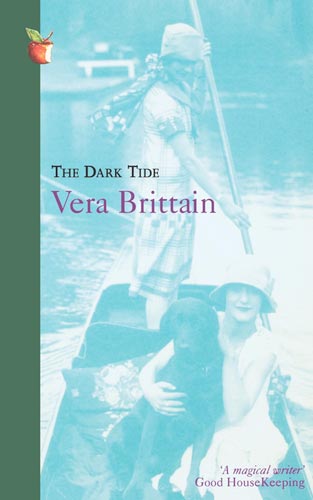
Vera Brittain, The Dark Tide

There are books that are bad in uninteresting ways and books that are bad and yet somehow still interesting. The Dark Tide, Vera Brittain’s first novel, is in the second category. In saying this I am basically repeating what seems to have been the critical consensus about The Dark Tide since its publication in 1923: its flaws seemed conspicuous (though there was not universal agreement about just what they were), but yet it had an energy and intellectual determination that made it something more than a failure, something other than forgettable. To her credit, Brittain herself is both frank and intelligent about the novel’s weaknesses: “the crude violence of its methods and the unmodified black-and-whiteness of its values.”  The Dark Tide, she says in her preface to the 1935 reissue,

still appears a surprisingly melodramatic and immature production for a young woman who had seen four years of War service and three of University training. It stumbled towards a technique which I have since repeated with possibly better results – the relation of an individual story against a larger background of political and social events – but the story was over-emphasized and the background lamentably inaccurate and incomplete. Yet, by the time I began the book, I was well into my twenties; I had passed through a veritable lifetime of annihilating experience; and I was not, I think, exceptionally unintelligent.

She goes on to suggest that the very “annihilating experience” she had been through had impeded her intellectual development even as it artificially accelerated her emotional development. The resulting asymmetry she proposes between head and heart does seem to me a plausible explanation for the extraordinary unevenness of The Dark Tide,  in which crudely-drawn characters careen around the story, knocking into each other like conceptual bumper cars. They deal only in extremes of passion or commitment, or, on the other side, of passivity and submission. What matters most to them all is how they feel about everything — and this, to me, was entirely unexpected, as it reverses the priorities and emphases of Brittain’s autobiographical writing. The Dark Tide doesn’t sound like Brittain at all, and clearly she didn’t think it did either. Though she wrote other novels (one of which, Honourable Estate, sounds like the next one I should read), there seems to be good reason why she is best known for her non-fiction, which she wanted to be “as truthful as history, but as readable as fiction.”

The Dark Tide is organized around two characters based, quite obviously, on Brittain herself and Winifred Holtby. Neither portrait is ultimately flattering, and as Mark Bostridge remarks in his introduction to the Virago edition, the identifications loosen as the novel goes on: he argues that “the two main female characters become increasingly representative of the different sides of Vera’s own personality.” Daphne Lethbridge has Holtby’s energy and outgoing personality, but lacks intellectual subtlety and social refinement; Virginia Dennison has Brittain’s petite elegance, intellectual seriousness, and social conscience. They disdain each other for reasons that make neither of them look good, and like Brittain and Holtby in real life, but under very different circumstances, they outgrow their hostilities and find each other unexpected allies. But the feminist principles and political engagement that make the Brittain-Holtby friendship distinct and inspiring are completely lacking here. Instead, the conflict between Daphne and Virginia is focused on their entanglement with their tutor Raymond Sylvester, who loves Virginia but is loved by Daphne. Full of thwarted desire and smarting from the blow to his ego when Virginia rejects his proposal, Raymond asks Daphne to be his wife, and from that spiteful moment the novel’s catastrophes unfold. Poor Daphne, thrilled at first to think her love is reciprocated, withers away under Raymond’s bitter dissatisfaction with her. Virginia renounces her intellectual ambitions on the grounds that they encourage her to be selfish and self-satisfied; she becomes a nurse. The women meet up again and Virginia (guilt-ridden by her part in Daphne’s unhappiness) offers her friendship which, by that point, Daphne desperately needs.  In the meantime, Raymond, still obsessing about Virginia, fixates on an opera singer who resembles her. His infidelity makes him resent Daphne’s clumsy affection and pathetic attempts to please him more and more (in this, Brittain is at least psychologically astute, though the writing is almost unbearably hyperbolic). Eventually he lashes out at her and leaves, unaware that his blow has sent his pregnant wife crashing into the fireplace and left her unconscious on the floor, where she is discovered an hour later, bloodstained and in premature labor, by (you guessed it) Virginia. The baby lives but is somehow crippled by the accident. Sad as this is, Daphne’s decline seems almost sadder still, as the crude energy that made her attractive in a blundering sort of way at the outset of the novel has evaporated entirely by the end: her only ambition is to make up to little Jack for his misfortune (for which,distressingly, she blames herself as much as her abusive husband). Then, adding ideological insult to literal injury, Raymond’s mistress appears to urge her not to pursue a divorce as Raymond’s political career is finally taking off but he is campaigning primarily against a proposed new divorce act – one which would actually make Daphne’s case against him easier and surer.  A divorce would show him up as a hypocrite and scuttle his chances of eventually becoming Minister of Arbitration. Thus private values and public service come into direct conflict, and Daphne decides that she will sacrifice her right to be rid of him rather than deprive him of the chance to do something good in the world. Daphne sees her decision as a “sordid compromise,” but Virginia applauds it in a long speech about the moral beauty of giving things up for “the weak and the wicked and the undeserving.”

There is material here for a great, if still problematic, novel about competing values: about women’s aspirations at a time of profound social and political change, about marriage and how its demands are affected, in their turn, by new ideas about women’s independence and intellectual and moral integrity, about private life and public morality – or, in a different register, about love and obsession and cruelty and submission. This is part of what I mean when I say that the novel is bad and yet interesting: that despite the clunky prose and plotting, the heavy-handed speechifying, and the cringe-inducing melodrama, the novel gives the sense of a rich (if confused) intelligence trying to get something done, or maybe to get something out. One example will be enough to get across the flavour of the novel. Here’s a bit of the turbulent proposal scene between Raymond and Virginia:

‘Miss Dennison!’ he burst out in a sudden overwhelming flood of passion, ‘you know what I’m going to say – you know what I want, but all this term you’ve been just the little devil that you are – aggravating, alluring, torturing – driving me nearly mad. And never, never would you let me get hold of you alone – till now. That in itself makes me hope – makes me hope just a little bit more. I love you – Virginia – I can’t sleep or work or think for loving you! I want you till I feel mad – mad – mad! . . . I don’t want you to give up any of the things you like doing – I only want to find you work to do – work for your splendid gifts – but with me – with me! Virginia – my dear – my beloved – wonderful, wonderful little girl – say you care for me a little – say you’ll come to me – marry me!’

Virginia waited for the torrent to subside a little. ‘No,’ she said very firmly.

Sylvester, white and trembling, looked at her with blazing eyes.

‘You don’t mean that! You don’t, you don’t! It’s another of your cruel tricks – your maddening wiles – Virginia!’

Finally convinced by her resolute refusals that her ‘no’ actually means ‘no,’ and insulted by her comments about his low moral standards, Sylvester turns on his beloved:

‘So that’s what you think of me, is it!’ Sylvester exclaimed. ‘That’s the sort of reputation I’ve got? Very well then, I’m going to live up to it. I’m going to make you kiss me before you go, you little devil! I’ll have that much satisfaction at any rate.’

He seized both her hands as he spoke, pulled her out of her chair, and began to draw her towards him. With a tremendous effort she managed to get one of her hands free – the one in which she still held her paper. [Oh yes, this is all during what is supposed to be a “coaching” session.] Summoning all her strength she lifted it above her head, and struck him violently with it in the face. He let her go immediately and staggered back, with eyes watering and one cheek crimson from the blow.

Yeesh, right? And yet fending him off with her paper is surely symbolic of the deeper contest between the feminine submission he wants (in the guise of romance) and her determination to achieve things with her life that she believes (as Brittain believed) were likely incompatible with marriage. He’s a sexual bully as well as the incarnation of masculine privilege in a context marked by women’s aspiration to claim their share of the authority that comes with education and the degrees that formally recognize it. If only the novel continued to beat him up; if only he had to pay, not just for his violence against Daphne, but for his regressive attitudes and his sheer, unmitigated meanness — and by that I mean, for things like being angry at Daphne for fainting during an ‘at home’ he insists on her hosting at short notice even though she is heavily pregnant and generally unwell and unhappy. If only Daphne had grabbed the poker during the miserable confrontation and struck him down, instead of being struck down herself … or if only Daphne and Virginia had united against him and formed the kind of genuinely mutual friendship Brittain and Holtby had, settling in together to raise Jack into a different kind of man than his father (in the true Bronte tradition, crippling him at birth would have been a helpful step in that direction).

But The Dark Tide offers neither complex realist analysis of the social conditions (and conditioning) that lead both Raymond and Daphne to act as they do, leaving us productively dissatisfied, nor a feminist revenge fantasy. Instead, it turns into a weird treatise on the value of self-sacrifice, leaving me worried that Brittain has been influnced too much by my least favourite aspect of George Eliot’s moral philosophy: the imperative articulated in The Mill on the Floss that “the responsibility of tolerance lies with those of wider vision.” At the end of the novel Virginia talks for nearly three pages about the greatness of Daphne’s decision not to divorce Raymond, on the grounds that “It’s never for the people who deserve it that we’re called upon to sacrifice ourselves”:

No, it’s for the weak and the wicked and the undeserving that we have to give things up. Look at the lives of people like doctors and nurses; more than half their days are spent on patients whose diseases are due to their own sins and follies.  Look at the teachers of boys and girls in schools; they don’t wear out their gifts and their energy on the brilliant and the ambitious, who’d get along all right without any teachers at all. No; they give their best work to the lazy and the backward and the stupid, who either can’t or won’t learn. Just in the same way the clergyman in a slum parish spends al his time and thought on the people who drink and swear, and beat their wives, or are unfaithful to their husbands. . . . You’re one of them now, Daphne, one of the children of the Kingdom, who because they save others lose the chance to save themselves.

Yeesh again, I’m afraid, first of all because this long speech really comes out of nowhere. I wouldn’t declare absolutely that no character ought to speak for three pages straight, even didactically: there might be a right time and place for it, a right novel, the right novelist. But surely the speech ought to feel organically part of the novel, something that everything else in the novel has prepared us to hear, and if The Dark Tide is about the beauty of self-sacrifice on behalf of the wicked and undeserving, this is the first we’ve seen of it. It seems telling that Daphne’s not convinced, also – but I don’t sense that Brittain is using the gap between Virginia’s conviction and Daphne’s disappointment to do anything in particular except continue distinguishing between them as characters, at Daphne’s expense as usual.

The sudden introduction of what seems a new theme, and the intrusive and inartistic way it is handled are both reasons to object to this part of the novel. An equally good, if not better, reason is that the doctrine is so ethically problematic. If the better are always to serve the needs and interests of the worst, doesn’t that mean that in the end, the wicked win? What’s the long-term good of self-sacrifice that serves only to prop up someone like Raymond? It’s enabling, that’s what it is! It’s exalting within limits, perhaps, and it may even be theoretically necessary, because if you put your own needs first, you blur the line between yourself and the undeserving. But it lets the bad guys win. George Eliot is uneasy about this too: think of Lydgate, whose better nature makes him tend to Rosamond at the cost of his own highest aspirations. What’s sad there is that precisely because he is the better person, he has no real choice. The same is true of Dorothea’s promise to Casaubon: she has to say yes, or she wouldn’t be Dorothea. It’s her best self that leads her to the brink of a sacrifice we all (including her) know he does not deserve. Eliot rescues Dorothea by killing off Casaubon, saving us all from the misery of watching Dorothea live out the consequences of her own moral elevation. The novel in which she does that would be utterly disheartening. If Viriginia is speaking for Brittain in The Dark Tide, she seems quite prepared to inflict such a doctrine on her character, but it’s impossible to believe Brittain would have accepted such terms for Holtby in real life.

Overall, it’s a strange, puzzling, annoying, unsatisfying novel. What it is not, on my reading, is what Bostridge calls it: “an amusing period piece.” It’s far too dark for that. Brittain quotes a contemporary review of it that concludes “Some day she may write a good book.” That seems fair. A Dark Tide is not a good book, but there’s something about it (including quite a powerful section about Daphne’s growing isolation and self-awareness in the early weeks of her marriage) that tells us the writer has a good book in her.

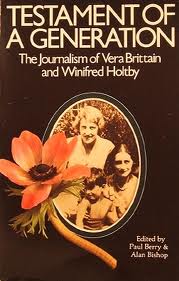
Testament of a Generation: The Journalism of Vera Brittain and Winifred Holtby

The more time I spend in the company of these two extraordinary women, the more I appreciate their energy and commitment, as well as the clarity and force of their prose. All of these qualities are on full display in this collection of their journalism. The editors, Paul Berry and Alan Bishop, have organized the contents thematically, a decision which makes sense on many levels, though the chronological leaps backwards as a new section begins are occasionally disconcerting. There is also an element of arbitrariness in the divisions, particularly, I found, between what was filed under “A Writer’s Life” and what under “Politics”–for such intensely political writers, always aware that the personal is also political, there’s not really much difference. In fact, the most striking thing for me across the collection was the consistency of tone, regardless of subject: straightforward, direct, assertive, drily humorous. To some extent, in their fearless confrontations with prejudice, folly, and hidebound tradition, they remind me of Victorian writers like Frances Power Cobbe (some of whose outstanding essays can be found in the excellent Broadview anthology Criminals, Idiots, Women, and Minors). But both Brittain and Holtby seem to me less artful than Cobbe, which I don’t mean as a criticism but as recognition that Cobbe and her contemporaries had worked hard enough for women’s causes that by the time these two are writing, there is less need (not no need, mind you) to dance around the issues, to pander strategically to masculine egos or social norms, or to adopt disingenuous poses.

A straightforward recapitulation of just how much progress  had been made comes from Holtby in an essay she wrote for Time and Tide about King George V’s Jubilee. She refused the invitation to join a resolution protesting against the celebrations on the grounds that the previous twenty-five years “were, on the whole, the most propitious that women in this country had ever known”:

Twenty-five years ago forty thousand women marched through the streets of London in what was known as the Women’s Coronation Procession. It was a protest against desires unfulfilled. It represented arts, sciences, authorities, powers; lawyers and doctors walked there, the prototypes of peeresses and abbesses; and they were led by women carrying banners who had been imprisoned for insisting on women’s right to use their abilities in such service. ‘It will not come in my time, ‘ Mrs Pankhurst said. But do I not remember the extraordinary service at which Mr Baldwin unveiled Mrs Pankhurst’s statue under the shadow of Parliament, in which he, the constitutionalist, honoured her, the rebel, for having ‘set the heather on fire,’ at which Dame Ethel Smythe in the robes of a doctor of music led the police band playing The March of the Women, which she had once conducted with a tooth-brush through the bars of a window in Holloway Gaol to a chorus of exercising prisoners? I have seen a woman cabinet minister walking through the lobby of the House of Commons; I have seen a woman architect chosen to design the Shakespeare Memorial Theatre; I have seen my own mother applauded by a county council when she was elected as its first woman alderman; I have myself been heckled as an agitator at Marble Arch, demanding the vote in the equal franchise campaign of 1927 and 1928; and I have been enfranchised. I have voted. And I know that those people who say that the world is no better off since ‘women have been let loose in it’ simply do not know what they are talking about.

She goes on to detail the “revolution in social and moral values” which is “a direct result of that challenge to opinion which we call the Women’s Movement.” But for all her appreciation of these positive developments, she is clear about “the imperfections of the movement,” about which she is equally clear and specific. Though these great gains have been made, the challenge going forward (which may sound all too familiar, depressingly, to feminists in the present moment) is to maintain momentum, build on successes, and extend the principles underlying it beyond those who have so far benefited–including looking beyond gender to consider inequalities of race and class. “I am constantly reprimanded for ‘flogging the dead horse of Feminism,'” Holtby observes; “I do not think the horse is dead.”

The articles, then, carry on the work of social analysis and criticism, sometimes at the micro level (as in the nice little piece “Should a Woman Pay,” about the explicit assumptions and implications of men’s picking up the tab–“the ethics of social encounter reflect the economics of an earlier epoch,” Holtby observes), sometimes at the level of state or even international politics. Holtby writes stringently, for instance, about South African leader Jan Christiaan Smuts, “an indefatigable general in the nationalist Boer War; an architect of empire in the years succeeding it.” Smuts “has achieved superb feats of generalship, statesmanship, and intellectual synthesis,” Holtby acknowledges; he has unified “the Dutch and British sections of the white community” of South Africa; and he has recently given a “speech upon liberty” at St. Andrew’s University “which has won the acclamation of the English-speaking world.” Holtby’s critique is relentless. Having conceded his skill, renown, and accomplishments, she takes him apart for presuming to speak as a champion of freedom and equality:

‘Popular self-government and parliaments are disappearing,‘ he said. ‘The guarantees for private rights and civil liberties are going.‘ Quite. Smuts should know. In Cape Province, until 1931, there was no constitutional distinction between European and non-European citizens in the matter of franchise and property. True, the educational tests and property qualifications for voting were so arranged that only a minority of black men were enfranchised . . . Still, liberty broadens down from precedent to precedent, we are told. . . . All change, we thought, would be an extension of freedom, at least under men like general Smuts. In 1931 European women were admitted to parliamentary franchise; non-European women were excluded. Today before the country is a Bill, almost certain … to be passed, disenfranchising non-European males as well as females. The Native Conference, supposed to serve as a substitute for other constitutional powers, criticized this and other Government proposals in 1926 and 1927, so has not subsequently been summoned . . . .

‘Dissident views are not tolerated and are forcibly suppressed.’ Smuts should know. He himself encouraged the South African Government to pass the Riotous Assemblies Act – an Act which makes ‘incitement to ill-feeling between black and white’ an offense punishable by banishment. Now where conditions in a country as as they are in South Africa . . . merely to speak aloud of the laws and administrations precisely as they exist is adequate to ‘incite ill-feeling.’ The Act has been used to prevent the development of trade unionism, to prohibit political protest, to render inarticulate any form of native criticism; it has been used to enable politicians to say – ‘But the natives themselves do not protest.’

Smut should know: the refrain is initially, disarmingly, innocent-sounding, but ultimately damning. Holtby’s conclusion goes beyond South Africa to a wider indictment of the consequences of failing, as Smuts fails, to imagine other people, different people, as fully human:

These abrupt failures of the imagination are among the most fruitful sources of injustice in the world. They are more common than deliberate sadism, more insidious than fear. Indeed, they breed fear. . . . The Jews to Nazi Germany, the Catholics to the Ku Klux Klan, Negroes to a southern states lynching party, women to eighteenth-century liberals – they are not human; they need not be accorded human privileges. The mind closes against any conception of their own point of view.

This is only one of many references to Nazi Germany, which is not surprising if you consider the general historical context (the piece on General Smuts is from Time and Tide in 1934), but it did surprise me a little because the majority of them are specifically feminist critiques, which is not the most familiar argument against Nazism today. In the piece on the Jubilee, Holtby makes a passing reference to “what has happened in Germany, where the pendulum of reaction has swung back so violently that all that had been gained seems lost again.” In “Black Words for Women Only” (1934) she considers Sir Oswald Mosley’s assertions about the importance of women to the Fascist movement–which would, he declared, “treat the normal wife and mother as one of the main pillars of the state.” “It is not irrelevant,” Holtby proposes, “to compare what Sir Oswald promises with what Herr Hitler has performed”:

The German Constitution of 1918 granted equality before the law to all citizens. Women entered politics, the professions, the civil services. Between thirty and forty-two sat in each of the various Reichstags as deputies between 1919 and 1933 – a higher proportion than in any other country. They held high executive and municipal offices.

But the Nazi movement has reversed all that. Women may vote, but none stand on the lists as candidates. Their associations are all now directed by men; since July, 1933, all the girls’ high schools have been controlled by men. Professional women are finding themselves compelled for one reason or another to resign from work. Married women are persuaded to leave their employment, and unmarried workers are often asked to surrender their jobs to men, as in one Hamburg tobacco factory, where 600 girls were asked to hand over their work to fathers, brothers or husbands, or to retire, marry, and claim the State marriage loan.

There is little hope for ambitious young women in Nazi Germany, where the brightest contribution of constructive economic thought towards the solution of the unemployment problem appears to have been the expulsion of large sections of the community from paid work, as a penalty for being women, Socialists or Jews, and their replacement by unobjectionable loyal male Aryans. Individual women have protested against this mass campaign to restore their economic dependence and drive them back to the kitchen. But their protests are penalized; public influence is strong, and there are women who have been temporarily persuaded to believe that Hitler’s policy really serves their interests.

Quoting one such woman, who wrote to the Manchester Guardian declaring that “Woman has again been recognized as the centre of family life, and today it has again become a pleasure and an honour to be a mother,” Holtby acerbically observes, “No explanation is offered of why or when motherhood ceased to be a pleasure and an honour – perhaps when children were driven to concentration camps?” “Throughout history,” she concludes,

whenever society has tried to curtail the opportunities, interests and powers of women, it has done so in the sacred names of marriage and maternity. Exalting women’s sex until it dominated her whole life, the State then used it as an excuse for political or economic disability. . . . Today, whenever women hear political leaders call their sex important, they grow suspicious. In the importance of the sex too often has lain the unimportance of the citizen, the worker and the human being. The ‘normal’ woman knows that, given freedom and equality before the law, she can be trusted to safeguard her own interests as wife, mother, daughter, or what you will.

I was reminded in these articles of Gaudy Night, which also ties together Nazism and the gathering clouds of war in Europe with hostility to women’s rights at home: the strongest clues to the perpetrator’s identity turn out to be her strong view that women’s place is in the home, her most important identity that of wife and mother, not citizen, worker, or human being.

Brittain’s political writing focuses more on her pacificism, which leads her to support, provisionally, Chamberlain’s deal with Hitler at Munich in 1938–“a policy beset with problems and fraught with peril,” she acknowledges, but an alternative to “an ever-darkening night of hatred, suspicion, and fear.” Once that dark night has arrived, she continues to write about the horror of war and the need to act with what compassion and justice are possible under its terrible pressure. About “massacre bombing,” such as that of Dresden, she is eloquent: “It made no undeniable contribution to military victory,” she says (having cited a number of military experts on this controversial question), “and it relegated men, for whose salvation Christ died, to the level of hunted and outraged beasts”; “the ruthless mass bombing of congested cities is as great a threat to the integrity of the human spirit as anything which has yet occurred on this planet.”

The section on “A Writer’s Life” (though overlapping in some of its concerns with the sections on feminism and politics) takes us in some more personal directions, as with Holtby’s account of her development as a writer–complete with quotations from a book of her juvenile poetry published, at her mother’s instigation, when she was thirteen. “I was,” she says, and it is borne out by the verses she quotes, “a creature of completely uncritical piety and sentimental convention.” (I too endured the complex blend of satisfaction and utter humiliation of having my  private poetic scribblings taken up and prepared for public viewing, though in my case the little volume was not released to the genuine public, only to a select group of family and friends–this at my grandmother’s instigation. All I can say in defense of the poems in it is that they are not conspicuously worse than Holtby’s, except in formal specificity.) Holtby’s review of Woolf’s The Waves was of particular interest: it shows the same generous reaching towards understanding of an aesthetics wholly unlike her own that she shows when explaining her decision to write her volume on Woolf’s life. And Brittain’s essay on “The Somerville Novelists” would probably be the kicking off point for the  seminar I imagine offering on that subject.

Vera Brittain, Testament of Friendship

Whether or not the spirit of man is destined for some unknown flowering in a life hereafter, the benevolence of the good and the courage of the undefeated remain, like the creative achievements of the richly gifted, a part of the heritage of humanity for ever.

I’m not sure that I would have fully appreciated the rarity of Testament of Friendship if it weren’t for Carolyn Heilbrun’s thoughtful introduction to my edition–and in a way, that’s part of the lesson I take away from the book, namely, that there isn’t really anything extraordinary about strong, supportive, important friendships between women. Women live these (if we are lucky); we know their value. What’s unusual is to find a story of such a friendship, something for which, as Heilbrun notes it is difficult to find a literary model. “Friendship between women is seldom recounted,” she observes; “[f]rom the love of women for one another as they work and live side by side … recorders of civilization have averted their eyes.” Vera Brittain makes a similar observation in her Prologue:

From the days of Homer the friendships of men have enjoyed glory and acclamation, but the friendships of women, in spite of Ruth and Naomi, have usually been not merely unsung, but mocked, belittled and falsely interpreted.

Heilbrun sees Brittain and Holtby’s friendship as unusual because for them it meant, “as it had long meant for men, the enabling bond which not only supported risk and danger, but comprehended also the details of a public life and the complexities of pain found there.” It is true that their lives, and thus their friendship, had what have more typically been masculine aspects, but too much emphasis on this point risks reinforcing the division of norms into masculine and feminine, and Brittain’s own account shows that she and Holtby lived and worked among many women who were also publicly active, and that they looked back to a tradition of other such women. Obviously, it’s important to acknowledge that this was not the norm, that there were practical as well as ideological obstacles to women’s participation in public life–but at the same time reality has never been neatly bifurcated into male and female spheres and there’s nothing intrinsically masculine about public life, only the expectation or belief that there is.

Though Brittain, like Holtby, is an avowed and articulate feminist, Testament of Friendship is only implicitly a protest against both the narrative and the political constraints on her friend’s life story. Though Holtby was an extraordinarily busy public intellectual (just how busy, I had absolutely no idea until I read this book), Testament of Friendship is a personal tribute–and yet, having said that, it seems artificial to separate out the personal dimensions of her life or of Brittain’s recounting of it from her public ambitions and activities. A better way to put it might be that Brittain celebrates her beloved friend in her entirety, seeing a complete union of principle and character across all aspects of Holtby’s life. Unable to refuse a friend’s request for help or a listening ear, Holtby was equally unable to countenance injustice or failures of principle in the world at large. While travelling in South Africa, for instance, she recognized the parallels between prejudice and systemic discrimination on the basis of sex and on the basis of race:

At camp one night in the Transvaal, she had heard two black servants teaching each other to read from a child’s exercise book. But wherever she went, the white people whom she met talked to her pessimistically about the native question. They told her that higher education was bad for natives and gave them ideas and undermined their loyalty; that political power was unsuited to natives, since they were not ready for it; that segregation and the Colour Bar and the disenfranchisement of the black men in the Cape were necessary for the preservation of white civilization and the safety of white women and the happiness of the home.

Sometimes, as Winifred meditated on these statements, they seemed to have a familiar ring. Suddenly, one day in Pretoria, she realised why. In her mind she began to substitute the noun “women” for the noun “natives,” and found that these fiercely held, passionately declared sentiments of white South Africa coincided almost word for word with the old arguments in England against women’s enfranchisement, women’s higher education, and women’s entry into skilled employment. She even perceived–as Olive Schreiner had perceived before her–a close relationship between the two forms of subjection . . . .

Henceforth Holtby is equally tireless in her crusade against both forms of oppression.

Brittain’s admiration for Holtby–for her radiant beauty, her astonishing energy, and above all her moral integrity–energizes what might otherwise be a somewhat pedestrian recounting of Holtby’s life and career from her childhood in a small Yorkshire village to her sadly early death. We get, I think, at least as strong a sense of what Brittain thinks about her friend as about that friend herself, who is–perhaps inevitably–an idealized figure. I don’t think we ever hear of her as anything less than keen, enthusiastic, and generous. Interestingly, Brittain is not so uniformly positive about Holtby’s novels: though she refers to them often, frequently bringing out parallels between Holtby’s views and her characters, finding ways Holtby refracts her personal experience through her creative imagination, Brittain is frank about their shortcomings, seeing all the early ones as subordinate in skill and interest to South Riding. As South Riding is the only one I’ve read, I have only Brittain’s word to go on, but the others do sound a rather motley assortment. Her comments on South Riding, though, did make me want to reread that novel, which I feel I have so far under-appreciated. South Riding represented, Brittain suggests,

the reconciliation, at long last, of the artist and the social reformer who had wrestled for so many years within her personality. Thanks to the wisdom of growing maturity, she realised that for her there could be no final victory of the one over the other, so she found material for literature in those preoccupations which had hitherto dragged her away from it. In South Riding she threw down a challenge to pity, the deadly and recognised enemy of her achievement, and pity itself, captured, enthroned and crowned, became the apotheosis of her art.

The result was a story which, for all its differences of time and place, bears a close family resemblance to Ibsen’s play, An Enemy of the People. Would the clever literary critics who maintain that the political and social themes of Winifred’s novels put her outside the ranks of the artist take, I wonder, the same view of Ibsen? To mirror universal values in local or personal experience is surely a major function of art; and in this Winifred superbly succeeded.

The comment here about “clever literary critics” is a reminder that Holtby is publishing her socially-conscious fiction during the same years that, say, Virginia Woolf is writing and publishing her very different works (Holtby’s first novel, Anderby Wold, appeared in 1923; South Riding was published in 1936)–or, for that matter, Elizabeth Bowen’s early novels are appearing. Though she didn’t use this terminology, Holtby knew perfectly well she was not a Modernist. Writing to a friend about her decision to write about Woolf for a series of ‘Modern Writers on Modern Writers,’ she says,

I took my courage and curiosity in both hands and chose the writer whose art seemed most of all removed from anything I could ever attempt, and whose experience was most alien to my own. . . . I found it the most enthralling adventure–to enter, even at second-hand, that world of purely aesthetic and intellectual interests, was to me as strange an exploration as it would have been for Virginia Woolf to sit beside my mother’s pie and hear my uncles talk fat-stock prices and cub-hunting. I felt that I was learning and learning with every fibre of such brain as I have.

According to Brittain, Holtby’s work on Woolf  “enabled Winifred to state her own basic problem–the conflict between means and ends, between practical measures for bringing the good life nearer, and the creation of enduring beauty which is part of the good life itself. The [Woolf] book is one prolonged analysis of the meaning of true art and the method of its attainment.” Studying Woolf’s books helped Holtby “formulate more clearly her own philosophy of life and death,” Brittain says, and then quotes this passage from Holtby’s book describing “the flashes of insight” some of Woolf’s characters achieve:

These are the moments of revelation which compensate for the chaos, the discomfort, the toil of living. The crown of life is neither happiness nor annihilation; it is understanding. The artist’s intuitive vision; the thinker’s slow, laborious approach to truth; the knowledge that comes to the raw girl, to the unawakened woman–this is life, this is love. These are the moments in which all the disorder of life assumes a pattern; we see; we understand; and immediately the intolerable burden becomes tolerable; we stand for a moment on the slopes of that great mountain from the summit of which we can see the truth, and thus enjoy the greatest felicity of which we are capable.

This is not the ‘literary criticism’ we are now accustomed to: it has what I have heard described as the “whiff of belles lettres” about it–and in many circles (especially academic ones) that’s a smell as unwelcome as anything you might unwarily step on in the dog park. As an artist’s reflections, though, and as a commentary on the experience of reading Woolf, it has the ring of truth.  I admire Holtby’s open-minded eagerness to learn from someone unlike herself, which seems to have been one of the unifying characteristics of all of her work, and indeed of her life.

Reading this book has added to my sense that we let the Modernists win too easily–by which I mean that in the literary history I am familiar with, the important thing about the first part of the 20th-century is, singly, exclusively, Modernism: there isn’t a place in the story for any of the writers who did not take up their commitment to “purely aesthetic and intellectual interests.” Some confirmation comes from peering at our most recent description for our course on ‘British Literature of the Early 20th Century’: I see only Conrad, Joyce, Lawrence, Lewis, Wilde and Woolf on the reading list. Neither Brittain nor Holtby appears on our 20th-Century British reading list for Ph.D. students’ qualifying exams, and neither does Antonia White, Rosamond Lehmann, Elizabeth Taylor, Margaret Kennedy, Barbara Comyns–not even Rebecca West, and certainly not Dorothy Sayers.* (Actually, the most recent student to take these exams in 20thC British added Sayers’s Murder Must Advertise–it was conspicuous to me that her supervisor had not taken the Sayers seriously as anything but a token specimen of genre fiction, and the only question the novel prompted from him was a derisive one about the relevance of the cricket match. Ahem: we can do better!) It’s possible that I can’t make sense of, say, Margaret Kennedy‘s novels because they aren’t actually very good. But it seems at least as possible to me that they don’t seem very good because I don’t know why they do the things they do–I don’t understand the story to tell about them. Holtby’s cheerful determination to undertake strange explorations of unfamiliar minds is a good model for all of us.

*I’d be curious to know from those of you at other institutions: How typical is this? Also, apparently Elizabeth Bowen doesn’t rate either, even though she is a Modernist (as far as these labels hold up, of course). Is that typical?

Boston by the Books

I’m back from a wonderful five days in Boston and it seems only fitting to post first (as I did following last year’s jaunt to New York) about the books that came home with me. It was a great bookish trip, thanks to the guidance but also the company of my co-editors at Open Letters Monthly, who were all (but especially Steve Donoghue) attentive and entertaining hosts.

We made two trips to Steve’s beloved Brattle Book Shop. The first day it was drizzly so the carts were not out and our browsing was all inside–which is not a complaint, as you could browse for hours inside and still feel there were tempting treasures you hadn’t found yet. I realized only belatedly, for instance, that most of the shelves are filled two rows deep, which means I explored only one layer. That day I settled on two novels by Ivy Compton-Burnett: A House and Its Head, in the typically elegant NYRB edition, and a Penguin of A Family and a Fortune. I’ve never read any Compton-Burnett before; my interest was piqued because she is the first author chosen by Her Majesty in The Uncommon Reader. At first she’s not a hit, but after Her Majesty becomes a more experienced reader, “the novel she had once found slow now seemed refreshingly brisk, dry still, but astringently so”:

And it occurred to her … that reading was, among other things, a muscle, and one that she had seemingly developed.  She could read the novel with ease and pleasure, laughing at remarks, they were hardly jokes, that she had not even noticed before. And through it all she could hear the voice of Ivy Compton-Burnett, unsentimental, severe and wise.

On our second visit to the Brattle we browsed the dollar carts, which are filled quite miscellaneously so that you never know what might pop out at you and seem too good to resist for the price. I found Barbara Reynold’s biography of Dorothy L. Sayers (not pictured here, as it is following by steve-post). I also picked up John Updike’s collected golf writings for my husband, figuring he likes both Updike and golf so this might well be a winner! And inside again, I found The Godwulf Manuscript, which is the first of Parker’s Spenser series (I also made a pilgrimage to the corner of Boylston and Berkeley, where Spenser’s office is), and Woolf’s The Common Reader, which I owned but lent out many years ago and have never gotten back. I think I was pretty restrained, really: it’s just as well the Brattle is closed Sundays as I was right in the neighborhood and would certainly have found more. My only disappointment was that this seemed the kind of shop likely to have a copy of Testament of a Generation: The Collected Journalism of Vera Brittain and Winifred Holtby–but no luck.

We went en masse to the Harvard Book Store on Thursday night. Time was limited, so all my finds come from the used section downstairs. One I was particularly glad to find was W. Somerset Maugham’s Cakes and Ale, which is the next reading for the Slaves of Golconda book group. I also found Salley Vicker’s The Other Side of You, which some of you recommended after I wrote up Dancing Backwards. And a bit more impulsively I chose Jane Gardam’s The Queen of the Tambourine: I’ve been interested in Old Filth for a while but haven’t come across it anywhere, and this one, which I see won the Whitbread Prize, looked appealingly dark and funny.

I was back in Cambridge on Friday but did all my browsing at the Coop, mostly because I had worn myself out walking all down Newbury Street earlier that day and then all around Harvard Yard (and all over Boston the two days before!). I was trying to pick books that I haven’t been able to find on the shelf up here, and one on my most-wanted list was Laila Lalami’s Secret Son which I was happy to find there. I have followed Lalami’s blog and journalism for some time, and I got Hope and Other Dangerous Pursuits in New York last summer and was impressed and moved by it. I’m really interested to see what she does working on a larger canvas.

Finally, I had a pleasant browse in the big Barnes & Noble in the Prudential Center, which is an important landmark because most of the OLM team has worked there (or in another B&N location) at some time. Though it lacks the deep bookish personality of the Brattle or the Harvard Book Store, it’s still a lovely bright store for exploring. I thought since I’d been collecting so much fiction I would go a different way with my selection there; I came away with Terry Castle’s The Professor. In one of those moments that make you wonder if there isn’t a larger force organizing your “random” reading choices, I discovered that the very first essay includes a long discussion of Testament of Youth. On her first reading, Castle had not liked the book much, finding Brittain “abrasive and conceited.” She quotes Virginia Woolf’s diary entry, which she had “tended to agree with”:

I am reading with extreme greed a book by Vera Brittain. Not that I much like her. A stringy metallic mind, with I suppose, the sort of taste I should dislike in life. But her story, told in detail, without reserve, of the war, and how she lost lover and brother, and dabbled her hands in entrails, and was forever seeing the dead, and eating scraps, and stting five on one WC, runs rapidly, vividly, across my eyes.

As she then explains at some length, Castle found her rereading of Testament of Youth quite a different experience, coming to appreciate how “phobic and self-critical” Brittain is,and especially  how she struggles against her fears (which Castle too was doing, post-9/11). She finds in Brittain a rare model of a woman who fought against the way women are “imprinted” with cowardice:

By coddling and patronizing its female members, society enforced in them a kind of physical timidity; then, with infuriating circularity, defined such timidity as effeminate and despicable. Both practically and philosophically, Brittain rebelled against the linkage. . . . Had I resisted her for so long–cast her off as an important Not-Me–precisely because, deep down, I felt so much like her? I found out now, with a sudden embarrassed poignancy, precisely how much I sympathized, both with her anxiety and with the florid hope that the men she knew might infect her, so to speak, with physical courage. Not very butch of me, I know. Not very feminist. But I had to confess it: I admired and coveted–quite desperately at times–the insane, uncomplaining, relentless bravery of men.

That’s not where I expected her to take the discussion, but it’s interesting and certainly provocative, as I expect the rest of the book to be.

Also pictured above is a handy little book about the MFA collection. This comes from a particularly rich but obscure book source in leafy Jamaica Plain. It was a special privilege to scavenge in the collection there! More about my experience at the MFA itself, as well as other touristy impressions of Boston, when I’ve caught up on some of the work that has been waiting for my return.

An Examined Life: Vera Brittain, Testament of Youth

Now that I’ve finished reading Testament of Youth, I am most impressed by it as a testament to Brittain’s determination to understand and give meaning to the war. Though the book is often very poignant (as in the excerpt I posted last time), it’s not, ultimately, an emotional book so much as it is an intellectual book. I like the book better for that commitment to thought over feeling, or to thought about feeling, and I admired Brittain, too, for facing up to what she felt was her responsibility to those who had died by doing something more than grieving for them. “How like we were,” she thinks at one point, “to the fighters of those old wars, trusting to the irresponsible caprices of an importuned God to deliver us from blunders and barbarisms for which we only were responsible, and from which we alone could deliver ourselves and our rocking  civilization.” Her lack of religious belief turns her away from such a passive response toward attention to the human and historical causes of the devastation she witnesses. Returning to Oxford after the Armistice, she turns from her study of literature to history, economics, and politics:

Henceforward . . . people will count only in so far as they recognize their background and help to create and change it. We should never be at the mercy of Providence if only we understood that we ourselves are Providence; our lives, and our children’s lives, will be rational, balanced, well-proportioned, to exactly the extent that we recognize this fundamental truth. . . . I don’t know yet what I can do, I concluded, to help all this to happen, but at least I can begin by trying to understand where humanity failed and civilisation went wrong. If only I and a few other people succeed in this, it may be worth while that our lives have been lived; it may even be worth that the lives of the others have been laid down.

The final section of the book chronicles her attempts to achieve this understanding and then act on what she has learned through her lectures, journalism, and political activism. How much more impressive this is than falling back on wishful platitudes about the inscrutability of God’s plan or the better place where the dead now reside. It’s appropriate that she returns a few times to her reading of George Eliot, who had very much the same insight about our relationship to what we call “Providence,” and the same sense that from it comes a duty to ourselves and others every bit as challenging and more morally elevating than obedience (under the promise of reward and the threat of punishment) to religious authority.

Brittain is similarly rational and deliberative in her approach to marriage, which seems to her not at all a desirable end in itself and, potentially, a threat to everything she works for as a feminist:

In spite of the feminine family tradition and the relentless social pressure which had placed an artificial emphasis on marriage for all women born, like myself, in the eighteen-nineties, I had always held and still believed it to be irrelevant to the main purpose of life. For a woman as for a man, marriage might enormously help or devastatingly hinder the growth of her power to contribute something impersonally valuable to the community in which she lived, but it was not that power, and could not be regarded as an end in itself. Nor, even, were children ends in themselves; it was useless to go on producing human beings merely in order that they, in their sequence, might produce others, and never turn from this business of continuous procreation to the accomplishment of some definite and lasting piece of work.

When marriage becomes a specific possibility rather than a theoretical issue (the courtship is, aptly, conducted largely by correspondence, through shared reading and writing and argumentation), she continues to worry, not just about whether it might compromise her political and professional commitments but also about whether she can marry and yet keep faith with those who died in the war. Marriage represents an emotional severance of the past from the present: “so long, I knew, as I remained unmarried I was merely a survivor from the past. . . . To marry would be to dissociate myself from that past, for marriage inevitably brought with it a future.”  Waking from a troubling dream in which her dead fiancé returns, facing her with an anguished choice between him and her new love, she remembers

with a startling sense of relief, that there was no resurrection to complicate the changing relationships forced on men and women by the sheer passage of earthly time. There was only a brief interval between darkness and darkness in which to fulfil obligations, both to individuals and society, which could not be postponed to the comfortable futurity of a compensating heaven.

Repeatedly through these years of her life Brittain faces what George Eliot calls “the burden of choice.” The courage she has to find is not the same as that shown by the young men (including so many she knew and loved) who faced death in the trenches, but it has its own dignity and significance. Even her decision to marry is part of the war she is fighting. Against the expectations that marriage ends women’s participation in a wider social and political life, she hopes to demonstrate that the experience of marriage and children “rendered the woman who accepted them the more and not the less able to take the world’s pulse, to estimate its tendencies, to play some definite, hard-headed, hard-working part in furthering the constructive ends of a political civilisation.”

The demonstration would not, I was well aware, be easy; for me and my contemporaries our old enemies–the Victorian tradition of womanhood, a carefully trained conscience, a sheltered youth, an imperfect education, lost time, blasted years–were still there and always would be; we seemed to be for ever slaying them, and they to be for ever rising again. Yet even these handicaps I no longer resented, for I was ceasing at last to feel bitterness against the obstacles that had impeded for half a lifetime my fight for freedom to work and to create. Dimly I perceived that it was these very handicaps and my struggle against them which had lifted life out of mediocrity, given it glamour, made it worth while; that the individuals from whom destiny demands too much are infinitely more vital than those of whom it asks too little. In one sense I was my war; my war was I; without it I should do nothing and be nothing. if marriage made the whole fight harder, so much the better; it would become part of my war and as this I would face it, and show that, however stubborn any domestic problem, a lasting solution could be found if only men and women would seek it together.

This may seem an elaborate rationalization of a decision she longs to make for other highly personal reasons. To me, though, it’s precisely the conversation a thoughtful woman had to have (possibly, still, has to have) about entering into an institution that for so long turned that personal relationship into one with so many complicated and disadvantageous legal, political, economic, and social consequences for women–at the time she writes about, for instance, a Matrimonial Causes Bill was debated and finally passed, “and for the first time in England the rights of men and women were equal with regard to divorce.”

I expected to be moved to tears by Testament of Youth. I was, but it matters more to me, and seems more fitted to Brittain’s own aims and accomplishments, that I was moved to great respect for her. I’m looking forward to starting Testament of Friendship soon.