Catching Up

When I said I was posting my review of Crewe Train a bit early because I had another big deadline coming up, in a way I misspoke. It wasn’t exactly my own deadline, although I was involved in it: a Ph.D. student I have been supervising defended her thesis on Friday, so my part of the event (reviewing the thesis and preparing questions for the exam), though time-consuming, was not nearly as important as hers! I’m happy to report that the defense was very successful and, aside from some odds and ends of paperwork and the submission of the very final copy, she and I are both done. I am very pleased for her: she should be proud of her hard work and its results. However ambivalent I may be about recommending graduate school as an option, there’s no question that the graduate students I have worked with over the years are some of the best and smartest people I know, and once they have made the commitment to do these degrees, I do my level best to be helpful and supportive.

In some ways, though, I have to admit that in recent years graduate supervision has been harder for me to do. The advice I have to give students based on what I know to be the standards and conventions within the discipline and profession is often not congruent with my own doubts about those standards and conventions, and my aversion to reading some kinds of academic criticism has only worsened as I spend less time doing it myself, making it tricky to coach students to write it! For these reasons, among others, I have been cautiously scaling back my role in our graduate program. As of yesterday, though, that contribution includes supervision of four completed Ph.D. theses and 16 completed M.A. theses. We had a celebratory dinner at Estia for the candidate and all six members of the examining committee. A small point, or maybe it isn’t so small: we couldn’t help but notice that from the external examiner on down, we were all women.

Preparing for Friday’s defense took up a lot of my time and energy last week, but there was routine class business to get done as well. I managed to return a set of papers in my first-year class, which was really worth the extra push so that they weren’t hanging over me this weekend. My conscience needs a break! In Mystery & Detective Fiction we were working through Ian Rankin’s Knots and Crosses. I know he doesn’t consider it his best, and in many ways it is also atypical, but it teaches awfully well because it is so deliberately literary–not to mention terse. Still, I’ve been wondering if next year I might take a chance on one of the longer ones and cut something else from the reading list. It’s such a challenge in that class finding the right balance between providing variety and overwhelming the students with too many different books. My own view has usually been that most of the books we read aren’t really complex enough to require a lot of classroom hours, so just taking longer on them would be counterproductive: we’d go more slowly, yes, but also feel that less was happening, that we were discovering less. The books are not particularly long or difficult reads, either, and I figure they can sub in easily enough for whatever leisure reading students might otherwise be doing! It’s hardly punishment to “have” to read The Murder of Roger Ackroyd or Indemnity Only, right? But students do often remark that there are a lot of books to keep track of. I might cut An Unsuitable Job for a Woman (even thought it’s a personal favorite) and put in Fleshmarket Close or The Naming of the Dead. Actually, since these are both in the 400-page range, I’d probably have to cut something else too. Well, something to think about. In the meantime, they write a mid-term on Monday which will be my next marking chore.

In the Somerville Novelists seminar, we have moved into the collaborative projects phase, and I’ll admit, I’m a bit worried. I had a sinking feeling last week that though we had been doing very well with our discussions of the individual novels–better and better, in fact, as the weeks went on–I had not done a good enough job keeping the larger frameworks of the course in view, or preparing the students to feel confident with the meta-level questions I’ve been hoping we’d address. I did some intervention once I realized that they were still thinking mostly in terms of local or close reading issues, and as I see the draft material starting to appear for their wiki projects, I think it worked. I also felt that they were tense and uncomfortable approaching their independent and collaborative projects despite the careful and detailed instructions and rubrics I’d given them. My intention was to make sure they had enough information about basic structures and expectations to think creatively and even have some fun working within them. What I’ve been feeling is that they still find them unpleasantly open-ended. I decided that I had to stop responding to this discomfort with yet more specifics. I tried to demystify the Pecha Kucha assignment by preparing one of my own–it worked better than intended, because if anything, I think they were underwhelmed by my efforts!* And now I want to keep out of their way a bit. We have one more group session, to discuss some secondary materials most of which we read before, as we were starting up the course: I’m really hoping that now they will feel ready to engage critically with this criticism, bringing their own sense of the material and its (and their) priorities to what these scholars have said and done about it. And then we don’t convene again until the first of their presentations: I’ll be available for consultations, and I hope they’ll take advantage of that, but otherwise it’s over to them.

In book news, I did manage to putter through Sue Grafton’s latest, ‘V’ is for Vengeance. I didn’t have much to say about it, but what I did say is here. I’ve been reading with interest the other posts on Crewe Train and resolving to make The Towers of Trebizond my next Rose Macaulay read, and I’ve started Wide Sargasso Sea for my local book group, which meets next Saturday. I have been feeling frustrated that nothing I’ve read recently has been really transporting, and when I’m done with Rhys I think I might either buckle down and get a lot more of Black Lamb and Grey Falcon read or start on Elizabeth Bowen’s The Death of the Heart, which has been beckoning to me from my TBR shelf–along with Anna Karenina, Alan Hollinghurst’s The Line of Beauty and Colm Toibin’s The Master. All of these look very tempting…but I worry that the last weeks of term are exactly the wrong time to commit to a book that really deserves my full attention.

*Speaking of those efforts, here are the slides. You’ll have to imagine the commentary that went with them! For this assignment we’re allowed two exceptions to the “1/1/5” rule, to demonstrate literary style.

Honourable Estatehttp://www.scribd.com/embeds/113685859/content?start_page=1&view_mode=slideshow&access_key=key-eo8lez5993z3yxtnrcc

This Week In My Classes: So Much To Do! Also, a New OLM!

It’s the time of term when I really just have to focus on doing one thing at a time: if I contemplate the big picture, it’s overwhelming. The truth is, everything does not in fact need to get done in a hurry or come due at once, but the constant appearance of more items on the ‘to do’ list creates that impression–and thus generates panic–if I’m not careful. Requests for reference letters are streaming in, for instance, and just fielding the inquiries and receiving and collating the documents and forms is a lot of virtual paper-pushing, but the deadlines are in fact spread out between now and January or later, so I have to be careful not to put these nice finite tasks ahead of more amorphous ones that are actually more urgent, if less defined. I do have one extraordinary event coming up next week, a Ph.D. defense (I’m the supervisor): it is not optimum to do these in the middle of term, but that’s how it’s happened, so by next Friday I need to review a 450-page thesis. Given just how important an event this is for the student and our graduate program, more routine business may have to get set aside–marking, for example. Nobody will suffer anything worse than a little suspense if the papers and responses currently awaiting my evaluation take a bit longer than usual to come back.

Routine business goes on, though, in all three of my courses. In Introduction to Literature, we’ve started our short fiction unit, which wraps up the basic ‘introduction to genres’ I’ve been focusing on this term. Next term we revisit all the genres but, as I said to my class today, from a position of strength! We won’t be beginners any more, so we will read longer texts as well as texts in thematic clusters that provoke different kinds of conversations than the ones we’ve been having. My expectations will go up, and they will have a larger role in presenting and analyzing the readings, including, I think, more collaborative group work. I’m really pleased with the good will and hard work I’m seeing from the students in this class so far. I know that they are feeling a lot of pressure at this point in the term too, but they’re hanging in there, and, I hope, feeling that at least in my class they are clear about what the expectations are and supported in meeting them.

In Mystery and Detective Fiction, we’re reading The Terrorists. It really is a superbly interesting and provocative book. Today’s focus was on the plural form of the title, and how the presentation of the different acts of violence and coercion in the novel challenge us to think about innocence and guilt, about motives and justifications, about not “whodunit” but about why. The two convicted murderers in the novel are both people for whom we feel a great deal of sympathy, while their victims hardly seem to deserve the protection of the state. Next class, when everyone has finished the whole book, we’re going to discuss our standard questions about the conclusion — is justice served? on whose terms? what does the novel present to us as a ‘just’ outcome, and how closely does that track what the law declares to be right or wrong? — and then I’m going to open up the discussion further to look back across our earlier readings and start trying to do some more comparative and synthesizing analysis, because whether they write the final exam or do the optional paper, they are going to have to reach a bit more than we’ve been doing on our assignments so far.

In The Somerville Novelists we are moving into the controlled chaos zone of planning the collaborative wiki project. It is a delicate balancing act for me. I need to avoid dictating exactly what I think will work and how I think they should do it (something I know some of them would prefer) but at the same time provide enough guidance and insight that they can make the best use of their time and resources. They’ve been doing some planning on their own, but we met as a class today and I think that it was just in time in some ways, because I realized that there was a risk of their thinking being a bit too narrow, a bit too zoomed in on the particular texts they’re working on, so that the larger framing issues the course aims to address were not part of the conversations they were having and thus not part of the plans they were making–issues like canonicity, for instance, or relationships between gender and genre. I had a chance to make this point today, I hope in a constructive way, and we will return to the discussion and to the planning process on Wednesday. I need to step back soon and let them build their wiki sections, but it’s really important that they not rush to formalizing the structure of their projects before we’ve worked out the conceptual issues better. In order to maintain the momentum of today’s conversation, I’m postponing Wednesday’s planned session on “Pecha Kucha,” which is actually a bit of a relief: I have been working industriously on my sample presentation and would have been ready for Wednesday, but I’ll be better rehearsed on Friday.

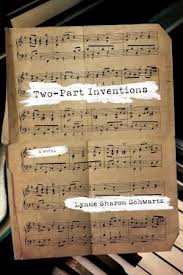
In other news, in case you missed the Twitter and Facebook announcements, there’s a beautiful new issue of Open Letters Monthly up, including what will almost certainly be my final OLM contribution for 2012: my review of Lynne Sharon Schwartz’s new novel Two-Part Inventions. I was so sorry not to be more enthusiastic about it, as her novel Disturbances in the Field is one of my all-time favorites. I wrote about it briefly here, and I wrote at length here also about my great admiration for Leaving Brooklyn. During the editing process, one of my co-editors asked if my review was an implicit response to the recent brou-ha-ha about critics being “too nice.” It certainly was not–at any rate, I did not set out to be not nice, and I hope the review does not come across as anything but what I believe it to be, which is honest and thoughtful. In his “Critic’s Manifesto,” Daniel Mendelsohn proposed that “The intelligent negative review … does its own kind of honor to artists: serious artists, in my experience, want only to be reviewed intelligently, rather than showered with vacuous raves—not least, because serious artists learn from serious reviews.” I agree that taking a work seriously is a way of honoring it and its author, and in this case (as with my review of Jeffrey Eugenides’s The Marriage Plot) I tried to write an “intelligent negative review.” It’s not the kind of reviewing that gets a lot of attention: it’s no good at all as link-bait, compared to the outrageous pan or the “vacuous rave”–but it’s hard work and I think does more service to readers and writers than either of the more extreme alternatives.

This Week In My Classes: More Margaret Kennedy

We had another session on The Constant Nymph today, and I think it’s safe to say we are getting more comfortable with it–which is not to say we have worked out our interpretations of it, but that we have a sharpening sense of what is interesting about it, of what critical conversation to have about it.

Today, for instance, we focused a lot on art, or more specifically, music, in the novel. Kennedy said herself that she meant the novel to focus on the conflict between “art” and “culture.” In the middle section we’re reading, we see this conflict embodied in the characters of Lewis Dodd, a composer, and his wife Florence. Florence fell for Lewis in part because she knows and admires Lewis’s “Symphony in Three Keys.” But she doesn’t know Lewis as we know Lewis from the first part of the novel, when we seem him to be single-minded and cruel, and also in love (in a slightly creepy, slightly idealized and otherworldly way) with the eponymous “nymph,” 14-year-old Tessa. Lewis represents, or at least stands for, art as an end in itself. In a revealing exchange with Florence, who is trying to use her social connections to further his career, she challenges his “arrogant” attitude:

“Your attitude is completely wrong. You put the wrong things first. Music, all art . . . what is it for? What is its justification? After all . . . “

“It’s not for anything. It has no justification. It . . . “

“It’s only part of the supreme art, the business of living beautifully. You can’t put it on a pedestal above decency and humanity and civilization . . .”

“You want to use it like electric light,” Lewis scoffs. He abhors the very idea of music that is commercial, consumable, even pleasurable. “Why do you write music?” asks Florence; “Don’t you want to give pleasure to people?” “No,” is Lewis’s blunt response.

Florence, as this dialogue shows, stands up for what it seems Kennedy means by “culture” (“My father’s cultured,” Lewis says scornfully). She wants her art, and her husband, domesticated: a major part of this installment focuses on the suburban home she establishes for them, which means nothing to Lewis (who literally can’t find his way around the rooms and is unable to describe it to his friends) and everything to her.

It’s easy to imagine a novel in which Florence’s belief that art can and should be commodified and incorporated into a suburban lifestyle of concert-going and outreach efforts at “bringing music to the people” would be ridiculed as tediously bourgeois, and there is something off-putting in the conventionality of her ideas. But Kennedy hasn’t set us up for quite such an easy call. The first part of the novel takes place in the chaotic home of Albert Sanger, Tessa’s father, an eccentric musical genius who lives with his family not only outside of England but conspicuously outside anything like ordinary English (or just ordinary!) morality. It’s not a pretty sight! Though the entire family has an unwavering devotion to music, which “was a sacred thing; perhaps the only sacred thing,” it’s hard to see this as very much in their favor when they are otherwise undisciplined, amoral, and just plain mean.

We had quite an animated discussion about this particular dialogue and how its terms help us think about the other parts of the novel. We also considered it as potentially reflecting on the novel itself: apparently Kennedy was quite self-conscious about the status of her own novel, which was initially received as high art (compared to Forster, for instance) but downgraded critically as it became a commercial success, so it’s odd that her characters almost anticipate the conflict between different ways of valuing art. And we talked about Tessa and tried to figure out where, if anywhere, she fits into this particular conflict in the novel. One of my students plausibly suggested that she’s a muse figure to Lewis, and I think we mostly agreed that she is at the center of the storm but not herself a part of it. She starts to get “civilized” by her time in England, which bothers Lewis in ways that reminded us of his dislike of having music packaged for a conventional audience: he likes her hair loose and wild, not plaited, and doesn’t like the way she starts to seem “sturdier.”

My favourite scene from today’s assigned reading is one in which Tessa, given a little money by her uncle and told to buy herself “something pretty,” comes back with a bowl. This too offends Lewis. “Tessa doesn’t want a bowl,” he states; “she oughtn’t to want one.”

“Why on earth not?” Florence was indignant. “It’s really an exquisite thing.”

“She has no house,” explained Lewis, taking the bowl and balancing it on one hand. “People with no houses ought to know when they are well off.”

“Take care! You’ll break it!”

“Bowls lead to houses. Houses are mainly to keep bowls in. If Tessa had a house she could buy as many bowls as she liked. She’d be done for. As it is, she should beware.”

And then, of course, he drops the bowl: “the lovely, brittle treasure lay in shivers on the floor.” Florence is more upset than Tessa.

This Week In My Classes: Meetings, Deadlines, Poems, Mysteries, and Nymphs

This past week was very busy, which is why I didn’t manage to post this during the week. For one thing, one of the committees that I’m on had to do a series of consultations, which involves both the actual meeting times and a fair amount of correspondence and negotiation getting things set up. Another committee I’m on got an announcement that had extremely worrying implications for our department’s MA program, and until the details got sorted out and corrected, that generated a fair amount of worried conversation and debate. These are important things, even if sometimes they seem, or turn out to really be, tempests in tea pots: one of the things most academics value highly about their work environment is self-governance, and that takes both time and concern to do well.

Then, it’s getting to be reference letter season, for grad school applications and for academic jobs, and I came up on my first few deadlines this week. Just as one example, it took me about two hours to complete a satisfactory draft of one of these letters and then print, scan, and email it according to the directions. Because every single place has a different process , some of them including forms to be downloaded and/or filled in, others requiring hard copies, and still others scanned versions, it’s very hard to create efficiencies: ten letters for the same candidate may all need to be done differently. Also, students have started taking me up on my urging to come and see me in my office to talk about their assignments. I believe very strongly in the value of such one-on-one meetings, but it’s a good thing that so far only about 10% of my 140 students this term have set them up, only because I couldn’t possibly take care of my routine class prep, not to mention my marking, if they all did. I also did some graduate advising work, responding to a revised thesis chapter while also thinking hard about and then trying to address appropriately some really important questions my student is struggling with about her degree program. These are not the kinds of things people outside the academy think about, in my experience, when they talk about our workload: everyone focuses on hours spent in the classroom, and specifically the undergraduate classroom. But taking care of our students (at all levels) involves a lot more than just showing up for class.

Last but not least, I have been working on a review for the November issue of Open Letters Monthly, and although editors get a little leeway in our usual submission deadlines, I really wanted to get it to my colleagues before the end of the week so that I would be sure to have time for revisions. I sent it off late Wednesday night: hooray! And I already have their thoughtful comments back and can tidy it up easily enough in time for the new issue. It’s mostly because I was using all my spare time to do that reading and writing project that there hasn’t been any blogging going on: for the last couple of weeks I really haven’t read anything of substance besides the book for the review (Lynne Sharon Schwartz’s newest, Two-Part Inventions) and the books for my classes. What did I think of Two-Part Inventions? You’ll have to wait for November 1 to find out!

And speaking of the books for my classes, what were they, you ask? In my first-year class we’re moving through our ‘introduction to poetry’ unit, gearing up for the first essay assignment. We read ‘I wandered lonely as a cloud’ and ‘God’s Grandeur’ for Monday, which gave me some reference points for a later discussion of how to develop a comparative thesis for a close reading poetry essay. For Wednesday, we read Elizabeth Bishop’s ‘The Fish.’ I’m not sure I’d read that poem before this year! I really enjoyed it, both as a poem to read and as a poem to work on in class; there are a lot of striking word choices that were good for provoking discussion–one of my major ‘talking points’ for them so far is “Don’t take the words on the page for granted,” and that’s just easier to do when the words are really unexpected ones! And then on Friday we worked explicitly on how to write essays about poetry. I’m trying to demystify the critical process by focusing on straightforward tasks like note-taking and pre-writing strategies. I have ended up talking a few times about my own writing strategies, including the things I find difficult and some of the ways I try to get past them. As I had a deadline of my own to meet, how to get the writing done was very much on my mind! I hope it’s useful to them to realize that writing is something I do, and struggle with, too.

In Mystery and Detective Fiction, we’ve just finished The Maltese Falcon and started An Unsuitable Job for a Woman. I really have nothing new to report about these books or the experience of teaching them, except that I think that this time I’m finally done with The Maltese Falcon, at least for a while. I’m starting to tune out when re-reading it for class, which is not good.

In the Somerville seminar, we’ve finished with South Riding, which generated lots of very lively and interesting discussion right to the end. I’ve been so encouraged by the response to it, and also so engaged by the novel myself, that I’m feeling frustrated that I can’t quite think of another course in which I could reasonably assign it. We used to offer a year-long class called ‘The Novel to 1900,’ which was fun, if challenging to those of us not altogether at home in the 18th century, but even if that was still on the books, which I don’t think it is, 1936 is even more of a stretch than 1908, the date of A Room with a View, which was the novel I used to close the course with. We now have a class called ‘Fiction of the Earlier 20th-Century,’ but it’s not specific to British fiction, and a class called ‘British Literature of the Earlier 20th-Century’ which is, obviously, not just novels. Both of these would be a real stretch for me! And also they are usually offered by the people in our department who do specialize more or less in these fields…though technically I think we do not currently have anyone whose research area is ‘earlier’ 20th-century British literature. The easiest thing to do with anomalous interests such as mine in this cluster of ‘Somerville’ texts is to offer a special topics seminar at the upper level, which is what I’m doing now: to some extent that relieves you from the burden of really wide or deep knowledge. Maybe I’ll put in for one of the more general courses one day, though, just to shake things up.

After South Riding, we started Margaret Kennedy’s The Constant Nymph. It doesn’t seem quite as odd to me this time as it did when I first read it, which I hope is a consequence, at least in part, of the work I’ve been doing for this class. But even in the context of my seminar, it’s an anomalous book, not obviously related in theme, style, or structure to our other readings. We have come up with some ideas about ways it relates to them, including its interest in women’s roles and women’s education, and also its attention to the potentially destructive force of sexuality. Each of our other novels, though, at least arrives in front of us with some obvious critical frameworks; each of them belongs to a critical conversation that’s more or less familiar, even if our specific examples are not the most canonical ones. The Constant Nymph does not. Scrounging around for explicit commentary on the novel, I have come up with a few ideas: there’s a lengthy discussion of it in one book on literature of the 1920s as a “sex novel,” for instance, meaning (in the context that book establishes) a novel focusing on a young female protagonist and on female sexuality. That does fit with our general impression that the book is a bit like Lolita–the “nymph” of the title is fourteen when the novel begins and the love interest of a much older man, though he doesn’t exactly act on, or even quite acknowledge, his feelings for her at first. Kennedy herself said the book was meant to explore the conflict between “art” and “culture,” so we’ve been kicking that around a bit. It is unnerving in some ways not to know where I want our discussions to go, what patterns or priorities to pursue. But the class is full of smart, curious people and I think we are doing well trying out ideas and seeing where they take us.

One thing we talked about right away is how obscure this novel is now compared to how famous and popular it was in its early days. One sign of its popularity is that there were three different movie adaptations of it, including one in 1943 starring Joan Fontaine. I was amazed that the trailer for this version turned up on YouTube. Watch it and see if you don’t suddenly want to read The Constant Nymph for yourself! Except that you might end up surprised at just how little the book resembles what you get here.

I hope to get some good extracurricular reading done in the next week or two. I have to, in fact, as both of my reading groups have meetings coming up! For Slaves of Golconda we are reading Rose Macaulay’s Crewe Train (remember, you can join in if you want!) while for my F2F group we are reading Wide Sargasso Sea, which is one I really should have read before now. I also have to read a PhD thesis for a defense on November 16, and keep up with the books for my classes … should be another couple of busy weeks.

This Week In My Classes: Love Poems and Social Novels

In English 1000, we’ve started our first poetry unit. We’ll be doing more poetry after Christmas, organized into what I hope will be provocative thematic clusters, but for now we’re just working through the basics of reading and analyzing poetry — meter and scansion, figurative language, poetic forms and modes. We haven’t really talked much about specific poems yet, since I’ve been using the assigned ones mostly to teach vocabulary for poetic devices, but on Wednesday we’re reading a little group of love poems and I hope to open things up a bit more than I have been doing so far. I haven’t quite decided how, though. The poems are Anne Bradstreet’s “To My Dear and Loving Husband,” EBB’s “How do I love thee,” and Shakespeare’s “Let Me Not to the Marriage of True Minds.” I guess some talk about sonnet form is probably appropriate, and about EBB’s appropriation of the conventions of love sonnets for a woman’s voice. Maybe we’ll get a bit silly and play Poetry Survivor: set up some standards for a great love poem and then vote one off the island out of the anthology as the weakest of the three. All this talk about metrical variation and synecdoche has probably made them afraid to react viscerally to a poem! The challenge, an exercise like that might show them, is to channel that gut reaction into an energetic analysis of the actual poetry.

In English 2040, it’s hard-boiled detective fiction time. Every year I swear I’ll dump The Maltese Falcon for The Big Sleep and I never do. But the thing is, first of all, that I really do think The Maltese Falcon is brilliant, and it teaches so well, by which I mean it brings up so many of the themes we’re interested in across all of our readings. Also, and this is not incidental, I have been working with it for a while and feel pretty confident talking about it. Even just considering how convoluted the plots of these novels are, that’s no small thing! Still, I’m sure The Big Sleep is just as brilliant in its own style. Maybe next year, since it looks like I’ll be teaching this class yet again…which is fine, as I really do enjoy it. I just find it kind of funny that the class I have offered most often in the last decade is this one, because it gets bums in seats (83 bums this year, to be precise).

Most fun this week is working on South Riding in the Somerville seminar. The students are very engaged, especially now that we’re past the initially disorienting ‘getting to know all the characters’ phase. We had a lively discussion today about the variable points of view in the novel and how they affect our understanding of the community and also our sympathies. One idea we considered is that the constantly shifting perspective makes it hard for us to arrive at moral judgments about the characters: just when we think we condemn their choices or actions, we are brought to see them in a different context. And yet there seem to be exceptions to this, people whose points of view show off their faults or limits. Alderman Snaith attracted the most attention. He seems clearly set up to be the bad guy, but it was pointed out that he isn’t really after anything so different from what everyone else wants (money, power, success)–he’s just smarmier about it. Also, he is indifferent to suffering caused by his pursuit of his own interests. Holtby has given him a back story that seems calculated to awaken our sympathy: it seems that he was abused or raped as a child by “evil men” and he’s been left “a psychological cripple for life,”  feeling only horror at “all thoughts of mating and procreation.” We haven’t really worked out how this particular trauma fits into the larger themes of the novel, or even into the overall portrayal of his character, but we were noticing other scenes or intimations of sexual violence and the destructive potential of sexual desire, from the death of Mrs. Holly in childbirth to the suggestion that Robert Carne raped his wife (the word he uses is “forced”). It’s a novel full of the rhythms and forces of the natural world, but it’s hardly a pastoral idyll: perhaps this is a way of showing that human life, despite the best efforts of civilization, is driven by the same powerful urges. One implication would be that reform (social, political, educational) is both urgently needed and inevitably futile. Sarah Burton’s idealism can make us want to stand up and cheer. “We’ve got to have courage, to take our future into our own hands,” she declaims to Mrs. Beddows. “If the law is oppressive, we must change the law. If tradition is obstructive, we must break tradition. If the system is unjust, we must reform the system.” But Mrs. Beddowss has “seen compassion impotent and effort wasted”; she reflects on the parade of miseries she has seen, on illness and suffering and injustice all brought on “by circumstances which neither courage nor intelligence could have altered.” Sarah dreams of “the gradual reduction of the areas ruled by chance,” but so far the novel has not filled its readers with optimism that such transformation is possible. Perhaps the novel is a lesson in lowering expectations. As Alderman Astell, the once-idealistic socialist, remarks to Sarah, “You begin by thinking in terms of world-revolution and end by learning to be pleased with a sewage farm.”

This Week in My Classes: Am I Making Excuses for Gaudy Night?

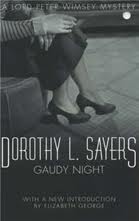
I’ve confessed here before that I can have trouble staying “objective and professorial” during discussions of Gaudy Night because I love the novel so much.  I have loved it pretty much since the first time I read it, which is a long time ago: my personal copy is from a 1978 edition, and though I can’t see any sign on it of when it was actually printed, I wouldn’t be surprised if it was close to that date, which would mean I’ve been rereading it since I was 12 or 13. (Here’s a possible clue: I have the matching edition of Busman’s Honeymoon, and it’s inscribed to me on my 13th birthday, in 1980.)

I don’t think it’s necessarily a bad thing for me to let on that I love a particular novel. I make no secret of my strong feelings about Middlemarch, after all, but I am also clear that it’s not my job or my purpose to get students to love it, or even like it: I’m trying to help them understand it, and teach them to appreciate it. I also teach novels I don’t particularly like, though I don’t typically make a big deal about that; again, my job (and theirs) is about something else.  What’s important is that I encourage, respect, and support students as they develop their own interpretations: my feelings about the novel should not come into this, only my knowledge of the novel and my experience thinking about how its different elements are related, and what they mean.

But are these aspects — my feelings, and what I’ll call my ‘expertise’ — really so unrelated? Don’t I love the novel because of how I interpret it, and don’t I interpret it as I do because of the time and thought I’ve put into reading and rereading it? Or is it that I read and reread it because I love it, and thus I interpret it as I do because of how I feel about it? What does it mean to “love” a novel anyway? And since this particular novel focuses on precisely the challenge of integrating head and heart, can’t I just stop worrying about which came first, the love or the understanding, and be happy that here I find the perfect fusion of the two?

I could, of course, and yet it wouldn’t be intellectually honest not to think carefully about the problems my students routinely raise on their first reading of the novel, and intellectual honesty is the fundamental principle of Gaudy Night. So here are some of them, and some preliminary responses. I think they are intellectual responses, responses based on my ‘objective and professorial’ understanding of the novel. But I worry that they are excuses, ways of getting around problems with the novel, that are motivated by my loving desire to protect it. Maybe — probably — they are some of both! What do you think?

1. The novel is elitist, and/or Harriet is elitist, about education.

I actually think that this is true, but for me it’s not a telling criticism of either Harriet or the novel. Both idealize a certain kind of education, and a set of values, according to which a university education is not for everyone the way we like to think (or talk as if) a university education is for everyone here and now. I thought this objection might be tempered in my Somerville seminar because we’ve already spent quite a bit of time thinking about Oxford as an idealized space as well as a place with very particular social and historical significance for women at this period. Up to this point the university had never been a democratic institution or even, really, a meritocratic one, but women’s access to it mattered and the dream of Oxford as a means for women to transform their lives was very powerful. Gaudy Night explores both this dream and its limits. I also think that it is self-conscious about this as a dream, including for both Harriet and Peter, neither of whom ever really imagines giving up the rest of their lives to embrace an academic vocation. And academic life is shown very much as a vocation, not a profession. It isn’t right for everyone. It isn’t even, as I’ve said, right for Harriet. Oxford itself, too, is shown to be much more (or is it much less?) than that ideal. But to Harriet, and, I think, in the novel overall, the life of the mind that Oxford symbolically represents is something special, something worth aspiring to and cherishing above other options. If that’s elitist, sign me up, I guess.

A key episode that always provokes intense reactions is Harriet’s conversation with her former classmate Catherine Freemantle, now Mrs Bendick, who has become a farmer’s wife. “What damned waste!” Harriet thinks; “All that brilliance, all that trained intelligence, harnessed to a load that any uneducated country girl could have drawn far better.” Is Harriet just being a snob? She asks Mrs Bendick about the “compensations” of her work and Mrs Bendick asserts that it is “a finer thing than spinning words on paper,” but she goes on to admit that she misses “things” and feels resentful of what she has given up. “It seems queer to me now,” she says, “to think that once I was a scholar.” If Sayers had wanted us to see working the land as a genuinely valuable alternative, couldn’t she have made Mrs Bendick happy and confident in her choice instead? Is she, therefore, dismissing farming as lowly labor, unworthy of a certain better class of woman, or is she regretting that a highly educated woman (still a rarity, in 1936) has lost, or given up, the opportunity to use her education?

There’s also Miss Cattermole, the current student who’s getting in all sorts of scrapes and hates that her parents have insisted she go to Oxford when what she wants is to be a nurse or a cook. “We haven’t got room for women who aren’t and never will be scholars,” rages Harriet after their conversation. Cattermole’s mother is of the generation that fought “to get things open to women,” and now Cattermole feels herself a victim of her mother’s feminist ideology. When Harriet demands, “Why do they send these people here?” is she, once again, being elitist, asserting that not everyone is fit to go to university? Or is she upset that a rare space at a women’s college is being wasted on someone who would be perfectly happy without this particular kind of specialized education? Who’s at fault here, anyway? Oxford, for not being right for Cattermole, or Cattermole’s mother, for mistaking her daughter’s opportunity for her daughter’s obligation?

2. The charge of elitism extends also to a more general complaint about class prejudice, and the identity of the perpetrator adds to the sense that the novel overall is kind of snooty.

I think this is partly true, but that it oversimplifies. Harriet herself is not upper class or aristocratic, and the difference in class and wealth between her and Peter is a major stumbling block in their relationship. Her education has changed her social position in some respects, and Oxford itself is a symbolically leveling environment for their relationship (their academic gowns are the same size, even). The privilege represented by the university is not exactly a matter of class, though, and the prejudices most on display in the novel are against the uneducated, or the enemies of (women’s) education. Annie’s own position at the college is a bit of a red herring, as far as class goes: yes, she’s working as a servant, but if things had gone differently she’d be a faculty wife. She’s dangerous and vilified because of her Nazi-affiliated views on women’s proper place, not because the novel (despite being set in a hierarchical, class-conscious world and full of people who take that structure for granted, Harriet included) is anti-working-class. I usually suggest that the central crime in a mystery novel can be read symptomatically. In Gaudy Night, the most dangerous force is a regressive sexism directed against women who have gone, or seek to go beyond, their historically limited roles through education. Such reactionary misogyny is, tragically, not a fiction in today’s world, where as we’ve just seen, it can take a tragically violent turn. Early Oxford women obviously did not face the same literal level of threat, but Annie embodies a version of the kinds of hostilities they really did incite.

3. Peter swoops in and solves the case, reducing Harriet to the status of a sidekick.

BalliolIt’s true that Peter is the ‘closer’ on this case. It’s also true that he withholds information and delays identifying his chief suspect, nominally on the grounds that he does not have sufficient proof and does not want to drive the suspect into hiding. But he also does so explicitly on the grounds that he thinks Harriet can figure things out for herself. He plays very nearly the ‘Great Detective’ role, including a classic reveal scene in which he lays out the facts of the case as he has sorted them out. Harriet’s role in the dénouement is closer to that of victim than that of heroine or detective: in classic Gothic style, she goes wandering down a dark hallway and nearly gets herself killed. But Peter makes clear that he solved the case only with the help of Harriet’s dossier, and Harriet  is taking risks in dark hallways because Peter has joined her on the case but not excluded her from it. Worried for her safety, he nonetheless accepts her right to take risks and encounter danger. Early in the novel he is injured because of a close encounter with a bad guy; now it’s her turn. It might be neater, if equality is the standard, for them to have worked literally together at each stage of the investigation, but their work until this point has been complementary yet not without conflict, and it’s not until after the case has been resolved that their relationship finally achieves mutuality (and they can finally kiss!). Disappointment that Harriet doesn’t triumphantly solve the case on her own ignores the novel’s dual purpose: it’s both a detective novel and a novel about the complicated relationship between Harriet and Peter. It is set up from the beginning so that both of these aspects need resolution. Harriet needs to figure out how she can retain her autonomy and love Peter. Feminism doesn’t have to mean doing everything without anyone else’s help. And love doesn’t have to mean capitulation. Harriet herself at one point imagines how much easier it would be to be “ridden over roughshod,” because hammering out an equitable alternative is exhausting in a world that sets up obstacles rather than providing models. Peter is not the man for that job, however–and a good thing, too, or she’d have to do a full-out Jane Eyre on him before they could marry with no threat to her self-respect.

4. Peter buys Harriet a dog collar to wear. He even wants to put his name on it! Clearly that’s a sign that their relationship is about her submission and his control.

 When I brought this up on Twitter, other readers promptly chimed in to say that, like me, they had never been perturbed by this–one noted that the dog collar is a handy solution to a pragmatic problem (what else could she wear as protection against strangulation?), while another remarked that her sense of the Harriet-Peter relationship was already strong enough at that point that there didn’t seem to be a problem. All three of us are resisting reading the dog collar symbolically, or at least as a symbol of ownership or control. In any other book, I don’t think I would resist this reading. Am I being disingenuous in arguing that I think it’s crucial to put the incident and the gift in context? Peter spends most of the novel explicitly not controlling Harriet: that’s not what he wants from their relationship, and the dog collar is proposed, in fact, as a means to her ends — with its protection, she can continue to take whatever risks she wants and live to fight (or write) another day. He doesn’t force it on her: she accepts it and later chooses to wear it. I’ve always felt that its symbolic role lies in that acceptance, which ties back to the problem of balancing independence with love. She has held Peter at bay because she believes she’s only safe (only retains her dignity and autonomy) if she takes nothing from anybody, or at any rate takes nothing from him. Gaudy Night is about her evolution away from that premise. What she finds at Oxford, and through her work on this case, is enough confidence in herself not to fear his generosity. The admittedly weird but fundamentally pragmatic gift of the dog collar opens the way to the gift of the chess set, which is an apt marker of the changing balance in their relationship. (There was another interpretation bandied about on Twitter, something to do with dog collars and their, er, erotic potential. Can we just rule out of order any attempt to turn this into 50 Shades of Sayers? As your whimsy takes you, indeed…)

5. In Busman’s Honeymoon Harriet is marginalized even further from the detective plot; this just completes the downward trajectory of Gaudy Night.

It is definitely true that in Busman’s Honeymoon Harriet is no longer on the case, and if the true measure of equality in their marriage was co-detecting happily ever after, then I concede the failure. But Harriet is a writer, not a detective! In Gaudy Night, that’s the strength she brings to the case and also the real quest she’s on (transforming the two-dimensional plot of her own detective novel into something more layered and complex)–well, that and learning to love again. I love Busman’s Honeymoon too, but the murder case in it always annoys me because I’m reading it for the romance. Gaudy Night is special because all of these aspects converge so splendidly.

Oh dear. Although I believe everything I’ve said here with all my head and my heart, and also believe these interpretations are entirely, dispassionately, defensible, there is an air of special pleading, isn’t there? And a disconcerting tendency to talk about Harriet and Peter as if they are really truly real … Please feel free to pitch in with your thoughts on the novel, and particularly on Objections 1-5. Clearly, I can use all the help I can get. Luckily for me, and perhaps also for them, tomorrow we begin discussions of South Riding, which I don’t know nearly well enough to love.

This Week and Last Week … But (I hope) Not Next Week!

It has been quiet over here, I know. That’s a symptom, as usual, of things not being quiet elsewhere and so my not having enough time and energy to spare for blogging. For the past couple of weeks it seems we haven’t had two straight days in which at least one member of my family hasn’t been home sick. When it’s the kids, that means extra pressure on the usual efforts to juggle schedules (and, of course, time spent giving them all the TLC we can muster). When it’s me, as it was (conveniently?) over the weekend, that means a fair amount of deferred maintenance on everything from class prep to grocery shopping. However, tonight things are looking up–I am mostly better, and my daughter is well (well enough, even, to get to her singing lesson, which we had to cancel two weeks running — ironically, this week her teacher wasn’t well, but she soldiered on so Maddie wouldn’t be three weeks behind). Only my poor son is still feeling pretty lousy, but at least he was sitting up and even eating a bit by the end of the day, so maybe he’s turning a corner, though I know it doesn’t seem that way to him right now because he mostly still can’t breathe.

One of the books I’m prepping for class this week is Gaudy Night–I find myself very sympathetic, on this reading, with poor Mrs. Goodwin who keeps having to leave work to tend to her sickly son. It is reassuring to think (or at least believe) that my own professionalism and suitability for my job isn’t being called into question the way Mrs. Goodwin’s is because I’ve had to cancel some office hours and miss a meeting or two! On the other hand, it hasn’t gotten conspicuously easier, in the intervening century, to find a really happy balance between the demands of work and the demands of family. Although it would be nice, once in a while, to take a real sick day and not actually do (or worry about) any work, I feel very fortunate that in this electronic age much of my work can be done from wherever, and whenever. My husband and I have also, for many years, been able to arrange to teach on alternate days, so that cancelling an actual class meeting is a rarity for both of us. It’s interesting to reflect on the complex triage we’ve developed. Classes trump meetings, meetings trump office hours, specific appointments trump office hours, office hours alone just get rescheduled, class prep gets done one way or another in the interstices, and research and writing … well, you can see how much non-essential writing I’ve been able to do in the past week! It’s notable that for both of us actually making it to class is so clearly the top priority. I have learned that students don’t usually much mind a cancelled class here or there, but we put a lot of thought and planning into our courses and for us, a missed hour can throw off a whole sequence (though I have also learned that it’s easy to overestimate how much that really matters). We are still clearly convinced that there’s real value-added in our physical presence and face-to-face engagement with our students. Just call us “the enforcers.”

Anyway, since I have little of intellectual substance of my own to offer right now, how fortunate that the new issue of Open Letters Monthly is fresh and full of goodies! By the time you’ve read every piece there from top to bottom, surely I’ll actually have finished a book or otherwise come up with something to say. And there’s lots of other good stuff around on teh internets, from proposals to remake the humanities PhD to discussions about the ethics of live-tweeting conferences to posts on Argentinian literary doom. Happy reading–and wish me luck.

This Week In My Classes: Good, Better, Best!

We’ve almost settled into a routine in my three classes, I think. The one I feel least certain about is my section of Intro. I think we’re doing OK, but I wonder if I made things a bit too intense at the very start of term as I focused on establishing expectations and framing our work as the preliminary stages in mastering a discipline. In my defense, I can say that the course is supposed to be a ‘writing across the curriculum’ offering and thus is supposed to teach writing in the context of training as a literary critic. But since I have a whole year to work with this group, I could have spared a bit more time, maybe, for getting-to-know you kinds of things. Well, we have the rest of the year to keep getting to know each other, and as far as I can tell, they are a nice group and seem willing to do what’s asked of them, and quite a few also seem willing to contribute to discussion already. Next week I’ll see if I can lighten things up a bit.

Mystery and Detective Fiction seems fine too. It’s a much bigger class (around 90) but a reasonable number of people are putting their hands up and saying smart things, and considering we’re working through The Moonstone, which is our longest and most formally complicated book, I’m hopeful that as we move into more accessible ones it will get more lively. The Moonstone is always such fun; though I occasionally wonder if I can make it through the sessions one more time (I think I’ve taught it for at least one class pretty much every year since 2003), once it’s underway I really have no complaints. I can’t imagine doing this particular class without it: I’ve rotated in different titles for many of the other subgenres I cover, but The Moonstone is a fixture.

Of greatest concern to me as this week began was how the first discussions of Testament of Youth would go in my Somerville Novelists seminar. I am so pleased to report that they have gone extremely well! Or, at any rate, that I have thoroughly enjoyed both preparing for them and participating in them–and judging by the level and the quality of the students’ participation, they too are finding plenty to interest them. Hooray! For each class there are three students bringing what I call “Start-Ups”: handouts with two questions and two passages they’ve chosen, to start up our discussion. We take a few minutes at the beginning of class to go through them (I used to require students to post them before the class so their classmates could come prepared, but I learned that invariably, students didn’t do that, or if they had, they still liked having the handout). Then we just go where people want to go.

We’re nearly half way through the book at this point–we’ve just passed Roland’s death–and so the personal drama has become more gripping, and we’ve started sorting out some of the ways she tells the story to make particular kinds of points. Last class, for instance, we talked about her idealization of Roland and how he becomes the embodiment of everything the war destroyed, and we also talked about the attention she pays to the physical bodies of the soldiers she nurses and how for her, that becomes a way of recognizing and valuing the physical side of her love for him. We’ve noticed the ways she emphasizes her feminist principles and the tensions this creates not just in the story she’s telling (for instance, she and Roland are reluctant to announce their engagement because they resist the conventional implications of marriage) but also in how she tells it (is her idealization of Roland perhaps symptomatic of an anxiety about having become one of “those women” she initially disparages, who have love and marriage and children as their first priorities?). We noted how strongly she dichotomizes first her provincial experience and her dreams of Oxford, and then the academic life at Oxford and the harsh realities of war: she seems to approach the world in terms of such antagonisms, and she also always wants to end up where the action is. We’ve talked about her desire to be taken seriously as an individual, not belittled or constrained as a woman, and then about Testament as a way of asserting serious value for a woman’s experience of war; we’ve talked about the frequent exchanges she and her male friends have about courage, and about the different ways they seek to overcome their fears and prove their valor. There’s more, too, but you get the idea: everyone’s noticing lots of interesting things, and we’re working out connections and trying to see where they take us. I’ve done a reasonable amount of steering and also of trying to abstract from particulars to draw out their implications, but there’s been no need for me to step in and fill awkward silences. Here’s hoping the energy continues, and that it motivates everyone to get busy with the wiki projects, which we’ll be focusing on pretty soon.

This Week in My Classes: Year 6 Begins!

I find this hard to believe, but 2012-13 will be the sixth year for my series on ‘this week in my classes.’ I began this series as a straightforward attempt to document and reflect on what goes on in an actual university English class, as opposed to the phantom indoctrination factory some people seemed to imagine we run. Though I still run into occasional examples of ‘bad old English professors talk nonsense and/or ruin all the fun’ comments, I’ve been thinking that there’s a different context now that makes it newly relevant for me to think about what it means to be ‘in my classes’: the much-hyped, much-debated, perhaps much-exaggerated disruption that is online teaching, and particularly MOOCs.

All summer there’s been an endless stream of commentary about what MOOCs can and can’t do, what they’re good for and what they aren’t–and, directly or by implication, about what, if anything, is the special value of actually being in a classroom face to face with a professor. Often, especially on the pro-MOOC side, and sometimes even in pieces that aspire to be even-handed (like this one, just yesterday), there are a lot of casually dismissive generalizations about the so-called “sage on the stage” model of teaching that supposedly dominates the contemporary academy–just for example, that recent piece talks about in-person education as “a classroom-based activity with a tweed-clad professor at a lectern.” I read these comments (which are then used, more often than not, to argue that face-to-face teaching is old-fashioned and overdue for disruption) and wonder whose teaching they are talking about. It’s true there are huge lectures, mostly (but not altogether) in subjects other than English, and that it is a stretch to call such classes “face-to-face” if one of the faces you mean is the professor’s. But it’s also true that there isn’t a lot of nuance in the claims I’ve seen about which classes might as well be scaled up to 10,000, or 40,000. Humanities classes raise significant pedagogical challenges for the MOOC fantasists; for a thought-provoking chronicle of one university teacher’s experience as a student in an online literature class, see here (I’m tempted to add “read it and weep!”). But it’s early days yet and who knows how things will develop.

At any rate, as I head back into my physical classrooms for the start of term, inevitably I’ve been thinking about whether I’m justified in believing that it’s not just more sociable but also pedagogically valuable to spend a few hours a week actually with my students, looking at their faces as they listen and react to what I say, watching them as I listen to them and respond to what they say. I believe it’s possible to build relationships, form communities, share ideas and knowledge, and get work done online–because I have done all these things myself. Maybe it’s because I know how much reciprocal effort and logistical precision is involved in a successful online venture that I can’t imagine undertaking it on a large scale. Or maybe it’s mostly that, as my grandmother always said, I’m a “people person,” which means I thrive on being around, well, people. I flatter myself (or do I?) that my students would (with exceptions, of course) rather be in a room with me–even on the occasions when I do just lecture (which are pretty occasional)–than watching a video of me (heaven forfend!) or posting on discussion boards. But maybe they wouldn’t! It’s probably salutary for me to have in mind that whatever exactly I do in my classes, it should be something more–more interactive, more spontaneous, more attentive, more in-their-faces–then they could get if they weren’t actually in the room. As a good first step, I can honestly state that I have never, to my recollection, worn anything tweed, and that I am rarely, if ever, sage.

As for specifics, this week is mostly about starting up. Last Friday was the first day in this term’s three courses: Introduction to Literature, Mystery and Detective Fiction, and The Somerville Novelists. Everything seems fine so far. The one I’m most preoccupied with is the Somerville seminar, and I will admit I found it unnerving today, in our first discussion of some readings, when I came up shaky on answers to a couple of straight factual questions–such as when, exactly, Testament of Youth was first published! I should have been ready with this detail, and I thought I knew, but in the moment I wasn’t sure I knew (I said I thought it was published in the early 193os, and the precise date is 1933–so I was OK!). This is the kind of thing I know pretty much cold in my 19thC fiction classes, in which I have taught the same two dozen or so novels in different combinations for about 17 years! I guess I shouldn’t expect to be as good at this new material right away, but that disconcerting moment was a good reminder that when preparing for these sessions, I need to pay as much attention to the basic facts as I do to the larger questions I’m trying to raise, because though they are certainly somewhere in my notes, I can’t count on their being cemented in my memory.

This Week in My Class Prep: Sorting, Drafting, and Pondering

The beginning of classes is getting close enough that working on class prep no longer seems like just a way of avoiding more amorphous (and thus more stressful) tasks like research and writing. All summer, of course, I’ve been doing reading and thinking with my seminar on the Somerville novelists in mind, but now I’ve got a draft syllabus including a tentative assignment sequence. I’ve also been working on a prezi to accompany my opening remarks on the first day. At this point my plan is to sketch out the contexts that I think will be most relevant to our discussions of our four main texts: the history of women at Oxford, the suffrage movement, World War I, and modernism. As I work out details for the course requirements (still only provisionally decided) I am trying to balance a more open-ended attitude than is typical of even my upper-level courses with enough structure that everyone feels confident about expectations and standards.

Right now I’m feeling a bit panicky about this course, to be honest: I am personally very interested in the material, and I’m hopeful that the students will also find it interesting and have enough genuine curiosity and drive to make it work. But at the same time I worry that my expertise won’t be deep enough to support them if their interests take them too far afield, and that what seems enticingly open-ended to me will feel aimless or vague to them. Still, I’m glad not to be doing yet another round of one of my more familiar seminars: even though I could set up and run ‘The Victorian Woman Question’ or ‘Sensation Fiction’ or even ‘Women and Detective Fiction’ quite easily, as I’ve taught each of these seminars multiple times now, it is more exciting and intellectually challenging to be trying something new, and my being fresh has got to be beneficial to the students at some level. As I finalize the organizational details, I’ll keep reading background and critical sources to build up my confidence in the course content. This week I solicited advice on Twitter and got a great list of recommendations for books on World War I, most of which I was able to round up from the library. This week I’ll be adding to my collection of sources on women and modernism, and doing some reviewing of our four primary texts to help me decide on the reading installments for the schedule. And tidying up instructions for the wiki assignment. And … so many other things.

Because I won’t be changing much at all in this year’s version of the Mystery and Detective Fiction class (I shook up the reading list last year), my other main worry right now is my section of English 1000, Introduction to Literature. It hasn’t been that long since I taught an intro class, but most recently I’ve been doing one of our half-year versions, whereas in 2012-13 I’m doing a full-year section for the first time since 2000-2001! The half-year course I did was just “prose and fiction” (there’s a second course on poetry and drama that completes the intro requirement for students). The full-year version is supposed to address all of the major genres, so that’s one difference. The other difference, of course, is just having a lot more time with the same group, which is a great opportunity to develop both relationships and skills. Because book orders were due in the spring, that part of the course planning was already done (and there too I got very helpful input from people on Twitter, especially about choosing a contemporary novel to round out the syllabus). Now I’m sorting the readings into some kind of order and mapping out writing assignments, keeping in mind the various rules for the university’s Writing Requirements and our departmental policies on first-year courses.

The objectives for Introduction to Literature are quite broad and include both literary and composition skills. Aside from having to work on all the major genres, practice writing about literature, and give explicit attention to grammar, punctuation, and citations, what we do in Intro is pretty much up to us–which is nice, of course, but it also leaves every decision pretty wide open. So far I’ve decided to use the fall term for units on essays, short fiction, and poetry, drawing on the anthologies I’ve ordered, and to bundle the longer readings in the winter term. I’m pairing Night and The Road, and doing a poetry interval on grief, despair, and death to go along with them; and then I’m pairing Unless and A Room of One’s Own, with a women’s poetry cluster including Adrienne Rich, Sylvia Plath, and Margaret Atwood to set that up. We won’t be spending a lot of time on drama, but we’ll be reading one short play in the fall term. There’s time for me to add another one for the winter, but I’ve already discovered that once I set aside time for writing workshops, peer editing, and so forth, there’s not enough time to read all the poetry I’d like to cover, so I’m reluctant to crowd the schedule even more. I know some of my colleagues don’t assign any essays in their intro sections, so I figure I’m following the rules at least as well as they are! I really look forward to teaching poetry, which I don’t typically get much chance to do (last year, with English 3000, was another welcome opportunity). Students often mutter things about not “getting” poetry, or simply declare that they don’t like it–to which I typically reply that they should not, then, be English majors! Though novels are my first love as a reader, I do consider poetry the highest form of literary art.

At 30 students, my intro section this year will be the smallest first-year class I’ve ever taught at Dal: as part of a curriculum restructuring a couple of years ago, we introduced one extremely large section (largely with the aim of guaranteeing our TA allotment and thus funding for our graduate students) and (the silver lining) turned some of the remaining sections into these little baby ones. 30 isn’t really tiny, of course: at Cornell, I got to teach a writing seminar capped at 17, and that’s a size that makes serious one-on-one attention possible. Our sections of 30 will have no TA support, so it will be just me and them–all year long! Though with no TA I’ll have the same marking load as in the formerly-standard sections of 60, I will certainly be able to give them more personalized attention overall, especially during class discussion and workshops.

Demand for these small sections has been very strong: I think they all have waiting lists of at least 20. I hope that the students who get spaces in them appreciate that it is increasingly rare to be face to face with a (relatively senior!) professor like this for a full year. Inevitably I’ve been reflecting on all the hype around MOOCs as I plan my classes this year and trying to understand why it is so easy for some pundits to talk as if a teacher’s personal interaction with her students is an expendable part of the learning process. I know that many kinds of interaction are possible online (given my own range of online activities, I hardly need to be told that!), and for years I have supplemented my classroom time with a variety of technological options, from holding office hours in chat rooms to curating discussion boards or hosting class blogs and Twitter feeds. So much of the inspiration and motivation for students’ learning, though, comes from what happens between us when we look each other in the eye! And I don’t mean just for them: for me, too, it is often critical to be focused completely on the student, which often includes interpreting what they are trying to say, rather than what words are actually coming out. Moving towards understanding is a very fluid, dynamic, interactive process. And I do so much more with their writing than mark things right or wrong–and it takes so much time! With adequate resources, I suppose much of this could be done in some virtual way, but at some point, without that live classroom experience, this would cease to be a job I’d want to do. I guess I feel that way particularly at this point in the summer, when my own energy and motivation is flagging from sheer lack of human contact. When colleagues ask me how my summer’s going, they typically look shocked when I reply that it’s going slowly and I miss the energy of the teaching term (even though I do  rather dread the hectic pace of it!).  I had just this conversation again just yesterday, in fact. But it’s true!