“A Book of All My Secrets”: The M Word, ed. Kerry Clare

mword

I got to a poem about us, about how quickly our children become themselves, and as I blithely read the poem over the air, my five-year-old daughter suddenly, breathlessly, began to sob. She was inconsolable. When my husband could finally calm her down enough to speak, she blurted out, “Mommy wrote a book of all my secrets.”

It seems appropriate to be posting about The M Word: Conversations About Motherhood on my son’s 18th birthday. Milestones like this inevitably provoke reflections: memories good and bad, nostalgic and bitter, celebratory but always (in my experience, anyway) more complicated than you anticipate — or might be willing to admit, at least in public.

That’s what makes The M Word so surprising, and also moving, gripping, funny, and, occasionally, really uncomfortable to read: the writers put it all on the table, all the confusion, ambivalence, difficulty, suffering, hope, despair, and insight that swirl around people’s different experiences with motherhood, whether they are or aren’t mothers, however motherhood is defined, and whether their situation arose from choice or accident, gift or tragedy. As many of the writers observe, there’s a popular public story about motherhood that is all bliss, smiles, and cuddles. For many of them, there is plenty of bliss, but that’s rarely the whole story and often not the story at all. The M Word doesn’t try to tell one story: it allows, even insists, on the coexistence of many different ones.

All of the stories are interesting, though I expect that for most readers, as for me, the intensity of interest will vary. Paradoxically perhaps, since I’m a mother myself, one of the essays I found most compelling was Patricia Uppal’s “Footnote to the Poem ‘Now That All My Friends Are Having Babies: A Thirties Lament,'” a mildly abrasive commentary on pregnancy and motherhood from the perspective of a woman convinced she does not want children. “Perhaps it is my workaholism that keeps me childless,” she speculates. “I know I would resent the time spent away from my computer and notebooks. I already do. I think our three cats are demanding, and I frequently have to shoo them away as they bat my hands while I type.” Although my decision about parenting was not hers, I understand her resistance to it, and I know she’s not wrong about the threat of resentment. Other essays, though, bring out parenting’s rich and varied rewards (which it is hard sometimes not to think of as compensations). Still others emphasize loss — Christa Couture’s heartbreaking “These Are My Children,” for instance:

Sometimes I feel my mothering is finite, or plays on a loop. I can replay both of my children’s lives to their conclusions in my mind, rewind, and play them again. There is no wondering what they will become.

And still others take up abortion, adoption, and infertility with the same frankness, offering the same unsparing emotional revelations.

The M Word is a very personal book. Is there a point at which writing about our own experiences as parents becomes an invasion of our children’s privacy? Sarah Yi-Mei Tsiang’s “Mommy Wrote a Book of All My Secrets” is the only essay that directly confronts this question. I found it very thought-provoking because I have chosen to be fairly reticent about my children — and indeed all my family and friends — here. For one thing, Novel Readings is not meant as a confessional space: its focus is just different. I do write the occasional personal post, and I don’t try to keep the rest of the writing strictly impersonal. One of the things I cherish most about blogging is the freedom to be more openly myself while writing,whether about Christmas or about books.  But my private life remains private (or, you might say, my public presentation of my private life is carefully curated!). Crucially, I choose what to say about myself in this public space, and I don’t think I have the right to make that choice for other people by sharing their stories (or my perspective on their stories) — by turning them into subjects or characters in my story. Clearly, a lot of writers feel otherwise, including everyone who has ever written a memoir and many (such as Miriam Toews) who have written conspicuously autobiographical fiction. I’m not saying they are wrong to do so (and I have read and admired plenty of life writing of one kind or another), but I can sympathize with Tsiang’s daughter (quoted above), with her sense of injury at the unexpected exposure. I’m not sure I agree with Tsiang that this was her daughter’s “first lesson in the fact that you cannot love without exposing yourself”: maybe so, but it’s one thing to expose yourself to your loved ones and another to find your secrets broadcast on the radio. At least Tsiang learns a lesson too: “that it is both a responsibility and a privilege to write about the ones you love.”

There’s lots in The M Word that made me think — often about my own experience of motherhood, as a mother and as a daughter, but also about what I know my family and friends to have gone through, hoped for, lost, or celebrated in this context, and about experiences and attitudes entirely different from mine or theirs. When I picked the book up (motivated by knowing Kerry Clare as a Twitter friend and author of the splendid blog Pickle Me This) I was a tad skeptical: I didn’t think I was actually that interested in motherhood as a topic. I realize now that’s because I hadn’t given it as broad a scope as Kerry and her contributors do. The result is a collection that confounds expectations.

Back Again — With Books!

VancouverBooks

Why is book shopping part of any vacation I take? It’s not as if we don’t have bookstores in Halifax. I think it’s something to do with the feeling of freedom from constraints that holidays bring. If I’m not responsible for work, regular meals, or housecleaning, surely I can be irresponsible in other ways too! Not that buying books is necessarily irresponsible. As my wise sister once pointed out to me (and she’s a person who has bought a book or two in her day…) a new book costs about the same as a decent (not even a really good) bottle of wine — and it lasts a lot longer and can be shared more widely! Besides, I’m an English professor, a critic, and a book blogger: books are necessities, not luxuries, right? (I feel pretty safe asking this rhetorical question here, since people who disagree are unlikely to be reading.)

My book haul this time is actually quite modest, especially considering some were gifts and one is a loan from my mother. I could actually go “book shopping” just on her shelves and make out better than in most bookstores, as there is a lot of overlap between our interests and tastes. Her Bloomsbury section alone is a treasure trove! And if you want to read about the history of the Balkans, she’s there for you. But I restrained myself and took only Carol Shields’s Small Ceremonies. I’m teaching Unless again this fall and this is one of Shields’s that I have never read. It has a great opening line — understated but immediately engaging in a way that reminds me of Anne Tyler: “Sunday night. And the thought strikes me that I ought to be happier than I am.”

olafsdottirMy mother and I made our traditional trip to Hager Books in Kerrisdale, which has a relatively small but carefully curated selection that always provides many tempting options. Here too I was restrained, though! I chose Penelope Lively’s Dancing Fish and Ammonites, which I had eyed there last year in hardcover but which is now available in a neat paperback. I liked Oleander, Jacaranda a lot; this later memoir looks as if it will focus more on Lively’s writing life. My other choice was more impulsive. In general my book browsing this trip was influenced by my frustration with the highly-touted The Goldfinch, and as a result I was drawn to books I had heard little or nothing about — which has its own risks, of course! (Serendipity isn’t always the worst guide, though, as I found when against all precedent I chose Molly Peacock’s The Paper Garden a few years back.) I don’t know exactly what made me pluck Audur Ava Olafsdottir’s Butterflies in November off the shelf, but once I had, everything about it appealed to me, from the cover design to the description of it as “a charming story of a free-spirited woman who reaches a life-changing juncture and embarks on a whimsical Icelandic road trip that sets her on a new course.” Who could resist? (I’m not sure if I mean the book or “a whimsical Icelandic road trip,” which actually sounds pretty inviting to me. If you come calling in a month or two and I’m nowhere to be found, I may be in Reykjavik.)

Small-Blessings_tpWords like “charming” can be warning signs for me, and yet I was also drawn to Martha Woodroof’s Small Blessings, which has a blurb from Oprah.com calling it “a charmer.” Oh dear, right? But it’s about a college professor and a book store manager, and (like Small Ceremonies) it looked like it would have an Anne-Tyleresque vibe. I looked at it in Hager Books but decided against it. When I stopped in at Indigo a couple of days later, though, there it was again, and this time I bought it. I read most of it during my long travel day home and finished it up this morning. It is charming. It’s not as good as the best of Anne Tyler, but it has the same interest in fairly ordinary people figuring out how to be happy, which is nowhere near as small a topic as it sounds. I appreciated how unpretentious the novel was: it never seemed to be straining after something the novelist couldn’t do. Usually I admire ambition: once again, I blame The Goldfinch — which, while not exactly a failure, seemed arrogantly inflated — for my seeking modesty for a while. Small Blessings does a lot less than The Goldfinch, and it doesn’t even aspire to be a novel of ideas (as far as I could tell). But what it does, it does nicely, with (yes) charm.

My other Indigo purchase is similarly small-scale, though not necessarily unambitious: I chose a volume of Alice Munro stories to add to the too-few I already have. I’m always vowing to read more short fiction in general and more Munro in particular. I chose Hateship, Friendship, Courtship, Loveship, Marriage because it includes “The Bear Came Over the Mountain,” which I have read and found thrilling and deeply moving. (It’s the basis for the film Away from Her, which I thought was very good.)

The only other book I bought on the trip was a slim book about Emily Carr, from the Vancouver Art Gallery. I have always loved Carr’s paintings, particularly the ones that are almost entirely trees: they so wonderfully capture the mystery and majesty of the coastal forests I grew up beside. Perhaps because her work was so casually familiar to me, I have never tried to actually learn about Carr as an artist, though I have owned her autobiography Klee Wyck since I was a child. There’s something poignant about looking at Carr’s rich, dark woods now, when fires are burning along the coast and this kind of dire forecasting is in the news:

Over the next century, climate scientists predict that Vancouver Island’s iconic trees—such as the cedar redwoods, western hemlocks and Douglas Firs—could die off in large numbers, completely transforming the island from a rainforest ecosystem to something else entirely.

The other books in my photo are also artsy. One is a collection of Arts & Crafts postcards, a souvenir from my parents’ recent trip to England. (My problem with this sort of thing is that the cards are always so lovely that I hesitate to use them as they are intended! Maybe I should buy one of those photo frames with a whole bunch of spaces and create something decorative out of them.) And finally, we visited a wonderful woman who is a dear friend of my parents and who recently celebrated her 100th birthday. Knowing my love of 19th-century literature, she very kindly gave me a beautiful Jane Austen “daybook” from the British Library. It is full of elegant illustrations and choice quotations from Austen’s novels. I hate to sully it with my not-so-elegant handwriting, but it would be very useful for me to enter the birthdays of everyone in my family: maybe if I did that I wouldn’t be late with gifts for anyone again!

StudyinBlue

My trip was about a lot more than books, of course: that’s just the part it seems appropriate to write much about here. Most important was the chance to spend time with my parents, and with my brother and sister and their families, and to catch up with some of my cherished friends. I was very happy to be able to do all that, even in the middle of a heat wave (and even when the city was blanketed in smoke from the fires). It’s good for my soul to reconnect with them all, and it’s also always restorative to soak in the beauty of the mountains and the sea.

KitsSunset


Meeting The Penderwicks and Thinking of Old Friends

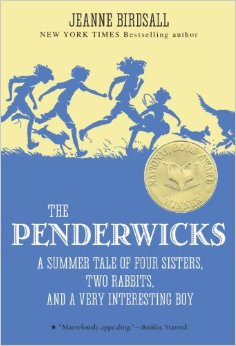
penderwicksOn the warm recommendation of two of my favorite readers, Sarah and Dorian, I read The Penderwicks this weekend. It’s charming! And, as the cover blurbs suggest, it’s a bit of a throwback, a children’s book of a gentler kind that seems (and is packaged, at least in the edition I read) to have come from an earlier time. This is not to say that it is simplistic: I would describe it as both sweet and sprightly, with just enough shadows (a dead mother, an evil step-father-to-be, a bit of tween angst, a ruined planter of jasmine) to keep it interesting. I enjoyed it — though I admit I did not love it, and can’t see myself rushing off to read the rest of the series. If I had a young reader to share them with, perhaps, but without taking any general stance on the whole adults-reading-kids’-books thing (I said my piece on that already, here), I’ll just say that for this adult reader, this one was a bit too thin and predictable to feel right for the reader I am now. (I’m bracing for your counter-arguments, you Penderwick lovers! Keep in mind I led with “it’s charming”!)

It got me thinking about the books I enjoyed when I was about the age The Penderwicks seems written for — the School Library Journal says Grades 4-6, but allowing for readers who are more precocious than they expect, let’s say ages 7 to 10-ish. Most of my favorites were historical fiction, one way or another: Alison Uttley’s A Traveller in Time, for instance (which I’m thrilled to discover has been reissued in the New York Review Children’s Classics collection), or Barbara Willard’s The Lark and the Laurel and The Sprig of Broom. I still have my crumbling copies of these, along with Barbara Leonie Picard’s Ransom for a Knight. I read all the Little House on the Prairie books, of course (I still have my original box set), and the Anne books, and Little Women (in my mother’s illustrated edition) — but it was the ones about brave girls having adventures in long-ago times that appealed most to my imagination. Those books were the gateway drugs to the “adult” historical fiction I read avidly throughout my tween and teen years, especially Jean Plaidy’s many series (also, I see, now being elegantly reissued) — which in turn led me to, well, where I am today, though I thought at the time that I would end up a historian. uttley

When you look back on your youthful reading, do you see signs in it of the person you grew up to be? Are there cherished childhood volumes on your shelves that have, like mine, survived moves and purges, and perhaps time in your own children’s custody? (Neither of my children ever caught the historical fiction ‘bug’: Maddie finally told me straight up to stop buying her books that I would like, which to be fair, is entirely the right advice. Plus Ransom for a Knight is pretty fragile, so it’s a good thing she never wanted to read it. Harumph!)

This Week in My Sabbatical: Winter Reflections

WP_20150203_004The thing about being on sabbatical during the winter term is that no matter what else changes, it’s still winter! And boy, have we had a reminder of that this week, with three storms already in the past seven days and another one apparently barreling up towards us tonight.

It’s no secret around here that I don’t cope well with east coast winters. Yes, it is very bright when the sun shines on the snowy landscape, and bare branches look better frosted with ice than not. But that’s really not very cheering when you spend your sunny day chiseling out the driveway and hoping the roads will be cleared in time to make it to appointments, lessons, and rehearsals, not to mention just to school and work.

Since I finally gave up on my dream of relocating, I have tried to find ways to make winters here less stressful, and I have actually narrowed down the problem to one main issue: winter driving. I don’t know if I’ve mentioned here before that I am fairly phobic about driving anyway — not everyday city driving, but I experience intense anxiety when driving (or, worse, being driven) on highways, for instance, or across suspension bridges, or on snow- or ice-covered roads. People who never suffer themselves from stomach-clenching pulse-racing anxiety are often disbelieving, impatient, or irritable about it and about the inhibitions it creates. I have struggled with it a lot myself, because I know that my fear leads me to pass up opportunities. Feeling guilty, ashamed, or self-critical has not, however, turned out to help at all (as other anxious people will probably understand). So a while ago I decided to give myself a break and spend less time either facing down or smiling bravely over the fear, and to live as much as possible within my comfort zone. I have enough stress about things that I can’t choose to avoid. Driving long distances, however? Not required. Going over the bridges to Dartmouth? Almost never necessary. The things I miss out on just, for now, don’t matter to me as much as the bad experience I’m spared.

Driving in the winter, however, is hard to escape altogether. If I could get by without driving when it’s snowy, though, I think I might not find winter stressful at all. Unpleasant, sure (I’m just never going to be one of those “take the lid off winter” types, and I don’t think anybody likes shoveling), but not anxiety-inducing. The problem is that walking isn’t a realistic option for everything we need to do, especially since a typical winter mess here is not just fluffy snowflakes but includes nasty ice pellets and freezing rain. (Today’s lovely variation is rain falling on top of 2 inches of ice that formed over about 6 inches of snow: huge lakes are forming where drains are blocked, and pedestrians are clambering precariously over mountains of encrusted slush.) Even if I were OK with dressing like some kind of Arctic sea explorer and sloshing doggedly through it, it’s a bit much to make the kids do the same, and add doctors and orthodontists and music lessons and extra-curricular activities to the basic demands of work and school and we really can’t manage without going in the car, however stomach-clenchingly pulse-racingly awful it makes me feel.

I have been doing better in the last couple of years, actually, and the more times I actually go out and drive in conditions like, say, yesterday’s or today’s, the more I know that it’s really not that bad if you have snow tires (I do) and take it slowly (you better believe I do!). But I still really hate it, and I hate the uncertainty associated with it too: I’m someone who likes to plan, to know what’s happening when, and the combination of unpredictable weather and hard choices between not driving and not going somewhere (or not getting someone else where they want or need to be) … let’s just say it doesn’t bring out the best in me.

There is something different this year, though, and that’s my perspective on winters in Halifax. I have been realizing that this whole mess is a problem that I might, one day, actually be able to solve, or at least work around. For one thing,  the kids are growing up. Owen starts at Dalhousie in the fall, and he’s probably moving into residence; Maddie is almost in high school. As their independence grows, so does mine. OK, so I couldn’t make a lateral career move to Vancouver. I almost certainly won’t be able afford to retire there either, and even if I thought I could, retirement’s a long way away. But eventually things like taking sabbaticals out of town won’t seem implausible, and maybe down the road I can figure out other ways to split my time between here and there. “Halifax is so nice in the summer,” people always enthuse. Well, so are most places, so that’s never seemed like a compelling argument in favor of Halifax in particular! But if I could get out of Halifax when it isn’t so nice (and spend more time, also, with the friends and family I miss so much when I’m stranded out here), I wouldn’t be so grudging about its charms.

It’s not a lot to hang on to, but when things are grim here at least I can keep playing with different scenarios, trying to figure out how I could make them work when the time comes. For now, though, I guess I’d better go see if I can clear any more ice away while it’s mild outside, because it’s supposed to drop to -14 again overnight (-26 with the wind chill!) and if all the stuff that’s melting now just freezes in place, I might never leave the house again.

Last Week In My Classes: Exams and What’s Next

The final exams for my classes were last Friday and Saturday, both at 8:30 a.m., both in Dalplex, our main athletics facility, which is converted during the exam period into, well, this:

dalplex

Looks depressing, doesn’t it? And it is, but it is also efficient: a cadre of assistant invigilators patrols the aisles, helping to bring extra exam booklets or escort students to the washroom, while an appointed Chief Invigilator works out the seating plan, makes announcements, and keeps track of the time. Though in some ways I prefer being in a smaller room alone with “my” students, the impersonality of this set-up is not all bad. And I always put out candy (toffees, this year), which I hope is at least very mildly cheering. (I was always too nervous to eat before exams, which meant my blood sugar would crash in the first half hour or so: a toffee or two would have really helped me out, which is why I do this. That, and because despite any rumors to the contrary, I’m a friendly person!)

Anyway, the consequence of having both exams back to back like this and quite late in the exam period is that I went from being completely caught up on work the previous Thursday night to having approximately 120 exams to mark. I decided not to start on them until Monday — I’m trying to reclaim my weekends, which is rarely possible during the term when you have a Monday morning class, but it seems like a good principle as far as work-life balance goes. So Monday morning I settled in, and Friday around mid-day I filed the second set of final grades.

It was not a pleasant week, and as usual it raised all kinds of questions for me about final exams. This is such familiar territory on this blog now that I’m reluctant to rehash the arguments for and against them. I wish I could do without them altogether, but experience teaches me that I can’t, at least not in classes that aren’t as self-selecting as 4th-year seminars (where I have never given exams). I’m almost as tired of fretting about exams as I am of marking them! The solution that seems most reasonable to me at this point — since the chief purpose of them in lower-level classes is to motivate work and attention during the term — is to change the kind of exams I give to make them less laborious for me to mark. I’ll be thinking more about that when I work out the assignment sequences for my next classes … which won’t be for months, because I’m on sabbatical as of the end of December!

Yes, that’s right, I have made it through to another teaching-free term. I was on sabbatical when I first started this blog, in 2007, then again in 2011. I got a lot done both times, but in somewhat miscellaneous ways. This time I am determined to be more deliberate about how I use my time, to get less distracted by small projects (essays and reviews that aren’t really part of anything, even if individually I’m proud of them). It has been very intellectually stimulating paying more attention to “that tempting range of relevancies called the universe,” but this sabbatical is about my “particular web” — which, yes, means that George Eliot book I keep talking about but not actually writing.

Actually, that’s not quite fair, since in the summer I wrote a kind of prospectus for the book — and since the five essays I’ve written on George Eliot (for Open Letters and the Los Angeles Review of Books) are all, in a way, trial runs at the kind of criticism I want the book to represent. That’s a long way from producing something longer and more unified, though, and I have been realizing how long it has been since I really thought on a larger scale than “essay” or “article.” I haven’t really worked at anything book-length since I turned my thesis into my first book; my second book was an edited collection, for which I did a great deal of work and wrote an introduction, but that’s not at all the same thing! The first challenges for me, then, are both conceptual and logistical. The prospectus really helped me with the former; now I have to face up to the latter by breaking down a large and still fairly vague plan into manageable first steps. And I have to make sure that I don’t let myself get too tempted away from this still frighteningly open-ended project to more concrete things I can finish up now. The short-term sense of accomplishment is like psychological toffee, really: you get a useful little sugar rush from it, but it won’t serve you well in the long term.

And that’s one reason I’m going to block off further thoughts, meditations, plans, and preparations for next fall’s classes. I love drafting syllabi! Choosing reading lists is fun! Even building Blackboard sites has its satisfactions, because it involves many discrete tasks that can be neatly itemized and checked off — but they really do not need to be done now. If you catch me working on them before July 1, when my sabbatical ends, rap my virtual knuckles, please! (Well, I will have to submit course descriptions and book orders in March or April, I think, but anything beyond that is not allowed!) I think this blog shows how seriously I take my teaching and how much time I put into it, but the point of a sabbatical is that you focus on the other things you’re supposed to be doing as a scholar.

Something I think may help me maintain a different kind of focus next term is spending less time in my office. We’ll see: it can be a very quiet, productive space for me. But it has been an emotionally very up-and-down term for me, especially where thinking about work is concerned, and there have also been a lot of specific work-related stresses. As a result, I’ve been feeling a strong desire to put a little distance between myself and the campus. I had been imagining I might take my laptop to our new library, which has finally opened to the public. But although it does seem to be a very exciting, vibrant space, my two visits so far have been discouraging about it as a potential workplace for me. We live close to the Atlantic School of Theology, which has a library with a pretty nice view; my guess is that it’s pretty quiet, so I might give it a try. Even just fixing on a different campus location for writing might be enough to break the mental cycle of weariness and discouragement.

The other thing I’m committed to is signing up for Jo VanEvery’s “Meeting With Your Writing” — for which, it occurs to me, I’d best be in my campus office, so I have a landline, but that’ll be fine for such a specific purpose.

So! That’s this term put to bed and next term planned out — in theory, at least. But now I’m taking a break to read, bake, and generally unwind and enjoy our quiet holiday traditions.Inspired by Howards End, I’m rereading A Room with a View, which I love as much as always; I’ve got a mental TBR list yards long; and I see several book-shaped parcels under the tree, which is always exciting. I’ll also be putting up a couple of year-end round-up posts here soon (here are last year’s).

Not At All Commonplace: Goodbye to D. G. Myers

I was deeply saddened this morning to learn of D. G. Myers’s death. I have been reading  A Commonplace Blog since I started blogging myself; I can still remember how pleased I was when I noticed that Novel Readings had made its way onto his blog roll. We have also both been on Twitter for a long time, and he was integral to many of the most stimulating conversations I have overheard or participated in there. We had very different reading sensibilities; there would not be much overlap between our lists of our top 100 favorite books. But I always enjoyed and learned from the learned and passionate way he wrote about books, and more than once he convinced me to try something I would not have picked up otherwise — Roland Merullo’s The Talk Funny Girl, for instance, or John Williams’s Stoner, which he was an advocate for well before it became a belated overnight sensation. With posts like “Francine Prose and the Great Tradition,” he gave the lie to those who dismiss book blogging as an inherently trivial and trivializing form of critical discourse. We had some of the same concerns about the direction of the modern academy in general and English departments in particular; his perspective on causes and possible solutions wasn’t exactly mine, but then, his experience was also different; posts like “An End to Readings” spurred me to think more and think harder about my own views on criticism. I was endlessly moved and impressed by his unsentimental candor and good spirits during his long illness; it seems fitting that what turned out to be his final blog post was entitled “Choosing Life in the Face of Death.” His was a sharp, smart, witty, provocative, generous voice in the online literary world; though I never met him face to face, I know already that I will miss his presence in my reading and thinking life.

A tribute from Terry Teachout appears here, another from Patrick Kurp here. Apparently an online “Festschrift” is in preparation; I’ll add a link to it when it goes up. As my own quiet form of acknowledgment, I plan to read one more book from the long list of those he convinced me I ought to, Christopher Beha’s What Happened to Sophie Wilder.Along with handing [readers] something good to read,” he said about this novel, “it will renew their faith in what literature is capable of achieving.” That renewal always seemed to me the faith that his own writing was most profoundly about.

Update: Here’s a link to the round-up of tributes from friends and colleagues.

On Being Neither Fish Nor Fowl

escherMy blogging has been a bit sluggish lately. Partly that’s because my life has been a bit busy, what with the start of term and all. But it’s also because I’ve been a bit broody and taking refuge in easy distractions, like rewatching the early seasons of The Good Wife, instead of in my usual levels of extracurricular reading and writing.

Broody about what? Nothing new, really: just the usual round-and-round of questions about how I’ve been using my time for the last few years and what I have to show for it. Not long ago I had vowed to put aside doubts and defensiveness about my decision to focus on writing that isn’t conventional academic scholarship: it’s not like my choices haven’t been carefully considered ones, after all, and if anyone really feels the need to challenge me on them, I’m quite prepared to have that conversation — but I thought I was done with both the advocacy and the apologetics, ready to just keep on with the projects I want to get done.

Then a couple of weeks ago I went to our meet-and-greet for new graduate students. It’s probably not fair to point at this event as the cause of my recent mental malaise. What it did, though, was reveal to me that I am not as sanguine as I thought about the state of my career — not that I regret it, but that I’m still vulnerable to conflicting and contradictory responses to it.

The specific trigger was a friendly and entirely appropriate question: “what’s your current research on?” That’s just the kind of exchange this event is supposed to encourage, of course, and for many years this question was not at all difficult for me to answer. This time, however, I wasn’t sure where to go with my reply. “I’m not doing any” seemed wrong (see “When is Reading Research“); “I’ve been working on a lot of different things,” while true, seemed somehow non-responsive; and “I don’t believe in academic research any more,” while temptingly snarky and also at least partly true (see “Mark Bauerlein’s ‘The Research Bust’“), is much too reductive, lacking all the nuance I have painstakingly tried to maintain in my public comments about this kind of thing.

I did, ultimately, say something about my having moved away, or out, from most academic research, and why; and I muttered something, also, about my work on a “cross-over” book on George Eliot, which, while not a scholarly project of the kind we usually discuss in academic contexts, will certainly require reading. Research. Whatever. The simple truth is, though, I am not in the loop anymore when it comes to the latest specialized research in my field, which is what the question was implicitly about, and while I don’t regret this at all, there’s a sense in which that makes me only barely qualified to do some of the things graduate students especially might ask of me — like, steer their own specialized research in my field. I also look at most conference calls for papers and realize that in almost every case I am unable to contribute: the only way I could generate the right kind of paper (or even the right kind of proposal) would be to radically change how I am using my reading and writing time.

While I vehemently disagree with the person who told me a year or so ago that I have “obviously thrown [my] career away,” then, (and let’s keep in mind, too, that research, however one does it, does not in itself define the whole of an academic career), I do at times falter under the realization that by some measures it looks as if I have — that in some respects or from some points of view (and why pretend otherwise?) I am failing as an academic.

Which is easy enough to live with, up to a point (again, because I have made choices that I stand by, to end up in this place) — but it would be easier if I could say “but look, I’m a success in this other way!” I can’t really say that, though. As I look around at what other people I know (online or “in real life”) are accomplishing outside of academia, I seem to be stumbling along by comparison there as well. Other academic bloggers have turned their posts into books, or into different kinds of writing gigs (or managed to publish academic articles and books while keeping up their blogs); other academically-trained writers I follow have moved on to publishing brilliant, original reviews and essays in prominent venues, becoming part of the bigger literary conversation in ways even my most topical pieces never seem to. I, on the other hand, seem to be puttering along, adding a piece here and a piece there to a somewhat miscellaneous portfolio of reviews and essays, while writing a blog that is neither quite academic nor quite bookish in a more popular way. If I’m not acting like an academic critic these days, what exactly am I doing? If I’m not a successful academic, what, or who, am I? In my grimmer moments, it feels to me that now I am nothing in particular: no longer in the game as a specialist, and not really in whatever the other game is — neither fish, that is, nor fowl, and floundering in my attempts to be either or both.

I almost deleted this post without publishing it because I was afraid it would sound whiny and petulant. Maybe it does. Maybe it is! I’m honestly not fishing for reassuring compliments or affirmation. I already know how to tell the “glass half-full” version of this story: that’s how I’ve talked myself out of funks like this before. But I had second thoughts about my second thoughts about saying anything at all about how I’ve been feeling — because it’s my blog, darnit, and it’s where I think things through. Also, given my frequent advocacy for blogging and non-academic criticism, and my posts about whether other people should engage in these activities, I think it would be misleading never to talk about the doubts and misgivings I do have, or to ignore the professional costs my choices have incurred (remember this one?). I try to stay positive, but it’s not like I don’t understand (and don’t sometimes agree with) the arguments against me.

I know, too, that the only way forward for me is just to keep on doing the best criticism I can, wherever I can (even if that isn’t what other academics mean when they say “research”) and to call it success when I think I’ve done it well. I am proud of what’s in that portfolio, even if it isn’t (yet) as deep a file as I’d like. It’s just hard to feel motivated to do this writing sometimes, when the rewards are so equivocal. It is also just hard to find the energy right now, when both teaching and administrative tasks are taking up a lot of my time. My other projects used to feel like more of a welcome liberation from the elements of academic research and writing that I have lost interest in or commitment to. Now, wobbling as I am between two worlds, it turns out both can be pretty constant sources of guilt and anxiety! I’m not reading enough – or I’m reading the wrong things! I’m not writing enough, or I’m not writing the right kind of pieces!

I know from experience that this too shall pass. I have writing plans I’m excited about – in theory, at least – and busy as the term is getting, I’ll make time for them and find in the work itself a better fix for these doubts and hesitations. I feel very tired right now, though, and for a little while longer I think there’s more of The Good Wife in my evening plans. At least I’m getting lots of crochet done at the same time!

Summer 2014: A Reading and Writing Retrospective

IMG_1315We may have been basking in some gorgeous summer-like weather lately, but classes have begun and that means we are well and truly into fall. It had been very quiet around campus — though I find the hush kind of dreary sometimes, I’d gotten used to it, and I’ve been feeling kind of cranky at the return of loud, cheerful voices in the hallway, doors opening and closing all the time, and other people impeding my progress on the narrow stairs! But the renewed energy is welcome, as is (mostly) the return to a more active, immediately demanding routine.
It’s generally a bit quiet online over the summer too, so I thought I’d repeat last year’s idea and do a quick review of my summer activities, partly to bring people up to date who haven’t been around very much and partly to take stock myself.

Summer Reading

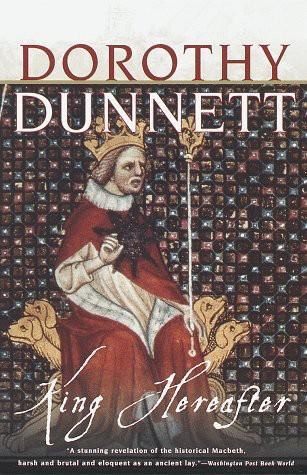
There were only a few real standouts in this summer’s reading. Chief among them is Dorothy Dunnett’s King Hereafter, which was a slow burn but became that most precious of reading experiences:  something satisfying and immersive on every level. I know Dunnett’s Lymond Chronicles so well that it was hard for me at first to adapt to the very different tone and pace of King Hereafter, but I can see why it is often referred to as her masterpiece. Reading it also prompted me to give Niccolo Rising another chance, and now I’m ready and eager to make my way through the rest of that series — though I doubt I’ll ever love it the way I love the Lymond books.

kinghereafterAnother highlight was Wallace Stegner’s Angle of Repose, a book ready-made for someone with my longstanding interest in women’s history and in intersections between fiction and historiography. A low point was Elena Ferrante’s Days of Abandonment. And another that I enjoyed reading but appreciated especially for the discussion my blog post prompted was Colum McCann’s Let the Great World Spin (I’m currently tracking down the Celine Dion book Tom recommended to help me think more about why we like or don’t like what we do or don’t.)

Some of the other rewarding reading I did was rereading with an eye to writing: Daniel Deronda, for instance, which I want to be the basis of an essay on George Eliot and marriage, and the Pennington novels by K. M. Peyton. But it seems as if many of this summer’s new books were in the OK-to-pretty good range (Finding Nouf or Burial Rites, for instance) or were fun enough without being much more than that (My Cousin Rachel or Friday’s Child).

Writing

I kept up my usual blogging over the summer, of course, with posts on my reading but also some reflections on teaching, including this reflection on facing my 20th academic year at Dalhousie. In as-yet-unpublished writing, I completed a prospectus of sorts for my George Eliot book — a conceptual sample, I would call it, something to clarify, if only for me, what kind of thinking and writing I want the book to represent. I also wrote a short piece that I submitted, experimentally, to a publication that has yet to get back to me about it (it has been 4 months and 10 days since I sent it in, but who’s counting?). At this point I’m mulling ideas about how to repurpose it, since rejection has always seemed the most likely outcome.

PenningtonI wrote three stand-alone pieces for Open Letters this summer. One was my version of our ongoing “Title Menu” feature (our attempt to take the popular form of the “listicle” and make it something more substantial and interesting than link-bait); my offering was “8 more George Eliot novels,” from Soueif’s The Map of Love to Cynthia Ozick’s The Puttermesser Papers. Then I wrote an essay about K. M. Peyton’s Pennington series, for no better reason (and really, is there a better reason?) than that they are longstanding cherished favorites of mine. I had started making notes for it before the bookish internet went berserk over a piece decrying the popularity of “Young Adult” fiction among old adult readers, and my thinking about that whole kerfuffle influenced the way I ended up framing my essay, which I thought might be received as a thoughtful contribution to the debate. I guess I should not have been surprised it didn’t get picked up at all by the people who were raging away about YA fiction just a short while before: everyone had moved on to the next thing, and also the essay is long, thoughtful (I hope) and avoids extreme declarations and hyperbole in favor of careful reading. That is not what you do if you want to play Internet Outrage! Which I don’t, really — imagine the collateral damage to one’s peace of mind! But it would be nice to be recognized a bit more widely as having something interesting and relevant to say.

My most recent piece is also for one of our ongoing regular features, “Peer Review,” in which we survey and comment on a book’s critical reception. Mine looks at the criticism to date of Elena Ferrante, whose Neapolitan novels in particular have attracted a lot of very positive (and, as I discovered, very uniform) attention. I found it a very interesting essay to work on, and now I’m watching the expected flood of coverage for her latest, Those Who Stay and Those Who Leave with much curiosity to see if anyone breaks the mould. The Wall Street Journal’s review calls it “startlingly frank,” which is right out of the usual playbook. Here too I found myself exploring territory — specifically, debates about women’s writing, anger, likable characters, and “chick lit” — that have been the subject of high profile, high stakes online exchanges. We’ll see if it sparks any discussion. It amused me to find myself doing a version of metacriticism again!

On a much smaller scale, I pitched in for our annual Summer Reading feature, and again for a Title Menu round-up of lesser-known works by major writers.

Other Projects

Two other projects provided some excitement in my summer. One was the Twitter Q&A I did in June with Stephen Burt as part of the Atlantic’s 1 Book 140 reading of Middlemarch. I was very gratified that my Middlemarch for Book Clubs site was highlighted as a resource for this, and Stephen and I had a lot of fun going back and forth about the novel. Indeed, we had so much to say to each other that we didn’t end up entertaining very many outside questions! But any time anyone wants to talk Middlemarch with me on Twitter, you know where to find me.

Then in July I worked with Matt Jakubowski on an interview for a series he’s beginning on critics and criticism. He sent me very thoughtful but also generously open-ended questions to answer by email and then patiently cut my long replies down into something manageable. I don’t usually think of myself as someone who has much visible presence as a critic (so many people review so many more books, so much faster, in much more prominent venues) — so I was flattered at Matt’s interest. I also found it useful, as well as motivating, to think about myself as a critic in the ways his questions presupposed: I do have a small but growing body of non-academic critical work to reflect on, now, and I think it is in fact underwritten by ideas about what criticism is or can be, as well as what kind of critic I want to be — or, what kind of critic I can be that might make my work distinctive.

photo

My personal accomplishments for the summer include two trips, one to Boston for an editorial summit (and, of course, some book shopping) — the other to Vancouver, for my parents’ 50th wedding anniversary festivities (and, of course, some book shopping!). I also got a tooth capped that has been broken since third grade, solved (I hope) an eye / contact lens problem that had had me looking weepy for about a year, and developed what turns out to be a “tendinosis” that put a stop to my plans to step up my running routine — that, too, I hope will be resolved soon, as I have been to see a physiotherapist at last and begun a healing regimen of exercises. None of this is exactly the kind of stuff that counts as being productive, but the store of books means more reading and writing to come, and self-care has its own value as well.

And now, it’s time to look forward! I’ll be keeping up my regular teaching posts: it will be the 8th year for “This Week in My Classes,” and while there’s bound to be some repetition in the themes and problems that come up, there’s always something new going on — this term, starting with teaching Villette in my 19th-century fiction class. I also have a sabbatical to look forward to in the winter term: my goal for this term is to keep up enough momentum on my writing that I can make the absolute most of that precious time. This may mean not writing as many smaller pieces — book reviews, for instance — that don’t serve my larger goals: I’m not someone who can crank out prose in a hurry, and “even” a review typically takes up a lot of mental space for me. On the other hand, sometimes being busier makes me more efficient, something I’m often aware of as I look back, as I have done here, at the results of my summer and find that I got as much if not more writing done in the midst of teaching!

Next Week in My Classes: Beginning My 20th Year

IMG_1306I started teaching at Dalhousie in 1995-96, which means that 2014-15 will be my twentieth academic year at the university. What with maternity leaves and sabbaticals, that doesn’t mean 40 consecutive terms (though for many years I did also do summer teaching), but that’s still a long time to be in one place doing the same thing.
Or, at any rate, that’s how it felt to me when I did this calculation a few days ago. In fact, I was suddenly and unexpectedly swept with gloom as I walked across campus with the phrase “twenty years” echoing in my head. It was a beautiful sunny day, with just a hint of fall freshness in the air, but the buildings looked all too familiar, the coming routines felt all too predictable, the inevitable administrative hassles of the new term seemed almost too much to go through yet one more time. Even the prospect of teaching Middlemarch again after a two or three year hiatus wasn’t enough to cheer me up. It’s not that I don’t know how lucky I was to get this job (even in the mid-90s the market was tough, though not as devastatingly so as it has become) and it’s not that I haven’t liked — loved, even — a lot of things about it. I just couldn’t muster much pride or sense of accomplishment. What did I have to show for those 20 years?

You’ll be glad to know that this fit of depression has mostly passed, though not entirely. I think feelings like this are a hazard of what is otherwise a great blessing and comfort, namely the stability and security of my position. If it sometimes feels like a mixed blessing, because the down side to it is a high degree of immobility, it’s obviously still, overall, something to be appreciated and (not incidentally) made the most of, as with the kinds of experimenting I have been able to do with my writing and teaching. A lot of the changes that I have brought about in my working life are not immediately visible, after all. “You know where to find me,” I tell departing students, sometimes a bit ruefully or even wistfully, as they move on to the next stage of their own adventures, and it’s true I do still spend my time in the same literal spaces. But my mental life has moved on quite a bit, to the extent that sometimes I feel strangely detached from some of the preoccupations of my departmental colleagues. (Some of that detachment grew, self-protectively, out of the lack of interest in or support some of them — not, happily, all of them — have shown for my new projects, from blogging to writing for Open Letters: being defensive is not a good long-term strategy, I found, and being an advocate also gets tiring in its own way, so I have had to stop caring so much and measuring myself by their standards.) I’m much more aware than I was in 1995 that there’s life — literary life, even! — outside the academy, and that makes some of what we worry about seem much less interesting and important. Anyway, for better or worse, that’s one way in which I do feel I have not been stagnating but changing and even growing.IMG_1278

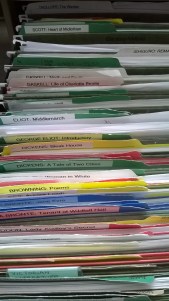
And it’s not as if I don’t have anything to show in other ways for my 20 year investment in Dalhousie. My academic research and publications certainly count as accomplishments, but when I am having a “save Tinkerbell moment” and need my belief restored, my surest remedy is a browse through the fat file folder I have of thank-you cards and messages from students. It’s enormously uplifting to know that the part I played in their lives mattered to them. Teachers at all levels can have this incalculably diffusive effect — I know my own life would be very different without the influence of my own teachers. I hope I told them how much difference they had made; I am certainly very grateful to the students who tell me, because knowing they cared helps me keep trying to bring my best self into the classroom every time. Even at a conservative estimate, twenty years’ worth is a lot of students: even if the majority move on and don’t remember my name, much less what we studied together, there are still plenty who carry something of me away with them — as I am cheeringly reminded every so often when one of them gets back in touch. “I saw someone reading Middlemarch in a restaurant awhile back and thought of how pleased you’d have been,” one former student recently emailed me, and I was pleased, not just that someone was reading Middlemarch (always a good thing!) but that she associated the book with me.

WP_20140827_005The other thing I have to show for my twenty years — something I benefit from every day I’m at work — is experience! It’s easy to forget, now, how new to all this I was in 1995-96. I was hired while still “ABD” (all but dissertation), and my hands-on teaching experience was limited to two of Cornell’s Freshman Writing Seminars (both capped — ah, luxury — at 17 students) and one stint as a TA (in a 19thC fiction class, too, because there were no first year writing classes big enough to use teaching assistants). The class on Browning’s “My Last Duchess” that I taught as part of my on-campus interview here was quite literally the first time I’d ever stood up in front of a room full of students (not to mention a back row of professors there to see how I did). So my first full-time term was really jumping into the deep end for me. I don’t recall any massive screw-ups beyond assigning way too much reading in my first section of Introduction to Literature and way too much writing in almost every class, because I had no idea how much time it would take to mark multiple papers for a class of 50 or 60. I had the time at first: I was keen to throw myself into a job I was excited about and knew I was lucky to have, and at first I had no children, either. But the hours and hours of marking … on top of having no files of teaching notes or materials to draw on, so absolutely every part of absolutely every class had to be prepared entirely from scratch. Good thing I was so young and energetic! (I was 28 when I came here, which means I was barely older than the first crop of graduate students I taught — in fact, now that I think back, I was actually younger than some of them.)
Now, on the other hand, I have a drawer full of notes, handouts, transparencies, and other materials, as well as acres of virtual storage devoted to more of the same. I don’t have everything covered, of course: every year I work in a new book or two somewhere, and I rarely use exactly the same notes or handouts twice. It is reassuring, though, to know that for a lot of texts I teach on a regular basis I have an archive to draw on for information and inspiration. I’m glad, too, that I haven’t recycled even the oldest paper materials, because I pull out treasures sometimes — such as, most recently, a cache of old student discussion questions for Villette including a set by Dorian Stuber, who was in one of the first Victorian novels classes I ever taught. Good questions about interesting books don’t go stale!

I also have found logistical systems that work well for me. I don’t think they are particularly original (when I mentioned them on Twitter, a number of people said they have similar strategies), but those of us who started teaching long before ProfHacker existed had to fumble our way into them. Since the second-most frequent comment on my student evaluations is “she’s really organized” (first is “she’s very enthusiastic”) I think they must be pretty good ones. One is very dull and basic: setting up spreadsheets to track all administrative aspects of every class, from attendance to essay submission to test scores. I don’t enjoy Excel, but  learning to use it reasonably well has shored up my record-keeping in important ways. A more fun thing I do to keep order is use color-coded folders for each course so that I can be sure I have the right ones when I’m gathering up my materials and heading out the door to teach. Red has become standard for detective fiction, and it’s usually green for 19th-century fiction, though this year I’m using some elegant William Morris folders (thanks, EB!). Other courses vary, but the key thing is that once I internalize a term’s colors I do a lot less scrambling at the last minute.

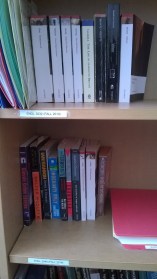
WP_20140827_004Another very simple thing I do is designate one shelf space for each course. Often coming back from class is a distracting time, with students tagging along for conferences or somewhere else to get to in a hurry, so I don’t have time to do fine sorting. Instead, I dump all the class material onto its shelf and organize it when I get my next chance — but in the meantime if I need to find a book or paper from it, my search is neatly delimited. Again, less scrambling! I have a pretty low tolerance for stress and confusion, so for me it’s well worth the little bit of forethought required. When I see offices with indistinguishable brown folders piled in heaps all over the place, I know that — while it must work for the office’s own occupant — I would be a nervous wreck by the end of a single day in there.

My only other crucial trick is using post-it notes — many hundreds of them, cumulatively — to mark important passages in the (yes, I admit it) very long books I teach so often. One of the treats of re-using a well-worn edition is taking advantage of the existing post-it notes, which often help me regain my footing in key interpretations and patterns as I go along; one of the treats of a brand-new copy (such as this year’s handsome Oxford World’s Classics Villette) is putting in a whole new set. (Yikes, how book-nerdy is that. But it is fun!) On Twitter, people mentioned colored pens, certain kinds of notebooks, and colored printer paper as other things that make their teaching days easier, more efficient, and also brighter. However much we use and now take for granted our electronic devices, there’s clearly still a special charm and a lot of use in old-fashioned school supplies.

So far I haven’t even mentioned the 20 years’ worth of increased knowledge I presumably have: when I consider how little I had read in 1995, and how much of that was not really very useful — well, I’m almost surprised they even let me teach! But they did, and here I still am. I’ve probably got another 20 years until I retire: just think how much more I will have read and learned and filed by then. I just have to keep my spirits up — so I don’t lose that third thing I’m often thanked for in my course evaluations: my sense of humor.

Vancouver Vacation: Sun, Fun, and Family

I’m back from another trip to Vancouver, this one organized mostly around the festivities for my parents’ 50th wedding anniversary. It was glorious weather the entire week, which was an especially good thing for the big party — a great event featuring family, old friends, lots of food and wine, and four musical performances from Bulgarian dance music to Bartok violin sonatas.

This was a shorter trip than my last one and involved quite a few family events, so I didn’t get around the city quite as much or see as many of my own old or newer friends (sadly, including Liz, with whom I had such a delightful lunch last year). Next time! But the city was as breathtakingly, unbelievably beautiful as ever:

ParkView

VancouverBlues

EnglishBay

And my parents’ garden was as tranquil as ever, with its colorful pots, shady trees, and soothing “gurglers”:

IMG_2381

IMG_2392

And Granville Island (my happy place!) was as bustling and tempting as always:

GranvilleMarket

IMG_2466

IMG_2497

And, of course, there’s always time to do a little book shopping:

VancouverBooks

My mother and I went on our traditional outing to Hager Books, which is small but nicely ‘curated’ and so always has particularly tempting options. I bought something old (Rose Tremain’s Music and Silence), something new (Jhumpa Lahiri’s The Lowland) and something that’s a bit of a gamble (Zoë Ferraris’s Finding Nouf, a mystery set in Saudi Arabia which, if it turns out to be well-written and smart, is a possible contender for my detective fiction class — I’m always on the hunt for books that offer a different perspective or use the form for different kinds of inquiries — we’ll see how it goes).

I picked up Heyer’s Friday’s Child at Carson Books, a used book store in my parents’ neighborhood. It’s a fun place to rummage around, though overall the prices strike me as a bit high for second-hand. This is a pristine copy of a Heyer I’ve never read, though, so I snapped it up. I also bought an Inspector Morse novel there, because something about being around my folks always reminds me that I haven’t read any of these (they are big Morse fans), but I started it and wasn’t grabbed, so I left it behind for them to enjoy. (I’m sure my Morse days will come: for my sins, I’m unmoved by the TV show as well. In the meantime, though, I may try the prequel show Endeavor, which they all highly recommended.)

And then at the big Chapters downtown (which, once you get up to the third floor, past all the frou-frou stuff that comes first, has a pretty big selection of actual books) I found two books from my standing wish-list: E. F. Benson’s Mapp and Lucia (because you can never have too much British social satire in your collection) and Harry Karlinsky’s The Stonehenge Letters — contemporary Canadian, so a bit of a rarity and a risk for me, but recommended to me by Steven Beattie, who knows a thing or two about Can Lit. I gave it a good look in the store before deciding to actually buy it, and I like his instincts: it looks meta-historical and original, but not so quirky I either won’t get it or won’t like it.

Now I have to get myself re-organized and on track for what remains of the summer!