Fear of Failing

success-failureEarlier this year there was a lot of buzz when a Princeton professor published a “CV of Failures.” I know: “Princeton professor” and “failure” hardly seem to belong in the same sentence. But that was pretty much exactly why Johannes Haushofer decided to make his record of rejection public. “Most of what I try fails,” he wrote in his preamble,

but these failures are often invisible, while the successes are visible. I have noticed that this sometimes gives others the impression that most things work out for me. As a result, they are more likely to attribute their own failures to themselves, rather than the fact that the world is stochastic, applications are crapshoots, and selection committees and referees have bad days. This CV of Failures is an attempt to balance the record and provide some perspective.

I admit that it seemed a bit silly to me at the time. Don’t we all fail a lot, and isn’t the point of a curriculum vitae to make the positive case? But he and the many people who responded enthusiastically to the whole idea of going public with failure weren’t wrong that in academic culture failures are hidden while successes are trumpeted — not just in the relatively discreet form of CVs (which are all-too-rarely made public anyway), but by announcements from Deans, or applause at Department meetings, or faculty book fairs, for example. In this context failure always feels a bit shameful (which is just one of many reasons the terrible job market for PhDs is so psychologically damaging). Academia is a profoundly evaluative, and thus incessantly judgmental, culture, and thus also a culture that all too easily divides us (if only tacitly) into winners and losers.*

fisforfailureI have been thinking about the question of failure in academia again since my promotion was denied. The appeal is ongoing, so I don’t yet know how the story will finally turn out, but no matter how it does, the fact will always remain that I was not successful in this process.** It has recently occurred to me that one reason last year was so difficult for me is that when things took a turn for the worse, one of my most intense reactions was humiliation. I felt profoundly embarrassed, because I had been held up for scrutiny and found wanting: I had not passed the test, and in this world, that feels not just like a professional evaluation but also like a very personal and all-too-public shaming. I know that this is not an entirely rational response, but I bet it also isn’t unusual for academics who fail in this way, especially when you add in imposter syndrome (endemic among academics) — this is the time you were finally exposed as the pretender you always were.
freakoutthrowstuffWhat I have been thinking about more recently, though, is how much worse this cringing attitude made the whole experience for me, because it led me to be not just discreet but downright secretive about what was going on. I’m not saying that I should have made all aspects of the case public (and I don’t plan to now, either): I have some doubts about the advice on Historiann’s blog (about another case) to “YELL AND SCREAM ABOUT WHAT’S HAPPENING,” not just because it seems to me a strategy that could backfire but also because it could look as if you’re trying to do an end-run around proper procedures. (Not that those procedures themselves might not sometimes deserve yelling and screaming about, of course, but as a general rule I don’t think professional matters should be litigated in the court of public opinion.) I just mean being frank about the basics, so, for instance, when people ask how you are doing, instead of saying “fine” and then going in your office and throwing things to relieve the stress of keeping up appearances, maybe saying “not great, actually, because my promotion application isn’t going as well as I’d hoped.”

My overwhelming desire to hide in my office and listen to Adele may have protected me in some ways, but it also, I belatedly realize, cut me off from what might have been really valuable gestures of support. Mind you, being more open might well have created other problems, since the sources of my troubles are one way or another all colleagues: presumably we don’t routinely discuss these processes more openly precisely because the airing of internal grievances threatens our collective collegiality. Of course, from my point of view the damage is already done: there are people I’ll never look at the same way again. Also, the prevailing norm of confidentiality strips away some kinds of accountability. My feeling at this point is that like any dissension between co-workers, it’s awkward any way you handle it, but my way — which meant closing myself off from many of the people around me — ended up being quite personally debilitating.

failureI don’t rule out that some of the intensity of my own reactions might be idiosyncratic: I myself was surprised that I took it all so hard, and that has been cause for some self-reflection. (Indeed, I have experienced fits of meta-failure in which I have been thoroughly unimpressed with myself for not handling everything better!) That’s what got me thinking again about the general context, though — about what failure means and how failure is treated in the academic world. And it also got me thinking about other failures in my own life, along the lines of the ‘CV of Failures.’ It isn’t, after all, as if this is the first time I have swung at something and missed. So in the spirit of Johannes Haushofer, here are a few more of my own failures. I’ll restrict the list to things that quantify more easily than, for instance, my general failure to thrive during my graduate coursework, and that are on a larger scale than, say, the many books I have failed to understand.

  1. I was rejected by most of the graduate schools I applied to, including the one I most wanted (the History of Consciousness program at UC Santa Cruz, which in retrospect I think might have been a complete disaster for me).
  2. I was also did not get most of the jobs I applied for, including the one I really (really) wanted (at Simon Fraser University, where I came close enough to have a campus interview). (Worse, almost, is that they sent the rejection by email so I wept over it in a dank basement computer lab, which is where we read email in those days.) Obviously, I did still get a very good job (just as I did get into a good graduate program) but I didn’t know at the time that’s how things would turn out.
  3. I didn’t get the only SSHRC grant I ever applied for. The funny thing about that, in this context, is that one criticism of my promotion case (from some quarters) was that I hadn’t applied for a SSHRC grant — I had, but it wasn’t on my CV because I didn’t think failed applications belonged there.
  4. I’ve been fairly lucky with articles submitted for publication, though I’ve certainly had failures there too. One that I remember with particular clarity came back with a very dismissive assessment and then was accepted unchanged by a different journal — good evidence for the “crapshoot” theory. Another came back as a revise and resubmit: that ended up being one of the most valuable experiences of my early professional career, as it was for Victorian Studies, the revision advice was both generous and rigorous, and they accepted it when I sent it back.
  5. I don’t yet have much experience with “pitching” essays to magazine editors, but I’ve failed almost every time I’ve tried. Sometimes these failures come in the form of absolute total silence in response — that I don’t really want to get used to, as it seems to me just plain bad manners. There was also that book review that was declared unpublishable.
  6. I have so far failed to turn my miscellaneous writing on George Eliot into a viable book project. I do consider this particular failure a work in progress, though. At the very least, as time goes on and I try different variations of it, I hope maybe I am failing better!
  7. (I thought of this one after I’d published this post originally.) Although I have been nominated 5 times for teaching awards, I have never won.
  8. (Updated) It turns out I did lose the appeal, so that’s a story that ends in a resounding failure. (Not just for me, IMHO, but definitely and specifically for me.)

Like Haushofer, I’ve been very fortunate overall in my academic career. The point is not to complain (that would be absurd, for someone in my privileged position, and anxiety over giving just such an impression has nearly kept me from posting this at all) but to reveal more of the whole picture, to be clear that my career has not been an unimpeded string of successes that nobody with any failures on their record could possibly hope to emulate. I’ve learned over the past year, too, that for all my successes — maybe even to some extent because of them — I still need to work on my own fear of failing, or, more specifically, of being seen to fail. This post is a start.

*I’m sure these attitudes are not unique to academia, but I think they may have some unique features there given the particular form and very long process of indoctrination professionalization we’ve gone through by the time we end up in these jobs.

**I know now; see #8 above.
Time Passes

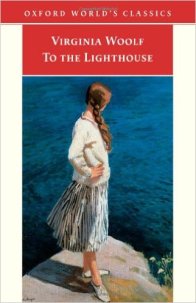
lighthouseoupI’m reading To the Lighthouse for the first time. I know, I know. I also know that I should love it, because it is beautiful and moving and brilliant and original — and I sort of do, so far, except when I don’t. I am not a particularly good reader of Woolf’s fiction: it was only a few years ago that I finally read Mrs Dalloway, and I “succeeded” in that only when I stopped working so hard and let myself “fall under the spell of the language, which is beautiful and languorous but shot through with moments of startling clarity and, sometimes, brutality,” as I said at the time. The same is true of the language of To the Lighthouse, though at this point in my reading it’s that very languorous beauty that’s interfering, perhaps paradoxically, with my pleasure in the novel. It is making me impatient, faintly fretful, with its self-conscious artistry. The novel is not opaque, the way late Henry James novels are, but for all its meticulous attention to the mundane, such that everything everyday becomes somehow transcendent, it feels strangely detached from the reality it explores with such nuance.

These are just early impressions, and of a first reading, at that — and I’m also not finished the novel. So don’t think the worst of me! I will learn more as I read on, and more still as I reflect and reread. It’s a good thing, really, to read a novel that doesn’t fit easily into the grooves of my mind. It’s good for my mind, I mean. Already, To the Lighthouse has me thinking — not just about what I want from my reading and why, but about fiction and realism, about mothers and children, about husbands and wives, about lighthouses visited and not, literal as well as metaphorical.

The part I’ve liked least so far is Part II, “Time Passes.” But even though I found it excessively mannered, with its calculated parentheticals, it does wonderfully evoke both the long sweep of time and specific moments and details of change that seize our particular attention:

The house was left; the house was deserted. It was left like a shell on a sand-hill to fill with dry salt grains now that life had left it. The long night seemed to have set in; the trifling airs, nibbling, the clammy breaths, fumbling, seemed to have triumphed. The saucepan had rusted and the mat decayed. Toads had nosed their way in. Idly, aimlessly, the swaying shawl swung to and fro. A thistle thrust itself between the tiles in the larder. The swallows nested in the drawing-room; the floor was strewn with straw; the plaster fell in shovelfuls; rafters were laid bare; rats carried off this and that to gnaw behind the wainscots.

Oxford“Time passes.” It’s such a neutral-sounding phrase, almost like a stage direction, one that requires all the director’s ingenuity to show us its truth without taking us through the whole chronology. It’s an obvious truth, one we’re all perfectly well aware of, but we feel it deeply only during what George Eliot calls “one of those rare moments of experience when we feel the truth of a commonplace,”

which is as different from what we call knowing it, as the vision of waters upon the earth is different from the delirious vision of the water which cannot be had to cool the burning tongue.

The immediate context of that quotation is Mr Casaubon’s confrontation with the reality of death in the great 42nd chapter of Middlemarch, but that isn’t all that different, when you think about it, from our confrontation with the reality that time passes. You can’t stop it. It’s inexorable! It stops, for each of us, only with death, which is thus rightly pervasive in the “Time Passes” section of To the Lighthouse.

Funny little things can really bring home the reality that time passes. I don’t mean just obvious chronological markers like birthdays. They do remind us, but they don’t surprise us: they just keep coming round again on their predictable dates. I’m thinking more about things like my embroidered series of Henry VIII and his wives. And if that seems like an unlikely connection, that’s exactly my point: when it occurred to me that it might be nice to do some work on these cross-stitched portraits again, I didn’t expect to end up contemplating either the relentless passage of time or my own mortality, but that’s what happened.

newstitches9You see, I’ve been working on these off and on since 1993. I was newly married then and still not quite accustomed to the amount of golf my husband likes to watch on TV every weekend. Since it was hard to get away from the TV in our small apartment, and it didn’t seem very friendly (or very practical) to absent myself from home altogether, I decided to take up some hobbies that would keep my hands busy and give me a sense of accomplishment while I watched golf with him. A long-time reader of Tudor fiction, I was also working on a dissertation about Victorian historical writing, including Agnes Strickland’s Lives of the Queens of England— one way or another, Henry VIII and his wives had been in my life a long time. My thesis also included a chapter on the symbolic significance of needlework in Victorian historiography! So I was pretty excited when I chanced on a pattern in New Stitches magazine for Katherine Howard (wife #5, beheaded, in case you can’t keep them all straight). and even more excited when I realized it was part of a series and I could order the back issues, which I did. Over the next few years I completed four of the queens (Katherine Howard, Anne of Cleves, Katherine of Aragon, and Anne Boleyn). Just two wives were left, plus Henry himself.
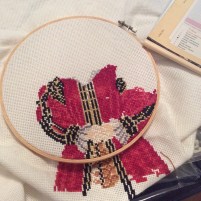
After we had children, though, I found it almost impossible to work on these patterns, which are quite fussy and require both close attention and a minimum of interruptions if you’re not going to lose your place. Also, embroidering on white fabric means keeping your work area, your hands, and anything that might touch the work very clean: you can’t just put your hoop down any old place and grab it up again when you’re back. Even when it started to seem possible in theory to go back to these patterns in the evenings, I discovered that multi-tasking at the necessary level had become much harder: keeping track of the pattern and of the plot in a gripping HBO drama, for instance, was too much for me. The long and short of it is that poor Katherine Parr has been malingering in the drawer, barely half-finished, for years now.

IMG_0910What inspired me to take her out? Mostly that I’ve been experimenting with audio books for a while and though I do enjoy coloring as I listen, I thought I might get more satisfaction out of doing something with more tangible results, and especially out of finishing this series. I hoped that my current audio book (Eloisa James’s Three Weeks with Lady X) would entertain me without overtaxing my poor brain while I followed the design. And in fact it seems just right as a combination of activities — except that I couldn’t help noticing that since the last time I worked with the pattern, it has somehow shrunk so that it’s much harder to see! (Well, OK, actually my eyes have gotten weaker.) Also, the needles: were they always so hard to thread? So those were two blunt reminders that time had passed. And they got me thinking about how much harder this kind of finicky work is going to get as I keep aging, which got me thinking that I’d better not wait another decade before starting (or finishing) Henry and Jane Seymour, because even if I am very lucky and stay healthy and safe from accident or catastrophe — even then, who knows how much more time I’ve got to work on them?

Suddenly, I feel the truth of a commonplace indeed: time passes.

IMG_0912  IMG_0911

Update: Lest y’all doubt my Woolf credentials, here’s one of the bravest (for me) pieces I’ve written for OLM – a literary essay in appreciation of one of the great literary essayists. Or you could check out the entries in the ‘Woolf, Virginia’ category. I think she’s a genius. It just occasionally occurs to me that she’s not my genius.

Sedentary Mascots: The Turner House, and My Houses

flournoy

Humans haunt more houses than ghosts do. Men and women assign value to bricks and mortar, link their identities to mortgages paid on time. . . . We live and die in houses, dream of getting back to houses, take great care in considering who will inherit houses when we’re gone. Cha-Cha knew his family was no different. The house on Yarrow Street was their sedentary mascot, its crumbling façade the Turner coat of arms.

Despite NPR’s bold proclamation on the cover of my edition, I’m pretty sure The Turner House does not deserve to be “described as the Great American Novel.” I think it’s a pretty good American novel. But it did not sweep me away, confound me, inspire me, or otherwise thrill me. For about the first 150 pages, it didn’t even really interest me that much, though I ended up curious about how its strands would come together, and about what would happen to the house on Yarrow Street. It struck me as a competent contemporary family saga, touching on a range of timely themes across its large cast of characters, full of nice particulars about its setting. It is also well constructed, though cutting back and forth across time and generations is not an especially original device and didn’t seem to me to provide any great revelations. Sure, a good novel. But “Great”?

I did like the premise — exploring ways a family home can be its center of gravity, both for the family members themselves and for the family’s sense of its own identity. My favorite part of the novel was the set piece I quoted from for my epigraph that is clearly meant to be the key-note of the novel (so clearly meant that it felt a bit thumpingly obvious by the time we got to it, near the end of the book). Cha-Cha’s newer suburban bungalow has to some extent taken over that centripetal role for the Turners, but its very different structure makes it mean something different, and then of course it does not embody the family’s history in the same way that the house on Yarrow Street does.

Iflournoy2 think that for me, The Turner House would actually have come closer to being a (if not the) “Great American Novel” if it had really embraced its potential capaciousness. How can a novel about a family with thirteen children (and assorted grandchildren and great-grandchildren) be under 35o pages? Imagine if every one of them — and Francis and Viola, too — had a separate section, full of contexts and choices and rich, textured details about their characters and their lives. This (missed) opportunity really struck me near the end of the novel, when we got a crisp précis of the account Lelah gives Brianne of her marriage to Vernon:

Lelah filled the stories with details she hadn’t thought about in decades, like his first car, a 1980 Cutlass Supreme, and what she’d worn to their courthouse marriage (a baby-pink knee-length dress with aggressive shoulder pads). She took her time, because she never wanted to repeat these stories again.

When I read this, I immediately thought “I’d like to hear those stories” — and then I imagined the book opening up, like a flower unfurling, and telling us all of the stories it just touches on in its current more minimalist form. What sweep it would have had! And also, what courage, because 350 pages is a nice, safe length. Some more conspicuous ambition of that kind would have made the book stand out to me more than it did. It certainly didn’t stand out for stylish writing: in fact, several times I was tripped up in my reading by basic grammatical errors.

The Turner House got me thinking about the family homes in my own life. My parents have lived in their current house since 1973, and it is still the focus of much family activity (not so much for me, of course, since I moved away, but for everyone else — sniff!). That’s certainly the house my own childhood memories are bound up in, but at the same time, it isn’t, quite, because when their children had all moved out my parents did a (much-needed) renovation that rendered the house unrecognizable from the inside — and nearly so from the outside, even though there weren’t many structural changes. My old bedroom is completely gone; the kitchen switched sides of the house; even the door to the basement is on the opposite wall from where it used to be, which still causes some of us a moment of confusion when we’re heading up or down. The only part of the house that’s really the same is the basement rec room, which served many functions over the years, perhaps most unusually as the site of a long-running weekly gathering of folk dancers who had great fun (and wrecked many knees) pounding out advanced step patterns from Bulgaria or Macedonia on the concrete floor. The house is much nicer now — but it’s odd to come in the front door and not see what still lives in my memory as “our house.”

scan0022The house I live in now will be the setting of my own children’s family memories, as we moved in when they were still too young to remember anything else. My most vivid memories of their infant years, though, are all from our first two Halifax homes. One was a traditional old house with bow windows up and down and lots of character inside — meaning, of course, lots of things that weren’t in very good condition. The walls, for example, were paint over wallpaper over aged plaster, and not altogether as solid as you’d like! That’s where we set up Owen’s nursery, where he took his first steps, where he used to astonish me with words, math, and music with his magnetic fridge letters, and where he played his first notes on the piano. I remember sitting up many, many nights that first hot summer after he was born, rocking and nursing and idly watching TV (usually Law & Order, which was always on somewhere) so I wouldn’t fall asleep and drop him — that’s where I was when the news broke of Princess Diana’s death.

Our next house was a less quaint but more solid 60s bungalow: that’s where we brought Maddie home to from the hospital during another long hot summer. As it happens, I was nursing Maddie when the planes flew into the World Trade Center: I remember calling out to my husband when the story popped up about the first one, and we were watching the news waiting for updates about what seemed, at first, sure to be an accident, and then seeing what we only later clearly understood to be the second one — it seemed to happen so fast, and to make so little sense. What odd juxtapositions both of those moments were of private and public life: neither newsworthy event had anything to do with me personally (though 9/11 certainly had repercussions that have affected all of us one way or another), and yet for me both are bound up in my most deeply personal recollections. I have many other memories of that house too, of course, including hours and hours playing with Owen and Maddie in its wonderful vintage basement (complete with real wood paneling on the walls and a salmon pink bathroom).

We’ve been in our current house since 2003. It lacks the charm of our first one but makes up for it (for us, anyway) in modern conveniences, and, more important yet, in being nestled in a quiet, tree-lined neighborhood. Many of our friends have cottages they retreat to in the summer, but we like to stay put and enjoy how lovely it is here when the weather finally turns nice! I wonder how Owen and Maddie will feel or think about this house in later years. It’s hard to know what kinds of memories you’re creating when you are still in the middle of the action, as it were. Because we’re cut off from our extended families on both sides, the memories that have built up here are nothing like the chaotic, inclusive ones described in The Turner House, and also nothing like the ones I have of my parents’ home, so often full of other people eating, talking, laughing, and making music. But we’ve done our best to develop family traditions that suit our eccentric little group! And there’s only so much you can do: for better and for worse, your space is bound to represent who you are. It’s not just literally that you can’t live in someone else’s house, or can’t simply move out of your own whenever you want to.


On This Day I Complete My 49th Year

hyacinthIt sounds more poetic when Byron says it! Also, of course, he was only 36 — and I think that was the last poem he wrote, whereas I certainly hope this is not my last post! There’s nothing particularly poetic about turning 49, in any case. It’s not a landmark age, and I’m not doing anything in particular to mark it: pizza and a beer, probably, and I made cupcakes yesterday that Maddie should be frosting as I write. Then probably last night’s episode of The Good Wife, and time to call it a night! Sounds relaxing. Sounds middle-aged. Sounds about right!

Birthdays do inevitably prompt reflection, though, more (for me, anyway) even than New Year’s Eves do. I was thinking about numbers this morning: in 2016 it will be 26 years since I moved away from Vancouver (still, in my heart, the place I consider home); 24 since I got married; 21 since I moved to Halifax and began my job at Dalhousie; 19 since I first became a mother. It’s approximately 44 years since I started reading, and since I started listening to opera — still the biggest sources of enrichment and pleasure in my life. It’s 16 years until I reach retirement age…but who’s counting, right? 🙂

Those seem like big numbers! They represent a lot of change but also a lot of continuity: as another poet said, though much is taken, much abides — and at the same time, the old order changeth, yielding place to new: it’s 9 years since I started blogging, 6 years since I joined the editorial team at Open Letters Monthly, and less than 1 year since my first review ran in the TLS. I don’t know what the next year will bring, personally or professionally — as George Eliot says, “Among all forms of mistake, prophecy is the most gratuitous” — but the older I get, the better I understand what I want and don’t want. I suppose that’s progress of a kind, if not necessarily wisdom.

It’s Easter Monday here today, which is not a holiday at Dalhousie, so my classes met as usual. There are worse ways to spend a couple of hours on my birthday than talking about Indemnity Only and Hard Times. It felt good today that I needed my notes so little — that we could keep the discussion going, and keep it interesting. File that under things I want more of in my 50th year: good books, good talk about books. I know some of that will happen here at Novel Readings, so thanks as always to everyone who reads and comments!

This Week In My Classes: Teaching as Therapy

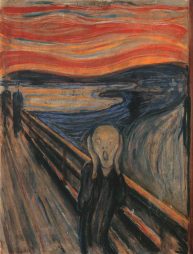
ScreamNot for them — for me!

I have actually noticed this often over my teaching career, but it has been particularly evident to me this week, when I have been feeling quite frustrated, angry, and disheartened by things that need to stay off this blog (at least for now): teaching is good for my mental health. However glum or grim I feel as I head over to my classroom, by the time I come out I almost always feel better: more energetic, more focused, happier about my job and even, usually, happier about my life in general. Why do you suppose that is? Fellow teachers, do you also experience this effect?

I think for me at least one reason it happens is that I always inhabit a persona when I’m teaching: class is always a bit of a performance, with me playing the role of “Myself, Only More So, And More Positive.” Though I am always sincerely enthusiastic about our readings and topics of discussion, I make a point of showing that enthusiasm and being as upbeat and energetic as I can manage about our work. My hope, of course, is that this enthusiasm is contagious, or at least that it gets and maybe even keeps people’s attention, if only in the spirit of “What is this strange woman so excited about?” Even when I’m depressed or cranky otherwise, I try to get into this role once class begins, and after a while, especially if participation is good and the discussion is interesting, I usually forget I’m in a bad mood and just carry on as usual. Advice to “fake it till you make it” has always sounded shallow, even a bit creepy, to me, but in this context, there’s definitely something to it.

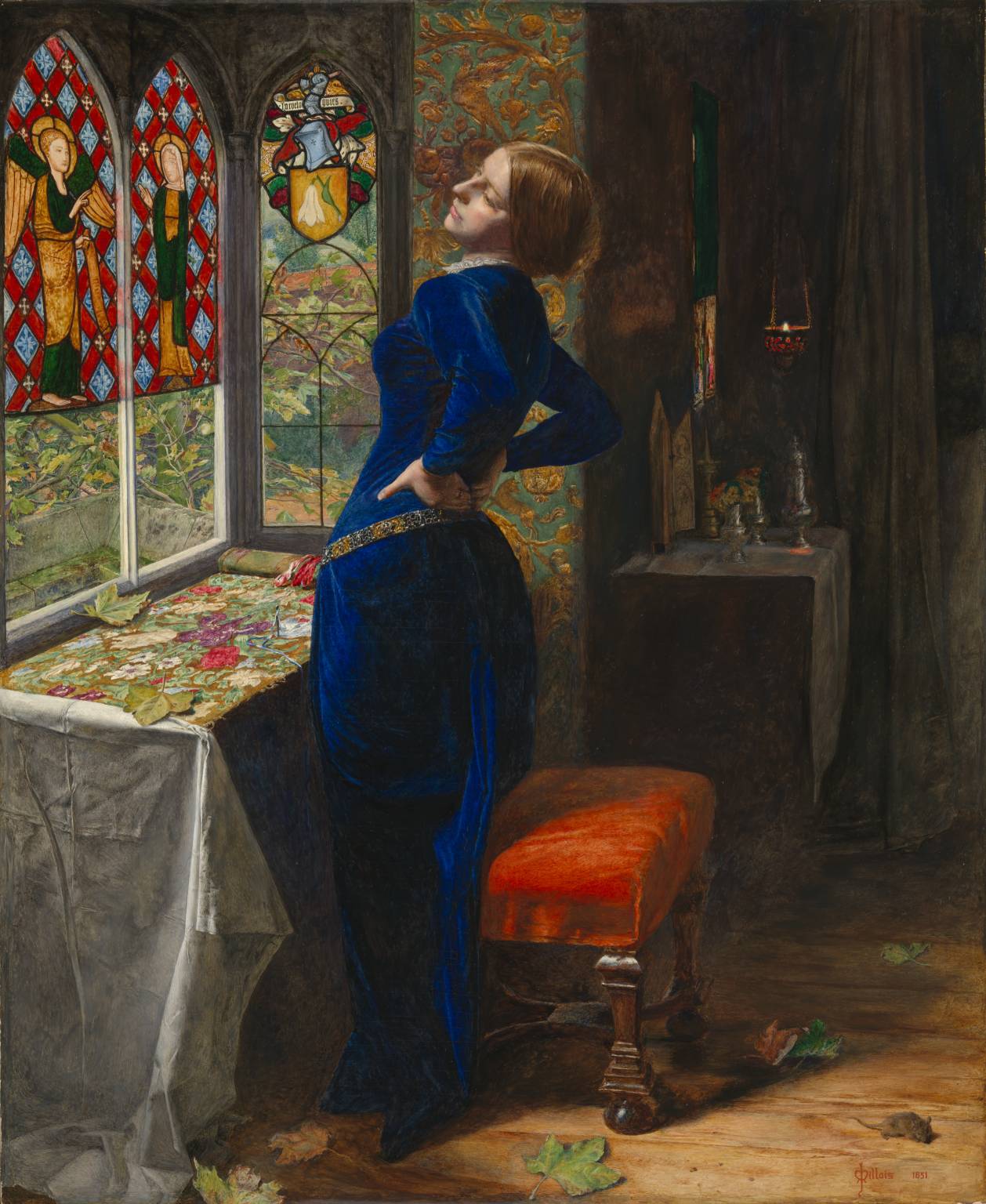
marybartonAnother reason teaching is a tonic for me, though, is precisely that I am not faking my interest in the course materials, and time spent really focusing on them brings me back in touch with the things that brought me into this profession in the first place. I loved being an English student myself (well, I loved being an undergraduate student – I mostly hated being a graduate student), and it’s in the classroom that the reasons for that are most present to me: the books themselves, of course, but also the open-minded engagement with them — teasing out what is most interesting, looking at the details and trying to put them into patterns that illuminate the whole, thinking and talking about the ideas that animate them, and all this, best of all, in conversation with other keen readers who bring their own questions and ideas to the process. This week’s readings are very purposeful, too, which gives our work on them extra urgency: in Mystery & Detective Fiction, we’ve just wrapped up Sjöwall and Wahlöö’s The Terrorists, and in 19th-Century Fiction we’ve just started Gaskell’s Mary Barton, so  in addition to their literary particulars, they raise lots of questions about art and politics, about class conflict, about women and economics and law and justice and equality … about values, in other words, and how novels can serve them. That’s good stuff! I have spent a fair amount of time in recent months dealing with the aspects of academia that I like the least. Time in the classroom reminds me that all the rest of it is, ultimately, in service of something I really do cherish.

It’s also just a good thing in general to be forcibly distracted from the source of one’s stress. I am something of a brooder, and when things are giving me trouble they go round and round in my mind, interfering with my concentration during the day, keeping me up at night, and generally infecting my consciousness. At these times, it’s not ideal to have reading as my chief hobby and pleasure, as it is a relatively passive activity and does not necessarily keep the troubled mind from wandering. Writing, too, can become pretty compromised by stress. If I do get caught up in either reading or writing, it can be wonderfully transporting and restorative, but sometimes that turns out to be a big “if.” Teaching, however, absolutely demands my full attention — which is why it can be so exhausting, but also, I think, why it can be so therapeutic. If for an hour or more you simply can’t get on that mental hamster wheel of doubt or anxiety or confusion, you may be a little slower clambering back on it when you return, and who knows, eventually you may even bypass it entirely and find a clear, positive path forward.

Happy New Year! and New Books! and New OLM!

Books2016

2016 is getting off to a good start in my corner of the world. For one thing, I have a lovely array of new books, thanks to the kind people who basically ran my entire Chapters wish list. Isn’t that an enticing stack? My problem now is that I can’t decide where to start: rereading Mr. Impossible, because I know how fun that will be? rereading Little Women, because I finally have my own elegant edition? embarking on Jane Smiley’s ‘100 Years’ trilogy? plunging into Fates and Furies? wandering New York with Vivian Gornick? I suppose I could postpone the decision by settling down to finish The Portrait of a Lady — not least because I don’t want to read The House of Mirth until I’ve done that.

It’s not just the beginning of a new year, of course: it’s also the beginning of the month, and that means, as always, that a new issue of Open Letters Monthly has just gone live. I’m in it a couple of times: in brief in our feature of most-anticipated books of 2016,and at greater length in an essay about different editions of Middlemarch that is also a review of the elegant new Penguin Classics Deluxe edition. I’m always wary of writing autobiographically, but I couldn’t think how else to approach this review, and I enjoyed reflecting on the versions of the novel I’ve accumulated over the years as well as on how the editions we read of a book affect the relationship we develop with it.

oxfordlawrenceAs usual, the issue includes a wide range of other interesting pieces. One of my favorites this time is Dorian’s essay on D. H. Lawrence’s Women in Love. My own experience with Lawrence so far is limited and ambivalent — but it has certainly made me curious, and Dorian writes so eloquently about both the language and the ideas of Women in Love that I’m feeling emboldened to read more Lawrence before too long. My co-editor Robert Minto offers a fascinating essay on Nietzsche’s Anti-Education, recently reissued by NYRB Classics, finding in it strains that might serve as cautionary to today’s “anxious citizens of academia”; Steve Donoghue reviews (as only he can) a new book on Sigismondo Malatesta, the only man ever to be reverse-canonized; Barrett Hathcock explores the hall-of-mirrors sensation of finding himself fictionalized by a student in his own creative writing class; and that’s just the top half of the Table of Contents. I hope you’ll check it out, and if you like anything about what we produce every month at Open Letters, I also hope you’ll consider supporting our efforts — we are entirely sincere when we say that a comment or a link is as welcome as a donation.

Very soon, I will also be launched on the new term. My classes this time are familiar ones in my teaching rotation: Mystery and Detective Fiction and 19th-Century British Fiction (Austen to Dickens edition). As usual, I’m feeling equal parts anticipation and dread at the prospect of starting it all up again. (I have already had one very typical anxiety dream in which I was unable to print notes or handouts because my files had disappeared, and the computer kept auto-updating as I desperately tried to find them, and the start time for class came and went … you’d think after all these years I would not need my subconscious warning me to prepare for class, but this did prompt me to go to campus early and print all my notes and handouts for Monday, so that’s good, I guess!) I’m also feeling very aware that this time last year my sabbatical term was just beginning: inevitably, I guess, that is provoking some reflection on how I used that time and what has become of the projects I worked on since it ended — more about that eventually, along with more of my regular posts on how things go in my classes.

But I still have one more full day, and since I did print my materials early (and have also built my Blackboard sites and labelled my folders and made my Powerpoint slides for opening day), I will spend it reading — if I can just settle on which book. Happy New Year!

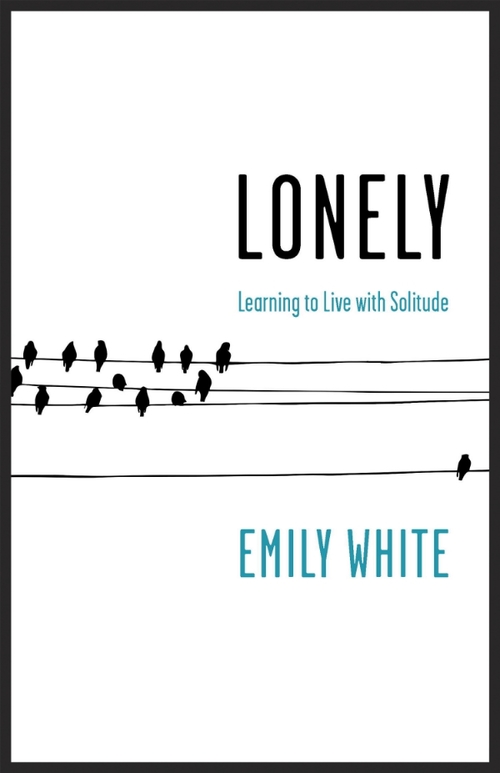
The Estranging Sea: Emily White, Lonely

lonely“The main thing I did with this book,” Emily White says on her website, “was break the taboo against talking about loneliness.” I felt the weight of that taboo as I debated whether to blog about having read her book. It seems obvious that I wouldn’t have looked it up if I weren’t lonely myself, after all — lonely enough, indeed, to be looking for insight and support.

Actually, I’m not sure that what inhibits me is thinking there’s a “taboo” around the subject so much as unease about what the admission of loneliness means, and how people might respond, or feel they should respond. I don’t want anyone’s sympathy, or offers of companionship, or invitations that come from obligation or pity. I also don’t want well-intentioned but ultimately fatuous advice, because trust me, anyone who’s looking up a book called Lonely at the library has already thought if it, whatever your suggestion is, and probably tried it too! As I have mentioned before, I also tend to avoid getting really personal here, in this public space (which is also, in whatever vexed and complicated a way, a professional, or semi-professional, space). And in whatever space, I don’t usually like to expose my vulnerabilities. I suspect that if asked, people who know me personally would likely describe me as someone who’s almost always fairly poised and in control. More turbulent emotions certainly leak out, in real life, here and (more often) on Twitter, where the brevity and fluidity of the form makes revelations feel less undermining (an illusion? perhaps!). But I’m not by instinct or habit particularly demonstrative or confessional in any context. (That’s probably why there’s a long history of friends of mine trying to get me to “let my hair down” — but that’s the subject of another post, or could be, if this were a different kind of blog!)

Reading Lonely helped me realize, though, that this tendency to keep my private feelings even as private as I do is actually a contributing factor to some of their negative effects on my life. Don’t worry: I’m not about to start oversharing! What the research White summarizes clarified, however, is that loneliness is less a function of sociability or social connections in and of themselves than of intimacy, or, properly, the lack of intimacy. (It is, as all of us have probably experienced, possible to feel much lonelier when among other people than when alone.) This information clarified, among other things, why joining clubs, taking up group activities, or otherwise doing the obvious things to “meet people” can exacerbate rather than resolve loneliness. I think this is also why, for all the wonderful and cherished friendship and support I get from people I know only or mostly online, sometimes loneliness can still hit me like a punch in the gut, because my own careful (though not airtight) curation of my social media presence enforces boundaries that limit these relationships even as they necessarily protect me and mine. This is why Facebook can sometimes be so inadvertently hurtful, and why a busy day at work, surrounded by students and colleagues, can bring no relief at all to this underlying feeling, though it can be an excellent distraction from it. And this is why even an hour in the company of someone who really (really) knows you can be so profoundly restorative, both emotionally and psychologically (White discusses some research linking these effects to a fundamental human need for connection as a form of safety) — and why it is thus so difficult when these people are both rare and far away, in different time zones.

Finally, this also explains why even a very lonely person can crave solitude: it’s not just that one’s own inner resources and individual interests are crucial to resilience and personal fulfillment, but that when you are alone, you can (for better and for worse) just be yourself. I have thought a lot, recently, about the Marianne Moore line that “the cure for loneliness is solitude.” I don’t think that’s true (though I continue to be fascinated by stories of meaningful solitude). But in my experience at least, however paradoxical this seems, solitude can abate feelings of loneliness, offering emotional ease or tranquility that soothes even as it risks becoming melancholy.

In the end, I didn’t find Lonely a particular powerful book. It was too much of a memoir — for my purposes, it spent too much time on White’s own experience. As a “self-help” book it also doesn’t offer much constructive advice: White pushes for us to understand loneliness as a psychological condition that calls for therapeutic intervention as much as anything else, and I never did get much concrete sense of what such treatment might accomplish, of whether it’s ultimately a coping strategy (which, given her emphasis on chronic loneliness, is what I suspect) rather than a program for building the kinds of intimate relationships that seem to be the real fix. (I admit, though, that as I lost interest in the wealth of detail about White’s personal situation, I did start skimming, so perhaps I missed some information.) It was certainly interesting to know that loneliness is a genuine research field (White’s own generalizations, though, are based on detailed interviews with about 20 people, which doesn’t seem like that broad a sample) and to think about the ways researchers differentiate loneliness from, for instance, depression. Most of all, though, it was just useful to see loneliness parsed out in the ways White and the experts she consulted do. Understanding a problem better isn’t, in itself, necessarily going to change or fix anything, but naming things — describing them accurately — is always somewhat reassuring. With that improved understanding comes a bit of courage, I think.

Is there a better poetic evocation of loneliness than Arnold’s “To Marguerite, Continued”? Maybe, but its combination of personal yearning and existential angst still thrills me as much as it did when I was a yearning and somewhat solitary teenager.

Yes! in the sea of life enisled,
With echoing straits between us thrown,
Dotting the shoreless watery wild,
We mortal millions live alone.
The islands feel the enclasping flow,
And then their endless bounds they know.

But when the moon their hollows lights,
And they are swept by balms of spring,
And in their glens, on starry nights,
The nightingales divinely sing;
And lovely notes, from shore to shore,
Across the sounds and channels pour—

Oh! then a longing like despair
Is to their farthest caverns sent;
For surely once, they feel, we were
Parts of a single continent!
Now round us spreads the watery plain—
Oh might our marges meet again!

Who order’d, that their longing’s fire
Should be, as soon as kindled, cool’d?
Who renders vain their deep desire?—
A God, a God their severance ruled!
And bade betwixt their shores to be
The unplumb’d, salt, estranging sea.

A Taste of Nova Scotia

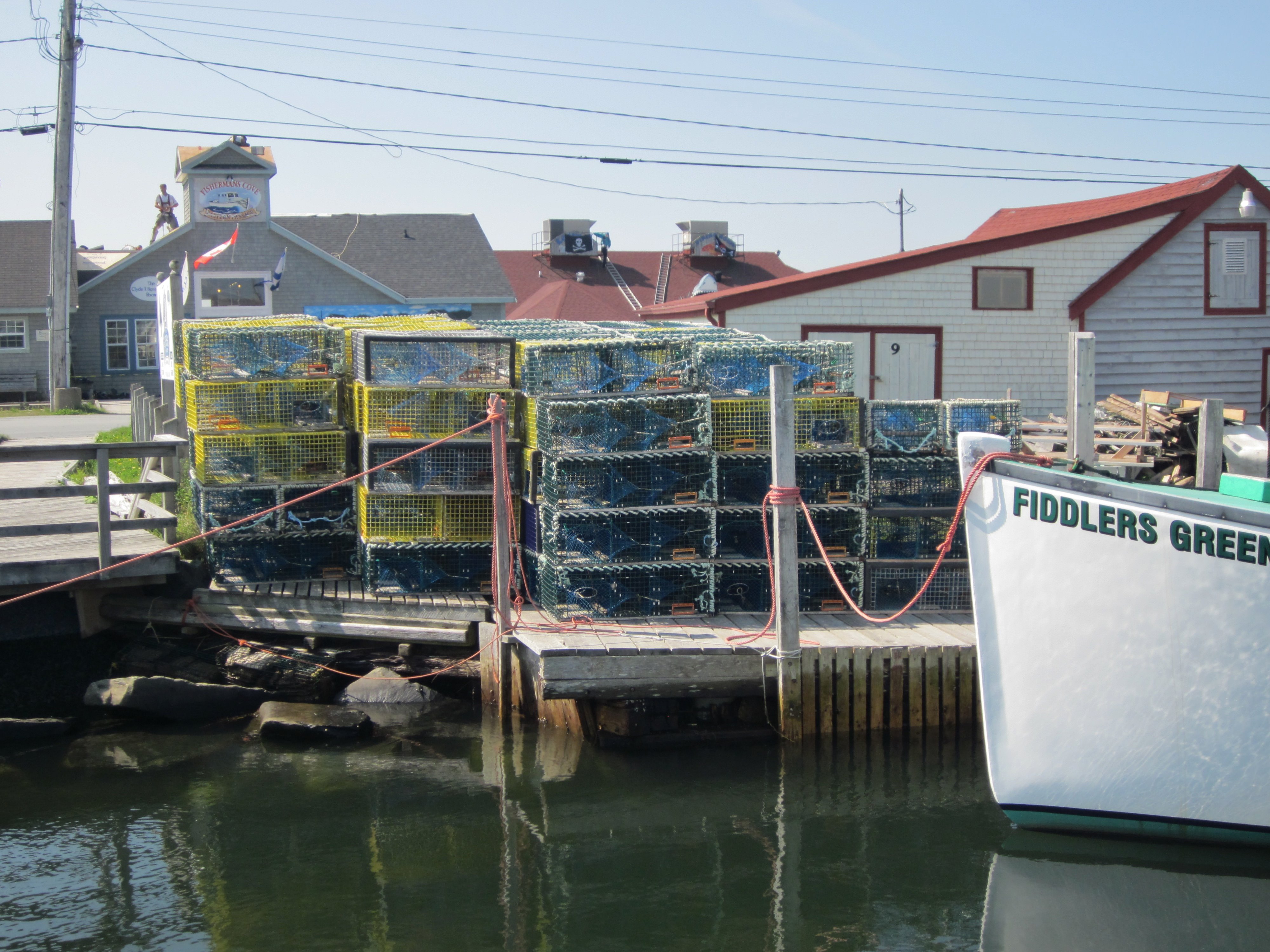
My lovely mother has been visiting us, and today we went exploring a bit. I don’t like highway driving (or really any driving, though of course I do what I have to), so I was happy to find an article about fun things to do around Halifax without a car. One suggestion was taking the bus out to Fisherman’s Cove. Here are a few pictures of this lovely spot. They will remind me, when I get cranky in a few months about being trapped in the winter hell-hole that is Halifax, that there are nice things about being in Nova Scotia!

FishermansCove

IMG_2924

IMG_2923

IMG_2929

IMG_2936

IMG_2932

IMG_2955

Also, if you actually do want a “taste” of Nova Scotia, this is the book for you.

Coloring Books … for Adults? Sure, Why Not.

IMG_0415I’ve watched the recent craze for “adult” coloring books with a mixture of amusement and nostalgia. While some people are celebrating the idea as both creative and consoling, others find it one more sign of the infantilization of our culture. For me, it brings back a lot of memories of family camping trips: coloring books and markers were necessary camping gear for us, along with Scrabble, cribbage, and my dad’s guitar. As I recall, it wasn’t only the children who colored, though I think for the grownups it was more a way of keeping us company than a choice they would have made left entirely to themselves. I’ve held on to and sometimes gone back to my collection of coloring books over the years, and all this fuss has had me thinking that it might be kind of fun to get them out again. In fact, I bought some new markers last weekend (OK, I admit it, I couldn’t resist the back-to-school displays, even though in principle I abhor that they were out as early as July). Maybe a little coloring is just what I need to get me out of my slump!

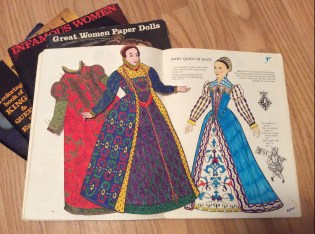
The coloring books that set off this recent fad are pretty different from mine, though. As you can see from the photos, mine are not abstract or flowery but historical and (though I didn’t realize this about them until recently) political. It was the 1970s when I got them, after all — and, though this too was not something I understood at the time, I had pretty progressive parents (the kind who bought us “Free to Be You and Me” and then, later, Our Bodies, Ourselves, both of which in those days were new and radical). They also never, as far as I recall, stood between us and any book we were interested in reading, which for me meant that I was deep into Jean Plaidy’s historical novels at an early age — not to mention Gone with the Wind (my changing relationship with which I wrote about at length at Open Letters a few years back).

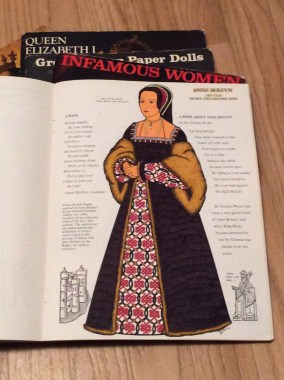
IMG_0416That historical interest explains why two of my favorite coloring books were Tudor ones: Henry VIII & His Wives and Queen Elizabeth I. Both are actually designed as paper dolls, though we rarely cut the figures and outfits out. I do have a loose cut-out of Elizabeth in the “Walsingham dress,” however, even though that picture (done in an entirely color different scheme) is still in my book: we must have had two copies of it at some point. Maybe my sister and I each had one. (Sarah! did I steal your Gloriana paper doll? sorry!) As I recall, I got the Kings and Queens of England book a bit later; I seem to have been taking the coloring more seriously then, as most of the pictures that have been filled in are done fairly carefully according to the information given about the colors of the actual portraits they are taken from — as with this earnest rendition of Richard III (my hero!), which I signed (!) and dated in 1980:

RichardIII

It’s the two coloring books of famous women that strike me as particularly interesting now, though — or, I should say, the book of “great” women and its evil twin, the book of “infamous” women. The childish printing of my name in the former suggests I got it not that long after its publication date (1974); it opens with Sappho and includes Cleopatra, Boudicca, Lady Murasaki, Joan of Arc, Pocahontas, Amelia Earhart, Susan B. Anthony, Bessie Smith, and Marie Curie, among others. All come with brief biographical notes and usually a literary quotation or two. Infamous Women is copyright 1976; it opens with Semiramis (naked, just by the way) and follows with Messalina, Queen Isabella, Margaret of Anjou, Lucrezia Borgia (of course!), Charlotte Corday, George Sand (?), and Mata Hari. This book has full page biographies for every woman: “Isabelle of Bavaria made herself the most hated queen that France ever had,” begins one; “Naples has had many cruel rulers, but the Neapolitans boast particularly of wicked Queen Joanna: she had, they say, many lovers, killed when she tired of them, and many husbands treated similarly.” What’s not to boast of, indeed?

What interesting artifacts these books are. Recently I joined in a bit of a communal Twitter rant about this piece on women’s “forgotten history”: forgotten by whom, is a reasonable question? Women’s history is actually a pretty venerable field now, so I think the real (if inadvertent) point is not that it is forgotten so much as that the writer, and apparently the authors she interviewed, took their own relative ignorance of women’s history as definitive. The wheel they’re busy reinventing wasn’t brand new in 1974 either (my first book is just one of several scholarly works looking at women’s history in the 19th-century) but second-wave feminism helped turn it into a vast and vital area of research. It’s easy to see Great Women as part of this feminist reclamation of the past, yet the pit-and-pedestal pairing of it with Infamous Women shows that simply bringing women into the story doesn’t necessarily transform the story itself: much depends on the underlying assumptions the facts are used in service of. There’s no doubt, though, that these coloring books are one way that I learned that history was not just the story of great men.

That, plus the nudity and the accompanying stories of sexual misdemeanors and often quite chilling violence (my parents clearly did not worry at all about corrupting my young mind, for which I sincerely thank them) means that my childhood coloring books were pretty adult fare to begin with! Now: should I start in on Eleanor of Aquitaine (quick: guess which book she’s in), or bring poor pallid uncolored Jane Seymour out from the shadow of the ever-dominant Anne Boleyn?

IMG_0418

By the way, I am more than thrilled to discover that Bellerophon still carries these coloring books! If enchanted forests aren’t your thing, you can order your own copy of Infamous Women and have some fun with cruel Queen Joanna yourself.

Not a Very Good Week

I’m in a slump — a writing slump, mostly, but (and relatedly) also an emotional slump. I will come out of it, I’m sure, but so far I haven’t figured out exactly how. Some of it is my usual summertime blues, which have been exacerbated this year by how grey and rainy it has been here. Some of it is discouragement about the writing I did over my sabbatical, which right now seems to have led only to dead ends. Some of it is frustration because the teaching tasks I turned to, to cheer myself up by at least getting something concrete done, haven’t gone that well. For instance, twice while I was entering my long list of reserve readings for my fall graduate seminar the library’s form timed out on me after I’d put in all the information — which is a painstaking process, believe me! (Third time’s the charm, thank goodness.)

That’s small potatoes, though, compared to discovering that the work I’d put in on my Blackboard site for my fall intro class has been completely wiped out (my section was mistakenly reset instead of someone else’s). I can do it all again — I’ll have to, obviously. But what is torturing me at the moment is that back in June, when I last worked on the site, I had hit on what I thought was a really good way not just of reorganizing the course materials but of explaining and introducing them: after several tries, I’d found a tone and wording that I thought hit just the note I wanted. And now, of course, I can’t remember exactly what I’d said and done. No doubt it was not perfect in some ideal way, but in my mind now there will always be an imagined but inaccessible Better Version. Working on Blackboard is so fun, too: who wouldn’t want to spend more time on it! That will teach me to start early.

Then there’s the Amazing Disappearing Notebook. For every seminar class I teach, I use a spiral-bound notebook for preparing my own class notes and for taking notes during discussion. I have a shelf full of these notebooks! It is very helpful to leaf through previous versions of them when prepping for a new iteration of a course, so naturally I went looking for my notebook from the last time I taught my grad seminar on George Eliot — and it is nowhere to be found. I have emptied filing cabinets and shelves and done all the insane things you do when you are sure something is in the room but you can’t see it anywhere. It’s not as if I absolutely need it: I wasn’t going to actually use it for teaching the class this time. But I really would have liked to have it as a prompt and a reminder! So, one more small source of frustration that adds to my cumulative feeling of failure.

On all these fronts and more, the fix is simple, in theory at least: I need to take a deep breath and just get back to work. I need to commit to a new writing project and stop second-guessing its interest or value; I need to get the darned Blackboard site back into shape, even if it isn’t the perfect shape; I need to finish drafting my syllabi and handouts and organizing reserve materials and rereading key materials so I’m ready for the first day. I need — and this one is harder — to return to my sabbatical writing and figure out (again) how to shape and direct it. I will do all of these things. In my entire life, I have actually never not done the things required of me — so there’s that to remember, when I exacerbate my slump by criticizing my own lack of resilience and lapses in productivity.

did get my application for promotion completed, so that’s one (pretty big) thing crossed off my list. I suppose that means this is not a good time to mope in public! Someone in a position to (and with a mandate to) judge might be watching. As I’ve said before, though, I think it’s misleading to pretend everything’s going swimmingly all of the time. Who knows: my discouragement might actually end up being perversely encouraging for someone else who is also feeling stymied. It happens! You’re not alone. We’ll get past it.

Update: I went for a walk, then got some small but necessary things done (finished a draft syllabus, did final edits on a submission for Open Letters, played around with my book order for a winter-term course). I feel a bit better. Maybe tomorrow I might even be ready to tackle some of the big things!