I love Steve’s series on his readings in the “Penny Press.” He engages with such gusto with all kinds of periodicals, from highbrow literary journals to lad mags to Dogfancy and National Geographic–and he’s so delighted when he finds good stuff, and so disheartened when his favorites let him down.
 Reading Steve’s posts always makes me think about the magazines I read. It’s a small number: I do most of my more miscellaneous reading online, and the only print periodical I actually have a current subscription to is the New York Review of Books (some years it’s the TLS instead, but next year I think it will be the NYRB again, and/or the London Review of Books). I do pick up individual issues of magazines sometimes–but they are almost never literary, culture, or news magazines. Usually, they are quilting magazines, with the occasional foray into Canadian Living (which I did subscribe to for many years–for the recipes!) and a dip into the Running Room’s freebie whenever I pass by the store. Once in a while I pick out something else for variety: I bought Granta‘s spring feminism issue, for instance, but I’m at least as likely to bring home something like the issue of Piecework shown in the photo.
I’ve been wondering why it is that these are the choices I make from the magazine rack and not, say, Harper’s or the New Yorker (or The Walrus, for that matter). What is the lure of these publications dedicated to food, fabrics, and healthy living? These are hardly the central concerns of my days, or at least, not so much that you’d think I would want pages and pages of articles about and glossy colour photographs of them. That said, I do dabble in all of these things: by and large I’m the family chef, and I appreciate getting new menu ideas; I do a little quilting and needlework; and I’ve been a slow, intermittent, but fairlypersistent runner since my “Learn to Run” clinic several years ago. Do you suppose that I buy these magazines because I wish these activities were a bigger part of my life? Do I buy them because doing so gives me the illusion that I do more of this stuff than I actually do–is browsing their pages a way of pretending I’m the sort of person who might run a marathon some day and distributes full-sized quilts to friends and family that have all the points of their triangle patches all neatly in position?
I do think that is part of why I buy them: to bolster my sense of commitment to things that are actually (partly by choice, partly by pragmatic necessity) peripheral to my main priorities. But why would I wish I were living the life that these magazines collectively illustrate, rather than the life I do in fact live? Why is my magazine pile not all book reviews–not to mention academic journals (which I read only under duress now)? Thinking about what the magazines I like have in common, I noticed that they all emphasize two things: the individual satisfaction of tangible achievements (something rare in academic work), and a strong sense of community created by a shared passion. The Running Room magazine and the quilting ones I like are especially conspicuous for their stories of people helping each other to realize their dreams: the Running Room has tributes to clinic leaders and coaches who inspired runners to do more than they thought possible, of people who began just as members of the same running groups and became fast friends. I love the “shop hop” issues of Quilt Sampler, which feature different shops around the country (sometimes in Canada, too) with stories of how they were founded, often by a couple or a pair or group of friends who just really wanted to shape their lives around something they loved and, happily, found a community of like-minded customers and became a supportive, creative community. I think I pore over these stories because academic work is only intermittently like that: the work itself, in fact, often seems to pull us (or at least me) away from the kind of creative fulfilment and warm-heartedness the quilt shop owners seem to enjoy in their work lives. Also, on a more personal level, I’m often a bit lonely in my day-to-day life: my extended family is all far away, my local friends are as busy and stressed out as I am, if not more; a lot of my work is done in solitude, and its group aspects are far from warm-hearted and creative (committee meetings, anyone?)–it’s easy to feel isolated, and the world these magazines conjure (and this is true of Canadian Living as well) is not like that. So, they represent a kind of fantasy life for me, in a few variations, one that if I had more time and energy and guts I might be able to pursue here (I could take a quilting class, maybe–but the nearest quilting store is quite far away, and winter is coming, with its icy roads… I could take another Running Room clinic–but they are often in the evenings, and I’m just so tired and swamped…and again, winter’s coming). Also, in my fantasy life I really love to cook, and nobody in the house has food allergies or any other dietary complications…
There’s one other thing I know I buy the quilting and needlework magazines for: often, their pages are just beautiful! And though I don’t have (or make, I guess) a lot of time for quilting, I do get some done now and then, and it’s inspiring to look at the colours and patterns and spend a little time indulging in the sensual pleasures they offer: they are treats for the eye, just as the fabrics are when you’re actually quilting (when they are a tactile pleasure as well–I bet all quilters sort their stash once in a while really for no purpose than to fondle the fabrics and look at them some more).
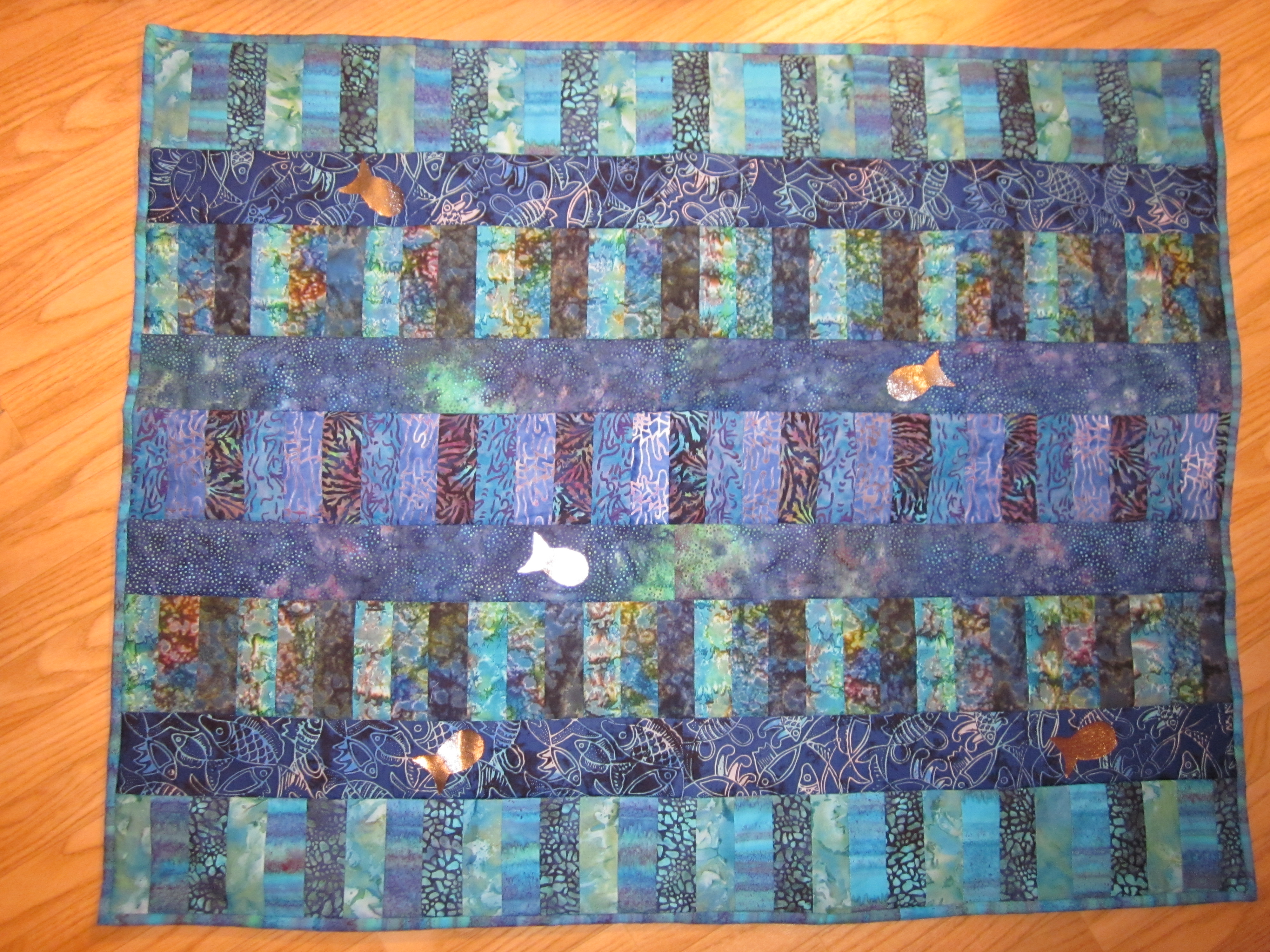
(A couple of my more recent quilting efforts: “Overall Bodie” and “Blue Ocean”)












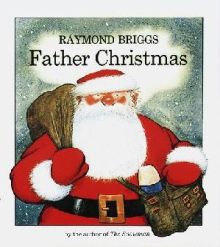 Raymond Briggs, Father Christmas. I just love this charming curmudgeonly Santa. Who doesn’t sympathize with the dreariness of having to plod off to work on a cold day? And whose spirits wouldn’t be restored by a little wine and cookies at mid-shift? Inevitably, at some point in the next little while, one of us is sure to look out the window and exclaim “Bloomin’ snow!” But at the end of the day, it’s all about making merry with the people (or, if you’re Father Christmas, the pets) you love.

 Another beloved Christmas book from my past is Ezra Jack Keats’s gorgeously gold and sepia-tinted edition of The Little Drummer Boy. This one too still lives in Vancouver, but I just discovered that it’s still in print, so may be next year it will be the traditional Advent book for my children. Par-rum-pum-pum-pum!
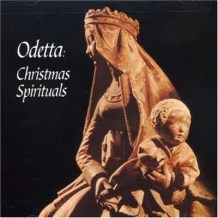
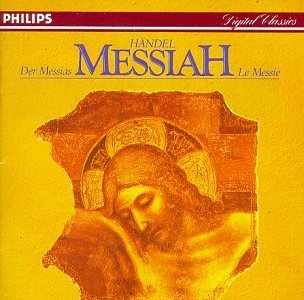
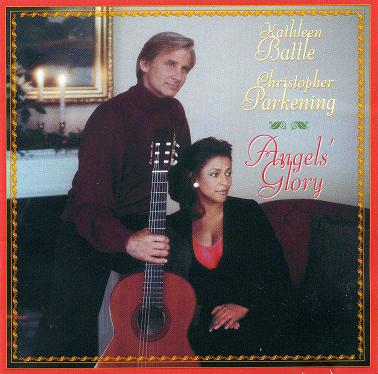
 Music is still essential to all holiday festivities, as far as I’m concerned. We got out our current stash of Christmas CDs this week. A lot of my old favourites are in the collection, along with ones that evoke holiday memories for my husband (
 I think, too, of George Eliot’s attitude, expressed implicitly and explicitly in so much of her fiction–that, as she wrote in a letter in 1874, “the idea of God, so far as it has been a high spiritual influence, is the ideal of a goodness entirely human.” I feel the same about the “Christmas” spirit: it’s really just the human capacity for love, charity, forgiveness, and generosity (not to mention reverence, sacrifice, and inspiration) that’s being celebrated, with nothing supernatural about it. The feelings evoked by carols such as ‘Silent Night,’ ‘It Came Upon a Midnight Clear,’ or ‘I Heard the Bells on Christmas Day’ (to mention just a few of my personal favourites) are really no different from the feelings evoked for me by any beautiful music, and the fundamental ideals of peace on earth and goodwill to men do not in fact require (and may even be hindered by) the specific myths of Christianity. And yet that tradition (as George Eliot acknowledges) for centuries provided a key framework for the development of these ideals (if not their perfect realization–indeed, quite the contrary, as history shows). And so I’m quite comfortable with the secularization of Christmas, which seems to me consistent with the goal of recognizing in ourselves–claiming for ourselves–those qualities most important to making the world a better place. It’s not God who blesses Tiny Tim, after all, it’s Scrooge! Why tie ourselves to the Christian calendar, then? Well, just as Christian traditions were superimposed on pagan and other rituals, so too our modern values and ideas are incorporating old ways and turning them to our own purposes. And the music really is beautiful–so I sing along, rejoicing.