 I can’t post about books I’ve finished this week because I haven’t finished any. I’ve been trying to read–keeping in mind my realization that my life as a whole is better if I do, and also if I then write about what I’ve read. One obstacle has been my eyesight, unfortunately! Happy as I still am with the multifocal contact lenses that make almost every other aspect of my life perfectly visible, apparently my eyes have been changing just enough that now, if I’m wearing them, I find it really hard to focus on books. I can read just fine without the lenses in, but I don’t like to take them in and out, so I’ve been fitting some reading in during the mornings before I put them in to start the rest of my day, and in the evenings when I will still need them a bit later for TV, I am experimenting with some cheap reading glasses–which do seem to help with that near focus, but make me pretty swimmy if I dare to look around and not just stare at the page. I need to see my eye doctor and reassess my options, but I don’t want to have an eye exam (which brings you inescapably up close and personal for quite a long time, if it’s thorough) until … well, until.
 So, one challenge is aging, and there’s not much to be done about that (and it’s only going to get worse, I know!) The other, though, has been the books I’ve been trying to focus on. Both are ones I have wanted to read for a long time, but neither has proved the right book for this moment, although one of them I am still working on. The first one I started this week was Elizabeth Bowen’s The Death of the Heart, which has been on my reading wish list for years. It looks great! I am sure it is great! But a couple of chapters into it, I just couldn’t bear it: it was making me feel both bored and claustrophobic. I suspect some of that is a deliberate effect, as it seems to be about a stifling world that tries to stifle people’s feelings. Bowen’s sentences didn’t help. I love Olivia Manning’s description of Bowen’s prose as being like someone drinking milk with their legs crossed behind their head: often, it just seems to be making something that’s actually fairly simple much more complicated than it needs to be! I can and have enjoyed exactly that about Bowen–but not now. Maybe The Death of the Heart will be a good book to read in the summer, on the deck with the languorous pleasure of sunshine to soothe my nerves and no constant fretting about discussion posts ungraded and PowerPoint slides to laboriously create. Back on the shelf it goes, until then.
 The other is John Le Carré’s A Perfect Spy, which I am still working on. I loved the Smiley books so much, and was so engaged by The Little Drummer Girl–how could I not want to read the book Le Carré himself considered his masterpiece? I acquired it in a flush of enthusiasm after reading the others, started it–and did not like it at all. Then I started it again, months later–and still could not get a grip on it. I took it off my shelves when I put Bowen back, because it seemed like the opposite kind of book and so I thought it might work where The Death of the Heart hadn’t. My hope is that if I can just get further in this time, I will figure it out, by which I don’t mean the plot (which I expect will be as twisty as always) but the voice and the style and the mood. It feels really different from the other Le Carrés I’ve read: it is more fragmented, more arch and nasty, and less (so far) morally serious. I know a lot of people argue that life is too short to keep reading books you aren’t enjoying, and this is a case in which I have obviously agreed so far, quitting it for other books that I liked better. I am not an absolutist about finishing every book you start–but I have, often enough, found that persistence can pay off, and I believe, too, that good books sometimes teach us how to read them, and it’s a lesson that can take more than a few chapters. I want to stick with it this time, just to give it a real chance. (Any admirers out there who would like to encourage me in this effort? Please chime in!)
 So that’s where I am this week! I have been thinking a lot about posting more in my once-usual “this week in my classes” series but I can’t seem to get past the twin obstacles of my classes no longer being distinguishable “events” and of all the work for them already being done by computer, which makes reflecting on them by writing about them on the computer a lot less appealing, for some reason. I have a rambling post partially drafted about the other topic that has been much on my mind: realizing that by the time we are back on campus, I will be among the most senior members of my department, not by age but by longevity. In fact, by July 1 2022, I will have only one colleague still around who has been in the department longer than I have. What does–what should–this mean to how I go about my work, or how I think about it? I don’t really know, and I thought that writing about it might help. Maybe it will! We’ll see. In the meantime, things go on exactly the same as they have for months and months. Vaccines are coming, but very slowly–as is spring. Reason for optimism on both counts, but what’s still required above all is patience, and after a year of this, I sometimes feel I have to dig pretty deep for that.

 She was entering by degrees exactly that condition which Joseph had predicted. She was being educated to tragedy, and the tragedy absolved her of the need to explain herself. She was a blinkered rider, being conveyed through events and emotions too great for her to encompass, into a land where merely to be present was to be part of a monstrous injustice. She had joined the victims and was finally reconciled to her deceit.
 Talking about our sympathies seems almost out of place, though, which is something else I found interesting about The Little Drummer Girl. It seems to me to be fairly careful about laying out the arguments for both sides, allowing neither Israel nor the Palestinians the moral high ground. Joseph is a crucial device in this respect, for us and for Charlie. As he lays out the case for Palestinian resistance, building the elaborate fiction that she will inhabit as a double-agent, she marvels “at the paradoxes of a man who could dance with so many of his own conflicting shadows, and still stand up.” Later, playing the part he has written for her, it is Joseph who begins to feel to her like the fiction, while the role he created becomes her reality:
 Given the ruthless and destructive behavior the novel shows by both “peoples” in pursuit of the justice they claim, is the novel’s message about the Israel-Palestine conflict “a plague on both their houses”? That angry impatience doesn’t seem to fit with the tone of the novel, which is relentlessly grim but also (and in this it definitely reminded me of the other Le Carré novels I’ve read so far) almost clinical. The characters frequently get heated but the novel remains coolly descriptive, not moralizing or judgmental. Everyone running Charlie, Israeli or Palestinian, is just doing what they think must be done: if there’s some other way forward, some better ought arising from the is of both recent history and current circumstances, nobody in the novel is talking about it. There’s certainly no thread of wistful “can’t we all just get along” idealism: this is not the kind of novel that “puts a human face” on a political problem in order to urge reconciliation. At most, it does this through negative example and by proxy, through Charlie–but I’m not sure we can take her case as a lesson about how innocents suffer: “And you are the same English,” Khalil says quietly, when the crisis has come, “who gave away my country.”
 The enemy here is once again the shadowy figure known as “Karla.” For Smiley, as Le Carré makes very clear, the pursuit is as much personal as political. “It’s to do with the people who ruined Bill Haydon,” he tells Ann in a scene full of devastatingly understated emotional pain–but he is thinking, “who ruined you.” Later, waiting to see if Karla will take “the last step,” Smiley rehearses the case against him:
 Every element of the case is shot through with moral and emotional ambivalence. The high point of the novel–the turning of one of Karla’s agents–wins Smiley the admiration of his people, reported to us in elegiac retrospection:
 As Smiley awaits the resolution of his quest, which he has undertaken in defiance of changed policies and protocols, under the shadow of “complete deniability” from the higher-ups, because this, this, is what they had once staked everything on, because this is the man against whom he has defined himself–as he stands in the shadows of the Berlin Wall, that relentless symbol of everything that divides his side from the other side–Smiley knows that if he wins this game he has made the difference between them irrelevant. “I have destroyed him with the weapons I abhorred,” he reflects, “and they are his. We have crossed each other’s frontiers, we are the no-men of this no-man’s-land.” And so he finds himself, against all odds, perhaps against all reason, hoping that Karla will not cross, or will not make it: “Don’t come, thought Smiley. Shoot, Smiley thought, talking to Karla’s people, not his own.”
 The Honourable Schoolboy itself is anything but brief, and that turned out–more or less–to be my problem with it. Of course, I am no stranger to long books, and I would never use scale on its own as a measure of literary merit. I’m also very aware that one person’s “too long” is another person’s “wonderfully immersive” or “lavish” or whatever. The question has to be whether, for you as a reader, the pay-off is proportional, or whether the book’s scope (whether broad or narrow) is the appropriate means to its ends. George Eliot said of Middlemarch, “I don’t see how the sort of thing I want to do could have been done briefly”: I have decades of experience now at explaining why I think she’s right about that, not to mention how we can approach Middlemarch so as to appreciate how she uses all the space she claims for it. The conspicuously shorter Silas Marner, in contrast, is pretty much perfect as it is. Being long, or being short, is not in itself either a necessary or a sufficient condition for admiration or pleasure.
 I can imagine that having taken these risks to get so much material, a writer would want to make use of it all! But maybe that personal investment also worked against him, making him reluctant to leave anything out, or unable to choose between what he knew and what his story actually needed.
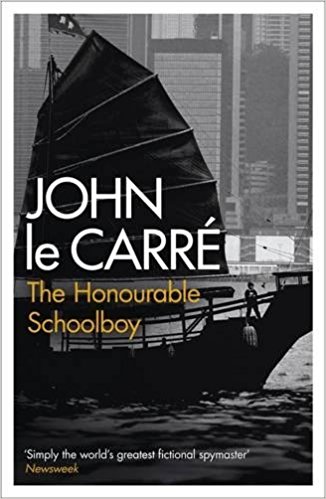 The other thing I really liked about The Honourable Schoolboy is Le Carré’s prose–which might seem contradictory, given my complaints about the novel’s length, but that just goes to show that good writing isn’t everything! Here’s just one example of the kind of sharply evocative description that is over-abundant in the novel: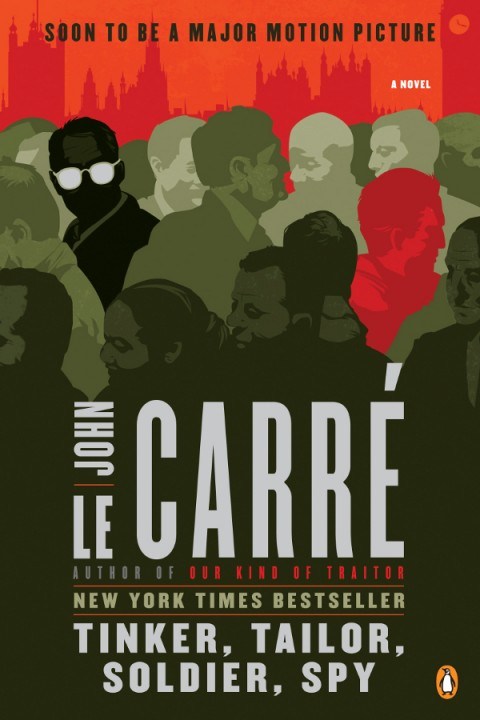
 As I did with Spy, I read Tinker, Tailor with mostly passive fascination, not trying to get ahead of Smiley to the truth about the mole known as “Gerald”–which is not to say I didn’t have my guesses, but the novel is not written to satisfy fair play conventions, and we only get information as it is doled out, by Le Carré as he chooses whose story to tell next and by Smiley, whose tactical reticence is its own form of genius. Smiley is of course the greatest of the characters here, but they are all–from gruff Jim Prideaux and his “watcher,” little Bill “Jumbo” Roach, to the four members of the Circus who give the novel its name–rendered with memorable specificity. Le Carré creates not just a world but multiple worlds, too, the best of them the damp, grubby, second-hand London in which Smiley conducts his backwards investigation. As he carries out his inquiries, we make excursions to other times and places, some louder and more lively, some even darker and more fraught with menace. But we always come back with Smiley to the Hotel Islay in Sussex Gardens, where he stays still while moving, in his mind, without cease:
 What’s particularly brilliant, though, is the way that in its very final chapters–once the mole’s identity is confirmed and thus the puzzle that is supposedly central to the novel has been solved–Tinker, Tailor, Soldier, Spy turns on itself. After all that time and work, there is no satisfaction, no triumph, for Smiley, in his own success. Instead, abruptly, what was almost an abstract research exercise becomes all too real, its consequences all too human: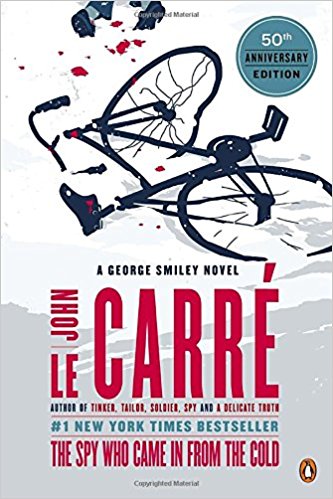
 Novel Readings