
I opened the book with some apprehension, wondering what archaic spelling and punctuation I would face. I found the expected f’s for s’s and a few other things that didn’t turn up as often, but I got used to them very quickly. And I began to get into Robinson Crusoe. As a kind of castaway myself, I was happy to escape into the fictional world of someone else’s trouble.
I read Kindred with unflagging attention: it is a gripping narrative, fast-moving and suspenseful and emotionally harrowing. It also, however, felt heavy-handed, almost didactic, and seemed formally and stylistically uninteresting. The time-traveling, which is never really explained or motivated–never given any autonomous logic–within the novel itself, functions as little more than a device to haul us back to to the antebellum South with Dana; its authorial objective is pretty clearly to teach us by immersion about the corrupting horrors of slavery. The back-and-forth in time also, of course, provides a neat mechanism for comparison: how much have things in fact changed; how deep-rooted and long-lasting are the effects of this traumatic past on the present; how, if at all, can a nation build a unified future on such a rotten foundation. It’s not that these aren’t interesting and important, even urgent, questions; I just didn’t find Butler’s literary treatment of them especially artful. Dana, too, seemed more a tool than a distinct character, though her relationship with Kevin, especially as his habits and attitudes are affected by his long stint away from their real (modern) life, seemed the most subtle and thought-provoking aspect of the novel.
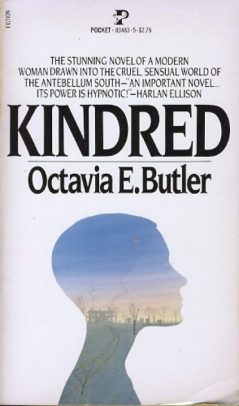 Thinking more about Kindred after I’d finished reading it, I wondered if I would notice more subtleties in it if I knew more about the specific genres it combines: it is a hybrid of time-travel fiction and the slave narrative, and while I have read an example or two of each of these, I have never given sustained thought to their conventions and I have little, therefore, to compare Butler’s effects or choices to. The reader’s guide in my edition includes an essay by Robert Crossley that says some things about these contexts. “One of the protagonist’s–and Butler’s–achievements in traveling to the past,” he says, for instance,
is to see individual slaves as people rather than encrusted literary or sociological types. . . . Here we see literary fantasy in the service of the recovery of historical and psychological realities. As fictional memoir, Kindred is Butler’s contribution to the literature of memory every bit as much as it is an exercise in the fantastic imagination.
OK, I can see that, although there may be less novelty in that recovery effort now than there was in 1979–which of course does not diminish Butler’s contribution. He also remarks that “Science fiction and fantasy are a richly metaphorical literature,” but Kindred itself is not, as he tacitly acknowledges when he says that in it “the most powerful metaphor is time travel itself” but then explains that “metaphor” as “a dramatic means to make the past live”–which is not really metaphorical, is it? In fact, time travel aside, Kindred is an almost laboriously literal novel; sometimes the research behind it seemed to have been simply incorporated into Dana and Kevin’s conversations or into her narration. Not that anything’s wrong with that literal approach, and it delivers a lot of drama that is both heartrending and morally devastating, but the result is really just historical fiction with a twist.
The one big exception is the obviously symbolic loss of Dana’s arm, which, as Crossley says, Butler “makes no attempt to rationalize” but allows to stand as a shocking mystery: “the author is silent on the process by which Dana’s arm is severed in the twilight zone between past and present.” He goes on to quote Butler’s explanation of the figurative meaning of this amputation: “Antebellum slavery didn’t leave people quite whole.” That makes perfect sense, but I’m less satisfied than Crossley is with the inexplicable and arbitrary process by which her arm is lost, which is wholly unrelated to the way Dana has passed between the eras up to that point. It feels, again, like a device that gets the job done, rather than like the culmination of a meaningful pattern that would give the novel the kind of creative unity and flair that I felt the novel, for all its ingenuity and sincerity, was somehow missing.
I should add that I read Kindred (or read it right now, at any rate) because my book club chose it for our next meeting. As always, we are following a thread from our previous book, which in this case was Lincoln in the Bardo. Perhaps it is inevitable that the next book after Lincoln in the Bardo would seem somewhat pedestrian!
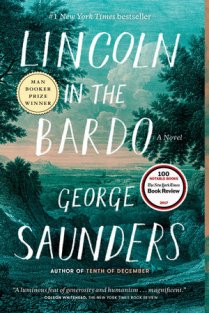
 It’s a bravura display of narrative ingenuity, and especially given how fantastical the premise is, the result could easily have been (and I fully expected it would be) flamboyant gimmickry, clever and original but soulless. It isn’t, though: I think Lincoln in the Bardo is actually one of the most touching and heartfelt novels I’ve read in years. However far it spirals away from reality, and however abstract its political or philosophical or historical implications become, it always comes back to the hardest and most intimate truth of all: nothing we love lasts. “None of it was real,” says roger bevins iii near the end:
 Willie’s death is as much the occasion for Lincoln in the Bardo as its subject, and there are many other sorrows recorded in it–many losses as or even more wrenching, many deaths as arbitrary or worse, and many lives that before those deaths were more deprived, more isolated, than Willie’s, that never had the kind of love that brings his stricken father out into the dark, cold night to sit one last futile time with his son. The world is much bigger, and has much bigger problems, than little Willie. His Presidential father, for one thing, carries the burden of leadership alongside his personal responsibilities and feelings. Lincoln imagines his own grief multiplied by the thousands dying in the Civil War:
 I was relieved to discover that nobody else in my book club liked A Fortunate Age either. For once, I feel reasonably confident saying it’s not me, it’s the book! I don’t think we’ve been so unanimous in our dislike of any our choices, in fact, since the disaster that was Paula McLain’s
  I particularly puzzled over why I found its detailed exposition so tedious. I am on record as a fan of exposition! But by half way through A Fortunate Age I was impatiently skimming through its dense paragraphs of stuff that just didn’t seem worth taking more time over. Rakoff inadvertently furnished a clue with her epigraph, which is from Daniel Deronda. (Beware: If you’re going to invite a comparison to George Eliot, it may well work against you!) True, Gwendolen Harleth is every bit as self-absorbed and ignorant of the wider world as the characters in A Fortunate Age, but (and for me this is crucial) George Eliot is not: her account of Gwendolen’s youthful egotism and willfulness is suffused with wry compassion; the context for Gwendolen’s story is not just the relentless minutiae of her immediate experience but everything else the narrator knows and thinks about the world she lives in. Gwendolen’s limitations do not limit her novel–but Rakoff’s characters are all we get in A Fortunate Age, and they don’t repay our sustained attention. I’m not saying the novel needed exactly what Daniel Deronda has–an intrusive narrator, for instance, or profundity, both of which are risky ventures if you aren’t George eliot–but it needed a broader perspective somewhere, a sense of what kind of story it is ultimately telling about these people and this age, especially since the book aspires (as its title indicates) to be about an era, not just a few individuals.
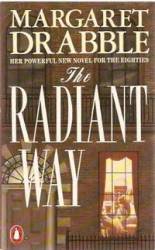 Jane Austen recommended three or four families in the Country Village as the thing to work on when planning a novel. . . . A few families in a Country Village. A few families in a small, densely populated, parochial, insecure country. Mothers, fathers, aunts, stepchildren, cousins. Where does the story begin and where does it end?
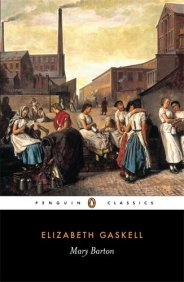 As this passage illustrates, The Radiant Way is about the condition of England in the 1980s, and its treatment of that era matches, rather than counters, what it suggests is the spirit of the age: it is (mostly) satirical, snide, cynical, bitter. I wonder if that is why it seemed to me so much more dated than, say, Mary Barton, with its heartfelt appeals to our common experiences and better natures. There is something naive, of course, about Gaskell’s novel, and many of her attitudes are outdated. Maybe I just prefer her kindness and optimism to Drabble’s somewhat ruthless explication of people’s weaknesses and compromises. The extent to which her analysis is still painfully current, too, shows that if anything she was prescient about the corrosion of the welfare state, the devaluation of art and education, and the instability of love as a foundation for happiness. Maybe I just wish it were dated.
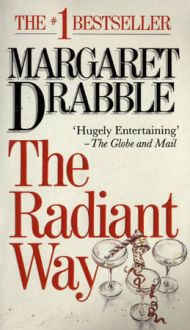 I read The Radiant Way for my book club (it’s our follow-up to
  One of the things (OK, the many things) I can be persnickety about is what to call whatever it is that I write here when I write about books. I call the results “posts,” not “reviews,” not because I consider a book review a limited or limiting form (not by definition, anyway, though in practice published reviews are very often limited, in scope if in nothing else) but because when I’m writing what I think of as a review I feel accountable, both to the book and to the implied audience. As a bare minimum, that accountability means reading every word in the book scrupulously, and then crafting a narrative about it that is very carefully considered. No review is authoritative in any absolute sense, of course, but when I’m wearing my Official Reviewer hat I aspire to a certain kind of confidence in my understanding of the book I’m writing about. Here, in contrast, I can write whatever I want, no matter how inadequate my understanding might be. My blog posts are narratives of my own reading experience, and so I’m answerable only for being honest and thoughtful about that.
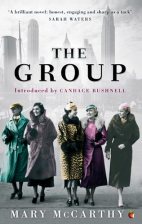 That’s an awfully long preamble to these remarks about Mary McCarthy’s The Group, which my book club met yesterday to discuss. As you might have predicted, I was putting off getting to the book until I’d said all that other stuff because I did not do a good job reading it, and as a result I wasn’t sure I should write about it. But then I remembered that I was blogging about it, not reviewing it, and so it’s okay for me to admit that and write about it anyway! If you want commentary by someone who is much better informed about The Group, I highly recommend
  I never had a conversion moment, but I’m glad I persisted with my reading, not just because it meant I could show my face at my book club but also because the book did turn out to be better than my first impressions of it. My experience improved as I got more used to the style–but I also gave myself permission to skim some of the relentless cascade of details that made up so many of those dense paragraphs. I understand that this may seem precious coming from a Victorianist! I tried to put my finger on what made McCarthy’s exposition seem so long and unpleasant to me in spite of my love for long and excessively detailed 19th-century novels, and I think it’s the same thing that made me recoil from most of her characters: she treats everything, and everyone, so coldly. Ultimately a lot about The Group is very sad, in some cases even tragic, but the novel has none of the humanity, none of the compassion, that its own stories could reasonably summon up. The word ‘sociological’ came up a lot in our book club discussion, and by and large we’d all found her depiction of her women’s lives interesting. But there’s something clinical about each of the women’s stories, with McCarthy observing them shrewdly, scrupulously, often wittily, but never sympathetically.
 I’m not sure if I liked the second half of the book better than the first because I adjusted to (or compensated for) McCarthy’s prose or because I liked the later characters better. Libby’s story was the first one that really engaged me, for the not especially good reason that I’m interested in writing and publishing, and that whole world has a sordid kind of glamour to me as a result. At my book club we were unanimous in liking Polly’s story the best; her relationship with her father is perhaps the only tender one in The Group, and her marriage also seemed like a respite from the acidity of the novel’s other relationships. (I should say that overall everyone else was quite enthusiastic about the novel–listening to them explain why helped me appreciate it better.) Kay’s reappearance in her story in a very different situation made me rethink my earlier reactions to her and her marriage, and the novel’s ending also made me realize that I had missed something of the forest because I was focusing too hard on the individual trees.
 Once Lolly has removed herself from the benevolent tyranny of her family, establishing herself in the wonderfully-named town of Great Mop, she reflects on their disapproval:
 Lolly’s final dialogue with Satan (winningly in the guise of a common gardener) is the pay-off for the somewhat slow burn of the first two thirds or so of the novel. In fact, it’s mostly a monologue, in which Lolly makes a compelling case for Satan’s intervention. “It’s like this,” she explains:
 Over the past week I read three novels. Only one, Michele Roberts’s
 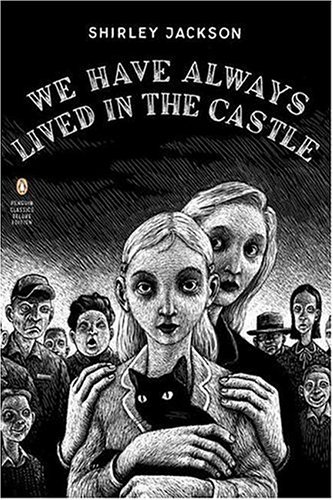 For my book club, I read Shirley Jackson’s We Have Always Lived in the Castle. What a treat that was. It’s like a perverse inside-out fairy tale. In our discussion of it, we got particularly interested in the way it destabilizes our sympathies. There’s the initial instinct to side with the narrator, which of course quickly turns out to be a mistake, except that she is being persecuted–though not unfairly, since after all, she is a murderer. Jackson evokes the horror of mob violence as well here as she does in “The Lottery”: the scene that begins with the fire chief throwing the first stone unfolds in an equally horrifying way–except that at least one of the targets is in no way an innocent victim, and later on, some of the villagers seem to be horrified, in their turn, at what they’ve done. We puzzled over Merricat’s motivation, or rather, over whether she has one, for killing her family. The suggestion seems to be that she didn’t much like being sent to her room without dinner, or in any way being thwarted or crossed. So the murders may be the act of a vengeful narcissist, a spoiled brat gone rogue. On the other hand, maybe there is no reason, which in its own way is even scarier. It’s a brilliantly written little book. I was hooked from the first paragraph, which is a perfect combination of whimsy and menace:
 I expected Sarah MacLean’s The Day of the Duchess to be a lot of fun too, but I really didn’t enjoy it and ended up skimming the last third or so of it just to get to the end. I have liked some of MacLean’s romances a lot, including The Rogue Not Taken, the first one in this series, but this book tilted too far towards the “feels” for me: it’s all angst and yearning, without any frolicking. I’m not necessarily saying it isn’t well done. It’s just that my own taste in romance tilts instead towards comedy. Also, more than I remember noticing in MacLean’s books before, The Day of the Duchess is full of the kind of writing that seems meant to force feelings on you, rather than allow you to arrive at your own reactions–lots of fragments, and lots of single line paragraphs, devices which to me almost always backfire: rather than increasing the impact of the line, they make it seem artificial, especially if the trick is used over and over again. I’ve been trying to think if there are any consistently serious romances that I really like. Laura Kinsale’s Flowers from the Storm is the only one I can come up with. Blame my inner cynic, which, as I’ve said before, makes me accept an HEA only if it doesn’t take itself too seriously.

 Lovely as Durrell’s scenery is, he’s at his best (as you’d expect) with animals:
 Perhaps, then, the child’s point of view (though of course the sophistication of the writing subtly belies it) is one reason children have loved this book. Another would be its humor: when things do happen, they are usually very funny. There’s some high drama, as well: the epic battle, for example, between the gecko Geronimo and the giant mantid Cicely:
 My book club met last night to discuss Jane Smiley’s Some Luck. We didn’t choose it with this in mind, but it ended up feeling like a good choice to talk about the night before the American election, because it is pretty clearly meant not so much as a story about a particular American family as a story about America told through a particular family. You can’t quite tell this at first (though the structure of the novel, a chapter a year, is a hint), but by the time this novel — the first in her ‘Last 100 Years’ trilogy — ends in 1953, it’s the march of time and the sense of a changing nation that predominate, not the details of individual lives.
 I think it is in part because the election was on all of our minds that our discussion turned quite a bit on what kind of story Smiley had chosen to tell about America. One conspicuous feature of Some Luck, for instance, is that it’s very much a story of white rural America: if Smiley intends the trilogy to be something of a national biography or a broader chronicle of the country, that seemed to us like a strategic error, one that replicates a certain vision of America’s “heartland” as the “real” America. That said, as some people argued last night, Smiley’s focus on an Iowa farming family and how it is affected by social changes that often seem to come upon them from elsewhere is itself certainly a very American story, even if it is not the story of America as a whole, and there’s not in principle anything wrong with her choice of a starting point. One reason I’d like to read on is that I’m curious about whether Smiley finds a way to complicate her origin story — to highlight its partiality as a story about America. Clearly, even in Some Luck, she is taking us well beyond Iowa as the family members spiral outwards into places and lives very different from those of our first couple, Walter and Rosanna.
 Novel Readings