Hero as Kitten: Georgette Heyer, Friday’s Child

fridayschildEarly in my Heyer adventures I was advised to stay away from the ingénue heroines. I’ve read about a dozen of Heyer’s novels now, and by and large I have followed that wise advice, seeking out and greatly appreciating the more mature, sensible, or knowing heroines of Venetia, Frederica, Devil’s Cub, or Black Sheep, for instance. Friday’s Child, however, features a heroine who is not just an ingénue but very nearly a child bride, an uncomfortable set-up indeed. Hero Wantage is just 16 when she is carried off to be married by special license to Lord Sherington, who is himself a bit anxious that he’s out of line. “Damme,” he exclaims as they hatch their scheme, “you’re nothing but a baby! . . . I don’t mind people calling me a libertine, but I’m damned if I’ll have them saying I took advantage of a chit not out of the schoolroom.”

He does marry her, however, though what he proposes and then establishes appears to be a marriage in name only: “you needn’t fear I shall be forcing my attentions on you,” he tells her at the outset, and there are no signs of passion or intimacy between them for nearly the entire novel. I wrote once before that I was finding Heyer’s novels “romantic but not sexy.” This reserve is a bit of a relief in this case, since Hero is so very young, not just in age but in outlook. She adores “Sherry” but follows him around craving his attention and approval in a manner more like a pet than a person — which makes it all the more cute but also irksome that he nicknames her “Kitten.” It would be creepy if he did sleep with her, or at least if he did so before they both grew up a bit.

I found it interesting that this very un-sexy relationship is at the heart of a novel that is actually quite sexually frank. Sherry is something of a libertine, known for his “bits of muslin” and his opera dancer. His associates are not much better, and one of them is such an unrepentant rake that there’s a pivotal scene involving a confrontation with his abandoned mistress and child. Hero’s marriage propels her, quite unprepared and without proper chaperonage, into the midst of this wholly unsuitable milieu. She is protected by her perfect innocence, but eventually even Sherry realizes that he isn’t doing at all right by his wife by exposing her to such habits and people. His friends, quickly won over by Hero’s good humor and guilelessness, become her allies and attempt to correct Sherry’s bad judgment. At the same time, though, his marriage clearly strikes them as odd, and one reason seems to be that they realize it is not a full marriage. The most explicit suggestion that to them, Sherry is wronging his wife by not consummating their relationship, comes from the Byronically handsome George Wrotham, who enrages Sherry by kissing Hero at a ball. It’s all just friendly (“There was nothing passionate in this embrace, and Hero had no hesitation in receiving it in the spirit in which it was clearly meant”), but it sure looks bad, and Sherry calls Wrotham out. Urged by his cronies to apologize, George bridles:

‘Sherry’s a dog in the manger!’ said George, his eye kindling. ‘Why don’t he kiss her himself? Tell me that!’

‘Nothing to do with the case,’ replied Mr. Ringwood. ‘What’s more, not your affair, George. I don’t say you’re wrong, but it don’t alter facts: you ought not to kiss her!’

Why should it be that Wrotham and Ringwood can see their precious Kitten in this different light but not her husband? As the novel tells it, the fault lies entirely with Sherry, whose maturation is brought about by his dawning awareness that being a good husband to Kitten means living more responsibly and, eventually, loving her entirely. It’s not so much Kitten who’s not ready, that is, despite her youth; it’s Sherry, who sees Kitten as so entirely separate from his own world of self-indulgent pleasures that it doesn’t seem to occur to him that she might have desires of her own beyond fun and bonnets.

If Kitten were a lot more than he thinks — if we knew what he doesn’t, namely that she is not a “chit” or a child but has strengths and resources and some adult perspective on the world — all would be well. But Kitten never does show herself as an adult. She’s forever getting into scrapes and being rescued; even the dénouement, which shows all Heyer’s unbeatable talent for bringing her various story lines together into a great comic finale, turns on other people’s planning, with Kitten never rising to the level of her real name. Her feelings for Sherry seem like a school girl crush from beginning to end, and when they do finally fall into a “passionate embrace” it doesn’t deter him from calling her a “brat” with his usual air of superiority. Add to that his tendency to bully her and box her ears — behavior that, to their credit, Ringwood and Sherry’s other friends find offensive (“he’s got no right to behave like a curst brute”) — and he’s far from my favorite Heyer hero, even if (like all good romance rakes) he does repent and reform.

And yet Friday’s Child serves up a lot of fun and laughs. It’s especially rich with Regency slang: I didn’t understand half of what Sherry’s “Tiger” Jason says (“Lor, you must have had a shove in the mouth too many, and I never suspicioned you was so lushy, so help me bob! Werry well you carries it, guv’nor! werry well, indeed! Gammoning me wot knows you you was sober as a judge, and all the time as leaky as a sieve!”), and the repartee among Sherry’s friends, if not exactly witty, is endlessly amusing. Also, the one truly nasty fellow gets his comeuppance just as he should. It’s just that to really enjoy these things that Heyer does so well, I had to fight off the faint queasiness induced by the other aspects of the novel.

Zoë Ferraris, Finding Nouf

noufFinding Nouf was one of my choices at Hager Books on my recent trip to Vancouver. I didn’t have any specific recollection of having heard about it before, but it turns out that a couple of people I know (well, know virtually, anyway) reviewed it when it was newly out, so perhaps that’s why the title caught my eye as I browsed the mystery section. I always have my eyes open for books that might bring a new twist on the genre to my detective fiction course — I’ve gotten more than a few good ideas from comments here and on Twitter over the years, including the Martin Beck books (now I routinely assign The Terrorists) and Walter Mosley (Devil in a Blue Dress is also now a staple). Inevitably in a course like this we talk a lot about common tropes and conventions; we work through some of the works that established the ones that are now central to the various subgenres of mystery fiction, and then we look at how those conventions can be used to explore a range of different issues that extend a single crime into a broader investigation — Sara Paretsky looks at systemic crimes like sexism and corporate corruption, for instance, Mosley at racism and structural inequities, Ian Rankin at the kind of social and political conflicts that have led some critics to call his Rebus books contemporary versions of the Victorian “condition of England” novel.

It looked like Finding Nouf might do something similar by using its specific crime (the murder of a daughter from a privileged family) to explore social and cultural issues in its own context, contemporary Saudi Arabia. To some extent it does exactly that: finding out what happened to Nouf involves exposing not just the nature of her very restricted life but her feelings about that life, and they are not happy ones. The story of her attempt to escape to a new life is not really as interesting, though, as the effect discovering her story has on Nayir, a friend of the family whose skills as a desert guide lead them to ask for his help while she is still missing, and who keeps on asking questions about her fate even after the family has asked him to stop. Though I didn’t find Nayir’s motivation convincing (at times, the machinery necessary to keep the investigation moving forward seemed pretty creaky), I thought his character protected Finding Nouf — which in some ways is very predictable — from some of the clichés that plague books about “life behind the veil” aimed at Western readers. If the only investigator were his accidental partner, Katya, the novel’s ideology would be a simpler one of resistance to the oppressions of being a woman in Saudi Arabia. But Nayir is profoundly pious — the sections told from his point of view are permeated with prayers and suras from the Quran — and conventional about women’s hidden lives and faces, and he is presented very sympathetically.

Katya, who both works and readily unveils, challenges his expectations and feeds his curiosity about women, while the revelations about Nouf help him sympathize with yearnings for something different. Their work together reflects the divisions of Saudi life (he has greater mobility and access to outside spaces, but only she can enter the women’s private spaces), but the fact of their working together defies it, which makes Nayir extremely uncomfortable at first but which comes to suggest (even to him) the benefits of freer interaction and greater equality between the sexes. It’s their story more than Nouf’s, then, which carries real thematic weight. To avoid spoilers, all I’ll say about Nouf’s case is that there’s a degree of misdirection that plays rather cleverly (or so I thought) on the likelihood that Western readers would expect the crime to confirm her status as a victim of women’s oppression, whereas the truth — while related to the context of women’s narrow lives — is more personal than political. (In this respect Ferraris’s plotting reminded me of Elizabeth George’s in Deception on His Mind). It’s a salutary reminder, if you like, not to take our categories of good and evil too simply for granted, a lesson Agatha Christie also teaches when she plays on, say, our trust in nice country doctors.

Finding Nouf had a lot of interesting aspects to it, then, but as a whole package it wasn’t entirely successful. There’s the creaky machinery, which I’ve already mentioned. Then the writing struck me as uneven: some of it is interesting and evocative, and there are many interesting “insider” details about life in Saudi Arabia that were vivid without being cheaply exoticizing (I particularly appreciated the cardamom-flavored Chiclets), but there were also soggy cliches and overwrought moments that didn’t do the work I think they were supposed to of ratcheting up the novel’s emotional intensity (“standing frozen in the hall, her heart split in half and lying on the ground”). The pacing seemed slow, the discoveries a bit protracted, though the novel itself is not that long. I have been wondering whether (as Mark Athitakis asks here) Ferraris would have done better to write a straight-up novel set in Saudi Arabia instead of  using the conventions of detective fiction, but on reflection I think it was a good instinct, given the potential of the genre to do the kind of exposé and critique Finding Nouf offers. It’s just harder than it looks to perfect the balance of form and substance, formula and novelty, that such a novel requires.

I can’t see myself assigning Finding Nouf in my class: it’s not interesting enough qua mystery novel for that. But I might try the second one in the series, just for myself, to see how Ferraris develops.

This Week: A Little Class Prep Goes a Long Way

EnglishBayIt’s always hard settling back into ongoing projects after a vacation, isn’t it? Although I’ve been back in my office regular hours every day this week, my progress on my writing has been halting, despite the haunting awareness that summer is ending soon and with it the luxury of relatively uninterrupted time to do it. I’m never altogether sorry about that: I’ve written here before about my tendency to fall into the summer doldrums, and though my two cheerful trips have mitigated the effects this year, I still find myself looking forward to the return of energy and sociability that comes with the start of term.

Since thinking about classes is in fact kind of cheering for me, then, and since I wasn’t being very productive in other ways, I’ve spent some useful hours in the last couple of days puttering away on some nice, concrete course-preparation tasks. I’m teaching just two classes in the fall, both ones I’ve taught before: Mystery & Detective Fiction (you’re probably tired of my reporting anything about this one, I’ve taught it so regularly in the past few years!) and 19th-Century Fiction from Dickens to Hardy (which I’ve also taught regularly but more intermittently). I’m not mixing up the mystery class this year except for taking off An Unsuitable Job for a Woman and adding back in a few more short stories, since in the last couple of rounds of teaching evaluations there was some muttering about the reading list being long and the pace being too fast. Unsuitable Job is one of my own personal favorites, but it doesn’t really represent any central issue or subgenre — I just enjoy teaching it — so if something had to go, it’s the one, not The Big Sleep or The Moonstone or The Hound of the Baskervilles. I guess Knots and Crosses could go, but it’s always very popular, while Unsuitable Job isn’t. But otherwise it will be business as usual. Still, the Blackboard site needs tidying up, dates and details need updating on the syllabus, and I’m tweaking a couple of policies about “bonus” points which in their previous generous form had the unintended consequence of bumping kind of a lot of people up into the A+ range for their final grades. Most of that is done now, though I need to give the syllabus one more careful look.

villette-charlotte-bronte-paperback-cover-artAs for 19th-Century Fiction, as usual I’ve changed up the reading list a bit (it’s so nice that there’s no oversight or interference to worry about with these decisions — it is entirely up to me which and how many books to assign). I’ve mixed and matched a pretty constant set of books in the past several incarnations of this course (you can see the chronicle of them here, if you’re curious) and though I’ve been happy with them, it felt like it was time to try some different ones, so this fall I’m starting with Villette and ending with The Odd Women, neither of which has ever been on my syllabus for this particular course before. In fact, I’ve never lectured on Villette, as I’ve only assigned it in seminars, and that not in well over a decade. Working up notes and materials for it, then, will be a big project for me in the next few weeks. I have taught The Odd Women much more often, but again usually in a seminar (“The Victorian Woman Question”). I do have some lecture notes for it from many years ago when I included it in a full-year class on Victorian literature. That was so long ago that the notes are hand-written! I expect I’ll do some things differently now. I gave the novel some fresh thought when I reread it recently with my book club; the general enthusiasm for it there makes me hope that my students will also enjoy it. I’ve put it last, slightly out of chronological order, so that for once we won’t be ending with Jude the Obscure (though we are still studying it). I’m not sure The Odd Women is much more cheering, really, but at least it has 100% fewer murder-suicides. For this course I needed to do the Blackboard site up from scratch; this is mostly done now, and I’ve made up study questions for the novels that didn’t yet have them and also pretty much completed the syllabus.

All of this is reassuringly finite and useful business to take care of. It all has to get done by the end of August anyway, so I’m not really stealing time away from other things, just redistributing it from writing to teaching for a while. I have set up a list of other class-related tasks, too, which is both calming (because it controls the potentially chaotic future) and practical (because now when I want to take a break from the more amorphous work of writing, I can choose something from the list to do rather than just feeling anxious).

Now that I’ve been overtly productive in these other ways for a while, I hope I’ll find that my mind and my mood are right to turn back with renewed focus to the two writing assignments I’ve given myself for these final weeks of summer. The first is to get as much as I can done on the next piece of my George Eliot book. Earlier this summer I worked hard on a more conceptual piece of it, a kind of draft introduction and sample. Now, having diligently reread Daniel Deronda with this in mind, I am working on an essay or chapter about women and marriage, particularly but not exclusively in Middlemarch and Daniel Deronda. Its current working title is “Smart Women, Foolish Choices” (which some of you may recognize as the title of a dreadful-looking self-help book). The second is a review-essay on Elena Ferrante for Open Letters, which I think will follow (more or less) the pattern of previous “peer review” features we’ve run, that is, a survey of critical reception organized to tell a story about that reception, or to interrogate it in interesting way. I’ve been reading as many reviews of Ferrante’s fiction as I can find, and I think they raise some pretty provocative questions about anger and women’s writing and ideas about “literary” fiction.

“Each of us narrates our lives as it suits us”: Elena Ferrante, Those Who Leave and Those Who Stay

ferrante3I finished reading Elena Ferrante’s Those Who Leave and Those Who Stay this weekend. I actually took it with me to Vancouver and had started reading it on the flight out — a bit to my own surprise, since I’d brought another book I thought would make better airplane reading (Elizabeth Renzetti’s Based on a True Story) only to find it wasn’t interesting enough (at least, not right away — I’ll come back to it!) to distract me from my fear of flying. Ferrante, on the other hand, whom I had expected to add unpleasantly to my tension, worked out better: her prose has a headlong, uncompromising momentum that kept my attention. But once arrived I did little reading, and then on the flights home I mostly watched Season 1 of Last Tango in Halifax, which I’d saved to my iPad. (I’m really enjoying it, by the way, and now I’m annoyed that I hadn’t heard of it in time to be recording Season 2 on PBS. It’s not my Halifax, of course, but the Yorkshire one.)

It took me a while to settle back into Those Who Leave and Those Who Stay once I picked it up again: the same pushy style that kept my mind busy on the plane seemed a bit grating under different circumstances. And then all the ambivalence I’ve felt about her other books, including both the first two in this Neapolitan trilogy — My Brilliant Friend and The Story of a New Name —  and (even more so) her earlier The Days of Abandonment,was renewed. Once again I was interested in the book but I didn’t exactly enjoy it, and by the end I wasn’t at all sure that it is a good novel. Though it does move forward, its energy seemed ultimately rather purposeless: it’s just the next thing, and the next thing, and the next thing, until it stops — rather than concludes. Collectively, the series is perhaps a Bildungsroman, perhaps even a double one, given how closely intertwined the stories of Elena and Lila are, at least in Elena’s mind and in her version of their lives. But as Lila tells her, with her usual enigmatic ruthlessness, “Each of us narrates our life as it suits us.”

Why does it suit Elena to narrate her life the way she does? I thought perhaps some clues to her meaning or purpose were being laid out for us in the possibly metafictional discussions of her own book, the one so many of her friends and family consider a “dirty” book, the one that brands her as the one who wrote an “ugly, ugly book.” Is the Neapolitan trilogy self-reflexive in that way? Is it an “ugly” book that lays bare what Ferrante sees as truths about life, perhaps her life? Does it, in this way, attempt to be her confession, maybe even her repentance (for the Elena in the novel is never uncompromisingly happy about her novels, and indeed is often ashamed of them), or is it her justification — saying, on her behalf, see, you read such an ugly, dirty book as this, so Elena — both Elenas — are right, are artists, are truth-tellers? But Those Who Leave and Those Who Stay does not resolve any questions about either Elena’s fiction: the character does not achieve any triumphant culmination, the novel does not offer any epiphany, the metafiction does not (as far as I have been able to tell) offer us a theory by which to understand what we are reading. If it’s a Kunstlerroman, it’s not one that, like Great Expectations, could only have been written by the character who has undergone the experience — learned the lessons — of the novel itself.

It is, also, an “ugly” book: I found myself thinking of Zola and wondering if the atmosphere of general grimness and disillusionment Ferrante seems to specialize in belongs to some extent in that naturalistic tradition. Certainly it has little in common with the “realists” I’m most used to and fond of. Its possibilities in this respect are limited by its intense first-person narration: I don’t think that Elena is an unreliable narrator, strictly speaking (we don’t get the literary signs we’d need to second-guess her altogether) but she’s certainly a partial and limited one, and our inability to rise above her festering consciousness means that the moral and social reach of the book is relatively constrained. That made me impatient, after a while: I wanted to know and see more than she could. I think this is another instance of me wanting the book to be a different kind of book, though, not necessarily a flaw in the novel’s execution.

Having said that, though, I will say that the book offers little of formal interest. Since I have to work with the translation, I can’t safely judge the prose: I’m curious to know if in Italian, she comes across as a stylish writer, because in English she seems pretty flat — energetic, again, moving forward almost restlessly, but with few phrases or descriptions that made me want to linger instead of keeping up. The overall story arc seemed to me to go crooked, too, as Elena’s artistic and intellectual struggles were crowded out by an affair which — though it did bring a kind of completion to one pattern in her life — did not seem integral to anything the novel was fundamentally about. What is the novel about, though? Maybe I’m asking the wrong question again: if it’s just the narration of a life, why should it be “about” anything? I think it should be, actually, because it’s supposed to be art and I like my art to have design, more design than life. But the Knausgaard phenomenon suggests that some people are fine with art that refuses to actually be art, or at least art that insists on hewing as close as possible to the formlessness of life.

I know these are fairly impressionistic comments so far. A lot actually happens in the novel, and for all my reservations about it I did find something gripping about it. I think I’m going to try to write something more deliberate and thoughtful about it for Open Letters. I find I’m particularly curious about why Ferrante seems to have had such an ecstatic critical reception since her books began appearing in translation: what is it about these books that many people find so exhilarating? There’s a bit of a Ferrante fad right now — why? I’ve wondered in my previous posts (about Ferrante but also about Claire Messud) about whether there isn’t a trend to value angry women. (Perhaps their anger makes them safe “literary” protagonists — there’s no mistaking Elena and Lila, or Olga, for a “chick lit” heroine!) But anger is not only a partial truth, it’s hardly a new truth. I’m about to reread Villette in preparation for fall teaching — now there’s anger, repression, and resistance that, to me, is more coherent and rewarding to immerse myself in imaginatively.

August in Open Letters Monthly — and an Interview

OMNI_DEC_1980_027

Once again it’s a new month and so we’ve got our new issue up. One neat new thing is the graphic “slider” at the top of the site, which showcases a range of pieces from the magazine (and which will also include new blog posts and highlights from Open Letters Weekly). We think this adds a bit of dynamism to the front page and we hope it will help visitors to the site spot things they’re interested in reading easily — though scrolling down the page to see the full Table of Contents and links to recent posts remains the best way not to miss anything.

MaryBarton-195x300As always, I think there are a lot of pieces well worth your time. Favorites of mine include Jessica Miller‘s smart and probing review of Rebecca Newberger Goldstein’s Plato at the Googleplex; Dorian Stuber‘s thorough piece — as much essay as review — on Bernard Wasserstein’s The Ambiguity of Virtue (about Gertrude van Tijn, whose work with the Jewish Council during WWII helped over 20,000 Jews escape the Holocaust but also involved her to a vexing degree in what some have seen as collaboration with the Nazis); Elisa Gabbert’s typically sharp critique of Ben Lerner’s regressively metafictional 10:04; and our collective feature on ‘minor’ works by major writers from Shakespeare to Muriel Spark. My contribution to this list is Gaskell’s Mary Barton; as I say there, in its day there was nothing obscure about Mary Barton, but thanks to Masterpiece Theater, today it’s North and South and Cranford that most people know, and I’d guess (though this may just be me) that these are also taught more often than Mary Barton.

I thought I’d also mention here, for those of you who might have missed it, that writer and editor Matt Jakubowski interviewed me for a series he’s beginning on the role of critics and criticism. We did the interview by email and then he cut and tidied my long responses into a single rather more manageable and coherent piece. I really appreciated his thoughtful questions; it was useful to me to look at my trajectory in the way his inquiries prompted me to, and also his interest in my critical work and approach was encouraging in a way I hadn’t quite expected — the internet is a big place and it’s easy to feel a bit lost in the crowd, so knowing that someone like Matt cared enough to single me out for a chat was a real boost. I’m looking forward to seeing his other interviews as they appear.

Vancouver Vacation: Sun, Fun, and Family

I’m back from another trip to Vancouver, this one organized mostly around the festivities for my parents’ 50th wedding anniversary. It was glorious weather the entire week, which was an especially good thing for the big party — a great event featuring family, old friends, lots of food and wine, and four musical performances from Bulgarian dance music to Bartok violin sonatas.

This was a shorter trip than my last one and involved quite a few family events, so I didn’t get around the city quite as much or see as many of my own old or newer friends (sadly, including Liz, with whom I had such a delightful lunch last year). Next time! But the city was as breathtakingly, unbelievably beautiful as ever:

ParkView

VancouverBlues

EnglishBay

And my parents’ garden was as tranquil as ever, with its colorful pots, shady trees, and soothing “gurglers”:

IMG_2381

IMG_2392

And Granville Island (my happy place!) was as bustling and tempting as always:

GranvilleMarket

IMG_2466

IMG_2497

And, of course, there’s always time to do a little book shopping:

VancouverBooks

My mother and I went on our traditional outing to Hager Books, which is small but nicely ‘curated’ and so always has particularly tempting options. I bought something old (Rose Tremain’s Music and Silence), something new (Jhumpa Lahiri’s The Lowland) and something that’s a bit of a gamble (Zoë Ferraris’s Finding Nouf, a mystery set in Saudi Arabia which, if it turns out to be well-written and smart, is a possible contender for my detective fiction class — I’m always on the hunt for books that offer a different perspective or use the form for different kinds of inquiries — we’ll see how it goes).

I picked up Heyer’s Friday’s Child at Carson Books, a used book store in my parents’ neighborhood. It’s a fun place to rummage around, though overall the prices strike me as a bit high for second-hand. This is a pristine copy of a Heyer I’ve never read, though, so I snapped it up. I also bought an Inspector Morse novel there, because something about being around my folks always reminds me that I haven’t read any of these (they are big Morse fans), but I started it and wasn’t grabbed, so I left it behind for them to enjoy. (I’m sure my Morse days will come: for my sins, I’m unmoved by the TV show as well. In the meantime, though, I may try the prequel show Endeavor, which they all highly recommended.)

And then at the big Chapters downtown (which, once you get up to the third floor, past all the frou-frou stuff that comes first, has a pretty big selection of actual books) I found two books from my standing wish-list: E. F. Benson’s Mapp and Lucia (because you can never have too much British social satire in your collection) and Harry Karlinsky’s The Stonehenge Letters — contemporary Canadian, so a bit of a rarity and a risk for me, but recommended to me by Steven Beattie, who knows a thing or two about Can Lit. I gave it a good look in the store before deciding to actually buy it, and I like his instincts: it looks meta-historical and original, but not so quirky I either won’t get it or won’t like it.

Now I have to get myself re-organized and on track for what remains of the summer!

“Is it genuine?”: Dorothy Dunnett, Niccolò Rising

niccoloInspired by my excitement about King Hereafter, I have finally started reading Dorothy Dunnett’s other big series, The House of Niccolò. I’ve actually owned Niccolò Rising for many years, and I’d started it a few times before, but it is another story with a slow burn and I’d never made it past Chapter 2. If I hadn’t been schooled in this trick of Dunnett’s so recently, I think I would have bogged down once more, and it did take a bit of determination to keep on. I remembered, this time, that I have to trust her and that if I do, I won’t be disappointed.
I wasn’t disappointed in Niccolò Rising — but mostly I wasn’t enthralled either, though I was almost always interested or curious. There are certainly sporadic sequences (as in King Hereafter) that are exciting or dramatic.  Then, a lot happens in the last 50 pages, and I was reminded that while King Hereafter stands on its own, Niccolò Rising is just the beginning of a much longer saga, so the real pay-off for her elaborate set-up (and it really is a tangled web she and Niccolò are weaving) is yet to come. I’ll certainly pursue it! Though I haven’t quite given my heart to anyone in this book the way I lost it so completely to Lymond, Claes / Nicholas is a really intriguing figure. Pobably the best thing about Niccolò Rising, in fact, is watching him transform from the wide-eyed, powerless, good-natured boy Claes into the much more poised man Nicholas and wondering, as his friends and associates do at the end of the novel, if I really know him at all. “He’s won the good will of everyone who has ever beaten him,” observes the doctor Tobie,

‘by being cheerful, placid, long-suffering, and, above all, by bearing no grudges. It makes him attractive to work with. For me, it would make him attractive to work for. But I’ve begun to wonder about this submissive role. Is it genuine?’

Julius grinned. He said, ‘Have you seen Nicholas putting up with a beating? It’s genuine.’

‘Oh, he puts up with it, at the time,’ Tobie said. ‘But what if he doesn’t immediately forget it, as you seem to think? What if every slight, every punishment is being quietly registered, because he is really a different sort of person altogether?’

‘I’ve wondered,’ said Gregorio.

‘Yes. So have I,’ said Tobie. ‘Is he what he seems? And then, from wondering, I started to notice things. The chief being this: whom friend Nicholas dislikes, it seems to me, friend Nicholas kills.’

“I started to notice things”: that’s Dunnett’s recipe, isn’t it, that we should notice things, and from there, do our best to connect them, as Tobie, Gregorio, and Julius proceed to do. They are much better at it than I am, though, and that is something that is starting to bother me, not so much about Dunnett as about myself as a reader. Is it my fault that here too I was so incapable of following the multiple threads that make up Dunnett’s incredibly intricate pattern? Is the pattern really so intricate, or am I not working hard enough, as a reader? I imagine that the pleasures of her books are greater for those who can keep track of the allegiances and loyalties and double-dealings, overt and covert, actual and possible, the way her heroes do. What makes them heroes, of course, is that they can do this, so maybe we aren’t expected to be in the know: as a device, it keeps us both surprised and impressed as she pulls out her version of the detective’s “reveal.” Other Dunnett readers: do you follow the game as it’s played, or wait, as I mostly do, for the outcome and the laying down of the hands? I grasp enough to appreciate the human confrontations, but that’s also mostly what I’m reading for, and maybe that’s a sign of weakness.

In any case, I do want to read on: she populates her novels with characters who provoke complex responses, which I really enjoy (here, so far, Katelina van Borselen is a particularly tricky one, and Marian de Charetty is particularly appealing) and there are worse expectations than that I will be consistently outsmarted even as I’m entertained and moved.

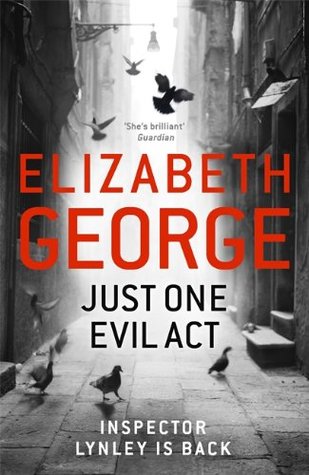
Elizabeth George, Just One Evil Act

oneevilactThe last time I wrote about Elizabeth George here, after reading 2008’s Careless in Red, I said that “I turned to these latest instalments [in her series] motivated far less by curiosity about the latest corpse than by the desire to know how things are going” with her main characters: Thomas Lynley, Barbara Havers, Simon and Deborah St. James. I was tiring of the detective plots that ostensibly motivated the novels but that really just provided an excuse and an occasion for personal stories and character development. Then with 2012’s Believing the Lie I admitted that these private lives were also becoming a bit stuck for me: so much angst, and so many words (I have thought for a while that George’s books aren’t getting edited as stringently as I’d like). Still, she’s a writer I trust enough to keep trying — as I kept on going even after the disaster that was 2006’s What Came Before He Shot Her (a good enough idea, but, in my opinion, really unsuccessful in the execution). We’ve been in a reading relationship since 1988, after all: that’s a lot longer than I’ve known most of my actual friends, or my husband, for that matter.

This weekend I caught up on her latest, Just One Evil Act, and it made me glad I’ve stuck with her and this series, because I really enjoyed it. I think one reason it worked so well for me is that it combines case and characters: the crime story is a big tangled mess involving Barbara Havers’ friends and neighbors Taymullah Azhar and his (maybe a little too sweet?) daughter Haddiyah. The more Barbara in the case the better, usually (Deception on His Mind, in which Barbara operates solo, is one of the most interesting books in the series), and in this case her annoyingly endearing bulldog tendencies have a certain poignancy because she really has no other friends, so her attempt to find out what has really happened has an urgency that transcends professionalism. Not that Barbara usually toes the professional line, of course, but sometimes she just seems defensive and stubborn, whereas here she is defensive and stubborn and really vulnerable. An ongoing theme of the series is loyalty, too, and here it’s not just her devotion to her friends that drives the plot but Lynley’s to her that is tested (again) to the limit.

I also enjoyed following the action to Italy: much of it takes place in Lucca, which looks as lovely as George makes it sound. It was kind of a two-for-one deal, a Lynley novel plus a Donna Leon mystery, all in one! Lucca

I wonder if one reason I’m slow to pick up new mystery series these days is that I have been reading the same ones for so long — between Rebus and Kinsey and V.I. and Lynley and Dalgliesh (and, less faithfully, Banks, and Kincaid / James) I just don’t have room in my heart for many more! That’s not to say I haven’t read mysteries I’ve liked recently (I have Dorian and others to thank for putting me on to Tana French, and I’ll probably keep up with any new ones in Kate Atkinson’s Jackson Brodie series, for instance), but I have sampled a lot of others and just not felt inspired to go steady with them, even if they struck me as pretty good. It’s not altogether bad to know they are in reserve! I can have a big Maisie Dobbs phase later on, when some of my old standbys have retired.

House of Cards Update: The UK Version

ukhouseAfter my previous post about the American House of Cards, a large number of people online and off told me how much better they had liked the British version, so we went ahead and watched it, and now I’m trying to decide if I too preferred it to its US counterpart.

I certainly didn’t think the UK version was itself better in every way: the production values are not as good, for instance, though that follows partly from its being so much older. The plots are brisker and not as complex and thus not quite as interesting or suspenseful: in the US version there’s a lot more to figure out, or at least to wait and see about. On the other hand, Ian Richardson is superb as Francis Urquhart: he brings a sly malicious glee to the role that makes Kevin Spacey’s Francis Underwood seem pretty dreary by comparison. I’d give Claire Underwood the edge as a character over Elizabeth Urquhart, though, partly on the basis of Robin Wright’s strong performance but also because she simply has more to do for herself, while all we ever see of Elizabeth is the Lady-Macbeth-like politician’s wife. I thought the balance of power in the US couple’s relationship added a very interesting dimension to the series. While being cautious about spoilers, however, I will say that in the very final episode Elizabeth emerges as a more powerful and controlling character than I had suspected — I wonder whether (if a 3rd season is in the works) the US series will follow her devastatingly cold logic to its same ruthless conclusion. Once you’ve made it to the top, after all, what other option is there, besides losing?

I thought the most interesting difference between the UK and US versions is that while both are about politics, the UK version is much more overtly political. For some time I wasn’t even sure which party Francis Underwood belonged to, and given how polarized American politics are these days, that’s both unexpected and (it seems to me, anyway) unlikely. His work on specific pieces of legislation is entirely self-serving, rather than ideologically motivated. In contrast, Francis Urquhart is clearly aligned with the right wing of British politics: he may resent Margaret Thatcher’s longevity (his petulance about her memorial is one of the show’s funnier bits) but if anything he aims to go further than she did in dismantling the welfare state and promoting a competitive rather than compassionate spirit. Similarly, the opposition to Francis Underwood is partisan only in that his congressional opponents would like to be the ones in power, not because they stand for principles other than his, but Francis Urquhart’s opponents abhor not just the man but his vision of Britain. This aspect is brought out most strongly in the episodes featuring Michael Kitchen as the idealistic new king (every time I saw him I thought “Foyle is King! Hooray!”), but the association of Urquhart’s villainy with a particular kind of party politics runs throughout the series. There’s still plenty of cynicism about how the whole system works, but identifying FU so strongly with the right suggests pretty strongly that any hope for virtue or heroism lies with the left.

Why do you suppose the creators of the American version chose to keep real political ideas so far from view? Was it a marketing issue — in such an oppositional political climate, would it have cost them too many viewers to be perceived as taking sides? I also find it interesting that they did make Underwood a Democrat: insofar as he does stand for anything besides Francis Underwood, it’s ruthless individualism and competition of the kind that these days seems more readily associated with Republicans. The choice could, I suppose, be seen as deliberately countering that stereotype, and perhaps also as a bit of push-back against the obvious “liberal bias” of The West Wing (which is impossible to imagine, at least for this non-expert non-American, as a show primarily about Republicans — though they did do a great job with Alan Alda as the very smart and sympathetic Republican candidate in the final season). By and large, though, I thought that the characters’ specific party affiliations were irrelevant in the US version: it was about power and greed more generically, and then about government as a domain in which these qualities rule unchecked — hence its overarching cynicism. In the UK version, in contrast, it’s bad government specifically that’s terrifying, though at the same time it is certainly entertaining.

So did I like the British version better? You might very well think so — but I couldn’t possibly comment. 🙂

Steps in the Dark: Miriam Toews, All My Puny Sorrows

toews_allmypunysorrows_cover

we had to go back and retrace our steps in the dark which I suppose is the meaning of life.

Miriam Toews’s conspicuously autobiographical novel All My Puny Sorrows is the story of two sisters, Elfrieda and Yolandi — from a Mennonite community, like Toews, and with a father who, like Toews’s, committed suicide. Elfrieda, like Toews’s sister, is a pianist; the novel is narrated by Yolandi, who (like Toews) has dealt for much of her life with  her sister’s depression and suicide attempts. Because Yoli’s perspective necessarily dominates, we never understand Elf’s feelings as clearly as we do Yoli’s rage and grief and love and baffled desperation. But this seems right in any case, since Elf’s point of view and feelings are, almost by definition, not neatly explicable: if they were, she wouldn’t be so tormented, not to mention so frequently hospitalized, medicated, and restrained.

Yoli is dedicated to saving Elfrieda from her “weariness of life.” But does saving Elf mean keeping her alive or letting her die — or even helping her find a way to die? Much of the novel turns on Yoli’s deliberations about whether and how she might do the latter: sneaking away to Mexico for a final toxic cocktail by the beach, or going boldly to Switzerland, where “mentally ill people … have the same rights as anybody else who wants to die.” “The core of the argument for [suicide],” Yoli explains to a friend, “is maximizing individual autonomy and minimizing human suffering,” but she herself remains irresolute about whether it’s better for Elf to live or die, or about whose choice that is to make, and ultimately she is saved from decisive action by the unwitting intervention of other characters. The ending hints that Yoli would have decided for Switzerland, but it’s suggestive, not definitive: it may be that she is just wishfully comparing the orderly Swiss process she imagines to the jarring reality.

Toews does Yoli’s voice well: by the end I definitely felt as if I’d been up close and personal with her trauma. The novel is not all crisis all the time, though: something else Toews does well is mix in humor, sometimes to nicely ironic effect — which can certainly happen when we’re dealing with sad or scary things in real life too. The family members and friends are vivid and lifelike, with their eccentricities and tensions and intertwined histories, and there’s tenderness, too, along with the laughter, as they do their best, as we all must, to get from one day to the next. But the colloquial first-person narration was ultimately too chatty and artless for me: Yoli / Toews is neither a great writer nor a great thinker, so not only is the prose mostly quite pedestrian but the novel does not expand beyond Yoli and Elf to explore the abstract problem their conflict dramatizes. To me, the novel ended up feeling small, even confined, as a result, even though it deals with some of the biggest questions there are. I would have liked to learn something, to have been offered some illumination, something to take away from the novel beyond description at the level of “this is what it felt like for me” — and while “for me” officially means “me, Yoli,” it’s hard not to think it also means “me, Miriam.” There’s a pleasing humility in sticking so close to home, and so close to one’s own heart, but there’s also something unambitious, even unimaginative, about it. Toews does a good job at “write what you know,” but All My Puny Sorrows also shows the limitations of that precept: as a reader, you get to know her, but not a lot else.

But why isn’t that enough? I realize that I am criticizing Toews not for failing at what she set out to do (because she doesn’t) but for not setting out to do something different — something less personal but broader and more ambitiously philosophical, something less intimate and colloquial and more stylish. (One of my marginal notes asks whether coming up with good one-liners really counts as having a style. She does get in some good ones: as a long-time user of the product, I chuckled especially at her observation that Vaseline Intensive Care lotion has been renamed “Vaseline Intensive Rescue lotion,” “to reflect the emergency atmosphere of current life on earth.”) I’ve been struggling for a couple of days to explain (or maybe justify) my lack of enthusiasm, especially when there are other small-scale novels I like very much — most of Anne Tyler’s, for example.

It’s possible that my dissatisfaction with All My Puny Sorrows is a side-effect of reading it right after King Hereafter, which is not just large in its scope but deep in its inquiries, not to mention challenging, and thus exhilarating, to read. (For a book about suicide, All My Puny Sorrows really skips right along.) But I think that another reason for my impatience is, a bit paradoxically, that the situation of the novel is in some ways quite familiar to me. For years a very close friend of mine struggled with serious and suicidal depression, so Toews’s novel brought back a lot of memories, of anxious waiting, of difficult, sometimes frantic, phone calls, and of many, many hospital visits — during all of which I had no power or responsibility except just to be there as much as I could and keep on being her friend. Because I was not family, I had less say and, in a way, less at stake than Yoli does in Elf’s care and future. It was an intense and pretty challenging experience nonetheless, and the novel’s focus on the supporter’s perspective rather than the patient’s had a particular resonance for me.

Shouldn’t that personal connection have made All My Puny Sorrows more, not less, meaningful to me, though? Why, with that experience of my own to think back on, did I find myself resisting Toews’s novel rather than appreciating it all the more? My theory is that it’s because her story is precisely not mine, and so the similarities between them only become really interesting if we go to a higher level of abstraction. She can tell her story, and I can tell mine (though I decided not to do so in more detail here, since in so many ways it is someone else’s story more than mine — which for me raises further questions about Toews’s strategy of making art out of her sister’s death). Unless there’s more to it than that, though, the result is just an accumulation of anecdotes. I don’t deliberately seek out literature that I expect to reflect my own life back at me, but because in this case I did find myself prompted to retrace my steps through some very dark territory indeed, I would have liked to do so in the company of someone who had more to say about the meaning of it all than I can manage on my own.

I have an uneasy feeling that I’m selling All My Puny Sorrows short. Lots of people have really, really liked it — including readers whose judgment I greatly respect. I’m not even sure that I’ve figured out my own reaction: all I know is that I wanted something from it that I didn’t get. I look forward to discussing it with my book club tomorrow night. At this point my favorite thing about the novel is that it included Philip Larkin’s “Days,” which inspired me to spend a sunny hour on the deck yesterday reading through his collected poems.