We’re well into the term now, and thus well into our first readings, which means that in Mystery and Detective Fiction we’re about half way through The Moonstone, while in 19th-Century Fiction we have just wrapped up our class discussions of Villette. Both novels are virtuosic displays of their authors’ skill at voices. Both Collins and Brontë create characters who are not altogether to be trusted, but Collins’s characters give themselves away over and over, usually in spite of themselves, while Lucy is a much more controlling — sly, elusive — narrator. Still, I’m never sure that she should be approached as an unreliable narrator, strictly speaking: her reticences are so selective, and her frankness, at times, so heartbreaking.
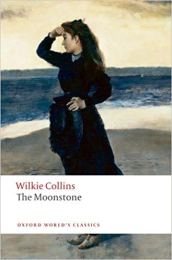 I have yet to get tired of teaching The Moonstone, which has been a staple of the detective class since I introduced it to our curriculum in 2003 and also an occasional offering in the Dickens-to-Hardy class. At this point I actually think I know it better than any other text I teach, with the exception of Middlemarch. What this means in practice is that I feel very relaxed during class discussion: though I do have a pretty clear agenda overall, I don’t need a careful script to make sure I don’t miss any aspects of it the way I do with books I’m still learning my way around. Today was Miss Clack Day, which is one of my favorites days. Here are two of the quotations I brought in to use as starting points:
In this retirement — a Patmos amid the howling ocean of popery that surrounds us — a letter from England has reached me at last. I find my insignificant existence suddenly remembered by Mr. Franklin Blake. My wealthy relative — would that I could add my spiritually-wealthy relative! — writes, without even an attempt at disguising that he wants something of me. The whim has seized him to stir up the deplorable scandal of the Moonstone: and I am to help him by writing the account of what I myself witnessed while visiting at Aunt Verinder’s house in London. Pecuniary remuneration is offered to me — with the want of feeling peculiar to the rich. I am to re-open wounds that Time has barely closed; I am to recall the most intensely painful remembrances — and this done, I am to feel myself compensated by a new laceration, in the shape of Mr. Blake’s cheque. My nature is weak. It cost me a hard struggle, before Christian humility conquered sinful pride, and self-denial accepted the cheque.
He beamed on us with his beautiful smile; he held out a hand to my aunt, and a hand to me. I was too deeply affected by his noble conduct to speak. I closed my eyes; I put his hand, in a kind of spiritual self-forgetfulness, to my lips. He murmured a soft remonstrance. Oh the ecstasy, the pure, unearthly ecstasy of that moment! I sat — I hardly know on what — quite lost in my own exalted feelings. When I opened my eyes again, it was like descending from heaven to earth. There was nobody but my aunt in the room. He had gone.
Really, is it any wonder that I burst out occasionally with exclamations like “isn’t she fun?!” Her passive-aggressive martyrdom in the first excerpt sets us up perfectly to discuss just what kind of a Christian she is, as well as the larger conflict in the novel between spiritual and mercenary motives (neatly epitomized, of course, by the different ways the moonstone itself is viewed and valued). And the second excerpt — oh, the second excerpt! Those deftly placed but utterly unconvincing words “spiritual” and “unearthly” to describe her pleasure! Those “exalted” feelings that carry her quite away from her physical self! Yeah, sure they do. Miss Clack is a comic ticket to much less funny topics: her invasive distribution of edifying pamphlets, for instance, leads us straight to forms of missionary or colonizing work that the novel’s Prologue has already made sure we see as bloody and oppressive. But it was nice of Collins to let us make these serious connections while still having a good laugh. The Mothers’-Small-Clothes-Conversion Society! It’s too delightful.
We worked outward from specific passages of Villette today too. I handed around four samples, but in the end we were able to draw so much out of this one that we had to put the others aside to be sure we had time to discuss what we thought about the novel’s conclusion (which is, of course, heavily foreshadowed here):
 On quitting Bretton, which I did a few weeks after Paulina’s departure — little thinking then I was never again to visit it; never more to tread its calm old streets — I betook myself home, having been absent six months. It will be conjectured that I was of course glad to return to the bosom of my kindred. Well! the amiable conjecture does no harm, and may therefore be safely left uncontradicted. Far from saying nay, indeed, I will permit the reader to picture me, for the next eight years, as a bark slumbering through halcyon weather, in a harbour still as glass — the steersman stretched on the little deck, his face up to heaven, his eyes closed: buried, if you will, in a long prayer. A great many women and girls are supposed to pass their lives something in that fashion; why not I with the rest?
Picture me then idle, basking, plump, and happy, stretched on a cushioned deck, warmed with constant sunshine, rocked by breezes indolently soft. However, it cannot be concealed that, in that case, I must somehow have fallen overboard, or that there must have been wreck at last. I too well remember a time — a long time — of cold, of danger, of contention. To this hour, when I have the nightmare, it repeats the rush and saltness of briny waves in my throat, and their icy pressure on my lungs. I even know there was a storm, and that not of one hour nor one day. For many days and nights neither sun nor stars appeared; we cast with our own hands the tackling out of the ship; a heavy tempest lay on us; all hope that we should be saved was taken away. In fine, the ship was lost, the crew perished.
Oh Lucy, “permitting” us to imagine you peaceful and happy even as you ruthlessly deny us precisely that comfort. What good is an illusion, after all, if its artifice is so completely exposed? What good, too, is laying claim to a conventional life, such as that enjoyed by “a great many women and girls,” if you’re only going to throw convention overboard — and, arguably, not regret its loss? Is a life of happy indolence really preferable, after all, to a life of determination and purpose, however grimly experienced? But if to be “idle, basking, plump, and happy” is to be no better than the pretty spaniel to which she (in an uncharacteristically overt moment of snark) compares Paulina Mary, is the novel’s final shipwreck really a tragedy? Such a vexing question, and such a provoking novel. I’m almost sorry to leave it behind — almost, because I am not nearly as comfortable with it as I am with The Moonstone, and it has been a mental and practical challenge figuring out how to approach each class. Next up in this class is Great Expectations: I think I know my way around that one pretty well.

 Welcome back to another season of “
 We may have been basking in some gorgeous summer-like weather lately, but classes have begun and that means we are well and truly into fall. It had been very quiet around campus — though I find the hush kind of dreary sometimes, I’d gotten used to it, and I’ve been feeling kind of cranky at the return of loud, cheerful voices in the hallway, doors opening and closing all the time, and other people impeding my progress on the narrow stairs! But the renewed energy is welcome, as is (mostly) the return to a more active, immediately demanding routine.



 Like
Like  I started teaching at Dalhousie in 1995-96, which means that 2014-15 will be my twentieth academic year at the university. What with maternity leaves and sabbaticals, that doesn’t mean 40 consecutive terms (though for many years I did also do summer teaching), but that’s still a long time to be in one place doing the same thing.
 The other thing I have to show for my twenty years — something I benefit from every day I’m at work — is experience! It’s easy to forget, now, how new to all this I was in 1995-96. I was hired while still “ABD” (all but dissertation), and my hands-on teaching experience was limited to two of Cornell’s Freshman Writing Seminars (both capped — ah, luxury — at 17 students) and one stint as a TA (in a 19thC fiction class, too, because there were no first year writing classes big enough to use teaching assistants). The class on Browning’s “My Last Duchess” that I taught as part of my on-campus interview here was quite literally the first time I’d ever stood up in front of a room full of students (not to mention a back row of professors there to see how I did). So my first full-time term was really jumping into the deep end for me. I don’t recall any massive screw-ups beyond assigning way too much reading in my first section of Introduction to Literature and way too much writing in almost every class, because I had no idea how much time it would take to mark multiple papers for a class of 50 or 60. I had the time at first: I was keen to throw myself into a job I was excited about and knew I was lucky to have, and at first I had no children, either. But the hours and hours of marking … on top of having no files of teaching notes or materials to draw on, so absolutely every part of absolutely every class had to be prepared entirely from scratch. Good thing I was so young and energetic! (I was 28 when I came here, which means I was barely older than the first crop of graduate students I taught — in fact, now that I think back, I was actually younger than some of them.)
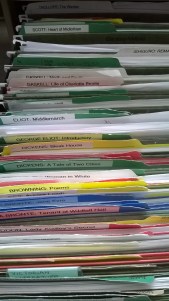
 Another very simple thing I do is designate one shelf space for each course. Often coming back from class is a distracting time, with students tagging along for conferences or somewhere else to get to in a hurry, so I don’t have time to do fine sorting. Instead, I dump all the class material onto its shelf and organize it when I get my next chance — but in the meantime if I need to find a book or paper from it, my search is neatly delimited. Again, less scrambling! I have a pretty low tolerance for stress and confusion, so for me it’s well worth the little bit of forethought required. When I see offices with indistinguishable brown folders piled in heaps all over the place, I know that — while it must work for the office’s own occupant — I would be a nervous wreck by the end of a single day in there.
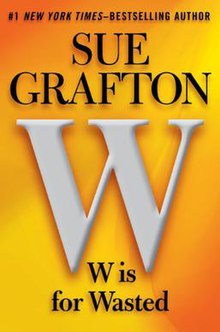 It’s actually a bit harsh to imply that reading W is for Wasted is a waste of time. Grafton is too good at her craft for that: the story is multifaceted and the elements unravel and then knit up together in a satisfying enough way. But it’s such a plodding book overall. First, Grafton seems to believe that she has to recap Kinsey’s history and living situation in detail every single time. Maybe she’s right about that strategically: not everyone reading W is for Wasted will have read A through V, after all, and she doesn’t want them to be confused or feel left out. That doesn’t make it any more interesting for those of us who already know all that. I’ve been trying to think how the other authors of long-running mystery series handle this continuity problem. That I can’t remember ever being bored or annoyed by, say, Robert B. Parker, or P. D. James, or Elizabeth George for the same reasons suggests that whatever they do about it, it’s somehow more artful. Grafton’s decision to keep Kinsey in the 80s also contributes to the boredom, I think: she and her life haven’t changed or progressed very far in the 30 years the series has been coming out.

 Novel Readings