
I don’t usually think about George Eliot and Christmas together, and when I do, it’s usually by way of Silas Marner, which is a lovely secular version of the Christmas story (among other things). Rereading The Mill on the Floss for my class this week, though, I was struck by this little passage, which somehow had never really stood out to me before:
Fine old Christmas, with the snowy hair and ruddy face, had done his duty that year in the noblest fashion, and had set off his rich gifts of warmth and color with all the heightening contrast of frost and snow.
Snow lay on the croft and river-bank in undulations softer than the limbs of infancy; it lay with the neatliest finished border on every sloping roof, making the dark-red gables stand out with a new depth of color; it weighed heavily on the laurels and fir-trees, till it fell from them with a shuddering sound; it clothed the rough turnip-field with whiteness, and made the sheep look like dark blotches; the gates were all blocked up with the sloping drifts, and here and there a disregarded four-footed beast stood as if petrified “in unrecumbent sadness”; there was no gleam, no shadow, for the heavens, too, were one still, pale cloud; no sound or motion in anything but the dark river that flowed and moaned like an unresting sorrow. But old Christmas smiled as he laid this cruel-seeming spell on the outdoor world, for he meant to light up home with new brightness, to deepen all the richness of indoor color, and give a keener edge of delight to the warm fragrance of food; he meant to prepare a sweet imprisonment that would strengthen the primitive fellowship of kindred, and make the sunshine of familiar human faces as welcome as the hidden day-star. His kindness fell but hardly on the homeless — fell but hardly on the homes where the hearth was not very warm, and where the food had little fragrance; where the human faces had had no sunshine in them, but rather the leaden, blank-eyed gaze of unexpectant want. But the fine old season meant well; and if he has not learned the secret how to bless men impartially, it is because his father Time, with ever-unrelenting unrelenting purpose, still hides that secret in his own mighty, slow-beating heart.
The immediate context is Tom’s return from Mr. Stelling’s school for the holidays, and the emphasis on coziness and fellowship helps bring out both his happiness at being at home again and the novel’s larger emphasis on home and family as the roots of memory and thus morality. The penultimate sentence here does something rather different, though, doesn’t it? It introduces (on a small scale) a Dickens-like critique of exclusion from these blessings, a quick but painful sketch of the unhappiness the season exacerbates for those unable to rejoice in its warmth and bounty. I find the personification of Christmas, and then ‘his’ characterization as the son of ‘father Time,’ strategically interesting. The “fine old season” could just as easily be winter, especially given the evocative descriptions of the snow, but we can’t do anything about winter, (sadly!): its sorrows are indeed “unresting.” Christmas, however, is what people have made of the season: it is the consolation we’ve come up with for its cold and privation. It is, in other words, a man-made, not a natural (or a supernatural), phenomenon. Eliot’s personification reminds us of that, and hints that we could perhaps do something about “unexpectant want.” The “rich gifts” of Christmas, after all, really come from us.
I’ve been trying to think of other explicit Christmas scenes in Eliot’s novels and am coming up blank. Anyone?

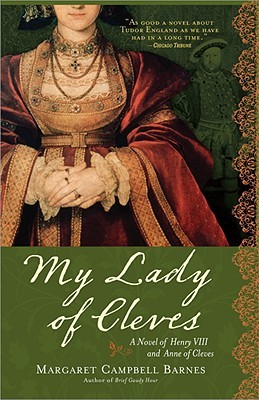
 My Lady of Cleves is much less ambitious than any of Dunnett’s novels: it is historical fiction as domestic drama, with no pretensions to theories or philosophies about the rise and fall of nations or faiths or civilizations. It is, as a result, much easier reading — and easier writing too, no doubt! Its premise is simple and sweet: that Holbein’s exquisite portraits of Anne, including the miniature that (mis)led Henry VIII into choosing her for his fourth wife, are evidence of a hidden love story between the great artist and his unprepossessing subject. How else, after all, to explain the mismatch between the beauty of his work and the reality of the woman Henry so contemptuously cast aside? Holbein must have seen something his king — coarse, lusty, spoiled — could not, and that something is what the novel creates for us: a woman of quiet dignity, but also strong feeling, held carefully in reserve, a woman who would — if things had gone differently — have made a good, perhaps even a great, queen, but who missed, or was spared, that fate.
 But it’s Anne who, rightly, holds first place in the novel overall. Barnes makes the lack of dramatic incident in Anne’s life itself dramatic: with the ghost of Anne Boleyn behind her and the tragic spectacle of young Katherine Howard’s fall before her, her relative tranquility seems precious, even if it is maintained through the sacrifice of her most passionate yearnings. I have no idea how much of Barnes’s portrait is based on historical records: her author’s note says that all the comments in the novel about Anne “were in fact made by people who knew and saw her,” but how much we know about Anne herself, as a woman, or about the details of her life before, during, or after her life-changing marriage is beyond my scope. What Barnes does so well, though, is make me believe in her version of Anne: it’s as if (and I know this sounds cliched) the poised woman in the portrait has stepped out of it into the novel.
 I have really enjoyed rereading Adam Bede for my graduate seminar over the past two weeks. Though I know the novel reasonably well, I have never spent the kind of dedicated time on it that I have on Middlemarch or The Mill on the Floss — or, for that matter, on
 We are into our second full week of classes now. I think things are mostly going smoothly, but that’s as much thanks to habit and experience as anything I’ve done particularly effectively in the past week or so. It’s not that anything is going badly — at least, not as far as I can tell. I just feel creaky, and I suppose that’s to be expected after almost nine months out of the classroom.
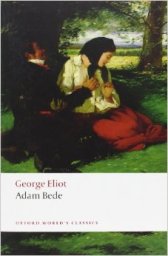 My other class this term is my graduate seminar on George Eliot. Here I have a cozy group, just five students, and it really is an entirely different ball game than Intro. Last week I gave an overview lecture on George Eliot to provide some common background, since as usual the students have quite a range of prior experience (this year, from none at all to a bit) reading her work. Then we took a look at some of her most famous essays, including “Silly Novels by Lady Novelists.” We spent some time on the vexed question of whether the essay’s brilliant snark is misogynistic. Since the last time I taught this seminar (in 2010), my own reading has broadened to include
  I actually hadn’t intended to read The Story of the Lost Child. By the time I finished

 Novel Readings