
Such, and so magnifying, is the virtue of a large and liberal theme! To produce a mighty book, you must choose a mighty theme. No great and enduring volume can ever be written on the flea, though many there be who have tried it.
We all probably know the Woody Allen joke about speed-reading War and Peace: “It’s about Russia.” It seems just as comical to say that Moby-Dick is about whales. Obviously, it’s about so much more than that: the whales themselves, especially the White Whale, are wrapped in as much symbolism as blubber, and Ahab’s quest, along with the whole voyage of the Pequod from Nantucket to its final moments, is subject to probably illimitable interpretations.
But! As I was reading the second half of the novel over the last couple of days, what I found most astonishing about it was not so much those metaphorical layers but the sheer inexhaustible virtuosity of its literal content. It really is about whales, after all, and about whaling, and many, many chapters of the novel are pretty spectacular just taken at face value. Take the chapters that describe how something is done, for instance — Chapter 78, for example, “Cistern and Buckets.” It’s not easy (or so I imagine, never having tried it myself) to explain a technical process — one likely to be unfamiliar to most of your readers in every respect — in a way that is at once accurate and artful, but sequences of that kind abound in Moby-Dick and they are all splendid. If you’re reading for plot, of course, they won’t seem to add much, but then, if you’re reading Moby-Dick for the plot, you’ve probably given up long before Chapter 78! In fact, while the writing itself is often memorable in these sections, what I especially like about them is what they implicitly presume about the novel’s readers — that we are capable of being interested, that we can get caught up in Melville’s own delight in digging right in to the nitty-gritty of every process, every routine, every role on board the Pequod.

And the chapters minutely dissecting and describing the whales: how fantastic are they! Sure, nothing happens in most of them, but isn’t that actually a kind of category mistake? They are what happens, the descriptions themselves are what happens, the attention they insist we give to every inch of these gargantuan creatures is what happens. There’s just something so breathtakingly daring and unlikely about them all. Here’s the beginning of Chapter 80, “The Nut,” for example:
If the Sperm Whale be physiognomically a Sphinx, to the phrenologist his brain seems that geometrical circle which it is impossible to square.
In the full-grown creature the skull will measure at least twenty feet in length. Unhinge the lower jaw, and the side view of this skull is as the side view of a moderately inclined plane resting throughout on a level base. But in life–as we have elsewhere seen–this inclined plane is angularly filled up, and almost squared by the enormous superincumbent mass of the junk and sperm. At the high end the skull forms a crater to bed that part of the mass; while under the long floor of this crater–in another cavity seldom exceeding ten inches in length and as many in depth–reposes the mere handful of this monster’s brain. The brain is at least twenty feet from his apparent forehead in life; it is hidden away behind its vast outworks, like the innermost citadel within the amplified fortifications of Quebec.
There’s really no genre of fiction in which this degree of detail about a whale skull is really justified, is there? It serves no purpose whatsoever except to tell us about the whale. There’s a whole chapter — one of my favorites from this second half — about the sperm whale’s tail:
The entire member seems a dense webbed bed of welded sinews; but cut into it, and you find that three distinct strata compose it:–upper, middle, and lower. The fibres in the upper and lower layers, are long and horizontal; those of the middle one, very short, and running crosswise between the outside layers. This triune structure, as much as anything else, imparts power to the tail. To the student of old Roman walls, the middle layer will furnish a curious parallel to the thin course of tiles always alternating with the stone in those wonderful relics of the antique, and which undoubtedly contribute so much to the great strength of the masonry.
It goes on for four more pages! Again, there’s really no excuse — except that it tells us about the whale.
 That’s not right, though. The excuse (as if any is needed) for all of this stuff about whales is the writing. The fortifications of Quebec! Old Roman walls! The alliteration in “a dense webbed bed of welded sinews”! In my first post about Moby-Dick I talked about how much I was enjoying its prophetic style, so reminiscent of Carlyle. I continued to relish the many passages that leap from the literal to the metaphorical or philosophical:
Oh, man! admire and model thyself after the whale! Do thou, too, remain warm among ice. Do thou, too, live in this world without being of it. Be cool at the equator; keep thy blood fluid at the Pole. Like the great dome of St. Peter’s, and like the great whale, retain, O man! in all seasons a temperature of thine own.
Even so, amid the tornadoed Atlantic of my being, do I myself still for ever centrally disport in mute calm; and while ponderous planets of unwaning woe revolve around me, deep down and deep inland there I still bathe me in eternal mildness of joy.
Oh! my friends, but this is man-killing! Yet this is life. For hardly have we mortals by long toilings extracted from this world’s vast bulk its small but valuable sperm; and then, with weary patience, cleansed ourselves from its defilements, and learned to live here in clean tabernacles of the soul; hardly is this done, when–There she blows!–the ghost is spouted up, and away we sail to fight some other world, and go through young life’s old routine again.
I love all of that: it too is daring and inspiring and really quite inexcusable. There’s just as much pleasure to be had in how Melville just writes about actual whales, though. And maybe even Melville wouldn’t be able to get away with so much rhetorical flamboyance if so much of Moby-Dick weren’t really, quite literally, about actual whales, so that his wildest flights of fancy, his deepest dives for profundity, remain anchored in reality.
My book club meets Monday night to talk about the second half of the novel. Once again I look forward to all the different perspectives I’ll hear.
 It comes back to the geese, in the end. I hoped it would, because of all the marvellous episodes in Wart’s education (the tyrannical pike, the totalitarian ants, the philosophical badger), his time with the geese is the most sublime. It’s beautifully written, for one thing, detailed and evocative, freely fanciful:
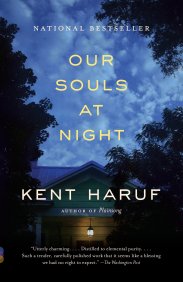 Our Souls at Night is the last of Kent Haruf’s Holt novels — he died not long before its publication. It seems fitting then, I suppose, that it is a bit bleaker than
 But across this strange commonplace idyll comes a destructive shadow: Addie’s son can’t accept his mother’s new friendship, finding the idea of a man in her bed disgusting and interpreting Louis’s motives in coarsely suspicious ways. Instead of rescue or salvation, then (the promise of which dominates both Plainsong and Benediction), Our Souls at Night highlights the possibility of ruin — again, on a very small scale, but in a way that feels larger, more significant, as if Gene’s small-mindedness represents in miniature the threat to all forms of grace. Happiness is made of such fragile things — trust, tolerance, affection, moments of talk and laughter — that it’s always vulnerable to blight. And as Addie and Louis find, resisting may in itself damage the very thing you hoped to protect.
 The choices he finally makes reflect–perfect, maybe–the choices he had made throughout his life. He returns to work for as long as he can, finding purpose in his “calling,” and he wrote this book, which his wife tells us in her Epilogue he “wrote relentlessly,” committed to “help[ing] people understand death and face their mortality” in a different way than he had done so often as a surgeon.
 On university campuses we hear a lot about innovation these days, from hype about the latest ed-tech fad to proclamations by institutions like my own about fostering a “culture of innovation.” This has got me reflecting on how we define or recognize innovation — something that is not as obvious, I think, as its champions, or as those who insist on it as a measure of academic success, typically seem to assume. In some fields, of course, it’s easy enough to tell when something is new, if it shifts or breaks a paradigm. But in others, context makes all the difference, as my own chequered career as a “thought leader” demonstrates.
 Today, of course, an interdisciplinary degree is wholly unremarkable; Dalhousie even has an entire
  But when I got to Cornell, I discovered that far from being a radical, I was actually a conservative! It turned out that there were some kinds of questions you couldn’t safely ask there, arguments you couldn’t seriously entertain, without undermining your feminist credentials. My first big mistake was giving a seminar paper called “The Madwoman in the Closet”: it queried some then-dominant trends in feminist criticism, particularly in 19th-century studies, and tried (perhaps crudely, but I was a beginner at all of this — and frankly, my somewhat old-fashioned training at UBC had not prepared me well for it) to figure out how politics and aesthetics were getting balanced (unbalanced, I thought, maybe, possibly) in the debates. My professor was keen to have these discussions, but said to me quite frankly that he felt that as a male professor, he couldn’t raise these questions. So I blundered in, and paid the price. I also wrote a more or less positive review of Christina Hoff Sommers’
  Exhibit C: my critical writing. There are many possible angles to consider here, but I’ll focus on my recent work outside of academic publishing, because its status has been much on my mind lately. In a way, the kind of criticism I’ve been doing recently — from book reviews to literary essays — is not innovative at all: it’s the same kind of work everyone else is doing who also writes for newspapers and magazines and literary journals. But from an academic perspective, to be writing for those venues instead of for academic journals is itself innovative: it’s the kind of thing that gets called “knowledge mobilization” or “knowledge dissemination” or “public humanities.” Except that some of these publishing ventures resemble (in style, not necessarily in content) an older kind of literary criticism — a kind some might call belles lettres — which is now considered passé in academic circles. So my recent work could be considered retrograde, not innovative. Except that to break from the conventions of academic writing and try to replicate the best qualities of belles lettres (fine, smart, accessible writing, with its own literary elegance) while still doing criticism informed by decades of academic scholarship … couldn’t that combination of new insights and old forms itself be innovative? Then, what about the content of the reviews and essays? Every new interpretation of a literary text is a critical innovation, isn’t it? So every review of a new book, representing a new intellectual encounter, is intrinsically ground-breaking, even if book reviewing as a form is the oldest kind of literary criticism. What if you make a new critical argument, based on original research, but in an essay outside the norms of academic publishing — if that argument falls in the forest, can anybody hear the innovation? Or what if the argument of an essay is new to one audience but not to another? What is going on then?? Am I doing original work or not???
 I’m so glad Emma Claire Sweeney put me on the list to receive a review copy of her new novel Owl Song at Dawn. A heartfelt story about love and acceptance, it is also an evocative look at a time and place — northern England in the 1950s — in which, for families like those Sweeney focuses on, these feelings had to be fought for and protected, not just against the callous or prejudiced but against earnest but wrongheaded well-wishers.
 Is there a name for books structured as backward explorations — books like
  Still, Ruth and Joe seem likely to putter on, if not in perfect amity, at least in stolid companionship, without any new crises, until a postcard arrives from an old friend that prompts Joe to dig up his decades-old journals, which Ruth then encourages him to read aloud. They both know, it turns out, that the journals tell the story of a trip to Denmark that became a turning point in their relationship, one that has long gone unacknowledged but that has been a small irritation in their consciousness for decades. “You wanted the pebble out of the shoe,” says Joe to Ruth after she has forced a long-deferred confession; “I suppose,” she replies.
 It’s tempting, perhaps, to look back with regret on a life that hasn’t turned out to be particularly memorable to anyone but the person who lived it. Early in the novel, Joe casts himself as a secondary character, a kind of Rosencrantz or Guildenstern, someone who watched other people live instead of really living himself:
 “The crib scene kills me,” Mark Athitakis
  Nature is not romanticized in this world: the McPheron brothers, for instance, are cattle farmers, and there’s too much birth, blood, and slaughter in their daily routine to make them sentimental. Haruf connects his characters to nature’s harsh realities, emphasizing their common cycles of life and hunger and survival. “I started thinking about it the other day,” Harold McPheron says to his brother Raymond, as they fret over Victoria’s pregnancy: “the similarities amongst em.” “I don’t appreciate you saying she’s a heifer,” says Raymond, horrified, but later, after they deliver a calf, with difficulty, from a heifer in distress, they both move seamlessly into discussing, not the heifer’s health, but Victoria’s:

 I love that, but I’ve also seen it before, or very nearly. This time it’s Cyprus, but before it has been Bruges, or Venice, or Trebizond. The particulars vary, but the effect doesn’t, really. And we also get many examples of another kind of passage that to me is a lot less inviting — the kind that traces out the loyalties and lineages and special interests that are the warp and woof of Dunnett’s plots. I’ve admitted more than once that these very complicated plots are hard for me to follow. In the Lymond books, that has never bothered me much because the melodrama carries me along and because they are dominated by a few highly charismatic figures: Lymond himself, of course, Margaret Lennox, Gabriel, Philippa, Sybilla, Guzel. The supporting cast in Nicholas’s life is appealing, but not one of them really stands out to me at this point. (Greater familiarity with the series would probably change this perspective, as, perhaps, would reading the books closer together. I had trouble recalling who everybody was when I began Race of Scorpions, never mind what exactly they had been up to before.) By the end of this book, I had stopped even trying to grasp what exactly Nicholas is up to and why, besides whatever was immediate and obvious in the moment.
 This is not to say there weren’t some great, even thrilling moments in Race of Scorpions: Katelina and the moths, for example, which is a scene I’ll remember for a long time, or, in a more violent register, the long-deferred confrontation with Tzani-Bey (who did what, exactly, to Nicholas, by the way? am I right to infer that his “mistreatment” was sexual?). I was also struck — not for the first time — by the ease with which Dunnett’s world incorporates a range of sexualities. This is something that’s very prominent in Race of Scorpions, because of Zacco, but the variety and fluidity of desire is a feature of the Lymond books too. It’s certainly not typical of other mainstream historical novels I’ve read set in the Renaissance: they tend, overwhelmingly, to be organized around heterosexual romance plots, without even a hint of other possibilities. And something else that Race of Scorpions has in common with the Lymond series is an emphasis on powerful women — here, Marietta of Patras or, as she is less elegantly called, “Cropnose” (because hers has been bitten off), and her foil, at least in beauty, Primaflora. So often in Dunnett’s books, while it’s the men out in front taking action, seemingly in charge, it turns out to be the women who, behind the scenes, are pulling the strings, plotting — like Dunnett herself.
 Novel Readings