 My recent reading has not been particularly exhilarating, but most of it has been just fine: no duds, just no thrills.
Julie Schumacher’s The English Experience was enjoyable but also seemed quaint, in a sad sort of way: what is the point, really, of academic satire given the existential threats to research, education, faculty, and students currently devastating the higher ed landscape in the United States? It’s true that things have been grim for a long time, including in the UK, where every day seems to bring more dire news about program closures, and in Canada, where “do more with less” has been the rule for decades thanks to chronic underfunding for our ostensibly ‘public’ universities. But Schumacher’s Professor Fitger and his students are very much American, and while there is both comedy and pathos in the story of their misadventures, and while the gentle optimism of the ending is a nice reminder that both travel and education can and should give people a chance to become someone a bit different and a bit better, the The English Experience, charming as it was, seemed more nostalgic than pointed.
Liz Moore’s Long Bright River is one of the best crime novels I’ve read in a while—though since I don’t actually read much crime fiction these days, I’m not sure that’s really saying much. I’d heard that it was character-driven, and it is; it is a good novel about families, especially sisters, as well as about the far-reaching personal and social harms of the opioid epidemic. It has a good number of twists and turns and kept me engaged without making me feel overly manipulated, which I appreciated. I’m always scouting for recent options to include in Mystery & Detective Fiction: I don’t think I would assign this, but mostly because it is pretty long and I’m not sure it’s good enough qua 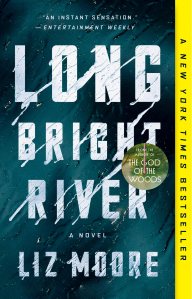 novel to spend the amount of time on it that I’d need to coax the students through its 450+ pages (more than two weeks, most likely). This is the conundrum of the “teachable” (vs. readable) text; this is why so far I have not assigned one of Tana French’s books either.
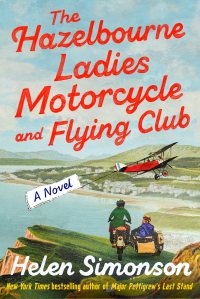
I loved both Helen Simonson’s Major Pettigrew’s Last Stand and The Summer Before the War so I eagerly picked up The Hazelbourne Ladies Motorcycle and Flying Club when I saw the paperback had finally come out. Unfortunately, it disappointed. There is plenty of good material in it. I enjoyed the details about women’s wartime experiences and then their struggles as they were displaced from their jobs as the men came back from the war; I liked the ‘neepery’ about both motorcycles and airplanes. The characters are all promising types, in this context, but as the novel dragged on (and the pacing did seem too slow to me, too much talking without much purpose, too many scenes not contributing all that much) they felt more like cut-outs representing those types than fully realized people. I felt the same about the novel’s plotlines around racism and discrimination: these are good things to represent, of course, but they seemed, if not exactly perfunctory, at least predictable. Reading it I thought again of the conversation I had with Trevor and Paul about historical fiction: this is not a bad novel, but I think it may represent the qualities or aspirations or limits that make some readers think historical fiction is not a really serious or ‘literary’ genre.
 I got Madeleine Thien’s Do Not Say We Have Nothing from the library as soon as I had agreed to review her forthcoming novel The Book of Records, on the theory that it was probably a good idea to know something about the earlier one in case there were connections. It turns out there is one possibly important one, though I’m still figuring out exactly what it means: throughout Do Not Say We Have Nothing the characters are reading and writing and revising a narrative called the Book of Records! I actually owned a copy of Do Not Say We Have Nothing for years and put it in the donate pile eventually because for whatever reason I still hadn’t read it. I assigned a story by Thien in my first-year class this year that I thought was really good, so this had already piqued my interest in looking it up again. I had mixed feelings about it. I found it a bit rough or stilted stylistically and never really fell into it with full absorption, but it is packed with memorable elements and also with ideas. It tells harrowing stories about the Cultural Revolution in China and focuses through its musician characters on how or whether it is possible to hold on to whatever it is exactly that music and art mean in the face of such an onslaught on individuality and creativity. It invites us to think about storytelling as a means of survival, literal but also (in the broadest sense) cultural—this is where its Book of Records comes in, as the notebooks are cherished and preserved, often at great risk. I’m not very far into Thien’s new novel yet but it seems even more a novel of ideas, perhaps (we’ll see) too much so.
My book club meets this weekend to talk about Northanger Abbey, so I also reread this. It has been so long since I read it it didn’t really feel like a reread, actually. It amused me, but that’s about it. After I’d finished it I read Marilyn Butler’s introduction to my Penguin edition and she makes the case that it is much more interesting and sophisticated than it is often given credit for. OK, sure, and I take her point that to really appreciate it we need to be as immersed in the other novels it alludes to as its characters are—but I’m not, and I’m not really interested in them (sorry, Jane!). I think I get the gist of the novel’s playful jousting with gothic conventions as well as other models of ‘women’s fiction’ from the time. I love and greatly admire both Pride and Prejudice and Persuasion, but for sheer pleasure I prefer almost any Georgette Heyer to this and don’t expect to read it again. Still, I am curious about what the other members of my book club have to say!
And that basically catches me up. I have just started Susie Boyt’s Loved and Missed, which so far seems as good as everyone said; I still have Olga Tokarczuk’s The Empusium on my TBR pile; and I’m still stalled out several chapters into Hisham Matar’s My Friends. Stay tuned for the next thrilling updates on my reading! 🙂
 Look, I don’t want to pretend everything is fine, in general or in my classes. Last week I was grading take-home midterms for Mystery & Detective Fiction and feeling to my core the truth of what is now a commonplace: AI is pervasive, and not “for better or for worse”—just, unequivocally, for worse. The one consolation I had (and it is, truly, not particularly consoling) is that the results, for the students, are not usually good. This means it doesn’t matter whether I can
 These are long, complex, demanding books! So when the author of that essay declares that “our average graduate literally could not read a serious adult novel cover-to-cover and understand what they read,” that students “are impatient to get through whatever burden of reading they have to, and move their eyes over the words just to get it done,” I have to wonder: are my students really so exceptional? I mean, I do think they are lovely and wonderful; I genuinely look forward to every class. It’s true they are English students, and mostly Honours English students at that, with some graduate students as well, so definitely, when it comes to reading, both an elite and a self-selecting group. Still, when we tell stories about higher ed today, shouldn’t we talk about them too?
 I have come here to walk the earth as human. I choose to be disguised and camouflaged. I live in the faces of the most betrayed and ignored of all humans. I live in silence. I am the words trapped on the bitten tongue. I am more than a statistic. I am more than another hashtag. I live in the heart of the poor woman, the black woman, the elderly woman, the sick woman, the healer, the teacher, the priestess, the witch, the wife, the mother and the girl. I am Death and I am quick. I am a rabbit and I can vanish. I can be anything I want to be. I choose the unheard and unspoken. I live in the silent scream and I will be silent no more and I have so much work to do . . .
 This was my favorite moment in Miranda July’s All Fours:
 I was so tired, but the mess on my bed—the same congestion into which I had nightly crawled without noticing—was suddenly intolerable to me. I yanked at the sheet and the motion sent everything to the carpet. I lifted the sheet with two hands and it billowed slowly back down, and as it did I felt some otherworldly possibility open up inside myself. I picked up one of the pillows from the floor and placed it back on the bed, smoothed the sheet down to make a flat, empty expanse. I stood looking at the bed and breathing. It isn’t something I ever told anyone—how could you say this?—but the lift and descent of that sheet, the air inside it, the peace when it settled, showed me what I wanted. I knew it in that moment, but it took years to find it.
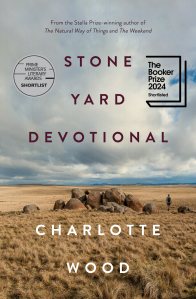
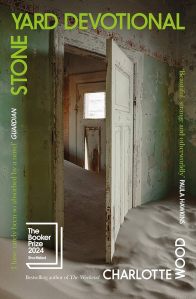 It wasn’t always clear to me as I read the novel why it had the specific pieces in it that it did (and of course I have not itemized them all here, though it is not a plot-heavy book). Sometimes when I’m reading a novel, even for the first time, I feel a gathering sense of its unity as I go along, of what holds it together for me. Other times if I work at it for a bit patterns emerge—sometimes, this happens while I am writing about it here! It’s likely that if I reread Stone Yard Devotional the ideas that connect its various elements would become clearer: I expect they would, because the novel feels so deliberate, so thoughtful. What did hold it together for me was its tone, or voice. I liked the way the narrator thought and talked. Often she leads herself, and thus us, along an unassuming narrative thread until she arrives somewhere quietly meaningful. Here’s an example:
 Stackhouse was no poet, no artist, and his literary tastes were unsophisticated. But he wrote for himself, not posterity, and he valued the notebook enough to fill more than three hundred pages, and to invite friends and family to make their notes in it too. His observations might be of consequence to no-one but himself, but isn’t it a happy thought that such documents can survive for centuries, intimate memorials to their owners’ preoccupations—unremarkable, hardly read, yet every one unique?
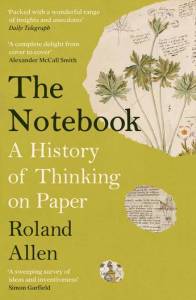
 My epigraph for this post comes from the chapter on common-place books; there is also one on seafaring logs and one on the remarkable Visboek, or Fishbook, created by the Dutchman Adriaen Coenen in the 1570s. A chapter on travelers’ notebooks highlights Patrick Leigh Fermor and Bruce Chatwin; one on mathematics of course focuses on Newton. The most famous naturalist to keep notebooks was Charles Darwin, and Allen’s remarks about his process exemplify the connections he makes throughout the book between writing and thinking:
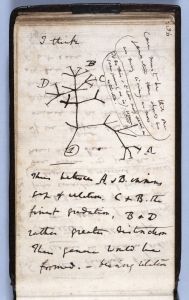 What’s distinctive here, of course, is focusing on notebooks themselves as enabling devices for Darwin’s achievements—Allen draws our attention over and over, as he makes his way through his many topics (including, besides the ones already mentioned, authors’ notebooks, recipe collections, police notebooks, patient diaries, and more) to the importance of the flexibility and portability of notebooks, the opportunities they create for in the moment as well as reflective writing, data collection as well as analysis and synthesis. The simple point that they can be carried with us and require so little else to do this work for us, or to support our work, is what matters: this is what was initially transformative and continues to be endlessly appealing, even in this electronic era. In the chapter on “journaling as self-care” Allen discusses the strong evidence for the value of “expressive writing” for helping to heal trauma (he also touches on the reasons that note-taking by hand seems to be more effective for learning during lectures).
 Like the Florentine accountants, Renaissance artists and early modern scientists before him,” Allen says, “he’d come to understand his notebook as a crucial tool for the mind, a way to turn intangible thoughts into more concrete written ideas that could more easily be manipulated.” So far so good, but once Carroll’s system becomes popular and highly commercial, and “bullet journaling was everywhere,” Allen starts to get a bit sniffy about it—especially about the “huge online community of bullet journalists who took to social media to celebrate and share their own journals.” “Looking at their lists and journal spreads,” he observes, “one senses less intentionality than a straightforward interest in prettification.” He doesn’t seem to approve of the way bullet journaling “fits neatly into the perennially irritating self-help genre,” and “yes,” he says, “if you follow bullet journalists online, you see many doodled sunflowers next to their things-to-do lists.” But, he concedes, “there is something substantial” there nonetheless. Given that he goes on to once more affirm that Carroll’s systematic use of notebooks belongs in the story he’s telling and even, as he notes, has a unique place, as Carroll is rare in himself thinking of the notebook “as a tool, wonder[ing] how it actually works,” I didn’t see why he got so grudging about it there for a while. Michael of Rhodes was interested in “prettification” too, as was the fishbook guy, after all!
 —even to care for the sick. With it, we can come to know ourselves better, appreciate the good, put the bad in perspective, and live fuller lives.
 Last week in my classes it was Reading Week, a.k.a. the February “study break.” Although overall this term has not been nearly as hectic as last term, I was still grateful for the chance to ease up. Work is tiring. Winter is tiring. Grieving is tiring (yes, still). It doesn’t help that I continue to wake up a lot at night with shoulder pain, something I have been trying to fix for years now. (I am getting closer, I think! I am working with an orthopedist who seems pretty confident about what needs doing, although we are waiting for an ultrasound to confirm that the issue is my rotator cuff.)
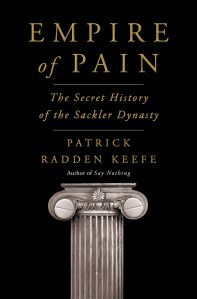 The one other book I got all the way through last week was actually an audiobook: my hold on Patrick Radden Keefe’s Empire of Pain came in, and it proved truly gripping, surprisingly so given that I knew a fair amount about the whole story from various other sources (including the harrowing series Dopesick). I was so caught up in it that I spent longer hours than usual working on my current jigsaw puzzle—which I think contributed to my shoulder pain somehow, so that was a weird confluence as it had me thinking a lot about how tempting the promise of relief would be even for chronic pain as relatively mild as mine. Of course the whole story is also infuriating and outrageous and horrific, and perhaps it would have been more calming to stick to my usual, more benign, program of literary podcasts!
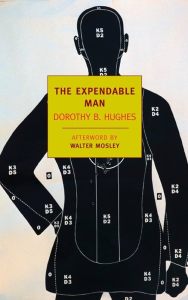 and that timing may well have been the real reason for my middling reaction to it. So far I am enjoying it just fine; we’ll see if when I get to the end this time I feel like reading on in the series.
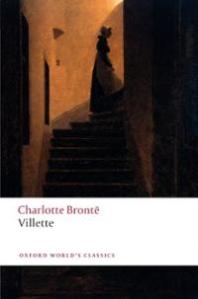 It’s not that the topic of my classes this week is uncertainty, exactly, or that there is anything particularly uncertain about this week—although I suppose that depends on where you’re looking, as nationally and globally there is plenty of unease to go around, while on campus, as the university shapes and shares its plans for coping with a massive budget shortfall (created in large part by heavy-handed federal decisions about international students, on whom universities have unfortunately come to depend because of decades of inadequate provincial funding) we are all wondering just how bad it will get. These are the external contexts for my classes, but by and large I try not to focus on them when I’m actually in the classroom, where persisting with what we find interesting and worthwhile to talk about seems like one way to make sure we uphold our values in the face of all of this.
 The main thing I’m thinking about, however, is not so much “what is the meaning of Villette?” (though if you have a favorite essay or theory about it, I’d love to know!) as “what is the role of uncertainty in pedagogy?” I don’t think of myself as a particularly authoritarian teacher, but in general I think it makes sense to acknowledge that I am a teacher because of my expertise; shouldn’t I act and talk as if I know what I am talking about? On the other hand, I don’t think any interpretation is definitive; if it were, our whole discipline would operate completely differently! I’m always so amused by Thurber’s story “The Macbeth Murder Mystery,” which concludes, tongue in cheek, with its wry narrator promising to “solve” Hamlet. Literature can’t be “solved”! Books worth paying attention to are layered or multifaceted; they look different or mean differently depending on how we approach them. I often explain literary interpretation to my first-year students with an analogy to the transparencies used to teach anatomy: each question or approach draws our attention to specific features. Just as all the parts and systems of the body cohere, interpretations have to be compatible to the extent that they can’t ignore or contradict facts about the text, but they do not replace each other or rule each other out. This means, of course, that it is fine that the articles I’ve mentioned illuminate issues in Villette without satisfying every question I have about the novel.
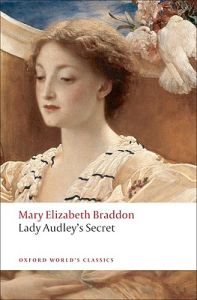 Villette, on the other hand, feels uncertain by design. It is destabilizing. Our confusion feels like part of the point. Maybe that is the underlying unity of the novel! Maybe there is no ‘right’ way for Lucy to be, to act, to love, to live, and so the novel, by immersing ourselves in her struggles, is just replicating them formally. “Who are you, Miss Snowe?” demands Ginevra Fanshawe at one point, with exasperation: aren’t we asking the same question, right to the very end? Why should unity be the end point, even for a novel that seems to be some kind of a Bildungsroman? I do wonder, though, why I am willing to give Brontë so much more credit than Braddon for the artfulness of her uncertainty. One factor is probably that there is so much evidence of design in Villette, if if I’m not sure what the patterns mean: all the buried (or not!) nuns, for example, and their tendency to show up when Lucy is most emotional; the recurrent imagery of storms and shipwrecks; the emphasis on surveillance, discipline, and self-control; the proliferation, almost to excess, of foil characters for Lucy, from little Polly to Vashti. At every moment of the novel I feel sure there is something meaningful going on.
 Novel Readings