I have still not deciphered the mystery of the hare. She remains the elusive, indefinable core that explains, perhaps, why we humans have projected so many of our fears and desires onto the species, investing hares with supernatural powers from the most evil to the most inviting, confirming our tendency to either worship or demonise those things we struggle to understand. The hare lends itself as a symbol of the transience of life and its fleeting glory, and our dependence on nature and our careless destruction of it. But in the hare’s—and nature’s—endless capacity for renewal, we can find hope. If it is possible, as William Blake would have it, ‘to see a world in a grain of sand’, then perhaps we can see all nature in a hare: its simplicity and intricacy, fragility and glory, transience and beauty.
Probably the most important parts of Raising Hare, Chloe Dalton’s memoir of how she took in an abandoned leveret and, in helping it survive, found her own way to a new relationship with nature, time, and life itself, are the ones in which she turns from her immediate experience and its personal resonance to larger issues of environmentalism and conservation. “From hunting to farming and the destruction of habitats,” she observes,
we have done so much harm to hares over the centuries. For sport—in other words, for idle amusement—and in our drive for economic efficiency, putting more pressure on the land than it and its wild inhabitants can bear. The turn of the seasons and our capacity for adaptation means there is always hope that we can do things differently. But in this, as in so many areas, our practices and our methods incline towards depletion: reducing the dwindling stock of nature that remains to us, today’s needs always outweighing our aspirations for tomorrow.
Raising Hare arrives rather than begins here, though, and so rather than feeling hectoring it feels urgent: Dalton spends most of the book sharing the gradual process of her getting to know the little leveret, eventually an adult hare who gives birth to her own babies, and so we are drawn in until we are as invested in its flourishing, as interested in its mysteries, and as fearful of its possible fate as she is.
Dalton is aware from the beginning that her involvement is problematic: hares are not domesticated, and even with the best intentions, interfering with wild animals can make things worse rather than better. Still, she is unable to leave the leveret where she finds it, alone, freezing, on a track where it is vulnerable to both natural predators and vehicles. Throughout her time caring for it and then living alongside it, she does her best to let it still be wild—refusing to treat it as a pet or even to name it. She does not attempt to train it; in fact, it seems fair to say that it is the hare that trains her, over time reshaping Dalton’s habits, attitudes, and expectations. “I felt a new spirit of attentiveness to nature,” she says,
no less wonderful for being entirely unoriginal, for as old as it is as a human experience, it was new to me. For many years, the seasons had largely passed me by, my perceptions of the steady cycle of nature disrupted by travel and urban life. I had observed nature in broad brushstrokes, in primary colours, at a surface level. I had been most interested in whether it was dry enough to walk, or warm enough to eat outside with friends. I could identify only a handful of birds and trees by name. I hadn’t observed the buds unfurling, the seasonal passage of birds, the unshakeable rituals and rhythms of life in a single field or wood.
A busy professional addicted “to the adrenaline rush of responding to events and crises,” Dalton has already had her usual life disrupted by the pandemic, which has “pinned” her in the countryside, her work life shifted (as for so many of us) to hours spent at her computer. The presence of the hare brings a new element of calm into her life:
I couldn’t help but compare its serenity and steadiness to the sense of frenetic activity that had pervaded my life for years, marked by constant vigilance, unpredictability and stress.
Observing the hare’s very different existence leads her to rethink her longstanding priorities, to wonder “what else I might enjoy that I’d never considered” rather than to assume that what she wanted was “for life to go back to normal.”
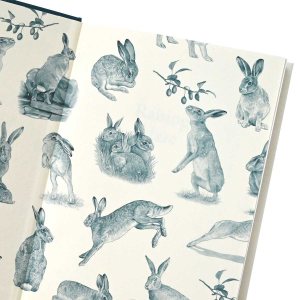 It is not an idyll: lovely as Dalton’s descriptions of the fields and woods are, the hare’s world is still that of nature “red in tooth and claw,” full of hazards and threats, violence and death, hawks and stoats and foxes. The worst carnage, however, is wrought not by nature but by man’s machinery. One day a pair of huge tractors harvest potatoes from the field next door. When they are finished, Dalton walks the furrows and finds them (in a scene worthy of Thomas Hardy) littered with dead or injured hares:
I stood at the edge of the fourteen-acre field and wondered with a sinking heart how many other leverets, or indeed ground-nesting birds, had been crushed beneath those implacable wheels and now lay within the ridges or lost to sight against the rutted brown earth. It was just another day just another harvest, a scene replicated up and down the land and across the world.
By this point in the book, she has earned our companionship in her anxiety for the one particular hare she knows, which serves in turn to draw us in to her horror at the scale of destruction. Noting that the whole process was designed for one particular kind of efficiency, she asks why we cannot put our ingenuity to work to reduce the harm done:
If it is possible to create robots and drones to reap our fields for us, could we not use technology to detected the presence of leverets, and fawns, and nesting birds, and could reasonable efforts not be made to relocate them, rather than simply leaving them to be crushed beneath our machines?
I think a lot of us are asking, with growing anger as well as despair, similar questions about many of the technologies that are doing so much harm to our natural world, often without offering a compensating good anywhere near as defensible as a more abundant and affordable food supply.
Most of Raising Hare is in a different register, though, so it never feels either didactic or despairing. Dalton learns about and from the hare by observing it and sharing space with it, and eventually with some of its offspring. She writes with care and tenderness about what she sees. The animals come and go from her house (she eventually gets a ‘hare door’ built to be sure they are never confined, even when she’s not there to open or close the entrances); she comes to see the boundary between her life and theirs as similarly artificial and porous. She has to accept that it is not her place to protect them, even if she knew how; the death of one of the hare’s babies from no evident cause is a reminder of the limits of her control as well as her knowledge. It is sad, but it is also part of what it means for an animal to be wild. “My lasting memory of the little leveret,” she says, “is of a small, graceful figure, staring at the setting sun.”
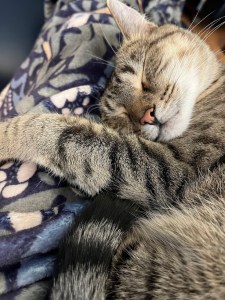 One reason Raising Hare resonated with me is that over the past six months, since Freddie came to live with me, I have been experiencing on a small scale some of the same adjustments to my own sense of time and priorities. Living close to the hare helps Dalton better understand people’s bonds with their pets:
I had come to appreciate that affection for an animal is of a different kind entirely [than for people]: untinged by the regret, complexities, and compromises of human relationships. It has an innocence and purity all its own. In the absence of verbal communication, we extend ourselves to comprehend and meet their needs and, in return, derive companionship and interest from their presence, while also steeling ourselves for inevitable pain, since their lives are for the most part much shorter than ours.
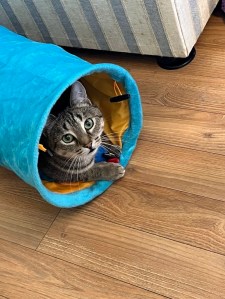
I spend a lot of time playing with Fred, and there is something so refreshingly simple about it: it’s not just that her antics often make me laugh, but that what she wants is just to play, and taking a break from my own work or chores to play with her forces me—or, to put it differently, gives me a chance—to put aside the “regrets, complexities, and compromises” and stresses and confusions and griefs that so often preoccupy me and just to be for a while. Sometimes it feels at first like an interruption, like something that takes patience, but the satisfaction of seeing her stalking and pouncing on her favourite dangly fish toy or rocketing through her tunnel always brings me around. And when she’s not playing, she’s napping, as often as possible on my lap; much like Dalton feeling inspired by the hare’s tranquility, I am calmed and soothed by Fred’s warmth and purrs. Because of her, I get up earlier now than I used to—but this means I can ease into the rest of my day, which I have come to love. I’m also very aware that while I decided to adopt her for my own reasons, now that she’s here, she has her reasons too, and she both needs and deserves my care and respect. That’s not quite the scale of revelation that comes to Dalton by way of the hare, but I think it’s related, part of the same recognition that we are, all of us, nature.
 There is more to life than great chess. Okay, great chess is still a part of life, and it can be a very big part, very intense, satisfying, and pleasant to dwell on in the mind’s eye: but nonetheless, life contains many things. Life itself, he thinks, every moment of life, is as precious and beautiful as any game of chess every played, if only you knew how to live.
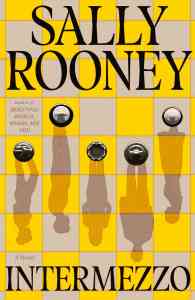 Like Rooney’s other novels Intermezzo takes people’s intimacies and relationships and feelings very seriously. It is a novel on a small scale, about two brothers muddling through some deeply felt but inadequately processed grief for their recently dead father while also muddling through their romantic entanglements, Ivan with an older woman, Margaret; Peter with a younger woman, Naomi, as well as his ex-fiancee Sylvia. I wasn’t always interested enough in Peter to care about his struggles, though that might have been the fault of the awkward style of his sections (Manov: “more Yoda than Joyce”—ouch!), or maybe it was due to my own greater sympathy, just instinctively, for Ivan’s story. Compared to Beautiful World, Intermezzo seemed less expansive, not in length but in reach. It didn’t convince me that the problems of these particular little people amounted to more than a hill of beans—and yet something felt true about its preoccupation with their problems, which really just reflects their own preoccupation with their own problems. We do, mostly, live like that, right? Even those of us who in some sense are committed to “the life of the mind” spend most of our time immersed in the petty and personal.
 Now that I had barely anything left, I could sit in peace on the bench and watch the stars dancing against the black firmament. I had got as far from myself as it is possible for a human being to get, and I realized that this state couldn’t last if I wanted to stay alive. I sometimes thought I would never fully understand what had come over me in the Alm. But I realized that everything I had thought and done until then, or almost everything, had been nothing but a poor imitation. I had copied the thoughts and actions of other people . . . There was nothing, after all, to distract me and occupy my mind, no books, no conversation, no music, nothing. Since my childhood I had forgotten how to see things with my own eyes, and I had forgotten that the world had once been young, untouched, and very beautiful and terrible. I couldn’t find my way back there, since I was no longer a child and no longer capable of experiencing things as a child, but loneliness led me, in moments free of memory and consciousness, to see the great brilliance of life again.
 In her extreme solitude, with no prospect of ever reconnecting with another human being, the narrator faces the world with no insulation between herself and everything else, from the vastness of the landscape to the equal vastness of these existential questions. Sometimes, of course, she is too worn out from the digging and scything and hiking and chopping and hunting to think about them, or about much of anything, but at other times she thinks back on her life before (or is it outside?) the wall, on “the woman I once was” and on the people she once knew:
 It’s no paradise she is living in now, and all this time to think is a curse as well as a blessing, bringing bitter grief as well as epiphanies. Who even is she, anyway, with nobody else to be present for? In one particularly striking scene she sees her own reflection and wonders what her face is for now, if she even needs it any more. Her narrative, which she calls a “report,” is her one act of resistance against her own erasure: perhaps, when she is gone, it at least will persist.
 It is a wonder that a poem, let alone an unread poem, could have such a vigorous life in the culture–and its story still had decades to run before the present day. In the late twenty-first century, even as wars broke out in the Pacific (China against South Korea, Malaysia, the Philippines and others), vanished poem and vanished opportunities coalesced into a numinous passion for what could not be had, a sweet nostalgia that did not need a resolution . . . The Corona was more beautiful for not being known. Like the play of light and shadow on the walls of Plato’s cave, it presented to posterity the pure form, the ideal of all poetry.
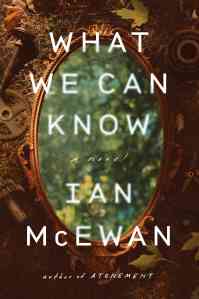 The second half of the novel offers a first-hand account of the poem’s origins, including backstory on all the figures in the poet’s life that Tom has obsessed over throughout his career. It is more conventional, high concept only in its relationship to the futuristic framing. It’s well done, though predictable and occasionally (I thought) a bit too contrived in some of its details. When I reached its rather pat ending, I found myself wondering if I had missed something that would be apparent on a re-reading of the whole novel: I think of how the early parts of Atonement, for example, vibrate with new meaning once you have read to the end, including not just the metafictional twist but also the way Briony’s fictionalization turns out to have incorporated advice you later learn she got from readers and editors. Tom’s version of the story is, I think it’s fair to say, an idealization, a kind of wishful thinking, a story that fits the evidence he has together to suit his vision of the people and events. It is inaccurate, not just because his information is copious but incomplete, but because what he wants to do (as Dorothea Brooke would put it, to reconstruct a past world, with a view to the highest purposes of truth!) is always already impossible. OK, I get it! I got that before I read the ‘real’ version—which is also, of course, inevitably partial, perhaps dubiously reliable. But do we learn something more specific about Tom’s version, are there specific things he gets wrong, or (to consider another possibility) is there evidence he mentions that undermines the version that makes up the novel’s second half? I didn’t notice any such clever moments, but there’s a lot I didn’t notice about Atonement on my first reading.
 Engine 721 doesn’t take it personally. She is made of wood and metal, and her temperament is stoic. Besides, she recognizes something kindred in Mado Pelletier’s iron conviction and unstoppable momentum. The bomber believes the world men have made is terrible, and so it is. Nor can the train deny that there is a certain beauty in the idea of burning, since she runs on flame herself.
That lunch bucket is an explosion waiting to happen. Its unstable elements sing out their longing so loudly, the train can hear them like a battle cry. All the force of combustion that makes the express the fastest vehicle on earth, this device has harnessed for instant havoc. It can take every part of an object, and every cell in the human body, and fire them in different directions.
So, for now, on we go.
Engine 721 doesn’t take it personally. She is made of wood and metal, and her temperament is stoic. Besides, she recognizes something kindred in Mado Pelletier’s iron conviction and unstoppable momentum. The bomber believes the world men have made is terrible, and so it is. Nor can the train deny that there is a certain beauty in the idea of burning, since she runs on flame herself.
That lunch bucket is an explosion waiting to happen. Its unstable elements sing out their longing so loudly, the train can hear them like a battle cry. All the force of combustion that makes the express the fastest vehicle on earth, this device has harnessed for instant havoc. It can take every part of an object, and every cell in the human body, and fire them in different directions.
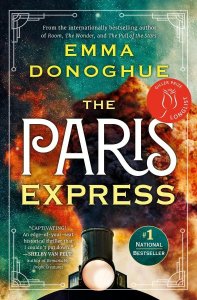
So, for now, on we go. Since the railway disaster Emma Donoghue recreates in The Paris Express is a documented historical event, I think a spoiler alert is not really called for. That said, I did not already know what actually happened, and I suspect Donoghue is counting on our not knowing, which is what kind of spoiled the novel for me. If you knew that THE BOMB DOES NOT GO OFF and NOBODY ON THE TRAIN DIES, the sense of impending doom that she does such a good job of building up would reveal itself immediately as shameless manipulation, which it turns out it is.
The Paris Express is not a bad novel. Donoghue is too adept for that. Given how it ends, though, I don’t really see the point of it. It’s just people on a train. She does a good job imagining them all for us (and if you like this sort of thing, there’s a long note at the end telling you who is real and which bits are made up). I got pretty invested in some of them, especially in the young anarchist who spends the whole trip clutching her homemade bomb, hoping there will be a big enough wig on the train to make detonating it the kind of political statement she aspires to. As the train raced along from stop to stop and the passengers met and mingled and shared quiet moments and lustful interludes and ate lunch and gave birth, there seemed to be a lot of potential ways their interactions could pay off. But even without climactic revelations or epiphanies (maybe assisting in a delivery would change Mado’s mind about blowing everyone up, for instance), there was power in the dramatic irony, this motley assemblage of different people all unknowingly hurtling towards disaster.
BUT THEY ALL WALK AWAY FROM IT. Geez. I mean, that’s nice for them (and rough for the one person who does actually die in the accident), but what that leaves us with is a whole bunch of people on a train. A series of character sketches, vignettes. It’s so deflating!
Since the railway disaster Emma Donoghue recreates in The Paris Express is a documented historical event, I think a spoiler alert is not really called for. That said, I did not already know what actually happened, and I suspect Donoghue is counting on our not knowing, which is what kind of spoiled the novel for me. If you knew that THE BOMB DOES NOT GO OFF and NOBODY ON THE TRAIN DIES, the sense of impending doom that she does such a good job of building up would reveal itself immediately as shameless manipulation, which it turns out it is.
The Paris Express is not a bad novel. Donoghue is too adept for that. Given how it ends, though, I don’t really see the point of it. It’s just people on a train. She does a good job imagining them all for us (and if you like this sort of thing, there’s a long note at the end telling you who is real and which bits are made up). I got pretty invested in some of them, especially in the young anarchist who spends the whole trip clutching her homemade bomb, hoping there will be a big enough wig on the train to make detonating it the kind of political statement she aspires to. As the train raced along from stop to stop and the passengers met and mingled and shared quiet moments and lustful interludes and ate lunch and gave birth, there seemed to be a lot of potential ways their interactions could pay off. But even without climactic revelations or epiphanies (maybe assisting in a delivery would change Mado’s mind about blowing everyone up, for instance), there was power in the dramatic irony, this motley assemblage of different people all unknowingly hurtling towards disaster.
BUT THEY ALL WALK AWAY FROM IT. Geez. I mean, that’s nice for them (and rough for the one person who does actually die in the accident), but what that leaves us with is a whole bunch of people on a train. A series of character sketches, vignettes. It’s so deflating!
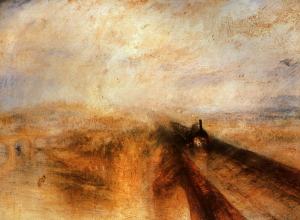 Also, she personifies the train. It makes some sense: apparently trains, like ships, are “she” to those who make them go. I like the idea that the train is a symbol: destructive technology, human ingenuity pushing too hard against the natural world, something like that. But the minute you say “You wonder how a train can read her passengers’ minds?” you’ve lost me. Keep it a metaphor, don’t over-literalize it, don’t tell me “she savours their memories and jokes, their doubts and rages, the way a worm tastes the earth.” Let us think for ourselves why a train might be antipathetic to something else that matters; let us experience the passengers’ humanity as something in tension with it.
I’ve read quite a few of Donoghue’s novels. I thought The Wonder (which I reviewed for the TLS) was really good, and Haven (which I reviewed for Canadian Notes and Queries) was too. I think she’s a good enough novelist that I wish she would write fewer novels—something I realize
Also, she personifies the train. It makes some sense: apparently trains, like ships, are “she” to those who make them go. I like the idea that the train is a symbol: destructive technology, human ingenuity pushing too hard against the natural world, something like that. But the minute you say “You wonder how a train can read her passengers’ minds?” you’ve lost me. Keep it a metaphor, don’t over-literalize it, don’t tell me “she savours their memories and jokes, their doubts and rages, the way a worm tastes the earth.” Let us think for ourselves why a train might be antipathetic to something else that matters; let us experience the passengers’ humanity as something in tension with it.
I’ve read quite a few of Donoghue’s novels. I thought The Wonder (which I reviewed for the TLS) was really good, and Haven (which I reviewed for Canadian Notes and Queries) was too. I think she’s a good enough novelist that I wish she would write fewer novels—something I realize 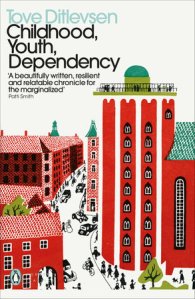 I made my way to the end of Tove Ditlevsen’s Copenhagen Trilogy without ever deciding if I was enjoying it or not. Enjoying might be the wrong word in any case: it’s not really a fun or pleasant story, and Ditlevsen herself does not come across as likeable, so what’s to enjoy? The better question is whether I was appreciating or admiring it, or interested in it. I am undecided on these questions as well. And yet her account of her childhood, youth, and “dependency” (meaning addiction) did exert a kind of pull on me, enough that I persisted to the end. One of the rewards, as I mentioned before, is coming across passages that hit hard. Some samples:
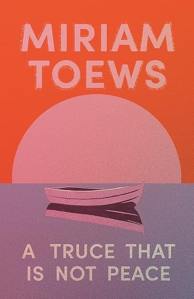 I also finished Miriam Toews’s A Truce That Is Not Peace, which is not really a memoir, I suppose, but I’m not sure what else to call it. It is about her life and about writing and about the death by suicide of her father and her sister—which is to say, it is about the same subjects as most of her other books, which is sort of the point, as it is written in response to a question she cannot clearly answer: “Why do you write?”
 I’ve been meaning to catch up on my recent reading for weeks now: it has been a month since I wrote up
 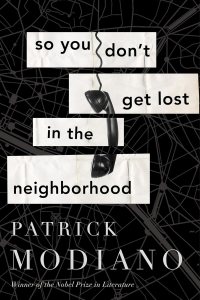 —which is not a bad description of how I decided to read the book. I don’t think I want to read anything else by Modiano, though. For a better-informed commentary, read
 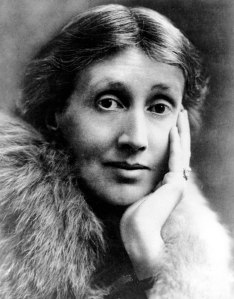 How I hate the word “relatable,” which is so often a shorthand for “like me and thus likeable,” which in turn is both a shallow standard for merit and a lazy way to react to a character. And yet sometimes it’s irresistible as a way to capture the surprise of finding out that someone who otherwise seems so different, elusive, iconic, really can be in some small way just like me—a writer of genius, for example, who reacts to invitations by worrying that she has nothing nice to wear and doesn’t look very good in what she does have. Yes, the period of Woolf’s diary I am reading is one of great intellectual and artistic flourishing, and this makes it all the more touching as well as oddly endearing that she frets so much about “powder & paint, shoes & stockings.” “My own lack of beauty depresses me today,” she writes on March 3, 1926;
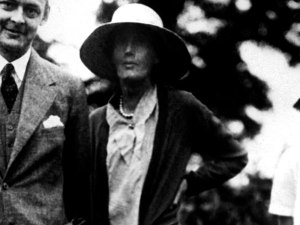 No sooner is she feeling more at ease, even easy, about how she looks, then stupid Clive Bell has to go and ruin everything: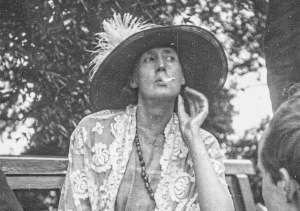
 It was just about a month ago that I last posted in this series.
  Noble aspirations, and already ones I have had a few stumbles living up to, but I have resolved not to spend the twilight years of my career in the classroom assuming the worst and chasing demons. After all, the highest incident of (discovered) plagiarism I have ever had was the dismal year that 1 in 5 of my intro students ended up in a hearing (with a near 100% finding that they had committed an offence)—and this was all cut-and-paste plagiarism of the most discouraging kind (much of it on pass-fail exercises, including supposedly personal writing like reading journals! I still can’t get over that!). Yes, AI is a game-changer, but I refuse to play, and I especially refuse to dedicate a single minute of precious class time to “training” students how to use it “responsibly” (as if there is such a way) instead of using our time on what they and I are actually there for.
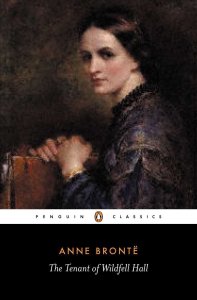 I have taught the Austen to Dickens class since then, but I assigned Jane Eyre. Much as I love Jane Eyre, I think I enjoy teaching Tenant more: its structure is so smart and complex, and the problems it tackles are, sadly, still so timely. I also appreciate that Anne Brontë’s attention is more clearly on social and systemic problems and solutions, while Jane Eyre is relentlessly personal—which is not to say, of course, that Jane’s story isn’t embedded in wider contexts, but her first-person narration focuses our attention constantly on what it is all like to her, on her individual feelings and values and decisions.
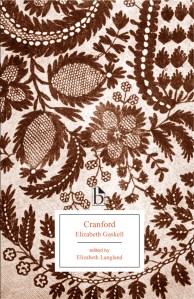 One of the biggest tasks I have underway at the moment as Undergraduate Coordinator is drafting a first attempt at what next year’s slate of classes will look like. As I pencil in my own courses (or whatever the Excel equivalent is of that!), I find myself reflecting that I won’t be on the timetable for that many more years. When I’m tired and grumpy, I feel some relief about this, but when I have just been in class and riding that adrenaline rush, I feel wistful, even bereft. What will make up for the loss of that energy, of that sense of purpose, of being on the front lines of something that matters, of being pretty good at something? I know there are other things that matter and I am trying to figure out what else I might be good at. Still, this is something that actually causes me more work-related stress than AI. I will try not to make these posts a dreary refrain about either of these topics! And on that note, we have two more weeks to spend on Tenant and then we are on to David Copperfield, and then, thanks to the added week in December, there will still be time for Cranford: hooray!
 You must have a plum. Or three. Only they’re so ripe some of them burst when you pick them. Ripeness is all, I said. Men must endure their going hence even as their coming hither. I’d managed to get it into my Oxford entrance exam, my idea that Lear is a darker play than Hamlet. Readiness is all, Hamlet says, and readiness is voluntary, an act of will, where Lear’s ripeness happens to us as to plums and pears, regardless of agency or volition.
 I don’t mean it would have been hard to express an opinion about its merits. I would not say I loved the novel, but I have never read anything by Moss that isn’t both meticulously crafted and convincingly intelligent. Every book of hers has left me appreciating the undercurrent of ideas in it, the sense throughout that something interesting is at stake. The same is true with Ripeness, on both counts, and in addition I think there is more lushness in her prose this time than in either Ghost Wall or Summerwater, both of which left me wishing she would return to the more expansive scope of her 19th-century series.
 Edith is in Italy to help out her sister Lydia, who is in a kind of moral as well as literal exile because she is unmarried and pregnant and it’s the 1960s. Their mother has made “arrangements”: when the child is born, the nuns will spirit it away and pass it on to its new family. Lydia is fine with this: the pregnancy is not just unwanted and awkward but the result of an assault, and all she wants is to be done with it and return to her life as a ballerina. She and Edith are not close and are not drawn closer by this interlude. When it is done, she returns to her dancing; it is Edith who is haunted by the baby she cared for when Lydia would not, and who writes her account of those strange months “for Lydia’s son to find if he comes looking.”
 If I were properly reviewing, I would reread the novel until I could explain better how the parts hang together. Big words like “belonging” or “identity” feel relevant but also too general. Lydia and Edith’s mother was herself a refugee, sent away from France just in time to save her from the fate the rest of her Jewish family met. She thought often of her own mother and sister, who were put on trains and then put to death. Whose claims to refuge are met with kindness and whose with protest? Who has the right to say that they are “from” anywhere? What does it mean to be separated from your family, by violence or by the kind of cold pragmatism that removes tiny Gabriel (named by Edith, as Lydia refuses to care, or at any rate to acknowledge her care, for him) and sends him off to strangers? But then, as Méabh’s new-found brother’s story highlights, how much does it matter where you were born, or to whom, if that has never been your home and they have never been your family?
