But this slight depression—what is it? I think I could cure it by crossing the channel, & writing nothing for a week . . . But oh the delicacy & complexity of the soul—for, haven’t I begun to tap her & listen to her breathing after all? A change of house makes me oscillate for days. And thats [sic] life; thats wholesome. Never to quiver is the lot of Mr. Allinson, Mrs. Hawkesford, & Jack Squire. In two or three days, acclimatised, started, reading & writing, no more of this will exist. And if we didn’t live venturously, plucking the wild goat by the beard, & trembling over precipices, we should never be depressed, I’ve no doubt, but already should be faded, fatalistic & aged.
You thought it was me who felt that way, right? But instead it is Woolf, feeling and thinking and, especially, thinking about feeling.
The parts I am most likely to bookmark as I am reading through the diaries are the ones about writing, the ones probably mostly already included in the Writer’s Diary Leonard compiled (I have it and have mostly read it, in the past, but am not cross-checking.) I do find Woolf the writer endlessly fascinating, especially now that she has / I have reached a point where she knows she is finally writing as herself, in her own way. “If this book [Jacob’s Room] proves anything,” she reflects,
it proves that I can only write along those lines, & shall never desert them, but explore further & further, & shall, heaven be praised, never bore myself an instant.
Imagine that: I bore myself constantly, especially when I’m writing in my own journal! By the end of Volume II of the published diary she is well along in Mrs. Dalloway (“in this book I have almost too many ideas,” she says, but excitedly, not with anxiety), and she is feeling it, not growing into her voice but now at last (her sense of it) finally using it, with a consciousness of freedom (“I’m less coerced than I’ve yet been,” she says about the writing process).
But at the risk of creating a dichotomy where there shouldn’t be one, Woolf the person is at least as interesting, partly because she is not so sure. She is thin-skinned, sensitive, doubting. She waits on tenterhooks for reviews, especially in the “Lit Sup,” where, she complains, “I never get an enthusiastic review . . . and it will be the same for Dalloway.” She is elated by a generous commentary from “Morgan” (E. M. Forster) and irritable about how long it takes for the Common Reader to get any notice at all—although we might wonder at her expectations: “out on Thursday,” she says petulantly, “this is Monday, & so far I have not heard a word about it, private or public.” Shouldn’t a genius be above this kind of fretting? But if courage is not the absence of fear but acting in spite of the fear, perhaps genius is not the absence of self-consciousness or doubt but writing exactly what you want in spite of those feelings, living venturously, trembling over precipices, braving depression—as long as you can bear it, anyway.
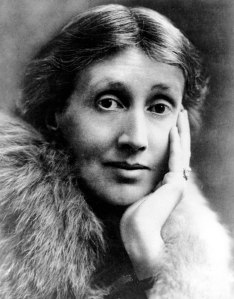 “This diary writing has greatly helped my style,” she says in November 1924; “loosened the ligatures.” I wrote before about how she seemed to be seeking or practising looseness through the relative formlessness of her entries. I’m into Volume III now, already done 1925 because that’s a very short year, and while there is still a lot of meeting and visiting and housekeeping, there are also still what seem clearly like practice sessions for her fiction, little set pieces like this one which, while in a way “just” records of something that happened, somehow do more, or go further:
I am under the impression of the moment, which is the complex one of coming back home from the South of France to this wide dim peaceful privacy – London (so it seemed last night) which is shot with the accident I saw this morning & a woman crying Oh oh oh faintly, pinned against the railings with a motor car on top of her. All day I have heard that voice. I did not go to her help; but then every baker & seller did that. A great sense of the brutality & wildness of the world remains with me—there was this woman in brown walking along the pavement—suddenly a red film car turns a somersault, lands on top of her, & one hears this oh, oh oh.
And yet she still continues on “to see Ness’s new house,” which they go through “composedly enough,” as we all do, if it isn’t our particular catastrophe.
I’m looking forward to 1926, when Mrs. Dalloway is published. In her introduction to Volume III, Olivia Laing notes that it covers “perhaps the most fruitful, satisfying years” of Woolf’s life:
[it] opens as Woolf is revising her fourth novel, Mrs. Dalloway, and her first volume of criticism, The Common Reader, and closes as she is editing The Waves. In the intervening years she writes To the Lighthouse, Orlando, and A Room of One’s Own, plus a formidable battalion of essays and reviews.
Now that’s a streak. Does she shake off those worries about how her work will be received, I wonder? I suspect not, as I know from other research I’ve done that years later she was pretty fretful about both the writing and the reception of The Years. In 1925, she’s daring to imagine, though, that she “might become one of the interesting—I will not say great—but interesting novelists.” As she turns her full attention to To the Lighthouse, she’s also rethinking whether she’s a novelist at all: “I have an idea that I will invent a new name for my books to supplant ‘novel” A new——by Virginia Woolf. But what? Elegy?”
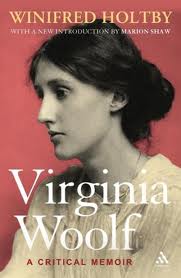 Winifred Holtby’s chapter on this period of Woolf’s life is called “The Adventure Justified”: “she was more sure now,” Holtby writes, “both of herself and of her public. She dared take greater risks with them, confident that they would not let her down.” It’s a wonderful chapter, rising almost to ecstasy about Woolf’s achievement in To the Lighthouse:
Its quality is poetic; its form and subject are perfectly fused, incandescent, disciplined into unity. It is a parable of life, of art, of experience; it is a parable of immortality. It is one of the most beautiful novels written in the English language.
But in November 1925, Woolf is feeling faded and fatalistic: “Reading & writing go on. Not my novel though. And I can only think of all my faults as a novelist & wonder why I do it.”
 It has been very quiet here lately, for reasons that may seem counterintuitive: I have had very little going on, because (long story short) the faculty at Dalhousie has been locked out by the administration since August 20, and while I am not in the union (I’m a member of the joint King’s – Dalhousie faculty) I have been instructed to do no Dal-specific work while the labour dispute continues. You’d think that this would mean I have all kinds of time to read books and write about them here, and yet what has happened instead is that the weird limbo of this situation has prolonged
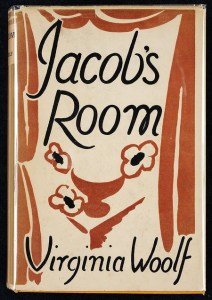 I have also been continuing my read-through of Woolf’s diaries. I am into 1923 now. 1922 seemed like a slow year and then she published Jacob’s Room and read Ulysses, both of which events generated a lot of interesting material. I am fascinated by her self-doubt: we meet great writers of the past when that greatness is assured, and also when their writer’s identity is established, but Woolf is not so sure on either count, and is hypersensitive—as George Eliot was—to criticism, especially when she felt her work was misunderstood, not just unappreciated. Jacob’s Room is significant because it is the first novel that, to her, really feels like her own voice: “There’s no doubt in my mind,” she says, “that I have found out how to begin (at 40) to say something in my own voice; & that interests me so that I feel I can go ahead without praise.” I am always fascinated and inspired by accounts of artists of any kind who find their métier and know it; I still think often of
 Sometimes I think that was the happiest day of my life, those hours of heat and silence and colour, alone with David high up on the moor. But then I remember that I have said that of many other days, so I cannot be sure. This I know—that it was almost perfect. Not quite, for perfection is dull: it took the serpent to make Adam and Eve appreciate their garden.
 The promise of ultimate victory for Ruan is embodied in David, her playmate, companion, and beloved. I give Smith credit for dangling the possibility that he will not, in the end, be true to Ruan: that her dream will turn out not to be his. Perhaps that would have been a more interesting novel, as it would have put their long alliance into a different light, undermining Ruan’s point of view (the novel is told in her voice)—but Smith spares her, and us, that disappointment. That said, the novel’s ending is surprisingly ambiguous or ‘open,’ and while Ruan is certain that happiness will come for her, “hand in hand with David,” I was reminded of the evasive ending of Villette.
 Probably most of the audience here knew the piece. But knowing it only made them eagerly anticipate the high point all the more. Masaru’s heart beat faster. And as always it struck him: What a truly emotionally rousing melody!
 There is also something just nice about the book, because the four characters it highlights care about music more than about competing. They are rivals in the competition but become caught up in each other’s playing. It’s not as simplistic as them rooting for each other instead of for themselves; it’s that as they listen to each other, they hear possibilities that excite them, idiosyncrasies that surprise them, and beauty that inspires them. It’s sweet. Their intersecting stories provide some structure for the novel as a whole, and by the end I was curious to find out who would win and why, but the outcome seemed almost beside the point by the novel’s conclusion—which I think is the point. After all, as one of the judges reflects, “could you really score art?”
 We watched this meeting with its strange weight of human dignity and goodness. I could not ever have believed that saying sorry might mean so much. None was their government. None bore responsibility. No one spoke for anyone other than themselves. Nothing said or done had any national consequence. Yet in that strange communion lay liberation. What other answer can any of us make to the terrible question of history?
 I expect Karen Powell’s Fifteen Wild Decembers is more interesting the less you already know about the Brontës when you read it, whereas I am pretty sure
  The novel is clearly building towards Wuthering Heights and includes some elements designed to get it, and Emily, and us, there, especially a boy (later a man) Emily sees on the moors who fascinates her with his elusive wildness. (There are hints of Cathy cutting her ghostly wrists on the windows too, among other allusions.) How the narrator of Fifteen Wild Decembers could plausibly generate the emotional frenzy of Wuthering Heights is not convincingly portrayed or explained, though. When Powell’s Emily eventually declares her aspirations for her fiction, they seemed to me unearned, not prepared for by what had come previously:
 And so on for another page and a half. For contrast, this is Gaskell’s account:
 I thought I had done very little reading in July, and I was prepared to defend myself: “
 The unexpected highlight was a very last minute choice: an interesting conversation with my lovely mom about A. S. Byatt convinced me I should reread the ‘Frederica quartet,’ but I felt too lackadaisical that night to jump right in so I plucked Byatt’s The Matisse Stories off the shelf on July 30 and finished it July 31. I’ve owned it for ages (I think it was a book sale find) but hadn’t gotten around to it. It turns out to be a really fascinating trio of stories all related (surprise! 🙂 ) in some way to paintings by Matisse, though in unpredictable ways. In the first one, a middle-aged woman reaches a breaking point at the salon and ends up absolutely trashing the place: I would never do such a thing to my nice stylist or the pleasant salon she co-owns, but there was something profoundly understandable about this woman’s rage. In the second, a self-absorbed, pretentious artist endlessly catered to (if silently criticized) by his deferential wife gets an unexpected come-uppance when it turns out their cleaning lady is the one whose wild artistic creations get noticed. The third turns on an accusation against a professor by a student who is clearly unwell; there’s a lot of thought-provoking discussion in it about art and standards, but what will stay with me is a stark moment of acknowledgment between two people who, it becomes clear, have both considered ending their lives:
 Nothing else I read made me think or feel as much as this little volume. I quite liked Ian Rankin’s Midnight and Blue; it has been especially fun watching Rankin push Rebus along through the years rather than preserving him in eternal crime-fighting youth. I also liked Kate Atkinson’s Death at the Sign of the Rook. I read Peter Hoeg’s Smilla’s Sense of Snow for my book club (I’m not considering this a re-read as it had been more than 30 years since my first go at it!). It starts out so strong! It goes so awry! It ends . . . with a parasitic worm? Really? Katerina Bivald’s The Murders in Great Diddling was mildly entertaining. Martha Wells’s All Systems Red—which I listened to as an audio book—was very entertaining and very short. Felix Francis’s The Syndicate was not very good: he took over his dad’s franchise and some of the results have been fine, but this one read like someone ticking off boxes.
 The 0.5 is Ali Smith’s Gliff. I lost traction on it about half way through. Smith is a hit-or-miss author for me: I think she’s brilliant and absolutely love listening to her talk about her fiction, but the Seasonal Quartet are the only novels of hers that I have gotten along with well at all.
 In my previous post I wondered whether we knew what Woolf’s wishes were for her diary: whether she imagined it as something others would someday read, or thought of it as—and hoped it would remain—a private space. How might these different ideas about what she was writing, or who she was writing for, have affected what she wrote? With these questions still lingering as I read on yesterday, I reached an entry that explicitly addresses what keeping a diary meant to her and what her aspirations were for it, particularly for herself as a writer. It’s a longish passage but I’m going to copy the whole of it here, because I find every bit of it so interesting. It’s part of her entry for Sunday 20 April, 1919.
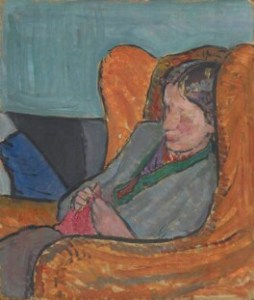 I love that.
 The flimsy walls did not shut out the world but made a sounding box for it; through every crack the smell of the world crept in, the smell of rain and sun and earth and the deodar trees and a wind strangely scented with tea. Here the bell did not command, it sounded doubtful against the gulf; the wind took the notes away and yet it brought the sound of the bells at Goontu very strongly; pagan temple bells. And everywhere in front of them was that far horizon and the eagles in the gulf below the snow.
 The nuns in this case have traveled to India to set up shop in what was previously St Saviour’s School, run by “the Brotherhood,” but which earlier had been known as “the House of Women,” meaning women with very different roles and habits (!) than those under the leadership of the staunch and upright Sister Clodagh. As they make their way to their new establishment, one of them, Sister Ruth, comments that she would like to know “why the Brothers went away so soon.” Sister Clodagh cannot give a direct answer, and she keeps her own doubts to herself: “she had lain awake thinking that they should not have come.”
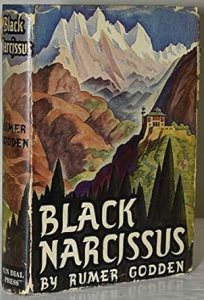 There are lots of interesting aspects to Black Narcissus. It trades in some familiar tropes around the “exotic east,” but I basically agree with Coe that Godden seems very in control of these, aware and critical of rather than acquiescent in them:

