 It certainly is easy to fall out of the habit of blogging–and this in spite of the fact that the most fun I’ve had in the last little while was writing my two previous posts. I enjoyed doing them so much! I felt more engaged and productive than I had in a long time, not because I was fulfilling any external obligation but because I was sorting out my ideas and putting them into words. To be honest, though, in both cases I was also a bit disappointed that the posts didn’t spark more discussion in the comments, and that set me back a bit, as it made me wonder what exactly I thought I was doing here–not a new question, and one every blogger comes back to at intervals, I’m sure. I appreciate the comments I did get, of course, and there was some Twitter discussion around the Odyssey post, which as I know has been remarked before is a common pattern now–though I can’t help but notice that there are other blogs that routinely do still get a steady flow of comments. Anyway, for a while I felt somewhat deflated about blogging and that sapped my motivation for posting. I know, I know: it’s about the intrinsic value of the writing itself, which my experience of actually writing the Woolf and Homer posts more than proved–except it isn’t quite, because if that was all, we’d write offline, right?
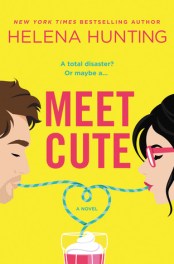 It hasn’t helped my blogging motivation that not much has been going on that seems very interesting. I certainly haven’t read anything since the Odyssey that was particularly memorable. I’ve puttered through some romance novels that proved entertaining enough but aren’t likely candidates for my “Frequent Rereads” club. Two were by Helena Hunting, a new-to-me author–Meet Cute and Lucky Charm, both of which were pretty good; one was Olivia Dade’s Teach Me, which had good ingredients but seemed just too careful to me, too self-consciously aware of hitting all the ‘right’ notes; and finally Christina Lauren’s Roomies, which was diverting enough until the heroine breaks out of her career funk by writing her first (ever!) feature essay, submitting it (not pitching it, submitting it) to the New Yorker, and learning in THREE WEEKS that it has been accepted. I’m not sure which struck me as more clearly a fantasy: the acceptance itself or the timeline.
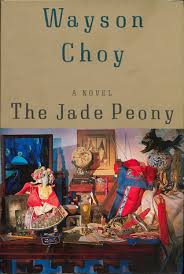 The other book I finished recently is Wayson Choy’s The Jade Peony, for my book club. I wanted to like this one more than I did. It certainly illuminates a lot about the Chinese community in Vancouver in the time it is set (the 1930s and 1940s): one thing our discussion made me appreciate more than I did at first is how deftly telling the story from the children’s perspectives lets Choy handle the historical and political contexts, as they often don’t quite understand what is happening and so our main focus is on the young characters’ emotional experiences in the midst of them. The book reads more like linked short stories than a novel, and for me it lacked both momentum and continuity as a result (that’s not my favorite genre), but many of the specific scenes have a lot of intensity and I think they will linger with me more than I initially thought.
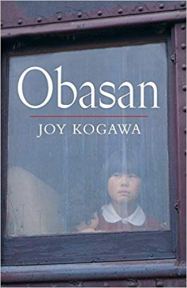 We chose Joy Kogawa’s Obasan for our next read. I’ve been trying to sort out why I’m not entirely happy about this. It makes perfect sense given our policy of following threads from one book to the next, and also Obasan is widely considered a CanLit classic, so it’s not that I don’t expect it to be a good book. I was mildly frustrated, though, that one of the arguments made in its favor was that The Jade Peony was very educational (about a time and place and culture not well-known to the group members) and Obasan would be more of the same. It will be, I’m sure, and in some ways this is an excellent reason for us to read and discuss it. But at the same time this “literature as beneficent medicine for well-intentioned consumers” approach is what turns me off Canada Reads, and I’m not sure it’s the way I want my book club to play out.
I’m torn about this, though! It is undoubtedly good for us (all white middle-aged middle-class Canadian women) to unlearn some of the complacency of our upbringing. I mentioned at our meeting that when I visited Vancouver’s Chinatown as a child I thought about it wholly in terms of feel-good multiculturalism–it never occurred to me in those days that it housed a community that had experienced many hardships including persistent and ongoing racism. Reading Tanya Talaga’s Seven Fallen Feathers similarly made me reconsider my childhood trips to the Museum of Anthropology and what I once thought they meant. We chose The Jade Peony because our discussion of Katherena Vermette’s The Break contributed, as it should have, to a collective sense that we should be trying as hard as we can to understand experiences of Canada that aren’t our own. But at the same time I want us to choose and discuss our books for lots of different reasons–and also not to fall into approaching books as if they are valuable only for their representative and/or didactic potential, using them to check off boxes rather than giving them room to be idiosyncratic works of art, if that makes sense. I think, too, that if you go looking for a book whose lessons suit the demands of your conscience, you may not end up with a book that really surprises or challenges you. I’m not sure if these concerns are reasonable ones or if I’ve articulated them properly. I’d love to hear from other people who puzzle over things like this when choosing what to read next, whether for themselves or for a book group or for some other purpose.
 My recent viewing has actually been more engrossing than my recent reading: we just finished watching Rectify, which I thought was superb–it is intense, thoughtful, and full of turns that surprise without seeming like cheap twists. It is very much character- rather than plot-driven, and it works because every performance is entirely believable. I hadn’t even heard of Rectify before I noticed it on a list of ‘best TV dramas’ and decided we should give it a try. It is not at all what I expected from the premise (a man is released after 19 years on death row): it is much more about how he and his family and community deal with this unthinkable change in circumstances then about the case and his guilt or innocence–though what they do with that question is also very interesting. If you haven’t watched it, I highly recommend it; if you have, I’d be interested to know what you thought of it.
And that’s what I’ve been up to since I last posted! Well, that and reading Téa Obreht’s forthcoming novel Inland, which I am reviewing, so I won’t steal my own thunder by laying out what I think about it here. (I’m writing the review ‘on spec’ so if the magazine doesn’t want it, then I’ll come back and thunder away about it!)
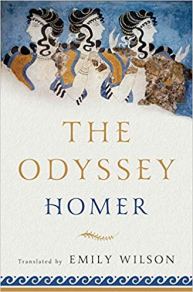 I have finally read Homer’s Odyssey. More precisely, I have read Emily Wilson’s Odyssey, which has been widely praised for its immediacy, accessibility, energy, and contemporaneity. These qualities–particularly the last–made it, I think, at once the best and the worst translation for my first experience with this classic text.
 Yet actually reading Homer for myself never felt like a powerful imperative. Perhaps it should have. I was part ashamed, part irritated when I saw this comment on Daniel Mendelsohn’s Facebook page, when he had kindly shared a link to
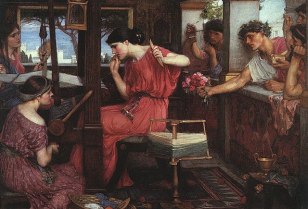 Another example, less jarring rhetorically but more disorienting emotionally, came after the appalling violence of Book 22, which Wilson’s bluntness made remarkably vivid. Here is a bit of that, to show how powerful the translation can be–this is Telemachus overseeing the deaths of the women who “lay beside the suitors”:
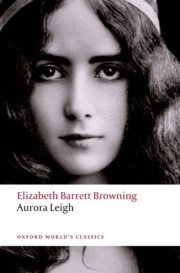 I commented on Twitter that reading this translation made me think of Wilde’s quip “Meredith is a prose Browning, and so is Browning.” I also noted that as an admirer of Elizabeth Barrett Browning’s self-consciously contemporary epic Aurora Leigh I am on shaky ground when it comes to complaining that poetry is too prosaic. “There are cases,” noted an early reviewer of Aurora Leigh with some acerbity, “in which Mrs. Browning has broken loose altogether from the meshes of versification, and run riot in prose cut up into lines of ten syllables.” “Is that poetry?” demanded another; “Assuredly not. Is it prose? If so, it is as poor and faulty a specimen as ever was presented to our notice.” EBB’s mission statement for her own epic comes in Book V of Aurora Leigh. “If there’s room for poets in this world,” she declares (“I think there is”),
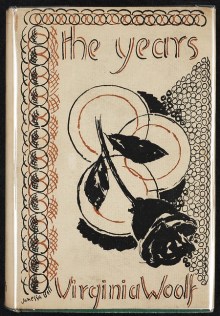
 I’m about three quarters of the way through my second reading of Woolf’s The Years. It is still pretty slow going for me, slower than before even, because instead of wondering what the heck is happening (or, as more often seems to be the case in the novel, not happening) I am trying to figure it out with the help of the various sources I’ve been reading around in and also the amply introduced and copiously annotated Cambridge edition–of its 870 pages, only 388 are actually The Years. That’s not really a sufficient excuse for my not having read once more to the end, though: the truth is that The Years engages me much more in theory than in practice. I quite like reading about it, but
  I would explain the novel’s failure on similar terms as Lee but with less subtlety: The Years is a failure because (deliberately or not) Woolf’s theory of the novel (including “her feeling that art should subsume politics”) was genuinely incompatible with her aims for this particular novel. She wanted (and this is pretty clear from what I’ve read of her diaries around this period) to write a “novel of purpose” (defined by Amanda Claybaugh in The Novel of Purpose as a novel “that sought to intervene in the contemporary world”). It seems plausible, and some scholars make this connection explicitly, that she was motivated to breach the wall between art and politics because of
  I’m not saying anything original about that process, which is well known. I’m just trying to clarify why I think (and why I think Woolf thinks) the result is a failure. “How to do that will be one of the problems,” she comments in her diary early in the writing process; “I mean the intellectual argument in the form of art: I mean how give ordinary waking Arnold Bennett life the form of art? These are rich hard problems for my four months ahead.” My take is simply that she did not solve these problems, or she refused to solve them, because she could not reconcile her means with her end. To put it bluntly, she could not bring herself to write the kind of fiction that would get the job done. Fiction can’t intervene effectively in contemporary life if nobody knows what you mean by it. Burying the meaning, as she did (“the rest under water”), however artistically consistent, is polemically (politically) stifling, or at least muffling. Obscurity is incompatible with activism.
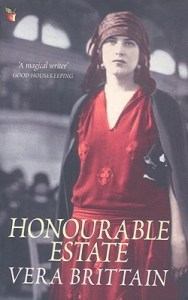 Though Holtby may be the pivot on which Woolf’s failure turns, it’s Vera Brittain’s Honourable Estate, not Holtby’s South Riding, that provides the most illuminating comparison to The Years, because it illustrates the perils of doing just what Woolf wouldn’t do: explaining everything. Where The Years (as many critics have noted) takes but subverts the form of the family saga, Honourable Estate embraces it. It covers nearly the same span of time as The Years and many of the same issues (the suffrage movement, the war, challenges to patriarchal dominance in the family, the hazards of sexuality, especially for young women, etc.). I wrote about Honourable Estate here before (
 Here’s just one of many potential examples showing how differently these novels approach the same material. Both include sections that take place in 1908, the year of the great “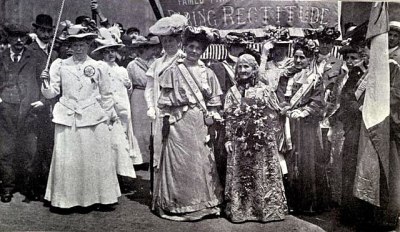
 In that earlier post on Honourable Estate I discussed Marion Shaw’s essay “Feminism and Fiction between the Wars: Winifred Holtby and Virginia Woolf,” saying that it “cautions us (me!) against underestimating the art of a novel like Honourable Estate.” Throwing that caution to the wind, I will say frankly that I think Honourable Estate is not a good novel (see, I knew we’d work our way back to the problem of measuring literary quality). It just seems so painfully obvious from start to finish! On its own terms, though, I’m not sure it is actually a failure. Unlike Woolf, Brittain had an uncompromised mission as a novelist. In her own foreword to Honourable Estate, Brittain explains,
 What an uncomfortable conclusion, though: even if I’m reluctant to let Woolf (or Austen) set the evaluative terms, I find it hard to concede that literary merit consists solely of doing whatever it is that you set out to do. I have argued (at some length!)
 Frannie’s early story has some elements of a slave narrative, though Frannie herself is somewhat disdainful of the form, “all sugared over with misery and despair”: “The anti-slavers are always asking me, what was done to you, Frances? How did you suffer?” She did suffer, and Collins does not spare the details, but the form Frannie wants for her story is the novel. “No one like me has ever written a novel in the history of the world,” she says, and the only hope she has as her end approaches is that her account of herself might “tempt a publisher.” All her life she loved only “all those books I read, and all the people who wrote them”:

 Naturally, my mixed and sometimes vexed response to Tenth of December got me thinking about what contemporary short fiction I have responded to more readily and positively. Because I don’t read a lot of short stories, I really don’t have a lot of other examples to draw on. I was very impressed with Adam Johnson’s

 This is the model of Dolly: “Charm, Jane, charm!” Jane, or the novel, acknowledges that Dolly’s way of life has been discredited by feminism, but the idea sometimes seems to be that those “older simpler longings” are natural, essential, defining, not just of Dolly but of what women need and want. “I now understand,” Jane explains, reflecting on her own reactions to Dolly’s choices,
 It has not felt like a very productive week, though it is hard for me to be sure right now as I am still in the
 My other reading has also felt relatively unproductive, though I suppose productivity is not really an appropriate measure for it (though I have long struggled with how or whether to make distinctions between
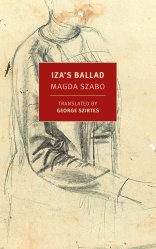 This is how things go for Ettie and Iza once settled in Budapest as well. Iza does what she thinks is best, and Ettie’s attempts to participate are either thwarted or criticized. Ettie’s ways are not Iza’s; she does not belong in the modern world of the flat, the city, the trams, the markets, the technology. Her cooking, her shopping, her cleaning–none of it is right. She tries to make a friend and brings home the wrong sort of person. Eventually she realizes that she is an inconvenience, a burden, on both Iza and her housekeeper Teréz: “Teréz would get on better without her. Iza could never relax when she was around.” One of the strangest and saddest signs of Ettie’s growing isolation is the relationship she develops with Iza’s refrigerator, at once a symbol of the alien modern world and a stand-in for the old life from which she has been so completely cut off:
 Though it incorporates several people’s perspectives and stories besides Ettie’s, including Iza’s, Iza’s Ballad felt to me like Ettie’s book, which is why the novel’s title puzzled me at first. It’s Lidia, who looks at Iza and sees her clearly “for what she was,” who articulates why it is really Iza who is central, Iza whose “self-discipline” is also “a hardness of heart that dares not indulge itself by grieving over dead virgins.” Iza’s perfection is the result of a lack of imagination and empathy, a resolute clarity of purpose that obscures rather than illuminates. The things that made Ettie’s life vivid and meaningful to her are invisible or irrelevant to Iza. “The poor woman believes,” Lidia reflects,
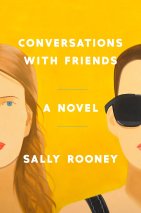
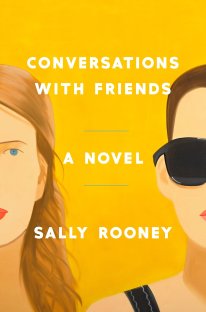 I don’t typically post about books I didn’t finish, and I don’t want to make a big contrarian to-do about my having given up on Conversations With Friends, but it is what I’ve been reading lately and I have given up on it, so I might as well at least comment briefly on it here.
 The start of a new month seems like a good time to take stock, once again, of how my plans and projects for this sabbatical term are progressing. May is actually the point in a winter term sabbatical when being on leave stops meaning that much, as the regular teaching term is now over for everyone anyway. May is often very busy with meetings, though (including our department’s traditional ‘May Marks Meeting’), so my time is still more my own than it would be otherwise.
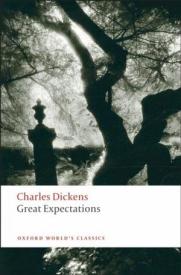 I have until the fall to settle on the book lists for my winter term courses, which are British Literature After 1800 and 19th-century British Fiction (the Austen to Dickens variation). I’ve spent quite a bit of time examining anthologies for the survey course and concluded that the most reasonable way to go is a slim custom text assembled from Broadview’s wide-ranging options. (Who is actually assigning these behemoth volumes? And how do they assign enough in one term to make it worth their students’ expense?) The down side is that for copyright reasons I can’t include much material past Joyce, but I think I can fill in a small number of contemporary poems and a story or two by other means. I have been playing around with a lot of different options for longer texts that I think would work well in combination, because the assignment sequence I am planning to use includes a final essay for which students would compare our last book with either of our previous ones. (One reason for this is that it means one way or another everyone has a stake in our final reading.) Right now the front runners are Great Expectations, Three Guineas, and The Remains of the Day: I can imagine a lot of interesting ways to connect Remains with the other two, including first-person narration, questions of class, dignity, money, and morality, and connections between personal and public politics. The 19th-century fiction book list is still uncertain: one of the big questions for me is whether Wuthering Heights will make it in or whether I’ll lose my nerve and fall back on old favorites.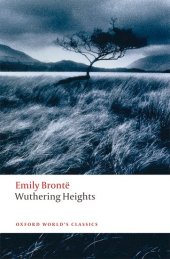
 Having said that, the more I read about Holtby and Woolf, and especially the harder I try to understand what’s going on with The Years, the more I’ve been identifying continuities between this material and longstanding interests of mine, including genre (
 So that’s where I am now, at the two-thirds point in this six-month sabbatical. I have checked off a number of the concrete tasks I set myself, and I have made progress on the more amorphous but no less important task of refreshing my own intellectual engagement. There have been other things going on too, of course (including Maddie’s performance in Jesus Christ Superstar and, exciting in a different way, her acceptance of a place in Dalhousie’s Fountain School of Performing Arts for next year), and as always I’ve been doing other reading, most recently
  Novel Readings