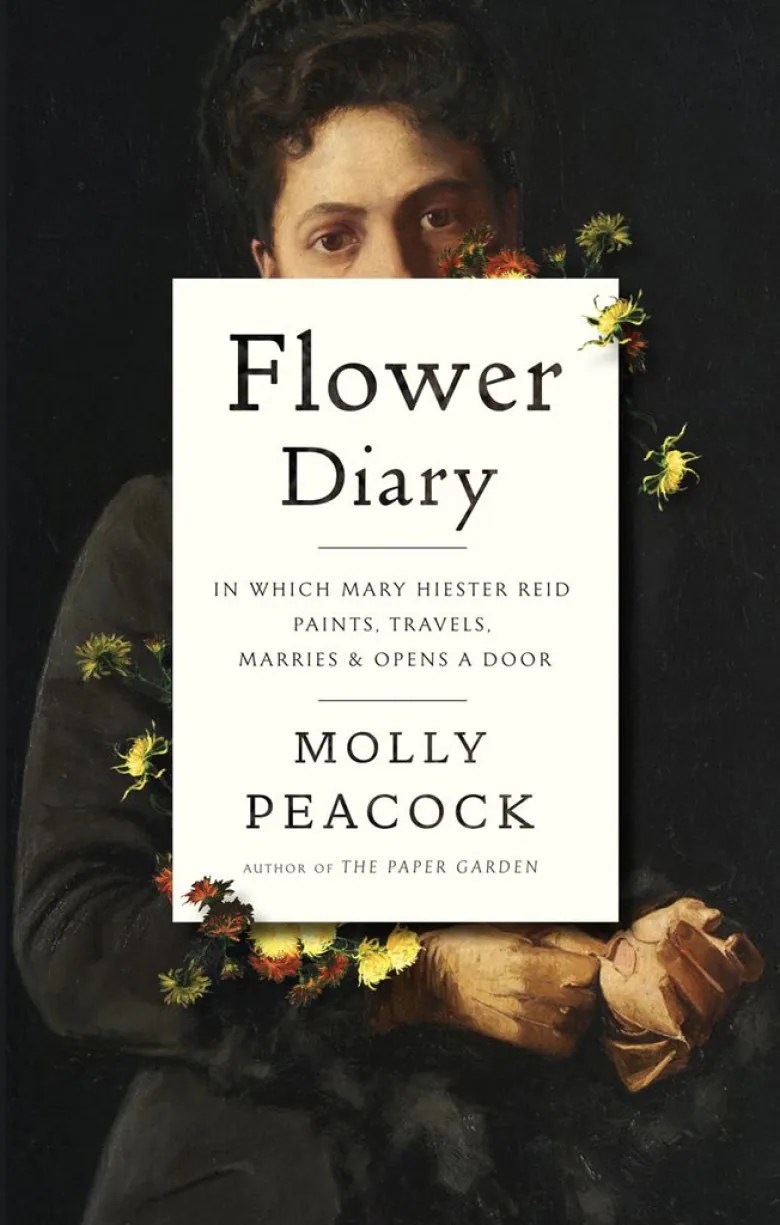
 In an era where Mary Cassatt eschewed marriage and a fully adult life to live with her parents in Paris so that she could produce her work, Mary Hiester bounded into an adulthood of painting with a grown-up’s problems of money and sex and logistics . . . Existing with an ambitious man in a socially constricted world for women of which a person today can barely grasp the demeaning dimensions, she lived, by her lights, “cheerfully.” She painted around the obstacles of an artist’s life by employing a woman’s emblem, the rose, and later an emblem of independence, the tree.
Molly Peacock’s Flower Diary weaves together three stories—each of which is also, in its own way, more than one kind of story: there’s the biographical account of artist Mary Hiester Reid, including her marriage to and working relationship with her husband George Agnew Reid; there’s the story of Peacock’s second marriage, which is also the story of her second husband’s illness and death; and there’s the story of Mary Evelyn Wrinch, who married George Reid after the first Mary Reid’s death. “The three of them,” Peacock notes, “are even buried together
in Toronto’s Mount Pleasant Cemetery, section 18, lot 22. Not side by side, but on top of each other; MHR is the foundational layer. Then George on top of her. Last, Mary Evelyn on top of George.
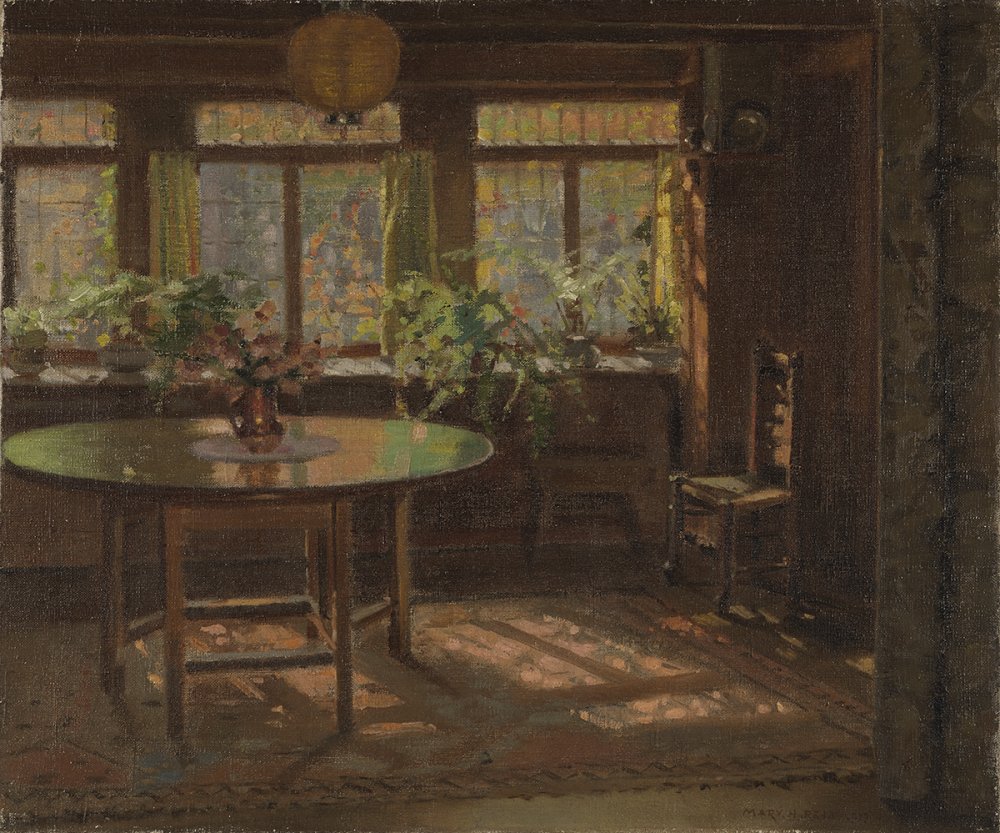
 Like Peacock’s earlier, similar work The Paper Garden, the biographical and autobiographical material is interwoven with commentary on art and creativity, especially in this case Mary Hiester Reid’s paintings. For me, these were the best parts of the book. Peacock is a wonderful observer. “A Fireside is rich, warm, and pillowy,” she says of one of Mary’s early paintings:
It’s full of interest for the beholder’s engagement (books, copper tea kettles, a Japanese print brought back from Paris, George’s copy of a huge Velazquez that Mary admired). To the side of the umber beams bloom paperwhite narcissus bulbs in a ceramic bowl. The sparkler flowers hurl out their scent in swift dashes of white that make you know it must be snowing outside. (Canadians plant them to bloom in January or February, life in the dead of winter.) Painted in 1910 when she was fifty-six, it is of a generous room where MHR lit her own art fire, warmed others, and somehow negotiated the complexities of a spiritual, aesthetic, familiar, and perhaps sexual, quasi-ménage à trois.
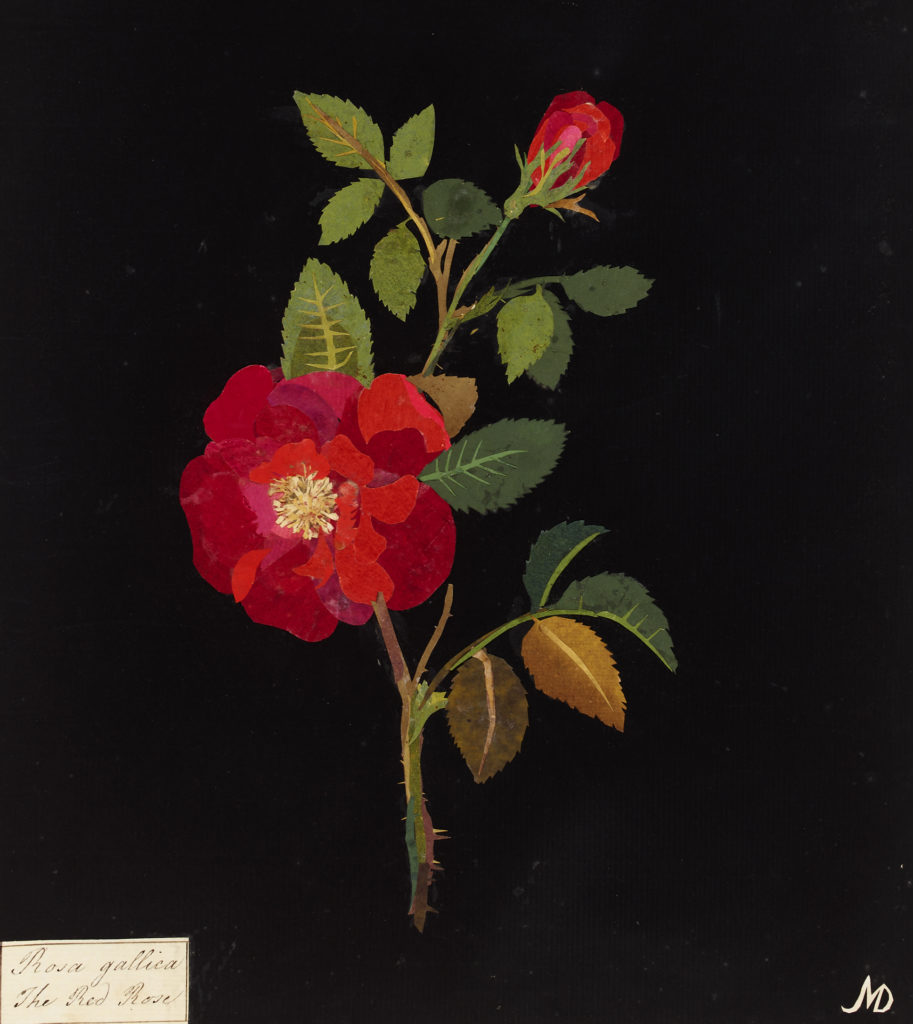
“Like the continent’s Depression, or perhaps her own,” she says later, of the still-life “Three Roses,”
Mary’s roses languish, looming from the dark background. One of them even drops two tear-shaped petals onto the table below. Another rose—the youngest?—barely out of the bud, has tightly folded petals. Each one is flushed, the pink of the inside of a mouth. The top flower almost pats the back of the one that has let two weeping petals go. It is a highly emotional scene—roses acting out a romance? The still life has a narrative quality.
Now that she’s described it that way, I can see it: does it make her description any less plausible that it never would have occurred to me to read so much drama into these quietly lovely flowers? I remember having similar questions about her interpretations of some of Mary Delaney’s paper flowers—and about some of the commentary in William Kloss’s ‘Great Course’ on Masterpieces of European Art. “You see, but you do not observe,” Sherlock Holmes famously chides Dr. Watson: it takes a trained eye, a sympathetic eye, perhaps a poetic eye, to see what Peacock sees. Her poet’s words, of course, also make the difference between plain description and illumination.
I found Mary’s paintings really beautiful. (Flower Diary itself is a beautiful object, with heavy, glossy pages and rich, high quality reproductions, a treat for the eyes.) I hadn’t heard of her before. Peacock explains that MHR’s influences were the “tonalists,” painters who “attempt to represent emotions in their paintings through times of day like sunrise, twilight, or sunset, and weather like fog and rain”— a key example is Whistler, whose portrait of Thomas Carlyle was a significant inspiration for MHR’s late composition “A Study in Greys.” MHR, Peacock says, “made [tonalism] her own, with a Realist’s touch”; she had “zero interest in the hard abstraction of modernism.” These labels and abstract explanations mean less to me than Peacock’s insights into the paintings as reminders “that a moment existed, that it flowered fully, that it was fraught and complex, and that a woman in a lace collar holding a palette insisted on its essence.”
 Flower Diary follows Mary’s artistic development, integrating it with the story of her personal life—as indeed the two were intricately related in reality. There are lots of parts to both, including the art school Mary and George ran and many trips to Paris and Spain and time spent in an artistic community in Onteora, in the Catskills. Peacock emphasizes Mary’s “persistence” as an artist. Hers was not a bad marriage, or an unsuccessful career: George was a supportive partner, and she was productive and accomplished and recognized. The times were not kind to ambitious women in general, though, or to women artists more particularly. “I don’t know where the assurance and conviction required for Mary’s sort of persistence comes from precisely,” Peacock comments,
but daily circumstances—the vector of a husband’s energy, an active social life, the maintaining of meals, clothes, sleep, friendship, sex, when no one expects you, a weaker vessel, to do what you do—require an internal stamina that must connect to a conviction that something inside of you will perish if you don’t protect your gift. I marvel at the ability to access emotions so thoroughly and to organize an art life, to display rage and to turn toward a canvas with plans. It is consummately adult to hold at once these contradictory responses and urges. “Going cheerfully on with the task” was her method. Eight paintings equaled health, equaled survival, equaled a truly textured life that could have disintegrated if the rage and disappointment she modeled had been enacted.
 “Going cheerfully on with the task”: there’s no doubt that this is admirable, and getting on with things rather than enacting one’s rage may indeed by a truly adult—the only possible—adult response to the complexities of life, including married life. There’s ultimately something a bit stolid about the woman we meet in Flower Diary, though, or about Peacock’s characterization of her anyway, and I think that’s why Flower Diary, interesting as it is, and full as it is of beautiful pictures and wonderful bits of writing, was a disappointment to me after the revelation that was The Paper Garden. The story of Mary Delany discovering and fulfilling her own peculiar creative genius late in life was so exhilarating; it seemed to offer so much hope. It is, as I said in my post about it “a subversive, celebratory view of growing older as a woman”: in Peacock’s wonderful phrasing, “Her whole life flowed to the place where she plucked that moment.”
When I wrote about The Paper Garden, it resonated with my rising hope that I too might be finding my moment. Now, almost a decade later, I feel less buoyant, more tired and uncertain. It’s not that I don’t recognize myself in MHR: it’s that I do (except maybe the ability to carry on the endless negotiations between life and work, reality and ambition, as “cheerfully” as she apparently could). Where Mary Delany offered inspiration, Mary Hiester Reid represents something more like sensible resignation: do what you can, keep on doing it as well as you can, be satisfied if the work is good. That’s exactly right, of course, and MHR’s work, as Peacock shows it to me, is good indeed. And yet at the same time it seems uncomfortably apt that the culmination of such a life is a study in greys and not an exuberant flowering.


 I am trying. I have read my first new book, now: Lauren Groff’s Matrix. It was a good choice


 “Where can we live but days?”
 A lot of people who know about grief have told us it gets better, though it takes time, but also that the process isn’t simple or linear: it isn’t as straightforward as just getting through more days, each of them easier than the last. Right now the passing days feel too fleeting anyway. “I don’t want it to be four days already,” Maddie said last week, and now it has been too many more days but also far from enough days to understand what this loss means for us. We still feel grateful that we know what it meant for Owen, and there is still comfort in his last words of love. But we are the ones who have to go on now, a family of three where once we were four. He couldn’t tell us how to do that any more than we could tell him not to leave us.

 He knows the airplane and its deafening drone and its gasoline reek. He knows the shape of Marian’s elbow and knee visible through the cockpit doorway. He pencils his neat log of figures, updating the distance they’ve covered, the time they will arrive . . . He feels the lines of latitude sliding underneath like the rungs of a ladder, watches the whitecaps through the drift meter, measuring the difference between where they are going and where they mean to go. That’s where life is, that wedge of discrepancy.
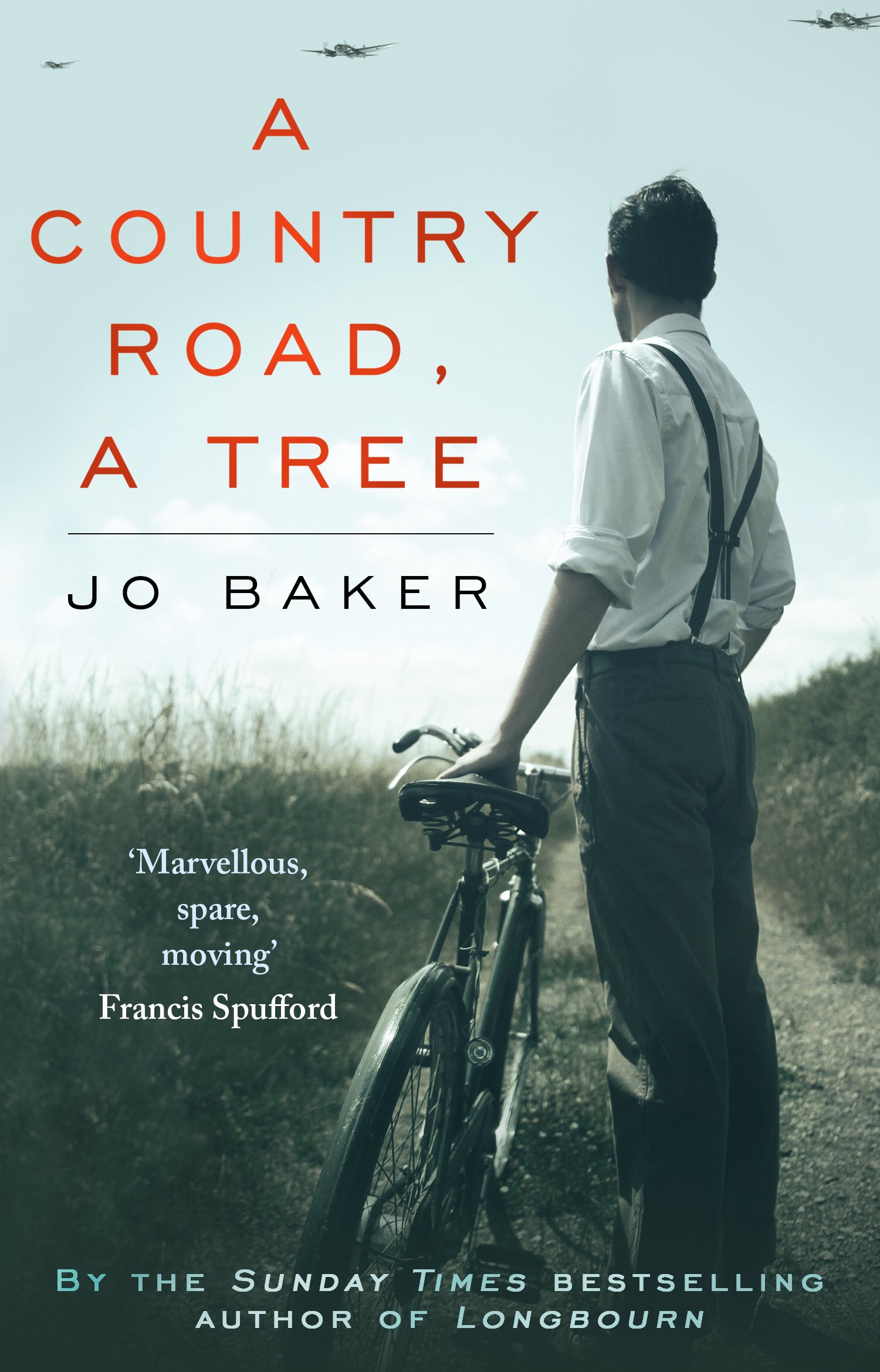
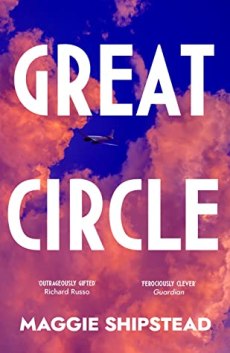 I was initially fine with the alternation between the past and present plots. By the middle of the novel, I had become impatient with Hadley’s sections, which felt at best peripheral to Marian’s much more interesting character and experiences, and at worst seemed gratuitous or even anxious, as if Shipstead lacked confidence in historical fiction, as if she felt that on its own it was somehow insufficient. The modern-day plot felt more like a device than a necessity—but a device to do what, exactly? I hoped that by the end of the novel I would realize the work the modern parts were doing and the two strands of the novel would prove integral to its overall vision.
 Still, I think you can open up room to highlight questions about how stories are told in lots of ways, and even if this is one way to make sense of Hadley’s role in the novel, it doesn’t quite make up for how much less vivid and interesting her sections are than Marian’s. There’s so much wonderful writing in the novel, and pretty much none of it is in the Hadley parts. One reason is that the prose is at its best (appropriately) when Marian is flying, the language rising in a crescendo of vividness and intensity up to what sometimes seems like a limit of what words can convey:
 I’m in the little lull between the end of routine class work and the arrival of final essays and exams. Pre-COVID, this was a time for two ritual activities: cleaning my office and going Christmas shopping. Since I’m still working almost entirely at home, the first of these is mostly, if not entirely, beside the point: my current workspace, set up in what was once my son’s bedroom (and still furnished for that purpose, including his 20-year-old mate’s bed), could use a bit of tidying, but because online teaching means there’s a lot less physical debris from the term’s work, it’s not particularly chaotic. I’ll take the teaching-related books and folders to campus for storage when my courses are well and truly wrapped up – and bring home more books related to my sabbatical projects – but there won’t be any major housekeeping to do here until I return to working full-time there.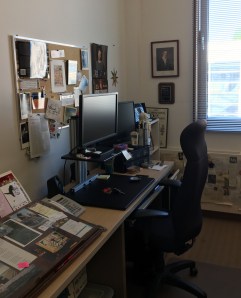
 So what have I been doing instead of cleaning and shopping? Honestly, I’m not entirely sure where the “extra” time has gone. One factor, I think, is that online teaching actually doesn’t end neatly the way in-person classes do, or at least my classes haven’t: there has been a fair amount of tidying-up stuff to do, especially record-keeping and wrangling problems of one kind or another. One thing I suppose I didn’t have to do but considered worthwhile was an audit of students’ course bundles for English 1015 (where I am, again, using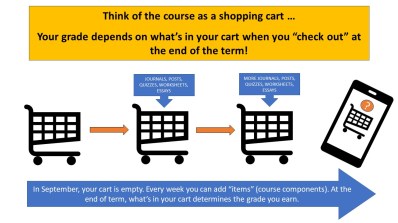
 Next fall! Yes, because much to my immense relief and gratitude I am on sabbatical this winter term. This means – although nothing seems absolutely certain about the future anymore – that this term may have been my last term of online teaching. Please let that be true! This is not to say that I’ve hated everything about it. There are some aspects of it I have grown to like, and others that I have learned the value of, whether I like them or not. I will probably never give an in-person quiz or exam again: the simplicity of arranging make-up tests is a gift, for one thing, and especially valuable as we are likely (I hope and expect) to be much more aware from now on of the importance of letting students stay home when they are sick. I also like online reading journals: I had used them in the past as a way of encouraging students to keep up with the reading and getting them to practice expressing ideas about it with low stakes, but then ‘upgrades’ to our LMS took away the journal function I had used and I gave it up. Now that I know how to set up one-on-one discussion boards in Brightspace, I can see keeping up some version of these, especially because Brightspace makes it pretty easy to keep the records.
 What else has been good about online teaching? Well, while I still greatly prefer the energy, intellectual stimulation, and good cheer of class discussions, I have been impressed at the level of commentary on the discussion boards, especially, this term, in my 19th-century fiction class. I was frustrated all term at how much of it went on at the very end of each module, which meant only rarely was there substantial back-and-forth among the students, but that logistical griping tended to subside when I read through the posts that had come in. I am certain that I “heard” from more students this way than I would have in the classroom: I have pretty good participation rates, and I work hard to make space for students who are shy or just slower to know what they want to say (by, for instance, requiring everyone to put their hand up and wait to be called on), but even so it is typically a minority of students present who actually contribute.
 The single thing I have missed the most in my online classes has been laughter. You can do a lot of things asynchronously, and honestly I’m proud of the courses I offered. But