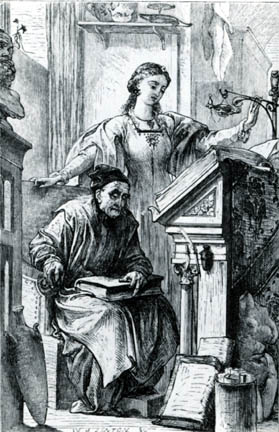
We’re through the first two volumes of Charlotte Bronte’s Villette in our summer reading group at The Valve; come here to contribute to this week’s discussion.
Author: Rohan Maitzen
Moral Tourism
I recently finished reading Nadeem Aslam’s The Wasted Vigil. It is a remarkable novel, equal parts beauty and brutality; as its parts accumulate it does an elegant job of evoking through its literary form some of its central motifs and symbols, such as the images gradually revealed, restored, or repaired from the walls of the house decorated originally to celebrate all the delights of the senses. The fallen Buddha that bleeds gold when assaulted by the Taliban’s bullets, the lingering fragrance from the perfume factory, the books nailed to the ceiling and gradually reclaimed but irreparably scarred, the canoe that becomes an unlikely symbol for a desirable but tragically impossible collaboration–the novel is full of rich but delicate details that can make you catch your breath with their unexpected eloquence about the damage, tangible and intangible, inflicted by the conflicts that generate its plot. It is a novel, too, that hums with nuance and yet somehow refuses to judge those on whom such ambiguities are lost: many of its characters themselves hold to intractable, unforgiving, unforgivable absolutes, but the novel often seems to be asking us how they could have done otherwise, with the result that the tragedy of the novel (and it is extraordinarily, lyrically tragic throughout) feels inevitable, which is the saddest thing of all. Like Bel Canto, though also very differently, The Wasted Vigil holds up against brutality an ideal of aesthetic, rather than political, commitment; in fact, at times it seems as if the greatest evil of the Taliban is less their physical violence (which many other factions in the novel are also shown to be capable of, after all) but their violence towards art and the beautiful. When we see a glimmer of hope, it comes from quiet moments of aesthetic appreciation; violence is, ultimately, vandalism.
I was moved and impressed by this novel. But I also became uneasy about it in ways that I did not feel uneasy about Bel Canto, I think because Aslam’s novel is much more directly intervening in our discourse about particular historical and political events. It is at times an exceptionally, horribly, violent novel, but my unease was not queasiness about the violence as such but rather about the kind of aesthetic experience the novel itself was offering me (including through that violence) and how my pleasure in the novel as a whole thus reflects on me as a reader. What does it mean to enjoy, or at any rate to appreciate aesthetically, a novel in which a captive soldier is literally pulled to pieces as sport, a wife is forced to amputate her husband’s hand, a young man’s eye is burned with a blow torch, a suicide bomb is detonated next to a school?
Puzzling over this question made me think more generally about the purpose of such a book and about my own purposes in seeking it out. The aesthetics-of-suffering issue is not uncommon (Holocaust literature seems the obvious example) and has certainly been analyzed and theorized–I’ve looked into this a little as part of preparation for teaching Elie Wiesel’s Night, for instance. There’s something a bit different about the recent wave of high-profile titles about the Middle East or the Arab or Islamic world, though, including Khaled Hosseini’s The Kite Runner and A Thousand Splendid Suns, Mahbod Seraji’s Rooftops of Tehran, Mohsin Hamid’s The Reluctant Fundamentalist, Yasmina Khadra’s The Swallows of Kabul and The Attack, to name a very few–and that’s not even touching on the many non-fiction titles, from memoirs to histories to political analyses.
It’s possible, of course, that what seems like a trend is actually just the result of my taking note of them as the circle of my own reading interests becomes less parochial, but my sense is that what has happened is that since 9/11, not only is the so-called “clash of civilizations” big news, but there is an interest, an appetite, among western literary audiences for stories that help them see different perspectives on current and historical events in a part of the world which, previously, they might have considered only glancingly, or with the reductive and limited insights available from following headlines and TV reports. The back cover of The Wasted Vigil quotes a reviewer suggesting as much–Peter Parker of The Sunday Times says that the novel “reminds us that fiction can do things that mere reportage can’t.”
One of the purposes of such novels, then, or at any rate one of their uses or effects, is revelation, maybe even instruction or pedagogy. That’s certainly one of the reasons I have been reading them: to the hoped-for satisfaction of a rewarding literary experience I can add the desire to learn more about these worlds that seem so other, to be in my reading life a better-informed citizen of the world and then perhaps, as a result, also to be a better-informed participant in real-world events–though I think there is also the temptation, the risk, to feel as if reading about, say, Afghanistan, is an actual substitute for trying to do anything about Afghanistan (would the money I spent on A Thousand Splendid Suns have been better spent as a donation to Canadian Women for Women in Afghanistan?). But if reading leads to understanding, especially appreciation for nuance and complexity, isn’t reading a kind of doing? Isn’t it a good thing to do? And wouldn’t the world be a better place if more people (former world leaders, even) perhaps read such novels?
And yet at the same time, fiction is not (quite) fact; anecdote, especially imagined anecdote, is not a reliable substitute for aggregate data and rigorous contextualization; impressions, however beautiful, are not analysis; and, finally, contemplation is not action, and actions must sometimes be reductive–nuance and complexity are, perhaps, luxuries permitted to those who need not make decisions. In Saturday, Ian McEwan actually makes a similar point about ambivalence, depicting it (or so I read the novel) as a luxury, even a self-indulgence, when decisive action is required; in the more theoretical realm, Geoffrey Harpham notes that “without action, ethics is condemned to dithering,” and perhaps novels feel ethically more satisfactory sometimes than real life precisely because they need not take a singular position. Ethical critics have often pointed to this “negative capability” as a strength of the novel form, but it is also a crucial aspect of its artifice.
While I was thinking these things I came across an phrase in an essay by K. Anthony Appiah that struck me as suggestive in this context. In the essay, “Cosmopolitan Reading,” Appiah is discussing Tsitsi Dangarembga’s novel Nervous Conditions; he is thinking about the question of the novel’s implied audience, “the ‘you’ addressed in the first paragraph of the novel”:
The usual answer, of course, is that the postcolonial African novel is addressed to a Western reader. Here, that is, according to the usual narrative, is a safari moment: an Africa constructed exactly for the moral tourist.
Appiah goes on to argue against reading Nervous Conditions in this way, but my interest is in the model he outlines of literature as a kind of “safari,” “constructed … for the moral tourist,” which seems at some level an apt characterization of the experience of reading something like A Thousand Splendid Suns or The Wasted Vigil (though the specific experience offered by each is, of course, quite different). I hear Appiah’s tone here as dismissive of that “moral tourist,” the reader seeking only an exotic experience, like a “safari,” rather than … I’m not sure what, actually. Is the alternative to being a “tourist” somehow “going native”? Is that any less problematic? Perhaps it is the author addressing the “Western reader” who is being faulted for offering up marketable, consumable, safe (fenced?) stories to suit the tourist’s taste. In her talk on representations of Arabs in western literature, Ahdaf Soueif points to some versions of this effect in recent novels; I’ve read some commentaries that object to the western fixation on veiling or stories of women’s oppression along similar lines. And yet … shouldn’t the story of women’s suffering be known, even if their victimization is not the whole story? Isn’t there something more substantial than “tourism,” than gawking, involved in seeking to know it? And, to come back to my opening comments on The Wasted Vigil, isn’t the aesthetic experience itself a kind of response, however inadequate, to the denial of their humanity?
Escallonia Hedge
Gently they go, the beautiful, the tender, the kind;
Quietly they go, the intelligent, the witty, the brave.
I know. But I do not approve. And I am not resigned.
One of my favourite quiet corners around here is a site called Escallonia Hedge. The name, as explained on the site, refers to the hedges surrounding the garden at Talland House, Virginia Woolf’s childhood summer home. Its author describes it as “a space through which things are meant to be discerned,” an opportunity for “trying to get comfortable with talking about texts in a comfortable but nonetheless what is called a ‘productive’ way. Maybe some dawdling along the way.”
I’ve read Escallonia Hedge since its inception. There aren’t many posts there, just over a dozen altogether, but every one showcases the author’s playful intellect and her delight in words and ideas. Here’s an excerpt, for instance, from a post on “Woolf and the Body”:
I have been thinking lately about Woolf and the body. Woolf is always thought of as being incredibly cerebral—which, no doubt, she was—but always to the point that I think there must be a popular misconception that she somehow rejects the body, does not think it important or take it seriously, just as there is the popular conception that she is somehow of a parcel with figures like T. S. Eliot, or how she must always and only be egotistical, when, really, she has one of the most sympathetic eyes ever.Thinking about this I am of course reminded of a frequently cited passage in On Being Ill, on the body as a pane of glass:
“[L]iterature does its best to maintain that its concern is with the mind; that the body is a sheet of plain glass through which the soul looks straight and clear, and, save for one or two passions such as desire and greed, is null, and negligible and non-existent. On the contrary, the very opposite is true. All day, all night the body intervenes; blunts or sharpens, colours or discolours, turns to wax in the warmth of June, hardens to tallow in the murk of February. The creature within can only gaze through the pane—smudged or rosy; it cannot separate off from the body like the sheath of a knife or the pod of a pea for a single instant; it must go through the whole unending procession of changes, heat and cold, comfort and discomfort, hunger and satisfaction, health and illness, until there comes the inevitable catastrophe; the body smashes itself to smithereens, and the soul (it is said) escapes.”
It just occurred to me as I lay in bed this morning, procrastinating on my papers (actually, not wanting to face the world), that Woolf’s frequent use of metaphors of glass is connected to this. Why is it sometimes that these very obvious things take so long to process or register?
Here’s another excerpt, this one from some commentary on a collection of Woolf’s writings called The Platform of Time:
The satire “JB” I found especially striking: it’s full of very interesting nonsense. It reminds me of how I tried to write at one point because I couldn’t find a sentence or a sense-making group of words that expressed what I thought, only I was writing that way sincerely whereas VW parodies the practice as confusion and excess. The character VW tells the character JB to find a single “image” to express what he means instead of clumping together various descriptors, and then JB tries to figure out what an “image” (simile, metaphor) means! (What is its use; where he can find an example of one; how it’s no good because it’s not GE Moore-ish enough (“how can a thing be like anything else except the thing it is?”).) This in contrast to JB looking at a “male siskin under a microscope” in an effort to compose a poem “in the manner of Gerard Hopkins” (“The siskin’s been dead a week”):
“Seepy, creaking, sweeping, with a creaking kind of beating of the penultimate dorsal jutting out femoral crepitational tail. The siskin whisking round the peeled off mouldy bottle green pear tree rivers. Well, I flatter myself that’s a pretty good poem—all true to an inch.”
Then there’s a big fuss about finding an image for the siskin, which in the end is arrived at by what JB has for lunch: “The siskin lies like—like cold salt roast beef the siskin lies. My word—that does it.” It’s moments like this I feel like saying “Oh Virginia Woolf, you’re the best!” I think the interesting thing about that line “like cold salt roast beef the siskin lies” is that it sounds beautiful but is being a framed in a way that makes it silly, reaching, and untrue. This is always the interesting thing about Woolf’s satirical moments, I think, and why I would say “Oh VW you’re the best”—many of them are a mixture of a form of sympathy and ridicule. Like Samuel Johnson’s satire manqué.
The author, Samantha Li, graduated from Dalhousie in May with first-class Honours in English. She would have begun her M.A. in English at U.B.C. in September. Tragically, she died on July 11, in a terrible car accident. She was 24. Her funeral service was today; I had the honour of being one of those invited by the family to speak at this heartbreaking event. All of us who had the pleasure and the privilege of working with Samantha will always remember her questing intelligence, her self-deprecating grace, her vivacious warmth, and her kindness. She was much loved, and will be greatly missed.
The lines I’ve quoted at the head of this post are from Edna St. Vincent Millay’s “Dirge Without Music.” As Samantha was also an exceptionally talented musician, however, it seems fitting to remember her with music as well. In this video, she is playing the violin; she is second from the left as we watch.
Postcolonialism Redux
I am still working on my understanding of postcolonial theory, with an eye to revising my paper on Soueif’s In the Eye of the Sun for eventual journal submission. The more I read, the clearer some things become, though I don’t pretend to anything like mastery over a field that (the more I read) looks increasingly complex and conflicted–which is to be expected of any field, of course, as you try to move beyond rough generalities. I think I do now see past some of my earlier confusions and slippages, and I also understand better the importance of some of the things people with more expertise in this area have said to me along the way. I think I also see ways in which some of these things people have said to me represent specific approaches to postcolonial studies that are themselves disputed. I realize that I have nothing to contribute to expert debate in this field (except, perhaps, grounds for further correction or guidance–which, of course, I will be happy to receive), so those of you who know this already, or are tired of trying to explain, can ignore what follows, but it helps my own thinking to see if I can say ‘out loud,’ as it were, what I have been learning.
One of the most important things I’m getting better at is making distinctions between different meanings of “postcolonialism.” For starters, I now understand that there was a time when (particularly in certain fields of study besides literature, such as history, economics, or political science) “postcolonial” meant more or less just what it sounds like, that is, it was a chronological marker meaning after the end of colonial rule. I think that the term was (and is) still used in this way, including in some discussions of literature that try to place particular texts or writers historically and also nationally. Gradually, however, this chronological sense of “post” as “after” shifted towards “post” as “against” or “anti”–at least, in some kinds of discourse, particularly including literary or theoretical. While not the first, perhaps one of the most important works in developing this meaning, or this use, of the term to signify an attitude rather than an era is The Empire Writes Back, in which the authors argue that what makes the literature of an array of countries is “distinctively post-colonial” is that it “foreground[s] the tension with the imperial power, and emphasiz[es] their differences from the assumptions of the imperial center” (2). In Feroz Jussawalla’s words,
What most convincingly defines a postcolonial novel, then, is the author’s attitude towards his or her country and its culture, an attitude of its distinctness and difference from that of the European colonizer. (“Postcolonial Novels and Theories”)
So now we have not just a historical distinction between pre-colonial, colonial, and post-colonial literature, but an ideological distinction between literature that is postcolonial in its attitude and literature that is not. Here I admit to some continuing confusion: is the opposite of postcolonial literature of this kind pro-colonial literature, or imperialist literature? Or is it the literature of the “imperial center” or “European colonizer”? Is that literature, by virtue of being, well, itself, assumed to be pro-colonial? Or is it, more neutrally, just literature that (again, by virtue of being itself) represents that against which postcolonial literature defines itself?
There is a further important distinction to be made between the discourse of postcolonial literature and that of postcolonial theory, or between postcolonialist as category of literary texts, and postcolonialist as a category of critical or theoretical discourse or a reading strategy. This issue was rightly brought up a couple of times by commenters on my previous posts (e.g. here), and I am increasingly aware of its relevance to the decisions I need to make about how (or why) to write about Soueif’s novels. Before I say more about that, though, I want to touch on a couple of additional points about identifying or defining certain texts as postcolonial, and particularly about what doing so means or implies about their relationship to canonical Western texts.
First, in my conference paper, I framed my reading of In the Eye of the Sun with an argument about how the novel resists being read as a “postcolonial novel”. I knew I was using a broad brush, but I felt from the reading I’d done so far that the generalization I had in mind was a reasonably safe one: that “postcolonial novels” were understood to be those that wrote back (to use Ashcroft, Tiffin, and Griffith’s phrase) against the literary language and forms of “the West”–again, those having (or assumed to have) a particular political attitude. So far, what I’ve read since has rather reinforced this view than undermined it (e.g. Jussawalla, who writes that “postcolonial literature is widely understood to be a literature that writes against empire”). There is an easy slip from here to the idea that all texts from postcolonial circumstances (historical, national) are assumed to be written about the same range of issues and from the same perspective. The very close relationship in critical writing between texts identified as postcolonial and postcolonial criticism and theory is part of what makes the big picture look this way, I think: that is, as a commentor pointed out at The Valve, it is typical for postcolonial texts to be addressed by postcolonial critics, which means they are known and talked about within a relatively specific (I might even say, narrow) context that artificially homogenizes their actual variety. At the same time, given the specific understanding of postcolonialism as an attitude or worldview, one to which the texts selected for such analysis need to, or are expected to, conform, some circularity in this process seems inevitable. This is what I had gathered, albeit impressionistically, from my own previous ventures into this field, and some of the articles I have read make points similar to mine about the resulting interpretive constraints. Here’s what I said in the previous exchange,
Your second point, about the distinction between postcolonialism as reading strategies and literature labelled “postcolonial” rightly identifies a slippage in my usage of that term, one I struggled with–but one that I think does happen in a more general way, in that books coming from “postcolonial” places are read with an emphasis on the kinds of issues (political, national) that are also primary in postcolonial theory. That is, a frequent starting assumption is that these books are primarily about colonialism, national identity, etc.–if not unambiguously as “national allegories,” then at least as statements about postcolonial positionality.
And here, for instance, is Jussawalla again:
Another unfortunate consequence of the rise of postcolonial theory is the unwillingness of some proponents to see anything in postcolonial literature except its challenges to hegemonic forces. Indeed, some novelists have articulated a sense of frustration with continually being tied to the colonial millstone.
Working towards a more nuanced understanding of the ways writers have engaged with the Western literary tradition, I thought John Marx’s essay “Postcolonial literature and the western canon” gave a very helpful synthesis; like the authors of The Empire Writes Back, who propose a development from “settler” literature to “literature produced under ‘imperial licence” to varieties of resistance and then appropriation, Marx highlights a movement from repudiation to critique, with an emphasis on anti-imperialism, to revision and rewriting, a less confrontational and more transformative form of engagement. Marx writes,
[A]cts of unwriting and rewriting had the effect of destabilizing the homology between colonial mastery and the mastery of European culture. . . . though such reworked versions tend to reinforce the centrality of Western writing by default, treating canonical texts as a source of raw material could not help but transform them . . . moreoever, they estranged the canon for Western readers, and uncovered complexity many had never noticed before.
I found particularly interesting Marx’s argument that the incorporation of postcolonial writing into the curriculum–and its wider audience more generally–has “enabled [even obliged, he implies] educators and their students to re-examine the interaction between literature and history as well as to redefine the meaning of cultural literacy and literary culture.” He sees as a result the emergence of a new, inclusive model of humanism. He quotes Anthony Appiah: “What is necessary to read novels across gaps of space, time, and experience is the capacity to follow a narrative and conjure a world: and that, it turns out, there are people everywhere more than willing to do.” In Marx’s view,
Because it maintains an authority to mediate local culture, postcolonial literature reveals that cultural differences can be overcome, as demonstrated by what Appiah describes as a basic human capacity to read and understand literature (at least of the narrative sort). Without sacrificing its point of entry into literary curricula as the representative of cultures repressed by imperialism, therefore, postcolonial literature seems poised to acquire the responsibility once claimed by the Western canon of mediating and defining the essential elements of our humanity.
The idea that literature bridges difference is hardly new, but this particular spin on it–that postcolonial literature in particular is coming to define a new ethically reinvigorated humanism for a global world– intrigues me and marks one of the key points I want to explore further. (It provides, among other things, a framework for reading both the literary and the ethical value of something like Nadeem Aslam’s extraordinary novel The Wasted Vigil, which I am currently reading.)
Marx’s (and, I gather, Appiah’s) interest in humanism seems like a useful place to return, however, to the distinction between talk about postcolonial literature and talk about postcolonial theory. Here, I’ve been trying to figure out how to understand (if not necessarily reconcile) arguments about the meaning of “implication” (as discussed, for instance, here) alongside claims that postcolonial theory is not “totalizing” (e.g. here). Still in the interests of trying to grasp larger principles (which are hard for a beginner to discern from ‘primary’ theoretical texts–though I have been reading what I can of these too), I found the distinction proposed in Neil Lazarus’s introduction to the Cambridge Companion to Postcolonial Literary Studies illuminating, though no doubt it (like everything else) is controversial.
Lazarus suggests that there are two main approaches to postcolonialism, one which considers Eurocentrism an “ideology,” and one which considers it an “episteme.” He considers Said someone who held the former view along with a “realist epistemology,” the implications of which are that one can stand outside Eurocentrism and “subject its claims to scrutiny”; “it is quite obvious [in Said’s work] that there is an ‘East’ and that it is systematically misrepresented in Orientalist discourse.” (Lazarus believes that scholars following Said have wrongly emphasized the Foucauldian idea that discourses produce worlds or realities.)
The second approach he describes considers Eurocentrism as “a hegemonic mode of conceptualization, whose structuring propensities are so deeply and insidiously layered that they cannot but be determinative of all scholarly production.” Resistance to Eurocentrism on this model can lead to scholars rejecting “modernity, Europe, and rationality itself”–because these modes of thought replicate (reflect, are constitutive of) Eurocentric values, and it is thus impossible to critique Eurocentrism from within.
I’m not sure, but I wonder if this distinction is at the heart of the objection raised here to my protest about postcolonial theory appearing to assume its conclusions when it claims that all literature of the colonial era is “implicated” in colonialism or imperialism. If Eurocentrism functions as what Lazarus is calling an episteme, that implication does seem inevitable. But if Eurocentrism is what he calls an ideology, then some writers, even Victorian writers, might, in principle, stand outside it and “subject its claims to scrutiny.” Would they still be “implicated”? Here, I’m still confused about whether the intent is to accuse (and, as I’ve said before, not only is the word “implication” not neutral, but neutrality is probably not a morally appropriate stance towards slavery or colonialism) or just to make a sort of obvious point that every writer during the colonial era had some link–personal, financial, etc.–to colonial enterprises, just as today most of us in the west have some link to, say, child labour or deforestation. The account of “implication” offered to me here,
Pointing out that a novel is implicated in colonialism is akin to arguing that, much like the society it seeks to describe (and out of which it was produced), a novel necessarily confronts, and is confronted by, its colonial legacy—even, and especially, when it does not do so explicitly.
does not altogether help me sort this out, because it continues to blur textual and critical postcolonialism, because I’m not sure what the “colonial legacy” of a novel would be, and because I don’t see why not confronting colonialism directly means confronting it (or being confronted by it) especially. I also continue to wonder whether, once you’ve adopted the view that everything is always already Eurocentric, it doesn’t became crucial (just as it might have been before that was your perspective) to distinguish between those that, despite (even in spite of) these lurking structural or systemic implications, nonetheless set out on the face of things to oppose or criticize colonialism. In any case, if the point of the postcolonial reading is to reveal how a novel “confronts, or is confronted by, its colonial legacy,” then I’m still not convinced that there isn’t something reductive about that approach (the same comment argued that it was reductive on my part to say “that post-colonial critics simply create confrontational, or corrective, readings”)–but as was also pointed out, every critical approach has its domain, and it may be no more reasonable to object to the emphasis of postcolonial critics on empire than it would be to object to the emphasis of feminist critics on gender.
Though I hope I’m making progress, clearly I still have a lot to learn about the terms and stakes of these debates. Perhaps ironically, then, the most important insight I have arrived at in the past couple of weeks may be in answer to my own very early question about Soueif, which was “whether working on an Egyptian novelist writing in a post-colonial context necessitates using post-colonial theory” (here). RFD noted that “if non-post colonial readings of novels like Soueif’s are going to happen, the novels need to be read by people who aren’t interested in post-colonial reading.” As I replied to him,
In fact I was not initially inclined to approach In the Eye of the Sun as a postcolonial text, or through postcolonial theory, but as I went along I felt–perhaps wrongly–that given the existing critical literature on it and the novel’s own awareness of moving between cultures and languages and so on, I had to start by trying to explain why I thought that was not in fact the best way to go. So that was the strategy I settled on for framing this paper, though in many ways the heart of the paper, for me, is the middle section I omitted here, in which I try to demonstrate the “affinities” between the two novels.
My latest round of reading suggests that suggests that a postcolonial reading is not in fact called for, though an appreciation of how Soueif might (or might not) be considered a postcolonial writer might be appropriate. Though I have a number of dissatisfactions with the paper I came up with for ACCUTE, chief among it is that I did not set out, after reading In the Eye of the Sun, to work on the issues that seem to be central to postcolonial theory (national identity, place, language) but rather wanted to consider the novel in relation to my own previous work on the ethics of fiction, particularly in relation to George Eliot. I think now that I should have done just that–but that I am better equipped to return to that project now, not least because postcolonialism in both literature and criticism is in so many respects an ethical project.
(x-posted)
Villette Chapters 1-8 at The Valve
The first post for this summer’s group reading of Villette is up at The Valve. Come and play!
Lloyd Jones, Mister Pip
I think there is a contradiction in my response to this book, one I’m not sure yet how to resolve. Why do I feel–how can I justifiably feel–that the novel conveyed very powerfully to me an experience wholly unlike my own, that is, the experience of suspense, deprivation, and, ultimately, horror, of the young narrator, Matilda, and yet find so unconvincing the novel’s central premise, that is, that Matilda and her comrades on ‘Bougainville’ could find Great Expectations so thoroughly engrossing–because everything about it is so alien to their own situation and experiences? I believed in the role “Mister Dickens” played in the story only at the level of allegory or fable. Perhaps that’s appropriate: perhaps Great Expectations plays the part in this novel that I thought opera did in Bel Canto, standing for artistic possibilities, here narrative rather than musical but still representative rather than particular: the ability of one voice to reach across time and place, to speak, to summon up other worlds, to express identity even when nothing else is left to believe in. But then Great Expectations is such a very specific choice: why use this book to do this job?
Is it simply that Jones really does consider Dickens “the inimitable,” the ultimate storyteller, and Great Expectations his masterpiece–and so what better book to stand for all the possibilities of the novelist’s art? And yet Mister Pip is not reverential towards Dickens’s novel, for all its alusive dependency, as the “original” text is constantly rewritten, especially as Mr. Watts plays Sheherezade to the audience of islanders and “rambos” and weaves together Great Expectations with his own life story and the combined wisdom of the village:
This wasn’t Mr. Watts’ story we were hearing at all. It wasn’t his or Grace’s story. It was a made-up story to which we’d all contributed. Mr. Watts was shining our experience of the world back at us. We had no mirrors. These things and anything else that might have said something about who we were and what we believed had been thrown onto the bonfire. I have come to think that Mr. Watts was giving back something of ourselves in the shape of a story.
So Great Expectations is the vehicle, or the occasion, or maybe the example, for other stories: a model for the ways words can create, express, and convey identity. Pip’s first-person narration is one formally crucial aspect for Jones’s purposes, I think, not just because Pip speaks so distinctively for himself, in his own voice, but because he speaks retrospectively. This technique gives the novel much of its power, as we hear young Pip’s story refracted through the much greater wisdom of his matured self–matured, crucially, into a novelist, so that much of what Great Expectations is about (like David Copperfield, too, of course) is the process of dawning self-reflection that enables morality–which depends so vitally on recognizing the reality of other selves or voices than your own. So Matilda, too, matures into the narrator of her own book. I admit I was a bit disappointed by the metafictional turn (“I took the top sheet of paper from ‘Dickens’ Orphans,’ [her thesis], turned it over, and wrote, ‘Everyone called him Pop Eye.'” Yes, that’s the first sentence of Mister Pip). Not only has this been done kind of a lot, but it felt like an awkward shift of register for the novel, as in fact did the whole last section after Matilda leaves the island. Again like Bel Canto, the novel seemed to lack the courage of its conviction, particularly about the magic of art. Why take us from the artifice (as I saw it) of the earlier parts, which (like Bel Canto) offer a fable pitting human creativity against violence and destruction, and then retroactively frame it as realistic? (This is not to say that Jones hasn’t evoked horrors that are, tragically, only too real, but he seems to have extracted their essence for his purposes here–this is not a novel about a particular civil conflict but about the degeneration of warring factions into “redskins” and “rambos,” symbols of inhumanity countered by the frail and all-too-human Mr. Watts, also surely a symbol more than a man.) Although of course the confusion may be mine, I think Jones is struggling with the genre of his book. Or perhaps it is Matilda struggling with the genre of hers. She says she has become disenchanted with the “grotesque” qualities of Dickens’s characters and tried in her own narrative “not to embellish.” She believes that behind their “masks” you can find”what their creator understood about the human soul and all its suffering and vanity.” But stripping away Dickens’s grotesque embellishments diminishes his art in the (supposed) interest of credibility–and isn’t his language itself his greatest contribution to the flourishing of “fancy” and thus humanity?
And so I still find myself asking (with Matilda’s friends, as it turns out) “Why Dickens?” and why this Dickens in particular. Jones, by way of Matilda, does bring out some thematic echoes–orphans, leaving home, losing or remaking or finding one’s identity. Most moving for me was what Jones does with the idea of the “gentleman”: this begins in Mister Pip, as it does for Pip, as a seemingly superficial dedication to good manners but develops through Mr. Watts and then Matilda’s mother into a commitment to a profoundly simple but far-reaching (and ultimately devastating) principle: “to be human is to be moral, and you cannot have a day off when it suits.” Pip eventually comes to something like this realization when he looks on the dying criminal Magwitch and sees in him “a much better man than [he] had been to Joe.”
Hounds and Beasts: Catching Up on Some Classic Mysteries
The most frequent suggestion in the course evaluations for Mystery and Detective Fiction over the years has been “more Sherlock Holmes.” I’ve never been that engaged by Holmes, which is why I’ve always been content to represent him in the syllabus with just a short story or two, but there’s no denying his importance to the genre, so for the 2010 version of the course I added The Hound of the Baskervilles–without actually having read it first (shhh!). It seemed an obvious choice, and is certainly acclaimed enough that I felt confident taking it on faith. Now that I’ve actually read it, I have no regrets about having assigned it: of its kind, it is certainly good. I remain, personally, not that interested in its kind, but it is suspenseful and clever, and well-written, too, particularly in its evocations of the brooding moors on which the mystery plays out:
‘It is a wonderful place, the moor,’ [says Stapleton], looking around over the undulating downs, long green rollers, with crests of jagged granite foaming up into fantastic surges. ‘You never tireof the moor. You cannot think the wonderful secrets which it contains. It is so vast, and so barren, and so mysterious.’
Or there’s this, from Dr. Watson, who gets more than his usual share of this novel:
In the evening I put on my waterproof and I walked far upon the sodden moor, full of dark imaginings, the rain beating upon my face and the wind whistling about my ears. God help those who wander into the Great Mire now, for even the firm uplands are becoming a morass. I found the Black Tor upon which I had seen the solitary watcher, and from its craggy summit I looked out myself upon the melancholy downs. Rain squalls drifted across their russet face, and the heavy, slate-coloured clouds hung low over the landscape, trailing in grey wreaths down the sides of the fantastic hills. In the distant hollow oon the left, half hidden by the mist, the two think towers of Baskerville Hall rose above the trees. They were the only signs of human life which I could see, save only those prehistoric huts which lay thickly upon the slopes of the hills.
Though the competition between natural and supernatural explanations plays out just as we expect it to in a Sherlock Holmes story, the powerful atavistic forces evoked by this landscape with its stone relics of an earlier pre-scientific age give additional thematic resonance to Holmes’s eventual unveiling of the truth behind the ghostly hound. Even knowing there must be a rational explanation for this apparition does little to take away from its chilling description–the stuff of nightmares:
A hound it was, an enormous coal-black hound, but not such a hound as mortal eyes have evern seen. Fire burst from its open mouth, its eyes glowed with a smouldering glare, its muzzle and hackles and dewlap were outlined in flickering flame. Never in the delirious dream of a disordered brain could anything more savage, more appalling, more hellish, be conceived than that dark form and savage face which broke upon us out of the wall of fog.
As is conventional in “Great Detective” stories, we are spectators to Holmes’s work here: there are clues, of course, but there’s a lot we can’t know. Having Watson in charge for several chapters gives us the illusion of greater involvement for a while, but as ever, Holmes controls crucial information, and the conclusion is a typical display of his superior knowledge and ability. It’s a polished performance–for both Holmes and Conan Doyle. I think my students will enjoy it.
I’m not as convinced about The Big Sleep, which I similarly took on faith as the obvious alternative to The Maltese Falcon (I’ve done Falcon in this class five or six times running and have felt it getting a bit stale). I recall that it took me a while to work up an interpretive apparatus for Falcon, so before I give up on The Big Sleep I should certainly read around a bit. But my first impression is very negative. The plot is extremely confusing, for one thing. Mind you, the plot of The Maltese Falcon gets pretty convoluted too, but it gets a lot of momentum from the relationship between Sam and Brigid right from the start. Also, Falcon has a sense of humour: parts of it are fun, even funny (Sam’s first meeting with Joel Cairo, for instance, or pretty much every scene with Gutman), and I can’t think of any fun parts of the Big Sleep. Almost everybody in it is nasty, and though I know Marlowe is supposed to stand for a higher, more chivalric code (yes, I noticed that knight in the window trying to rescue the lady with the “convenient” hair), it wasn’t easy to see what he was fighting for. General Sternwood seems to get his loyalty, but not because he’s especially admirable or worth protecting, that I could see; there’s Harry Jones, I guess, but that’s setting a pretty low standard. And the women! At least Brigid is really in the game, and much of her ‘femme fatale’ posturing is theatrical. I’m not sure what to make of Vivian Sternwood’s play for Marlowe (Carmen, of course, is a psychotic nymphomaniac). Brigid at least never has a line quite as bad as Vivian’s “‘Hold me close, you beast.'” Is Vivian the damsel who needs rescuing? I guess her loyalty to her sister has a grain of something worth saving in it. Overall, anyway, I found the novel tiresome: sexist, homophobic, convoluted. Maybe I’ll warm to it–or maybe I’ll make a frantic call to the bookstore and see about changing back to The Maltese Falcon. Tips welcome on how to appreciate it!
The bygone ages of the world were actually filled by living men…
I’m back. I had a wonderful time playing tourist in both Oxford and London, though of course both cities are so saturated with potential delights for a lover of literature and history that it was impossible to take in everything I would have liked to see. But I was very happy with the priorities I had set. All of the ‘big ticket’ sites I visited–the Bodleian, and Christ Church, and Westminster Abbey, and Hampton Court, and the Tower–were thoroughly satisfying, but equally delightful was wandering down Chancery Lane past Lincoln’s Inn, or roaming through Chelsea and Bloomsbury. I went relatively light on museums and galleries this time, spending the most time at the National Portrait Gallery, with just brief stops at the National Gallery, the British Museum (I kept meaning to go back and never made it), the V&A (almost literally just passing through), and the Natural History Museum. It was just more fun doing other kinds of things.
Of all the places I went and things I saw, I was most moved by those that most vividly reminded me of Carlyle’s words about Scott, that he had “taught all men this truth … that the bygone ages of the world were actually filled by living men, not by protocols, state papers, controversies and abstractions of men.” For instance, at the Hampton Court exhibit on Henry VIII’s wives, on display was a locket containing some of Katherine Parr’s hair and a manuscript letter from Catherine Howard to her alleged lover, Thomas Culpepper. To someone who grew up on Jean Plaidy’s Tudor series and worked on Agnes Strickland’s Lives of the Queens of England for her thesis research, these are thrillingly personal remnants of an oft-told tale. In Oxford, I was enormously (and unexpectedly) stirred by seeing Newman’s pulpit in St. Mary’s:

Of course, I sought out this location in Chelsea:
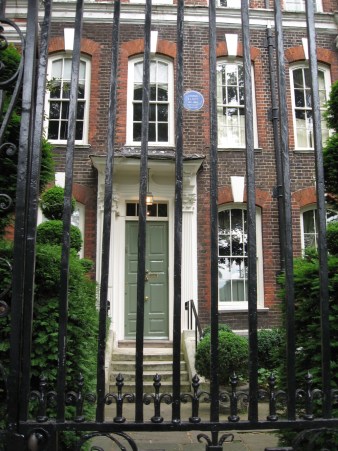
But it was Carlyle’s house that was really exciting to be in:


You can really imagine the Carlyles’ life there: it is all set up as they had it (90% of the items and furnishings, the staff told us, were actually owned and used by the Carlyles), and on display are all kinds of touchingly intimate artefacts including Valentine’s Day cards from Thomas to Jane, a screen decoupaged by Jane herself (if she were alive today, she’d be a scrapbooker), and even a fragment of the manuscript of The French Revolution burned by J.S. Mill’s hapless maid. Below are a couple of the most familiar contemporary images of the Carlyles’ home:
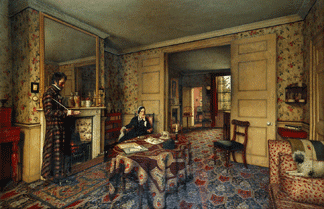

I sat in the garden by the door, and stood right where TC is standing in the painting! The guide told us that Chopin once played on their little piano, and of course they received all our favourite Victorians in that sitting room. The “soundproof” attic was particularly interesting, and another special treat was the 80th birthday ‘testimonial’ signed by George Eliot, Thackeray, Lewes, David Masson, and almost every other literary figure you can think of who was around in 1875.
The Dickens House Museum was good too, of course. Here’s his sitting room, with the “Cruikshank” chair”:

He didn’t live in this particular house that long, and many of its furnishings are approximations of what the Dickenses would have had, rather than their own pieces. Still, it’s something to stand in the room where Mary Hogarth died and see Dickens’s own report of the event. Best of all the many interesting items on display there were Dickens’s reading copies of his novels, complete with highlighting, annotations, and insertions. I love to feel the people behind the books and ideas I spend so much time talking about.
Although it’s impossible not to feel there’s something obvious, even cliched, about the Tower (and Hampton Court and Westminster Abbey too), still, to me these are irresistible places. I was interested in how much slicker these sites have become, with their guide ropes and audio tours and gimmicks (Clarence’s face projected in a butt of malmsey? really?)–but the enormous solidity of the stones and walls and towers speaks for itself of the continuity of history. I’m not sure the new memorial on Tower Green is an improvement on the simpler plaque that was there before:
 But you can still stand and look around and think about Anne Boleyn seeing virtually the same scene as she walked to the scaffold, and that’s what it’s all about: not abstractions, but men and women making their way along.
I did do some reading while I was away, including Murial Barbery’s very engaging The Elegance of the Hedgehog and Alaa Al Aswany’s Chicago. And at Heathrow I calmed my pre-flight nerves by browsing W. H. Smith and came away with Kate Atkinson’s When Will There Be Good News? and Nadeem Aslam’s The Wasted Vigil, which was A. S. Byatt’s book of the year. So once I recover from the travelling (and from my daughter’s birthday and my son’s Grade 6 ‘graduation’, both of which happened the day I got back), I should be able to do some novel blogging again. And our Villette reading starts soon. Oh, and as if all this isn’t exciting enough, waiting for me at my office was a box of actual hard copies of my Broadview anthology, a bit later off the press than originally planned but looking very handsome, if I may say so myself.
On Vacation!
I leave tonight on the red-eye for Heathrow. The last time I was in England I celebrated my 19th birthday at Hampton Court:

(It was the eighties, which excuses the glasses. I’m afraid there is no good excuse for the boots–though we were there in March and it was pretty damp and muddy everywhere.) So it has been a long time–OK, 23 years–since I was there, and I’m very excited about this trip. Last time I was there as a prospective history major with a lingering obsession for Richard III:
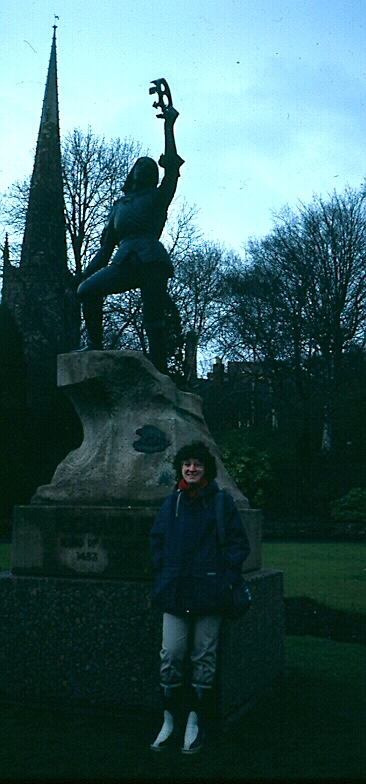
This time my interests are a bit different–and my time is much shorter. I’ll be in Oxford for three days and then in London for just about a week, which is not nearly enough time but will have to do. In Oxford I’m staying in a little hotel right across from Peter Wimsey’s college. The last time I was in Oxford I had never read Jude the Obscure; I wonder if the city will look more depressing this time. In and around London, I’m going back to Hampton Court, and to the Tower (both are having Henry VIII exhibits, as if they knew I was coming, though actually I probably have The Tudors to thank for this), of course, and to the Dickens Museum and the Carlyle House and the British Museum and the National Portrait Gallery and …
I will probably find it hard to leave the internet alone entirely, but I don’t expect to be posting anything here. When I get back, it will be time to start Villette!
Wherefore art thou, Romola?
This just in: the Oxford World’s Classics edition of Romola is out of print. Does that mean it is losing (or should I say winning?) the battle for “least read George Eliot novel”? Admittedly, it does contain the truly terrible line of dialogue “you are as welcome as the cheese to the macaroni” (an Italian friend of mine assures me that in Italian, this idiomatic expression does not sound nearly so, well, cheesy)–but Romola is a truly extraordinary novel in many ways. Romola herself can be a bit tiresome in her pursuit of virtue (she’s a bit like a trial run at Dorothea Brooke), but even she has some great dramatic moments–the encounter with Savonarola when she’s finally seized the courage to run away from her unworthy husband among them. And that unworthy husband, Tito Melema, may be George Eliot’s greatest portrait of an egotist whose small concessions to self-interest accumulate until he achieves a truly villainous status. And the “dead hand” that in Middlemarch is a metaphor for men’s grasping efforts to control events from beyond the grave, is literalized in Romola in this extraordinary scene between Tito and the adoptive father he believed long dead and thus unable to expose his self-serving lies:
“An escape of prisoners,” said Lorenzo Tornabuoni, as he and his party turned round just against the steps of the Duomo, and saw a prisoner rushing by them. “The people are not content with having emptied the Bargello the other day. If there is no other authority in sight they must fall on the sbirri and secure freedom to thieves. Ah! there is a French soldier: that is more serious.”
The soldier he saw was struggling along on the north side of the piazza, but the object of his pursuit had taken the other direction. That object was the eldest prisoner, who had wheeled round the Baptistery and was running towards the Duomo, determined to take refuge in that sanctuary rather than trust to his speed. But in mounting the steps, his foot received a shock; he was precipitated towards the group of signori, whose backs were turned to him, and was only able to recover his balance as he clutched one of them by the arm.
It was Tito Melema who felt that clutch. He turned his head, and saw the face of his adoptive father, Baldassarre Calvo, close to his own.
The two men looked at each other, silent as death: Baldassarre, with dark fierceness and a tightening grip of the soiled worn hands on the velvet-clad arm; Tito, with cheeks and lips all bloodless, fascinated by terror. It seemed a long while to them–it was but a moment.
The first sound Tito heard was the short laugh of Piero di Cosimo, who stood close by him and was the only person that could see his face.
“Ha, ha! I know what a ghost should be now.”
“This is another escaped prisoner,” said Lorenzo Tornabuoni. “Who is he, I wonder?”
“Some madman, surely,” said Tito.
He hardly knew how the words had come to his lips: there are moments when our passions speak and decide for us, and we seem to stand by and wonder. They carry in them an inspiration of crime, that in one instant does the work of long premeditation.
The two men had not taken their eyes off each other, and it seemed to Tito, when he had spoken, that some magical poison had darted from Baldassarre’s eyes, and that he felt it rushing through his veins. But the next instant the grasp on his arm had relaxed, and Baldassarre had disappeared within the church. (full text here)
I think Oxford is missing a bet in letting this one slip out of its catalogue. All is not lost, however. The Penguin Classics edition is still available, as is the Broadview edition which, though it has two columns of tiny print and so is not kind to the weak-eyed among us, includes Frederick Leighton’s gorgeous illustrations: