Last Week and Next in My Classes: A Mess of Modern(ist)s

It’s that time of term now when every day is a struggle to triage the demands on my time and attention–and last week I got distracted by a personal (or at least not-quite-work-related)  issue and failed utterly to settle in to grading assignments as I really should have, meaning this coming week will need to be even more tightly packed. Unlike this time last term, though, I have lecture notes and class materials on hand already for the Brit Lit survey, which is a huge help, and I also have the luxury of not one but two guest lecturers. Last week my very able TA took over for the class on Joyce’s “The Dead,” and next week another very able Ph.D. student is dealing with T. S. Eliot. Not only is it a relief to let someone else take charge for a while, but I thoroughly enjoy being on the other side of the podium on these occasions. After all, it was the rewards of being a student that lured me down this path in the first place! And I’m never reminded of that more clearly then when I get the treat of learning from someone smart and passionate all over again. It’s interesting, too, to observe how other people manage both the material and the room.

My own lecture last week was on Virginia Woolf’s essay “Modern Fiction.” I surprised myself by how worked up I got about it! Not only are the governing ideas of the essay really helpful and important to thinking about how formal and aesthetic priorities shift between the Victorian and the modern period, but they also lay the groundwork for the analysis we’ll be doing of Atonement in just a few weeks. All that aside, though, it’s just such a strikingly intelligent, thought-provoking, and beautifully written essay. Observing to my class that it appeared in the TLS in 1919, the same year as Woolf’s great essay on George Eliot, I wondered aloud (as if any of them care about this–but then, you never know, maybe they lie awake at night wondering, too!) who writes for the TLS today in anything like such a memorable way, with that stunning combination of erudition and idiosyncrasy. Have the conditions of contemporary publishing and reviewing made such magisterial yet speculative writing inconceivable? “Modern Fiction” is, of course, the one with the marvellous image of the ‘luminous halo,’ part of Woolf’s protest against the dreary literal materialism of Wells, Bennett, and Galsworthy. “Life escapes,” she says of their writing; “Whether we call it life or spirit, truth or reality, this, the essential thing, has moved off, or on..”:

The writer seems constrained, not by his free will, but by some powerful tyrant who has him in thrall, to provide a plot, to provide comedy, tragedy, love interest, and an air of probability embalming the whole so impeccable that if all his figures were to come to life they would find themselves dressed down to the fashion of the hour. The tyrant is obeyed; the novel is done to a turn. But sometimes, more and more often as time goes by, we suspect a momentary doubt, a spasm of rebellion, as the pages fill themselves in the customary way. Is life like this? Must novels be like this?

“Must novels be like this?” That seems to me a great question to ask–of any fiction. What are its imperatives? What (perhaps as a result of those imperatives) are its limitations?

That’s actually sort of the angle from which we approached Friday’s reading, Katherine Mansfield’s “The Garden Party”–not a novel, of course, but an inquiry (or so I read it) into what fiction can or should do. There’s the party, with its beautiful flowers and other aesthetic preoccupations, and there’s the gritty reality of the accident and the “poky little holes” where the workers live. Laura’s moral confusion–can they, should they, continue with their party?–is diverted by the sight of her reflection in “her black hat trimmed with gold daisies,” which renders the painful idea of the dead man and his bereaved family “blurred, unreal, like a picture in the newspaper.” Later, having carried the basket of party leftovers to the widow, Laura stands over the body of the dead man, and says,”Forgive my hat.” But just when you might think she (and perhaps through her, the story overall) is turning against, apologizing for, choosing frivolous beauty over serious realism, we are confronted with her ecstasy at what she has seen: “It was simply marvellous,” she tells her brother about the sight of him. “Isn’t life . . . isn’t life—” Isn’t life what? She doesn’t say, and that sense of revelation inflected with uncertainty epitomizes something about at least one aspect of modernism. Whatever life is, it isn’t simple–or, to return to Woolf, it isn’t “a series of gig-lamps symmetrically arranged.”

Next week, before T. S. Eliot we have Yeats. And not to neglect my Women and Detective Fiction seminar, we have finished up our work on Death in a Tenured Position, and moved on to Sue Grafton’s ‘A’ is for Alibi. So those two, plus the remaining assignments, plus two promotion cases, plus revised MA and PhD thesis chapters hungry for comments, plus curriculum proposals to review, plus about eight remaining reference letters with deadlines coming up . . . But I’ve been through enough weeks like this before, now, to know that it all, somehow, always gets done.

Writing and Life: Influential Critics

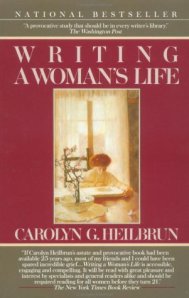
heilbrunSome time ago one of my most thoughtful readers (hi, Tom!) suggested I write about “a teacher/scholar whose work has had a significant influence on you.” I really liked this idea because, as I said in the resulting post, “It is impossible to overestimate the importance the right teacher at the right time can have on a student, though it may be impossible to foresee what will turn out to be ‘right’ ahead of time.” The teachers I wrote on included one from elementary school, one from high school, and one in particular among several who were important to my university years. At the close of the post, though, it occurred to me that the original question “may have been meant to elicit more about scholarly and critical, rather than personal, influences.” “I’m still thinking,” I concluded, “about that dimension of influence. No question, I have learned a lot from many teachers and scholars. But is that the same as having been ‘influenced’ by them? And have any of them actually inspired, moved, or motivated me?”

I’ve been thinking about those questions again recently because as I have tried to figure out what is most important to me to express as a critic (now that my long apprenticeship is over and I’m answerable primarily to myself for the future direction of my research and writing) I have identified two critics whose work indeed does inspire, move, and motivate me. More specifically, I have noticed that two critical books in particular repeatedly help me see and articulate what matters to me, or interests or challenges me, about many of the books I read, teach, and write about. One of these is Wayne Booth’s companionably plump and erudite The Company We Keep: An Ethics of Fiction, and the other is Carolyn Heilbrun’s slim but mighty Writing a Woman’s Life. Oddly, both were originally published in 1988. That means both were quite current when I started my PhD program at Cornell in 1990. But neither work–indeed, neither author, that I recall–was assigned, or even mentioned, in any course I took.

Booth’s book I discovered for myself when, soon after I earned tenure, I allowed myself to reconsider the focus of my scholarship, hoping to capture in my research the same excitement and urgency I felt in my teaching. I was dubious that I would ever feel much exhiliration pursuing increasingly esoteric projects about obscure women historians; I had done what I wanted to in that area with my thesis (which became my book). What I wanted to talk about was how and why novels actually mattered in our lives. I felt (feel!) that they do, profoundly, and I thought (think!) that one important facet of their significance is ethical. But I didn’t know how to talk about this in a rich way that would also be sensitive to fiction’s many other significant facets, including form, aesthetics, and history. The Company We Keep not only talks about exactly this, but it does so in Booth’s wonderfully engaging, unpretentious, open-minded way. It was criticism that talked about how we live in the world, and about literature as part of that living rather than something abstractly theoretical. Booth’s work was part of a wider debate about the ethics of fiction that included, among many others, Richard Posner, Martha Nussbaum, and, eventually, me: I published two academic essays as a result of this turn in my research (here’s one, in PDF; here’s the teaser for the other). The ideas it generated infused my teaching as well, particularly in a course I designed on ‘close reading’ that I will offer again, for the first time in 5 years, next fall. More recently, I wrote an essay on Gone with the Wind that attempted a “Boothian” reading of that problematic novel: an ethical reading that avoids (or so I hope) simplistic finger-pointing while accepting morality as a key aspect of literary evaluation. (Judging by the comments, not everyone was convinced! But I hope, in the spirit of what Booth calls ” coduction” [my favorite neologism!], some readers found themselves thinking about Gone with the Wind differently, even if they didn’t agree with me in all the details of my argument.) Clearly, Booth counts for me as an influential critic; I only wish I had read him earlier and been in a program where he and his interests had been prominent instead of–well, instead of much of what I was assigned.

I have a longer relationship with Heilbrun’s little book, which was given to me by my mother soon after its publication, with a lovely inscription noting that she had found it “interesting and provocative” and hoped we would talk about it “over tea.” It seems appropriate that Writing a Woman’s Life should have come to me in this way, as a gesture of shared interests and an invitation to intimacy and support, because that kind of female community and the strength it generates is one of Heilbrun’s major themes. Written relatively late in Heilbrun’s long career, its brevity is deceptive as it distills the accumulated insights of three decades of academic experience and feminist scholarship (for Heilbrun, often in a vexed relationship with each other). It’s wise, articulate, and insistent. I drew on it in formulating the central argument of my thesis and book, quoting from its first chapter, which is nominally on George Sand but is also on the difficulties and the vital necessity of finding appropriate ways to shape narratives of women’s lives. “Lives do not serve as models,” Heilbrun writes;

only stories do that. And it is a hard thing to make up stories to live by. We can only retell and live by the stories we have read or heard. We live our lives through texts. They may be read, or changed, or experienced electronically, or come to us, like the murmurings of our mothers, telling us what conventions demand. Whatever their form or medium, these stories have formed us all; they are what we must use to make new fictions, new narratives.

She moves immediately on to an example from George Eliot, to the Alcharisi in Daniel Deronda, who vehemently “protests women’s storylessness.” She writes in the book about women who lived lives that chafed against the stories they knew, and about biographies of these women that did, or, more often, did not find a better story to tell their lives in. She writes about anger and courage, about love and compromise, about age and beauty, about Dorothy Sayers and Virginia Woolf and herself. Writing a Woman’s Life is as much polemic (graceful and witty as it is) as theory, and it makes big claims supported by allusion and invocation rather than narrow claims defended by bulwarks of footnotes and metacriticism. It’s not, exactly, scholarly, but then it wasn’t exactly meant to be, because it’s a book that’s about living life as much as it is about writing it. “I risk a great danger,” Heilbrun remarks at the outset: “that I shall bore the theorists and fail to engage the rest, thus losing both audiences.” But Writing a Woman’s Life is never boring because it has all the urgency I wanted criticism to have. Though I didn’t immediately see it as a relevant book when I was reconsidering my own critical path, it’s urgent because it too is ethical criticism, in that broad sense of ethos that drives Booth’s arguments as well, and it’s urgent because it thinks it matters what and how we read: it takes fiction seriously because it sees reading as part of living, as shaping how we think and thus how we live.

I’ve found myself returning again and again to Heilbrun’s ideas about the limits of narrative forms and the problems of conceptualizing new stories (especially love stories) when talking with my students about many different novels, from The Tenant of Wildfell Hall to The Mill on the Floss to Sue Grafton’s ‘A’ is for Alibi. Like Booth’s book, Heilbrun’s has been recurrently useful not so much in the details but in the lens it offers for bringing key problems into focus–or, to try a different metaphor, for the way it illuminates the problems I want to talk about. Reviewing a new biography of George Eliot that frustrated and disappointed me, I turned to Heilbrun for help in explaining why. I just turned to her work again while teaching Death in a Tenured Position, which was written by Heilbrun under her pseudonym, Amanda Cross. (In another odd coincidence, Death in a Tenured Position is dedicated to May Sarton, whose novel The Small Room I just read and wrote up for the Slaves of Golconda.) Looking at it again, and also reading with great interest and pleasure the essays in her collection Hamlet’s Mother and Other Women, I found that after all these years, she more than most critics speaks in a voice I want to listen to. She’s infectiously passionate about the books and writers and issues she addresses, and she explains them sympathetically: her approach is inspiring, even, again, if we might differ on the details. Her  own story, also, with its brave ending, is moving in its effortful integrity. She was a controversial figure, but that in itself is motivating. As she says towards the end of Writing a Woman’s Life, those of us who are very privileged,

not only academics in tenured positions, … but more broadly those with some assured place and pattern in their lives, with some financial security, are in danger of choosing to stay right where we are, to undertake each day’s routine, and to listen to our arteries hardening.

“I do not believe,” she concludes, “that death should be allowed to find us seated comfortably in our tenured positions.” There, she is surely correct.

‘Teaching a Person’: May Sarton’s The Small Room

Reading May Sarton’s The Small Room was a disorienting experience, at once intensely familiar and disconcertingly alien. The protagonist, Lucy Winter (is there a deliberate echo of Bronte’s Lucy Snowe?), is an English professor at a small women’s college. Brought in on a temporary appointment that she is led to believe may lead to a tenured position down the road, she rapidly becoms entangled in a complicated web of personal relationships and pedagogical challenges. I wrote ‘professional challenges’ initially, but to me one of the most conspicuous features of Sarton’s version of academia is how unprofessional it seemed, and how little the working environment of Appleton College resembles my own university environment–which is why it is particularly interesting to me that at Tales from the Reading Room, litlove reports that to her, the novel “seemed to be talking directly to me about my life as it was spent in the university.” (You can read other responses at the Slaves of Golconda site, too.)

Starting with the familiar aspects, Lucy faces, and beautifully articulates, the emotional highs and lows of teaching. When a class is going well–when the students become engaged–things fly along. When they don’t, when they are, as Lucy sees some of her freshmen, “as passive as fish,” a peculiar kind of despair can set in because (as the novel emphasizes in many of its aspects) teaching is always very personal to the teacher: you have chosen work, accepted a vocation, based on a passionate commitment to values you suddenly realize, in those moments, are insignificant or worse to many of those to whom you expose yourself daily just be standing there in front of them.  How can they be so indifferent, you wonder?! How can you move them, connect them to the excitement you feel coursing through you? Though Lucy is later (and probably rightly) ashamed of giving in to her rage, her speech to her students after a particularly dispiriting marking session certainly struck a chord:

‘Here is one of the great mysterious works of man, as great and mysterious as a cathedral. And what did you do? You gave it so little of your real selves that you actually achieved bordeom. You stood in Chartres cathedral unmoved. . . . This is not a matter of grades. You’ll slide through all right. It is not bad, it is just flat. It’s the sheer poverty of your approach that is horrifying!’

Unrealistically, after her rant her students break into applause. ‘That was wonderful,’ one of them says; ‘Why didn’t you get angry before?’ (My own expectation is that the students who actually needed to hear the rant would be absent that day, and the others would be offended at being yelled at when they had in fact tried hard on their assignments.) The ideal contrast is meant to be shown, I think, in the long account of her colleague’s seminar on Keats, which Lucy attends to watch “a master of the art” of teaching. The class begins with “a painful, stumbling series of unrelated questions and answers” then under the teacher’s guidance becomes “something like a fugue,” and finally “the summation flowered.”

Lucy’s remark about giving the work “little of [their] real selves” goes to the heart of the book’s interest in both teaching and learning, which turns on the question of how personal an activity either can or should be. That teaching is inevitably personal is pointed out at several moments, along with the problems that then arise of whether it is necessary or possible to confront each student in a sufficiently individual way without losing one’s own way and then failing, after all, to teach them. “How carelessly she had criticized her own professors down the years!” Lucy reflects.

How little she had known or understood what tensions drove them on and tore them apart, what never-ending conflict they must weight and balance each day. For she had come to see that it was possible, if one worked hard enough at it, to be prepared as far as subject matter went . . . but it was not possible to be prepared to meet the twenty or more individuals of each class, each struggling to grow, each bringing into the room a different human background, each–Lucy felt it now–in a state of peril where a too-rigorous demand or an instantaneous flash of anger might fatally turn the inner dierction. . . . . How did one know? How did one learn a sense of proportion, where to withdraw, where to yield?

And she guessed, not for the first time, that there could be no answer ever, that every teacher in relation to every single student must ask these questions over and over, and answer them differently in each instance, because the relationship is as various, as unpredictable as a love affair.

The plagiarism case that provides the crux of the novel’s plot becomes the test case, perhaps the limit case, for this problem of proportion, as the different parties involved in resolving it are brought to believe that the appropriate response is not the one mandated by college policy but one that reflects a more personal (psychological) understanding of the student’s action. “Teaching is first of all teaching a person,” Lucy realizes, and the college’s decision (against the vigorous opposition of one of its most important trustees) to bring a psychiatrist on staff represents a commitment to this highly individualized approach.

It also, or so it seemed to me, suggested a recoil from what had seemed like an ideal, both for Lucy and in the book more generally: the image of the teacher as (in Lucy’s indirect words), “a keeper of the sacred fire.” The novel invokes an inspirational model of teaching, one that relies on the power of the teacher’s personality and on the development of students as acolytes. That a student might get singed (or worse) by that “sacred fire” seems to be one of the lessons of the plagiarism case, as the student involved is being closely mentored by one of the college’s star professors and caves under the pressure of her expectations. This, presumably, is an example of someone not finding that sense of proportion, not seeing “where to withdraw.” Is Lucy’s relationship with Pippa, an accomplished but less conspicuously brilliant, student meant to stand as an alternative model, one in which a more cautious or impersonal or self-conscious approach to teaching ultimately is better for learning? The advice Pippa found useful is hardly “sacred flame” kind of stuff:

“I did what you said. I kept making outlines, discarding wonderful stuff because it wasn’t necessary. You said, ‘Keep the center clear.’ And you said, ‘If you get into a panic, spell things out 1, 2, 3.’ . . . You smile, but all that helped.”

Still, at the end of the novel Lucy’s motivation for staying on at Appleton is not practical but emotional, or at least visceral: “If I stay,” she tells her colleague, “it will be for love.”

So what about this interesting novel was alienating, when its central issues (distance, vocation, integrity, pedagogy) are also central to my own life? The main thing is simply that its focus on such intense, personal relationships between teachers and students, and its emphasis on teaching as “teaching a person,” may seem natural in a small college when you have “twenty or more individuals” in a class, but at a simply pragmatic level, it’s impossible (and self-destructive) to teach much larger groups on that model–or so I have come to believe. For instance, I know my own teaching load is not nearly as heavy as it gets, but I just received my teaching assignment for next fall and it is one class capped at 75 students, another capped at 40, and another capped at 20. Next winter I’ll have a class of 75 and a class of 40. There will be some overlap of students among these classes, but as they are all at different levels, there won’t be a lot. And there will be some students I’ve taught before–but again, not a lot. So of the students in those 250 spots, probably 200 will begin their courses as strangers to me. At many Canadian universities (and indeed in other departments at Dalhousie) a professor might easily have 250 students in just a single course (we have been looking at moving to classes of 150-200 for some of our offerings but have, sort of ironically, been held up by the total unavailability of big enough rooms). I’d love to “teach a person,” and I try to make opportunities to turn names and faces on my roster into individuals I know something about, but in practical terms, there’s only so much I can do. And there’s a lot I need to do just to manage these numbers: I can’t be endlessly tweaking policies to accommodate, as they do at Appleton, the math genius who isn’t completing other work.

I also work in a much more bureaucratic environment than Sarton depicts. If I find a student has plagiarized, there’s a process I have to follow, and the student union (which votes, in The Small Room, on Jane’s fate) has nothing to do with it. There are policies for almost everything, in fact, including appropriate lines for relationships between students and professors, and my syllabus gets longer and longer as the administration issues more and more edicts. Last year we had to include specific statements about attendance and missed work in response to the university’s rapidly developed H1N1 strategy. The Small Room suggests a world in which decisions about students’ futures are debated and decided among small groups of people all of whom know the student’s history, record, and campus relationships intimately. That world may exist somewhere, but it’s not mine.

I’m not entirely convinced, either, that I’m sorry it isn’t. As The Small Room eloquently dramatizes, the price is high for teachers who take on their students’ whole lives rather than just their academic work. There are great risks of arbitrary or uneven judgments, too, when personal feelings are permitted so much play along with subjective notions about who does and who doesn’t deserve special treatment. There are problems, as well, with the idea of teaching as something “sacred”: the novel holds to what now seems an old-fashioned view of literature as a kind of secular prophecy (hence, for instance, the Chartres cathedral comparison Lucy makes), and the Keats seminar culminates in insights about Fanny Brawne’s life and personality, the professor’s scholarship giving her the wisdom to speak “from a cloud,” a “creative power,” a “mystery.” This is no longer what we imagine is the professor’s role, or the role of scholarship.

And yet, having said that, having acknowledged that the world of Sarton’s college is not the world of the modern multi-purpose, highly professionalized, bureaucratic university, I also have to admit that I felt some yearning for her world. Many (maybe most)? of the professors teaching literature in these big impersonal schools started down that career path because, like Sarton’s teachers, they felt a fire burning in their head–because they were in love. For many of us, learning to live and work in the university as it is now constituted (in North America, at least) has been a disillusioning and dispiriting process–though even so, for many of us, it’s teaching that still brings us closest to that inspirational flame. I may not be able to know or teach all 250 students a year as individuals, but over time I do get to know a lot of them, and it’s tremendously exciting to be part of their development. For every time you want to (or, ahem, actuall do) yell at them, as Lucy does, to stop holding themselves back, there are times when their enthusiasm and curiosity rise up to meet you and you feel the thrill and the responsibility of being their guide and companion in something that matters. So much about the discourse of education today seems to disregard the value of that connection to the whole person–it’s all about outcomes and measures and productivity and, of course, jobs after graduation. Is that really what we want? We as teachers? or as parents? as students? If Lucy’s view seems dangerously personal, the current obsession with students as consumers seems dangerously limited and limiting. If we can’t ever hope to teach students as people, or to be people ourselves when we teach, who will ever, in the end, actually learn anything worth knowing?

One final note: I happened to be working through Death in a Tenured Position this week in one of my classes and I notice that it is dedicated to May Sarton. Carolyn Heilbrun (who wrote the novel under her pseudonym Amanda Cross) also wrote a couple of essays on Sarton that are included in her collection Hamlet’s Mother and Other Women. I think there are a lot of connections between Heilbrun’s book and Sarton’s–but I’ve run myself out of time and gone on long enough for this post, so I hope to write something on those connections, and maybe onHeilbrun’s work more generally, next chance I get.


This Week In My Classes: The Importance of Being Earnest

The thing is, though Wilde means it ironically and makes it seem very funny, I think it is important to be earnest–not all the time, maybe, but in essence, and certainly about important things. And the move from Gaskell’s Mary Barton to Wilde’s play in my survey class this week really made me feel that preference on my reading pulses. We spent Monday on the conclusion of Mary Barton. It’s heavy-handed, sentimental, didactic, and politically compromised, but for all its faults, it’s a rousing rejoinder to Wilde’s quip that “there is no such thing as a moral or an immoral book: books are well written or badly written, that is all.” That is not all.  Mary Barton really means what it says, and that sincerity makes it worth my time and argument–that, and its commitment to making people’s lives better by helping them understand each other better. It also finds beauty in acts of common human love and decency, and conveys the richness and variety of human lives even in the face of the most unrelenting circumstances. Wilde may have enjoyed the idea that you need a heart of stone to read the death of Little Nell without laughing, but I am wholly susceptible to scenes such as this one:

Barton grew worse; he had fallen across the bed, and his breathing seemed almost stopped; in vain did Mary strive to raise him, her sorrow and exhaustion had rendered her too weak.

So, on hearing some one enter the house-place below, she cried out for Jem to come to her assistance.

A step, which was not Jem’s, came up the stairs.

Mr Carson stood in the door-way. In one instant he comprehended the case.

He raised up the powerless frame; and the departing soul looked out of the eyes with gratitude. He held the dying man propped in his arms. John Barton folded his hands, as if in prayer.

“Pray for us,” said Mary, sinking on her knees, and forgetting in that solemn hour all that had divided her father and Mr Carson.

No other words would suggest themselves than some of those he had read only a few hours before:

“God be merciful to us sinners. – Forgive us our trespasses as we forgive them that trespass against us.”

And when the words were said, John Barton lay a corpse in Mr Carson’s arms.

So ended the tragedy of a poor man’s life. (from the Gaskell Web etext)

Gaskell really wants her writing to be a force for good in the world. That’s not every artist’s goal, and it is a risky one. But despite everything, I am moved by this tableau of the murderer dying in the arms of his victim’s father, both desperate to salvage their humanity from the wrecks of their lives. And in fact, maybe I am moved, not despite everything, but because of everything Gaskell has done to prepare us for this moment. As some parts of Mary Barton show, and as is still better demonstrated by her later novels, Gaskell is capable of much greater restraint, which is what we often take as a key element of ‘artistry,’ but at this moment she  throws that kind of aesthetic caution to the winds: it’s all about the pathos, the regret, the forgiveness. You’re in or you’re out, at this point in the novel. Me, I’m in.

With The Importance of Being Earnest, in contrast, I tend to side with Shaw, who reviewed it in the Saturday Review in 1895:

I cannot say that I greatly cared for The Importance of Being Earnest. It amused me, of course; but unless comedy touches me as well as amuses me, it leaves me with a sense of having wasted my evening. I go to the theatre to be moved to laughter, not to be tickled or bustled into it; and that is why, though I laugh as much as anybody at a farcical comedy, I am out of spirits before the end of the second act, and out of temper before the end of the third . . .

Still, despite resenting my amusement just a little, I did enjoy (and I think the class enjoyed), the clips from the brilliant film starring Edith Evans as Lady Bracknell, who delivers this famous line better than anybody:

Metablogging: Three Interesting Posts

Like conventional academic criticism, lit-blogging is subject to fits of self-consciousness culminating in metablogging. While a few years ago such posts were likely to be forward-looking and exploratory, about the possibilities of blogging as a new frontier in criticism, the latest round of posts from Dan Green, Scott Esposito, and Steve Mitchelmore are more equivocal. Actually, Dan Green is pretty much just negative:

Literary blogs are (unwittingly, I hope) abetting the capitalist imperative to get out “product” as quickly as possible. New books appear, are duly noted, presumably consumed, and then we’re on to the next one. While sometimes lit bloggers consider an older title, it’s usually by an already established author or a “classic” of one sort or another. Little time is spent considering more recent books that might not have gotten enough attention, or assessing a writer’s work as a whole. Once the book has passed its “sell by” date, nothing else is heard of it and every book is considered in isolation, as a piece of literary news competing for its 15 seconds. The more potential readers come to assume that this is the main function of lit blogs, the less likely it is that the literary blogosphere will have any lasting importance. Literary blogs might let you know who reviewed what in the New York Times, but that The New York Times might not be the best place to go for intelligent writing about books is not something they’ll have the authority to suggest. (read the whole piece here)

Stephen Mitchelmore’s response is almost elegaic, but there’s still a hint of that early utopianism:

I have to admit that for years I was mystified why my blog writings have gone apparently unnoticed, at least in terms of page views. While the most popular blogs were getting thousands a day, I was lucky if This Space gathered 300. I thought, isn’t my review of Littell’s The Kindly Ones better than almost all the others, and didn’t my post on a road traffic accident say more about life’s relation to literature than any journalist’s exposé of an author’s life? Perhaps, however, these explain why it is relatively unpopular. Anyway, I have a difficult relationship with praise and criticism, with self-effacement vying for dominance with aggressive resentment. It is probably best to write, as in those early days of Spike, as if nobody is watching. After having published a dozen or so reviews in print media, I’m nowadays genuinely happier to work for weeks on long reviews or essays and have them disappear into the gaping void. Finding a way to talk about the reading experience is, I’ve realised, the greatest pleasure of writing; where it ends is of no importance. Still, over the last fourteen years of online work, I’ve seen the names of my key writers – Thomas Bernhard, Maurice Blanchot and Gabriel Josipovici – become familiar whereas before they were marginalised. If I have had only a minor role in this, it has made the effort worthwhile.

Yet I still like to imagine an ideal literary website in which the design, the writing and, most of all, the editorial vision offers a unique and dynamic approach to literature and culture in general, countering the banalities of commercial literary sites. So what might it look like? I have an idea but it requires an exceptional amount of work by people who have to earn a living elsewhere. Perhaps such a website is only ever the green ray as the sun sets on one’s hopes. Such a feeling is nothing new and we may learn something from previous attempts in strikingly similar times. (read the whole post here)

Scott Esposito picks up the thread:

I’m not sure how ironic Stephen was being about not understanding why his reviews were lesser-known than those elsewhere (and generally his are of much higher quality that what you’re likely to find in other places), but it’s not too hard to explain. Likewise, the method of building a literary site with high amounts of traffic is not mysterious. Go have a look at the Huffington Post books section, where every week you can find gossip about celebrity memoirs and counter-intuitive lists along the lines of “10 Most Outrageous Outfits From New Book ‘Critical Mass Fashion’ (PHOTOS).” Just make sure to have enough important names within your h1 header, say something contentious but not terribly complex that will generate a billion links, and keep it all short and with a lot of photos. Copy that with your own stable of writers, and you too can build a fairly well-trafficked site. This is not rocket science.

Obviously, some people would shoot for other things in a site besides high traffic, and this points out the problem with focusing on hits as a measure of a website, even though the first question anyone ever asks me about my sites is how many hits they get. But as Stephen’s site demonstrates, you can be influential even without getting major traffic. So choose what you want your site to be, and then do it. (read his whole post here)

“Choose what you want your site to be, and then do it” strikes me as excellent advice. Like every blogger, I wonder at regular intervals what I do this for. I think it’s disingenuous for bloggers to suggest they write purely for themselves: no need to post online, in that case. We all write online in the hope of getting readers. But it doesn’t have to be thousands, or hundreds, to be a satisfying experience (in my case, I average barely 100 hits a day, at least based on the Sitemeter tracking, and we all know that not every hit is an actual reader). If you take Scott’s advice and write what you want–and invest in Mitchelmore’s insight that “finding a way to talk about the reading experience is … the greatest pleasure of writing,” which I think is a large part of the truth–your site will have integrity and reflect your own values as a reader and critic. Then the readers you get will be those you want to enter into conversation with, and the extension to criticism represented by your site will be sincere. I think Dan Green’s disappointment stems from his having had very specific hopes or ambitions for lit blogging. His was one of the first blogs I started reading, and the seriousness with which he took the work and the potential of blogging as an alternative form of criticism was really important to my own developing sense of what the form might allow, what purpose it might serve. While he’s right that there’s a real loss if the overall direction of the ‘litblogosphere’ is towards commercialization and marketing, the form itself remains infinitely malleable. The risk (indeed, the likelihood) is that the good stuff–the thoughtful, independent, eclectic voices–will be drowned out by the louder ones that pander and preen and sell (out). So here I agree with Scott that it’s no good to ‘persist in this “take your ball and go home” attitude.’ The New York Times may not be the be-all-and-end-all of criticism, but it would be nice to be able to harness some of the power of the prestige print publications, now all with notable online presences. If only their blogs and reviewers would play nicely with others and actively seek out interesting independent voices online who represent serious critical alternatives, showcasing them rather than insisting on the tiresomely reductive ‘critics vs. bloggers’ debate. If they really care about the condition of criticism in the present day, they would join in the effort to sustain good discussion, which–whatever its provenance–actually supports their own work by continuing to take books seriously.

This Week in My Classes: Worlds in Crisis–Mary Barton and P. D. James

After last week’s big effort towards launching the students in my survey class on their research assignments, we spent our first two classes this week with Mary Barton: no PowerPoint, no overheads, just me, them, and the novel. My impression (though it is necessarily impressionistic, since I can’t even really focus on most of their faces in our particular room) is that they are finding the reading a bit of a slog right now. This is not really surprising, since for many of them this is their first experience reading Victorian fiction (probably, any long fiction, though since many of them are English majors, I shouldn’t assume the worst, I suppose). And even those who have ventured into the nineteenth century before are more likely to have read Austen or the Brontes than any Gaskell, much less Gaskell at her most sentimental and didactic. Wait–that’s probably Ruth, so they should consider themselves lucky to be reading a novel in which there is a lot of action, including a fire (with a daring rescue), a murder, a boat chase, a trial scene, and a touching deathbed reconciliation. In Ruth, as I actually told them yesterday, the basic story is that Ruth is seduced and then spends 400 pages being very, very sorry. On Monday I focused on Gaskell’s strategies for softening her readers up to the working-class families who make up the large majority of the novel’s population, only, once she’s made us all cozy with them, to start bumping them off in large numbers. The string of deaths in the first 90 pages of the novel really is quite shocking, which of course is the point: we need to ask, as the characters themselves as, why their lives are so precarious. We looked also at John Barton and the process by which he becomes a radical, a Chartist, and eventually a [spoiler alert!] murderer. Gaskell is careful to show the social and economic causes of his alienation, hostility, and violence: his Chartism is not the result of any moral failing on his part, but of his desperate circumstances, and, most important to her analysis, of his perception (largely justified) that those around him with power and money do not listen or care. Communication between the classes: this is, essentially, Gaskell’s prescription for solving the ‘condition of England’ problem, and of course her novel is explicitly offered as an aid to that conciliatory process. Mary Barton is another example, that is, of a novel in which the characters have difficulties that would be solved if only they had the opportunity to read the novel they inhabit. (Vanity Fair is another one, or so I have argued.) Is there a name for this kind of self-referential intertextuality?

If Mary Barton were called John Barton, as Gaskell once planned, then it would be a more radical book than it is, but in Mary Barton John’s story is–not sidelined, exactly, but nearly overwhelmed by Mary’s story, which is in some ways a predictable love triangle. Yesterday we (well, I–Monday, I hope to really bring them into the discussion, since by then they should have read the whole book!) focused on how that story, and women more generally, fit into the novel’s larger interests. I looked especially at Mary’s Aunt Esther, who is lured by her experience of financial independence (she worked in a factory) to desire more social mobility than the novel sees fit: she eventually falls for a rich man and then becomes a fallen woman, and she wanders the margins of the town, and the novel, as a cautionary tale for Mary. Tomorrow we will spend our tutorials on the ever-exciting topic of proper MLA-style citations, then Monday we wrap up our class work on the novel with, I hope, some vigorous debate about the novel’s proposed solution to its problems.

In Women and Detective Fiction we’re reading P. D. James’s An Unsuitable Job for a Woman. I very much admire this novel, which exemplifies James’s desire to use the structure of the mystery novel as a frame on which to hang (an unfortunate verb, in this particular case!) issues of character and theme. I was rereading its conclusion today soon after reading this eloquent and depressing post at Tales from the Reading Room about the recent catastrophic budget cuts being proposed for higher education in the UK, which include potentially reductions of as much as 100% for humanities education. This juxtaposition gave unusual resonance to the confrontation between Cordelia and Sir Ronald Callender, who has murdered his own son in order to protect the funding for his laboratory. In response to Cordelia’s appeal to love, Callender makes an overtly utilitarian argument for his crime:

[D]on’t say that what I’m doing here isn’t worth one single human life. . . The greatest good of the greatest number. Beside that fundamental declaration of common sense all other philosophies are metaphysical abstractions.

Callender is a ‘conservationist,’ that is, an environmentalist. So in some sense he is pursuing the ‘greatest good of the greatest number.’ But Cordelia confronts his narrow definition of ‘good’ with an appeal to humanity (‘what is the use of making the world more beautiful if the people who live in it can’t love one another?’), and it’s surely no accident that the individual victim here is a humanist and that one of the battlegrounds is Cambridge, which Cordelia idealizes as “ordered beauty for the service of learning” before she realizes that its scholarly pursuits have at least two faces: in Bunyan’s words, which she quotes, “then I saw that there was a way to hell even from the gates of heaven.” That James takes Cordelia’s side is suggested by Sir Ronald’s role as the villain of the piece. He has created his own Frankenstein’s monster in the person of his lab assistant, Lunn, whose subservience to his scientific master nearly leads to Cordelia’s death. In a genre that typically rewards objectivity and detachment, Cordelia (though just barely) survives and succeeds because of her attachments and loyalties, her refusal to allow love to be devalued, even after death. Though in the end she causes at least one, arguably two, deaths, and lies even to the point of becoming an accomplice to a murder, Dalgliesh concludes that “she’s absolutely without guilt.” Using the skeletal apparatus of a crime novel, then, James has in fact written a novel about values, and in particular about the conflict between two visions of learning, one coldly scientific and the other youthful, naive, idealistic, but ultimately worth fighting for–a novel, as it turns out, well suited for the current moment.

Recent Reading: Micro Edition

The pile of books I’ve read but not written about is growing. I guess it’s a good sign that, however busy I am, I’m still getting some things read that aren’t strictly for work. But right now it feels like, between teaching and administrative responsibilities (which are heating up, inevitably, as the term moves along) , writing a book review, doing the usual round of editing for Open Letters, and resisting the temptation to get drawn into long debates with commenters on my Gone with the Wind essay (it turns out the down side to getting attention is getting negative attention!), I won’t do any long book posts for a while. But I had an idea: if Bookphilia can do 10 word reviews, surely, so can I–or as close to 10 as is reasonable to expect from a Victorianist!

Anita Brookner, A Start in Life. So depressing it made me want to draw the curtains, turn out the lights, and drink. Or go to Paris–which would probably cheer me up.

Leila Aboulela, The Translator. In the end, it didn’t seem a lot more to me than a love story, and not a very believable one at that. Evocative prose, though.

Robert B. Parker, Pale Kings and Princes. Spenser, Hawk, and lots of Susan–all’s well with the world, or at least it is when this invincible team is done its work.

Elif Batuman, The Possessed. This one I’d quite like to write about at more length. Maybe on the weekend. I had no such adventures as a graduate student, that’s for sure! She went to Uzbekistan, I went to, um, Buffalo. I’ve been out of graduate school longer than she has, also, and I’m still not able to find my experiences there funny. I consider myself still in recovery! If I ever write the story of those days, there’s a ‘townie’ bar that will represent a sanctuary from a world in which I had to keep my head up while someone told me (in front of others) that I was “intellectually calcified,” and another told me (in writing) that because I wanted to argue about concepts of literary merit (I was for them), I needed to prove I wasn’t D’nesh D’Souza. Did I mention I’m still in recovery?

If you’re looking for more substantial blog posts, I recommend Adam Roberts’s review of Room at Punkadiddle (and also see this helpful roundup at The Second Pass). Stefanie at So Many Books makes Rosy Thornton’s The Tapestry of Love sound very appealing (I recently read and enjoyed Hearts and Minds), and Craig Monk weighs in on Freedom at The Classroom Conservative. Stevereads turns to Rosemary Sutcliff, then has a bad day with comics, and at LikeFire Daniel Nocivelli writes about what sounds like a wonderful story in the New Yorker: “a magnificent look, through the eyes of a book, at the many and varied transformations occurring across a half-century of one woman’s life, from her junior year abroad to her deathbed.” Enjoy! And more substance from me soon.

This Week In My Classes: Gaskell, Sayers, and Literary Research

It was a short week, thanks to the Thanksgiving holiday–so why do I feel so flattened? It has something to do with the 6-8 hours I put in just trying to decide what to include in and how to present an introduction to literary research for my survey class. There are just so many things I want to say to them, to help them with, and to warn them against! They are doing a very particular kind of assignment that mimics the process of doing the research for a critical essay but with several specific steps that are really about learning to use (and discriminate among) the overwhelming array of potential sources of information now available. Having now heard not one but two presentations in my fourth-year seminar that relied heavily and unapologetically on Wikipedia, I’m more determined than ever, not to stop students from using Wikipedia (I use it myself, after all), but to make sure they start there, not stop there, and that they know why.

Anyway, I feel as if I hadn’t quite got to the point I wanted with the presentation, but here it is–without, of course, my running commentary including qualifications, elaborations, and acknowledgments of points of controversy. What I was most interested in accomplishing was getting them away from the idea that research means looking up ‘the right answer,’ and impressing upon them that research is not a linear journey from one question to one result but a kind of spiralling process. I tried to find the graphics that best represented the way I hoped they conceptualize their task. If anything strikes you as a major howler, do let me know, as it seems fairly likely I’ll get another chance at this course next year.

My other task for the survey class this week was setting up our study of Elizabeth Gaskell’s Mary Barton (which is what their research assignment focuses on–I used Hard Times for my examples as it seemed close enough to be useful and suggestive). I’m disappointed now in the way I did that, actually. The class size and room, along with the particular goals of the course, which make me feel pressured to ‘cover’ things, made it seem right to provide a lot of general context on the 19th-century novel and social problem fiction. But I used to do a lot more interactive teaching even in the early sessions on novels, and I think I’d like to go back to that even if it’s hard to pull off in a tiered lecture hall. While it’s true they don’t usually know much, if any, of that general context, it will probably mean more to them if I let the explanations arise more organically from developments in the novel itself and make sure they are getting involved sooner rather than later.

In Mystery and Detective Fiction, we wrapped up Gaudy Night. Here too I felt a bit disappointed. Maybe I’m losing my teaching mojo! It’s true that I haven’t been nominated for a teaching award since 2007 and my evaluations are not as consistently high as they once were… But actually in this particular example my disappointment was that the class just didn’t seem very excited about the novel, and since it is one of my very (very, very!) favourite books, I felt I had somehow failed it. Or them. Maybe that was the problem, though I tried not to make it too obvious that it is one of my very (very, very!) favourites but to entertain arguments on both sides about how effectively it achieves Sayers’s aims of integrating the ‘novel of manners’ with the detective story, or how intelligently Sayers unifies her characters and situations with the novel’s themes, including women and academic life and the difficulty of balancing the demands of the head with the desires of the heart. It’s funny how it is sometimes much easier to teach things you aren’t very invested in personally!

And now, home for the weekend. In my bag: Mary Barton and An Unsuitable Job for a Woman, for work; Elif Batuman’s The Possessed, for fun (and a little for ideas, as I keep turning around and around in my head different ideas for writing projects of my own); Brenda Maddox’s George Eliot in Love, for a review I must finish this weekend (!); and an advance copy of Jill Paton Walsh’s latest Peter Wimsey concoction–maybe, also, for a review, but also just because.

Reading David Copperfield

‘Amateur Reader’ is doing a lovely series of posts on his reading of David Copperfield over at Wuthering Expectations. Up so far:

I had seen it somewhere. But I could not remember where. – In David Copperfield, Dickens tames his prose.

Dickens had reached a dead end, and he knew it.  Many of his most rhetorically complex passages only barely serve the story of which they were nominally a part.  The Haunted Man, is, at times, barely comprehensible.  Dombey and Son is never that bad, but is still extraordinarily thick in places.

I had not read David Copperfield (1849-50) when I wondered if its switch to the first person was partly an attempt by Dickens to tame his own prose.  It was!

What ravages I committed on my favourite authors in the course of my interpretation of them – David Copperfield, Author.

Charles Dickens switched to a first person narrator in David Copperfield.  Once, influenced by baleful Modernists, I would have found myself surprised that Dickens was interested in, and wanted to answer, the usual first person questions.  No more, though.  Nineteenth century writers were no fools.

The sensation of the very airs that blew on me. – Proustian Dickens.

The whiff of Proust is in that air, with the smell of earth and leaves.  Standing at the window (a real action) evokes a more or less conscious memory, the visual image of the tramps, which reminds Copperfield of his own journey as a tramp (ending, more or less, at this window), accompanied, involuntarily, by some associated (non-visual) memories.

Dame Joan Sutherland (1926-2010)

Joan-Sutherland-005

Dame Joan Sutherland has died at her home in Switzerland. I wrote a little about my love affair with her voice here. For me, as for many, hers was the voice. What a legacy of beauty and joy she has left us. Here she is, from the treasure trove of material you can find on YouTube, singing ‘Regnava nel silenzio’ from Lucia di Lammermoor, recorded live at the Royal Opera House Covent Garden in 1959–the beginning. Updated: the Covent Garden video is gone from YouTube, so here’s another splendid rendition: