This Week in My Classes: Not with a bang but a whimper

My last class of the term was Monday afternoon–a review session for the final exam in my Brit Lit survey. I had hoped to go out on some kind of high note. Usually I plan a bit of a closing peroration about the value of literature and the intellectual rewards of our work over the term, and sometimes (ever the optimist) I bring a list of suggested further reading. Two things militated against rhetorical flourishes on Monday. First, I got sick–“just” a cold, but you try (I’m sure some of you have tried) being eloquent when you have a cold. (It turns out that even speaking as much as I did was a bad idea, since almost immediately after class the virus marched its happy way to my  larynx and took away my voice, which made my other major commitment for this week, participating in a PhD comprehensive exam, just that much more challenging!) The second factor was the format of the class: I like to do review in a Q&A format working off a handout of possible exam questions. I figure they should have their last chance to make me explain or clarify the things they feel uncertain about. But that means it wasn’t a very orderly session, and I didn’t have the physical or mental strength to reclaim the room at the end to make any kind of goodbye statement. Well, I’m sure they didn’t mind. I feel frustrated about this particular class because I really haven’t been able to judge their level of engagement as well as I usually can. One-on-one exchanges with students usually gave me a good feeling, but then the students who bother to talk to you one-on-one are a self-selecting group. I think I offered them quite a lot of good stuff this term (with the help, too, of some great guest lecturers) but I’m not sorry that someone else is taking this class next year: I’d like to rethink a few things about it before I do it again. I’m sorry to say that one of the things I’m reconsidering is the wiki project I designed. I was very enthusiastic about this assignment when I introduced it last year, and the results were pretty good despite some initial resistance and some lackluster participation from a few. I thought I could overcome the resistance better this time by talking about the value it had proved to have for last year’s group, and I made it worth more to motivate the slackers to do their share. Though some students really stepped up, overall the investment in the wikis seemed worse this year. Given how much effort it takes to set them up and administer them, I think I might not try again, or I might try such a thing only in a much smaller class where I can really play an active role in stimulating ideas and generating the kind of enthusiasm for results that is necessary to carry it along.

So now it’s all over but the marking: 23 essays for Mystery & Detective Fiction (they went through proposals with me already, so I’m expecting the final results to be quite good–plus in this group the level of engagement was conspicuously high), 60 or so for the survey (which thankfully I split with my TA), and then 60 or so exams, which don’t even get written until December 18. I can’t say I am looking forward to the next two weeks, but at the end of them lies my sabbatical, for which I have high hopes.

Christmas Music

From the Novel Readings Archives

For me (as for many people, I’m sure) one of the things I like best about the holiday season is its music. I grew up in a house full of all kinds of music, and for about six years I worked part time (and sometimes full time) in what we then called a ‘record’ store, The Magic Flute, which specialized in classical music. Getting out the Christmas records was part of an elaborate set of holiday rituals and meals in my family, beginning with our ‘Advent’ brunch the first weekend in December (Eggs Benedict) and culminating on New Year’s Eve (Chicken Florentine and Pêches Flambées, followed by charades and then banging pots and pans on the front porch when we heard the ships in the harbour signal midnight). For probably a decade, somewhere in between these dates my parents hosted a big carol singing party and pot-luck dinner: as their friends are all both musical and great cooks, this was always a joyful occasion! Music was either playing or being played (and sung) nearly all the time, so it’s no wonder that hearing carols now brings back a lot of memories–some more specific than others.

odetta

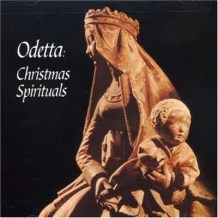
For instance, we usually sang ‘Children, Go Where I Send Thee’ driving back over the Lions Gate Bridge from my grandmother’s house in West Vancouver after Christmas dinner (we loved Odetta’s Christmas Spirituals). A highlight of the carol sing event was always ‘The Carol of the Bells’ with all its parts. I used to take Joan Baez’s Noel up to my room when I wanted some quiet time. As a die-hard Joan Sutherland fan, of course I had her Christmas album, and though sometimes I admit her operatic flair is too much for the simpler songs, her version of ‘O Divine Redeemer’ still brings tears to my eyes. (I met her once–but that’s a story for another post.) And of course we had many traditional choral albums, and the Canadian Brass, and Bing Crosby, and Burl Ives singing ‘A Holly Jolly Christmas,’ and a great LP with “Mr Pickwick’s Christmas” on one side and “A Christmas Carol” on the other, read by Ronald Coleman and Charles Laughton (and how fabulous to discover that this is still available! I highly recommend it).

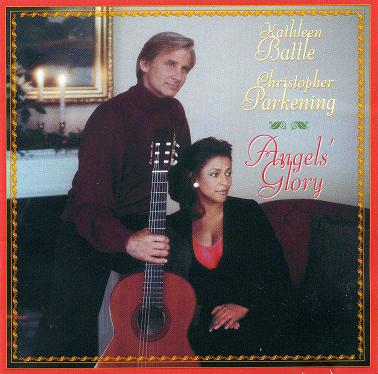
At The Magic Flute, Christmas was a big season, of course. My fellow employees and I used to shudder at the first playing of the Bach Choir Family Carols because we knew we would hear it probably 3000 times before the doors closed on Christmas Eve. The year Kathleen Battle’s A Christmas Celebration came out, it sold like crazy; I recommended it to one woman who came back the next year and sought me out specially to tell me how much she loved it (I love it too, especially its version of ‘Lo, How a Rose E’er Blooming,’ though lately I have been listening more to the Christmas album Battle recorded with Christopher Parkening, Angel’s Glory, which includes what I consider the most beautiful recording of ‘Silent Night’ ever made). One of the biggest issues every year was which recording of Messiah to recommend. Opinions were always divided between ‘original’ and modern instruments; the version with the English Baroque Soloists under John Eliot Gardiner was a big seller. To soothe our nerves during quiet spells, my colleague Mandy and I used to slip on George Winston’s December.

wintersongMusic is still essential to all holiday festivities, as far as I’m concerned. We got out our current stash of Christmas CDs this week. A lot of my old favourites are in the collection, along with ones that evoke holiday memories for my husband (Andy Williams, for instance, and Jo Stafford). We enjoy the Boston Camerata’s Renaissance Christmas and the hyper-traditional O Come All Ye Faithful with the Choir of King’s College, Cambridge; On Yoolis Night by the Anonymous Four will undo any damage wrought by long days at work–or at the mall, which is equally likely this time of year. There are now, too, albums that evoke memories, not of our childhoods, but of our childrens’, such as Loreena McKennit’s To Drive the Cold Winter Away and Sarah McLachlan’s Wintersong. We have rituals of our own, including decorating the tree while listening to Michael Bawtree’s wonderful recording of A Christmas Carol (available only by private sale at this time, as far as I know)–and when we gather in the morning for our own ‘Advent’ brunch, the first thing we will do is to put on some Christmas music.

I do think sometimes about the incongruity of an atheist embracing Christmas. But then I think of all the sacred music–and art, and architecture–that brings so much aesthetic and emotional pleasure the rest of the year, and I feel reassured that there is no hypocrisy in loving the music even though I do not believe in the specific doctrines it sometimes expresses. After all, when the overall worldview for so long was overwhelming theistic, it is inevitable that art and music should have taken religious form; to turn our back on these great achievements because they belong to a different mentalite is to turn our back on the past simply for being the past.

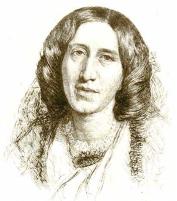
82780-eliotdrawingI think, too, of George Eliot’s attitude, expressed implicitly and explicitly in so much of her fiction–that, as she wrote in a letter in 1874, “the idea of God, so far as it has been a high spiritual influence, is the ideal of a goodness entirely human.” I feel the same about the “Christmas” spirit: it’s really just the human capacity for love, charity, forgiveness, and generosity (not to mention reverence, sacrifice, and inspiration) that’s being celebrated, with nothing supernatural about it. The feelings evoked by carols such as ‘Silent Night,’ ‘It Came Upon a Midnight Clear,’ or ‘I Heard the Bells on Christmas Day’ (to mention just a few of my personal favourites) are really no different from the feelings evoked for me by any beautiful music, and the fundamental ideals of peace on earth and goodwill to men do not in fact require (and may even be hindered by) the specific myths of Christianity. And yet that tradition (as George Eliot acknowledges) for centuries provided a key framework for the development of these ideals (if not their perfect realization–indeed, quite the contrary, as history shows). And so I’m quite comfortable with the secularization of Christmas, which seems to me consistent with the goal of recognizing in ourselves–claiming for ourselves–those qualities most important to making the world a better place. It’s not God who blesses Tiny Tim, after all, it’s Scrooge! Why tie ourselves to the Christian calendar, then? Well, just as Christian traditions were superimposed on pagan and other rituals, so too our modern values and ideas are incorporating old ways and turning them to our own purposes. And the music really is beautiful–so I sing along, rejoicing.

What about you? What holiday albums bring back your fondest memories? Is there a song or a singer you can’t do without at this time of year?

(Originally posted December 6, 2009)

Good Reading for All

I seem to have little to say for myself right now. I blame the end of term for the mental clutter it creates (there’s physical clutter, too, of course, but that’s more easily dealt with). Luckily, there are lots of other people writing interesting things about books.

For instance, the December issue of Open Letters Monthly is up! As usual, its essays and reviews range widely in both subject and style, which means there’s something for everyone. For instance, if you are in the mood for something darkly disturbing, check out Colleen Shea’s review of Yoko Ogawa’s Hotel Iris, which raises questions (in the context of the glut of press coverage of a horrifying recent murder trial) about aestheticizing violence against women. For the political junkies, there are pieces on both of the big “W”s:  Greg Waldmann casts a cold eye on George W. Bush’s Decision Points, while Steve Donoghue has a somewhat chilly response to Ron Chernow’s new biography of George Washington. Alice Brittan offers a compelling analysis of Nadine Gordimer’s collected short fiction, while Ingrid Norton completes her ‘Year with Short Novels’ with a look at Charles Portis’s True Grit. Andrew Flynn is not impressed with Charles Hill’s Grand Strategies, but Morten Hoi Jensen appreciates finding the human side of Saul Bellow in his collected letters. All this plus Stephen King, Halo, Stephen Sondheim, perfume, and more…

The book world is awash in year-end features (I guess nobody publishes anything worth reading in December?). The Millions is running its annual ‘Year in Reading’ series, with contributions so far from John Banville and Lionel Shriver, among others.  At The Little Professor, Miriam Burstein has her own unique take on the ‘Year in Books (including Brontes and vampires’:

Most appalling religious novel: Mme. Brendlah, Tales of a Jewess.

Best modern antidote to Tales of a Jewess: Lillian Nattel, The Singing Fire.

Religious novel above and beyond the call of duty: Martin Shee, Oldcourt.

Religious NOVEL most ADDICTED to CAPS for EMPHASIS: Robert Wood Kyle, The Martyr of Prusa, or the First and Last Prayer; A Tale of the Early Christians.

Has anyone seen the plot?: The Vicar of Iver: A Tale, which, despite the subtitle, had no storyline whatsoever. (read the whole list here!)

At Wuthering Expectations it has been just one interesting thing after another, as usual. Try these posts on Newman, for starters, and then these on Henry Esmond (no, AR, I don’t think it’s teachable–at least, I would never try! I read it for my PhD comps and then never again. “Conceptual purity” indeed!).

At Tales from the Reading Room, litlove recently offered a crime round-up, which may give some of us more ideas for our TBR lists (as if they needed to get any longer, right?).

At stevereads, there’s something for the intellectuals in the crowd as Steve continues his great series Penguins on Parade with Michael Psellus’s Fourteen Byzantine Rulers–but if you scroll down to the next post, you’ll find something a little less cerebral, too…

Stefanie at So Many Books has gone from May Sarton’s The Small Room to e. e. cummings’s The Enormous Room, which is quite a transition.

At The Second Pass, John Williams has “finally taken the plunge into Freedom“; his response to the first 187 pages is here, with, of course, more installments to follow.

That’s hardly all, but that’s all I have time to round up for now.

In other news, my copy of Skippy Dies has just arrived and has lured me away from the Lydia Davis translation of Madame Bovary. Eventually, I will be writing about these books and more–many more, once I get through the papers and exams and arrive in the free, clear air of my sabbatical next term.

This Week in My Classes: Almost the End!

The last couple of weeks of term always feel like the mental (and organizational) equivalent of coasting hands-free down a steep hill on a bicycle while wearing an unzipped backpack spewing pieces of paper. Though to some extent the pressure of new content subsides (I have really only two more class hours in which I am responsible for lecturing or leading discussion), there are a lot of moving parts. This week these include practice exams and peer editing worksheets, for instance. Also, realizing the end is nigh, students suddenly start actually coming by my office hours for help with their papers, or (less endearingly) brandishing medical notes or sob stories of various kinds to explain their many absences or failure to meet course requirements along the way. Complaints about scheduled exam times are not uncommon, either. For the record, I too would be much happier not to have an exam at 8:30 a.m. on December 18!

Tomorrow, then, is my last real lecture in the British Literature After 1800 survey class. Last year, due to an oversight when I drew up the original syllabus (I forgot about Good Friday!) I had to cut my planned final lecture on Atonement and use that hour for our peer editing. This term I have that hour back, and I hope to use it not just to highlight and discuss some of the most interesting things we learn about Atonement from its concluding revelations but also to elicit some reflections on the course overall. After all, Atonement raises a number of questions about what we want or expect or need from art–particularly the novelist’s art, but also, along the way (with its invocations of Auden and Yeats, for instance) from poetry, and through The Trials of Arabella, perhaps from drama as well. Friday is peer editing, and Monday is exam review, and that’s a wrap. Well, except for the grading,  of course, which (between final essays and the late exam) will take me right through to Christmas, I expect. Sigh.

And tomorrow is also our last seminar discussion in Women and Detective Fiction, as Friday’s class is a student presentation and Monday I have set aside our class time for conferences on their final papers, as these are their major assignment of the term. They’ve done proposals already. We are working our way through Prime Suspect, and have been having some good discussions–with wide-ranging allusions back across our other texts, which I’m happy to see at the end of a course–especially about what many critics discuss as the dual crimes of so many women’s crime novels: there’s the specific crime under investigation, and there’s the broader ‘criminal’ context of what I suppose is easiest to label misogyny, though depending on the example, it may be something that seems to deserve a subtler name, like discrimination, or marginalization, or depreciation. Even going back to Miss Marple we find that one aspect of the case is the detective’s gender: for Miss Marple, there’s the way she is constantly underestimated by those around her because of her little old lady persona (as we discussed, this can be a strategic advantage for her, of course) and who also often solves a puzzle thanks to experience or expertise that is also gendered–domestic knowledge, for instance. So not all of the works we looked at take gender as a problem, but it’s always an issue, because it always does make a difference to who someone is and how they live in the world. I think the first novel we read this term that clearly stakes out territory as a feminist analysis of this context is Death in a Tenured Position, though An Unsuitable Job for a Woman is a tricky case (James disavowed any feminist intention, but the reasons for feminism are all over the place in the novel). With Prime Suspect, one of the questions we haven’t finished with is how far Tennison’s efforts are ‘feminist’ and how far they are self-interested, with sexism simply an obstacle she needs to overcome to succeed. (Is there a difference?)  Like Miss Marple, Tennison uses knowledge she has because of her sex (recognizing the labels on victims’ clothing, for instance), but she also makes an issue of looking closely at women’s faces: the initial misidentification of the victim is a result of the men on the case not differentiating between women, which is a theme continued through the series, including the incident we discussed yesterday in which Tennison is approached by a ‘john’ while interviewing two prostitutes. At key moments like this her proximity to the victims is played up and her power as a DCI shown to be unstable, or at least something that needs to be repeatedly asserted. One important sequence near the beginning has her standing next to a photo display of two murdered women, both blonde: in that shot, she can easily be seen as the next in line, a possibility recharged near the end when one of the forensic team holds up a hair he’s pulled from a crime scene and asks, “Your girl blonde?” Tomorrow we’ll look closely at the final interview with Moyra and then at Tennison’s triumphant celebration with “the lads” after the case is cracked. Many of the early scenes emphasize (through camera angles, for instance) her isolation from the team. At the end she has certainly won them over:  is that success? On what terms?

Book Club: Morley Callaghan, Such is My Beloved

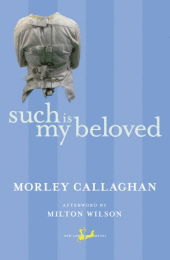
I recently finished reading Morley Callaghan’s 1934 novel Such is My Beloved, which was the first selection for a new reading group I have joined. Yes, I know: I have openly expressed my skepticism about the ‘reading group approach,’ and I never expected anyone to upset my long-held belief that nobody would want to belong to such a club if I were a member. Yet lo and behold, I have a (non-academic) book-loving friend who has another (non-academic) book-loving friend, and so on and so on, and now here we are, a group of eight women (is that inevitable? the on-site husband served wine and promptly absented himself) pledged to meet every other month to talk about our chosen text. As it turns out, the friend of my friend knows another of my friends, also an English professor, and so there are two of “us” in the group. We have vowed to be on our best behaviour, and at the inaugural meeting at least, I think neither of us betrayed any particular classroom habits. I admit, though, it felt odd just letting the discussion go wherever it went, when I’m so used to steering or focusing seminars. It was at once freeing, as I had no responsibility for things like making sure we tested our interpretations against specific passages from the novel, and frustrating–because I had no authority for things like making sure we tested our interpretations against specific passages from the novel! It was certainly an energetic and engaged discussion, and I’m looking forward to getting to know everyone better at our January meeting.*

It helped me adapt to this new reading environment that I approached Such is My Beloved with absolutely no preconceptions, and that even after reading it I came to our discussion with no fixed interpretations, or even frameworks for interpretation. If, as Henry James says, “the house of fiction has not one window, but a million,” the window of Canadian modernism is one (of many) I haven’t looked out of often–OK, not at all, really, until now. The closest I’d come is helping edit an essay on Elizabeth Smart’s By Grand Central Station I Sat Down and Wept for Open Letters Monthly a couple of issues ago. If we had started with something I know well–Vanity Fair, say, or Atonement–I would have had a lot more trouble letting our conversation be a conversation and not trying to subvert it into a seminar. But I didn’t know what I would find when I read the book, and having read it, I was (am) still a beginner at thinking about it, so in some respects the randomness (or, putting that more positively, the range) of our discussion was helpful because it let me consider different ideas and see if they resonated with my experience of reading the novel.

Thinking back over our meeting and then looking again at the book, I find it interesting that the issue that proved most controversial (is Father Dowling sincerely disinterested? is his love for Midge and Ronnie really pure?) is precisely the one I had thought was not at issue and which, for me, gave the novel its great poignancy. As I read Such is My Beloved, Father Dowling is absolutely sincere and noble in his motives. He may be misguided in his methods, perhaps even in the objects of his love (though I believe, also, in his commitment to loving the girls precisely because they are not particularly special or beautiful or deserving, but simply because their full humanity needs and deserves to be redeemed). He is certainly foolish, unworldly, and morally extravagant. He has the simplistic obduracy of the idealist; that in Callaghan’s world he is perceived first as disruptive (the opening paragraph tells us that Father Anglin and “some of the old and prosperous parishioners” find his ardour “disturbing,” and Father Anglin wonders if “the bishop could be advised to send him to some quiet country town where he would not have to worry about so many controversial problems”) and finally as insane, reflects on that world and its moral and spiritual limits, surely, not on Father Dowling. He reminded me of Trollope’s Mr Harding, in The Warden: having discerned the right thing to do, he can hardly bear the discovery that others cannot, or will not, support his principled effort to do it, and though he persists, he isn’t strong enough to defy his antagonists outright. And just as no particular good comes from the Warden’s resignation–except (and of course this is crucial) to the Warden’s conscience–so too no particular good comes from Father Dowling’s efforts to save Midge and Ronnie. I suppose we can hope that the priest’s influence has changed them just enough that when they get off the train in some new town, they will think a little bit more of themselves and continue to take halting steps towards a better life. Father Dowling himself vacillates between hope and despair. “I know what will happen to them,” he thinks;

“They’ll drift into the old way of life. They’ll go from one degradation to another, they’ll be poor and hungry and mean. No one will ever love them for themselves. No one will ever want to help them and they’ll get harder and harder till they’ll be immune to all feeling.” . . . Then he straightened up and thought, “I shouldn’t say that. That’s blasphemy. They’re abandoned from my help. Surely not from the mercy of God.” This comforted him. He walked more easily with the strong city sunlight shining on his face that was now almost confident and trustful. . . . He looked up, and again he was thinking, “They’ll be lost to all human goodness. What will become of them?”

If there’s hope, surely it lies as much in his own actions as in the mercy of God: he took an interest in them; he fell in love with them–not physically or romantically (I never thought so, anyway, though at least one group member suspected repressed prurience in his attentions) but divinely. Why them, as was asked at our meeting? Isn’t he surrounded with other needy people? I suppose, but that’s why I describe it as falling in love, to try to account for the idiosyncrasy of his choice, which isn’t even a deliberate choice but one that steals upon him as he pursues, not the girls, but their lost innocence.  I was touched by his happiness the night he brings them the new dresses. When they try them on, they stand “shyly” in front of him, “looking around with an awkward uncertainty,” and it seems their real natures are briefly illuminated as the harsh protective attitudes of the streets fall away. It seems “wonderful to him that he had discovered these new traits in them”:

He felt very happy to have thought of the dresses. It seemed that for a long time he had been scraping and groping away at old reluctant surfaces and suddenly there was a yielding life, there was a quickening response. He sat there hardly smiling, looking very peaceful.

We can juxtapose that moment with the scene of the client who leaves an encounter with Midge with his “dark eyes shining with new life, . . . laughing and shaking his head happily.” Here are two models of satisfaction, one of the spirit, the other of the flesh. Perhaps I’m a naive reader, or perhaps it’s the result of years of reading Victorian novels, but I’m prepared to take Father Dowling’s happiness at face value: he is moved precisely for the reasons, and in the ways, he says he is. It’s true that his love becomes obsessive, and also that it leads him into ecstasies that are passionate, even erotic. For me, the most striking passages of the novel were those in which the priest’s swelling sense of love infects Callaghan’s otherwise fairly inelegant, even pedestrian, prose (something in the sound of it kept making me think of Steinbeck, though it has been so long since I read Steinbeck that I don’t really trust myself on this point). Here’s one example I particularly liked, in which the impending arrival of spring brings young lovers out into the softening evening and also brings out the love in Father Dowling’s heart:

There was a freshness in the air that made him think of approaching spring. He passed a young man and a girl walking very close together and the girl’s face was so full of eagerness and love Father Dowling smiled. As soon as the mild weather came the young people began to walk slowly around the Cathedral in the early evening, laughing out loud or whispering and never noticing anybody who smiled at them. The next time Father Dowling, walking slowly, passed two young people, he smiled openly, they looked at him in surprise, and the young man touched his hat with respect. Father Dowling felt suddenly that he loved the whole neighborhood, all the murmuring city noises, the street cries of newsboys, the purring of automobiles and rumble of heavy vehicles, the thousand separate sounds of everlasting motion, the low, steady, and mysterious hum that was always in the air, the lights in windows, doors opening, rows of street lights and fiery flash of signs, the cry of night birds darting around the Cathedral and the soft low laugh of lovers strolling in the side streets on the first spring nights. He felt he would rather be here in the city and at the Cathedral than any place else on earth, for here was his own home in the midst of his own people.

There’s certainly more at stake here than ascetic religion–something sensual, earthly, and also aesthetic. But I don’t think that makes Father Dowling a hypocrite. Rather (and here I take a hint from the title) I thought the book called into question forms of religious devotion that exclude the world and the flesh, that attempt too strict a separation between holy and earthly love. The failure is not Father Dowling’s, not his inability to ration his dedication to the girls he has made his personal mission, but belongs to the professed Christians around him who reject his vision of an all-encompassing ardour. His vision threatens those around him, of course, not only because he urges them to act as they speak, but because he redefines morality as an economic problem–a symptom of poverty, not spiritual corruption. He thus becomes a social radical as well, though in this he believes he is simply perfecting the theories preached (but not practised) by his church. Ever the Victorianist, when I read that Father Dowling becomes “convinced that moral independence and economic security seemed very closely related,” I thought of Becky Sharp‘s “I could be a good woman if I had £5000 a year.”

So for me, it turned out to be a somewhat familiar book after all, with a protagonist who joins Mr Harding or Jude Fawley in testing and ultimately exposing, and suffering for, the limits of a religious ideal. Father Dowling is an extremist of virtue in a world of moral compromises, a dreamer among prudish (and prurient) pragmatists, a leveller in an entrenched hierarchy. No wonder the poor man ends up catatonic. For me, the evidence that we are not to leave him at the doors of the asylum but should rather follow him on his quest, though it leads nowhere, is the quiet beauty of the closing imagery:

There was a peace within him as he watched the calm, eternal water swelling darkly against the one faint streak of light, the cold night light on the skyline. High in the sky, three stars were out. His love seemed suddenly to be as steadfast as those stars, as wide as the water, and still flowing within him like the cold smooth waves still rolling on the shore.

It’s the gentlest martyrdom imaginable.

*In case you were wondering, the reading group’s organizer proposed that our next book should be prompted in some way by its connection to our first. If depressing novels about Catholic priests is our genre, there’s really only one obvious place to go, and thus for January we will be reading and discussing Graham Greene’s The Power and the Glory.

Cross-posted (with a little trepidation) to Editing Modernisms in Canada; thanks to my colleague Dean Irvine for the invitation, and especially for lending me his vintage New Canadian Library edition of Such is My Beloved, with its interesting introduction by Malcolm Ross.
This Week in My Classes: V. I. Warshawski, Ha Ha Ha

We’re getting into the end of term craziness: I just returned a batch of essay proposals in Women and Detective Fiction, we’re starting drafts and peer editing in British Literature Since 1800 and starting to talk a little about the final exam, and of course we’re still working our way through new course material, including Ian McEwan’s Atonement and, in the seminar, Prime Suspect I. I have some work still to do on Atonement in preparation for this afternoon’s class, but I wanted to report one happy little moment I had during this morning’s class presentation on Sara Paretsky’s Indemnity Only (which, by the way, the students have become very engaged with–I think maybe half of them have chosen it for one of the texts in their final essay).  One thing the students did during their presentation was play us this trailer for the 1991 film V. I. Warshawski, starring Kathleen Turner:

I was happy that the students recognized some of the authentic lines (such as “What does the ‘V’ stand for?” “My first name”), but I was happier that they burst out laughing as soon as the clip began and pretty much laughed all the way through: it was obvious to them that the film (at least as marketed through the trailer) has very little to do with the form or values of the novel (and novelist) we’d been studying in class. Sure, some of the superficial aspects are the same, but far from settling in to easy appreciation of ‘watching’ instead of ‘reading,’ they know that what they were seeing was something different–and not something better, either. Don’t get me wrong: Kathleen Turner has great legs, and the feisty, tough-talking character she portrays is a close cousin of our Vic. Also, as we have discussed in some detail in the seminar, one of the interesting features of the way V. I. is characterized is that she is interested in looking good, and the novel (indeed, the series) refuses the view that strength and power are incompatible with femininity, or that the successful detective must “be a man”. But the trailer plays up V. I. ‘s strength–and particularly her feminism–for comic effect, and as for the line “Try beautiful, it works much better”? No. I saw the film once many years ago–perhaps before I’d read any of the books–and don’t remember it at all well enough to know if if the trailer represents it accurately or rather caters to marketing priorities (serious socially conscious feminism won’t sell?). My feeling right now is that life is too short to watch again just in order to find out. Besides, I have to review Prime Suspect–which I admire partly for the dead seriousness with which it examines feminist issues in both crime and detection.

Fearless Pedantry: A. S. Byatt, The Children’s Book

byattThe Children’s Book has a tremendous solidity to it, a kind of fearless pedantry that I think a reader is bound to find either fascinating and reassuring or tedious, even burdensome–or both, I suppose, at different points in the novel. Mostly, I liked the novel a lot, though I can’t say I loved it because t is an oddly passionless book, resolutely unsentimental. I don’t hold that against Byatt: in fact, I  respect her for it. She doesn’t pander to readerly prejudices. Instead, she rewards the persistent reader with her own accumulated knowledge and insight, and with the emotional aftershocks that follow a cerebral, rather than visceral, commitment. One is surprised, or I guess I should just say that I was surprised, at how involved I was, by the end, with her people. The Children’s Book is a panoramic historical novel, a ‘sweeping’ family saga, that reads not at all like those blurb tags might lead us to expect. In this respect, I’m reminded of Wolf Hall, which is not at all what typically passes for historical fiction. But where Wolf Hall is magnificent in its intensely idiosyncratic, sideways approach to history–history as and through character–The Children’s Room insists on the chronicler’s detachment, as well as the cataloguer’s combination of breadth and specificity–it’s history as information management.

For me, then, a big part of the reading experience was the learning experience: all kinds of things I had never given any sustained thought to, from puppetry to pottery, as well as abstractions I had never thoroughly personified, including anarchism and Fabianism (thus revealing myself not much of a scholar of the fin-de-siècle, I realize) were both explained and dramatized. There are passages of deliberate exposition that make really no concession to the fiction they support:

Backwards and forwards, both. The Edwardians knw they came after something. The sempiternal Queen was gone, in all her manifestations, from the squat and tiny widow swathed in black crape and jet beads, to the gold-encrusted, bedizened, crowned idol who was brought out at durbars and jubilees. The little pursed mouth was silent for ever. Her long-dead mate, who had most seriously cared for the lives of working-men and for the wholesome and beautiful and proliferating arts and crafts, persisted beside her in the name of the unfinished Museum, full of gold, silver, ceramics, bricks and building dust. The new King was an elderly womaniser, genial and unhealthy, interested in oiling the wheels of diplomacy with personal good sense, in racehorses, in the daily shooting of thousands upon thousands of bright birds and panting, scrambling, running things, in the woodlands and moors of Britain, in the forests and mountains of Germany, Belgium, Denmark, and Russia. It was a new time, not a young time. Skittishly, it cast off the moral anguish and human responsibility of the Victorian sages Lytton Strachey was preparing to mock. The rich acquired motor cars and telephones, chauffeurs and switchboard operators. The poor were a menacing phantom, to be helped charitably, or exterminated expeditiously. The land, in places, was running with honey, cream, fruit fools, beer, champagne.

This particular section actually runs almost 10 pages, proliferating context, with no reference to the novel’s characters until we rejoin them–or more accurately, until the narrator picks up their threads again, tying them back in. Though I can imagine being bored or annoyed by Byatt’s strategies, for the most part I was simply too interested to be impatient.

I did get impatient, sometimes, at the attention lavished on the puppet shows. I understand–or at any rate I assume–that they are integral to the novel’s thematic development in various ways, and that they provide opportunities to deepen character development by adding associations (some literal, some suggestive or allegorical) to what we know about them. I didn’t always get it, though (for instance, I felt rather a dunce about the whole Tom Underground fiasco), and I turn out not to be as interested in special effects in theatrical productions as I am in pots (and thus I reiterate my earlier wish that the novel were illustrated–perhaps the V&A could put out a special edition? or, indeed, here’s a book that might be fabulously developed as a hypertext,  or as an etext, complete with animations of the puppetry and interactive maps of the trenches of WWI).

But I don’t want to undersell the power The Children’s Book had over me by its final chapters. It’s a testament to Byatt’s skill and creative depth that she can generate such a large cast of characters, divide her narrative attention among them so dispassionately, and yet make them all distinct enough that any loss is a blow. In my earlier post I mentioned that I felt the war bearing down on them all. It came later than I expected, but its effect was all the more devastating for concluding the novel (more or less) as well as so many of the stories we have followed for so long. The ruthless quality that’s always there in Byatt’s prose finds its moral purpose in this section; I found myself thinking of Yeats’s criticism of the war poets and their emphasis (as he saw it) on “passive suffering” as well as the more general problem that has come up a few times in my Brit Lit survey class about the aestheticization of violence. Here are a couple of excerpts from the trenches (I’ll blank out the names of the specific characters, out of deference to those who haven’t read the novel yet):

**** went into the shelter, to fetch cigarettes. There was a singing howl, and a shell exploded in the trench. A splinter of it took off most of ****’s head. **** took one look, and vomited. Men came running, stretcher-bearers, men with a blanket to cover up what they could, men with buckets and mops to cleanse the dugout. . . . Two days later **** stood up, in his newfangled tin hat, which like most of the men he wore at odd angles, on the back of his head, like a halo. He was not the first, or the last, to be killed by the very skilful German sniper behind the stump of the ruined tree.

—-

They were told to advance. The German shelling was precise. Hundreds of men died behind their own front line, or struggled back to the medical post. **** got out of the trench in one piece and so did Corporal Crowe. They started to walk forwards towards the black stumps of a wood on the skyline. There was noise. Not only shells and bullets, whistling and exploding, but men screaming. They stumbled over the dead and wounded, over men, and pieces of men, and were reduced to crawling, so mashed and messed was the earth and the flesh mashed into it. After a brief time **** felt a thump, and found his tunic damp, and then soaked, with his blood. He tried to crawl on, and could not, and other men crawled past him and sprawled in the mud. He bled. He lay still. He knew in the abstract that stomach wounds were nasty. His head churned. He wished he had not had the rum. He wished he would die quickly. He did not. Men crawled round and over him and he came in and out of consciousness. He noticed when there were no more men, and he noticed nightfall, unless the dark was death. It was not. But he was dead by the time he was found by the stretcher-bearers, so they took his identity-tag, and looked in his bloody pockets for letters of photos…

In the first example, there’s simply no time to recover from the first death before the second one, which is two days but not even two paragraphs later. I thought for a moment, reading about the German sniper, that Byatt was going to indulge in the melodramatic ironies available to a novelist with protagonists on both sides of the conflict. I should have known better. The tone of these passages, also, never changes from the bluntly descriptive, but notice how the perspective shifts in the second example, from “their” joint mission to the pair of walking men, then to our particular man, until his consciousness cannot sustain the story and he is overtaken by the stretcher-bearers. Byatt’s persistent prose can seem artless in its steady march from one statement to the next, but over and over I found that a little close attention showed the steady, experienced hand shaping the clay into a capacious yet subtle and detailed form.

This Week in My Classes: Grafton, Paretsky, Auden, Heaney, Rushdie!

I think the only unifying theme to this week’s readings is (a slight variant on) Cliff Clavin’s immortal Jeopardy question.

And, speaking of Jeopardy, Monday’s class was our final session on Grafton’s ‘A’ is for Alibi, which means it was time for a student presentation. What is the connection? Thanks for asking! Years ago I decided I couldn’t allow students to drone on from notes for these events so I instituted some rules: no more than 10 minutes just talking at the class, and the rest of the time must be used for some balance of audio-visual materials, group discussion, and activities. Lots of different activities are allowed, from splinter groups to take up particular passages or problems, to hands-on activities, role-playing, or games. Probably because it’s the most fun, many groups choose to devise a game. My rule is that the game (or other activity) must be thematically relevant and somehow move us closer to understanding some substantial issue from the course or reading. Students usually prove ingenious at accomplishing these goals! With An Unsuitable Job for a Woman, for instance, we played Hangman (!): each challenge was a key quotation from the text, and if we killed off our victim we had to tackle a discussion question. Monday, then, we played Sue Grafton Jeopardy. Categories included ‘Biography,’ ‘Plot,’ ‘Characters,’ and ‘Weapons,’ which certainly tested our familiarity with the details of the novel,and the “daily doubles” were (again) discussion questions. They let me play! Often I am assigned an impartial role (I was the presiding judge, for instance, in “Law and Order: Gaudy Night edition”). But I’m sure my team would have won without my participation. (Hee.) It’s amusing to see how competitive everyone gets–and the discussion questions give us a chance to put that more trivial knowledge into wider contexts, so don’t worry: it’s not all about the cookies. Tomorrow we start work on Sara Paretsky’s Indemnity Only. I lectured on this novel in my detective fiction survey course last winter term (see here, for instance) but I think it will be especially productive to come to it right after Grafton, because the two novelists are often discussed together and they do, structurally, some similar things–revising hard-boiled detective conventions, for instance. But both the personalities and the styles of feminism are quite different in the books. The two series are still going strong and they have developed in quite different ways, too, though I think in ways that you can see from the beginning, Grafton more of a quirky individualist, Paretsky with a more ambitious social and political reach. My students responded quite positively to Kinsey Millhone, though not for the kinds of reasons I necessarily hope for (they found her very “relatable”).

I got sort of inspired, as I prepped for Monday’s session on Auden for my Brit Lit survey class, and thought that if I couldn’t necessarily bring my students to the cathedral, I could perhaps bring the cathedral to them. So I planned to take a few minutes of class to dim the lights and play them this clip (which sadly I’m not able to embed), even though “Funeral Blues” is not in our anthology. I think John Hannah does such a beautiful job, and of course the poem itself is beautiful, mournful, but unsentimental. That it’s a clip from a mainstream film seemed right for my purposes, which include making sure we think about literature as something not meant to be confined in homogenizing anthologies. Luckily, I’m teaching in a classroom that, though it’s terrible for discussion, is all set up with computers and projectors. Well, of course, when I got to class the computer in the podium was not on, and no combination of buttons on the console brought it to life–and the machine itself is completely secured inside various locked panels. So much for that. I may bring my laptop on Wednesday and try again (although it occurs to me that when I showed them a video clip, I also could not locate a volume control, so who knows how well they’d be able to hear it). Dear People Who Preach The Importance of Teaching With Technology: You have to support us well or we just can’t do it. A/V support is in a different building (ironic, since I’m teaching in the computer science building).

Ah well. Back to basics on Wednesday, then, with Seamus Heaney–though I’d like to be able to show some graphics of the bog people. I moved Heaney from the tutorial session into the lecture session because things went so splendidly last year when we talked about “Digging.” Probably it will fall completely flat as a result. And I moved Rushdie into the tutorial spot, thinking “The Prophet’s Hair” was just the kind of story to stimulate lively discussion around the seminar table.  (That, and the excellent colleague who lectured on Rushdie last year is on sabbatical this year and could not be corralled into making her guest appearance again.) We’ll see.

In lieu of the Auden clip, here’s Seamus Heaney reading “Digging” himself. I’m interested in the emphasis he places on the two instances of “my” in the last bit. I hadn’t heard it that way, in my mind.

Weekend Reading: Byatt and Brennan

There could hardly be two more different books than the ones I am reading this weekend. The first is A. S. Byatt’s The Children’s Book, which I have been puttering away at for a while. I chose it sort of perversely because, though I am very busy at work, I wanted my ‘light’ reading to feel rewarding, and I trust Byatt to write with scope and intelligence. Indeed, I sometimes find her novels too intellectual, but better that, I mostly think, than its opposite. I’m just over half way through now and my reaction is ambivalent. I like the sweeping family saga aspect of it: I’m rather helplessly caught up, now, in worrying about what this large and diverse and painstakingly realized array of characters will do, what will happen to them–during WWI, for instance, which I can feel bearing down on the plot as well as on the novel’s metaphors and images (trenches! tunnels! unseen poisons! clay!). I am finding Byatt’s style strangely monotonous, long strings of regularly structured declarative sentences. It’s a novel built (or so it seems to me so far) on exposition, on a commitment to telling instead of showing. Frankly, it’s kind of a relief to feel I’m in the hands of a writer who knows exactly what she wants me to know and who is going to do the work of laying it out, rather than resorting to artfully elliptical minimalism. Also, her exposition is usually interesting, full of descriptive specificity:

Philip had not been included in the party, and had not expected to be. He had taken some bread and cheese and set out in the strangely unseasonal weather on a long ramble. He walked to his favourite Marsh church, the diminutive, brick-built church of St. Thomas à Becket, near Fairfield. Philip thought of this church as his own particular church; he knew little about Thomas à Becket, and did not know that the church was built on Becket lands. He had never seen a church so isolated. It stood amongst water-meadows, stretching flat and far, on which for miles the fat sheep busily cropped the salty grass. There was no road leading to it, and from it no village, no high road could be seen, only the marshes and the weather. The marshes often flooded in the winter, and then the church appeared to float mysteriously on sheets of flood-water, reflected in the dark-bright surface on calm days, blustered and beaten by howling winds and spray on stormy ones. Philip made his way from tuft to tuft of the marsh grass, for it was sodden underfoot and water welled up between tussocks. When he got to the church, he looked around at the endless sky, the flat horizon, the apparently endless sheep-studded meadows, and felt peaceful. He didn’t think exactly in language. He noticed things. The dabbing movement of a duck. The awkwardly beautiful, almost crippled look of the trailing legs of a flapping heron. Fish squirming in mud. Patterns made by the wind.

You see what I mean about the prose? Not until the paragraph arrives in Philip’s mind, away from language to noticing things, do we get the rhythmic variation of the sentence fragments. The book’s details are supported by an extensive foundation of research. Sometimes this is perhaps too apparent, or maybe it’s just that reading, say, the account of the ‘Grande Exposition Universelle de Paris’ in 1899, you have to be aware that she looked all this up before she took her people there. Still, I think she gives it the feeling of something her people experienced: she individualizes their mental and emotional journeys there. I’m loving the pots: I would much rather have illustrations, pictures of the pots (and the tiles, too) that her characters make, as well as the ones they admire in the Victoria and Albert and everywhere else, than the interspersed excerpts from Olive’s children’s books–even though I know those stories provide key elements of the novel, building character, foreshadowing actions, anticipating themes. Mind you, I didn’t care about the poetry in Possession either.

I’m also reading Maeve Brennan’s The Long-Winded Lady: notes from the New Yorker, which arrived recently in the mail (thanks again, SD!). Brennan is also an expert at noticing things, but she puts her notices into language with great deftness. A lot of these ‘notes’ are about nothing in particular, but they take on their own interest either because of her voice (“Washington Square Park was being very satisfactory the other morning at six o’clock,” begins one vignette; “There is something on Broadway that is not to be found at home,” she observes in another, “and everyone who walks along the great street begins to look for it”) or because it turns out there was something worth attending to there after all. I love her intimate but somehow, also, estranged looks at New York. I get the feeling that though she made her home there, she never entirely felt of the city, and that sudden starts of surprise at it fed that habit of noticing. I loved “The Solitude of Their Expression,” much of which is simply a record of what she sees watching from her window in the “two big rooms in a Forty-ninth Street hotel” where she’s living:

It was one of those lucky evenings when the white summer day turns to amber before it begins to break up into the separate shades of twilight, and in the strange glow the towering outline of the city to the south turned monumental and lonely. The Empire State changed color suddenly, and lost its air of self-satisfaction. [I love that!] Nothing was really certain anymore, except the row of pigeons standing motionless, and beneath, the old lady calmly reading her letter.

As I read it, I keep thinking that “The Long-Winded Lady” would have been a wonderful blogger.

Standing in Chartres Cathedral Unmoved

I’ve been thinking more about this passage from May Sarton’s The Small Room that I quoted in my earlier post on the novel, from Lucy’s irate speech to her students on returning their woefully inadequate assignments:

Here is one of the great mysterious works of man, as great and mysterious as a cathedral. And what did you do? You gave it so little of your real selves that you actually achieved bordeom. You stood in Chartres cathedral unmoved. . . . This is not a matter of grades. You’ll slide through all right. It is not bad, it is just flat. It’s the sheer poverty of your approach that is horrifying!

I’ve been marking assignments myself (in my more benign moments, I call it ‘evaluating assignments,’ which sounds less adversarial). But that’s not actually what has had the line about standing in Chartres cathedral unmoved running through my head. Instead, it’s our recent class meeting on James Joyce’s “The Dead,” which I know I am not alone in finding one of the greatest pieces of modern fiction: smart, patient, subtle, powerful, poignant. My very smart talented teaching assistant led the class, and as always happens when I hand over the reins, I learned a lot and was reminded why I ended up where I am today, namely, because I loved being an English student. (I had the same treat today because another of our very smart and talented graduate students kindly took over the class on T. S. Eliot. Boy, we can pick ’em!) Because I was sitting among the students, I couldn’t see their faces, so I had less than my usual sense of whether they were engaged or listening, but there was certainly not a flurry of responses in answer to Mark’s questions about the story. Now, it’s not a hugely forthcoming group anyway,  and for that I partly blame both the style in which I have decided to teach the course (basically, lectures, with some Q&A, which seemed to fit the purpose of the course) and also the room we were assigned (quite a formal tiered lecture hall, narrow but deep, which exaggerates the distance and difference between the front of the room and the back and makes the prospect of throwing up your hand to volunteer an idea more intimidating, I expect, to any usually reticent students). Anyway, I sat listening to Mark and looking at the moments on the page he called our attention to and filling up with the old excitement–but also simmering a little at what seemed to me an undue lack of excitement in the rest of the room. ‘Aha!’ I thought. ‘This is what Lucy was talking about! Here they are, in Chartres cathedral, unmoved!’

chartres

But the more I’ve thought about that moment and my reaction, the less satisfied I am–not with them (though come on, it’s “The Dead”!), but with myself and with the unfair lose-lose situation I am (silently) putting the poor students in.

The thing is, my classroom is nothing like Chartres cathedral. And I don’t mean just in the look and layout, though here’s a picture so you can imagine the scene for yourself:

No, the dissimilarity I’m thinking about is one of atmosphere. Or, perhaps more accurately, attitude. As I remarked in my write-up of The Small Room, Sarton seems to me to be appealing to “an old-fashioned view of literature as a kind of secular prophecy,” imagining a world in which “the professor’s scholarship giv[es] her the wisdom to speak ‘from a cloud,’ a ‘creative power,’ a ‘mystery.'” I wasn’t–and I’m not–lamenting that this is not my academy. I’m not a secular priest; I have no special creative power, no authority to speak to them from some mysterious height– no interest, either, in evoking spiritual revelations. That’s not my business. We can’t just stand there and emote, after all. There’s not much point in their bringing their “real selves” to their work in the way Lucy seems to want it: what would I grade them on? Failure (or success) at having their own epiphanies, rather than failure (or success) at explaining the concept of ‘epiphany’ in the context of Joyce’s fiction in general and “The Dead” in particular? As Brian McCrea writes,

People who want to become English professors do so because, at one point in their lives, they found reading a story, poem, or play to be an emotionally rewarding experience. They somehow, someway were touched by what they read. Yet it is precisely this emotional response that the would-be professor must give up. Of course, the professor can and should have those feelings in private, but publicly, as a teacher or publisher, the professor must talk about the text in nonemotional, largely technical terms. No one ever won a National Endowment for the Humanities grant by weeping copiously for Little Nell, and no one will get tenure in a major department by sharing his powerful feelings about Housman’s Shropshire Lad with the full professors.

And as I wrote in response to McCrea in a (much) earlier post,

While we can all share a shudder at the very idea, to me one strength of McCrea’s discussion is his admission that marginalizing affect, pleasure, and aesthetic response is, in a way, to be untrue to literature, and that the professional insistence on doing so also, as a result, marginalizes our conversation, alienating us, as McCrae says, “from our students, our counterparts in other academic departments, our families [unless, he allows, they include other professional critics–otherwise, as he points out, even they are unlikely to actually read our books and articles], and, ultimately, any larger public” (164-5). (In Democracy’s Children, John McGowan makes a similar point: “There remains a tension between the experience of reading literature and the paths followed in studying. . . . To give one’s allegiance to the academic forms through which literature is discussed and taught is to withdraw [at least partly] allegiance to literature itself” [65]).

They aren’t standing in Chartres cathedral unmoved. I’m slamming the door of Chartres cathedral in their face. They might well have been feeling all the excitement I could hope for, or at least those who actually did the reading for the day might have. But it wouldn’t be their fault if they thought the CIBC Auditorium was no place to bring it up. It wouldn’t be Mark’s fault either, or mine. We do show enthusiasm and appreciation for the literature we’re covering, to be sure, but it’s not of the viscerally rapturous variety, or even the aesthetically transcendent variety. It’s a heavily intellectualized variety, and while I don’t think that makes it inauthentic, it isn’t something they are quite ready to emulate, not yet. I want them to feel the readings, and to show that they feel them, but there’s really no appropriate way for them to express that feeling in the ways they would find natural.

But what are we to do?  I’m not a fan of the unreflexive response, and taking down the nets would open up our class discussions (at least potentially) to a particularly banal and subjective kind of verbal tennis (“I really like this” / “Can you say more about why?” / “Not really, I just thought it was nice / beautiful / relatable”). Nobody learns anything from that. I usually just hope that my enthusiasm (however peculiar its variety) catches their interest and makes them read more, and more alertly, then they otherwise would. I try to give them tools to notice and think about their more personal responses, too: how they might have been achieved by the formal strategies of the work, and what their implications might be. I was remembering, though, a conversation of my own with one of my undergraduate professors. We had been reading Matthew Arnold, including “To Marguerite–Continued,” at a time when a lot of emotionally difficult things were going on in my life, and after our seminar (in which, as I recall, we talked about things like faith and doubt, and modern alienation, and verse forms, and metaphors) I very tentatively went up to the professor–one of my favorites, a wry 18th-century specialist who always looked faintly sardonic (as is only fitting, of course, for that period). “But don’t you think,” I remember saying (and those who know me now would not, probably, believe how nervous it made me even to stand there and ask this kind but intimidating man anything at all) “don’t you think that life is like he says? that we are isolated like that?” “Perhaps,” was his only reply–that, and a quizzical lift of his eyebrow. Well, what else could he say? What did my angst have to do with his class?

But (I’m full of these equivocations tonight, apparently) I can’t help but think that, for all the gains involved in professionalizing the study of literature, one of the reasons our students don’t graduate and go out into the world and absolutely trumpet the value and significance of the work they did with us is precisely that we have given up that prophetic role. We stood with them outside the cathedral, perhaps, and told them it mattered, and explained its history and architecture and social role and so forth, but left them to stand inside, moved, on their own. To be sure, they might have ignored it altogether if it weren’t for us (how many of these kids would pick up Joyce on their own?), but no wonder they are left thinking that when it came to the things that really mattered, we weren’t there for them.