To Robert Graves: Thank You For All That!

There’s one way in which Robert Graves is important to me that has nothing to do with Goodbye to All That or any of the other significant contributions he made to literary history, and that’s his role in turning me from a history major into an English major–and thus steering me down the whole professional road I have since followed. I told most of this story once before, in a post I wrote appreciating the important teachers in my life. I had always been a passionate reader but a skeptic about the idea of literary criticism (anyone can read, right? so what is there to study?). History, on the other hand, was about something measurable. But things changed, ultimately in my view of history and the degree to which it too is literary, but first in my attitude towards literary criticism:

one day we had read a poem I really liked (it was Robert Graves’s “The Cool Web“) and I finally put my hand up and ventured some replies to his questions about Graves’s language and how particular words fit the central ideas of the poem. He seemed pleased! My answers were good! I knew what he was talking about! Things started to fall into place. He wasn’t making things up, because I could see them there too, in the poem, and thinking about how the details of form and language built up the whole piece made the poem better, more pleasurable, more exciting to read. It was like something coming into focus, something I (as someone who had always loved to read both fiction and poetry) had always seen, but had never really looked at.

I began contributing more often to class discussion (though I never became particularly voluble as a student–despite being, um, chatty in real life, I always felt both shy and nervous about speaking up), and more significantly I became absorbed by the process of literary analysis and interpretation. My first-year experience motivated me to enter the 2nd-year English pre-Honours program U.B.C. then offered, and in a little twist of fate, the sight poem I was given for my oral exam in it was “The Cool Web.” I felt almost like I was cheating because I knew the poem so well! The exam went well (don’t worry, there was more on it that “The Cool Web,” so it’s not like I coasted completely!) and the next year I started my combined Honours program in English and History, a combination of interests that sustained me through an Honours thesis on Carlyle’s The French Revolution and Middlemarch as ‘novels’ and ‘histories,’ then a Ph.D. thesis on gender and genre in Victorian historical writing…and on to the emphasis I still put on historical contexts and historiographical interests in the texts I teach. (From my fall course evaluations: “Too much history for an English class.” Huh.) I didn’t much like the Graves I met in his autobiography, and I don’t know much about the man himself beyond that, but I will always be glad I happened upon him in that form at that moment. “Who can tell what may be the effects of writing?” George Eliot asks in Middlemarch–and it is amazing, really, to reflect on the difference one poem made in my life.

“The Cool Web” was the poem I chose for today’s Close Reading tutorials, where we are preparing for an annotation assignment due next week. I still find it a wonderfully stimulating (and teachable) poem:  complex and artful enough to be interesting, direct enough to be accessible, and surprisingly moving.

The Cool Web

Children are dumb to say how hot the day is,
How hot the scent is of the summer rose
How dreadful the black wastes of evening sky
How dreadful the tall soldiers drumming by.

But we have speech, to chill the angry day,
And speech to dull the rose’s cruel scent.
We spell away the overhanging night,
We spell away the soldiers and the fright.

There’s a cool web of language winds us in,
Retreat from too much joy or too much fear:
We grow sea-green at last and coldly die
In brininess and volubility.

But if we let our tongues lose self-possession,
Throwing off language and its watery clasp
Before our death, instead of when death comes,
Facing the wide glare of the children’s day,
Facing the rose, the dark sky, and the drums,
We shall go mad, no doubt, and die that way.

This Week in My Classes: Contact Hours

One of my goals for this term was to increase the amount of direct contact between me and my students. One step towards that goal was my (re)introduction of seminar groups into my 3rd-year “lecture” class on the Victorian novel. It’s not a straight lecture class: hostile media reports to the contrary, I know no professors who literally only lecture, and in English, some degree of back-and-forth with the class is, I’m confident, 100% the norm in every class. English is not a fact-finding discipline at heart, after all: though we need to teach vocabulary, provide contexts, and model interpretation, the overall goal is students who can think and write their own way through the course material. My Victorian novels classes are probably pretty typical, in that sometimes I do hold forth for most of the 50 minute session, especially when introducing new material, but most often I gather ideas from the class and return them reorganized, or challenge them, or complicate them, or offer illustrative examples for them. The classes are capped at 40 and are usually full (this term, Barchester Towers seems to have scared a few away during the last bit of the add-drop period, and we are down to 34, which is an atypically small group). In a class that size you can get quite a bit of student involvement, but it’s still not possible to hear from everyone or to give everyone’s ideas a lot of sustained attention. And the more I talk specifically to a student, the more I find that student engages and learns. So I’ve broken them up into two groups, one meeting basically every Friday while the other had a dedicated reading hour (Friday afternoons–yes, I’m positive they will all use that hour to go to the library, definitely!).

We had our first small group session last Friday, and I was extremely encouraged about the plan: it went great! Although it was clear that many of them were not falling in love with Barchester Towers (the word ‘dry’ was used!!), the discussion was very lively and did not require a lot of intervention from me to keep it going. It was great to hear what they were thinking about and responding to, and to have a chance to steer them from observation to analysis in a more immediate way. Some students were particularly keen on the Stanhopes–one said that they had “saved” the novel for her by livening it up just as she was worrying that it would be all dull clergymen all the time (I’m paraphrasing loosely, but that seemed to be the gist of it). I am so fond of Mr Harding and the Archdeacon that I admit I hadn’t been focusing that intently on the Stanhopes (except the Signora, of course) but it’s quite right that they bring a degree of informality into the book, as well as a careless cosmopolitanism that does break up the intense provincialism of the other characters. That very looseness of theirs enables some key developments in the plot (for instance, it’s the Signora’s interference, improper as it is from some perspectives, that finally gets Eleanor and Arabin together), so that was a great place to take the discussion. The general topic I had settled on as the focus of the session was the women of Barchester Towers, as in the first lecture meetings our focus was primarily on the men and their ‘parties.’ Eleanor was not a great favorite! I guess she is rather dull at first. I hope by the time she boxes Mr Slope’s ears, they were giving her more credit.

So that’s one way I am changing things up. I’m doing something quite different in my Close Reading class that turns out to be another way of increasing direct contact, although that isn’t exactly how I’d thought of it–and that’s regular homework. We have tutorial groups already in Close Reading, as it is a skills-oriented course and supposed to include plenty of hands-on, collaborative, and consultative time. Because of that hands-on emphasis and my previous experience when reading assignments are light that students rather blow off class preparation (sure, you can breeze through a sonnet while waiting for the classroom to open and be ready to go, right? wrong! especially, though not exclusively, when it’s a Donne sonnet!)–because of those features of the class, and because for the first time I’m using an actual textbook that includes question sets and practice exercises, I thought it made sense to assign specific things to get done before each class, usually fairly simple questions that apply the current topic (say, meter and scansion, or figurative language, or poetic structure) to select texts. I actually called it ‘homework’ in the syllabus and have been feeling kind of self-conscious about that; I even acknowledged to the class that I know that terminology sounds a bit high schoolish. But I also stressed that all the homework does is make tangible what would be my expectation anyway, namely that they would actually work on the material before class, and practice applying what they have learned.

The thing is, I have graded four sets now, and to my surprise (I expected to find it tedious) I quite like the experience of it, precisely because it does put me in contact with the students so often and in such a non-threatening way (well, non-threatening to me, at least). The homework sets are not “worth” a lot each (2%), and as long as they are responsibly completed, I’m giving them full marks: it’s not about deducting points for scanning it wrong or calling something “anaphora” when it’s not. The point is I can see their work, see how they are doing, what they get and what they don’t, and give them prompt feedback. I can also see who’s doing the work and who’s not, and as the evidence about this accumulates, I’ll use it to nudge the slackers, because I bet there will be a strong correlation between doing the weekly work for the class and doing well in the class! It’s not like I haven’t given regular small assignments of one kind or another in a lot of classes. Often they are in the form of discussion questions and reading responses, or in-class writing starts, or reading journals (which is what these homework assignments will become when we have finished our time with the textbook). It’s just that these exercises feel very straightforward, both in their relationship to the course objectives and in terms of my interaction with them: they are about practising, for them, and about coaching, for me. I hope that getting that kind of personal feedback, even on such a small scale, will help them feel connected to me and to the work we are doing: as they see that I do go over their homework and use it to prompt them towards better work, I hope they won’t see it as “busywork” but as a meaningful, if minute, interaction between us.

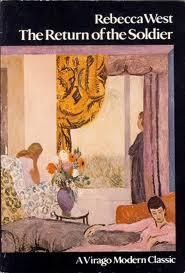
Rebecca West, The Return of the Soldier

This strange, beautiful, overwrought little novel surprised and disturbed me. Its story is  simple: a soldier, Chris Baldry, returns from the front a victim of shell-shock that has cost him fifteen years worth of memory. The news is broken to his wife, Kitty, and his cousin, Jenny, by Margaret Grey, who as Margaret Allington was once in love with (and loved by) Chris. In his damaged mind, their affair is immediate and ongoing, while his marriage is unknown, his wife a stranger. As the novel progresses we realize, with Jenny (our narrator), that the fifteen years lost to his memory were, to him, years already lost in another way: lost to the love he had to give up, lost to the effort to maintain his family business and the family home, Baldry Court. Kitty and Jenny have never understood that the life they shared with him–perfect, elegant, insulated against ugliness–was for him a death of the soul. His return from the war, ill and lost and confused, is a return to Margaret and an opportunity to find himself again through her; their reunion is painfully touching, the more so because we see and feel it only from the literal and emotional distance of Jenny’s perspective.

Jenny’s point of view is the most disconcerting aspect of The Return of the Soldier. At first I was troubled by uncertainty about far we were supposed to go along with her, which is a question that matters because she’s really dreadful: not just judgmental, but nastily so. Here’s her initial description of Margaret, for instance, just arrived to break the news of Chris’s illness:

The bones of her cheap stays clicked as she moved. Well, she was not so bad. Her body was long and round and shapely and with a noble squareness of the shoulders; her fair hair curled diffidently about a good brow; her grey eyes, though they were remote, as if anything worth looking at in her life had kept a long way off, were full of tenderness; and though she was slender there was something about her of the wholesome endearing heaviness of the draught-ox or the big trusted dog. Yet she was bad enough. She was repulsively furred with neglect and poverty, as even a good glove that has dropped behind a bed in a hotel and has lain undisturbed for a day or two is repulsive when the chambermaid retrieves it from the dust and fluff.

But Jenny can already sense something significant, can at least credit Margaret with an impulse towards “candour and gentleness.” As the story goes on, though her language remains permeated with the same hateful condescension, Jenny–in spite of herself–also acknowledges repeatedly that Margaret has, that Margaret is, something valuable and beautiful. It’s Jenny’s problem, not Margaret’s, that Jenny can’t reconcile this knowledge with her own repugnance towards Margaret. Jealousy is  part of it, as Jenny clearly (thought this is never overtly admitted) loves Chris herself. It’s not only personal animosity, though: Jenny and Kitty practice a creepy kind of aestheticism literalized through the way they tend to Baldry Court, where everything must “be made delicate and decorated into felicity.” How can Margaret, with her coarse hands and cheap clothes, even dare to enter? “Surely she must see … that no one accustomed to live here could help wincing at such external dinginess as hers.”

The novel overall is a profound chastisement of Jenny for her cruelty, her judgments, her mistaken priorities, even for her love, which is cloying and limiting in comparison to the luminous generosity of Margaret’s. It’s Jenny and Kitty–especially Kitty (eventually seen by Jenny as “the falsest thing on earth”)–that have destroyed Chris, as much as the war has; it is his life with them, especially his marriage, which he wants to forget as much as anything he has seen in the trenches. They don’t even know him well enough to cure him: it’s Margaret who does, and the bitter irony of the novel is that the cure will in fact destroy him–again. Worse yet, for Margaret, is that one inevitably consequence of his return to reality will be her banishment, her loss now replacing his. A further extension of this irony is that his return to sanity will send him back (healthy, once again) to war: once he returns to them with his memory restored, he must return as a soldier.

The moral and emotional stakes are high, and West makes the most of them. In fact, at times I thought she made too much of them: the writing is (like Baldry Court) highly decorated, rich with adjectives and imagery and detail. Not knowing anything of West’s writing except some bits of her criticism, I was surprised by the thickness of the style: its insistently showy but languid artistry. I didn’t dislike it: it’s compelling, and as I became more interested in Jenny as a narrator, I thought it mostly reflected her consciousness, her self-consciously aesthetic sensibility. But then there’s this bit, as Jenny observes Margaret watching over Chris while he sleeps:

…it was the loveliest attitude in the world. It means that the woman has gathered the soul of the man into her soul and is keeping it warm in love and peace so that his body can rest quiet for a little time. That is a great thing for a woman to do. I know there are things at least as great for those women whose independent spirits can ride fearlessly and with interest outside the home park of their personal relationships, but independence is not the occupation of most of us. What we desire is greatness such as this which had given sleep to the beloved.

It is Jenny speaking, of course, but the moment is infused with such intensity, and the comments reflect so much of what is held out as noble, even heroic, about Margaret overall (that she loves so generously, that she gives so much of herself and expects nothing in return, that she is sanctified in her devotion to others) that I can’t attach them only to Jenny’s already problematic point of view. In fact, I think this is meant to be an epiphany of sorts for Jenny: an acknowledgement of where she and Kitty have fallen short in their love, and perhaps by extension fallen short as women. Kitty’s icy beauty (not to mention the entire relationship she has in fact had with Chris–her husband, after all) is completely devalued by comparison with Margaret’s hovering nurturance. This scene, for me, was a low point. The novel’s conclusion, on the other hand, with its commitment to “the wine of the truth” which we “must drink or not be fully human,” was a high point. If Chris’s marriage to Kitty has been in some fundamental ways a lie, it’s no better to repress the marriage itself and go on living another lie. In imagining that they could protect him, Jenny and Margaret have “forgotten that it is the first concern of love to safeguard the dignity of the beloved.” And so we arrive at the saddest moment of all, as Chris walks back towards the house, “not loose limbed like a boy, as he had done that very afternoon, but with the soldier’s hard tread upon the heel.” “He’s cured!” whispers Kitty. As the soldier returns, it is easier to mourn than to celebrate.

Goodbye to Robert Graves, Goodbye to All That

I finished Robert Graves’s autobiography Goodbye to All That tonight. When I wrote about it on the weekend, I was wondering if he would shift gears and begin reflecting on the experiences he recounts. The short answer to that is no. There are dribs and drabs of commentary that, if extended, would have added the kind of layered response I was looking for. For instance, Graves is asked at one point by a local Rector to speak at a War Memorial service:

He suggested that I should read war-poems. But instead of Rupert Brooke on the glorious dead, I read some of the more painful poems by Sassoon and Wilfred Owen about men dying from gas-poisoning, and about buttocks of corpses bulging from the mud. I also suggested that the men who died…were not particularly virtuous or particularly wicked, but just average soldiers, and that the survivors should thank God they were alive, and do their best to avoid wars in the future.

That’s very nearly it, as far as addressing the significance of the war or what he personally carried away from it. Perhaps he has written more about it somewhere else. He wrote poems about it: perhaps he felt that, in them, he had said what he wanted. The thing is, I finished Goodbye to All That with no desire to find out or read more. I just came away from the book not liking him very much–and what that should have to do with anything, I don’t altogether know, but even acknowledging that any autobiography involves the creation of a persona that should not be naively identified with the subject etc. etc., still, this is what he wrote to represent himself, and to me, he comes across as a bit of a jerk. Here’s his example of taking “a stern line,” for example (from the Epilogue, technically, so written later than the rest of the book, but still…). During WWII, while serving as an Air Raid Warden, he is called for a medical examination,

and the policeman brought me a third-class railway-warrant together with an order to appear before a medical board at Exeter. As an officer on the pensioned list, I refused to travel except first class, a privilege to which my rank entitled me. He and I might find ourselves in the same compartment, and it would never do for us two to mix socially.

Now, I wonder if he’s being ironic at his own expense here, but questions of rank actually come up quite often in the book, right from the early part when he notes that having “paid so heavily for the fourteen years of my gentleman’s education” he felt “entitled, now and then, to get some sort of return.” In any case, taking a stern line on traveling first class compares badly to the kinds of things Vera Brittain takes a stern line on following her own war experiences. I didn’t much like his discussions of his time teaching in Egypt either, for the same reason: his attitude about both the job and his students is arrogant and dismissive. He quotes, apparently in full, three “diploma essays” from students at the Higher Training College in Cairo where he served as an examiner. It’s true they are mostly ludicrous (on The Character of Lady Macbeth: “The impression on the reader becomes very great and feels with anger”) but the writers are laboring in a second or even third language, after all. Graves’s dry conclusion: “I decided to resign.” He would. Of his assignment to teach literature at Cairo University, he remarks, that the students “professed themselves anxious to master Shakespeare, Wordsworth, and Byron in that time. I had no desire to teach Wordsworth and Byron to anyone, and wished to protect Shakespeare from them.” But then he disdains them for considering it “beneath their dignity to admit the existence of ballads in Egypt” because of their class prejudice against the fellaheen.

I commented on the matter-of-fact tone and the unthinking forward movement of the narrative in my previous post, and in the comments, Mike quoted this passage from Graves’s essay “P. S. to Goodbye to  All That“:

I have more or less deliberately mixed in all the ingredients that I know are mixed into popular books. For instance, while I was writing, I reminded myself that people like reading about food and drink, so I searched my memory for the meals that had significance in my life and put them down. And they like reading about murders, so I was careful not to leave out any of the six or seven that I could tell about. Ghosts, of course. There must, in every book of this sort, be at least one ghost story with a possible explanation, and one without any explanation, except that it was a ghost…But the best bet of all is battles, and I had been in two quite good ones–the first conveniently enough a failure, though set off by extreme heroism, the second a success, though a little clouded by irresolution.

I replied that this sounded discouragingly cynical, but once we got out of the war sections, it seemed more and more accurate to me. Graves’s stories of life in the trenches are intrinsically compelling just for being so far from ordinary life, and the bluntness of his style preserves them from any sentimentality and himself from any pretense of heroism. But after that the book is just a chronicle of what happens and who he meets, with particular care taken to drop names and anecdotes: a few pages on visiting with Hardy, notes on his relationship with Sassoon (which had the effect of making me want to reread Pat Barker’s Regeneration trilogy rather than anything more directly by or about Graves), stories about meeting T. E. Lawrence  (yes, of Arabia). He gets married, and his wife Nancy actually sounds pretty interesting (she’s a committed feminist who refuses to take his surname, just for instance), but we don’t get to know much about her or about why their marriage came apart. They have children but he spends little time with them. They putter around Oxford, open a shop, go out of business, go to Egypt–and the book stops.

The most thought-provoking thing in the book, ultimately, may be this little bit about genre not far from the end:

I made several attempts during these years to rid myself of the poison of war memories by finishing my novel, but had to abandon it – ashamed at having distorted my material with a plot, and yet not sure enough of myself to turn it back into undisguised history, as here.

Brittain too first tried to write about the war in fiction. Both clearly concluded that their way forward was not exactly through “undisguised history” but through memoir, letting themselves into the story and telling it as they experienced it personally. Only Graves doesn’t really bring himself into it: what he thought and felt about it, how it affected him, what he thinks it meant–none of that is in this book. For me, that made it a real disappointment, a much lesser book than it could have been. Is it unfair to think that’s a reflection on Graves? As always, I’m prepared to believe it might reflect on me, bringing the wrong expectations or models to the book he decided to write.

We Are All Mr. Harding

Substitute, say, “education or technology” for “politics or religion,” and doesn’t this sound familiar?

“New men are carrying out new measures and are carting away the useless rubbish of past centuries!” What cruel words these had been; and how often are they now used with all the heartless cruelty of a Slope! A man is sufficiently condemned if it can only be shown that either in politics or religion he does not belong to some new school established within the last score of years. He may then regard himself as rubbish and expect to be carted away. A man is nothing now unless he has within him a full appreciation of the new era, an era in which it would seem that neither honesty nor truth is very desirable, but in which success is the only touchstone of merit. We must laugh at everything that is established. Let the joke be ever so bad, ever so untrue to the real principles of joking; nevertheless we must laugh — or else beware the cart. We must talk, think, and live up to the spirit of the times, and write up to it too, if that cacoethes be upon us, or else we are nought. New men and new measures, long credit and few scruples, great success or wonderful ruin, such are now the tastes of Englishmen who know how to live. Alas, alas! Under such circumstances Mr. Harding could not but feel that he was an Englishman who did not know how to live. This new doctrine of Mr. Slope and the rubbish cart, new at least at Barchester, sadly disturbed his equanimity.

That’s a little snippet from Chapter XIII of Barchester Towers. Poor Mr. Harding: he just wants to be left alone to enjoy his quiet life and be a generally good person. Is that too much to ask? And yet in true Trollopian fashion, the answer is not as easy as we’d like, as Mr. Harding himself is sadly aware:

Had he in truth so lived as to be now in his old age justly reckoned as rubbish fit only to be hidden away in some huge dust-hole? The school of men to whom he professes to belong, the Grantlys, the Gwynnes, and the old high set of Oxford divines, are afflicted with no such self-accusations as these which troubled Mr. Harding. They, as a rule, are as satisfied with the wisdom and propriety of their own conduct as can be any Mr. Slope, or any Dr. Proudie, with his own. But unfortunately for himself Mr. Harding had little of this self-reliance. When he heard himself designated as rubbish by the Slopes of the world, he had no other resource than to make inquiry within his own bosom as to the truth of the designation. Alas, alas! The evidence seemed generally to go against him.

Just because the old ways are comfortable does not mean they are right–and worse yet, just because Mr. Slope is the agent of change does not mean change is altogether wrong. If only! When Barchester Towers is not being extremely funny, it’s often being surprisingly wise. Sometimes it’s both at once.

This Week in My Classes: Poems and Prelates

And we’re underway! It’s still a bit chaotic (cue rant about Pet Peeve #47, the long class add-drop period, which sends students the message that they can join a 12-week course 2 weeks in and expect not to be behind) but most of the students seem to have made it back from the break (PP #53, why don’t they just come back for the first day of term?) and even if they haven’t, it seems reasonable to start acting as if they have, including holding them accountable for catching up to us. Though this makes me sound cranky, I’m actually feeling pretty perky today, mostly because I enjoy being back in the classroom and I’m pretty keen about the material we’re working on in both of my classes.

In Close Reading, we’re working through some basic elements of poetic analysis: last week, we talked about diction; today, I reviewed major types of figurative language; and Wednesday and Friday we’ll focus on scansion. In theory, this is review for most students, but in practice, especially since we have muddied diluted diversified our core curriculum and program requirements so much, there’s no guarantee they will have spent time on it. And if they have, there’s no guarantee, of course, that they will have retained, much less mastered, it. So I really do focus on the basics. The immediate goal is to grasp what the elements are–to be able to recognize and name them. But this in itself is not much of an objective, and especially because this is an upper-level course, I try hard to emphasize that the real goal is to be able to talk better about poetry, to be able to recognize what’s going on in a poem when we read it, to be as precise as we can about its effects. In the handout I prepared for them, I quoted this excerpt from a good book called Poetic Designs:

No one reads the rules for the game of … hockey for pleasure; yet no one can possibly understand the game without knowing the meaning of ‘icing the puck’ or ‘offside.’  Without this understanding, the game is a meaningless blur.  Only with it does the game begin to ‘make sense.’  But prosody, like the rules of hockey, is not simply a body of information that one learns and then ‘applies.’  The truly informed fan sees the offside happen before the whistle blows, experiences it in the stir of action.  In poetry as in sport, the observer’s eyes—and ears—must be educated to this same point of instinctive understanding.

Yes, I had some hope that the hockey analogy would appeal to a room full of Canadian 20-somethings! But the same principle applies to, say, quilting: if you know what the norms and standards and challenges are, you can appreciate “the achieve of, the mastery of the thing” when you see it, not just at an analytic level, but “in the stir of action.” If you don’t know much about it, you might like it just fine, and you might have a strong personal response to it, but you couldn’t appreciate it in the same way you could if you had that “instinctive understanding” that combines knowledge and excitement, insight and affect. One of our first readings was Frost’s “Design,” for instance. It’s a deceptively simple poem; it adds to my appreciation of its deceptive simplicity that I see how regular the first line is–that sing-song rhythm leads us along as if into a harmless nursery rhyme–and then find my poetic innocence betrayed by the irregularities that follow. I’m not a hard-core poetry expert, and I sometimes think that helps in this particular class: we’re not going after the most obscure or complex levels of analysis, just practicing how to develop and support our reading. We’re trying to understand how we know what we think we know about our readings, as well as why they have the effects and meanings they do.

In 19th-Century Fiction, today was our first day on Barchester Towers. I took pretty much the whole time myself, with some introductory framing comments about Trollope and his aesthetic, and then an explanation of the basic hierarchy and social significance of the Church of England in the mid-Victorian period. About Trollope, I noted the ways his rather literal novels resist ideas about what is literary, being neither difficult nor particularly poetic. He was never really the go-to novelist for the fancier kinds of literary theory, not yielding as well to symbolic, psychoanalytic, or deconstructive approaches. But he has proved amenable particularly to ethical criticism (as with Ruth ap Roberts’s nicely titled The Moral Trollope). I talked about his interest in institutions, not just the church in the Barsetshire novels but the law and government in the Palliser series, and about his exploration of the interaction between institutions–which have their own abstract logic and their larger missions and priorities–and the individuals who actually constitute those institutions. That’s the point at which some explanation of the Church of England becomes essential, from the general, such as the extent to which it is always already a political institution (not to mention a social and educational one), to the particular–such as what it means for the position of Warden to be ‘in the Bishop’s gift’ or why the impending change of government matters so much to the novel’s very opening question, who will be the new Bishop of Barchester? I always feel a bit bad when I talk so much, but then, it’s pretty hard to navigate intelligently in Barchester Towers without knowing something about these matters. Once you get the idea, you can be “in the stir of action” as you read it. Next time we will get into the novel itself, and into class discussion, starting (as you always must and should, in Trollope) with people: we’ll talk about Archdeacon Grantly, Mr Slope, and Mr Harding to start with, I think, sorting out what they stand for and what the larger implications are of the antagonisms among them.

I really hope that the students are finding Barchester Towers amusing. How could they not? There’s the brilliant comedy of Mrs Proudie’s reception, for instance, at which Signora Neroni’s sofa strips the Bishop’s haughtily arrogant wife of her finery, and there’s the constant entertainment of Trollope’s narrator, who really comes into his own here, after warming up so charmingly with The Warden: “And now, had I the pen of a mighty poet, would I sing in epic verse the noble wrath of the archdeacon.” Good heavens!

Reading Robert Graves, Goodbye to All That

I’m about half way through Robert Graves’s autobiography Goodbye to All That. My interest in reading it was sparked by Testament of Youth: Brittain points to Graves’s book both as an inspiration for her own memoir of the war and as a kind of counter-example to it, as she wanted her book to tell a very different story about the war, the one she thought was (to some extent inevitably) overshadowed by battlefield accounts.

So far, Goodbye to All That definitely is a very different book, as much because of Graves’s different tone and personality as because of the difference in their experiences. I’ve been trying to figure out just what makes it sound so different from Testament of Youth. One factor, I think, is that in the early parts, Graves has quite a wry and engaging sense of humor. For all that I found Brittain’s voice compelling, I don’t recall ever finding her funny, and in fact the extent to which she takes herself seriously is probably the least attractive thing about her books–though I also, perhaps paradoxically, respect her intellectual seriousness very much. Graves writes with more ease, somehow: he sounds very confident and direct, and the narrative has a lot of forward momentum. There’s not much reflection on broader contexts or issues (again, so far), which helps things move along briskly–but it’s odd to find that we are now well into the war (and deep into the trenches) and Graves really hasn’t said anything about the war as a larger event–about why it was being fought and how he felt about that, about its effect on his generation or society more generally, about any of the things Brittain (who often writes with a retrospective cast) sees as motivating her story. Testament of Youth is very much a reflective book about the effects of the war on a generation. Goodbye to All That just carries us along with Graves, who doesn’t give the impression that he himself thought deeply about the war at all before or during it, and who isn’t infusing his account of it with whatever he might have come to think about it later. As a result, the war seems doubly meaningless, both in itself and as the subject of his book, and there’s a way in which that seems appropriate given how chaotic, haphazard, and insane it seems to have been to those fighting it.

Here’s a little bit from the description of his first major action, near Bethune in 1915:

No orders could come through because the shell in the signals dugout at battalion headquarters had cut communication not only between companies and battalion, but between battalion and division. The officers in the front trench had to decide on immediate action; so two companies of the Middlesex, instead of waiting for the intense bombardment which would follow the advertised forty minutes of gas [much of which had spread back into the British lines], charged at once and got as far as the German wire – which our artillery had not yet cut. So far it had been treated only with shrapnel, which had no effect on it; the barbed-wire needed high-explosive, and plenty of it. The Germans shot the Middlesex men down. One platoon is said to have found a gap and gotten into the German trench. But there were no survivors of the platoon to confirm this. The Argyll and Sutherland Highlanders went over, also, on the Middlesex left; but two companies, instead of charging at once, rushed back out of the gas-filled assault trench to the support line, and attacked from there. It will be recalled that the trench system had been pushed forward nearer the enemy in preparation for the battle. These companies were therefore attacking from the old front line, but the barbed-wire entanglements protecting it had not been removed, so that the Highlanders got caught and machine-gunned between their own assault and support lines. The other two companies were equally unsuccessful.

The account of their work that night bringing in the wounded and dead is as harrowing as you’d expect. “The Germans behaved generously,” Graves remarks, not firing on them “though we kept on until it was nearly dawn.” He reports that the Argyll and Sutherland Highlanders “had seven hundred casualties, including fourteen officers killed out of the sixteen who went over; the Middlesex, five hundred and fifty casualties, including eleven officers killed.” The tone is similarly matter-of-fact throughout, sometimes with a degree of detachment that is disconcerting: “I found no excitement in patrolling, no horror in the continual experience of death.” Will he eventually say something about the emotional and psychological experience of the scenes he depicts with such precision? One night he goes out on patrol in No Man’s Land; while crawling through the mud and barbed wire, he recalls, “I snatched my fingers in horror from where I had planted them on the slimy body of an old corpse.” How do you just move on from this, as he does? Literally, of course, he had to, but he’s moving through a landscape in which craters are inhabited by “the corpses of men who had been wounded and crept in there to die. Some were skeletons, picked clean by the rats.” I’m very curious to see if or how he moves from description to reflection.

A New Year, A New Term!

Winter term classes start for us today. Happily, it’s a dry day, with no ice or snow complicating the back-to-school logistics. On the other hand, with the wind chill it “feels like” -21C, so there’s no forgetting that it is winter. (The distinction between the actual temperature and what it feels like always seems such a silly one: who cares what temperature it doesn’t feel like?)

Things ease up for me a bit this term, as I shift down from three courses to two. I prefer it this way, as I find winter both physically and psychologically exhausting. Also, there’s less time to get ready for it than there is to prepare for the fall term! I was marking exams until December 23, and with such an early start date for this term, I had to start puttering away on syllabi and handouts and Blackboard sites and reading for my new courses pretty much as soon as my fall grades were filed. However, I do feel pretty well prepared this week. We’ll see how long that lasts!

I’m teaching one class this term that I haven’t taught since I started blogging–since even before then, actually, as I last offered it in 2005. This is a class on ‘Close Reading,’ which, as I explained at some length in lecture today, is one of our department’s core ‘theory and methods’ classes (the others are ‘History of Literary Criticism’ and ‘Contemporary Critical Theory’). When I first taught Close Reading, back in 2003, it had fairly recently been invented and added to the curriculum as a mandatory class for all English Honours and Majors students. I found it exhilarating teaching a class that so clearly had (or, appeared to have!) the backing of the whole department: it made it easy to make statements about the use and value of the skills we were practicing. Now that students are required to choose one from this cluster, I make my pitch in a somewhat different way, focusing not just on what I still see as the generic importance of close reading skills to answering all critical and interpretive questions, but also on the extra-curricular importance of really paying attention to, and asking questions about, the things we read. There are lots of good reasons for English students to learn about the history of criticism and about the array of theoretical approaches that are practiced in our discipline. There are also discipline-specific reasons for working hard on close reading. But the specialized approach and vocabulary of literary theory becomes less and less useful and relevant the further you get from campus–which is not to say literary theory has no value, or no intrinsic interest (though at times I have thought both of these things myself!). But the importance of being an attentive, well-informed, questioning reader matters more and more as you get away from school and take over primary responsibility for your own book lists! Much of what we require of students in our curriculum aims at making them mini-critics, mini-professionals, but that’s exactly what most of them won’t be. I particularly emphasized in my talk today ways in which close reading takes us through aesthetic questions into ethical ones: here I am influenced, of course, by Wayne Booth, and in fact I quoted some of what he says about the choices that lie behind the finished literary product, and about the choice we make about whether we want to be “friends” with particular books. I hope that these general remarks helped frame the course in an interesting and even provocative way for the students. Much of what we will be doing on a day to day basis will be much more concrete, down in the nitty-gritty details. But if they can think about where this kind of analysis can take them, or about what kinds of broader conversations it supports and enhances, I think they’ll find it a more resonant experience.

My other class is the second installment of the 19th-century novel, the Dickens-to-Hardy half. I taught this last in 2009, when the book list was North and South, Great Expectations, Lady Audley’s Secret, Middlemarch, and Jude the Obscure. I shuffle the books around a bit every time, and this time I’m leading off with Barchester Towers–in past versions of the course, I have often started with The Warden, which I am very fond of, but I’ve been wanting to bring in Barchester Towers for a long time so finally I just made up my mind to it. Since I’ve never lectured on it before, I’m feeling slightly regretful right now, since if I were doing The Warden again I’d have all my materials to hand plus I’d be intimately familiar with the novel. But I’ve been rereading Barchester Towers and enjoying it enormously. How could I not? It is funny, poignant, sharp, and sentimental–sometimes all at once! I’ve kept Great Expectations (though I kind of wish I’d had the guts to sub in Bleak House, just because, well, because it’s Bleak House, and because I’ve taught and thus read Great Expectations pretty often lately). Then it’s The Woman in White, which I alternate with Lady Audley, and then Middlemarch and Jude to close. The tweaks in the book list keep me alert. I decided to stick with the letter exchange assignments that I used last term. I haven’t actually had time to look at my fall course evaluations, so I don’t know if the students were happy with the assignment sequence, but there are a lot of things I like about it, including keeping everyone focused on every book as we go, and giving them lots of writing practice.

I have put one small innovation in place in the 19th-century fiction class. I have been regretting the difficulties of having more direct contact with students as class sizes in general go up, and in these 19th-century novels classes I have also been feeling that there is less reciprocal engagement during class sessions–I have my lecture notes more carefully planned out, usually, and though there is always a core of talkers in the class when I work on generating discussion, there are also a lot who don’t speak up and thus at least seem fairly passive. I have a theory that this passivity sometimes (not always) shows up in their written work: it’s not very lively, it’s not very excited, it’s very safe (if they are attentive) or off the mark (if they aren’t). Students who come to confer with me one-on-one very often not only do better assignments and show more improvement across the term, but seem more energetic in class. Of course, this correlation is probably because those who come to see me are precisely those who have that extra bit of keenness! Anyway, I wanted to change the classroom dynamic a bit, so I’ve designated most Friday classes as seminar meetings: I’m dividing the class into two subsections, and each time one group will meet with me seminar-style, around a table. With a class of 40, we can’t do better than 20 for these, but 20 is actually the usual size for our 4th-year seminars, and it’s much smaller than a typical tutorial in the classes where this kind of break-out group is the norm (these are usually around 30). We’ll do general discussion but also some worksheets and practice for assignments–tutorial kind of stuff. I hope this will help them get to know both me and the course material better, in a different way. It will also force me to change up what I do with the other hours and to loosen up a bit in my own control of our time. There’s nothing intrinsically radical about including tutorials, of course, but they are not at all the norm here for classes of this size and at this level. We’ll see how the plan goes over!

A New Year, A New Open Letters!

Welcome to 2012! What better way could there be to usher it in than to pore over the lovingly-edited pieces in the brand new issue of Open Letters Monthly?

I think we’ve started the year off well, with four members of our core editorial team contributing pieces: John Cotter reviews a risky new novel about Mohamed Atta, one of the hijackers of American Airlines Flight 111; Greg Waldmann takes us on an exhilarating trip not only through Charles Rosen’s book on Music and Sentiment but also through some wonderful examples and analysis of that underappreciated form, classical music; the inimitable (and apparently indefatigable) Steve Donoghue writes a wonderful appreciation of a 5-volume 19th-century biography of Prince Albert (yes, really–you may have to read the piece to believe me, but it’s terrific); and I go back to the Victorians with a ‘Second Glance’ feature on Anne Bronte’s wonderfully smart and provocative The Tenant of Wildfell Hall

Of the other wide-ranging and interesting pieces we are running this month, I’ll highlight two in particular, as I’m pleased to have had a hand in bringing them to Open Letters. Amardeep Singh offers up a knowledgeable perspective on Rabindranath Tagore, about whom I knew little but would now like to know more, and Dorian Stuber reviews Steve Sem-Sandberg’s ambitious novel The Emperor of Lies, taking the opportunity to consider broader issues about the difficulty of representing the Holocaust–not just in fiction, but at all.

There’s also new poetry and new cover art (and an interview with the artist, Bill Amundson); our regular mystery columnist writes up P. D. James’s Death at Pemberly; we introduce our new poetry editor … and that’s not all, so I hope you’ll come over and take a look.

Novel Readings 2011

It’s time again for my ritual look back and the highs and lows of my reading year. Because I was on sabbatical for the few half of 2011, I got quite a lot of reading done–or so it seems, anyway. Since I don’t keep statistics, I can’t be sure if the quantity of books was particularly high in 2011. But the range of my reading was greater because of the greater freedom. Some of the reading I undertook solely out of personal interest turned out to be fruitful in unanticipated ways–indeed, so much so that the next time a colleague asks when I find time to “do all that reading,” I just might answer “my reading is my research.”

Book of the Year:

This one’s a tie, this year, between Helen DeWitt’s The Last Samurai and Vera Brittain’s  Testament of Youth (on which I wrote three different posts). It’s hard to imagine two more different books! But both are outstanding and profoundly affected me. DeWitt noted recently on her blog that The Last Samurai ” is, for the time being, well and truly out of print”–I thought so, as after I finally read my copy and was overwhelmed by its combination of heart and intellectual pyrotechnics I thought I might give some copies as gifts this season and could not find any new copies around. (She recommends buying a used copy and sending a donation via PayPal: if you don’t yet own The Last Samurai and would like a mind-bending read, do as she says!) The impact Brittain’s work has had on me is extensive, as blog readers will know. In addition to the further reading I’ve been doing about Brittain, Holtby, and their contemporaries, I’ve proposed a new seminar (to be offered in the fall!) on the ‘Somerville Novelists.’ Expect significant rereading, and also some energetic research, over the next several months.

Other Books I’m Particularly Glad I Read:

Maj Sjöwall and Per Wahlöö, The Story of Crime. I am so glad I finally took the advice I had received a few times over the past couple of years and looked up this fabulous series of police procedurals. They greatly expanded my understanding and appreciation of crime fiction in general and Scandinavian crime fiction more particularly, and they are also just really great reads.

Shirley Hazzard, The Transit of Venus. This was one of the Slaves of Golconda choices for this year. It’s a dense, intense, moving novel that interested me while I was reading it but got more and more interesting as I thought about it afterwards. It’s a novel I am tempted to assign one day, in part for an excuse to work through it really carefully (including noticing the various subtle clues about its plot and conclusion that I didn’t properly process on my first reading).

Brian Moore, The Lonely Passion of Judith Hearne. This very depressing book was one of the choices of my local book group. Absorbing and moving as it was, I admit I’m glad that after it, we broke the trend of depressing novels about drink and religion.

Elizabeth Bowen, The Heat of the Day and The Last September. The Heat of the Day was another book group selection. It was not particularly successful in that context, but I found it a difficult but mesmerizing read and was prompted to explore Bowen further. I thought The Last September was marvellous, and I’ve got The Death of the Heart in my TBR pile for 2012.

Vera Brittain, Testament of Friendship. I would have found this book compelling even if it weren’t part of my developing interest in these particular women, just for its attention to women’s friendships.

Robert Graves, I, Claudius. This was a tough one. I didn’t love reading it, exactly, and I would have found it even harder if I hadn’t cheated a little by watching the astonishing BBC adaptation first–but how else was I expected to remember who everybody was? But it’s a brilliant book.

J. G. Farrell, Troubles. This one I just thoroughly enjoyed. It’s smart, dark, devious, and intermittently hilarious. It too has added to my 2012 TBR list, as having been introduced to the peculiar genius of J. G. Farrell, now I have to read the other volumes in his Empire Trilogy.

Jennifer Crusie, Anyone But You. It’s not this book in particular that matters so much as its role in overcoming my prejudice against romance fiction. I still feel sheepish browsing the romance section at the library (the covers! must they be so tawdry? and must the books have the tacky heart stickers on them?), but opening myself up to the possibility that I might enjoy books in this genre has paid off as I’ve discovered some others I like even better.

Books I Didn’t Much Like:

Henning Mankell, Faceless Killers. This one could actually go in the “glad I read” list, on the grounds that although I really didn’t like it at all, it was part of the learning curve I was going through about Scandinavian crime fiction, and it was the comment thread on this post that reminded me I should finally try Sjöwall and Wahlöö.

Christina Stead, The Man Who Loved Children. Couldn’t finish it–one of only two deliberately abandoned books this year (the other was Molly Gloss’s Wild Life). But I’m keeping it (them, in fact). Books have their moments, and enough smart people (including Elizabeth Hardwick) think well enough of The Man Who Loved Children that I expect I’ll try again some other time.

Jennifer Egan, A Visit from the Goon Squad. Meh.

Terry Castle, The Professor. Nasty. Self-involved. Funny. An uncomfortable combination.

Colm Toibin, Brooklyn. I understand the suggestion that the narrative mimics Eilis’s own suppressed personality. It’s risky to be flat on purpose: something else needs to leak through, or else you’re just, well, flat. That’s how Brooklyn seemed to me. I have The Master, though, and look forward to reading it. If it’s style is different enough, I’ll believe the “he’s being flat on purpose” argument, though I can’t promise that it will make me like Brooklyn any better.

Jeffrey Eugenides, The Marriage Plot. I already wrote 5000 words on this novel–I think that’s enough!

The Low Point:

Paula McLain, The Paris Wife.

My Year in Writing:

I wrote four pieces for Open Letters Monthly in 2011–well, five, if you count the one that won’t appear until January 1, which I just finished revising this morning. Of these, the essay on Ahdaf Soueif means the most to me, because I seized what felt to me like an important opportunity to consider Soueif’s fiction in relation to the ongoing Egyptian revolution. But I was also pleased with the review of Sara Paretsky’s Body Work, because it gave me a chance to articulate what I’ve learned from teaching about her work in my mystery classes. The other two–reviews of Marjorie Garber’s The Use and Abuse of Literature and Jeffrey Eugenides’ The Marriage Plot–proved very difficult to write, but in the end I was glad I had thought through why both books left me so dissatisfied. I had the most fun with the new piece, probably because it brought me back to Victorian fiction (still, in spite of everything, my home turf!).

I wrote some other blog posts in 2011 that particularly stand out for me as I review my archives:

‘Baking Has Taken On a Sinister Character’: My Grandmother the Writer: This one’s a personal favorite. My grandmother was very dear to me as well as very influential, and there are many things about her and her life that I appreciate more (or at least differently) as I age.

Not Quite Cricket: Dorothy Sayers’s Murder Must Advertise: This post was such a lot of fun to write! I had been wanting to revisit Murder Must Advertise ever since a colleague got my goat by not taking it seriously at all qua novel, as if Sayers, as a “genre” writer, couldn’t possibly be doing anything interesting. (The trend continues.) As I wrote (and wrote and wrote), I found plenty interesting going on–and Murder Must Advertise isn’t even Sayers’s best novel.

SATC2: Just because it’s not a good movie doesn’t mean the appropriate response is to make fun of it, or of the women who went to see it.

Reality Check: My ‘Spotty’ Publication Record: Yes, I was venting, but in the process I think I had some important things to say about the ways standard methods of evaluating academic scholarship box us in.

Cassuto on Blog: ‘I have nothing against them, but I don’t read them either’ (and the follow-up): As I spent a lot of time in the spring and summer preparing a presentation on academic blogging, I had a lot to say about the dismissive attitude towards blogs as a form that doesn’t seem to have improved much in the past 5 years. At the very least, I think people who don’t read blogs should not pronounce on them, any more than people who have never logged on to Twitter and tried following some people who share their interests should pronounce on Twitter.

Books I’m Most Looking Forward to Reading in 2012:

Reviewing my list of books I looked forward to reading in 2011, I’m glad to report that I did in fact read a lot of them! The Last Samurai, for example, was on that list, as was The Power and the Glory, Kristin Lavransdatter, unspecified Virago classics (I read a number of them), and Brooklyn. There are some carry-forwards from that list: War and Peace and Madame Bovary, and the rest of Hermione Lee’s Virginia Woolf, for sure. As always, I have stacks of books around that all look enticing, but I can point to a few that I am particularly keen to get to sooner rather than later:

Robert Graves, Goodbye to All That

Paul Scott, The Raj Quartet

 Angela Thirkell, Wild Strawberries

J. G. Farrell, The Siege of Krishnapur and The Singapore Grip

Elizabeth Bowen, The Death of the Heart

The Iliad

Naguib Mahfouz, Palace of Desire and Sugar Street

Penelope Fitzgerald, The Blue Flower

Rebecca West, The Return of the Soldier, The Fountain Overflows, and Black Lamb, Grey Falcon

Judith Flanders, The Invention of Murder

Ahdaf Soueif, Cairo: My City, Our Revolution (forthcoming)

First up, though (besides the books for my classes, which start up again all too soon) will be Ford Madox Ford’s The Good Soldier, this too for my book group.

Once again I’d like to thank everyone who reads and comments here at Novel Readings. A special thanks to all of you who keep up your own engaging, diverse, and endlessly stimulating book blogs: I feel very fortunate in the community of readers and writers I have found online. Best wishes for 2012!