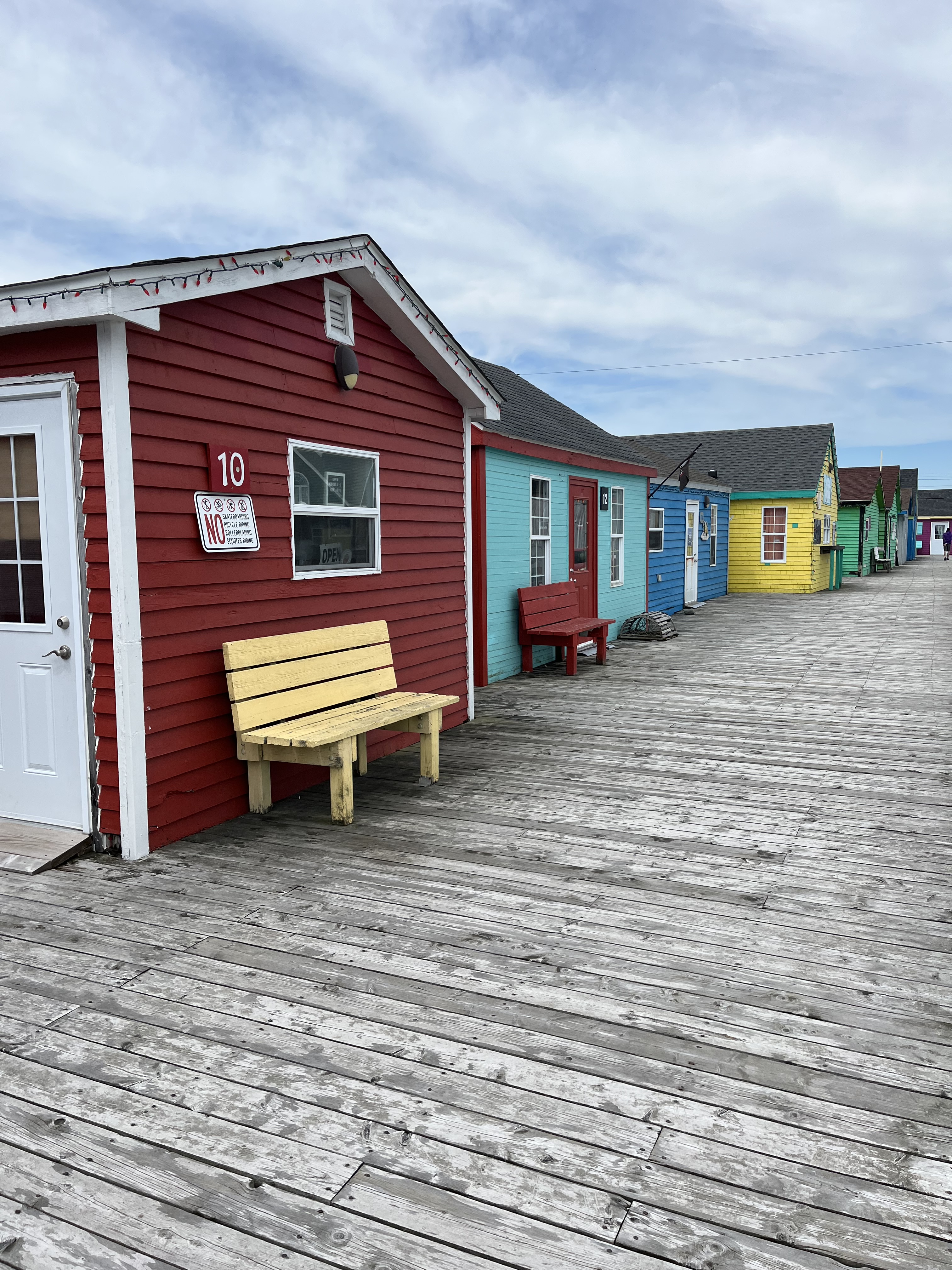
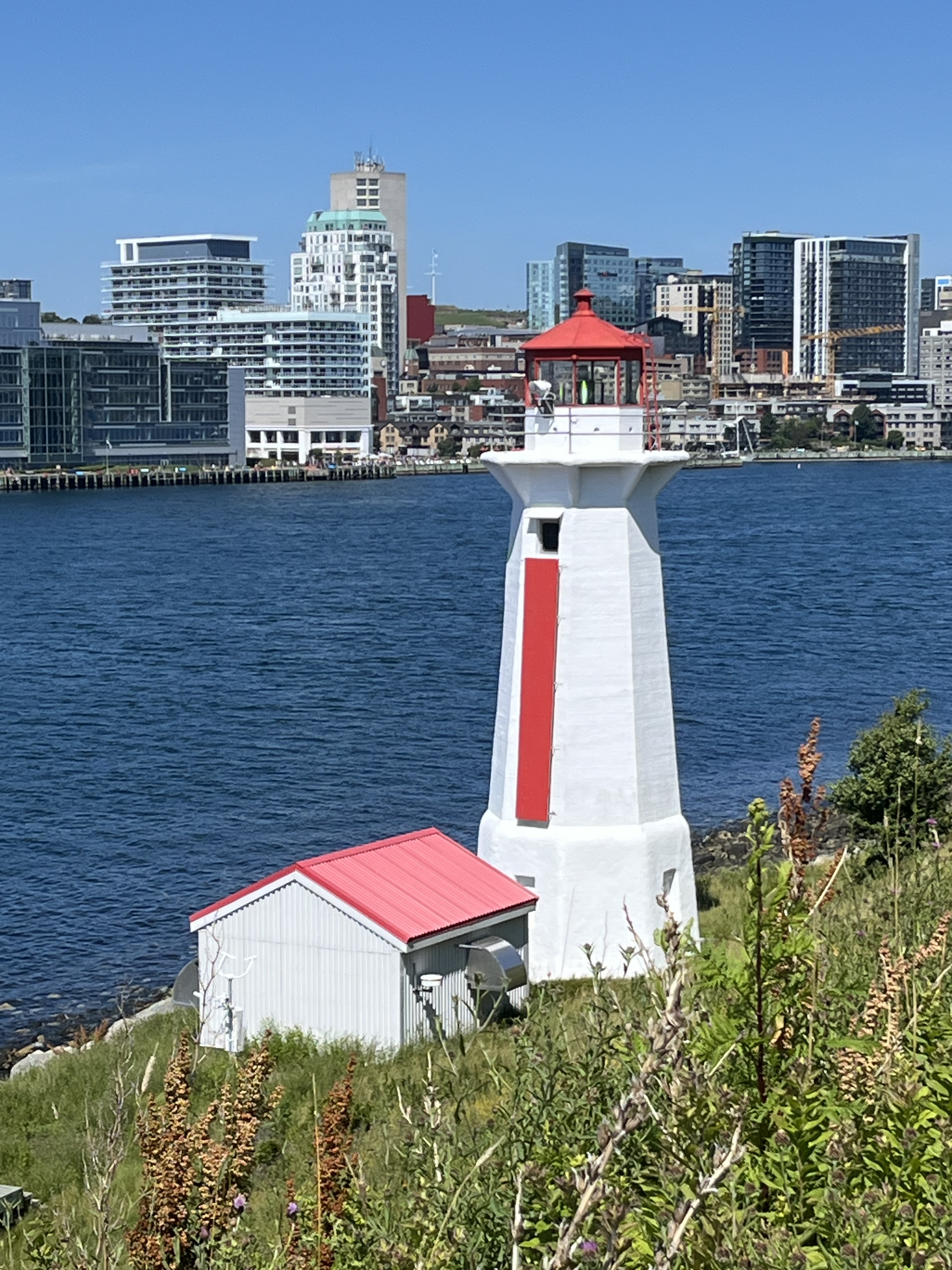
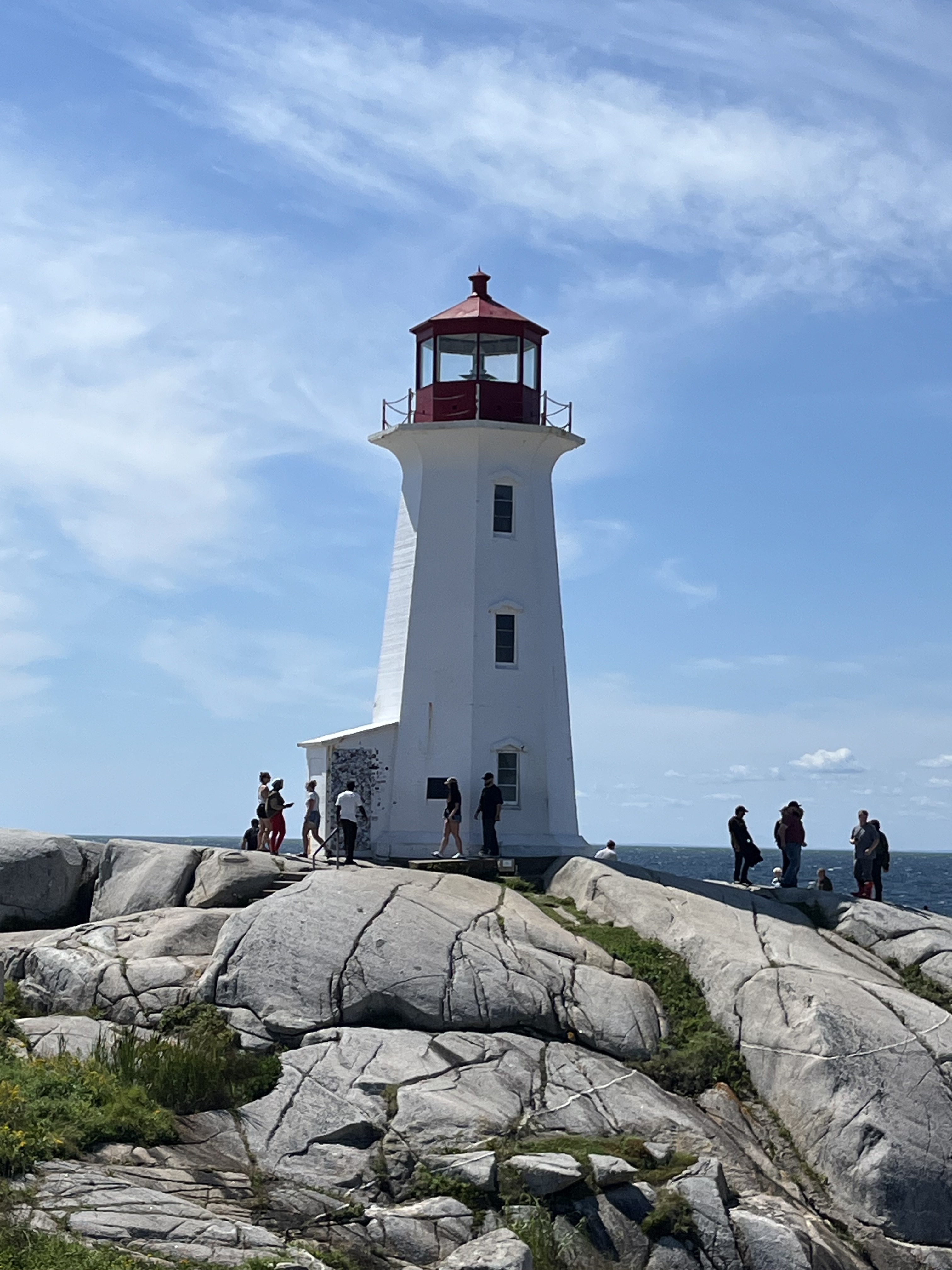
I hope you didn’t think I’d abandoned my art adventures! It’s just that July and August were mostly so drearily hot and humid that I lost a lot of energy, sometimes for going out, and other times for reporting back. But I have in fact crossed off nearly all the galleries on my summer bingo card. A couple of them turned out to be closed for the summer, but I happened across others that I hadn’t originally known about or planned to go to, like the little one at Fisherman’s Cove (an outing that was also on my bingo card). I may fit one or two more in before classes begin for me next Wednesday: I see 14 Bells is actually open weekends, for instance, unlike a lot of the others on my list.
I continued to find it a hit or miss experience; I continued to find myself more drawn to watercolours; and I continued to puzzle sometimes over what makes paintings that (to my amateur eye) seem to display little technical skill worth framing and displaying. I’m not going to call out any specific examples. I do know something about modern art in a kind of general way, not just from visiting major galleries and from reading but also from watching the Great Courses art history videos; I understand that a lot of it is conceptual rather than what I might think of as pictorial, or aims to provoke ideas or reactions besides “that’s beautiful.” I understand some similar things about contemporary ‘classical’ music–but I still usually hate listening to it, and while ‘hate’ is too strong a word, some of the art I have seen is similarly unappealing. I don’t think this makes me reactionary exactly. I have very positive reactions to some abstract art! I think that for me, seeing something I recognize as artistry makes a difference, maybe.
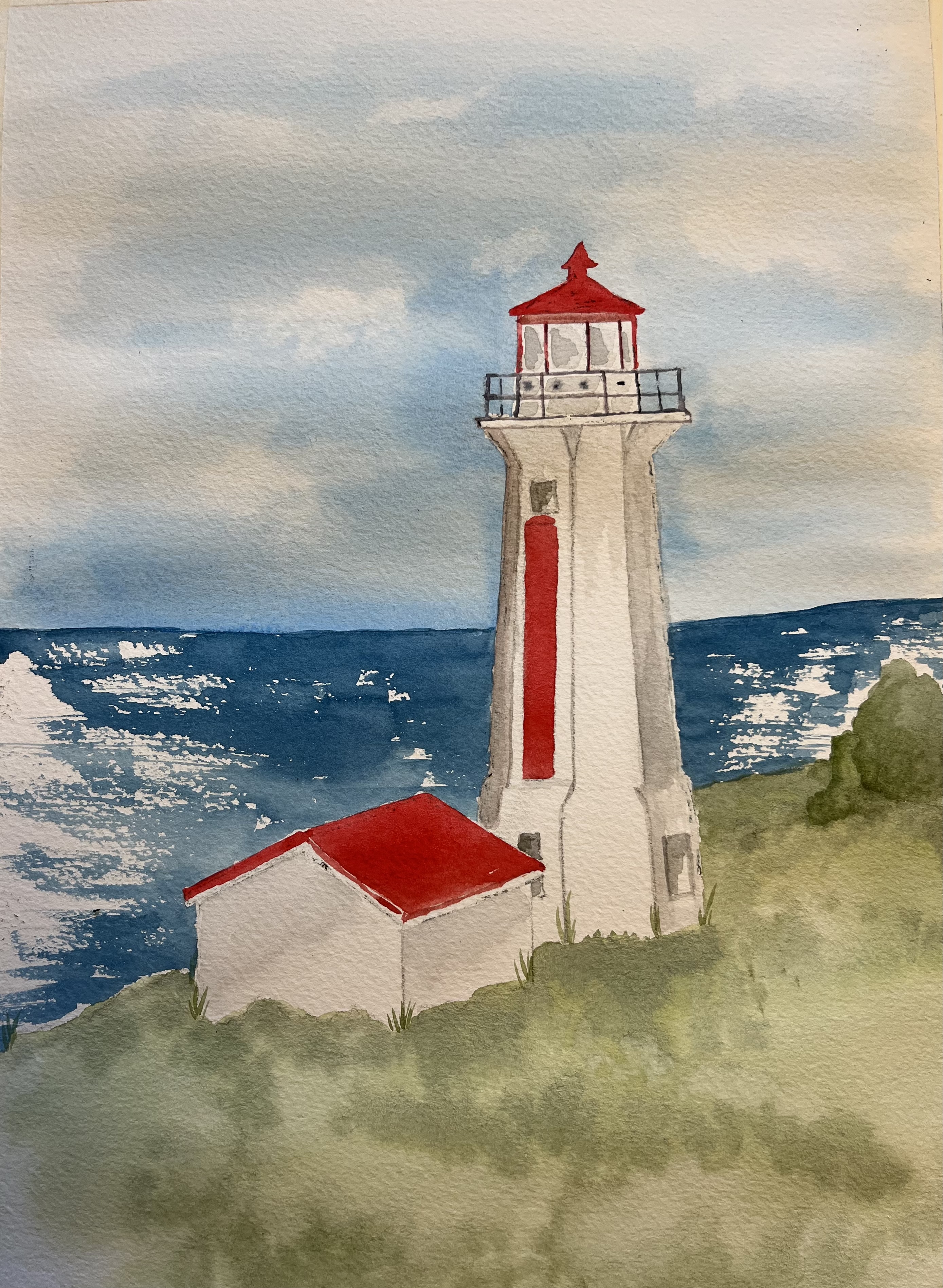
Anyway! I took away from these outings a better sense of just how much artistic activity there is in this region, and how intensely local most of it is. I made more notes of artists whose work I did like: at the Secord Gallery on Quinpool Street, I lingered over the work of Kelly Mitchelmore; at 1274 Hollis I really enjoyed the paintings by Heather Crout and Helene Martin. In the small gallery at Fisherman’s Cove I was very drawn to Edward Wedler’s work–and was particularly interested that he does a lot of his painting en plein air. I bought a small print of one of his paintings and had a brief chat with him too, as he was on duty at the counter the day I was there. At Argyle Fine Art, I found Adele Webster’s paintings beautiful and calming: they are acrylic on board yet have something of the translucency I like in watercolour. I saw a lot of paintings at the Teichert Gallery, where you can pull out their many racks to take a look–but the process is a bit annoying and noisy, so I found it hard to be attentive or contemplative!
I wondered before if I would come to love the Nova Scotia landscape more through looking at it more often through an artist’s eyes. Maybe, a little? I was rereading some sections of The Mill on the Floss recently trying to choose a passage (for a purpose I will say more about in another post) and lingered over this beautiful bit:
We could never have loved the earth so well if we had had no childhood in it,—if it were not the earth where the same flowers come up again every spring that we used to gather with our tiny fingers as we sat lisping to ourselves on the grass; the same hips and haws on the autumn’s hedgerows; the same redbreasts that we used to call “God’s birds,” because they did no harm to the precious crops. What novelty is worth that sweet monotony where everything is known, and loved because it is known?
The wood I walk in on this mild May day, with the young yellow-brown foliage of the oaks between me and the blue sky, the white star-flowers and the blue-eyed speedwell and the ground ivy at my feet, what grove of tropic palms, what strange ferns or splendid broad-petalled blossoms, could ever thrill such deep and delicate fibres within me as this home scene? These familiar flowers, these well-remembered bird-notes, this sky, with its fitful brightness, these furrowed and grassy fields, each with a sort of personality given to it by the capricious hedgerows,—such things as these are the mother-tongue of our imagination, the language that is laden with all the subtle, inextricable associations the fleeting hours of our childhood left behind them. Our delight in the sunshine on the deep-bladed grass to-day might be no more than the faint perception of wearied souls, if it were not for the sunshine and the grass in the far-off years which still live in us, and transform our perception into love.
I no longer consider Vancouver my home, but I feel things deep inside whenever I fly in and finally see the mountains, or walk along the streets or beaches and in the parks, that I never feel here.
I made a point of seeing more of the local scenery myself this summer by going on outings that did not require me to drive on the highways. (I just don’t see how, if you’re doing something for fun, you can be expected to do it in a way that you find genuinely and not unreasonably stressful!) One was to Fisherman’s Cove: I’d been there before long ago and remembered it being charming, which it is, sort of. The village itself is charming, and the colourful row of little shops is sweet too, except that what they sell is just so unrelentingly cheesy and touristy. The same is true of Peggy’s Cove, which I finally (after 31 years of living in Halifax!) visited in person. Peggy’s Cove is a spectacular site, and I really enjoyed my expedition there, including the funny and informative commentary from the guide on the bus tour I took–but it really does look just like the photos, which makes it weirdly anticlimactic, and I can’t see any need to ever go back there. Just in terms of value for money, I give the edge to my trip to Georges Island in Halifax harbour. For a fraction of what it cost to go to Peggy’s Cove and a fraction of the time it took to trek out by ferry and bus to Fisherman’s Cove, I got a delightful boat trip there and back, including a loop around the island before docking there, and an interesting time poking around the fortifications and enjoying the view of the city from there.
As you can tell, I made a concerted effort to have a better (richer, more interesting, less depressed) summer than I often have. (I did have work to do too, including a TLS review that will be out in the next issue, and another writing project I will say more about in a bit, as well as the usual preparation for the fall, an MA thesis to read, and bits of ongoing advising work.) On the whole, the effort was successful: it was a better summer. Still, the very phrase ‘concerted effort’ is a bit of a tell, right? I also worked hard to maintain the ‘social connections’ that my therapist is always reminding me are essential to our wellbeing. I was always happy to spend time with my friends–but again, ‘worked hard’ says something about the realities. People are busy with their own things in the summer, whether those are family things or travels or cottages: this is how it always is. Now they’re coming back and asking how my summer was and that says something too. I am working on being OK with that. I understand that social connection is a good thing, but maybe (and I have pointed this out to my therapist!) if someone just is alone a lot, it would be helpful not to constantly frame that as a problem but to work with them on approaching alone time as itself a good thing. I just finished Robert Coplan’s The Joy of Solitude and now I’m reading Solitude: The Science and Power of Being Alone by Netta Weinstein, Heather Hansen, and Thuy-vy T. Nguyen. Both books are really interesting on the research around solitude (including the need not to conflate it with loneliness)–and both books offer a potential counter-narrative to the familiar rhetoric around the current “epidemic of loneliness” or isolation that we hear so much about. There’s a chapter in the latter called “Can We Get Better at Being Alone?” and the answer, encouragingly, is yes.


Solitude is in my DNA too, so I understand the ‘effort’ involved in being more connected. I’m no counsellor, but it seems to me that you are on the right track, that is you are doing things that you like doing, you are visiting places that inspire your art, and importantly, when you do meet up with friends, you have something new and interesting to talk about.
And there is always the chance that as you are doing these things you enjoy you will encounter a soul mate. I don’t mean a romantic interest, I just mean someone whose company you might enjoy. Even for isolates, it’s good to make a new friend who enjoys similar interests.
PS I do not agree with George Eliot, and neither would many others who have migrated to new places and cherished the earth in their new home without any childhood memories as a catalyst. We live in a world where for many a childhood idyll is a fantasy and escape from that kind of childhood is liberation.
LikeLike
Childhood is not an ‘idyll’ for Tom and Maggie either, and I’m not sure that’s what she is saying lies behind that affection for familiar landscapes – the ones we ‘imprint’ our imagination on. But I’m sure you are right that it often happens that people feel that kind of deep connection to landscapes they came to later: it’s just not really the case for me.
Making new friends in middle age is definitely a different ball game. I saw a ‘meme’ recently that said “All of the people I would really get along with also don’t want to leave their house” and I felt seen, as they say. 🙂
LikeLiked by 1 person
I feel Iâve had the opposite experience in being a Nova Scotian (and living primarily in NS up to my mid-30s) who moved to Vancouver expecting to be here three years at most, and now Iâve been here almost 30 years. Vancouver is home now, and Iâll continue to live here even now that work is over.
>
LikeLike
It certainly sounds like you had a good (or better) summer, with a lot more done than I’ve managed in recent years (and it’s always good to see GE shoehorned into another post!).
LikeLike
Always here to shoehorn her in!
I have definitely come to understand the concept and practice of “behavioural activation” in recent years. At the same time, I am realizing that for me at least, there are trade-offs to constantly trying to do more because that is pitched as the right way to carry on.
LikeLiked by 1 person
Thanks for the quote from Eliot. I’ve read the book but must have missed it; at any rate, this has been my experience. I grew up in and lived most of my life on the prairies, and am now in Tsawwassen, just south of Vancouver, between Boundary Bay and the Strait. Surrounded by water, in other words. And while I like going to the water, after 10 years I’m still feeling like a visitor to the “landscape” (seascape) of my environment. My soul home is that slightly rolling prairie and big sky of Alberta where I was a child. Everything somehow gets measured beside that “sweet monotony,” the “mother tongue” of my imagination.
LikeLike
”I understand that social connection is a good thing, but maybe (and I have pointed this out to my therapist!) if someone just is alone a lot, it would be helpful not to constantly frame that as a problem but to work with them on approaching alone time as itself a good thing.”
I love this.
LikeLiked by 1 person