 I didn’t much like March Violets–it just didn’t work for me. I should perhaps have anticipated this: in general, noir fiction isn’t really my thing. But I didn’t expect Kerr to go all in on his imitation of Raymond Chandler. Stylistically at least, I think I would have liked it better if he’d gone all in as the next Dashiell Hammett. I have to grit my teeth to get through the metaphorical excesses of The Big Sleep, and Kerr’s, while less florid, also seemed less poetic and a lot more forced. I also think there’s no excuse for perpetuating the sexism of classic hard-boiled detective novels in a contemporary pastiche. In fact, while I find Philip Marlowe’s misogyny disturbing, I give Chandler credit for showing the price Marlowe pays for it, in his embittered isolation, while Bernie Gunther’s sexism (“Her breasts were like the rear ends of a pair of dray horses at the end of a long hard day”) serves only to show off Kerr’s own hard-boiled credentials. (“There’s only one thing that unnerves me more than the company of an ugly woman in the evening, and that’s the company of the same ugly woman the following morning.”)
There were certainly things about March Violets that I thought were well done. The historical setting is one: Kerr really effectively conjures up the atmosphere of 1936 Berlin–the violence and brutality, the pomp and posturing and power-brokering, the shady corners and the moral gray areas. The plot was pretty convoluted, but that’s authentically Chandleresque, for better and for worse. I was amused by the metafictional interlude with the SS officer who is a crime fiction aficionado. “Part of the image, eh?” he says to Bernie when he takes a refill of schnaps:
“And what image would that be?”
“Why, the private detective of course. The shoddy little man in the barely furnished office, who drinks like a suicide who’s lost his nerve, and who comes to the assistance of the beautiful but mysterious woman in black.”
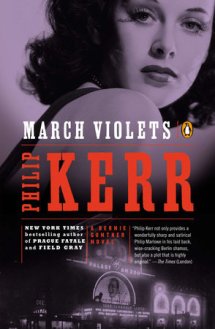 When Bernie gets smart with him, the officer observes that “the ability to talk as toughly as your fictional counterpart is one thing … Being it is quite another.” I can’t imagine any reader of March Violets needing any such overt signals of Kerr’s knowingness about genre conventions, as there’s nothing subtle about his attempt to recreate the feeling and many of the themes of his hard-boiled predecessors, but it was still a nice light moment in an otherwise dour novel.
Something that really didn’t work for me was the episode in which Bernie goes “undercover” at Dachau. One problem, I thought, was that Kerr handled it badly: it seemed obvious that he took the responsibility of writing about Dachau seriously and the result was a tonal shift and some sudden onset “info-dumping” as Bernie turned from cynical private eye to eloquent witness (“Work sufficient to destroy the human spirit was the aim of Dachau, with death the unlooked-for by-product”). The whole sequence (which was also wildly implausible) felt like a device, a gimmick to give Kerr the opportunity to include Dachau in his scene setting–and that, in turn, felt tasteless to me.
Kerr’s concept–to revisit Chandler’s “mean streets” in the context of fascism and the fear and instability it brings, when everyone might be an informer and nobody’s life (or death) is really worth inquiring into very closely–is a really good one, and Bernie’s attempt to negotiate this world while being (in Chandler’s terms) “neither tarnished nor afraid” sets up what I can imagine become a lot of morally interesting scenarios as the series goes on. I didn’t enjoy reading March Violets, though: its tone just didn’t suit. I finished it thinking that rather than reading any further in this series, I’d rather read more of Maurizio de Giovanni’s Commissario Ricciardi series. They too take us down the mean streets of fascism, but they have a gravity to them–an elegance, almost, and a sadness–that I find more appealing than Kerr’s noir nastiness.
 We have had more storms since the last time I posted but happily no more storm days, so we are still on schedule … for now! (In fact, things are looking
  I really did enjoy rereading the novel this time, especially the reliably hilarious as well as deliciously subversive final encounter between Elizabeth and Lady Catherine. One thing we spent a fair amount of time on in class is the way Austen manipulates us into liking or disliking characters, only, much of the time, to undercut or at least complicate our “first impressions” so that we realize we are vulnerable to the same interpretive mistakes as the characters. In this respect I think even Mr Collins gets a bit of a reprieve from our initial distaste. Not only is his offer to Lizzie actually quite honorable, despite also being laughable, considering he has no obligation to make up to the Bennet sisters for the future loss of their home, but at Hunsford we see that while he is still absurd, he treats Charlotte well and has made it possible for her to live a dignified life. I don’t think there’s any backtracking on Lady Catherine, though: she remains an antagonist to that bitterly delightful end:
 In British Literature After 1800 we are still reading poetry and I am still struggling with “how to balance attention to context and content with attention to form,” as I put it in
  This is hardly a radical strategy, including for me. I do often (and did this term) provide study questions for the novels in my 19th-Century Fiction classes, for example, to help students organize their observations as they read the long books–to know what, of all the many details flooding past them, to really pay attention to. But I also find it pretty easy to ask questions in 19th-Century Fiction that will get at least some answers, and usually lots of them, because we always have plot and character as starting points, from which we can level up to questions about form and theme. Maybe because I don’t teach poetry often, I underestimated the difference it makes to be working on, not just poetry, but poetry much of which is in a somewhat archaic diction. My impression (though I may be mistaken) is that many of the students are struggling with the literal meaning of the poems–their basic paraphraseable content. Perhaps, too, the variety in our reading list that keeps things interesting for me (and is to some extent necessitated by the survey format) is making things harder for them because each poet is so different and thus makes different demands on our attention as readers. With that in mind, in the study questions I came up with I tried to make the assigned poems more legible for them, combining questions about theme with prompts to consider form, and making some connections across the poems.
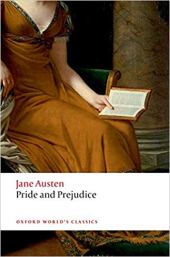 We are well into Pride and Prejudice in 19th-Century Fiction this week and I have to say that while
 In British Literature After 1800 we are skipping briskly through our small sample of Romantic poets. The rapid pace is at once the blessing and the curse of a survey course with a mandate to span more than 200 years of writing in multiple genres: we don’t spend long enough in any one place to go into a great deal of depth, which means we also don’t spend long enough on any one topic to get tired of it. I enjoy the variety myself, including the chance to talk about genres and examples that don’t come up in the courses I teach more often–such as Romantic poetry! In fact, because the introductory courses I’ve taught for the last several years have been either Introduction to Prose and Fiction or Pulp Fiction, I’ve spend hardly any time on poetry at all except for Close Reading, and the last time I taught that was Fall 2017. So I’m having fun, but also feeling a bit wobbly about how to balance attention to context and content with attention to form.
 One distinctive aspect of Love Is Blind is its preoccupation with music. I expected this to bring a more transcendent dimension to the novel–life may be flat, but melody elevates it, or something. Brodie’s own relationship to music is mostly mechanical, though: while he works for a piano virtuoso, his job is weighting the keys and perfecting the piano’s pitch, not rhapsodizing over the results, and the pianist himself is elated at his own skill but conveys no spiritual and hardly any emotional connection to the music he produces. I found this disappointing; it made me think again about other novels about music that made me more excited about it, such as
  Given the cyclical nature of the academic life as well as the recurrence of texts and topics in the classes I teach most often, there are lots of things I might be saying “Not again!” about! This week, however, the particularly irksome repetition is the disruption to the start of term thanks to a big storm–not
  So what, besides calming my nerves (and perhaps theirs as well), is on the agenda for our remaining classes this week? Well, in British Literature After 1800 Friday will be our (deferred) Wordsworth day. In my opening lecture on Monday I emphasized the arbitrariness of literary periods and the challenges of telling coherent stories based on chronology, the way a survey course is set up to do. But I also stressed the value of knowing when things were written, both because putting them in order is useful for understanding the way literary conversations and influences unfold, with writers often responding or reacting to or resisting each other, and because historical contexts can be crucial to recognizing meaning. My illustrative text for this point was Wordsworth’s “I Wandered Lonely As a Cloud,” which (as I told them) is the first poem I ever memorized, as a child. It was perfectly intelligible to me then, and it is still a charming and accessible poem to readers who know nothing at all about what we now call ‘Romanticism.’ Without historical context, it seems anything but radical–and yet Wordsworth in his day (at least, in his early days) was considered literally revolutionary. His poetry “is one of the innovations of the time,” William Hazlitt wrote in “The Spirit of the Age”;
 In 19th-Century Fiction it’s time for Pride and Prejudice, though I’ll start with an abbreviated version of the lecture I would have given on Wednesday on the history of the 19th-century novel. It has been several years since I’ve taught Pride and Prejudice (
 There’s no doubt that if I were teaching Mansfield Park these questions would be a big part of our discussion, as they are when I teach The Moonstone. I haven’t so far arrived at any ideas about how — or, to some extent, why — we would take up this specific line of inquiry in our work on Pride and Prejudice. Perhaps I am too prone to let the novels I assign set their own terms for our analysis–to rely on their overt topical engagements more than what they leave out or obscure–but this particular novel doesn’t seem to be about race and empire, even though its characters live in a world where these things (while never, I think, explicitly mentioned) matter a lot. Beyond acknowledging that fact,
  Ring out the old, ring in the new,
 The first time I read Beginner’s Luck I felt that there was so much going on that it got a bit distracting. Maybe this has something to do with my expectations for romance: though there is a lot of emotional intensity in Clayborn’s novels, the central relationship is embedded in a lot of what seemed like padding. It turns out, though, that for me anyway this is exactly what makes her books fun to reread, as more of the novels’ patterns–the connections between their parts–become clearer over time. At the same time, it’s the emotional intensity that means I give a pass to what might otherwise bother me about them, which is that the love story relies (more so in the second and third books in the trilogy than the first) on an initial set-up that seems, if you think about it hard at all, pretty contrived or unlikely. This is especially true of Luck of the Draw, which has nonetheless turned out to be my favorite of the trilogy.
 The Witch Elm has been written about a lot elsewhere; of the reviews I’ve read, I think
  Novel Readings