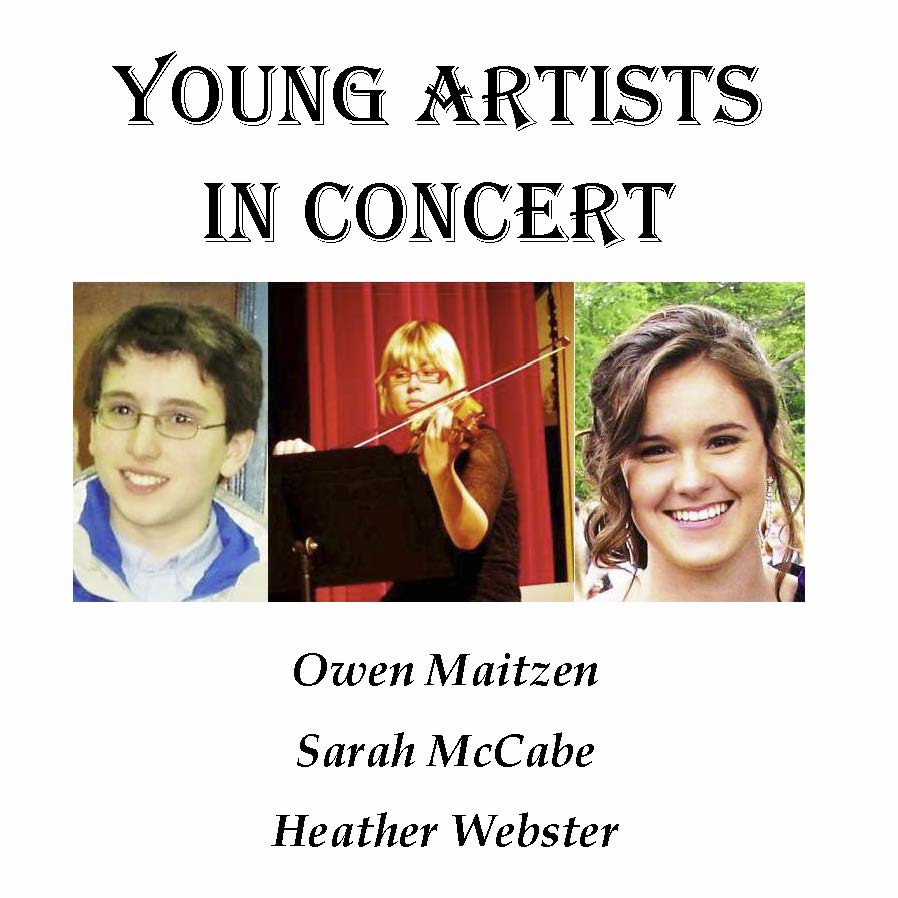
 I’ve posted a couple of times before about my son’s compositions. Last week he and two other talented young musicians performed in a concert that included a number of his original pieces (a Sonatina for piano and violin, two solo piano pieces, and a setting for voice and piano of Poe’s “Romance”) along with pieces by Ravel, Fauré, and Wieniawski–and, in an unusual twist, some piano-violin improvisations prompted by audience suggestions. It was a big event that took a lot of preparation, especially by Owen (who played in every piece on the program) and my husband, who handled most of the logistics. The evening was a treat: not only was the music delightful but it was wonderful to watch the three young performers working together for the love of it. The audience was very appreciative, and we have been been beaming with pride (and basking in reflected glory) ever since! Audio tracks of the entire concert are now available here, for anyone who would like a listen.
Year: 2011
Helen DeWitt, The Last Samurai
 The Last Samurai is the story of a single mother, Sybilla, and her son, whom she calls “Ludo”–though on his birth certificate it says either ‘David’ or ‘Stephen,’ ‘one or the other.’ It makes sense that Sybilla would consider it pointless to be certain, because one of the things this novel is about is precisely how we figure out and then live up to who we think we are. It’s also about the accidents that determine the lives we lead, regardless of who we might be, and about the choices and values and loves and hates and languages and books and ideas and music and art and movies and people that constitute those lives and make them worth living–or not. It’s a celebration of genius and an attack on mediocrity, a paean to the human capacity to create and learn and think and reason and a lament for the seductions of banality. It’s about quests and heroes and, of course samurai. Its parade of erudition is at once dazzling and surprisingly entertaining, and also inspiring, because it’s in the service of intellectual curiosity and love of knowledge, not accomplishment or grades or prizes.
It’s Ludo’s curiosity, in particular, that gives the novel its momentum: he is a child prodigy whose brilliance at once thrills and terrifies his mother. Ludo’s voice, and his quest for his father, eventually take over the novel from Sybilla, but she remains its presiding genius; without her, Ludo’s endless questions would go unanswered. Though their relationship is never sentimental (indeed, they rarely seem like parent and child, at least in the ways we would casually expect), their attempts to care for each other have an emotional intensity and an intellectual integrity that are ultimately very moving. A book so extravantly episodic and allusive risks losing its humanity. Somehow, miraculously, for all its jouissance, all its postmodern display, The Last Samurai never does.
 This is a novel that feels exceptionally difficult (and more than usually pointless) to excerpt from–and yet, the temptation! And it incorporates so much that it’s difficult to know what to single out for commentary. One aspect of it that is obviously very important, both structurally and thematically, is its engagement with Kurosawa’s The Seven Samurai (which I have never seen–but the range of things alluded to in this novel that I don’t know first-hand is so long there’s no point remarking them all). The Seven Samurai is Sybilla’s favourite film. Not only does she watch it over and over, but she thinks of it as taking the place of a male role model in Ludo’s life. What she doesn’t expect, when she first shows it to him (when he’s five) is that it will prompt him to demand to learn Japanese.
L: When are you going to teach me Japanese?
I: I don’t know enough to teach you.
L: You could teach me what you know.
I: [NO NO NO NO NO] Well
L: Please
I: Well
L: Please
Voice of Sweet Reason: You’ve started so many other things I think you should work on them more before you start something new.
L: How much more?
I: Well
L: How much more?
The last thing I want is to be teaching a five-year-old a language I have not yet succeeded in teaching myself.
I: I’ll think about it. . . .
Her problem is that Ludo is urgent with his demands to learn, not just Japanese, but Latin and Greek and much much more, and that there isn’t, really, any reason not to teach him whatever he wants to know except the widespread (mis)understanding that he is too young for this kind of thing–a view they encounter over and over as they ride the Circle Line to keep warm:
. . . he has been reading the Odyssey enough for a straw poll of Circle Line opinion on the subject of small children & Greek.
Amazing: 7
Far too young: 10
Only pretending to read it: 6
Excellent idea as etymology so helpful for spelling: 19
Excellent idea as inflected languages so helpful for computer programming: 8
Excellent idea as classics indispensable for understanding of English literature: 7
Excellent idea as Greek so helpful for reading New Testament, came through eye of needle for example mistranslation of very simple word for rope: 3
Terrible idea as study of classical languages embedded in education system productive of divisive society: 5
Terrible idea as overemphasis on study of dead languages directly responsible for neglect of sciences and industrial decline and uncompetitiveness of Britain: 10
Stupid idea as he should be playing football: 1
Stupid idea as he should be studying Hebrew & learning about his Jewish heritage: 1
Marvellous idea as spelling and grammar not taught in schools: 24
(Respondents: 35; Abstentions: 1,000?)
Oh, & almost forgot:
Marvellous idea as Homer so marvellous in Greek: 0
Marvellous idea as Greek such a marvellous language: 0
What place genius, what price genius, in a world like this? These are among the difficult questions Sybilla faces, as she reads about the education (and eventual breakdown) of John Stuart Mill, or about “the example of Mr. Ma (father of the famous cellist).”
 One of the most fascinating explorations of this in the novel is the story of the pianist Kenzo Yamamoto, who becomes obsessed, not with how to play a particular note or phrase or piece, but with how else you could play it, or how else it could sound:
Yamamoto: To put it another way, let’s just take a little phrase on the piano, it sounds one way if you’ve just heard a big drum and another way if you’ve heard a gourd and another way if you’ve heard the phrase on another instrument and another way again if you’ve just heard nothing at all–there are all kinds of ways you can hear the same sound. And then, if you’re practising, you hear a phrase differently depending on how you’ve just played it, you might play it twenty or thirty different ways and what it actually is at any time depends on those things it might be–
He gives a disastrous concert at Wigmore Hall in which he played “about 20 minutes of drum music after each of six [Chopin] Mazurkas . . . with the result that the concert ended at 2:30 in the morning & people missed their trains & were unhappy.” Sybilla takes Ludo to hear Yamamoto in concert at the Royal Festival Hall. The first half is uneventful, but after the interval, Yamamoto begins to play the Brahms Ballade Op. 10 No. 1, first just phrases and then eventually the whole piece:
For the next seven and a half hours Yamamoto played Op. 10 No. 1 in D minor, and sometimes he seemed to play it exactly the same five times running but next to the sound of a bell or an electric drill or once even a bagpipe and sometimes he played it one way next to one thing and another way next to another. . . .
Eventually he plays it through nine times along with a tape of traffic and footsteps, then when the tape stops and there is silence he plays it “so that you heard it after and over the silence.” Then, after all those hours playing Op. 10 No. 1, the audience is “shocked to hear in quick succession Op. 10 No. 2 in D major, Op. 10 No. 3 in B minor and Op. 10 No. 4 in B major, and you only heard them once each”:
It was as if after the illusion that you could have a thing 500 ways without giving up one he said No, there is only one chance at life once gone it is gone for good you must seize the moment before it goes, tears were streaming down my face as I heard these three pieces each with just one chance of being heard if there was a mistake then the piece was played just once with a mistake if there was some other way to play the piece you heard what you heard and it was time to go home.
 Her bitterness at the inadequacies of the Circle Line riders is balanced by this moment of grace. Why do we put such limits, not just on our children, but on our art? Much, much later in the novel, Yamamoto says to Ludo, “When you play a piece of music there are so many different ways you could play it. You keep asking yourself what if. You try this and you say but what if and you try that. When you buy a CD you get one answer to the question. You never get the what if.” There’s no place for Yamamoto’s “what if” in the world of concert halls and recording studios and trains to catch.
The risk DeWitt takes is that this dedication to the highest possible forms becomes, or at least will come across as, sheer elitism, a blunt attack on popular taste. About a third of the way through the novel, pestered endlessly by Ludo for the name of his father, Sybilla presents him with a challenge: she gives him a tape of Liberace, a drawing by Lord Leighton, and a magazine article and tells him “You will not be ready to know your father until you can see what’s wrong with these things.” More than that,
Even when you see what’s wrong you won’t really be ready. You should not know your father when you have learnt to despise the people who have made these things. Perhaps it would be all right when you have learnt to pity them, or if there is some state of grace beyond pity when you have reached that state.
As Ludo takes over as the novel’s narrator and the plot (to the extent that it is linear) becomes the story of his attempt to find (or choose) his father, this quest to discern the failings of Liberace (which is, not incidentally, also the code name Sybilla uses for Ludo’s father), of Lord Leighton, and of the boring magazine article runs in parallel. I wasn’t sure I wanted Ludo to grow up into another Sybilla, or even to pass her test–Sybilla herself does not live happily or easily with her ideas, after all–and yet the whole book pits itself against relaxing into easy compromises, whether moral or ethical or aesthetic (and I’m not sure that the novel allows for a distinction between these). There’s nothing easy about Ludo’s progress towards the novel’s conclusion, but I think that through each of his encounters with potential fathers, he learns and grows in ways that eventually exceed what Sybilla wanted, or even thought was possible, for him.
There’s much more to The Last Samurai than this, but if I started listing off more of its ingredients it would make the novel sound like a kind of flamboyant bricolage rather than the gratifyingly readerly treat it is.
This Week in My Classes: WMT, AC, and EBB
It’s a short week, because of the Thanksgiving holiday on Monday. I think I saw the effects of the long weekend–not good ones–in my 19th-century novels class, where the limp response to questions about Vanity Fair (except from a couple of stalwart contributors) suggested people hadn’t exactly spent it keeping up with the reading. It has been three years since I taught Vanity Fair (shocking!) and I’m not having as much fun with it as I’ve had before, and I also don’t get the impression that very many students are having fun with it. I feel as if I must be doing something wrong, though I’ve been too busy the past couple of weeks to get creative about possible fixes. The novel is massive as well as somewhat miscellaneous: I’ve been suggesting ways to manage the information overload by looking for parallels and patterns, themes and variations (on vanity, for instance) but maybe they are just feeling overwhelmed. Or maybe they are loving it and just not letting on. Will Vanity Fair join Waverley as a novel I just don’t want to teach because of the burden of resentment and disconnection it puts on the class? But what about the two or three students who do love it? And what about the fact that it is just one of the great Victorian novels? Why should I care if they don’t love it? I’m sure things will pick up when we get to Tenant of Wildfell Hall next week.
In Mystery and Detective Fiction, we have wrapped up our discussion of The Murder of Roger Ackroyd and are heading into our first mid-term on Friday. Funny how the looming presence of an exam improves attendance and concentrates attention. I think the discussion of Ackroyd went well. I always try to provoke as much discussion as possible about the morality of a novel in which violent death is treated so casually. It’s almost comical, in fact, the way the characters mill around Ackroyd’s dead body checking whether windows are closed and so on, and then when Poirot blithely sits down in the very chair in which Ackroyd was killed. We spent some time on the issue of why the chair wasn’t too bloody for that to be a good idea sartorially, never mind morally, and that let us move into the issue of the detective’s necessary (or is it?) detachment, a scientific or clinical attitude we also saw in, for instance, our sample Dr Thorndyke story–and which is of course exemplified in Sherlock Holmes, who is described by Watson as a “thinking and reasoning machine.” We have also read “The Problem of Cell 13,” featuring The Thinking Machine himself. The value of detachment gets challenged by some of our later readings, including especially P. D. James’s An Unsuitable Job for a Woman.
In the Victorian ‘Woman Question’ course, we are making our way through Aurora Leigh. It has been even longer than three years since I got to teach this strange, wonderful poem in its entirety. In our first session on it, I asked what background the students had in Victorian poetry, and the basic answer was none at all. That’s distressing! And it also means that some sections of the poem, like the central part in Book V about redefining the epic for modern times, lose a lot of their argumentative force. It would be nice to be able to refer to, say, Idylls of the King and know they have some idea what I’m talking about. Increasingly I regret that for various logistical reasons we simply can’t have specific prerequisites for what are supposed to be our most ‘advanced’ classes. It’s an issue that particularly irks me when I teach the seminar on sensation fiction: much of the interest of the genre and the course arises from the relationship of sensation novels to the Victorian ‘canon,’ but when Lady Audley’s Secret and East Lynne are the first Victorian novels someone is reading, it’s hard to have substantial discussion about why such novels were scandalous in their day and marginal in the field until very recently. On a still more basic level, my group was evasive about their background in scansion too, and we’re reading quite a bit of poetry this term–I can’t be expected to provide remedial instruction in poetic forms and versification for an honours seminar, surely! and yet how can we really talk about poetry without being able to talk about it as poetry? Aurora Leigh is particularly challenging in this regard because it is already a hybrid form, a verse-novel, so the temptation is strong to abstract the plot from the language and discuss characters, relationships, and social issues as if they don’t come to us in blank verse…but they do, and it matters that they do, not just because form always matters but because genre and poetic form are central issues of the poem itself and we can’t think well about how it reflects or advances its own aesthetic theories unless we care about it as poetry. Still, the discussion is going reasonably well, as far as it can go under the circumstances.
Confessions of a (Former) Non-Romance Reader; or, Everything I Know About Romance Novels I Learned on Twitter
 Life is short, I’m busy, my TBR list is long and endlessly proliferating — so why would I waste my time on books that are shallow, badly written, and pander to silly, juvenile fantasies of finding Mr. Right? They’re so formulaic as to be essentially interchangeable and so numerous they are clearly also disposable. And their covers are so embarrassingly lurid!
Yes, I admit, these are things I have always (casually, without much reflection) thought about romance novels. Though I am not particularly interested in several other kinds of “genre” fiction (science fiction or fantasy, for instance), I have never dismissed these categories as, well, categorically beyond the pale, the way I have romance novels. I figured there were good or bad, trivial and significant, examples of science fiction and fantasy, and over the years I’ve tried some samples, but there is so much else to read that is more to my taste that I never felt motivated, much less obligated, to pursue them. Still, I always knew that was about me, not them. I’m not a voracious reader of mystery fiction either, but I know my way around the field and need no persuasion to agree with Raymond Chandler’s famous proclamation that “an art which is capable of [The Maltese Falcon] is not ‘by hypothesis’ incapable of anything”–indeed, I’m on record making my best case for the arbitrariness of the genre fiction / literary fiction distinction in general and the literary potential of the police procedural in particular.
But romance? Not only have I always assumed that there’s nothing in it for me, but I’ve assumed too that there’s not much in it for anybody. Chick-lit is bad enough. I have hung out with lots of readers my entire life, and nobody I know reads romance novels! Enough said!
Well, maybe not.
I’m not about to make a big pronouncement in defense of romance novels. I’m hardly qualified to, having read approximately five from cover to cover. But I will say that I have recently been through a process of re-education about them that has been very interesting to me as a reader and a thinker, and also, not incidentally, rather revealing to me personally. If I were going to pronounce on anything at this point, it would be on the value of keeping an open mind, and on the value of Twitter and blogging for enabling unexpected conversations. It has been frequently remarked that the internet makes it too easy for us to seek out and corral knowledge that suits our existing ideas and preferences, ignoring or filtering out disagreement and contradiction. That’s true. You can friend and follow and subscribe to and like as select a group as you choose, eventually operating in a self-perpetuating bubble of the like-minded. But the internet in general, and social media in particular, can also bring you into contact with a much wider range of people and ideas than you ordinarily would, and even if you make those contacts initially because of some common interest, that one point of intersection may be the beginning of a more dynamic relationship in which both similarities and differences are important and valuable.
I have found this to be especially true of Twitter, perhaps because of the very large and constantly shifting network of connections every tweeter is part of. Through the mechanisms of linking and retweeting, for instance, I see not only the tweets directly from those I follow (a wide assortment of academics, journalists, critics, writers, quilters, publicists, bloggers…) but RTs from those they follow, which are sometimes themselves RTs from those they follow. Looking to see where a tweet or link originated, I often find myself following someone new, either on Twitter or through my Google Reader subscription. Connections proliferate! It’s overwhelming at times, not because of the triviality often ascribed to Twitter by those who haven’t used it or haven’t found a way to use it that serves their interests–but because far too much of interest and substance goes by than I can ever realistically hold on to.
Anyway, back to romance novels. Through the various intricacies of Twitter relationships, I have ended up with some wonderful “tweeps” who, among other things, are happy un-closeted romance readers. (One thing I’m now aware of is that many romance readers are, in fact, in the closet about this particular reading taste–hence, as often reported, their rapid and enthusiastic embrace of e-reading.) My Twitter friends write and talk about romance novels in ways that made me first realize and then reflect on my careless assumptions about both the books and their readers. My curiosity piqued, I started peering at the romance titles available electronically from my public library–and though by and large what I saw of them seemed to confirm my prejudices (tawdry covers! cheesy-sounding plot lines with 2-dimensional characters!), I kept in mind and puzzled over the satisfaction books of this kind gave these strong, intelligent women who know perfectly well the challenges and rewards of other kinds of reading.
 On Twitter, in the meantime, my tweeps joked, good-naturedly, about actually persuading me to read a romance novel someday, and they batted around titles they thought might be my “conversion” novel–so finally I took the bait and borrowed Loretta Chase’s Lord of Scoundrels, apparently known to some as one of the best romance novels of all time, from the library. Well, that was a setback. I thought the novel was ridiculous! In fact, it was so much like what I had always snidely imagined romance novels to be that I wondered if it was a parody! Egad. Then I tried Georgette Heyer’s Sylvester–not a genre “romance,” exactly, but in the romance tradition. That wasn’t much more successful.
We went back and forth and gradually clarified that historical romance was not the right direction for me (I don’t much like generic historical fiction either, after all): I should try “contemporary” romance. This development was very educational for me. For some reason I hadn’t thought of romance as a genre that (like mystery fiction) comes in well-defined subgenres among which readers make informed choices. Because I didn’t really know how else to search the library’s online catalogue for samples, for instance, the romances I’d scanned were all Harlequin titles, of the ‘Billionaire’s Virgin Bride’ type, while the ones being recommended to me were “historicals” (including one about the Crystal Palace that I haven’t been able to find so far–I expect I’ll hate it, but I’m curious to see it anyway! Victorians and hot sex, always a good combination, right?). They seemed more alike than different, and not in good ways. (I realize some of this is the effect of marketing, not content.) If I’d been taking the whole genre more seriously from the start, of course, it would not have come as such a revelation to me that it is not one more or less silly thing but simply a form that (again, like msytery fiction) can contain multitudes. At this point one of my Twitter tutors suggested I look up Jennifer Crusie, and so I read Anyone But You next–and quite enjoyed it! And now I’ve also read Getting Rid of Bradley and am about half way through What the Lady Wants, and they’ve been amusing and entertaining as well.
 Thinking about why I liked Anyone But You (not loved, mind you, but liked–to the tune of 2 stars on Goodreads), I realized that it is really a prose version of a romantic comedy, a movie genre I enjoy. I actually have a collection of favorite romantic comedies I own on DVD, including Moonstruck (the best!), When Harry Met Sally, Notting Hill, You’ve Got Mail and Sleepless in Seattle. These are not high art films–but then, almost none of the films I watch are! I don’t reject these films for being “only” what they are. I appreciate how well I think they do what they set out to do, which is tell a romantic story about people I can be brought to care about, with humour and a touch of grace. They indulge happily-ever-after fantasies, yes, but with just enough realism to be engaging and just enough tongue-in-cheek self-consciousness about their own love stories (sometimes, with overt meta-commentary on it, as with the invocation of Pride and Prejudice in You’ve Got Mail or of An Affair to Remember in Sleepless in Seattle) to give a little tartness to their sweetness. As mystery novelists work within but manipulate conventions, these films follow formulas but succeed insofar as they tweak them to make them new. There’s comfort in knowing how things will turn out (again, as in mystery novels, with the reassurance of order restored). They are feel-good movies. What’s wrong with a feel-good book? Anyone But You is exactly that. In fact, it would make a nice little rom com. I can totally see Meg Ryan in it! It even has the quirky secondary characters. If it’s perfectly OK with me to enjoy Sleepless in Seattle even though I know it is not a great, profound, or innovative film–just a charming one–then why shouldn’t there be a place for charming, light-hearted romance in my reading life?
Yet something still strikes me as particularly slight or insubstantial about my small sample of romance novels, and I’ll keep on thinking about this as I read more. I’ve been thinking, for instance, that one of the reasons it’s easier to take mystery novels seriously is that they trade in “important” things like law, justice, and, of course, death. Romance novels seem more trivial because they are “just” about falling in love. But then, the same is true of many literary novels, and falling in love–not to mention deciding to marry someone–can reflect as many complex and important aspects of character and society as crime. The romance novels I’ve read so far don’t really do this–but just as there’s no reason in principle why detective fiction can’t be as literary as The Maltese Falcon or the Martin Beck books, there’s no reason in principle why romance novels can’t be great literature too. In fact, many novels we already acknowledge as great literature follow that same basic plot. Is there a continuum, then, from (say) Jane Austen or George Eliot to Jennifer Crusie? Maybe, though the differences in both style and substance seem conspicuous and significant!
As for the personal revelations hinted at above, all I’ll say is that thinking through my assumptions about and reactions to romance novels has involved thinking about my own experience of and thoughts about romance, love, and marriage. Few of us (happily) have personal experience of murder, but most of us (happily or not) have been through our own experiences of relationships. It’s a commonplace in fiction that we get ideas about life from books. We also bring our life to our reading, and the things we find unrealistic, sentimental, naive, or foolish are as potentially revealing as the things we find admirable, desirable, dreamy, or delightful. Detection is something we are distanced from, and its various literary forms also typically emphasize and reward detachment. Romance, on the other hand, is a very intimate genre–and I don’t mean just the sex scenes!
My education is ongoing. I’m sure there will be some follow-up discussion on Twitter and elsewhere.
And yes, if you were wondering, I am ‘X.’
More Ph.D. Puzzlement
The leaders of the American Historical Association (AHA) recently published a mini-manifesto, “No More Plan B,” that has received quite a lot of positive attention. As reported in Inside Higher Ed, the authors want to stop seeing non-academic careers as “alternatives” (a term they see as usually implying “bad alternatives”) to tenure-track professorial appointments. They argue for a change in both the rhetoric and the emphasis of doctoral programs:
Grafton and Grossman cite data from the last year (and the last several years before that) in which more history Ph.D.s are entering the job market than there are tenure-track openings. Despite the talent of the new history Ph.D.s, “many of these students will not find tenure-track positions teaching history in colleges and universities,” they write.
Further, they say that people cannot simply wait for the economy to improve. “As many observers have noted, this is not a transient ‘crisis,’ ” write Grafton and Grossman. “It’s the situation we have lived with for two generations. And it’s not likely to change for the better, unless someone figures out how to work magic on the university budgets that lead[s] administrators to opt for flexible, contingent positions rather than tenure-track jobs. AHA supports and joins in efforts to convert contingent to tenure-track jobs — but it’s unrealistic to expect these to pay off on a large scale. We owe it to our students and to our profession to think more broadly.”
In this environment, Grafton and Grossman write that the idea of working outside academe needs to be basic to all discussions with graduate students, from the time they look at programs to their dissertation defenses. But history departments also need to consider “bigger” changes than just talking about options, and those changes, the statement argues, should include adjustments in the doctoral curriculum. “If we tell new students that a history Ph,D. opens many doors, we need to broaden the curriculum to ensure that we’re telling the truth. If the policy arena offers opportunities, and we think it does, then interested students need some space (and encouragement) to take courses in statistics, economics, or public policy,” they write. “Accounting, acting, graphic design, advanced language training: students thinking at once creatively and pragmatically have all sorts of options at our research universities. And of course there’s the whole exploding realm of digital history and humanities, and the range of skills required to practice them.”
Throughout the time students are in graduate school, they need to feel that their faculty members will support their choices to work in or outside of academe, they write.
I endorse wholeheartedly the call for faculty members “to stop looking down on those who build careers elsewhere.” I find it hard to imagine any advisor having such an outdated, narrow-minded, short-sighted and belittling attitude–but the anecdotal evidence does seem to be strong that many Ph.D. students run into this kind of silliness.
Where I still find myself puzzled, though, is over how (and, to some extent, why) Ph.D. programs should be “broadened” to take into account the wide but at the same time rather nebulous list of other careers for which specialized academic training in a particular discipline is said to prepare people. It’s not that I don’t think Ph.D.s learn valuable skills: it’s that Ph.D. programs are also about content and about discipline-specific expertise as much as (if not more than) transferable skills of the kind invoked when the AHA’s James Grossman cites investment banking as “the perfect example” of an overlooked match between training and career prospects:
“You have people who as part of their occupation need to be able to assess how two companies will get along in a merger. What does that require? It requires exactly the same conceptual framework historians use when we think about structure, human agency and culture,” he said.
Aside from the depressing notion that we should promote studying “structure, human agency and culture” on the dubious grounds that it prepares someone to facilitate corporate mergers, surely there is some difference in the conceptual frameworks involved? And even if there isn’t, to what extent are the time-consuming, intellectually demanding, and discipline-specific aspects of Ph.D. programs that are designed to professionalize–in the richest sense of that word–someone as a historian actual requirements for those other careers? Why, to put the question another way, would someone actively interested in a non-academic career chose the long and possibly circuitous route of getting a history Ph.D. on the way? An M.A., sure, but a Ph.D.? As one of the Inside Higher Ed commenters remarks,
While I applaud the AHA for acknowledging that there are good jobs for Ph.D.s outside academic departments they are still not quite getting it. If you take a look at those non-academic jobs, for how many of them would you say that the History Ph.D. is the best path to getting the skills and credentials needed to be hired in them? How many require a History Ph.D. Not many, I suspect. Almost all History Ph.D.s earned their degree because they wanted to become academic historians, not because the skills they developed would help them be good at something else.
From the perspective of graduate students,” another comments, “‘No Plan B’ is self-centered. If the objective is no longer a tenure-track teaching job (preferably at a research university) why not enroll in a graduate program (not history) whose purpose is to prepare students for these other livelihoods?” It has certainly been my experience that 100% of students I talk to who are applying to Ph.D. programs have academic careers in mind, and so I agree that there’s something awry in the way these arguments for seeing non-academic careers as something besides “alternatives” are being set up.
That said, it might be true that if Ph.D. programs were sufficiently redesigned, people would head into them with a wider range of intentions and expectations. It’s not clear to me, though, how we could reconcile that broader agenda with the standard demands of Ph.D. programs as they are currently constituted–which is, with a persistent focus on preparing students for academic careers. Indeed, in the 20+ years I have now been involved in graduate education, the strongest trend I’ve seen is towards academic “professionalization,” with workshops on everything from conference proposals to fellowship applications to academic job interviews, and ever-rising pressure to publish, attend conferences, and participate in professional groups and activities. Students whose first priority is an academic career need (or they certainly expect, and even, in my experience, demand) this kind of “support” to an extent that was barely imaginable 20 or 30 years ago. What would the new, multi-purpose Ph.D. look like?
The AHA’s proposal seems to be to re-tool Ph.D. programs, not by redesigning them from the ground up, or by streaming requirements based on intended outcomes, but by preserving all the essential academic elements while adding yet more requirements for both students and departments:
Yes, time is a problem. It already takes a long time—a very long time—to obtain a doctorate in history. We don’t advocate narrowing the historical work that constitutes graduate education in history. Nor do we agree with the well-meaning observers who suggest that graduate training in humanities fields could be made less onerous, and attrition reduced, by easing the requirements: for example, by cutting the dissertation down from the grub out of which a book should emerge into three or more articles that can be researched and written in one to two years. We leave the feasibility of shorter dissertations in other humanities disciplines for our colleagues to assess. In history, the dissertation is the core of the experience. It’s in the course of research that historians firm up their mastery of languages and research methods, archives and arguments; and it’s while writing that they learn how to corral a vast amount of information, give it a coherent form, and write it up in a way accessible to non-specialists. Most students learn the challenges and satisfaction associated with extended narrative and/or complex analysis only at this final stage.
Instead of cutting down the dissertation, departments need to find ways of keeping dissertation writers attuned to the full range of opportunities that their work opens. Why not incorporate preparation for the future into the later years of doctoral training? This might be the time for an additional course or two, adventures into new realms of knowledge that build skills for diverse careers. That such diversification offers an antidote to melancholy and writer’s block is merely a bonus, even more so if these explorations can also add texture or new insights to a dissertation. Departments might also consider workshops that explore the world of work, bring in speakers from government and other areas where many historians find jobs, and mobilize their networks of contacts as advisers for their students. Internships could provide even deeper experience, although care would have to be taken to integrate them into dissertation writing calendars.
If they aren’t going to “ease” requirements by decentering the dissertation (as the MLA has already argued we in literary studies should ‘decenter’ the monograph in tenure and promotion cases), how are students going to manage to do more courses or internships in “the later years of doctoral training,” also known as “the years in which you try to finish your thesis before your funding runs out”? “Care would have to be taken,” indeed.
It’s true that disciplines vary, and it’s easier in some ways (even for me) to be “attuned to the full range of opportunities” that history students’ work might open to them than it is for me to see obvious alternative (sorry) applications for the specialized expertise acquired in an English Ph.D. program. (This is not, to be clear, meant to say I don’t see value in that expertise, just that I don’t find the ‘transferable skills’ argument very compelling as a reason to do the things a literature Ph.D. has to do.) Maybe, too, Ph.D. theses in history do train students to write up their research “in a way accessible to non-specialists,” which would certainly make them a better bridge to non-academic jobs than the English thesis usually is. Maybe a lot of things about the “Ph.D. Conundrum” are different in history. Still, When I read the AHA statement, I felt, no doubt cynically, that there is an elided step in the logic, a step where they say “we want to keep Ph.D. enrolments up.”
This Week in My Classes: Amidst the Mess, Three Mysterious Morsels
The past week or so has just felt crazy with tasks and details to keep on top of. When we’re planning courses, we (or maybe it’s just me?) tend to focus on big picture issues, like which books to assign and which assignment sequences to use. Once that’s all decided, there’s filling in the syllabus, usually a happy task full of dreams of lively discussion prompted by clever juxtapositions (like this week’s cluster of ‘poems by women poets about women poets’ right before we start Aurora Leigh!) and supported or solidified by informal and formal writing. What we (or maybe just I) tend not to prepare so well in advance are things like spreadsheets for record-keeping or evaluation forms for seminars, or attendance sheets–which it is nearly pointless to get to organized about anyway, at least until the add-drop period ends and the list has some stability! I’ve reached the point in all of my classes where I needed all these things firmly in place, as assignments have been coming in, quizzes have been written, students have given seminar presentations, and so on. Luckily I do have templates for all these kinds of things, or at least a set of best (or usual) practices, so I’m not dreaming them up from nothing, but I am drawing them up or finessing them to suit this year’s particularities. And of course this administrative stuff (plus the marking of quizzes and evaluation of assignments and so on) has to happen in addition to the other aspects of class prep, so just when you are starting to think “see, the teaching term isn’t that busy after all–I’m getting all my readings and class notes ready in plenty of time!” you are reminded why the teaching term actually is quite intense.
Then as if this year’s classes aren’t enough to be worrying about, the deadlines for course proposals and timetabling for next year have been moved way up, and in fact we were asked to submit our teaching preferences for 2012-13 by last Friday. I’m reasonably certain that this deadline has nothing to do with program planning or pedagogy (heaven forbid we should think about next year once we have some kind of idea how this year is going) and everything to do with recruiting: Dal’s big fall Open House is October 14, and it probably helps to be able to point prospective students to at least tentative course listings. This process was further complicated for us this year by bad budget news in the faculty that had repercussions for our TA allocation and thus, potentially, for our graduate student funding–which meant rejigging much of our curriculum on the fly to ward off various worst-case scenarios. Once again, program planning and pedagogy were given short shrift because of external imperatives! This is not to trivialize the budget difficulties, but it’s a real shame the timetable for figuring out how to deal with them was not different. Book orders for the winter term also came due, though luckily I had made most of my decisions about that already. Still, I’ve been stymied by discovering, to my great surprise, that a book I had counted on assigning (Ishiguro’s The Remains of the Day) appears not to have a Canadian edition available at the moment. Seriously? The bookstore and I are working on this, but if we can’t find a workaround, I’m going to have to decide on something else in something of a hurry.
Add in the three tenure and promotion cases I’m involved in, the three Ph.D. students I’m supervising who persist (darn them!) in being industrious and thus giving me work to do, the two Honours students I’m now mentoring in preparation for our year-end Honours “conference,” the reference letters I’m already assembling documents for (and then writing, collating, addressing, and mailing), and the two other committees I’m on that persist in holding meetings or circulating materials for us to read (darn them too!)–and whew! My head has been buzzing, and my stress levels nasty, by the end of most days. The student union president who blithely commented in a recent Maclean’s story that “Professors have a pretty good gig . . . You put in some office hours, you teach for a few hours and then you end up with a decent paycheque” should maybe job-shadow a professor or two before concluding that it’s only reasonable for us to return all student emails within 12 hours. (Yes, that’s right: we were born knowing even the most recent developments in our field–amazing, eh?–and basically just sit around until it’s time to go pontificate. Assignments appear from nowhere, and magically reappear with comments and grades! Hmm: I just might contribute a little to that Facebook group mentioned in the article…)
 Happily, at the center of all this you still do have those “few” hours in the classroom, and even more happily, it is often a treat getting ready for them because you are working on something you find genuinely interesting and exercising not just your expertise but your creativity in figuring out how to get your students equally involved in it. I’ve been teaching a lot of quite familiar material so far this term, but as always I’ve tweaked my syllabi here and there for variety and to keep me alert. One regular source for new material is whatever reader I’ve chosen for Mystery and Detective Fiction: it’s easier to change up smaller readings, and I’m often dissatisfied with an anthology for one reason or another so I have used quite a few over the years. This year, after much (much!) exploring, I settled on the inexpensive and perfectly suitable Dover collection Classic Crime Stories, and this week, much welcome relief from the other dull or worrisome things I’m taking care of comes from the three short stories we’re reading about “Great Detectives”: Jacques Futrelle’s “The Problem of Cell 13,” G. K. Chesterton’s “The Blue Cross,” and R. Austin Freeman’s “The Case of Oscar Brodski.” All of them are models of ingenuity in both the construction and the telling of the plot. All of them feature detectives who reason their way to solutions beyond the reach of us ordinary people, but each detective has a unique character and very particular gifts–and one of them, Father Brown, of course also has enormous endearing charm. Futrelle’s Thinking Machine is the least appealing of them, I think: his sheer arrogance is interestingly offset by the way his promise to think his way out of his solitary cell turns out to be, let’s say, misleading (of the three, he’s the one whose solution to his problem is ultimately most un-astonishing–though certainly surprising until explained–and relies the most on quite ordinary kinds of help from other people). The fellow-convict who believes his guilty conscience is driving him to confess provides another example of the Holmes-like trope of the seemingly unnatural element that has a perfectly natural explanation. Father Brown brings a new dimension to the uncomfortable proximity between the criminal and the crime-solver that we have been discussing from the beginning of the course: unlike many famous detectives, he manages to retain his innocence despite his deep understanding of guilt. “The Case of Oscar Brodski” is the most formally interesting, with its first part (“The Mechanism of Crime”) telling us the crime going forwards, and its second part (“The Mechanism of Detection”) taking us backwards as each bit of evidence is traced to its source and the events are reconstructed. It is also the one with the most violent crime, and thus the one that most emphasizes another uncomfortable aspect of this kind of detective fiction, namely, the lack of human feeling so often displayed as the intellectual problem is given priority. Nobody is particularly upset by the decapitated corpse of poor Brodski! We’ll be spending a lot more time on this problem (if it is one) when we discuss The Murder of Roger Ackroyd starting Friday. Today, I have planned an in-class exercise designed to prompt the students to generate their own commentary on the stories: I asked them to read with an eye to “teachable” moments, explaining (as per my previous post) that they are supposed to be reading actively enough to get what’s interesting and relevant on their own. I’m going to put them in pairs and then larger groups and circulate transparencies for them to write up ‘lecture notes’ on, and then put them up on the overhead projector and see what they’ve come up with.
This Week in My Classes: Modelling the Process
We’re deep into the reading in all three of my courses now. On Monday we ‘wrapped’ The Moonstone in Mystery and Detective Fiction; we’re finishing up The Tenant of Wildfell Hall in The Victorian ‘Woman Question’ tomorrow; and in 19th-Century Fiction we’ve moved on from Persuasion to Vanity Fair. Those hours spent in the classroom actually talking with students about these fabulous novels are my favorite hours of the day–better even than the hours spent rereading the novels.
In recent years, and this term especially, I’ve been trying especially hard to make explicit what I think I (we) are doing in our classroom time. In particular, I’ve been commenting explicitly during class discussions on ways I see those discussions as models for the kind of work I want the students to do on their own. I have always thought of my class time as “exemplary” in this way — that is, as providing examples. When I lecture, sometimes I am delivering information and context, but more often I am offering an example of literary interpretation, building observations from the text into an organized “reading” of the text. In class discussion, we go through this process together: I pose questions and solicit the students’ observations and ideas, collecting them in a loose way on the whiteboard, often in the form of lists of words or phrases–and circles and arrows and many lamentable attempts at drawing. Then I encourage them to look over what we’ve come up with and think about what it means. My role at this point is to help the students appreciate the significance of what they’ve noticed, and to lead them to make explicit things they are already more or less aware of. I try to do this in an open-minded and open-ended enough way that it builds their confidence: they are noticing important things, they can discover patterns and connections, they can develop their own interpretations based on careful reading and thinking. At the same time, especially early in a course, I don’t proceed entirely randomly! I ask about aspects of our readings that I know will prove interesting and fruitful to analyze, and in that way I try also to model the kinds of questions and approaches that are appropriate to the class.
But until fairly recently I had basically assumed that it was obvious what we were doing and why. It isn’t, of course, at least not for students who aren’t already somewhat experienced in the process of moving from reading and taking notes about what’s on the page to finding an interpretive framework that makes sense of what they’ve noticed. Gradually (and perhaps I was just obtuse in not having realized this much earlier on) it occurred to me that the mismatch between my expectations and students’ work could be attributed to a mismatch between what they thought I / we were doing and what I understood us to be doing. The more I thought about this, the more I noticed that, for instance, lots of students busily write things down when I’m talking but not the rest of the time–waiting for me to deliver the information, rather than engaging in the process of analysis. In their written work, they often weren’t transferring ideas or practices from the examples “covered” in class to other characters or situations or features of the novel. Often, they were reiterating plot summary in answer to questions about why things are significant, rather than making that move from observing the plot to thinking about what their observations meant. In other words, many of them were approaching our class time as the time when I would tell them what things meant, rather than showing them how to figure out meaning. Of course, sometimes I do tell them what things mean, but the purpose is to show them how it’s done (when I lecture more formally) and to show them how to do it (when I summarize and synthesize their observations during more open discussion).
One factor in making me more aware that it would help to talk more explicitly about method and process was teaching a lot of non-majors in the Mystery and Detective Fiction class. I began to adapt for it some of the assignments but also some of the commentary I use in my first-year classes to orient students in the methods of literary criticism–not just addressing terminology but also things like how you identify what a theme is in a literary work, how you get from the literal words on the page to a reasonable idea about what else the book is about–and how you know when you’re going too far (not that there are strict rules for this, but I think all English professors are used to complaints that we are “reading too much into it,” so it’s helpful to be as clear as possible about how you legitimate an interpretation, about the kind of evidence as well as, frankly, the kind of experienced intuition that leads you to say that this, but not that, is a good “reading”).
I don’t know for sure whether my new meta-commentary is really that helpful, but I hope it is doing at least a little to clarify that literary criticism isn’t really that mysterious a process, and it’s certainly not something that I should do while they watch (and then write down the results). It’s what they are supposed to be learning and doing, as much as they are also learning what the contexts are for their readings and what the books are like as reading experiences.
John Williams, Stoner
 I’ve finished Stoner, and I’m still uncertain how I feel about the way Williams handles his academic context. Far from ending it awash with nostalgia for an era before the intense professionalization of literary studies (and the academy more generally), I actually found myself thinking that it makes a case (albeit indirectly) for greater professionalism, given the ways Stoner’s career is hampered and diminished by the pettiness of colleagues and the lack of clear and consistently enforced policies about everything from graduate admissions to workload! And just what he does as a professor remains quite vague, though we are told repeatedly how hard he works, what long hours, and so on. But even though I couldn’t entirely shake off these concerns about the imprecision of this aspect of the novel, I did end up feeling that his academic life wasn’t really–or at least, wasn’t entirely– the point. I’m not sure the novel would have worked no matter what job he had, but it’s a story about one man’s life and death in a more abstract way, about the experience of being Stoner, of having his feelings and hopes and setbacks and disappointments. I suppose the academic job helps to establish him as someone whose hopes and expectations are of a particular kind: intellectual, perhaps also spiritual, though not religious. His conversion to English studies does, actually, have something of the aura of a religious conversion, as he listens to a Shakespeare sonnet and finds his perception of the world transformed:
The thin chill of the late fall day cut through his clothing. He looked around him, at the bare gnarled branches of the trees that curled and twisted against the pale sky. Students, hurrying across the campus to their classes, brushed against him; he heard the mutter of their voices and the click of their heels upon the stone paths, and saw their faces, flushed by the cold, bent downward against a slight breeze. He looked at them curiously, as if he had not seen them before, and felt very distant from them and very close to them. He held the feeling to him as he hurried to his next class, and held it through the lecture by his professor in soil chemistry, against the droning voice that recited things to be written in notebooks and remembered by a process of drudgery that even now was becoming unfamiliar to him.
Implicit in this (and perhaps throughout Stoner, though here again the vagueness of its treatment makes me uncertain) is an idea of literature that is at once elevating and profoundly anti-intellectual (there’s no mention of any analysis of the sonnet, any contexts provided for it, not even any commentary on its formal elements). The introduction to this edition quotes Williams objecting, in a “rare” interview, to the idea that “a novel or poem is something to be studied or understood rather than experienced,” but there’s no reason why these must be antagonistic approaches, and in his sympathetic portrayal of Stoner, who does, after all, dedicate himself to studying and teaching literature, Williams does not seem to rule out the possibility that analysis can further the “joy” he claims in the interview is the purpose of reading. Through Stoner’s relationship with Katherine Driscoll late in the novel, we are told that Stoner reconciles “the life of the mind and the life of the senses,” after having come to believe, “without ever having really thought about it, that one had to be chosen at some expense of the other.” This discovery motivates and enhances Stoner’s research as well as his teaching–but we have had only the most impressionistic sense of his work before this: this emphasis on a conflict between head and heart comes upon the novel somewhat belatedly, I think, and thus does not stand as an overall gloss on the novel’s presentation of academic life.
But as I said, I don’t think Stoner really is an “academic” or “campus” novel at heart (though I’d be curious to know what other readers think). It’s more a portrait or character study, of a protagonist whose life comes to be defined by his inabilities to transcend his petty circumstances or his vexed relationships with the people in his life who misunderstand and thus inhibit him (most notaably his parents) or those who actively hamper his attempts at happiness. The story is beautifully told, with economy and restraint but also, as the quotation above shows, with compelling details and often real and moving eloquence. I felt the novel’s power most strongly in the final chapter. I felt most distant from it as it told the story of Stoner’s marriage to the neurotic, unstable, passive-aggressively vindictive Edith. There seemed something tediously predictable about the tale of a man whose potential is hindered by his foolish infatuation with the wrong woman, a man whose path is beset with obstacles because of her unreasoning opposition and inability to love. In its own way, I think Stoner represents yet another variation on what Nina Baym labels the “melodrama of beset manhood” (see here and here for some explorations of how this myth of what constitutes a “great” American novel may still be reflected in contemporary fiction, or in how contemporary fiction is received). Katherine Driscoll provides a foil to Edith, of course, but she’s used primarily to show a better but inaccessible option for Stoner, one more thing that his bad wife and nasty colleagues drive out of his reach. That Stoner’s working world is primarily masculine (Katherine, a visiting “instructor” who is finishing her dissertation, is the only academic woman we meet) is to a large extent a historical phenomenon, but it’s interesting to consider the contrast between Stoner and Private Life. Smiley’s novel covers much of the same chronological period but gives a very different impression of its protagonist’s relationship to the wider world. In Stoner the focus really is intensely singular. I enjoyed Private Life more, but Williams has the edge in eloquence and beauty of style. More than any of the other issues and ideas I have touched on here, a moment like this gets to what I ultimately felt was the heart of the novel:
There was a softness around him, and a languor crept upon his limbs. A sense of his own identity came upon him with a sudden force, and he felt the power of it. He was himself, and he knew what he had been.
Reading Stoner: Another Time, A Different Academy
I’m reading John Williams’s understated and fairly depressing novel Stoner (I’m only half-way through, so perhaps it gets less depressing, though I doubt it, the way things are going–and I’m reasonably certain the tone and style won’t change–but we’ll see). One of the reasons I have been very interested in reading it is that it’s a novel about an English professor, and who doesn’t have a prurient curiosity about seeing how their occupation looks in fiction? And the smattering of other academic novels I’ve read have been either satires (David Lodge, Kingsley Amis, Zadie Smith) or mysteries (Amanda Cross — and there’s a strong satirical element there too, especially in Death in a Tenured Position). The exceptions I can think of are Wallace Stegner’s Crossing to Safety, which I liked very much but can’t now remember in much detail because I read it in the era Before Blogging, and May Sarton’s The Small Room. I tire of the satires, because though I agree academics are prone to take themselves and their work a bit too seriously, at the end of the day a lot of us are at least really sincere about what we do, and the values that motivate us are not ridiculous, however bizarre or arcane their outward manifestations may seem to others. The flip side of this “look at the funny creatures” mode is idealism of the somewhat problematic kind found in The Small Room, or, in a way, in Gaudy Night (my favorite academic novel of all). What’s more elusive, in my experience of academic fiction, is straight-up realism. Perhaps writers fear that if they show the mundane business of academia they will bore everyone–my husband and I have often speculated that this fear lies behind the very odd distortions of university life that break out any time a television show goes to college (seriously, Friday Night Lights, a freshman class with a professor who holds weekly salons? and a TA who gives a student a C because–knowing basically nothing about her at all–he imagines she can do better?)–or any time a movie has a professorial character (I can’t remember how which one it was that showed a professor meeting with his agent and getting a large advance for his next book, but again, seriously?). Even when I know being realistic is not really the point, as in On Beauty, I find it distracting when issues like timetables for tenure and promotion or the granting of sabbatical leaves, never mind actual teaching and grading, are handled with no concessions to the way these things are actually done.
So far, Stoner seems to be more or less aiming at realism. Certainly, there’s little idealism beyond the traces of it in Stoner himself, and Stoner is too sincere for the novel to seem like satire–though the characterizations of his colleagues all trend towards caricature. But the English Department of Stoner’s experience is still far from my own, and in this case what is distracting me is trying to figure out whether the differences are just historically accurate–whether what Williams is trying to capture is just a sense of the way things used to be, that is, amateurish, vague, unregulated–or in service of some larger idea. Stoner begins his career in the early decades of the 20th century, and things definitely were different then. English itself was only recently professionalized as a field of study and was in the early stages of its development as an academic discipline. But there’s something disturbingly indistinct about the world Williams is describing. What I keep wishing for is some exposition, some active narrative work to contextualize Stoner’s academic experience as a historical phenomenon, or as part of Williams’s broader interests (which at this point I am finding elusive). Here’s Stoner being advised to go on to graduate school, for starters:
‘But don’t you know, Mr. Stoner?’ Sloane asked. ‘Don’t you understand about yourself yet? You’re going to be a teacher.’
Suddenly Sloane seemed very distant, and the walls of the office receded. Stoner felt himself suspended in the wide air, and he heard his voice ask, ‘Are you sure?’
‘I’m sure,’ Sloane said softly.
‘How can you tell? How can you be sure?’
‘It’s love, Mr. Stoner,’ Sloane said cheerfully. ‘You are in love. It’s as simple as that.’
It was as simple as that. . . . He went out of Jesse Hall into the morning, and the grayness no longer seemed to oppress the campus; it led his eyes outward and upward into the sky, where he looked as if toward a possibility for which he had no name.
I realize that I will have at least one further context for this kind of moment by the time I finish, namely the rest of the book. Perhaps as we follow the rest of Stoner’s career the tension between this naive, if lovely, idea of professing literature and its eventual professional realities will be developed. I’m not disavowing love as a motive for professing literature-I think it remains one of the chief motivators for anyone who starts down this path, and often shows through in our teaching, if not so often in our academic writing–only, nobody could end up as a professor now based on their love (or their teaching) alone. It is not as simple as that any more (though not without reason, and perhaps not without benefits either). I’m curious to see what the novel does about this, if anything.
There are little things too that distract me. At one point, Stoner heads off to a funeral and we’re casually told he gets someone else to take his classes. While this is not impossible, it’s a lot harder than it sounds, or so I’ve always felt–and found. For one thing, it’s not easy to find someone available to teach at a moment’s notice, but even putting aside logistics, it’s tricky to find a substitute who can carry on where you left off and leave things ready for you to pick up again: often, we are teaching things our colleagues know little or nothing about, and even when they do know the texts, their approach may be quite different–which is not a bad thing in itself, but can be confusing for everyone. This may reflect Stoner’s more canonical time, when expert knowledge was concentrated around a narrower body of material, or just my own no doubt disproportionate skepticism about having other people cover for me. (Now that I think about it, I have a serious scheduling conflict coming up that would be great to resolve by having someone else step in for at least one of my classes–I should explore that possibility further rather than assuming I’m going to have to cancel them!) There’s the way the appointment of a new dean and a new department chair is handled–in both cases, in ways radically unlike the elaborate and transparent process we would expect to go through in my own university. Again, things were different then–but I’m interested in some commentary on that, on how that kind of cronyism and inside politics and informality reflect not just different practices but also an idea of the university that has been superceded. Then there’s the impressionistic account of Stoner’s research, especially as he moves into work on his second book…
Probably everyone exposed to fictional treatments of their profession gets similarly hung up on whether the portrayal seems fair and accurate. I can only imagine what ER doctors and nurses think about ER or surgeons about Grey’s Anatomy, or lawyers about The Practice, etc. Is accuracy a legitimate thing to fret about, I wonder? Perhaps I’m especially sensitive about how English professors are depicted because these days there seem to be so many belittling, reductive, anti-intellectual assumptions about them in circulation that reflect at most only the extreme outliers. Somewhere there may be English professors who work only four hours a week from September to April, who farm out all their grading to teaching assistants in order to jet-set around, who spend what little classroom time they have on political indoctrination–but I don’t know any of them, any more than I know any, or at least many, who are starry-eyed idealists or absent-minded bores shuffling around in tweed jackets, lost in intellectual abstractions. It’s not a novelist’s job to counter these stereotypes with the specificities and complexities of our reality, but it’s hard not to bring your reality with you when you read a novel that is, ostensibly, in some way, about the work you do.
This Week in My Classes: Back in the Saddle Again!
Finally! I planned to write this post last week, which was my first full week of classes since last December. But the Evil Virus of Doom spoiled that plan. Here I am, though, ready to start my fifth year in this regular series. I began it as a defensive reaction to some truly vituperative comments about English professors I encountered back in 2007. I guess I was sheltered, because I was quite shocked to discover that people hated us so! And also quite puzzled by the caricature of our work that they offered. Now that I read a lot more mainstream journalism and other public commentary about higher education, I have, sadly, come to expect just such ignorant vituperation. No amount of reason, argument, or enthusiasm seems likely ever to make a difference. But I thought, in my early 2.0 days, that greater transparency would help, and thus the very imaginatively-titled series ‘This Week in My Classes’ was born. As I’ve written about regularly since then, the value of the exercise proved to be as much intrinsic as anything else, and I look forward to continuing to reflect on my teaching as yet another semester gets underway.
So, what does this term have in store? I have another round of Mystery and Detective Fiction. I spent quite a bit of time on my sabbatical reconsidering the reading list for this class, which I have offered almost every year since I first introduced it to our curriculum in 2003. I continue to find it a lot of fun to teach, which I think is the result of tweaking the book list regularly, of the open-endedness of the course agenda, and of the lively mix of students I typically get–it’s a popular class with non-majors, and an absolutely elective class for English majors (at least, as far as I know it doesn’t fill any of their specific requirements). By and large, everyone is there out of interest and with the hope and expectation that it will be a fun class. Sure, some of them are also hoping that it will be an easy class–which is why we do The Moonstone early on, to show them that they are going to have to put in time and effort to keep up. (Well, that, and of course The Moonstone comes pretty early in our chronology!) I have a good feeling about this year’s group. Right from the first day, when we read aloud and then discussed James Thurber’s delightful story “The Macbeth Murder Mystery,” there were plenty of hands up and plenty of appreciative chuckles, and quite a few people seem engaged with The Moonstone as well.
I’m also teaching 19th-Century British Fiction from Austen to Dickens again. I last taught this in the spring session of 2010, which is quite a different kind of teaching–very compressed and high intensity–and for which I therefore compromise somewhat on the reading load by assigning more short texts (“The Two Drovers” for Scott, A Christmas Carol for Dickens, and Silas Marner for Eliot). For this go-round I am back with my more traditional list of five full-length novels (when I started teaching these courses, I always assigned six, but somehow now that seems like too much). Here too I routinely shuffle my choices, sometimes to reflect a particular theme, but more often just to keep favorite books and authors in circulation. We have begun with Persuasion, and by next week we will be on to Vanity Fair–which I certainly did not try to assign in the 3-week version of the course! Austen is usually a pretty easy start; this year, as usual, many students have read Austen before, some of them a lot. Those who haven’t read her are usually predisposed to like and admire her (though I long for a student who dares to be contrary and call her “boring”–if only to see what kind of discussion follows). Also, her novels are quite short. Vanity Fair, on the other hand, demands a lot of everyone. I’ll do my best to carry them along. There’s always someone who loves it, and really, one a year is enough.
And my other fall course is a 4th-year seminar on The Victorian ‘Woman Question.’ The last time I offered this course was 2008, when I did a variation focusing exclusively on novels and, more exclusively still, on novels that take us past or beyond the courtship plot and the marriage ceremony: The Tenant of Wildfell Hall, East Lynne, Middlemarch, He Knew He Was Right, and The Odd Women. It was an amazing course: I had a great group of students who really rose to the challenges of this rather daunting reading list, and we had some of the best class discussion I can remember. Before that, I always used to do more or less the readings we are doing this time: a mix of poetry, non-fiction prose, and fiction, including The Tenant of Wildfell Hall, Aurora Leigh (all of it!), The Mill on the Floss, The Odd Women, “Goblin Market,” an assortment of short poems, Mill’s The Subjection of Women and various essays from the excellent Broadview anthology Criminals, Idiots, Women, and Minors. I’m looking forward to going back through this set again. The discussion has been quite good already, and today we already had our first group presentation. I always discourage the students from holding forth for very long in their presentations, and I require them to include some kind of game or activity that gets us all involved. It’s always fun and surprising to see what they come up with. Today, for instance, after learning some general context and then focusing on some passages from our readings, we played “Snag, Marry, Kill,” in which those playing women had to give up their share of the candy they won to those playing men when they married. The bluntness of this unjust process made us laugh at first, but in the end it stimulated some very insightful discussion about entitlement, resentment, and the effect of individual character on systemically unjust rules (for instance, those who had to give their candy to classmates who were already their friends felt better about it, which brought us back to what Mill and Cobbe say about how “well” unjust laws work if everyone involved is kind and honorable enough not to take advantage of them).
Although this term has gotten off to a rocky start in other respects and, as usual, I resent the administrative and pedagogical confusion created by our long add-drop period, it does feel good to be back doing the part of this job I like the best. This week has its share of further complications–Maddie was home sick today with a bad cold and may need one more day before she can go back to school, my husband is headed to Amherst College to give a talk and is anxiously keeping an eye on the Air Canada news, and tomorrow night I am giving a talk myself at the Halifax Public Library, which I am quite excited about. It all feels rather hectic after the more ambling pace of a sabbatical and of the summer months! I’m just so happy to have my laptop completely restored, though (as of today, I think I have reinstalled and reoorganized everything that needed installing and organizing), that I feel ready for anything.
 Novel Readings