“Women Catch Courage”: Carolyn Heilbrun, The Last Gift of Time

lastgiftThe greatest oddity of one’s sixties is that, if one dances for joy, one always supposes it is for the last time. Yet this supposition provides the rarest and most exquisite flavor to one’s later years. The piercing sense of “last time” adds intensity, while the possibility of “again” is never quite effaced.

It’s impossible not to be very aware, reading The Last Gift of Time: Life Beyond Sixty, that Carolyn Heilbrun committted suicide in 2003–six years, that is, after the book’s publication. As she tells us in the Preface, she had “long ago settled upon the determination to end [her] life at seventy,” but arriving at that age, which once seemed “far off, indeed unlikely ever to occur,” she surprised herself by choosing to live past it. Life, for her, became a daily decision, an empowering one because it meant she remained in control of the narrative of her own life. As someone who finds the opacity and finality of death profoundly disturbing, I am fascinated by her clarity and resolve about it.

The Last Gift of Time is a series of personal essays reflecting on Heilbrun’s experience of aging as well as on issues that took on new relevance or new dimensions as she aged. Perhaps because they are quite personal, to me they were not all equally substantial or valuable. I didn’t much like the chapter “Living with Men,” for instance, which seemed to me to overgeneralize carelessly. But I loved “The Small House,” in which Heilbrun writes about her desire for solitude, in pursuit of which she eventually buys a small house in the country. It turns out she does not love being alone quite the way she expected and she and her husband end up, paradoxically, finding “solitude together.” But she is astute about the temptation, the fantasy, of solitude, “a temptation so beguiling that it carries with it the guilt of adultery, and the promise of consummation.” Being alone and being lonely are not necessarily the same conditions–indeed, my own experience is that it is sometimes possible to feel much more lonely when not alone. I imagine many women, particularly ones with young families, feel both longing for “quality time” with themselves and guilt about that desire; men who want to get away from it all have (as Heilbrun points out) more cultural support and precedent for it. I wonder how far Heilbrun is right that the pleasure of solitude depends on its being both voluntary and temporary.

Another chapter I enjoyed is the one on e-mail, which is also really about balancing aloneness and togetherness. E-mail “reaches into our privacy without invading it,” as she remarks, and she rightly notes too that it enables new relationships to develop as well as sustaining old ones that might otherwise erode with distance. She’s writing when this technology was still relatively new for non-techies. I got my own first email account in 1990, when I moved away from Vancouver to go to Cornell, and I remember how it sustained me (as, indeed, it still does) to open my mailbox and find messages from home. As Heilbrun notes, there’s an intimacy to email that is different (not better, just different) from both face-to-face and phone conversations: “with e-mail, one moves into it without notice, and may find there messages that are not, strangely enough, appropriate for the telephone.”  Also, because they are written and not in ‘real time,’ email messages can allow us not just extra reflection but also “the practice of wit.” I imagine Heilbrun would have been even more exhilirated by blogging–and might even have been an enthusiastic Facebooker.

220px-Carolyn_Gold_HeilbrunTwo other, more literary, chapters also stood out for me. One, “Unmet Friends,” talks in general about the way writers can come, in our minds, to be our close friends, though we have ‘met’ them only through their words on the page. “Women catch courage,” Heilbrun proposes, “from the women whose lives and writings they read, and women call the bearer of that courage ‘friend.'” Heilbrun’s main example is Maxine Kumin, who, she says, “exists as a close friend only in my mind.” She talks in engaging detail about how she got to ‘know’ Kumin and what their ‘friendship’ has meant to her over the years. “Kumin,” she explains, “spanned both the refuted and the desired aspects of my life.” But she also mentions Dorothy L. Sayers (“her life and her writings spoke to me of a more expansive life, an existence devoted to aims riskier than I had previously allowed myself”)–and Virginia Woolf, who, though “a writer I have studied, taught, and written about with admiration, has never been a friend: she is entirely too much of a genius for that.” There’s also a separate chapter on a writer who became Heilbrun’s real-life friend, May Sarton. Heilbrun mentions her reading of Sarton’s 1968 memoir, Plant Dreaming Deep, “a work that quite literally caught me in its spell,” as “the beginning of our friendship;” that comment, plus her account of Sarton’s eccentric personality and vexed writing career, made me glad I had coincidentally picked up Plant Dreaming Deep at the same time I bought The Last Gift of Time.
The final chapter in The Last Gift of Time is “On Mortality.” It’s here, of course, that the knowledge of her suicide lingers most hauntingly over her words, but the chapter is neither morbid nor sentimental–she considers her death in the context, especially, of her children and grandchildren, and admits that she faces her own mortality with equanimity but cannot bear the thought of her husband’s: “Perhaps death, the nearness of it, transforms long marriages. . . . I have noticed that marriages that have endured over many decades seem to have earned, as reward, a mutual mellowness.” She has learned to stop expecting or demanding change; she quotes George Balanchine’s instruction, “Just dance the steps,” and suggests that similarly she has come to believe that in marriage too, one should worry less about larger meaning and significance and “just dance the steps.” The chapter ends with a poem that was new to me and that will linger with me, Jane Kenyon’s “Otherwise.” An excerpt:

I slept in a bed
in a room with paintings
on the walls, and
planned another day
just like this day.
But one day, I know,
it will be otherwise.

For Heilbrun, that day was October 9, 2003.

This Month in My Sabbatical: Not a Bad Start

I’m sort of missing the routine of my weekly teaching posts–not just writing them, but the act of taking stock that they represent. So I thought I would have a go at a similar exercise reflecting on my  progress (if that’s what it is!) through my sabbatical term. It may be even more useful, in a way, to make sure I am self-conscious about the passage of time, because my days are much less structured and my goals are in some ways more diffuse! So here goes.

Ongoing Business: Despite what non-academics often think, being on sabbatical does not mean not being at work–it means shifting the focus of your work, particularly by re-allocating the time usually spent in class prep, teaching, marking, and administration to research and writing tasks. Most of that time, that is, because there are always teaching and administrative tasks that still need to get done. For instance, this month we were asked to turn in our course descriptions for next year, which means I have already spent some time thinking about reading lists. Book orders will be due later this spring, so at this point my choices are only tentative, but I did brood about how things went with specific books or courses the last time and make some changes accordingly; I also researched and then wrote away for exam copies of some alternative texts, particularly for the Mystery and Detective Fiction class. I set up and marked a make-up exam for a student who had a family crisis right before our December final. I worked through 100 pages of a draft thesis chapter from one of my Ph.D. students and about 40 pages from another (and I attended a colloquium paper presented by yet another whose committee I am on). I wrote a lot of reference letters (and have three more I plan to finish up today or tomorrow).

Housekeeping: During teaching terms, though I stay on top of the day-to-day business pretty well, I find there’s not a lot of time to spend thinking about how I organize things, or sorting through old materials to see what needs to stay and what can go. After 15 years in this job (and 10, now, in this particular office) stuff does rather pile up. One of the first things I did in the new year, then, was to begin going through my filing cabinets: so far I have three bags of paper ready for recycling, and much less duplicate or unnecessary material taking up space. I’ve also donated (or at least put out on our “help yourselves” shelf in the department lounge) an array of unwanted books. Equally important now that we do more and more of our work electronically, though, is electronic filing, and here I have begun a big project of reorganizing my files of course materials. Long ago I decided to keep my paper notes and handouts in files by author and text, rather than course, which has worked very well for me: if I’m teaching, say, Great Expectations, I pull out the DICKENS GREAT EXPECTATIONS folder and in it I find old lecture notes, discussion questions, overheads, essay topics, etc. But my computer files have always been by course and then by year. This worked well for a few years, but now I often find myself puzzling over which year it was that I taught The Tenant of Wildfell Hall or where the latest version of the exam questions on Jude the Obscure are filed. Of course, you can simply search for key terms, but inefficiencies still emerge if you’re trying to browse your materials for a particular text or topic–plus there’s redundancy here too, as I end up with many files of lecture notes revised, expanded, or improved on over the years but still stored in multiple versions. So I’m re-sorting all this stuff into the kinds of groupings that I think will help me quickly gather what I need when I’m prepping for class and deleting outdated or duplicate files. Once the teaching ones are better organized, I’d like to do the same for my research materials. Many of these files I might copy into OneNote, which is where I now organize my new notes and draft materials.

Research: My main research project for this sabbatical is getting a version of my essay on Ahdaf Soeuif ready for submission to a peer-reviewed journal–at least, I think that’s what I want to do with it, though I admit, the revolution still unfolding in Egypt has made me feel dissatisfied, somewhat, with what I’ve been doing. More about that later, perhaps. In any case, I have finished taking my fresh set of notes on The Map of Love (on January 25th, as it happens, I was just working through a scene of intense political discussion in the novel, a debate about the future of Egypt and the possibility of change). One of the challenges of academic writing is figuring out, not just what you want to say, but when you’re ready–or allowed–to say it, given the array of contextual and critical material that already exists. When can you stop reading, in other words, and feel entitled to contribute to the discussion? There is no right way to answer this, of course, and it is easy (at least for me) to get so overwhelmed by the vastness of the existing scholarship and the difficulty of drawing lines between what’s relevant and what’s peripheral that I can’t put two words of my own together. I find what helps me most, in this situation, is to go back to my primary text, allowing whatever else I’ve been reading to buzz around in the back of my mind and help me notice things and generate questions as I go. I make detailed notes, going page by page through the novel, and along the way I usually begin to see where the main questions are for me, and how I might begin to answer them. Then I am better able to see what I don’t have to read, and to position myself in the discussion I want to be a part of. In this case, because I am starting from my analysis of In the Eye of the Sun, I wanted to stay in roughly the same territory, thinking about the relationship between Soueif’s work and the English literary tradition she repeatedly invokes. But The Map of Love is a very different book, particularly in its form, and it seems much less confident about the idea of common ground (or ‘mezza terra’) that I argued is central to the earlier novel. Towards the end of last week I started roughing out the new section of the essay.

Other Reading and Writing: I’ve done quite a bit of reading this month. I began looking at some recent books in Victorian studies, in keeping with my goal of refreshing my own expertise for both teaching and criticism in “my” field. One was Patrick Brantlinger’s Victorian Literature and Postcolonial Studies, but it ended up not being of great interest, as it recapitulates texts and debates that I had already become reasonably familiar with. He’s a good writer and it’s a good overview, to be sure. I’ve begin Rachel Ablow’s The Marriage of Minds: Reading, Sympathy, and the Victorian Marriage Plot, and I have James Eli Adams’s A History of Victorian Literature out from the library–another overview, but given how specialized critical work has become, I thought I’d start big and zoom in. But, speaking of specialized, I saw Julie Fromer’s A Necessary Luxury: Tea in Victorian England in the library while I was browsing around and couldn’t resist checking it out as well. Necessary indeed! I’ve documented most of my other reading on this blog already, including the beginnings of my Margaret Kennedy project–I’m two books in and feeling, frankly, underwhelmed, but I will persist! And if the essay that results is along the lines of “Margaret Kennedy: As Well Known as She Deserves, Actually,” well, that will be as interesting in its own way as “Margaret Kennedy: Underappreciated!” Among the other books I’ve read and written up are Graham Greene’s The Power and the Glory and Tove Jansson’s The Summer Book, for the book clubs I now participate in, and I’m now reading Henning Mankell’s Faceless Killers, not really for fun (how could it be? too grim!) but with an eye to my mystery class in the fall.  In addition to the ‘other writing’ that I have done here on Novel Readings (including a long piece on Sex and the City 2), I also wrote a review of Sara Paretsky’s Body Work for Open Letters Monthly–though this is not an academic publication, it certainly draws on the work I’ve done preparing for my courses on detective fiction.

Overall, then, though I’d like to be a bit further along in the rough draft of the Soueif essay, and though I feel I have not, actually, done as much reading as I’d like, or (with the academic reading) as much as I probably should have, I think I have made a reasonable start on accomplishing my goals for this sabbatical. A lot of time I might have spent working on other things, I spent reading and watching coverage of events in Egypt–I’m not inclined, actually, to see that as in any way irresponsible. I’ve also been going fairly regularly to the gym, where I run around the dreary concrete track, and I’ve made good progress on my cross-stitch “Bookshelf” sampler, including changing the pattern to include more of the books and authors I like best! Maybe next weekend I’ll get the binding on the quilt that has been sitting unfinished on my sewing table for months, and then I’ll really feel I’m getting things done…

Novel Readings 2010

My turn! Here’s my traditional look back at the highs and lows of my reading and blogging year.

Book of the Year:

Hands down, and entirely to my delighted surprise, since I had no particular expectations going into it, my favourite book of the year was Dear Genius: The Letters of Ursula Nordstrom. I raved about this book in my original post, and I’d like to emphatically repeat what I said there:

If you ever read a book, or were a child, or read a book to a child–if your childhood was shaped in any way by the books you read–then you should buy this book and read it immediately.

I don’t usually do this, but I feel strongly enough to provide a link straight to Amazon so you don’t waste any time getting your own copy. Mine was a gift, and for that, many, many thanks to the amazing Steve Donoghue of stevereads, book-giver extraordinaire.

More books I’m particularly glad I read:

After featuring it three times running on my ‘most looking forward to’ list and making at least one false start, I did finally read Vikram Seth’s A Suitable Boy (it took two posts to cover it, here and here). I enjoyed it thoroughly, proving my long-held theory that sometimes books simply have to ripen a while on the shelf before the reading experience can be perfectly tasty. “Would I read A Suitable Girl?” I asked, rhetorically, I thought; “You bet I would.” Imagine my pleasure in learning that just such a book is forthcoming!

Lynne Sharon Schwartz’sLeaving Brooklyn proved every bit as rich and satisfying a read as my long-time favourite Disturbances in the Field, though in quite a different style and register. It’s a coming-of-age story, “an intensely personal but also profoundly commonplace experience, movingly represented in a book by a woman, about a woman, that [I concluded my original review] I think deserves to be called ‘important.'” It would have been my ‘book of the year’ if it hadn’t been edged out by Dear Genius–but that’s OK, because Dear Genius is a book that advocates for all other books!

Hilary Mantel’s A Place of Greater Safety took longer to grip me than Wolf Hall, but once I was well into it, it really wouldn’t let me go, even though there was absolutely nobody in it to like or even (except sort of theoretically) to root for. A bit like A. S. Byatt, Mantel is resolutely severe, not only towards her characters, but also towards her readers, giving them little comfort or even encouragement as they press on:

if, as I recently suggested, reading Ian McEwan’s prose is like getting acupuncture to your brain, I found reading A Place of Greater Safety akin to walking barefoot across a stretch of gravel towards a graveyard: you aren’t particularly enjoying the experience, but it has its own vividness and particularity, and there’s a morbid fascination in the direction you know you’re headed.

Even at the end–the guillotine for pretty much everyone, as we know it will inevitably be–she avoids what I called “tumbril sentimentality” of the Tale of Two Cities variety (I can’t imagine Oprah ever assigning this novel to her followers). Impressed as I was by Wolf Hall, I read several other novels from Mantel’s back catalogue this year and was repeatedly startled by her range of styles and interests (not one, not even A Place of Greater Safety, really fits the marketing tag ‘by the author of Wolf Hall‘ as they are all simply too dissimilar). The other that resonated most deeply with me was The Giant, O’Brien. Fludd was under the tree for me this year, so there will be at least one more Mantel novel in 2011.

Penelope Fitzgerald, The Bookshop. I found this “a gem of a book: spare but revealing, quirky but unsentimental” (hmm, I’m noticing a trend away from sentimentality this year–even A Suitable Boy, though full of sentiment, does not ultimately cater to our more wistful or wishful emotions).  I’m glad finally to have begun my relationship with Fitzgerald; I’ve been meaning to read The Blue Flower for years and I look forward to doing so in 2011.

Elizabeth Hardwick, A View of My Own. When I grow up, I want to be Elizabeth Hardwick. Well, OK, not exactly, but I envy her the force and confidence of her critical voice. Even when I disagree with her, I really want to talk to her about what she says. I was particularly interested in her essay “George Eliot’s Husband,” which sets a high standard for biographical thinking not met at all by a particular more recent attempt to write about my favourite novelist–Hardwick says more worthwhile things in a few pages than that author comes up with in a couple hundred.

A. S. Byatt, The Children’s Book. Another tough-minded, unsentimental novel, as expansive in its own way as A Suitable Boy or A Place of Greater Safety. I called it “history as information management,” and I meant that as a tribute of a sort. Byatt is an accomplished novelist; while Seth’s abundance (though I loved it) occasionally seemed cluttered, Byatt’s somehow has a tautness to it. If Mantel writes historical fiction that defies conventional expectations of the genre, Byatt does the same with the ‘sweeping family saga.’

Laila Lalami, Hope and Other Dangerous Pursuits. I called this “a quietly harrowing account of hopes turned back and diminished,” and concluded that “hope is a dangerous pursuit, not just because of the risks of the pursuit itself, but because sometimes the chance you take brings you only further away from what you really wanted.”

Morley Callaghan, Such is My Beloved. This book, a classic of Canadian modernism, took me out of my comfort zone as a reader; talking about it with the new book group I belong to took me out of my comfort zone in other ways–but salutary ones! I ended up finding some kinship between Father Dowling and a couple of Victorian protagonists who founder, similarly, on the mismatch between their most strongly felt principles and the pragmatic realities of their world. But Callaghan’s setting, contexts, and language are not Victorian at all.

May Sarton, The Small Room. In the end I didn’t love this novel, but it interested me enormously, as did the conversation it generated on (and around) the Slaves of Golconda reading group. Its central themes certainly struck a chord with my ongoing anxieties about my professional work and the public discourse around higher education:

So much about the discourse of education today seems to disregard the value of that connection to the whole person–it’s all about outcomes and measures and productivity and, of course, jobs after graduation. Is that really what we want? We as teachers? or as parents? as students? If Lucy’s view seems dangerously personal, the current obsession with students as consumers seems dangerously limited and limiting. If we can’t ever hope to teach students as people, or to be people ourselves when we teach, who will ever, in the end, actually learn anything worth knowing?

Daphne du Maurier, Frenchman’s Creek. Dare I say that they don’t write pulp fiction like they used to? Purple prose, absolutely, but as I said in my original post, it’s ‘royal purple, richest velvet.’ I haven’t worked my way through the rest of the du Maurier collection on my shelf, but what’s a sabbatical for, if not to catch up on books you otherwise have no excuse at all for reading?

Books that disappointed, for one reason or another:

Happily, once again there weren’t very many of these. Leading the pack is certainly Brenda Maddox’s George Eliot in Love, which I reviewed for Open Letters Monthly. Here’s the money quote:

I wasn’t just disappointed in George Eliot in Love—by the time I finished it I was equal parts astonished and enraged. The book is not just George Eliot ‘lite’–it is superficial, prurient, and at times simply offensive. Maddox comes across as naively underqualified for her task: her good intentions are as painfully evident as the bad judgment and limited expertise she displays throughout. Focusing persistently on the pettiest details of Eliot’s biography, Maddox strips her of both dignity and intellectual substance and leaves us with an impoverished version that belies Elizabeth Hardwick’s confidence (expressed in her marvelous essay “George Eliot’s Husband”) that it was impossible to make this accomplished woman “look foolish and small.”

I was pleased (though hardly surprised!) that George Eliot in Love also won a spot in the ‘Worst Nonfiction, 2010‘ smackdown at stevereads: “Maddox should chronicle Paris Hilton next and leave the deep end of the pool to the grown-ups.” Ha! Between us we perhaps give the lie to the old saw about the only thing worse than not being talked about.

I was underwhelmed by Louis Menand’s The Marketplace of Ideas:

I really wish that, having grabbed people’s attention, Menand would have seized the opportunity, not to lob another petty grenade at his struggling colleagues but to insist that we not concede too much to either the rhetoric or the pressures of the marketplace. Surely an English professor who is also a public intellectual is uniquely positioned to make the case for, not against, the rest of us.

For quite different reasons, Tracy Chevalier’s Remarkable Creatures was also distinctly unremarkable: “The subject of the book is intrinsically interesting, but if a novelist can’t do any better than this, we might as well read non-fiction, or, better yet, poetry”–the salient example of the latter being, of course, In Memoriam A.H.H.

I think my expectations were just too high for David Mitchell’s Cloud Atlas. I really enjoyed reading some parts of it, but I don’t ordinarily seek out work in some of the genres he plays with (notably, science ficton) and I was frustrated by the way so many different kinds of storytelling were shoehorned into one book–even though Mitchell is dazzlingly smart (too conspicuously so, I sometimes thought) about the unifying threads. My conclusion after reading it was “after a while I found I was more aware of  his virtuosity and the ingenuity of the nesting narratives than I was actually engaged in them.”

The best of the not-entirely-satisfying collection is Ian McEwan’s Solar. I’d rather read an imperfect novel by Ian McEwan than any novel by probably the majority of other contemporary writers. I actually couldn’t quite decide which category to put Solar in, it’s so nearly excellent–but in the end, I decided McEwan set too high a standard for himself with Atonement and (for me, at least) Saturday, so for failing to live up to it, here he is down here.  A bit of my original post:

Of course it is not a universal prescription for excellence that a novel satisfy both heart and head, but that’s what I want, that’s what I think takes a novel from good to great, and Solar seems quite content to leave my heart untouched. I think this is a missed opportunity for a novelist with McEwan’s gifts. Why not set against the shabby opportunism of the protagonist (who is both brilliantly drawn and wholly unsympathetic) either some idealism not undermined by the general attitude of cynicism that permeates the novel–even if only to show it up as ineffectual against the absurd realities of political and scientific institutions–or some unembodied but evocative commitment to the beauties of the planet Michael Beard only pretends to cherish? Bleak House is an unforgettable critique of the stupidities of a system that serves, at most, only those who constitute it, because we see beyond it, unrealized, an idea of human flourishing, of love and justice, worth yearning for. Thus we find the yammering of innumerable lawyers both comic and tragic. Where is Miss Flite, or Lady Dedlock, never mind Jo the crossing sweeper, in McEwan’s universe?

Books I’m most looking forward to reading in 2011:

There are too many to enumerate, really, including all the treasures delivered for Christmas from my lovely family, but here are a few titles, if only to motivate me as the new year gets underway.

  1. Tolstoy, War and Peace. This is the new Suitable Boy: it will be on this TBR list until I get it read! Surely being on sabbatical, if only for half  the year, will remove most of the standard excuses.
  2. Flaubert, Madame Bovary. Yes, the new Lydia Davis translation. I’ve begun this, but it got pushed aside during the Great Cough and Cold of late 2010.
  3. Christina Stead, The Man Who Loved Children. I’ve been curious about this since reading about it in Hardwick’s A View of My Own.
  4. Sigrid Undset, Kristin Lavransdatter. This one is another object lesson in why you should never “purge” your book collection, no matter how often you move or how many times someone close to you mutters baleful warnings about running out of space. I owned this trilogy as a girl, never got around to reading it, purged it, and now–older and wiser–rejoice to have found a nice Penguin edition in a local bookstore.
  5. A delicious stack of old Virago Modern Classics, including novels by Margaret Kennedy, Antonia White, Rebecca West, and many others.
  6. Vikram Chandra’s Sacred Games. I’ve owned this for a couple of years without reading it–I think its time has come.
  7. Helen DeWitt, The Last Samurai. The discussion at Conversational Reading piqued my interest about this novel, which I’ve owned for many years without reading (note again the value of the ‘ripening on the shelf’ theory to justify these habits!).
  8. Graham Greene, The Power and the Glory. This is the next book up for the book group that read Such is My Beloved. I read it many years ago but Greene is an author I haven’t done anything with since turning ‘pro,’ and I’m finally, belatedly, interested.
  9. Colm Toibin, The Master and Brooklyn.
  10. Hermione Lee, Virginia Woolf. I’ve made some progress on this one, helped by an excursion into Woolf’s letters and diaries. I’d like to finish it in 2011!

I observe that not one of these is a work of literary history or criticism! There’s some chance that being on sabbatical will also give me a chance to recover some energy for that kind of reading! Certainly I will be doing some of it, as I am working (still!) on at least one academic paper which I hope to get into publishable form by the end of my leave.

Other Novel Readings highlights:

In 2008 I noted the invitation to contribute to The Valve as an important development in my blogging life. 2010 saw my farewell to The Valve, following on a resolution to “Get On With It!“–whatever, exactly, “it” is. The biggest development in 2010, congruent with this shift in emphasis, was the invitation from the fine folks at Open Letters Monthly, first to move Novel Readings to its new home, and then to join their editorial team. Both steps have been good ones for me, helping to sustain my blogging energy, bringing me into contact with all kinds of interesting writers and readers, even providing an excellent excuse for a trip to New York. Under the influence of these developments I increased my contributions to Open Letters, taking advantage of the flexibility and outstanding editorial input the magazine offers to write some more pieces on Victorian literature (Felix Holt and Vanity Fair), a couple of reviews (in addition to George Eliot in Love, I reviewed Claire Harman’s Jane’s Fame) and an essay on Gone with the Wind that took me a little outside my usual 19th-century ‘beat’ but reflected  my ongoing interest in ethical criticism–and my desire to write in a more personal voice. The Gone with the Wind essay earned me a link from Arts & Letters Daily, which helped me believe that I do have something interesting and even valuable to say as a critic–something that I have rarely felt in my almost 20 years as a practising academic critic. Looking ahead to 2011, I hope I can continue to build my confidence as a writer and critic, keep discovering what I have to say and saying it as well as I possibly can, in my own voice.

To everyone who reads and comments here at Novel Readings, and to all of you who keep up your own wonderfully thoughtful, diverse, and stimulating book blogs, thank you, and Happy New Year.

Writing and Life: Influential Critics

heilbrunSome time ago one of my most thoughtful readers (hi, Tom!) suggested I write about “a teacher/scholar whose work has had a significant influence on you.” I really liked this idea because, as I said in the resulting post, “It is impossible to overestimate the importance the right teacher at the right time can have on a student, though it may be impossible to foresee what will turn out to be ‘right’ ahead of time.” The teachers I wrote on included one from elementary school, one from high school, and one in particular among several who were important to my university years. At the close of the post, though, it occurred to me that the original question “may have been meant to elicit more about scholarly and critical, rather than personal, influences.” “I’m still thinking,” I concluded, “about that dimension of influence. No question, I have learned a lot from many teachers and scholars. But is that the same as having been ‘influenced’ by them? And have any of them actually inspired, moved, or motivated me?”

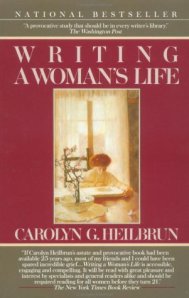
I’ve been thinking about those questions again recently because as I have tried to figure out what is most important to me to express as a critic (now that my long apprenticeship is over and I’m answerable primarily to myself for the future direction of my research and writing) I have identified two critics whose work indeed does inspire, move, and motivate me. More specifically, I have noticed that two critical books in particular repeatedly help me see and articulate what matters to me, or interests or challenges me, about many of the books I read, teach, and write about. One of these is Wayne Booth’s companionably plump and erudite The Company We Keep: An Ethics of Fiction, and the other is Carolyn Heilbrun’s slim but mighty Writing a Woman’s Life. Oddly, both were originally published in 1988. That means both were quite current when I started my PhD program at Cornell in 1990. But neither work–indeed, neither author, that I recall–was assigned, or even mentioned, in any course I took.

Booth’s book I discovered for myself when, soon after I earned tenure, I allowed myself to reconsider the focus of my scholarship, hoping to capture in my research the same excitement and urgency I felt in my teaching. I was dubious that I would ever feel much exhiliration pursuing increasingly esoteric projects about obscure women historians; I had done what I wanted to in that area with my thesis (which became my book). What I wanted to talk about was how and why novels actually mattered in our lives. I felt (feel!) that they do, profoundly, and I thought (think!) that one important facet of their significance is ethical. But I didn’t know how to talk about this in a rich way that would also be sensitive to fiction’s many other significant facets, including form, aesthetics, and history. The Company We Keep not only talks about exactly this, but it does so in Booth’s wonderfully engaging, unpretentious, open-minded way. It was criticism that talked about how we live in the world, and about literature as part of that living rather than something abstractly theoretical. Booth’s work was part of a wider debate about the ethics of fiction that included, among many others, Richard Posner, Martha Nussbaum, and, eventually, me: I published two academic essays as a result of this turn in my research (here’s one, in PDF; here’s the teaser for the other). The ideas it generated infused my teaching as well, particularly in a course I designed on ‘close reading’ that I will offer again, for the first time in 5 years, next fall. More recently, I wrote an essay on Gone with the Wind that attempted a “Boothian” reading of that problematic novel: an ethical reading that avoids (or so I hope) simplistic finger-pointing while accepting morality as a key aspect of literary evaluation. (Judging by the comments, not everyone was convinced! But I hope, in the spirit of what Booth calls ” coduction” [my favorite neologism!], some readers found themselves thinking about Gone with the Wind differently, even if they didn’t agree with me in all the details of my argument.) Clearly, Booth counts for me as an influential critic; I only wish I had read him earlier and been in a program where he and his interests had been prominent instead of–well, instead of much of what I was assigned.

I have a longer relationship with Heilbrun’s little book, which was given to me by my mother soon after its publication, with a lovely inscription noting that she had found it “interesting and provocative” and hoped we would talk about it “over tea.” It seems appropriate that Writing a Woman’s Life should have come to me in this way, as a gesture of shared interests and an invitation to intimacy and support, because that kind of female community and the strength it generates is one of Heilbrun’s major themes. Written relatively late in Heilbrun’s long career, its brevity is deceptive as it distills the accumulated insights of three decades of academic experience and feminist scholarship (for Heilbrun, often in a vexed relationship with each other). It’s wise, articulate, and insistent. I drew on it in formulating the central argument of my thesis and book, quoting from its first chapter, which is nominally on George Sand but is also on the difficulties and the vital necessity of finding appropriate ways to shape narratives of women’s lives. “Lives do not serve as models,” Heilbrun writes;

only stories do that. And it is a hard thing to make up stories to live by. We can only retell and live by the stories we have read or heard. We live our lives through texts. They may be read, or changed, or experienced electronically, or come to us, like the murmurings of our mothers, telling us what conventions demand. Whatever their form or medium, these stories have formed us all; they are what we must use to make new fictions, new narratives.

She moves immediately on to an example from George Eliot, to the Alcharisi in Daniel Deronda, who vehemently “protests women’s storylessness.” She writes in the book about women who lived lives that chafed against the stories they knew, and about biographies of these women that did, or, more often, did not find a better story to tell their lives in. She writes about anger and courage, about love and compromise, about age and beauty, about Dorothy Sayers and Virginia Woolf and herself. Writing a Woman’s Life is as much polemic (graceful and witty as it is) as theory, and it makes big claims supported by allusion and invocation rather than narrow claims defended by bulwarks of footnotes and metacriticism. It’s not, exactly, scholarly, but then it wasn’t exactly meant to be, because it’s a book that’s about living life as much as it is about writing it. “I risk a great danger,” Heilbrun remarks at the outset: “that I shall bore the theorists and fail to engage the rest, thus losing both audiences.” But Writing a Woman’s Life is never boring because it has all the urgency I wanted criticism to have. Though I didn’t immediately see it as a relevant book when I was reconsidering my own critical path, it’s urgent because it too is ethical criticism, in that broad sense of ethos that drives Booth’s arguments as well, and it’s urgent because it thinks it matters what and how we read: it takes fiction seriously because it sees reading as part of living, as shaping how we think and thus how we live.

I’ve found myself returning again and again to Heilbrun’s ideas about the limits of narrative forms and the problems of conceptualizing new stories (especially love stories) when talking with my students about many different novels, from The Tenant of Wildfell Hall to The Mill on the Floss to Sue Grafton’s ‘A’ is for Alibi. Like Booth’s book, Heilbrun’s has been recurrently useful not so much in the details but in the lens it offers for bringing key problems into focus–or, to try a different metaphor, for the way it illuminates the problems I want to talk about. Reviewing a new biography of George Eliot that frustrated and disappointed me, I turned to Heilbrun for help in explaining why. I just turned to her work again while teaching Death in a Tenured Position, which was written by Heilbrun under her pseudonym, Amanda Cross. (In another odd coincidence, Death in a Tenured Position is dedicated to May Sarton, whose novel The Small Room I just read and wrote up for the Slaves of Golconda.) Looking at it again, and also reading with great interest and pleasure the essays in her collection Hamlet’s Mother and Other Women, I found that after all these years, she more than most critics speaks in a voice I want to listen to. She’s infectiously passionate about the books and writers and issues she addresses, and she explains them sympathetically: her approach is inspiring, even, again, if we might differ on the details. Her  own story, also, with its brave ending, is moving in its effortful integrity. She was a controversial figure, but that in itself is motivating. As she says towards the end of Writing a Woman’s Life, those of us who are very privileged,

not only academics in tenured positions, … but more broadly those with some assured place and pattern in their lives, with some financial security, are in danger of choosing to stay right where we are, to undertake each day’s routine, and to listen to our arteries hardening.

“I do not believe,” she concludes, “that death should be allowed to find us seated comfortably in our tenured positions.” There, she is surely correct.

Metablogging: Three Interesting Posts

Like conventional academic criticism, lit-blogging is subject to fits of self-consciousness culminating in metablogging. While a few years ago such posts were likely to be forward-looking and exploratory, about the possibilities of blogging as a new frontier in criticism, the latest round of posts from Dan Green, Scott Esposito, and Steve Mitchelmore are more equivocal. Actually, Dan Green is pretty much just negative:

Literary blogs are (unwittingly, I hope) abetting the capitalist imperative to get out “product” as quickly as possible. New books appear, are duly noted, presumably consumed, and then we’re on to the next one. While sometimes lit bloggers consider an older title, it’s usually by an already established author or a “classic” of one sort or another. Little time is spent considering more recent books that might not have gotten enough attention, or assessing a writer’s work as a whole. Once the book has passed its “sell by” date, nothing else is heard of it and every book is considered in isolation, as a piece of literary news competing for its 15 seconds. The more potential readers come to assume that this is the main function of lit blogs, the less likely it is that the literary blogosphere will have any lasting importance. Literary blogs might let you know who reviewed what in the New York Times, but that The New York Times might not be the best place to go for intelligent writing about books is not something they’ll have the authority to suggest. (read the whole piece here)

Stephen Mitchelmore’s response is almost elegaic, but there’s still a hint of that early utopianism:

I have to admit that for years I was mystified why my blog writings have gone apparently unnoticed, at least in terms of page views. While the most popular blogs were getting thousands a day, I was lucky if This Space gathered 300. I thought, isn’t my review of Littell’s The Kindly Ones better than almost all the others, and didn’t my post on a road traffic accident say more about life’s relation to literature than any journalist’s exposé of an author’s life? Perhaps, however, these explain why it is relatively unpopular. Anyway, I have a difficult relationship with praise and criticism, with self-effacement vying for dominance with aggressive resentment. It is probably best to write, as in those early days of Spike, as if nobody is watching. After having published a dozen or so reviews in print media, I’m nowadays genuinely happier to work for weeks on long reviews or essays and have them disappear into the gaping void. Finding a way to talk about the reading experience is, I’ve realised, the greatest pleasure of writing; where it ends is of no importance. Still, over the last fourteen years of online work, I’ve seen the names of my key writers – Thomas Bernhard, Maurice Blanchot and Gabriel Josipovici – become familiar whereas before they were marginalised. If I have had only a minor role in this, it has made the effort worthwhile.

Yet I still like to imagine an ideal literary website in which the design, the writing and, most of all, the editorial vision offers a unique and dynamic approach to literature and culture in general, countering the banalities of commercial literary sites. So what might it look like? I have an idea but it requires an exceptional amount of work by people who have to earn a living elsewhere. Perhaps such a website is only ever the green ray as the sun sets on one’s hopes. Such a feeling is nothing new and we may learn something from previous attempts in strikingly similar times. (read the whole post here)

Scott Esposito picks up the thread:

I’m not sure how ironic Stephen was being about not understanding why his reviews were lesser-known than those elsewhere (and generally his are of much higher quality that what you’re likely to find in other places), but it’s not too hard to explain. Likewise, the method of building a literary site with high amounts of traffic is not mysterious. Go have a look at the Huffington Post books section, where every week you can find gossip about celebrity memoirs and counter-intuitive lists along the lines of “10 Most Outrageous Outfits From New Book ‘Critical Mass Fashion’ (PHOTOS).” Just make sure to have enough important names within your h1 header, say something contentious but not terribly complex that will generate a billion links, and keep it all short and with a lot of photos. Copy that with your own stable of writers, and you too can build a fairly well-trafficked site. This is not rocket science.

Obviously, some people would shoot for other things in a site besides high traffic, and this points out the problem with focusing on hits as a measure of a website, even though the first question anyone ever asks me about my sites is how many hits they get. But as Stephen’s site demonstrates, you can be influential even without getting major traffic. So choose what you want your site to be, and then do it. (read his whole post here)

“Choose what you want your site to be, and then do it” strikes me as excellent advice. Like every blogger, I wonder at regular intervals what I do this for. I think it’s disingenuous for bloggers to suggest they write purely for themselves: no need to post online, in that case. We all write online in the hope of getting readers. But it doesn’t have to be thousands, or hundreds, to be a satisfying experience (in my case, I average barely 100 hits a day, at least based on the Sitemeter tracking, and we all know that not every hit is an actual reader). If you take Scott’s advice and write what you want–and invest in Mitchelmore’s insight that “finding a way to talk about the reading experience is … the greatest pleasure of writing,” which I think is a large part of the truth–your site will have integrity and reflect your own values as a reader and critic. Then the readers you get will be those you want to enter into conversation with, and the extension to criticism represented by your site will be sincere. I think Dan Green’s disappointment stems from his having had very specific hopes or ambitions for lit blogging. His was one of the first blogs I started reading, and the seriousness with which he took the work and the potential of blogging as an alternative form of criticism was really important to my own developing sense of what the form might allow, what purpose it might serve. While he’s right that there’s a real loss if the overall direction of the ‘litblogosphere’ is towards commercialization and marketing, the form itself remains infinitely malleable. The risk (indeed, the likelihood) is that the good stuff–the thoughtful, independent, eclectic voices–will be drowned out by the louder ones that pander and preen and sell (out). So here I agree with Scott that it’s no good to ‘persist in this “take your ball and go home” attitude.’ The New York Times may not be the be-all-and-end-all of criticism, but it would be nice to be able to harness some of the power of the prestige print publications, now all with notable online presences. If only their blogs and reviewers would play nicely with others and actively seek out interesting independent voices online who represent serious critical alternatives, showcasing them rather than insisting on the tiresomely reductive ‘critics vs. bloggers’ debate. If they really care about the condition of criticism in the present day, they would join in the effort to sustain good discussion, which–whatever its provenance–actually supports their own work by continuing to take books seriously.

Finding My Voice: Posts on Criticism

I’ve been doing some housekeeping here on Novel Readings, setting up some index pages to make my archive of old posts accessible. I’m organizing them according to the categories you see on the tabs above: Academia, Criticism, Fiction, and Teaching. That’s not everything, but it turns out to be quite a lot! The process has been interesting and invigorating, because as I review and update the links I realize not just how many posts there are but how they reflect the evolution of my thinking about literature and criticism, as well as of my habits and practices as a critic. Most of the posts on criticism show me wrestling with my desire to reconcile the values inculcated over many years of academic training with a strong wish to write in a different way, with a different sense of purpose and for a different audience. In early 2008, for instance, I wrote a post for The Valve on “Literary Criticism in/and the Public Sphere”  that drew on my reading of scholars including Brian McRae, Morris Dickstein, and Ronan McDonald. When I wrote it, I wasn’t sure what criticism that lived up to some of its closing suggestions might look like. Now, however, I can point to my recent essay on Gone with the Wind at Open Letters as an example of the kind of thing I had in mind, what I called a “renewed and theoretically updated Victorianism”: a close reading with an emphasis on ethics but supported by an engagement with form. The Gone with the Wind essay also represents a step towards the goals I expressed in a more recent post about metacriticism and my sense that the conversation in academic blogging was going in circles:  “I just want to get on with it: trying to find a critical voice, and to hone and articulate perceptions that reflect both rigorous reading and a more personal, affective, and engaged vision of criticism.” I know I haven’t finished developing as a critic or a reader, but it is exciting to realize that I have moved forward and begun actually practising criticism differently, including speaking more as myself. Working on the index pages has really brought home to me how important blogging has been to this process.

The old post from The Valve is linked to from the ‘On Criticism’ page, but I thought I’d re-post it here (with updated links) as well in case anyone would like to comment on it (I don’t post at The Valve any more). It’s a bit long so if you want to read the whole thing be sure to click on the ‘read more’ link!

Literary Criticism and/as the Public Sphere

When I heard the learn’d astronomer,
When the proofs, the figures, were ranged in columns before me,
When I was shown the charts and diagrams, to add, divide, and measure them,
When I, sitting, heard the astronomer where he lectured with much applause in the lecture-room,
How soon unaccountable I became tired and sick,
Till rising and gliding out I wander’d off by myself,
In the mystical moist night-air, and from time to time,
Look’d up in perfect silence at the stars. (Walt Whitman)

It is a commonplace of the history of literary criticism that the character of criticism changed when and because criticism entered the academy and became professionalized, somewhere around the turn of the 20th century (and ever after). The nature and consequences of this change have been examined and re-examined often over the years, in books such as John Gross’s The Rise and Fall of the Man of Letters (1969), Morris Dickstein’s Double Agent: The Critic and Society (1992), Geoffrey Hartman’s Minor Prophecies: The Literary Essay in the Culture Wars (1991), Christopher Knight’s Uncommon Readers: Denis Donoghue, Frank Kermode, George Steiner, and the Tradition of the Common Reader (2003), or the essay collection Grub Street and the Ivory Tower: Literary Journalism and Literary Scholarship from Fielding to the Internet (1998)–to name just a few.

Brian McRae’s Addison and Steele Are Dead: The English Department, Its Canon, and the Professionalization of Literary Criticism (1990) is certainly among the more lively and provocative books I’ve read on this topic. As his title suggests, McRae frames his consideration of English departments as professional and institutional spaces with arguments about what features in the work of Addison and Steele “render it useless to critics housed in English departments”–not, as he is quick to add, that “their works are without value, but rather, that they are not amenable to certain procedures that English professors must perform” (11). The short version of his story is that professional critics require difficult, complex, ambiguous texts to do their jobs (e.g. 146); the “techniques of simplicity” that characterize Addison and Steele propel them, as a result, out of the canon. As he develops his argument, McRae offers an interesting overview of the 19th-century and then 20th-century critical reception of Addison and Steele. He explains the Victorians’ admiration for these 18th-century predecessors largely in terms of the different understanding that prevailed about the relationship of literature, and thus of the literary critic, to life. Rightly, I’d say (based on my own work on 19th-century literary criticism), he sees as a central Victorian critical premise that literature and criticism are public activities, that their worth is to be discussed in terms of their effects on readers; hence the significance attached, he argues, to sincerity as well as affect. Especially key to McRae’s larger argument is his observation that the 19th-century writers were not “academicians” or “specialists in a field” (89):

For Thackeray and his contemporaries, literature is a public matter, a matter to be lectured upon before large audiences, a matter to be given importance because of its impact upon morals and emotions. For the present-day academic critic, literature no longer is a public matter but rather is a professional matter, even more narrowly, a departmental matter. The study of literature has become a special and separate discipline–housed in colleges of arts and sciences along with other special and separate disciplines. The public has narrowed to a group of frequently recalcitrant students whose need for instruction in English composition–not in English literature–justifies the existence of the English department. (92)

As McRae tells the story (which in its basic outlines is pretty similar to that told in other histories of criticism), this decline in the critic’s public role has had both significant costs (among them, the critical ‘death’ of Addison and Steele) and significant benefits. At times the book has a nostalgic, even elegaic sound:

People who want to become English professors do so because, at one point in their lives, they found reading a story, poem, or play to be an emotionally rewarding experience. They somehow, someway were touched by what they read. Yet it is precisely this emotional response that the would-be professor must give up. Of course, the professor can and should have those feelings in private, but publicly, as a teacher or publisher, the professor must talk about the text in nonemotional, largely technical terms. No one ever won a National Endowment for the Humanities grant by weeping copiously for Little Nell, and no one will get tenure in a major department by sharing his powerful feelings about Housman’s Shropshire Lad with the full professors. (147)

Not that McRae thinks they should–and indeed we can all share a shudder at the very idea. But to me one strength of McRae’s discussion is his admission that marginalizing affect, pleasure, and aesthetic response is, in a way, to be untrue to literature, and that the professional insistence on doing so also, as a result, marginalizes our conversation, alienating us, as McRae says, “from our students, our counterparts in other academic departments, our families [unless, he allows, they include other professional critics–otherwise, as he points out, even they are unlikely to actually read our books and articles], and, ultimately, any larger public” (164-5). In Democracy’s Children: Intellectuals and the Rise of Cultural Politics (2002), John McGowan makes a similar point: “There remains a tension between the experience of reading literature and the paths followed in studying. . . . To give one’s allegiance to the academic forms through which literature is discussed and taught is to withdraw [at least partly] allegiance to literature itself” [65]. In A Mirror in the Roadway: Literature and the Real World (2005), Dickstein too remarks that “Since the modernist period and especially in the last thirty years, a tremendous gap has opened up between how most readers read if they still read at all, and how critics read, or how they theorize about reading” (1).

Continue reading

Bloggers and Critics: Everything new is old again

My previous post on appreciating book bloggers was in progress as the discussion unfolded on Twitter about ‘book bloggers ruining everything’ (via Ron Hogan, for one, who was watching a discussion from earlier this year between Charles McGrath and Daniel Mendelsohn* that involved a fair number of pot shots at book bloggers [see here if you want to watch it for yourself]). I’ve been thinking that one of the reasons these reductive and dismissive attitudes towards bloggers have any traction at all, and come from such otherwise very smart people, is the problem of filtering.

In blogging (as in every medium) there is good stuff (even some great stuff) and bad stuff (even some really truly terrible stuff). It is probably true, just because of the lack of inhibitions on blogging and other forms of self-publication, that the bad-to-terrible stuff  outweighs the good-to-great stuff by a larger margin than in old forms of print media. It takes patience, curiosity, time and open-mindedness to trawl the vast array of blogs (even in the subset of book blogs) looking for the good stuff. Lots of us do it, because there are real rewards for lovers of books and criticism and conversation. But it’s vanishingly unlikely that someone who gets all their links from the Big Established Sites, including their blogs, will find most of the sites we write for or read, because they all seem to read and link to exclusively other Big Established Sites. The Book Bench at the New Yorker, for instance, has its own often engaging posts, but it links around pretty much exclusively to places like the Nation, or the Guardian, or the Wall Street Journal, or PEN. These are worthy sites, of course, but anybody who’s interested in the Book Bench is probably already following them, one way or another. At most, all the Book Bench is doing is letting us know which pieces in these esteemed sources were of particular interest to them, or saving us the trouble of sorting through more than a couple of our RSS feeds for the day. The blogroll at the Book Bench has 24 links–not a bad start, but all, again, high profile already (mostly other mainstream media outlets, plus Maud Newton, Sarah Weinman, and a couple of the best-known online book sites–The Millions, The Second Pass). Again, all worthy of our attention–well, there’s one on their list I’m not sure about, actually, and why it’s there and not some of the ones I admire, I have no idea.  The Guardian has a smaller and even odder selection; at the TLS, both Peter Stothard and Mary Beard have small blogrolls too, though ones that reflect a bit more idiosyncrasy, which is nice. Still, none of these sites (or a number of other blogs associated with major papers and magazines) seem genuinely bloggish, in that there’s really no sense of the reciprocity I suggested distinguishes blogging as an especially open and generous form. The major aggregator sites (I’m thinking of Arts and Letters Daily, for instance, or Three Quarks Daily) also rarely step outside the rarified world of the ‘top’ sites. It would be refreshing, and good for the general conversation about books (which we’re all passionate about–or at least amateur book bloggers are), if these Big Established Sites would participate in the remarkable opening up of the cultural conversation that the internet has enabled.  Right now, I think  followers of the big sites are bound to feel a bit claustrophobic after a while, not to mention excluded. The exercise of looking for the good stuff among the bad would be tiring and discouraging some of the time, but acknowledging the smart, articulate blogs that are more than what Mendelsohn calls “unchecked effusions”–and doing so in a forum that already has  a little credibility in the world of old media–might help people like McGrath and Mendelsohn stop conflating form and content–or just ignoring content altogether. A good place to start would be with the handful of sites I listed.

*I admit that I was particularly disappointed at the tone of Mendelsohn’s comments (though he does acknowledge that there are some good lit blogs, and his point about chasing ‘hits’ by writing what gets attention is a fair one) because I wrote what I still consider one of my best blog posts about his remarkable book The Lost. What difference does it make that I wrote this sitting in my basement fairly late at night? (I’ll spare you the detail of whether or not I was actually in my pyjamas: the blogger’s wardrobe seems to be an issue of surprising concern to some people.) It’s either good writing and analysis or not. It’s true that I wrote it without the benefit of an editor (well, besides myself–and I’m pretty tough on myself, as I am on others), but the unmediated scrutiny of online readers is another way to test the merits of the result. In my case, I was gratified to be recognized for my work by Three Quarks Daily, where the editors named this post a finalist in their arts and literature blogging contest last year (these contests, by the way, are a great step towards the kind of sorting project I wish sites like this should do–but I don’t notice 3QD linking regularly to the winners or finalists in their regular posts).

“The Story of an Eye”: Lynne Sharon Schwartz, Leaving Brooklyn

lsschwartz-210-exp-Leaving_brooklyLeaving Brooklyn is hands down my favourite reading of the summer, maybe even of the year so far. It’s also the only book I’ve read in a while that has sent me, immediately on finishing it, straight to the computer because I wanted to blog about it. Having said that, I realize that immediately after finishing a book is not necessarily the best time to write about it, as it allows no time for reflection. But Leaving Brooklyn excited the reader in me, and that’s a great feeling.
It’s an especially good feeling because I’ve been feeling a kind of mild, prickly annoyance at the whole conversation buzzing about the literary / lit-blogging / book-tweeting arena to do with men’s writing and women’s writing prompted by the fuss about Jonathan Franzen’s new novel. There was the shallow piece at the Atlantic, for instance, in which the writer realized he didn’t read books by women and set himself the noble project of “consciously trying to read at least one piece of fiction by a woman for every one I read by a man.” “This sounds stupid, I know,” he continues–yes, it does, because “fiction by a woman” is not a genre, and while it’s all very nice and inclusive to advocate reading “books outside of the reader’s direct experience as a way of understanding the world,” the very way the problem and its putative solution are framed here is impossibly reductive. Plus, of course, it’s impossible to imagine a woman reader seeking out a “piece of fiction by a man” as if that’s a coherent and potentially illuminating category–which of course proves the problem that men’s writing is more easily taken as universal, including by women–who have centuries of experience accommodating themselves, provisionally, to a more-or-less masculine point of view in order to enter into fictional worlds. I sympathize, though not entirely, with the reaction of Linda Holmes at NPR’s ‘Monkey See’ blog, who noted that the discussion would be improved by abandoning the term ‘chick lit,’ which is now far too casually flung around as if it embraces all “books that are understood to be aimed at women, written by women, and not important” (that “not important,” of course, is not Holmes’s view of books aimed at, written by, or about women). I’ve intemperately expressed my own impatience with what I take to be exemplary chick lit titles here a couple of times, and I’m not nearly as impressed with Jennifer Weiner as Holmes is, though I certainly consider Weiner’s books (including In Her Shoes) a big step up from, say, Confessions of a Shopaholic. But I do think that there’s something to the complaint that assumptions about literary significance still skew towards the masculine.

Anyway, I don’t want to set Leaving Brooklyn up as a case study in the gendering of literary standards, but it struck me so forceably as being a breathtakingly good novel that I am puzzled about why it’s not (to put it bluntly) more famous than it is. Why, just for instance, is The Catcher in the Rye a modern classic, and not this wonderfully pungent, self-reflective, intelligently emotional and erotic story? Now, to be fair, I’m not an expert on contemporary American fiction, and perhaps Leaving Brooklyn is considered precisely a modern classic. Or perhaps, as it was published only in 1989, it will grow into that status. Or perhaps it will shrink into the somewhat more marginal status hinted at by the odd qualifier in Russell Banks’s cover blurb: “The blend of lyricism and history, of memory and the imagination–all shot through with the female erotic–is wonderful,” he writes (my emphasis). Well, it is wonderful, and it is shot through with eroticism, sort of. But just as courses I teach with ‘Woman’ in the title consistently attract very few male students, how likely is it that this particular endorsement of the novel will be taken as indicating that it’s one of those books “aimed at women, written by women, and not important”?

But never mind all that, really, because the reason that whole discussion annoys me is precisely that it directs our attention to the writer and not the book. There’s a reason Charlotte Bronte and Marian Evans chose to publish under pseudonyms. Gender makes a difference, to be sure, but it’s when that difference becomes the measure that writers want to evade it.

Leaving Brooklyn is a novel that is intensely about a particular place and time: Brooklyn, obviously, in the post-war years. Street names, subway stops, card parties, news stories all evoke that era and the peculiar aura it has, especially for the protagonist, Audrey. “The air was suspended on a discrepancy,” she recalls:

something like the discrepancy between my mother’s use of the words ‘To thine own self be true’ and their true meaning. It was a presumption of state-of-nature innocence, an imaginative amnesia, and a disregard of evidence such as photographs of skeletal figures in striped pyjamas clawing at barbed wire, of mushroom clouds and skinned bodies groping in ashes.

The disjuncture between what is known and what is said is given oddly literal metaphoric form in the opposition between Audrey’s two eyes (“This is the story of an eye,” the novel enticingly, obliquely, begins, “and how it came into its own”)–one, her left, is perfect, but her right eye wanders, due (or so her mother believes) to an unspecified injury just after Audrey’s birth. So Audrey sees straight on, with perfect clarity, but also sees everything askew. She can see around corners, or so she feels; she can see through the discrepancies, the surfaces and half-truths. How is it possible–is it even desirable–to unite these perspectives? Not then, or at least not in Brooklyn, Audrey realizes. Brooklyn demands an end to wandering, as represented by the hard contact lens Audrey is prescribed to control the errant movements of her eye: “Conscientious parents pursued standardization as Calvinists performed good works,” she reflects. Difference was not to be borne but confronted.

But of course Audrey never does see as everyone else does. She learns to compensate for her lack of binary vision (just incidentally, so apparently did I, before an eye operation in my early childhood that repaired a problem with my depth perception): she navigates stairs and corridors, street crossings and subway stations, with precision and accuracy. She also learns to navigate the intangible complexities revealed by her intelligence and imagination, those qualities fed by her imperfect physical sight. She’s a reader and a thinker, sharp, unsentimental, feeling Brooklyn as a constricting force she must leave emotionally as well as literally. She can’t leave, of course, because Brooklyn is her past, part of her identity, who she was before she became who she is: “no matter how much I leave, it doesn’t leave me.”

Leaving Brooklyn is not just about leaving Brooklyn, though. It’s about, among other things, precisely that inextricable tie we have to our past and our early selves, but also about how we reconstruct that self, looking back and trying to recognize ourselves in the child we once were.  “I am confused about who I was,” she reflects:

why else would I need to tell this story about my eye? The confusion is that I seem to have grown up into someone who could not have been me as a child. Yet in the telling the girl grows to sound more and more like the woman I became. The voice overcomes her. The real girl with her layers concealing me becomes more elusive the more I tell. She has been superseded, but I am sure she existed. As I try to find her in me, I keep finding me in her.

At one point she feels the convergence of her selves:

She was me, at that moment. She already knew what I know. This is so startling to come upon that I have to stop and contemplate it. And her. Oh yes, I see myself plainly, right there, bearing the seeds of all I would come to know.

This is metafiction without pretense or flamboyance; Schwartz integrates crucial insights about the inevitable inauthenticity of memoir as a genre with the dramatic urgency of personal discovery.

It’s not accidental that this moment of identification occurs while Audrey is having sex with the Park Avenue eye doctor who prescribed the contact lens. Their affair is not, initially, revelatory to Audrey, but as its erotic possibilities unfold for her, her perception of the world around her becomes less bifurcated: her mind and her body begin to feel equally present to her, though what she sees in Brooklyn is that a woman “could choose the life of the mind or the life of the body, but she could not have both.” Though the doctor eventually expresses his somewhat pathetic (and certainly inappropriate) passion for her, he’s a catalyst for her development: he’s its occasion, not its object. The affair prompts her to see that there might be “another way to live,”

some free and unhampered way I could recover from those years before I stood waiting in the ration lines gripping my mother’s hand, before I began school and was assigned a place in the ranks.

It’s not desire that liberates her, not erotic freedom that she seeks. It’s not love, either–it’s the risk of “caving in” to the doctor’s love that scares her away, the risk of having to be true to him, or to them, rather than to herself. It’s something more like space–mental space, room to decide for herself, to identify herself. Walking through Manhattan after ending the affair, she experiments with an eye patch she has taken from the doctor’s office. But which should she cover, the good eye or the bad? She covers the left eye first, and the world becomes “a huge amorphous mass, its fine points and articulations lost in blur and darkness.” That’s not right: “I needed to find my life, not lose it.” Heading home from the subway, in Brooklyn again, she covers her right eye and “saw clearly the usual sights,” then switches it again. But that’s no real test, she thinks, as she knows the route “so well I could have walked it blindfold.” And yet as she goes along, everything around her indistinct, she is filled with “limitless buoyancy”:

It seemed I might leave the earth and sail up unimpeded, as the snow around me was sailing down, and float right over Brooklyn up to where the stars drifted. . . I didn’t want to float away, though; I was so enraptured that I wanted to remain here on earth, or maybe just a few inches above, and dance. Everything seemed perfect and right; the world, glistening and abundant, unfurled its rightness and perfection–how come I hadn’t noticed it before? Of course I would have everything I wanted, my life would be all I dreamed.

Her ecstasy is inexplicable: “it came from nothing that had happened to me today or ever, beyond circumstance, out of nowhere, a gift that wouldn’t last.” But what she feels is the spaciousness of human possibility, liberated momentarily from the specificities of history. Of course it can’t last, but at that moment she feels that her “entire past barely existed, could be rolled up into a mote in the eye and winked away.” Eventually her own life will begin, she thinks, and then “oh how freely I would float.” It’s the bad eye, the wandering eye, that sees her home that night, and with it she looks through and then past Brooklyn with the hopeful, naive, ambitious exaltation of youth. It’s an intensely personal but also profoundly commonplace experience, movingly represented in a book by a woman, about a woman, that I think deserves to be called “important.”

Best of ‘Novel Readings’: James Wood, How Fiction Works

This review first went up in March 2008. My brooding over deep vs. broad reading has had me thinking again about Wood’s criticism, which I wrote admiringly about when I first discovered him in 2007. (This remarkably belated discovery speaks volumes, I think, of the divide between academic and public criticism.) I have also been thinking a lot about Becky Sharp, because in an essay for the July issue of Open Letters Monthly I lay out a more elaborate version of the argument I touch on here for her incidental significance to the novel in which she is so captivating a heroine. Both lines of thought led me back to take another look at this piece. I haven’t kept up with all of Wood’s reviews since, mostly because he and I often choose different books to pay attention to, but when I do (as with his recent piece on David Mitchell) I’m still struck by the elegant erudition of his language and analysis. Still, as this review shows, I have some sympathy with Lauren Elkin’s proposal that Wood is “a fine specimen of a book reviewer” but not exactly a “literary critic.” Not, as they used to say on Seinfeld, that there’s anything wrong with that.

How Fiction Works was also very ably reviewed in 2008 in Open Letters Monthly, by Dan Green of The Reading Experience.


The dust jacket describes How Fiction Works as Wood’s “first full-length book of criticism.” Anyone led by this blurb to expect sustained analysis supported by extensive research and illustration will be disappointed, as in fact How Fiction Works turns out to be essentially a ‘commonplace book,’ a collection of critical observations and insights of varying degrees of originality and sophistication, developed with varying degrees of care and detail. Wood acknowledges having set deliberate limits on his project, likening it in his introduction to Forster’s Aspects of the Novel, proposing to offer practical “writer’s anwers” to “a critic’s questions,” and admitting (though with no tone of apology) that he used only “the books at hand in [his] study.” To some extent I agree with other reviewers who consider it only fair to evaluate the book Wood wrote, rather than regretting he didn’t write another one. Yet even within the parameters Wood sets, I think there are grounds for wishing he, with his exceptional gifts and qualifications as both reader and critic, had not sold himself (or us) short in fulfilling them. Further, beginning with the invocation of Forster but going well beyond it, the book has pretensions to grandeur: for instance, also in his introduction Wood remarks that Barthes and Shklovsky “come to conclusions about the novel that seem to me interesting but wrong-headed, and this book conducts a sustained argument with them” (2). With gestures such as this, Wood claims an elevated stature for his critical contribution that is undermined by its casual construction and over-confident approach to scholarship. Though How Fiction Works provides many further proofs of Wood’s critical gifts and considerable erudition, I think it also proves that even the best practical critic flounders when working only with what he has already to hand or in mind.

Right off the bat I was irritated by the book’s structure. Wood has said that he felt liberated by using the numbered “paragraphs” or sections, but allowing yourself to skip from thought to thought in this way means letting yourself off the hook too often. Frequently in the margins of my students’ work I write “And so? Finish the thought!” One effect of crafting, first paragraphs, and then longer pieces as sustained wholes is that in working out the overall movement of your ideas and building in appropriately specific transitions, you confront both the logic and the further implications of your claims: the form pressures you to think better. Numbered bits, however, relieve that pressure: you can just stop with one topic and start the next, and as long as they are more or less related, you can claim to be producing a unified whole, even if you are only papering over gaps. In How Fiction Works, the breaks often seem unnecessary: a new number sets off what is really just the next sentence in the idea already unfolding. Most of the time, however, they are substitutes for careful transitions. They allow a certain stream-of-consciousness effect to creep in: that last bit reminds me of this exception to a general principle, or of a writer who also does that, or of another favourite excerpt, or of a time I went to a concert with my wife. Well, OK, I guess, and no doubt it would have been much more difficult to do a coherent chapter offering a theory of, say, fictional character, realism, or morality and the novel. And I suppose it’s true that non-academic readers don’t want the kind of detail and complexity such a full account of these topics would require. Even so, the numbered bits felt lazy to me. The footnotes too had an aimlessness about them. Some of them covered ideas or examples that seemed no less important to their chapter than most of the bits allowed their own numbered section (note 53 on p. 150, to give one example) while others appeared entirely unnecessary to the book (note 40 on p. 121, or note 41 on p. 124, for instance).

The TLS reviewer objects to Wood’s “grace notes”: “It is sometimes hard to distinguish a gasp of admiration for another’s skill from the contented sigh when the books in one’s study satisfy one’s own theories.” I shared this reaction, not least because “how fine that is” (139) is an expression of taste, not criticism. But Wood is a compelling reader of details, even passages. It’s when he makes broader assertions that he leaves himself more open to objections. For one thing, he has some governing assumptions about what fiction is for that he treats as universal rather than historically or theoretically specific. In his chapter on “Sympathy and Complexity,” for instance, as a footnote to his remarks on fiction as a means of extending our sympathies (the occasion for one of his shockingly few references to George Eliot!), he adds this:

We don’t read in order to benefit in this way from fiction. We read fiction because it pleases us, moves us, is beautiful, and so on,–because it is alive and we are alive. (129)

Well, maybe, but not everybody, and not all the time: for instance, most of the Victorian critics I have been editing for my Broadview anthology [now that the anthology is actually out, I wonder if Wood would like a copy–maybe I’ll send one along!] would not have recognized this highly aestheticized motive for novel reading. Is it fair, or even sensible, to say that they were simply wrong? Or to ignore how the formal developments of the Victorian novel furthered ends not adequately respected by Wood’s post-Jamesian formulations? His is in many respects a teleological account of the history of the novel. “Progress!” he exclaims after a quotation from Proust: “In Fielding and Defoe, even in the much richer Cervantes, revelation of this altering kind occurs at the level of plot” (125). But were Fielding and Defoe trying to do what Proust did and failing? How much better we might understand them if we allow them what James calls their “donnee.” “It is subtlety that matters,” he declares in his chapter on character; “subtlety of analysis, of inquiry, of concern, of felt pressure”: “I learn more about the consciousness of the soldier in Chekhov’s The Kiss than I do about the consciousness of Becky Sharpe [sic] in Vanity Fair.” But Becky Sharp’s consciousness is surely not the point of Vanity Fair; indeed, I argue in my own lectures [and now, in my essay in July’s Open Letters] that too close a focus on Becky risks diverting us from Thackeray’s grand gesture of holding the mirror up to ourselves, so that the novel becomes an opportunity for us to reflect on our own morality and mortality. “Was she guilty or not?” the narrator asks–and, remarkably, will not tell us, because ultimately she is not the point but the occasion, the device. Thackeray is not a failed Chekhov any more than Dickens is a failed Flaubert. To Wood, “the history of the novel can be told as the development of free indirect style” (58), but that history is partial and often distorting.

About the operations of free indirect discourse and the importance of knowing who ‘owns’ which words, on the other hand, Wood is typically astute. Here’s one place where examples from Middlemarch would have served him well, though at the risk of undermining his generalizations. Consider this passage from Chapter 1, for instance:

And how should Dorothea not marry? — a girl so handsome and with such prospects? Nothing could hinder it but her love of extremes, and her insistence on regulating life according to notions which might cause a wary man to hesitate before he made her an offer, or even might lead her at last to refuse all offers. A young lady of some birth and fortune, who knelt suddenly down on a brick floor by the side of a sick laborer and prayed fervidly as if she thought herself living in the time of the Apostles — who had strange whims of fasting like a Papist, and of sitting up at night to read old theological books! Such a wife might awaken you some fine morning with a new scheme for the application of her income which would interfere with political economy and the keeping of saddle-horses: a man would naturally think twice before he risked himself in such fellowship. Women were expected to have weak opinions; but the great safeguard of society and of domestic life was, that opinions were not acted on. Sane people did what their neighbors did, so that if any lunatics were at large, one might know and avoid them.

Think how much is lost on a reader who improperly identifies the source of that word “naturally”–or the last two sentences altogether!

Wood is good on the telling detail as well as the quality he calls “thisness”: “any detail that draws abstraction towards itself and seems to kill that abstraction with a puff of palpability” (54). But again, when he moves into prescription, he becomes less persuasive, as when he objects to the “layer of gratuitous detail” in 19th-century realist fiction. Again, the challenge is in defining “gratuitous” (as, clearly, Wood himself is well aware), but he can’t propose any principle except, perhaps, his idea that “insignificant” details avoid irrelevance if they are “significantly insignificant” (68). After recounting an incident in which he and his wife had “invented entirely different readings” of a violinist’s frown at a concert, he claims that a “good novelist would have let that frown alone, and would have let our revealing comments alone, too: no need to smother this little scene in explanation” (72). Again, well, maybe. I can imagine at least one “good novelist” who might have done great things with their “different readings” of that little moment, perhaps even using their “revealing comments” as a chance to reveal even more about perception and reality as well as human relationships (“these things are a parable…”). Doesn’t it depend on what your novel is about and on the formal methods you are using to realize those goals?

I’d like to return before I close to the “Sympathy and Complexity” chapter, because this is a topic close to my heart, one on which I have spent a lot of my own critical energy recently, and one I expected Wood to handle particularly well. “Perfunctory” is the best word I can think of to describe it. I’ve mentioned already his dehistoricizing assumption that “we” don’t read in order to receive moral benefits. I doubt this is true in practice, and I also question the separation he implies between moral and aesthetic readings. Here is a case in which even a little research outside “the books at hand in [his] own study” would have immeasurably enriched his discussion: Wayne Booth’s The Company We Keep, for instance, would have helped him complicate exactly that separation. And the conversation about how fiction might do “what [Bernard] Williams wanted moral philosophy to do” (135) has many participants besides Williams: Martha Nussbaum comes promptly to mind. Further, not all novels avoid providing “philosophical answers”; he replicates Nussbam’s error in generalizing about “the novel,” but as a professional novel reader, he should know better.

Here the hybrid character of How Fiction Works proves a genuine weakness, I think. This chapter is not a full, responsible, or authoritative inquiry into its subject. Of course, it does not pretend to be (remember, the book promises only “a writer’s answers” to “a critic’s questions”). But then how should we evaluate it? Doesn’t Wood do even his non-specialist audience a disservice by taking up complicated subjects on which there already exists a rich body of scholarship and offering his own fairly casual observations with the confidence of real expertise? What a much greater contribution it would be to distill that complex material and present it accessibly! To grab what’s at hand and say just what comes to mind bespeaks an enviable but also problematic degree of confidence. And while the non-expert reader is in no position to object, the expert reader is easily deflected with the excuse that she is not the intended audience…

After I read How Fiction Works I re-read some of my collection of Wood’s essays, including his reviews of Never Let Me Go, Saturday, and Brick Lane. This is really wonderful stuff, as I have remarked before; I admire it wholeheartedly for its critical acuity, its literary elegance, and its moral seriousness. But considering How Fiction Works strictly as one among many books about books (and Wood is wrong, or perhaps disingenuous, when he says “there are surprisingly few books” of this kind about fiction [1]), I think there are many better choices available. I continue to recommend David Lodge’s The Art of Fiction, for instance, which takes up many of the same topics as Wood, though under a less grandiose umbrella of prescriptive claims. I think it’s an exciting development that Wood has landed a job in Harvard’s English Department. In taking this now unconventional route from journalism to the academy, he is following in the footsteps of many eminent Victorian critics (David Masson, for instance). But considering how bitterly difficult it is for those following the established professional route to land any academic job at all, it’s frustrating to think that he may not be held to anything like the same standard of rigour as many critics far less lauded and applauded. Here’s hoping that he has more books in him as good as The Broken Estate.

(Original post cross-posted to The Valve.)

Jane Smiley, 13 Ways of Looking at the Novel

From the Novel Readings Archive

One of the reasons I began blogging in the first place was to experiment with writing about books in a non-academic way. One of the first blogging projects I took up, therefore (because research is an academic habit that is hard to give up), was reviewing examples of non-academic writing about books–books about books, but written for actual readers. I read Nick Hornby’s The Polysyllabic Spree, for instance, which was the subject of one of my earliest blog posts, and Sara Nelson’s So Many Books, So Little Time, and Francine Prose’s Reading Like a Writer, and John Sutherland’s How to Read a Novel, among others. Unlike OLM’s Sam Sacks, who thought Jane Smiley’s 13 Ways of Looking at the Novel was a “low point” in the genre of “books about the culture of reading” (to Sacks, Smiley comes across as “a supercilious book-club leader uttering inanities over a demitasse cup”–ouch!), I thought Smiley’s was one of the best of the bunch.* It seems apt, then, to continue my series of posts resurrected from the Novel Readings archives with my own review of this particular book about books.

*Continuing in a nostalgic vein, my comment politely disagreeing with him about Smiley (which seems to have been lost in the move to the new OLM layout)  was one of my earliest interactions with Open Letters. And I also read Michael Dirda’s Classics for Pleasure, the main subject of his review, for my ‘books about books’ project but didn’t write it up because I thought Sam was completely right (and completely articulate, of course) about that one.


Of the array of ‘books about books’ aimed at general audiences that I’ve read in the last few months, Thirteen Ways of Looking at the Novel is by far the most intelligent and engaging. Smiley writes as a novelist primarily, reflecting often on her own experiences and motivation as an author, but she also writes as a scholar, a dedicated reader, and an insightful literary critic who can capture a significant idea about a writer or a text in a well-crafted sentence or two. Here, to give just one of many examples, is Smiley on Anthony Trollope:

Trollope was a great analyst of marriage as a series of decisions that turn into a relationship and then, as time goes by and the children grow up, into history and architecture; simultaneously, he was the great analyst of politics as it devolves into feelings and their effects on the nation. If we say that Trollope is the ultimate realist, we are recognizing that his work as well as his life recognized more points of view, more endeavors, more sensations, more things to think about and reasons to think about them than almost any other novelist; that the technique he developed for balancing the attractions of these sensations–in sentences, paragraphs, chapters, characters, and entire books–beautifully mimics the way many people construct their identities moment by moment. (133)

Not only is that analysis elegantly put–I love the description of marriage moving from something intangible and negotiable into something with the solidity of a building–but every reader of Trollope will appreciate how well Smiley has captured the distinctive qualities of Trollope’s accomplishment in something like the Palliser novels or the Barchester chronicles.

I was particularly impressed with Smiley’s engagement with the moral implications of some of the novels she considers. Her comparative discussion of Wuthering Heights and de Sade’s Justine (in which Bronte’s novel comes off much the worse) is an excellent example of ‘ethical criticism’: like Wayne Booth, Martha Nussbaum, and others (though without explicit reference to any theoretical work in this area) Smiley illustrates that elements far more complex than a novel’s content need to be considered when evaluating its ethical import:

Justine shows that whatever an author’s motives for depicting horror, the form of the novel itself molds the depiction. Ostensibly shocking and immoral, Justine actually promotes a certain moral point of view–that integrity and virtue can be retained and recognized in the face of relentless suffering. In addition, to expose secret corruption is to challenge its existence because of the nature of the novel as a common and available commodity. (111)[F]ar more shockingly cruel, in its way, than Justine is that staple of middle school, Wuthering Heights. No one has ever considered Wuthering Heights to be unsuitable for young girls; most women read it for the first time when they are thirteen or fourteen. There are no sex scenes in Wuthering Heights. . . . At the same time, there are no beatings or shootings in Wuthering Heights. The only blood is shed by a ghost in a dream.

At the same time, the theme of Wuthering Heights is that any betrayal, any cruelty, any indifference to others, including spouses or children, is, if not justifiable, then understandable, in the context of sufficient passion. . . .

Do the characters of Wuthering Heights perpetrate even a grame of the harm that the characters of Justine do? No. Does Wuthering Heights seem in the end to be a nastier novel than Justine does? Yes. They are similar in that both are unrelieved and both have endings that are happy relative to the rest of the novel. But it is more disheartening to read about Heathcliff’s domestic sins than it is to see the crimes of the ruling class exposed, because the exposure of political crimes seems like a step towards ameliorating them, while Heathcliff’s cruelties are specifically directed at those he should be nurturing, and only chance intervenes between him and his victims . . . . The paradox is that novelists ended up exploring the rich subject of the morality of interpersonal relationships only to discover that while, on the one hand, this subject was safe from the danger of sex and violence, on the other hand, achieving in such plots the satisfying feeling of redress is difficult if not impossible. (114-5)

The specifics of her argument will no doubt strike other readers as debatable, but to me her analysis is an effective example of the Victorian critical premise that I have been exploring in my research: that it is not the subject but its treatment that determines a novel’s moral character. The conclusion to this particular section also, I think, effectively captures the problem of the unsatisfying endings that are so common in 19th-century marriage plots (Tenant of Wildfell Hall, for instance, or Middlemarch): the novels expose and critique systemic problems with marriage and the condition of women but struggle to resolve them–or (as with Jane Eyre or The Mill on the Floss) resolve them by abandoning realism. Continue reading