While writing a series of novels featuring the same detective allows an author to develop the main character (it’s a requirement of detective novels, after all, that many characters remain opaque or two-dimensional enough that we aren’t sure if they “dunnit” or not, so character development is typically quite restricted), it also risks repetition, especially if the writer is fixated on a very particular social and political vision. Paretsky’s determination to use her novels to expose the evils of corporate capitalism means that you can pretty much predict the villains (big business) and their motives (profit) in every novel, and her continuing characters aren’t that interesting to me anymore. The near-death escapes strain credulity, especially as V.I. ages (Sue Grafton’s decision to keep Kinsey Millhone stuck in the 80s has saved her from this problem). The plotting is competent and the writing is OK, but it seems to me that this is a series that just doesn’t have anything new or interesting to offer.
Sarah Waters, The Night Watch
I’ve been eagerly waiting for the paperback edition of this novel, as I am a big fan of Fingersmith (such a smart novel, artistically and intellectually) and was thoroughly entertained by Tipping the Velvet. The Night Watch
I’ll just add that as historical fiction, The Night Watch struck me as wholly convincing.
Historical Fiction (Again)
I’m still thinking about what makes some historical novels so much more convincing than others, and about my annoyance that the protagonist of The Linnet Bird was so predictably progressive in her attitudes. The problem can’t be as simple-minded as not finding it believable that a 19th-century woman would be anti-imperialist; of course, on such issues there were contrary opinions in the 19th century, just as there were men and women who advocated women’s rights and the abolition of slavery. These were attitudes that went against mainstream assumptions in many ways, and that is part of what gives them drama as fictional positions, as the characters who fight for such enlightened views get to be rebels for our causes: they are fighting for what we widely accept as right. But does this mean that it is impossible for historical fiction to appeal to modern audiences if its protagonists accept the mainstream attitudes of their time? This week I watched an interesting period drama called Far From Heaven, in which the main character is a “perfect” 1950s wife and mother with liberal views on race who gets into a sympathetic relationship and then a romance with her black gardener. It becomes clear to them that what they want is so far out of step with the norms of their community that they cannot persist: his daughter’s safety is threatened, for instance, and both of their sets of friends condemn their attempt to cross the racial line. At the same time, the film explores the struggles of her “perfect” businessman husband with his homosexuality. The film makes very clear that both his love and hers are forms of impossible desire because of the historical moment in which they arise. I thought all of this was movingly presented; the highly stylized character of the film prevented it from being maudlin or cliched, as did the absence of heroism or simplistic happy endings. In the context of the thinking I’ve been doing about historical fiction, though, I found myself wondering if it would be impossible to do a sympathetic story in which a character who is not tolerant of such divergence from the norms was the protagonist: Kathleen’s best friend, for instance, who feels sorry for her having a gay husband (but has no liberal views on homosexuality), and whose sympathy seems to dry up when Kathleen admits her feelings for a black man. Of course we do not accept or want to sympathize with those attitudes, but does her (historically typical) mindset put her outside the pale? Is this why Gone with the Wind is not an entirely respectable novel today–because, among other things, its main characters are almost all quite satisfied with racial discrimination and slavery? But isn’t that realistic, in terms of majority opinion in the antebellum south? Can you depict that society as it was historically, depict its Weltanschauung without a layer of overt critique, and not appear to be (or really be) endorsing past values which we have learned to reject as immoral? Perhaps it’s time I put aside the Lymond Chronicles for a while and took another look at GWTW.
Dorothy Dunnett, The Game of Kings and Queen’s Play
Reviewing these first two books in the Lymond Chronicles, I have confirmed both that they are exceptionally convincing and vivid historical novels and that it is nearly impossible for me to approach them with anything like critical detachment. Part of the reason is just how well-known they are to me after all these years; another part is how almost wholly concerned they are with historical context, plot, and character. If there are broad “themes,” they arise from these fairly concrete elements, I think, rather than from abstractions or philosophies. One idea they explore through the protagonist is what I might call the burden of excellence, the expectations and responsibilities that arise for the possessor of extraordinary gifts, such as those with which Lymond himself is endowed. In their own quite different styles, Dorothy Sayers’s Peter Wimsey novels and George Eliot’s Daniel Deronda also investigate the challenges faced by people of outstanding abilities who sometimes resent the leadership or guidance others want from them. In this age of Forrest Gump and books “for dummies,” we seem much more at ease withweakness and stupidity than with brilliance, but these protagonists show there is plenty of drama (and perhaps even more significance) in intelligence and strength.
The Lymond books do also engage with other ‘issues’ that are somewhat less personal or less tied to the main character, though he is the agent for their examination. Nationalism, for instance–the costs and benefits, beauties and absurdities–of love for country is a major problem in The Game of Kings and also, through the Irish connections, in Queen’s Play, which also picks up questions about aesthetics and morality. But though I have not done a patient analysis, I would not consider any of these ideas central to the ‘aboutness’ of the novels. They seem more part of the cultural context of the characters, which is a world in which these ideas are being given new urgency (as borders and allegiances shift) and new forms. That is, it seems to me at this point that the characters debate because they need to, to be themselves at their time in history, not because Dunnett has a larger agenda about Scottish identity or the role of art in life.
But it’s the charisma of the novels themselves that overwhelms me: they are remarkably wide-ranging, as daring as any of Scott’s in their insistence on informing us about history and politics, and allusive beyond any other novels I’ve read–and yet all of this never oppresses or overwhelms. It also transforms plots that are improbable, melodramatic, and grandiose into narratives that (to me, anyway) never feel that way. It’s remarkable, actually, how tawdry the novels can sound even in some of the blurbs that are meant to market them. Here’s the cover copy from my old Popular Library edition of Checkmate:
Against the splendor and squalor of the dissolute court of France…amid the crosscurrents of political intrigues and passionate liaisons…through a labyrinth of danger and deceit…a bastard nobleman searching for his heritage, and the beautiful virgin bride he married but could not bed, move toward the climax that will mean greatmess and fulfillment, or else disgrace, destruction and damnation…
Any reader of Checkmate knows that in a way, that’s an accurate description, but it is entirely unfaithful to the tone and quality of the novel, which is not at all the kind of bodice-ripping pathos-soaked costume drama evoked. I suspect that the publishers figured nobody would buy the book if it were described more accurately!
Follow-Up: Historical Fiction
Since I don’t currently own a copy of The Eagle and the Raven, I’ve been looking around at other historical novels which I have found compelling over the years. As historical fiction was one of my earliest passions (according to my mother, I took my copy of Jean Plaidy’s The Young Mary Queen of Scots to class with me in first grade) I have a number of sentimental favourites still in my collection. Yesterday I browsed through about half of Child of the Morning, the other Pauline Gedge novel that used to enthrall me. It certainly looks a lot better than The Linnet Bird, and one reason is that Gedge seems to have tried hard to make her people not just act but think like Ancient Egyptians (I think that was actually the draft title of the Bangles song…). Hatshepsut really considers herself the daughter of the god, and this belief drives her actions and shapes her character, including what in a different telling might have been a false pseudo-feminist assertion of her right to the power usually accorded only to men. The novel teeters on the brink of romantic cliches in the central love story (some might think it falls over that edge) and it does not strike me as terribly literary or at all innovative in its form, but OK, for the most part, I was willing to say yes to it (see previous post).
But the real touchstone in 20th-century examples has to be Dorothy Dunnett‘s Lymond chronicles, and I don’t know that I’ll be able to resist turning this inquiry into why some historical novels work and others don’t into an excuse to reread the whole set–something I have not done for too many years. I took my old copy of The Game of Kings down this morning and realized it is more than 25 years since I first read it (I know because it is inscribed to me on my birthday in 1979). I had not realized until recently that my enthusiasm for these novels is actually part of a much wider phenomenon. I have still never met anyone else who has read them. Here’s a testimony from Scottish novelist Linda Gillard (you’ll notice I have learned how to use the ‘insert link’ function):
The Chronicles are my literary Forth Bridge. I re-read the cycle perpetually and when I come to the end of Checkmate, the final volume in the series, I always feel a need to return to the beginning again. With every re-reading I admire Dunnett’s achievements more, marvel at how she dared to write books that could not be appreciated fully in one reading or even two. She didn’t care if you couldn’t immediately grasp a point of plot or motivation. She refused to simplify. She expected you to work hard and knew that many readers enjoy working hard
Just starting The Game of Kings has quickened my reader’s pulse, but also I realize that these novels are among those that I’m reluctant to approach in a critical or technical way. Still, that’s how many of my students feel about Pride and Prejudice or Jane Eyre and I always assure them that such an approach won’t spoil the fun.
Linda Holeman, The Linnet Bird
I managed to finish The Linnet Bird, but frankly it was a struggle. The author has clearly done a lot of homework on historical and cultural details, but then I don’t really want to feel while reading a novel that the author has done a lot of homework–this, of course, has been the frequent objection to Romola, though for me anyway, George Eliot’s homework is always worth our while to contemplate, as it is never at the level of ‘talking points about the English in India’, which is about where Holeman’s seems to stay. I have been working with Henry James’s essay “The Art of Fiction.” At one point, discussing a novel he has recently read that attempts to trace “the development of the moral consciousness of the child,” he sums up his judgment of the attempt as follows:
For myself (since it comes back in the last resort, as I say, to the preference of the individual), the picture of the child’s experience has the advantage that I can at successive steps … say Yes or No, as it may be, to what the artist puts before me. I have been a child … and it is a simple accident that with M. de Groncourt I should have for the most part to say No. With George Eliot, when she painted that country, I always said Yes.
I can sum up my reaction to Holeman’s novel in a similar way: for the most part, I said no to it. Besides the lack of historical sense that I commented on in a previous post (particularly in the characterization of Linny Gow herself), I found the predictably PC plot incredibly tiresome. The English in India are all stupid, shallow imperialists–except Linny herself, who has a remarkably 21st century perception of their stupidity and insensitivity, and does not struggle at all to reconcile that perception with her shock at witnessing suttee. And surprise: she falls in love (well, sort of–she discovers ‘desire,’ as she tells us) with a Pashtun horse whisperer and finds in his primitive camp in Kashmir the sense of community and acceptance she has never found in uptight, pretentious, British society, where she was never allowed to be fully herself….
I really wanted to like this novel, partly out of an odd sense of loyalty to a Canadian author, but on finishing it, my overpowering feeling was relief that I had waited to read it before picking up Holeman’s second novel, prominent on new release shelves everywhere. I think I’ll reread A Passage to India: maybe what Holeman did not do as homework was study her literary predecessors. I’m also curious to take another look at another historical novel by a Canadian author, Pauline Gedge’s The Eagle and the Raven, which years ago was such a favourite of mine that my copy fell completely apart. Would I say yes to this novel, after all this time, and if so, why? (Why, too, are other novels set in the 19th-century so much more persuasive, including Sarah Waters’s brilliant Fingersmith and Michel Faber’s The Crimson Petal and the White?)
Thoughts on This Project–and a Question for You
I began writing up my quick ‘notes on current reading’ about a year ago , partly for fun, partly as a way to answer questions from friends and family about what I’d been reading lately and what I’d thought about it, partly as an exercise in non-academic writing about books. I didn’t (couldn’t) take a lot of time over my comments, and indeed I decided not to allow myself to rethink and revise, to free myself from the many forms of self-consciousness endemic in professional criticism. For some years, though, in my professional capacity, I have also been brooding about the nature and purpose of that professional criticism. I wanted to increase the value and relevance of the research I was doing, and to bring to my scholarship the kind of excitement and motivation I feel about my teaching. On my sabbatical this term, I have been continuing to think about this issue, and trying to imagine an alternative form of literary writing that might be of interest and use to a wider audience than the narrow readership of a typical academic article or monograph. As my previous posts here indicate, one way I have been pursuing this question is through reading books about books aimed at general audiences. I have also begun exploring web resources, including online magazines and literary blogs. Of course, there are hundreds, probably thousands, of such sites now; every one I arrive at points me towards more and more.
On one hand I have been finding all of this very stimulating. It’s wonderful to see how lively and widespread the virtual conversation about books is, as well as to see that there is a big market for intelligent books about reading. It is also a salutary reminder, as if I needed one, of how small the academic literary world is, or can be, and how specialization works against the kind of general knowledge and broad cultural awareness that characterize the best of the sites and books I’ve looked at so far. It’s even a bit shaming to realize how oblivious I was to all this activity.
On the other hand, I am starting to get something of the same sense of futility here as I did with academic criticism, though for different reasons. If academic criticism fails to engage a wide audience because it is too specialized, too professionalized, too removed from the interests of ‘common’ readers, all this other material seems unlikely to engage a wide audience because there’s just too much of it. How can someone filter through it all, especially when much of it is updated daily? While the academic peer review system serves very different purposes than those embraced by reviews and blogs, out in cyberspace it’s an intellectual free-for-all, and the ease of setting up a place to comment (even I could do it!) makes it possible for anyone to put forward an opinion as if it should be considered on an equal footing with anyone else’s. Further, even supposing someone has the smarts and the training to offer insightful commentaries, how likely is it that blogging is the best way to express them, given the apparent pressure to say something pretty much every day? What really are the expectations here? What is the purpose of all this chatter?
I’m not about to retreat to my Ivory Tower, but I do feel a certain queasiness setting in. I’ve found a number of sites that strike me as worth keeping an eye on, but it’s hard for me right now to imagine making a great effort on, say, my own blog–because it’s hard to imagine it standing out, whatever approach I took, among all the others.
One other note here: In my reading around, I have noticed that my own impatience with literary criticism is echoed emphatically by a lot of writers out there, many of whom are not just impatient but positively vitriolic about English professors. Daniel Green of the blog The Reading Experience, for instance, writes about “academic schoolmasters, who now only serve to inflict the miseries behind the thick walls of their suffocating scholastic prisons” (see his article “Critical Conditions” at the Center for Book Culture). Ouch. While I find a lot of lit crit dreary to read, I do think there’s something to be said for expertise. Green talks about seeking a middle ground for “sustained and careful, but also lively and accessible criticism,” to which I say “hear hear” and let’s not underestimate the training and education it takes to be truly “careful.”
This post actually represents a break from another resolution I had made, which was to keep my blog about books, not about me. I’m curious though, in case anyone does read these pages: what does a widely read, intellectually serious lover of literature want from literary criticism? What makes a review, or a blog, or any commentary interesting and useful to you?
Sir Walter Scott, The Bride of Lammermoor
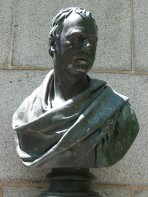 This novel, like Wuthering Heights, is on my list of “alternates” to consider for my 19th-century fiction course–it would replace Waverley, which I have persisted in teaching for over a decade, despite its inevitable status as least-popular-book-on-the-reading-list. I thought I’d review Bride in particular because not only is it relatively short (OK, by 19thC standards) but its tragic plot and gloomy drama seem likely to have more crowd appeal. I did, mostly, enjoy reading through it this time: it’s relatively fast moving (again, by 19thC standards) and there’s plenty of thematically interesting material to work with, especially about fate vs. individual choice or agency, women and power, aesthetics, and also some of the same historical and historiographical problems explored by Waverley. But–though this may be because I have not worked with Bride carefully at this point–Waverley just seems much more useful for demonstrating what Scott means to the history of the novel…plus (though I usually have trouble convincing all but a few students of this) Waverley is a very funny novel, and except for the tedious Caleb, Bride is pretty slim on humour.
Thinking about Scott while also beginning Linda Holeman’s The Linnet Bird has helped me clarify a bit what I mean when I say I find a book “thin.” Holeman’s novel, while entertaining so far, does not give a rich sense of why, historically, its people are as they are: what are the social, economic, intellectual, and other structures that shape (if not necessarily determine) the options they have and the ways they understand them? Both Scott and George Eliot are particularly good at presenting their stories of past times so that you understand that a plot just like this particular one would not unfold in the same way, not just with different characters, but at a different historical moment. Other Victorian novelists have been described as writing ‘histories of the present,’ because they perceive their own time with a similar commitment to understanding its complexity and contingency. My dissatisfaction with Quindlen’s Black and Blue can be traced to a deficiency in its historical sense as well, I think: though unlike The Linnet Bird it is not deliberately a historical novel, it might have done much more to explore violence against women as a phenomenon manifested in a particular way at a particular time. What are the forces and systems that enable a husband’s violence, a wife’s shame and submission, in that place at that time, so that at some other point along the way things would have developed differently? What are the ideas of masculinity or femininity that are at stake? Many more specific questions would fill in this list (for instance, questions about the significance of Fran’s job). Quindlen focuses much more on the psychological, individual factors–on personalities–than on these broader issues, but her novel thus stands more as a case study than a social analysis, taken from a late 20th-century context it does not attempt to understand. In that sense it is written for its own time (contemporary readers will fill in that context based on their own sense of how things work today) rather than to offer insights (rather than snapshots) for later generations of readers. Is it fear of exposition (of the dreaded ‘telling,’ instead of ‘showing’) that limits how much explanation authors writing for a general readership are willing to include? In Waverley, Scott apologizes for his lengthy accounts of history and politics but protests in his defense that his story will not be intelligible without them. In the deeper sense–that is, beyond the simple action of the plot–every story relies on that kind of context, and I appreciate novelists able to integrate it in some engaging way, thus offering the reader a fuller picture of what the world looks like from their perspective. (I’d say this is one of McEwan’s accomplishments in Saturday.)
Emily Bronte, Wuthering Heights
 I thought it was about time I re-read Wuthering Heights, not least because I am a little tired of teaching Jane Eyre in my 19th-century novels course and wanted to consider the obvious alternative. What a grim, unpleasant novel it is, though. The people in it are almost universally awful, and those that are not, like Edgar Linton, are weak and ineffectual, as if soft feelings just make you vulnerable. I remember at one time finding the passions of Heathcliff and Cathy romantic, but on this reading I found it impossible to associate either of them with any positive or sentimental feelings. The teacher (and critic) in me sees all kinds of stories to tell about the novel’s structure and themes, but I wonder how much enthusiasm I could muster for lecturing on it without something (or somebody) in it to root for. I have often made the argument to my students that the disappointments we are left with in George Eliot’s novels stimulate us to action: we wish for a realistic ending that is more satisfactory, for Maggie Tulliver, say, or Dorothea, and thus turn a critical eye on the real world that let them (and us) down. I can’t see taking this approach to Wuthering Heights, though, because the novel’s characters don’t really seem to deserve better than they get. Still, there’s no denying the raw power of the book, and its gloomy gravestones would certainly provide a contrast to the more conventional ‘marriage plot’ endings.
Anna Quindlen, Black and Blue
I picked this novel up in the library because I have been reading Quindlen’s How Reading Changed My Life (as part of my exploration of the genre of ‘books about books for actual readers’) and mostly enjoying it. It’s a gripping novel but I thought it was also manipulative, in the way We Need to Talk About Kevin is manipulative, that is, you are carried along by a fearful prurience about how bad it might get before it’s over. As a dramatization of domestic violence, it’s very effective, and its realistic assessment of Fran’s vulnerabilities, especially as a cop’s wife, was enraging, but she and the other characters never seemed particularly complex, and the analysis of her motives for both staying and leaving carried no surprises. Maybe the most poignant part, for me, anyway, was the portrayal of her son’s struggle to reconcile his mother’s experience with his own loyalty to his father. For lots of reasons, I would have preferred a different ending, but I have a strict ‘no spoilers’ policy so I won’t discuss that issue any further…

