If Adam Bede isn’t enough Victorian reading for you for one summer, the Trollope discussion group is nearly finished Orley Farm. Next up, beginning July 7, is The Small House at Allington. From the back of my Oxford edition: “The Small House at Allington introduces Trollope’s most charming heroine, the bewitching Lily Dale . . . She so endeared herself to readers of the Cornhill Magazine, where A Small House was first published in serial form, that Trollope was bombarded by letters begging him to marry her to her lifelong adorer Johnny Eames.” I read it once when, as a sabbatical project, I undertook to go through the whole of the Barsetshire series in order (great idea, by the way). I remember enjoying it a lot, and I just might see if I can fit it in along with Adam Bede…
Adam Bede at The Valve
OK, it’s up: the first invitation to post comments about Adam Bede as part of The Valve‘s “summer reading project.” I couldn’t resist pasting in a nice long excerpt from “The Natural History of German Life” as a prelude. Hey, it’s my party, and I’ll drone on and on if I want to… Click over and speak your piece about Chapters I-V.
 Corbould, Dinah Morris Preaching on Hayslope Green
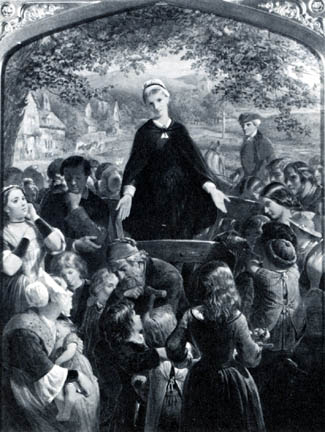 Corbould, Dinah Morris Preaching on Hayslope Green
(from the Victorian Web)
Victorian Halifax
 I complain a lot about living in Halifax, but when spring finally arrives out here, the city has some redeeming features. This bright, beautiful morning, I enjoyed one of my favourite Halifax things: a trip to the city’s Victorian Public Gardens.
First opened in 1867, the Public Gardens feature the most spectacular rhododendrons I’ve ever seen, as well as formal flowerbeds, a gazebo (with band concerts on Sunday afternoons), a large duck pond (with abundant ducks) and all manner of fountains and statues. It’s a green oasis in the middle of downtown: you can barely hear the hum of traffic, and as you stroll the well-kept walkways (no dogs, no joggers, and no bicycles allowed!), you can easily feel as if you have stepped back into a Victorian fantasyland.
There’s a Boer War memorial fountain, and a fountain commemorating Queen Victoria’s Diamond Jubilee. Even the swans are named ‘Horatio’ and ‘Nelson.’
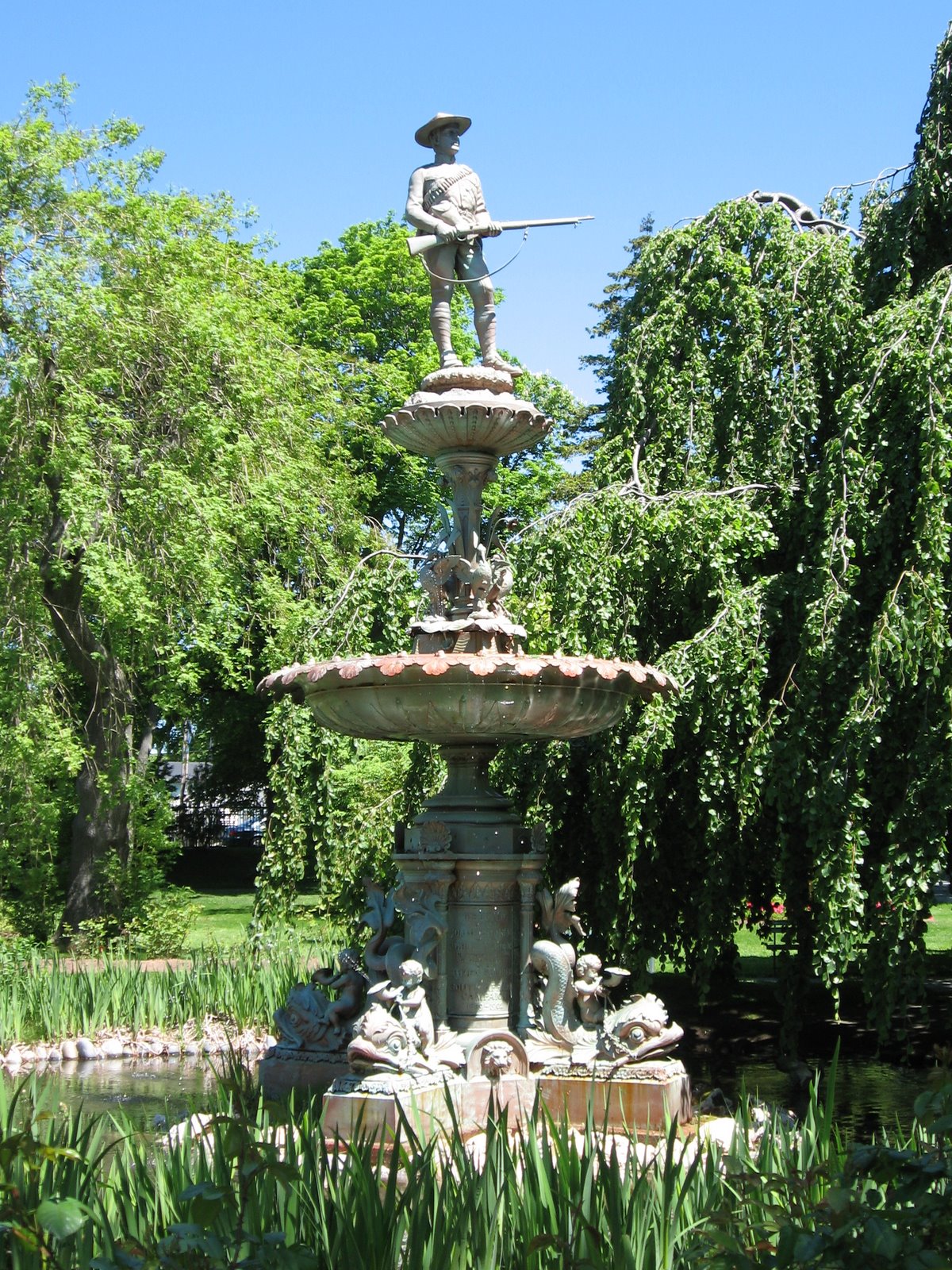 Boer War Memorial
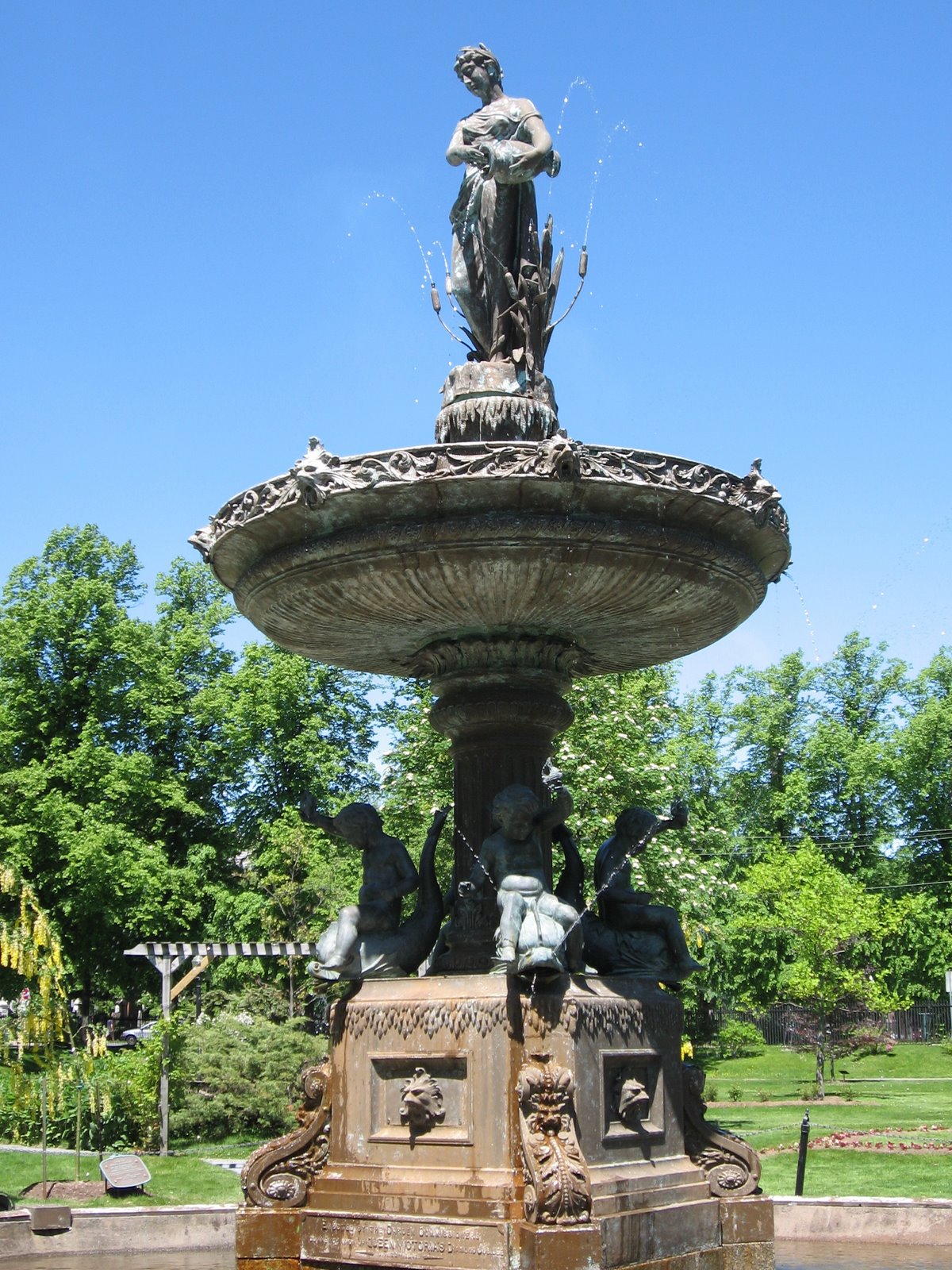 Diamond Jubilee Fountain
 Horatio (or Nelson)
When Hurricane Juan struck Halifax in 2003, the Public Gardens were hit hard (though not with quite the devastating results seen at nearby Point Pleasant Park, which lost an estimated 70% of its trees). Since then, the Gardens have been beautifully restored. Here are a couple more pictures from today’s trip, including a shot of the bust of Walter Scott that used to be right outside the front gates (during the restoration, it was relocated to just across the street, near the statue of Robbie Burns–we’re not called New Scotland for nothing).
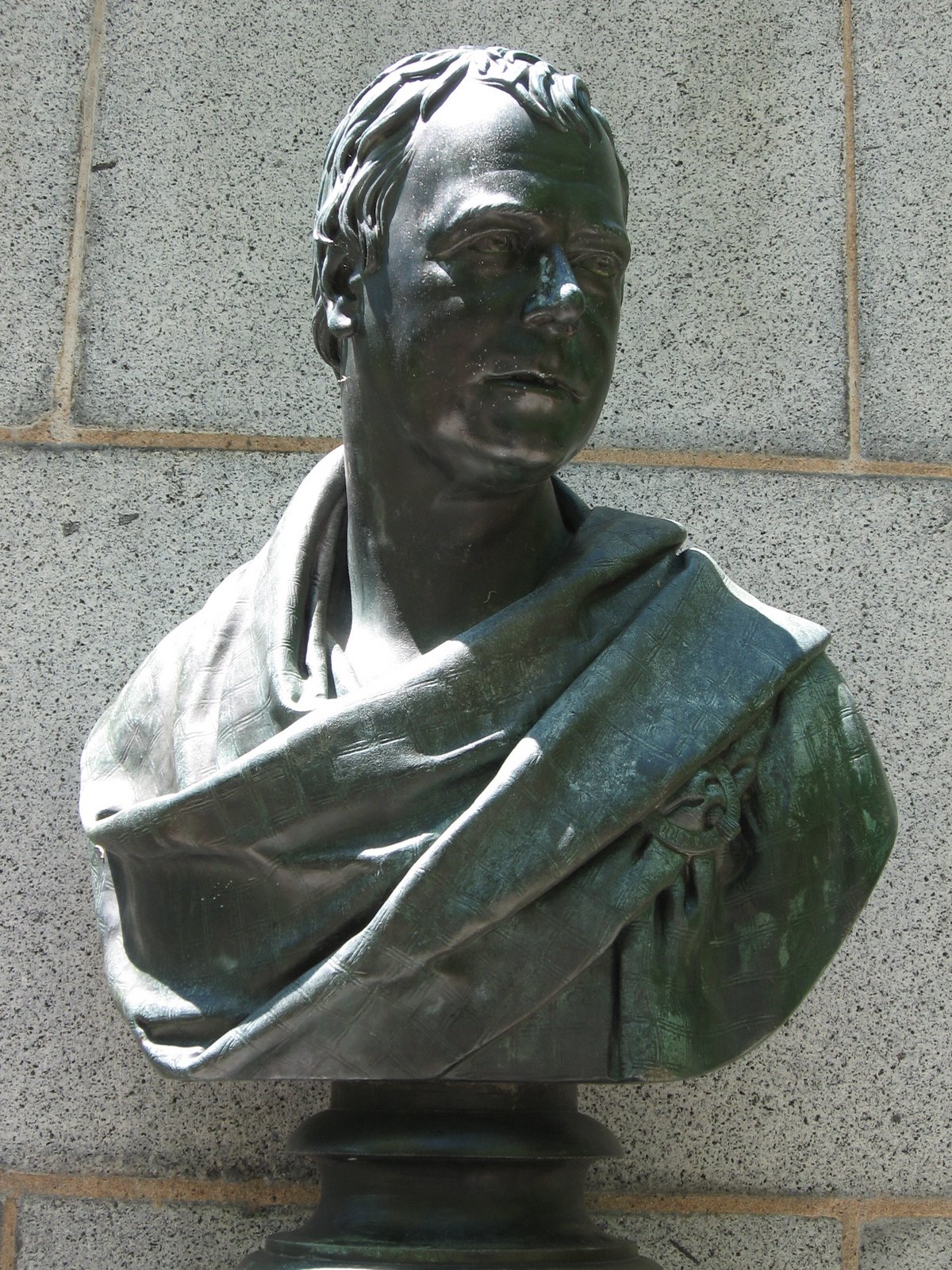 Sir Walter Scott
 Robbie Burns
 Massive Rhododendrons
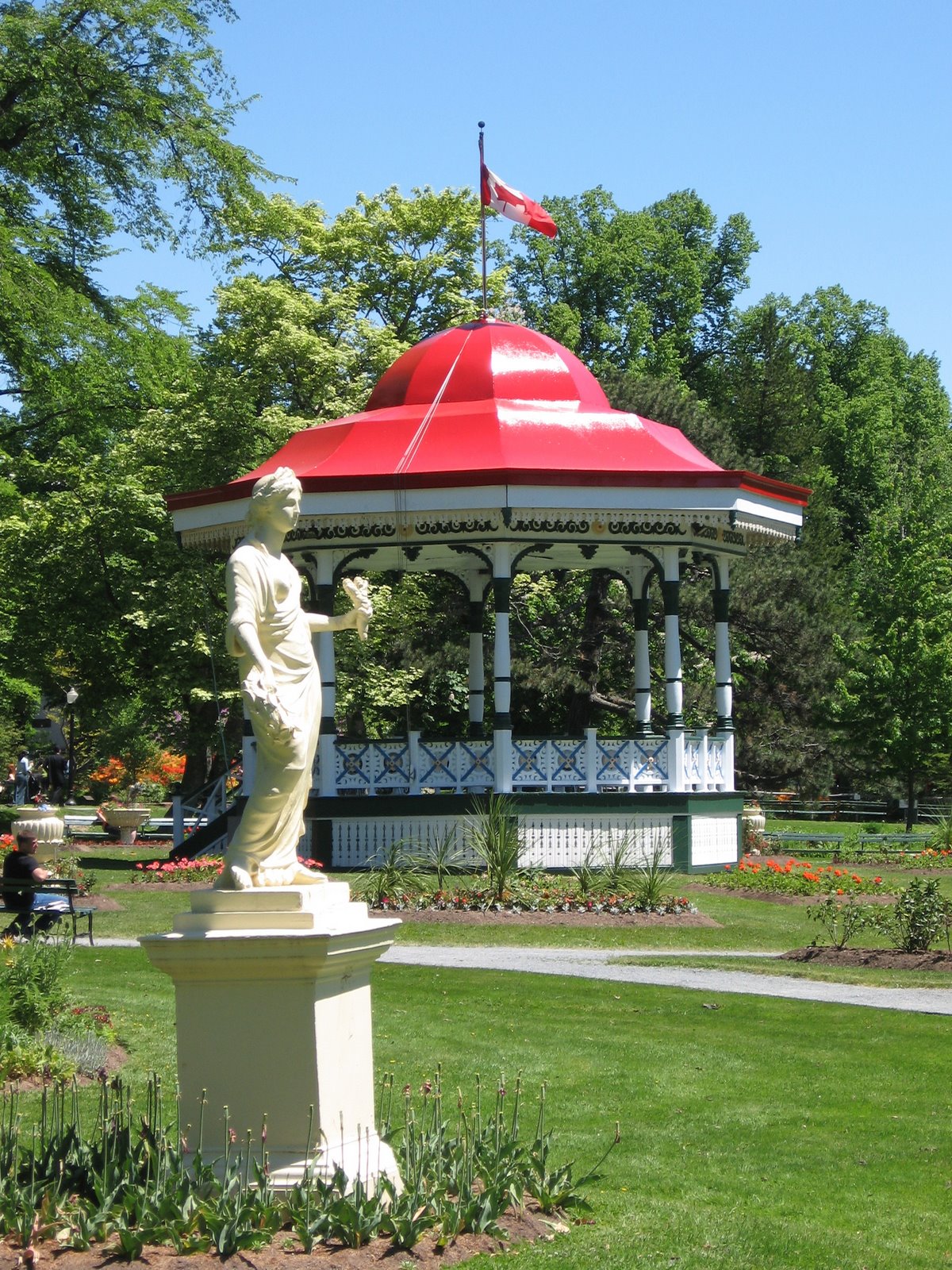 Victorian Gazebo
 Excellent Companion
with sassy new haircut
The Reader
A couple of weeks ago I posted about an article on Scott I found at The Reader Online. I’ve since spent quite a bit of time exploring the website for The Reader Organization, including learning more about the affiliated “Get Into Reading” program, the “Reading in Practice” MA at the University of Liverpool, and The Reader Magazine itself. Yesterday I also downloaded Issue 29, currently available for free from the website. I am fascinated and energized by what I have found, especially in the magazine, which includes, along with a range of new poetry and fiction, several examples of a genre of writing (or criticism) I have been trying to imagine for about 18 months, namely serious literary commentary written for (but not underestimating) a non-academic audience. For instance, Issue 29 includes a sort of round-table on Wordsworth’s The Prelude with contributors including Stephen Gill, Michael O’Neill and David Wilson; an essay by A. S. Byatt on “the ways that novelists have taken up the slack after the absconding of God. Post-Darwin, post-Freud, human identity is an arena of DNA and sex. Can science and our own biological reality offer a route away from our narcissism?”; essays on Conrad; book reviews; and much more, including features specifically designed to help “readers connect.” I highly recommend downloading it for yourself and taking a look at this publication, which recently celebrated its 10th anniversary. Perhaps you will find yourself surprised and frustrated, as I am, to be learning about it so belatedly. (Though maybe it is already widely known and I was just unaware of it. Do I blame myself–for having academic ostrich syndrome–or distance–as I am not aware that the magazine has distribution in Canada?) Perhaps you will also find yourself inspired, as I am, to see such a reconciliation between ‘readerly’ and academic approaches to literature–and grateful to the internet, for making connections and discoveries like this possible…I’m not aware of another publication (or organization) quite like this one, in its joint attention to contemporary and ‘classic’ texts–though I’d be happy to learn that there are such.
This Week in My Classes (June 11, 2008)
Yes, I’m teaching again. And hooray for that, I say: it puts a lot of energy back into my days, plus it gives me people to talk to as my colleagues head off on research trips or out to their cottages. I’m about a week into Women and Detective Fiction, an upper-level seminar I’m offering in our spring session–which means we are meeting 10 hours a week to get in a term’s worth of material in less than a month. Although the pace of these courses can be somewhat frenzied, I like the concentration they create: for once, all of your students’ attention is on your class, for one thing, and when you refer to the last book you read, they can usually remember it, because you just wrapped up discussion on it yesterday.
So after doing some early classics and some Miss Marple last week, yesterday we finished up with Gaudy Night. As I told them, it is a novel I expect to become more important and resonant to them as we get further along in our readings. For me, it’s plenty resonant already–indeed, it’s one of my top 10 novels, period. But it has never been a popular success when I’ve taught it. Its preoccupations–with the life of the mind, with the relationship of intellectual integrity to other kinds of honesty and commitment, and with the challenges of balancing head and heart, work and life–are perhaps too abstract for many students, or too remote (so far) from their own experiences of either love or education. I admire the unity of the novel, in which the detective plot and the romance plot turn (as Sayers said she meant them to) on the same point. Reacting against the puzzle mysteries of the era, Sayers remarked that “the reader gets tired after a time of a literature without bowels,” and in Gaudy Night she set out to humanize the genre and restore it to what she saw as the higher standards of its 19th-century forebears, such as the works of Wilkie Collins and Sheridan LeFanu (on whom, one of many nice metafictional touches, Harriet Vane is doing a research project while at Oxford). Harriet’s own detective fiction undergoes a similar transformation over the course of the novel, too. But most of all I enjoy the relationship between Peter and Harriet, which I read as one of the most successful fictional attempts I know of to imagine both the challenge and the realization of an equal partnership between two equally independent and intellectually demanding characters. What more satisfying proposal–thematically, politically, romantically–is there in a novel than Peter’s to Harriet at the end? OK, maybe I exaggerate. Maybe.
Tomorrow we move to P.D. James’s An Unsuitable Job for a Woman, then Death in a Tenured Position, so we go from Oxford to Cambridge and then to Harvard. Then we’re into the feminist revisions of hard-boiled private eyes, with Sue Grafton and Sara Paretsky, and then Prime Suspect, and then we’re done, all by June 27. I have been meaning to add an example of lesbian detective fiction into the reading list, and I should probably work to bring it more up to date–Prime Suspect (the one we’re doing) is from 1992, so that doesn’t seem so current anymore. Even the first time I worked on it with a class, one of the students laughed at the “dated” hair and fashions. I couldn’t see what she meant at all! That made me feel old, alright. Ruth Rendell and Elizabeth George are two likely candidates, I suppose, though I don’t see anything that interesting in terms of genre in George’s novels (though I think highly of most of them). Who’s out there doing something new with the form? Suggestions always welcome, especially as I’m not actually an avid mystery reader –I tend to stick with the authors I know I like, and to get irritated by gimmicky special interest ones (crossword puzzles, catering companies, bed and breakfasts, home repairs, quilting…you know the type).
Adam Bede at The Valve
At my instigation, The Valve is hosting a Reading Project this summer. We’ll be collectively working our way through George Eliot’s Adam Bede; here’s the schedule:
June 17 Book 1 Chapters 1-5June 24 Book I Chapters 6-11
July 1 Book I Chapters 12-16
July 8 Book II (Chapters 17-21)
July 15 Book III (Chapters 22-26)
July 22 Book IV (Chapters 27-35)
July 29 Book V (Chapters 36-48)
August 5 Book VI and Epilogue
August 12 General Discussion
Anyone interested is welcome to read along. The idea is to complete the specified chapters by the date given. A post will then go up at The Valve soliciting comments. People who keep their own blogs are free to do their posts at ‘home’ and put links to them in the Valve threads. At least to begin with, there are really no other rules. Come over and play!
Related Links:
The Victorian Web’s George Eliot page
George Eliot Resource Page (Mitsuharu Matsuoka, Nagoya)–includes information about the George Eliot Fellowship
BBC Warwickshire George Eliot Photo Archive
George Eliot biography (from a nice student project at the University of Virginia)
Adam Bede searchable etext (Princeton)
Adam Bede etext (Adelaide)
“George Eliot” by Virginia Woolf
Buy the Book:
Take That! Poetry as Punishment
Here’s a nice variation on the “Changing Lives Through Literature” approach to crime and punishment:
The criminal justice system in Ripton, Vt., prescribed poetry, of all things, as punishment — and we hope rehabilitation — for 25 teenagers (townies all) who broke into Frost’s old summer house in the woods last December. They trashed it during a snowy night’s bout of drinking and partying.
Skeptical at first, Mr. Parini, who teaches at nearby Middlebury College, accepted the invitation to teach the wayward teens. He did not pull any iambic punches in class last week.
One lesson was built around “The Road Not Taken,” Frost’s caution on the fateful choices that crop up in the dense woods of life. Harsher still was the choice of “Out, Out,” Frost’s account of a youth’s precious life spilling away in a sawmill accident amid the heedless glories of Vermont.
“They seemed shaken to their foundations,” said Mr. Parini, not that surprised. “A wake-up call: don’t waste your life.” (read the rest here)
My Teachers: An Appreciation
This post is my 200th at Novel Readings, and I’d like to turn it into something of a special occasion.
A month or so ago, finding myself in “a bit of a posting slump” after wrapping up my series on “This Week in My Classes,” I asked for suggestions about things to write about. I recently received this nice suggestion by email from Tom Wood: “How about a post on a teacher/scholar whose work has had a significant influence on you?” I really liked this idea, because I still think with admiration and gratitude of several teachers whose influence, support, and guidance shaped my life in ways exceeded only by the love and direction provided by my parents. So, for this 200th post, I thought I’d take up Tom’s suggestion and celebrate them.* Now that I’m a teacher myself, I reflect often on the potential we have, in this profession, for making a difference in someone’s development. If you had a particularly memorable or influential teacher, I hope you’ll post a comment telling me about them!
It is impossible to overestimate the importance the right teacher at the right time can have on a student, though it may be impossible to foresee what will turn to be “right” ahead of time. In my own case, I think of my sixth grade teacher, Mr. James. I hadn’t wanted to be assigned to his class, as he had a reputation for being brilliant but eccentric and sort of scary–all of which he was, and indeed still is! But he was the right teacher for me after all: he saw something in my moody, bookish 12-year-old self that caught his interest enough for him to lend me extra books and encourage me to be less fearful about the differences between my own strengths and the qualities that earned other students ease and popularity with their peers. I think, too, of the indomitable Joni MacDougall, who browbeat me into being a better writer and let me, as a nerdy tenth grader, visit her History 12 class to give a presentation on Richard III (when I say “nerdy,” I mean that I was the youngest member–at least to my knowledge–of the Richard III Society of Canada). Later, when she had moved to a different school, she invited me to speak to her social studies class on the Industrial Revolution. Both teachers intimidated, bullied, and pressured me; both also, in equal measure, inspired and motivated me. Somehow, they had an idea of what I was capable of that exceeded my own, and by urging me to cultivate my own interest in reading and history, they started me along my career path well before I could have articulated anything like academic ambition for myself.
But probably the most influential moment, and the one I never saw coming, was my enrollment in D. G. Stephens’s first-year English class at UBC. I nearly missed it: I had registered for another section, but after the first class meeting I was told that I had to switch to what they called a “Z” section (I had done well on a placement test, I think). So I showed up in Dr. Stephens’s class for the next meeting (and, I distinctly remember, had to write an in-class essay on the seven deadly sins, about which everyone else had been forewarned). Prior to taking his class I had fully intended to major in history. I was a lifelong avid reader, but a complete skeptic about literary interpretation: when I thought about literary criticism at all, which was almost never, it seemed to me an exercise in second-guessing, or just plain guessing–in seeing what wasn’t there. In retrospect, I think this dismissive attitude was partly the result of growing up in a house full of devoted readers: I took reading for granted and didn’t see why or how it could be complicated.
So what happened to me in Dr. Stephens’s class? Obviously, whatever it was, it changed my mind about a lot of things. But it wasn’t because he was messianic. His teaching style is probably best described as “understated,” in fact.** I particularly remember the way he would make a comment and then scan the room, looking for responses, which were slow and hesitant in coming (his demeanor was, or I remember it as being, a bit intimidating–wryly ironic, a bit cynical). Many of his remarks were actually very funny, and I came to believe he was looking around to see if anyone got the joke. (I do that too, now: it’s a good way to see who’s paying attention.) But I don’t remember that he ever cracked a real smile himself. When he asked the class a question, I often wondered what mysterious answer he had in mind. Whatever I was thinking seemed too obvious to be right, and clearly hardly anybody else would hazard a guess. But it was frustrating not to have more discussion, and one day we had read a poem I really liked (it was Robert Graves’s “The Cool Web“) and I finally put my hand up and ventured some replies to his questions about Graves’s language and how particular words fit the central ideas of the poem. He seemed pleased! My answers were good! I knew what he was talking about! Things started to fall into place. He wasn’t making things up, because I could see them there too, in the poem, and thinking about how the details of form and language built up the whole piece made the poem better, more pleasurable, more exciting to read. It was like something coming into focus, something I (as someone who had always loved to read both fiction and poetry) had always seen, but had never really looked at.
I actually have all of my old undergraduate essays (it’s a good exercise in humility to look them over, especially during marking season). I certainly didn’t get all As in his class. What I did get was a sense of the rewards of interpretation, of lingering over details, of making a specific connection with a text. It probably helped me that Dr. Stephens was not a showy teacher, and it certainly helped me that he was a rigorous one as well as a witty one. I didn’t give up the idea of majoring in history. Instead, I became the first UBC student to do a combined Honours degree in English and History (back in the olden days, interdisciplinarity was not the norm). I had many excellent teachers in both departments, and superb mentors for my Honours thesis in James Winter and Jonathan Wisenthal. But I dedicated my thesis to Dr. Stephens, with gratitude.
*I realize that Tom’s question may have been meant to elicit more about scholarly and critical, rather than personal, influences. I’m still thinking about that dimension of influence. No question, I have learned a lot from many teachers and scholars. But is that the same as having been “influenced” by them? And have any of them actually inspired, moved, or motivated me? (If not, is that a problem or a loss?)
**My search of the UBC website for pictures or other details about Dr. Stephens to link to revealed that he won a “Master Teacher” award in 1974 and 1977 (fully a decade before I took his class), so clearly I wasn’t the only student he impressed. This raises the further question for me of whether UBC had, at that time, a deliberate policy of putting senior and well-regarded faculty in their first-year classrooms.
Vikram Seth, A Suitable Boy (I)
I’m about 300 pages into A Suitable Boy, and I thought it might be useful (and, frankly, motivating) to commit to blogging my way through it, as I did with He Knew He Was Right last summer. Actually, the two novels have some features in common so far. First, both give a whole new meaning to the concept of a “slice of life” novel: call it, perhaps, a “swathe of life”! Both are multiplot novels organized around a variety of households. Both emphasize character, plot, and setting over overtly aesthetic or literary effects or themes–though with 900 pages of the Seth novel to go, that could change. Both also are told in a fairly flat prose style; so far, I would say Trollope is the livelier narrator, more playful and intrusive, with a wider variety of styles. Seth’s writing here is certainly descriptive, evocative of a specific time and of specific places, but (so far) it lacks the intensity of An Equal Music. The first-person narrator there is a key difference, of course, but third-person narration can be more engaging or intense than I am finding A Suitable Boy so far: it seems tepid or distanced.
This effect, however, may be purely in my mind, the result of the difficulties I am having getting close to the novel myself. As someone who reads long books professionally, I wasn’t intimidated by this one (though I continue to be frustrated by the logistical problems it raises because I literally can’t fit it into my tote bag for those precious stolen moments of pleasure reading). But I’m not doing as well as I’d expected. For one thing, I’m really struggling to keep track of who the characters are. I keep flipping back and forth to the handy family trees in the front. Presumably I will get better at this as I press on.
A more difficult problem for me is my unfamiliarity with the milieu of the novel, meaning not so much the bold outlines of the historical context (though my relative ignorance is certainly being impressed upon me) as the details of dress, food, and social and religious customs invoked on every page. I’m longing for a glossary! Scott provided one for his non-Scottish readers; Ahdaf Soueif, much more recently, provides a very helpful one in In the Eye of the Sun (from “Abu-l-rish: a popular district in South Cairo” to “Zebiba: a raisin; a brown mark that appears on the skin of the forehead as a result of much praying”). Soueif is self-evidently concerned with orienting (no pun intended) readers from outside the culture she writes about, a concern that is thematically appropriate to a novel itself preoccupied with cross-cultural communication and the intricate ways literary language participates in defining personal and national identities. Why does Seth see no need to provide a similar aid to his readers? Or, if he recognized this as a potentially useful thing to include, why did he opt against it? Maybe the fault lies in me. Am I particularly ill-informed–do most readers get all the allusions and know all the vocabulary? Am I supposed to be content to get only an approximate sense of so many details? Am I just lazy not to be reading with a stack of reference books beside me? Or is this a deliberate strategy of alienation for readers on the ‘outside’? I’m not finding this an overwhelming problem; I’m certainly learning as I go along.
Update: I went over to Sepia Mutiny for some more information about this book and one of the first things I found was a comment about the absence of a glossary:
A Suitable Boy: … the publisher asked, can we have a few more foreign characters to appeal to the foreign market… that’s why I was rather surprised that the… interminable book about a rather obscure period of Indian history in the ’50s… without war, without the assassination of prime ministers, without… much in the way of sex… without even a glossary… was successful outside India…
Whether to include a glossary: You can describe what a duck is, but if somebody hasn’t even seen a duck… If someone’s read Dickens… they have certain references to the geography of London… that we don’t get. But as long as the writer’s not trying to be particularly obscure… we give them latitude…
These are “liveblogging” notes from an interview Seth did with members of the South Asian Journalists Association; the complete interview (which I hope to listen to soon) is archived here.
If I Had a Million Dollars…
A member of the VICTORIA listserv just brought this to our attention:
GREAT EXPECTATIONS – DICKENS’ WRITING DESK AND CHAIR TO BE OFFERED AT CHRISTIE’S IN JUNE WITH PROCEEDS TO BENEFIT GREAT ORMOND STREET HOSPITAL
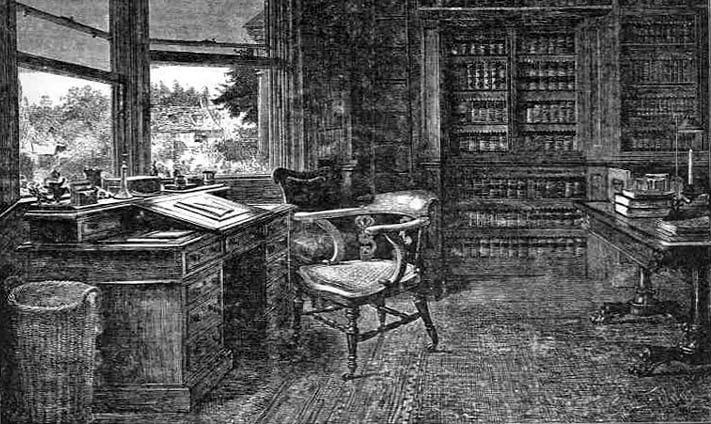
Yes, it’s the set seen in this famous engraving “The Empty Chair.” Christie’s expects the set to go for L50,000-L80-000.

