Open Letters Monthly: The Criticism Issue

The March issue of Open Letters Monthly went live this morning. It’s the journal’s 5th anniversary, and we’ve celebrated by paying tribute to some of the great critics of the last century–those who inspire, challenge, and provoke us as we try in our own ways to be the best critics we can be. The issue is a treasure trove of thoughtful analysis and personal reflection. Sam Sacks writes on Frank Kermode, the “wisest of secular clerics”; John Cotter covers Gore Vidal’s essays with authority; Steve Donoghue writes with feeling about the great Elizabeth Hardwick; Greg Waldmann recounts the inspirational effect of reading Edmund Wilson;  Jeff Eaton takes us back to Emerson; Maureen Thorson looks at Randall Jarrell’s Poetry and the Age; Nicholas Nardini takes on Lionel Trilling, “godfather of the liberal imagination”; Dan Green offers a reconsideration of Richard Poirier’s A World Elsewhere; Stephen Akey appreciates Anthony Lane’s Nobody’s Perfect; and I face my fear and write for the first time about Virginia Woolf, in an essay on her Common Reader volumes. Also in the issue is our monthly poem and our regular mystery column, this time a retrospective on the life and work of Dame Agatha Christie. Every month we put out the very best critical writing we can, but this month’s focus on the critics we admire most seems to have motivated us to work even harder than usual. We’re very excited about the issue, and proud of all the work we’ve done–for five years now. I’ve only been on the masthead for a couple of those years, but I couldn’t be happier and prouder today to be a part of Open Letters.

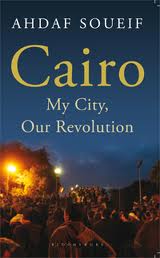
Ahdaf Soueif, Cairo: My City, Our Revolution

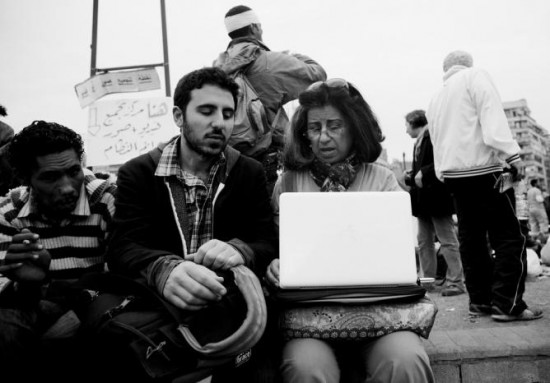
Everything about Cairo: My City, Our Revolution shows that it was a book Ahdaf Soueif felt compelled to write. Partly a chronicle of the 18 days in 2011 that changed the course of modern Egyptian history, partly a memoir of Soueif’s life in and love for Cairo, the book is emotional, affecting, polemical, and necessarily imperfect–because, as Soeuif is very aware, the story it tells wasn’t over when she wrote it and (as she often remarks) will have developed even further by the time it reaches its readers.

So why write it and publish it now, instead of waiting until we know more about what came after those 18 days? One obvious response would that it will almost certainly be years, not months, before we’ll know how things turn out–as if, of course, there ever can be a definitive or complete story of any event. Defining beginnings and endings is always to some extent arbitrary. What Soueif has done, then, is not to offer (and not to pretend to offer) a ‘history’ of the Revolution, but to give an account of a specific moment that actually, by historiographical standards, does have remarkably clear boundaries. On January 25, 2011, protesters marched to Tahrir Square demanding the fall of the Mubarak regime; on February 11, 2011, Mubarak stepped down. From the distance of one year, perhaps that has come to seem like not much, like  not enough; the regime fell but what has replaced it? On February 11, 2011, though, Mubarak’s resignation was more than most had ever imagined. It wasn’t (isn’t) everything, but without it, there could have been nothing further. So there’s an intrinsic rationale to telling that story, to giving us one insider’s view, one participant’s experience.

Viewed as this kind of immediate record, Cairo: My City, Our Revolution is both gripping and inspiring. Soueif’s descriptions of the atmosphere inside Tahrir are especially moving: ringed around with tanks, beleaguered by agents of the regime every imaginable way, within Tahrir it’s another world:

Even the light in here is different, the feel of the air. It’s a cleaner world. Everything’s sharper, you can see the leaves on the trees. Badly lopped, they’re trying to grow out. Everyone is suddenly, miraculously, completely themselves. Everyone understands. We’re all very gentle with each other. As though we’re convalescing, dragged back from death’s very door. Our selves are in our hands, precious, newly recovered, perhaps fragile; we know we must be careful of our own and of each other’s.

The Midan is sparkling clean. The rubbish is piled neatly on the periphery with notices on it saying ‘NDP Headquarters.’ . . . Lamp posts have put out wires so that laptops and mobiles can be charged. The field hospitals provide free medical care and advice for everyone. A placard reading ‘Barber of the Revolution’ guides you to a free shave and a haircut. A giant transparent wall of plastic pockets has gone up. The shabab [youth] sit next to it. People tell them jokes and they draw or write them and slot them into the pockets; a rising tide of jokes and cartoons. A Punch and Judy show is surrounded by laughing families. A man eats fire. There’s face-painting and music and street theatre and a poetry stand.

The protestors watch Omar Sulaiman interviewed by Christiane Amanpour:

We watched the old torturer, stiff with formality and self-belief, clinging on to his simple conspiratorial concepts, holding himself rigid against the tide, his thumbscrews and cattle prods for the moment useless. When he says his message to us is: ‘Go home. We want to have a normal life,’ the streets answer with one voice: ‘Mesh hanemshi / Enta temshi!’ We’re not going / You go home!

And then, in the Midan, there was a wedding, and then more music and everywhere there are circles of people sitting on the ground talking, discussing; ideas flowing, from one group to another until the most popular find their way to one of the four microphones on the stages. I pause by one group and they immediately invite me to sit. People introduce themselves before they speak. Three civil servants, a teacher, a house painter, two women who work in retail. They talk about what brought them to Tahrir. In the end, the house painter says, it comes down to one thing: a person needs freedom.

Soueif’s enthusiasm for this utopian moment is infectious, as is her admiration for the young people who started it, fought for it, and in many cases died for it. She recalls a man “with his hand on his son’s shoulder” who says to her as they pass, “Yes, really. I thought so badly of him; sitting all day at his computer. Now look what he and his friends have done. Respect. Respect.” Her book is an eloquent tribute to these young men and women and to all the protestors who held their ground. It’s also a passionate reiteration of their idealism, of the hope for a free, open, compassionate world that Soueif found manifest in miniature in Tahrir during those 18 days. (Here’s an interview with Soueif from February 3, 2011, that captures the energy of that time. She’s wonderfully articulate, as usual.)

As a document about that moment in time, then, Cairo: My City, Our Revolution is compelling. A second rationale for the book, though, is that Soueif also explicitly considers it a contribution to the larger struggle begun on January 25, 2011 but nowhere near finished when the book went to press, and certainly not finished today either. Soueif’s account of the 18 days is offered in two parts that sandwich a third section called simply ‘An Interruption.’ Here, from the vantage point of October 2011, Soueif records and reflects on some of the events after the protestors left Tahrir: “On February 11 it seemed that we had emerged into a clear open space and that our progress would be swift. Now, eight months later, our landscape is more ambiguous, more confused.” Egypt has not been transformed: “SCAF have allowed no one to examine, punish, rehabilitate the security establishment, so the country is full of armed and disgruntled police and baltagis [enforcers], short of cash and ready to be used. The regime is still rich. And the old alliance between the regime and the security establishment is still in place.” The army that refused to fire on its own people now hinders the revolution at every turn; the generals rule nearly as despotically as Mubarak, and the result is “a story of escalating confrontation between the revolutionaries and SCAF.” Protests are violently broken up, people are beaten and jailed, different elements exert their influence–“I see the Saudi flag flying in Midan el-Tahrir.” The organic community of those 18 days has been dispersed.

But Soueif believes its energy has not been lost, and her book is an effort to sustain it and to spread its idealism and optimism.”Events in Egypt,” she concludes,

did not go in a beautiful straight line from our Tahrir days to a truly representative government implementing the empowerment of the people. So we’re still fighting. And this book is part of my fight, my attempt to hold our revolution ‘safe in my mind and my heart.’

She sees signs “across the planet” that people around the world understood and supported the Eygptian protesters because there is a common dream of freedom and dignity. She invokes as one example the Occupy movements, which achieved in their encampments similarly inspiring, fragile models of a world governed by something besides power and greed. She’s right that “as [we] read, [we] know a great deal more” than she can about what has become of those movements. She was right that “there are many bad possibilities.” Is she also right that “there are more good ones”? It’s not an easy time to be an idealist, but Soueif argues that “optimism is a duty”:

if people had not been optimistic on 25 January, and all the days that followed, they would not have left their homes or put their wonderful, strong, vulnerable human bodies on the streets. Our revolution would not have happened.

And so she closes with her most optimistic dream: that Cairo, the city she loves and has watched degraded and defaced and corroded, is now

the capital of an Egypt that’s come back to her people, that’s regained control of her land, her resources, and her destiny, and Egypt that is part of a world on its way to finding a better, more equitable, more sustainable way of life for its citizens,where people’s dreams and ambitions and inventiveness and imagination find an open horizon, and where variety and difference are recognized as assets in confident, vibrant, outward-looking communities.

This vision reminds me of her writing about the ‘Mezzaterra,’ which I think is central to her fiction as well as her political vision (I wrote about it in my essay on Soueif for Open Letters). Her insistence that optimism–belief in the possibility of a good outcome–is a moral duty is compelling. Nothing guarantees bad outcomes more surely than giving up on the hope of better ones, after all. There was a lot of that kind of negative thinking during the 18 days of the revolution, and I’ve heard and read plenty of people pointing to recent violence and trouble in Egypt as if it shows they were right to expect no great improvements. Against such defeatism, Soueif’s book is a great tonic. Perhaps inevitably, because I have thought so much about Soueif and George Eliot together, its underlying belief that we make things a bit better just by hoping for the best reminded me of Dorothea, who tells Will, “I have a belief of my own, and it comforts me”:

That by desiring what is perfectly good, even when we don’t quite know what it is and cannot do what we would, we are part of the divine power against evil–widening the skirts of light and making the struggle with darkness narrower.

Soueif is deeply (understandably) troubled by her sense that Mubarak’s fall unleashed “the Forces of Darkness” encased and organized by his regime: “Now the casing’s been smashed and the Darkness is out there, unchannelled, panicked, rampant, twisting into every nook and cranny as it seeks to wrap around us again.” A book, however eloquent, may not be much, against such forces. But her hope is clearly that it will help keep the light of the Revolution bright and, indeed, make “the struggle with darkness narrower.” “This is about a better way of being in the world,” she says in the interview I’ve linked to above. That seems well worth hoping for.

 

This Week in My Classes: No Classes!

That’s right, it’s February Break, or Reading Week, here at Dalhousie, and just in time too, because I have so much to do! By way of motivating me and helping me keep track, here’s my task list for the week. I’ll update it as things get done!

  1. Finish essay on Virginia Woolf’s Common Reader volumes for Open Letters Monthly (done!)
  2. Finish essay on blogging and academic practice for Journal of Victorian Culture (done!)
  3. Mark 30 short fiction annotation assignments for Close Reading (done)
  4. Read and give feedback on 63-page Ph.D. thesis chapter (done)
  5. Write two reference letters, both due March 1 (done)
  6. Prepare thoughtful reply to inquiry about blogging for someone else’s article about it (done)
  7. Finish reading The Woman in White and prepare concluding lecture for next Monday’s 19th-Century Fiction class (done)
  8. Keep reading Middlemarch and prepare lectures and activities for next week’s Close Reading classes, plus intro lecture for 19th-Century Fiction (done)
  9. Finish blog post on Ahdaf Soueif’s Cairo: My City, Our Revolution
  10. Start series of blog posts on Rebecca West’s Black Lamb and Grey Falcon (my Balkan photos scanned)
  11. Submit book list to library for upcoming course on the ‘Somerville novelists’ (preliminary list underway)
  12. Brace myself for Fall 2012 book orders, which will come due April 1. (begun exploring options; publishers contacted for review copies)
  13. Mark 1 late poetry assignment for Close Reading (done)
  14. Edit incoming pieces for the 5th Anniversary Issue of Open Letters Monthly (I almost forgot that my own duties to this issue don’t begin and end with my own contribution!) (done!)

That list is sort of in order of priority, though I’m likely to intersperse lighter tasks like the Soueif blog post with harder ones like the thesis chapter and marking assignments. And the class prep for next week is here because I don’t want to wake up on Sunday and realize that in focusing on my special projects for this week, I let the routine business slip and end up in a panic. It’s a lot to do, but because this is also supposed to be a bit of a break, my aim is to work hard during the day and not work (or not work so much) at night the way I usually do. I have one more season of MI-5 to go on Netflix. An episode a night would be a nice treat–well, not so nice, since they keep killing off characters I’m fond of. But still, it’s a distraction.

February 28 Update: I didn’t get quite everything done during the actual break, but now it’s looking pretty good. The Rebecca West posts weren’t really a high priority anyway, but I am eager to get started on them and to keep reading the book. Not on this list is ‘Read Winifred Holtby’s Anderby Wold, which I have in fact been doing…so a post on that should follow before long. I think having this list posted publicly did prove motivating!

This Week in My Classes: Close Reading Middlemarch

You can’t really do it, of course, or not and finish the novel in a few short weeks. I’ve been rereading it for years and I know I still haven’t read it closely enough. Still, if you can slow down and really pay attention, I don’t know a book that’s more fun to try reading closely than Middlemarch–which is why I’ve been crazy enough to assign it in my Close Reading class.

We’re just starting up the novel this week, so on Monday I gave an introductory lecture on ‘The Interesting Life of Mary Ann Evans,’ part of my belief that humanizing the author will help give the students courage as they stare down what is one of the longest books they’ll probably be assigned during their degree. In that lecture I also lay out some general principles that are important to George Eliot’s philosophy of fiction in general and to Middlemarch in particular–ideas about realism and sympathy and morality. Though I worry a bit that starting with big abstractions will put students off the novel or make them approach it with something less than their usual enthusiasm for plot and character, I think it’s not a good idea to assume we can work inductively with such a big text. In this class especially, our work is on understanding and appreciating the literary techniques at work and how they support or convey such large-scale ideas. We will be able to talk better about what’s going on at the level of literary devices if I give them some shortcuts to themes and patterns.

On Wednesday, we worked on ways the novel teaches us how to read it. We talked about the title and subtitle, for instance, and how they let us know that we’re in kind of a middling community, marching along rather than wandering according to impulse (certainly not dancing!). We’re reading a “study of provincial life,” not, say, an exposé of the seamy underside of London: that sets up some expectations too, and it begins our education about the narrator, a learned observer, perhaps a scientist or philosopher, someone outside or above the action. That’s a good place to talk about what omniscient and intrusive narrators are good for: with other texts (such as Updike’s “A & P”) we had talked quite a bit about the advantages of first-person narration, but also about what a first-person narrator can’t usually do, such as provide historical background or critical perspective on himself. Exposition (or “telling”) sometimes gets a bad rap in contemporary talk about fiction, so it’s good to spend a little time on its  uses. One of the overall goals I have for the course is precisely this kind of attention to what different choices enable. In Middlemarch, one result of Eliot’s narrative strategies–not just her particular kind of narrator but also her attention to multiple points of view–is a lot of dramatic irony. We know a lot that the characters don’t know, or see things in ways they don’t. In the first chapters, we especially see more than, or differently from, Dorothea: we know that her marriage to Casaubon is a dreadful idea, and knowing that, we watch with shock and horror as she rushes ardently into it. But because we also get a lot of information from, and about, her point of view, we understand why she does it.

Today we had our first tutorial sessions on the novel. One of my goals was to get people started talking more about the novel, just to loosen everyone up. There’s a certain intimidation factor with such a big book, and we need to get past that and just start reading it and discussing it as soon as possible. But this is not a class on 19th-century fiction as such (in that class, we start Middlemarch next week, though, so yay, more!) but a class on close reading, so today I also wanted to help them see how and why to really pay attention. One of the most important stylistic features of the novel is precisely its constant shifting among different points of view, which happens at the level of individual sentences as well as paragraphs, chapters, and entire volumes. Eliot uses a lot of free indirect discourse, so some of the shifts are subtle. It can be fun but is also sometimes crucial to tease them out. If you aren’t paying attention to point of view, you might wrongly attribute observations or conclusions to the narrator, for instance (and thus take them to be the ‘position’ of the novel overall) that properly belong to specific individual characters or groups or communities.

Here’s one of the passages we read through today:

And how should Dorothea not marry? — a girl so handsome and with such prospects? Nothing could hinder it but her love of extremes, and her insistence on regulating life according to notions which might cause a wary man to hesitate before he made her an offer, or even might lead her at last to refuse all offers. A young lady of some birth and fortune, who knelt suddenly down on a brick floor by the side of a sick laborer and prayed fervidly as if she thought herself living in the time of the Apostles — who had strange whims of fasting like a Papist, and of sitting up at night to read old theological books! Such a wife might awaken you some fine morning with a new scheme for the application of her income which would interfere with political economy and the keeping of saddle-horses: a man would naturally think twice before he risked himself in such fellowship. Women were expected to have weak opinions; but the great safeguard of society and of domestic life was, that opinions were not acted on. Sane people did what their neighbors did, so that if any lunatics were at large, one might know and avoid them.

Much of that paragraph reflects the perspective of that “wary man”; it’s certainly not the narrator who thinks it’s “natural” to think twice about marrying unconventional women, or who sees it as the “great safeguard of society” that women not act on their weak opinions–or, if these are the narrator’s views, they are ironically inflected ones, as the rest of the novel might reveal. Unconventional people and ideas are, after all, disruptive.

Here’s another paragraph just a little bit further on:

She was open, ardent, and not in the least self- admiring; indeed, it was pretty to see how her imagination adorned her sister Celia with attractions altogether superior to her own, and if any gentleman appeared to come to the Grange from some other motive than that of seeing Mr. Brooke, she concluded that he must be in love with Celia: Sir James Chettam, for example, whom she constantly considered from Celia’s point of view, inwardly debating whether it would be good for Celia to accept him. That he should be regarded as a suitor to herself would have seemed to her a ridiculous irrelevance. Dorothea, with all her eagerness to know the truths of life, retained very childlike ideas about marriage. She felt sure that she would have accepted the judicious Hooker, if she had been born in time to save him from that wretched mistake he made in matrimony; or John Milton when his blindness had come on; or any of the other great men whose odd habits it would have been glorious piety to endure; but an amiable handsome baronet, who said “Exactly” to her remarks even when she expressed uncertainty, — how could he affect her as a lover? The really delightful marriage must be that where your husband was a sort of father, and could teach you even Hebrew, if you wished it.

Again, we start with the narrator, but if you miss the slide into free indirect discourse at the end, imagine what an odd idea of the narrator’s values you’d have! The more familiar we get with the characters as well as with the narrator, the more assured our attributions become (different characters speak very differently, as we’ll get to have some fun with in class when we do my “Look Who’s Talking in Middlemarch” handout (if you follow the link and do the quiz, let me know!).

The other topic for today’s tutorials was diction–a small word with big implications for Middlemarch. Our textbook introduced the concept of “semantic fields” in the section on poetic vocabulary, and I’ve been encouraging students to work with the same idea here, starting with the vocabulary associated with Dorothea and Mr. Casaubon. I gave them one direct hint (watch for uses of “ardent”) and we’ve already started running into “petty”: those two words define one of the novel’s central thematic conflicts, so if they start paying attention to them–to who uses them or where they apply–they will start to find that the initial impression the novel gives of information overload is offset by an awareness of patterns the information falls into. I hope.

You see, this is why I think Middlemarch is a good choice for a class on close reading: it just gets better the more closely you read it. It’s not a book for rushing through (though I do remember reading along breathlessly to the end on my first time with it!).

Margaret Kennedy, Together and Apart

The Constant Nymph was the first of Margaret Kennedy’s novels that I read; I described it at the time as “fairly odd” with a “flat affect,” and mentioned having trouble getting “my interpretive bearings.” A bit later I read The Ladies of Lyndon and it too “left me perplexed.” “Is it possible,” I wondered at the end of that post, “that my Margaret Kennedy project will lead me to the conclusion that she is justly forgotten as a novelist?” It has only taken me a year (!) to read another of her novels–and this time I find my interest buoyed rather than deflated (am I mixing metaphors here?).

Together and Apart (1936) is a more concentrated domestic novel. It tells the story of Betsy and Alec Canning, whose marriage has flat-lined: it’s not terrible, but it’s not great either. He’s casually unfaithful, she’s restless and bored, especially with the company they keep on account of Alec’s work–he’s a lyricist who, partnered with a composer friend, has turned out a number of hit operettas. “I never imagined,” Betsy writes to her mother, “that they were going to turn into the Gilbert and Sullivan of this generation.” In the same letter, which opens the novel, Betsy announces to her mother that she and Alec are getting divorced. She hopes to preempt a family crisis, but of course that’s just what her letter initiates, as her mother rushes over to Alec’s mother with the news and the next thing you know Mrs. Canning Sr. turns up at their cottage scheming to keep them together. She fails, because (and the novel is quite good at dramatizing this) people are complicated and perverse and act on motives that aren’t always clear to themselves, much less to other people. As a result, it’s not as easy to manipulate them as she hopes. And from there, the novel follows the effects of the Cannings’ break up on them and on two of their children, Eliza and Kenneth. None of what happens is the stuff of high melodrama: the situation is messy, with no clear villains or victims (though, and again the novel is canny about this, both those involved and those observing try to sort it out so as to assign these roles distinctly).

The movement of the novel’s attention among the family members  suggests that the togetherness and separation of the title are meant to refer more broadly than just to Betsy and Alec. They all muddle along, moving sometimes closer together, sometimes further apart. Towards the end, Eliza observes that “the Cannings were not a family any more. They were five individuals with no corporate existence.” Both her tone and the overall tone of the novel make this movement seem inevitable, though there’s certainly more resignation than celebration of it–no expectation that people doing what they individually want will necessarily bring them any greater happiness. Both Betsy and Alec do end up in new family arrangements, for instance, but this is not a story of true love winning out over convention or anything so conveniently romantic. What they have is just different, not better.

The novel is written mostly with the same flat affect I observed in the other ones, with no overtly literary language, nothing showy like the prose of, say, The Return of the Soldier. It’s very straightforward, very conventionally realistic. Having said that, though, I should note that there are some interesting features to the novel’s form, including an epistolary section that puts the actions and feelings of the main characters into wry perspective. There’s also something artful about the shifts from one character’s story to another. Two sections really stood out for me, too, for their emotional intensity. One is the fictional rendering of what Kennedy’s daughter tells us, in the introduction, was the real-life moment that started Kennedy thinking about the story of the novel:

Together and Apart was conceived one sleepy afternoon on an escalator of London’s underground. A man was coming up and a woman going down. She could not read their expressions, only that, as they passed, there was a movement of recognition, then each turned and held the other’s gaze as long as they remained in sight.

That’s a perfect image, of course, for the way lives intersect and affect each other, and Kennedy fills that moment in her novel with all the poignancy you’d expect when two people have been, for a time, integrally connected and now find themselves irreparably separated. Then there’s the death of Alec’s mother, who is not at all a sympathetic character but whose final illness, seen through her son’s eyes, becomes another powerful moment for meditating on what it means to be together and then apart:

There was so much to which he had no clue–things that had happened long ago, before his own life began; the fears, the hopes, the joys of a young girl, of a child. There was a whole world which had lived in her memory alone and which would vanish with her. To know so little, to have cared so little, to have left so much locked in her heart forever unsought and unvalued, was to be a partaker in her death. He felt now that he might hold her back from oblivion if he had known all, everything about her, all that she had felt and heard and seen so as to make her memory his.

Maybe it’s the more familiar territory of this novel that made it read so much more intelligibly. Maybe in the dozen years in between The Constant Nymph and Together and Apart Kennedy had learned something about her craft. Whatever accounts for it, Together and Apart made me rethink my readiness to give Kennedy up as justly forgotten. I own one more of her novels, Troy Chimneys. This looks to be something else altogether, again: it’s a historical novel set in Regency England, first published in 1953 and the winner, I see from the blurb, of the James Tait Black Memorial Prize. I guess that’s next up! My exploration of the “Somerville novelists” continues.

Ford Madox Ford, The Good Soldier

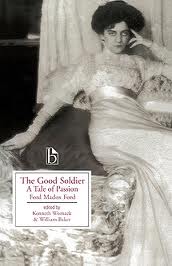
My local book group met today to discuss The Good Soldier. I finished reading it a few days ago and marked off this small accomplishment on GoodReads, where along with checking off the “read” box, we are given the opportunity to rate the book–which I did. Because my GoodReads account is linked to my Twitter account, my rating duly appeared in my tweetstream. Soon after, I received this tweet:

I got a real kick out of that message, because it got at exactly the problem I’d been having (and am still having) with my own response to the novel. Even though I recognized The Good Soldier as an extremely artful, intricately designed, psychologically probing book full of all kinds of juicy details ripe for interpretive picking, I really didn’t like it. Because the novel is so conspicuously a well-crafted aesthetic artifact, what accounts for my distaste for it? Perhaps this is one of those times when I have to say to a novel, “Honestly, it’s not you: it’s me.” But what is it about me that ruined this relationship? I think my ‘tweep’ may be right: it’s a Victorianist glitch.

The Good Soldier tells the tangled story of Edward Ashburnham (the “good soldier” of the title) and his wife Leonora, and of the narrator, John Dowell, and his wife Florence. It is, John tells us at the outset, “the saddest story [he’s] ever heard,” and from a certain perspective–not just his–it is sad indeed. There’s betrayal and adultery and bitterness and self-abnegation and manipulation, religious repression and moral confusion, malevolence and ineptitude–oh, and not one, not two, but three suicides. By the final stages of the novel everybody who isn’t dead yet pretty much hates everybody else, though how you would know what is love and what is hate in this group isn’t entirely clear. Dowell tells the story retrospectively, after all the misery has unfolded, and after his own gullibility and naïvete have been thoroughly exposed and demolished. (How Dowell could not have known the things he claims not to have known is a perplexing and important question: is he altogether an innocent betrayed? did he see but refuse to accept the truth? how reliable, in other words, is he, and how much is his version of events self-serving? How does he know, also, as much as he claims to know about the thoughts and motives of the other characters? How can he be at once both so ignorant and so knowing?)

I read The Good Soldier with the morbid fascination that seems called for by the novel itself: it invites prurient curiosity (first, what’s so sad about this story? and then, how bad are these people? and, how bad will things get for them?) and rewards it with sordid revelations; it layers and meanders and revisits meanings so that our attention must be scrupulous and sustained, but it holds us at a distance by, paradoxically, immersing us so completely in one voice, one point of view, that we know our efforts can always be subverted by yet another twist or revelation. The reading experience is compelling but also claustrophobic: by the end of the novel, I just wanted to get out of it, to open a window and let in some air. I was intensely tired out (and I’m sure I was supposed to be tired out) by the psychological tortuousness of the story and its narration–but I was also intensely tired of the whole damn bunch of them and their self-absorbed, privileged, neurotic lives.

The Good Soldier reminded me of The Golden Bowl, which had a similar effect on me except that it went on for much, much longer. Ford, as it happens, wrote a critical study of Henry James, and is pretty clearly working with ideas about the novel that are very influenced by James’s preoccupation with consciousness. I wrote a bit about my problems with the “Jamesian consciousness” in an essay on George Eliot, James, and the moral-philosophical criticism of Martha Nussbaum. I believe the words “elitist” and “exclusionary” may have come up! These are not quite the same qualities I felt in The Good Soldier, and a conspicuous difference in form between The Golden Bowl and The Good Soldier is Ford’s use of first-person narration. Ford’s prose is also much easier to follow than James’s. But there’s that same preoccupation with limited individual perceptions as if, scrutinized closely enough, given enough room to display all their twists and turns and uncertainties and evasions, those perceptions are all that matters. But–and here, I think, is that “Victorianist glitch”–it isn’t, at least not for me. All these people care about is themselves. There are indications of how those selves are connected to a wider social and political world: Leonora Ashburnham’s religion, for instance (she’s a Catholic) is a balefully determining influence on her values and thus on her warped and self-destructive marriage. Dowell and his wife are Americans; that matters too. But the implications of these broader contexts are endlessly personal, and the characters have no interest in its being otherwise. I just couldn’t care at all about them and their toxic mix of neuroses. I wanted to knock their heads together and tell them to go get jobs or do something useful, and along the way to stop using and abusing each other and everybody else they ran into. “Close thy Byron,” I wanted to yell at them; “open thy Goethe!” Yes, that’s right: I wanted to quote Carlyle at them and remind them that the way to healthy living is work:

Produce!  Produce!  Were it but the pitifullest infinitesimal fraction of a Product, produce it in God’s name!  ‘Tis the utmost thou hast in thee; out with it then.  Up, up!  Whatsoever thy hand findeth to do, do it with thy whole might.  Work while it is called To-day, for the Night cometh wherein no man can work.

Sartor Resartus is sometimes read as a transitional text: stop being Romantic, and get busy being  Victorian! I think it works just as well as a diagnosis of what I sometimes feel reading around in Modernist texts, and certainly of what I felt reading The Good Soldier. My Responsible Professional Self knows that this is an absurd conclusion about Modernism in general and possibly about The Good Soldier in particular, but whatever Self made me chose Victorian literature as “my” field thinks there’s something to it. Call it a “glitch” if you like, and make as good a case as you want for the brilliance of The Good Soldier (and I am sure there is an excellent case to be made), but in the house of fiction, this is just not my room.

This Week In My Classes: Men and Women and The Woman in White

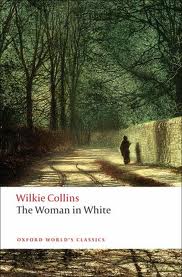
The Woman in White isn’t the only thing going on in my classes this week, but it’s by far the most fun–and happily, it seems as if the students like it too. They had to submit their questions today for the next round of letter exchanges, and I saw more than a few comments about how much more suspenseful and enjoyable it is than our first two novels. I’m a bit surprised that they didn’t find Great Expectations suspenseful: Collins doesn’t have any moments better than the one in which Pip returns to London from a visit to Miss Havisham, only to be met at the gate by the note in Wemmick’s writing, “Don’t go home!” But I can see why they are feeling the suspense more in The Woman in White: Collins sets a faster pace than Dickens, and he builds the suspense less by images and intimations and more through heavy-handed foreshadowing and cliff-hangers. It really is great fun–and part of the fun comes, I think, from the impression the whole novel gives off of a writer having a blast with his own material.

Today we talked about gender roles in the novel. We started with our hero Walter Hartright, whose heart certainly is in the right place, but who doesn’t exactly live up to the promise of that noble-sounding name in his actions. The advantages that accrue to him (socially, legally, economically) because he’s male are undercut by the disadvantages of his class position. It’s even made explicit that he is effectively neutered by his role as a drawing master:

It had been my profession, for years past, to be in this close contact with young girls of all ages, and of all orders of beauty. I had accepted the position as part of my calling in life; I had trained myself to leave all the sympathies natural to my age in my employer’s outer hall, as coolly as I left my umbrella there before I went up-stairs.

It’s possible to read the rest of the novel as the story of how Walter learns the value and use of his, um, umbrella. His polite propriety has costs, after all: when he learns that the woman he loves, Laura Fairlie, is engaged to the creepy Sir Percival Glyde, he mopes, weeps, and runs off to South America, leaving her to the ineffectual protection of her girly uncle Frederick  (“he had a frail, languidly-fretful, over-refined look–something singularly and unpleasantly delicate in its association with a man”) and the ardent but also ineffectual care-taking of her manly half-sister Marian (“altogether wanting in those feminine attractions of gentleness and pliability”). Laura herself is almost too ideally feminine: “Think of her,” Walter muses, “as you thought of the first woman who quickened the pulses within you that the rest of her sex had no art to stir. . . . [she has] all the charms of beauty, gentleness, and simple truth, that can purify and subdue the heart of man”).

Laura epitomizes the ideal Victorian woman: she is pure, virtuous, innocent, and unworldly. Of course our hero falls in love with her! But actually Laura is so perfect she’s boring, and so Walter’s love for her seems oddly uninspiring and unheroic. It also seems significant that her double in the novel is a woman who has escaped from an asylum and is twice mistaken for a ghost. Readers since the novel’s first publication have found Marian much more attractive–in spite of (or is it because of?) the “dark down on her upper lip [which is] almost a moustache.” What do we really want in a woman, Collins seems to be asking? Or, for that matter, what do we expect in a man? If Walter, our good guy, disappoints by becoming so predictably infatuated with Laura, what does it mean that Count Fosco, Sir Percival’s flamboyant co-conspirator, is the only man in the novel with the good sense and good taste to appreciate Marian? “Under happier circumstances,” he effuses, “how worthy I should have been of Miss Halcombe–how worthy Miss Halcombe would have been of ME.”

When is Reading Research?

I’ve been thinking more about what we mean when we say “research.” In my post on the ‘duties of professors,’ I quote C. Q. Drummond’s remark,

If research in an Arts Faculty means humane learning, then we all hope our teachers are as much involved in research as they possibly can be. We want them to know better and better what they are talking about, so that they will have, and will continue to have, something intelligent and important to profess to their students. But if research means output or publication, as it so often does today, how do the students profit?

In his turn, Drummond quotes George Whalley, who suggests that the word “research” is altogether misleading or inappropriate when applied to humanistic inquiry: ““The functions of research are specialized and limited; … the word research is not a suitable term for referring to the central initiative and purpose of sustained inquiry in ‘the humanities.'” “Most professors in Arts Faculties,” Drummond proposes, “would be better off reading more and publishing less.” Of course, reading is research for most humanists–that is, it’s the research process. But not all reading is research–or it it?

When we talk about “doing research,” I think we conventionally mean reading in service of a particular research project, that is, reading in pursuit of a foreseen research product, a published essay or book. Does that mean that reading for which we cannot already identify such an outcome is not research, then? Certainly it’s reading for which we can get no particular institutional support. For instance, if I want to get a research grant, it does me no good to justify my budget on the grounds that I am gathering materials on subjects about which I would simply like to know more than I do, or in which I have a developing interest but, as yet, no idea what, if any, payoff there will be in terms of publications. I also can’t get research support to develop new classes. I might be able to get a grant from our Center for Teaching and Learning–although peering at their page, the only grants I see them offering are for “faculty members who are seeking new and innovative ways to incorporate technology into their teaching practice” and “high impact initiatives that address student engagement activities/projects in the first year of their studies.” Too bad if I just want to follow my curiosity, acquire new expertise, and then gather students up to share it through reading and discussion.

My own new class on the ‘Somerville Novelists’ may, in fact, incorporate technology (brace yourselves, students–I’m thinking wikis again!), but it will have been developed from reading I did initially purely out of interest–and of books I bought with my own money. I don’t mind about the money–though it’s sometimes frustrating to realize how much the university relies on our willingness to do things “on our own” without which the institution would be a much poorer place, and by that I don’t mean poorer financially. (I bought the laptop I’m using with my own money too–the university doesn’t provide “home” or portable computers, or at least our faculty doesn’t, but imagine how academic work would grind to a halt if we could not work evenings and weekends, or not without coming in to campus. But that’s another issue…sort of.) I don’t really draw strict lines between what I do for work and what I do for myself, precisely because being a professor is not just having a job but having a certain identity–filling (or aspiring to fill) a certain kind of role in the world. But especially since reading Drummond’s essay I’ve been thinking about the way our particular understanding of “research,” one that yokes together the process and the product, undervalues other kinds of reading. I do mind about that, because I think it artificially narrows both that job and that identity.

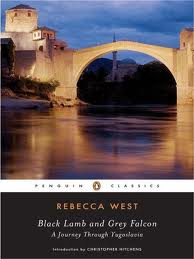
Is there really only one professionally worthwhile kind of reading? I’ve recently bought Rebecca West’s Black Lamb and Grey Falcon. I bought it out of interest: I’ve been exhilarated by learning about other early 20th-century women writers, and West is a major figure. I’m not sure where to place her: she’s not specifically in the Somerville crowd I’ve been looking into, and she’s not really a Modernist (I don’t think). I’m curious to figure out more about her. Reading The Return of the Soldier made me more curious. She is not–and Black Lamb and Grey Falcon is not–obviously continuous with any issues or genres I have an explicit “research” interest in. There are plenty of books in “my field” of Victorian literature that I haven’t read, and there are also plenty of books about Victorian literature that I haven’t read. I have some declared “research” projects that have not reached the official finishing point of publication in an academic journal (much less an academic monograph). Clearly, if I read (when I read) Black Lamb and Grey Falcon I am doing it only for myself: it’s not research. And yet reading it will almost certainly  help me have “something intelligent and important to profess to [my] students,” and that I don’t know exactly what else will come of it isn’t necessarily a bad thing. It isn’t even necessarily a bad thing that nothing concrete (beyond some blog posts) may ever come of it. But by some measures–the only ones that mean much, professionally, these days–it would be more productive for me to read the umpteenth specialized analysis of Middlemarch. Now that would be research.

Fantasy Life: Anne Tyler, Ladder of Years

tyler-ladderThere was a hashtag going around on Twitter today for people sharing the titles of books they read over and over–#GroundHogDayBook, in honor, of course, of Groundhog Day. That’s a funny sort of meme for those of us who read professionally, since I reread as much as I read, maybe more. So it doesn’t seem quite right to point to Middlemarch or Jane Eyre or Great Expectations in response, even though I do reread them at least yearly, and love to do so. What about books I reread for no other reason than because I want to? As it happens, I’m rereading one of those today: Anne Tyler’s Ladder of Years.

What is it about Ladder of Years that I like so much? It is one of my longstanding comfort reads (along with Alison Lurie’s Foreign Affairs and Joanna Trollope’s A Village Affair). It’s not that it’s a mindlessly soothing book, or an altogether cheering book. It’s the story of a woman who has become somewhat disoriented in her own life. This is a familiar figure in Tyler’s novels–Back When We Were Grownups, for instance, opens with the beguiling line, “Once upon a time, there was a woman who discovered she had turned into the wrong person.” Who hasn’t felt that way occasionally? In Ladder of Years, Delia feels adrift in her family: she’s not sure her husband ever really loved her (in her darker moments, she suspects he chose her to be sure he’d get her father’s medical practice), her children are teenagers and older and have little time for her, and in general she feels hectored, ineffectual, and unappreciated. One day, on their family vacation, entirely without premeditation–barely even with conscious intent or agency–she walks away along the beach and doesn’t turn back. She gets a ride out of town and goes as far as the small community of Bay Borough, where she rents a room in a boarding house, gets a job, and starts a whole new life.

That’s probably a pretty common fantasy for anyone with a life that feels, as Delia’s does, cluttered rather than meaningful, busy but not fulfilling. It’s a quiet kind of mid-life crisis: an attempt to recapture some essential self, some connection to the world that isn’t overwhelmed by other people–by how they see you, what they want from you, what they say about you. For Delia, her resettlement is a purification: sitting in her barren rented room, she reflects with some satisfaction that she can “detect not the slightest hint that anybody lived here.” “I’m here,” she writes to her tactfully inquring mother-in-law, “because I just like the thought of beginning again from scratch.” Her new life is entirely uncluttered: no family, no friends, no emotional attachments.

But Tyler knows (and so does Delia, deep down) that it’s just a fantasy. Life disentangled is no life, really, and Tyler’s are novels of reconciliation, not alienation. Friends and feelings and connections accrete even around Delia’s stripped-down existence in Bay Borough. Reading Carson McCullers’s “A Tree, A Rock, A Cloud” right after accidentally adopting a cat, Delia realizes she has begun again on the sequence of loving: “First a time alone, then a casual acquaintance or two, then a small, undemanding animal. Delia wondered what came after that, and where it would end up.” We know it can only end up back in the life Delia really lives, but from her time alone and what follows from it, she gains the strength and clarity to return to it as herself–and to accept her own changing place in it, and on the ‘ladder of years.’

Much as I vicariously enjoy Delia’s escape and the cool, unsentimental way she sets about reinventing herself, it’s her return that makes the novel calming, something I turn to when I’m feeling fretful in my own life. We don’t really want to abandon the people we love, no matter how difficult or annoying or distracting they can be; without the elements we sometimes chafe against as complications or impositions, our lives would be thin and bare and joyless, like Delia’s spartan rented room. Delia tries to walk away, not just from her life, but from life itself. The novel unassumingly, with Tyler’s characteristic dry whimsy, returns her, and us, to where we belong.

This Week in My Classes: Fun with Fiction

In Close Reading we have finished our poetry unit (yay, say the students–no more scansion!) and been working on short stories. The basic idea is the same: our focus is on paying attention to the various ‘technical’ elements in them, to see how they work to support the effects and ideas of the stories overall. The process of picking out individual elements often feels somewhat artificial, but there’s also a useful discipline in it. Often, we work backwards from a general impression, of a character or scene, for instance, to figuring out how we got that impression. So far we’ve talked about point of view, narration, characterization, and setting. Because one of the guiding principles of the course is that it provides portable knowledge and skills, I’m having some fun bringing in illustrative examples from all kinds of books in addition to our officially ‘assigned’ reading. Here are some of the excerpts we considered as examples of different approaches to characterization:

Dorothea knew many passages of Pascal’s Pensées and of Jeremy Taylor by heart; and to her the destinies of mankind, seen by the light of Christianity, made the solicitudes of feminine fashion appear an occupation for Bedlam. She could not reconcile the anxieties of a spiritual life involving eternal consequences, with a keen interest in gimp and artificial protrusions of drapery. Her mind was theoretic, and yearned by its nature after some lofty conception of the world which might frankly include the parish of Tipton and her own rule of conduct there; she was enamoured of intensity and greatness, and rash in embracing whatever seemed to her to have those aspects; likely to seek martyrdom, to make retractions, and then to incur martyrdom after all in a quarter where she had not sought it.

He belonged to that class of men – vaguely unprepossessing, often bald, short, fat, clever – who were unaccountably attractive to women. Or he believed he was, and thinking seemed to make it so. And it helped that some women believed he was a genius in need of rescue. But the Michael Beard of this time was a man of narrowed mental condition, anhedonic, monothematic, stricken.

Macon wore a formal summer suit, his traveling suit—much more logical for traveling than jeans, he always said. Jeans had those hard, stiff seams and those rivets. Sarah wore a strapless terry beach dress. They might have been returning from two entirely different trips. Sarah had a tan but Macon didn’t. He was a tall, pale, gray-eyed man, with straight fair hair cut close to his head, and his skin was that thin kind that easily burns. He’d kept away from the sun during the middle part of every day.

 He had a great relish for feminine beauty; he was addicted to observing and analyzing it; and as regards this young lady’s face he made several observations. It was not at all insipid, but it was not exactly expressive; and though it was eminently delicate, Winterbourne mentally accused it – very forgivingly – of a want of finish. He thought it very possible that Master Randolph’s sister was a coquette; he was sure she had a spirit of her own; but in her bright, sweet, superficial little visage there was no mockery, no irony.

Dear Joan,

 I do hope I know you well enough to say this.

 I think you ought to forget about your leg. I believe that it is something psychological, psychosomatic, and it is very hard on Charles. It is bringing both him and you into ridicule and spoiling your lives.

 Do make a big try. Won’t you! Forget about your bodily aches and pains. Life is a wonderful thing, Joan. I have discovered this great fact in my work with the Dying.

 Your sincere friend,

   Eliza (Peabody)

We were talking about the role of description or exposition, speech (including thought) and action, external points of view, and what I called ‘accessories’–all the things on or around a character that help communicate who they are, from literal accessories to homes or occupations or hobbies or what books they are reading in a scene. I quoted David Lodge’s remark, from The Art of Fiction, that “all description in fiction is highly selective; its basic rhetorical technique is synecdoche, the part standing in for the whole”: that seems to me a helpful principle to keep in mind. It was interesting how much information we could glean from these small pieces, especially as nobody in the class had actually read any of the novels I took them from. I think (I hope!) they could see the point of the exercise, which was to help us realize how we know what we (think we) know when we’re reading along. Working on fiction in this way you always have to resist their tendency to get caught up in the plot, so using examples out of context, which might seem perverse in other contexts, is actually helpful in this particular course.

In Victorian Fiction we are nearly done with Great Expectations–already! One of the things I like to think about with this novel is the development of young Pip into the Pip who is morally capable of narrating the novel. One of the most moving chapters in the novel for me is Chapter 44, in which Pip first confronts Miss Havisham and Estella with his new knowledge of the real identity of his benefactor. He hasn’t yet moved all the way from confusion to compassion, but already he is working to make something right out of the wrongs he–and they–have done in pursuing their false ideas, and to restore some sense of love and forgiveness to their devastated lives. “You will get me out of your thoughts in a week,” says Estella as Pip, overcome with grief and horror, begs her not to throw herself away on the malignant Bentley Drummle. Pip’s response moves not only us, but also, against all expectation, Miss Havisham:

`Out of my thoughts! You are part of my existence, part of myself. You have been in every line I have ever read, since I first came here, the rough common boy whose poor heart you wounded even then. You have been in every prospect I have ever seen since — on the river, on the sails of the ships, on the marshes, in the clouds, in the light, in the darkness, in the wind, in the woods, in the sea, in the streets. You have been the embodiment of every graceful fancy that my mind has ever become acquainted with. The stones of which the strongest London buildings are made, are not more real, or more impossible to be displaced by your hands, than your presence and influence have been to me, there and everywhere, and will be. Estella, to the last hour of my life, you cannot choose but remain part of my character, part of the little good in me, part of the evil. But, in this separation I associate you only with the good, and I will faithfully hold you to that always, for you must have done me far more good than harm, let me feel now what sharp distress I may. O God bless you, God forgive you!’

In what of unhappiness I got these broken words out of myself, I don’t know. The rhapsody welled up within me, like blood from an inward wound, and gushed out. I held her hand to my lips some lingering moments, and so I left her. But ever afterwards, I remembered — and soon afterwards with stronger reason — that while Estella looked at me merely with incredulous wonder, the spectral figure of Miss Havisham, her hand still covering her heart, seemed all resolved into a ghastly stare of pity and remorse.

That ability to touch someone’s heart is fundamental to Dickens’s fiction, isn’t it? This moment makes an interesting comparison to the climactic encounter between Dorothea and Rosamond in Middlemarch, which also turns on an encounter with someone else’s ‘center of self’ and on the morally inspirational effect of generosity…and yet the scenes are arrived at so differently and belong in other ways to such different worlds.