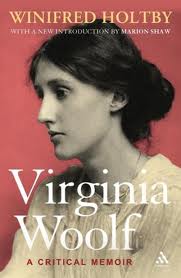
“She is in love with life”: Winifred Holtby’s Virginia Woolf: A Critical Memoir

holtby-woolfIn my post on Vera Brittain’s Testament of Friendship, I quoted a passage Brittain includes from Holtby’s letters, addressing her decision to write a critical biography of Virginia Woolf:

I took my courage and curiosity in both hands and chose the writer whose art seemed most of all removed from anything I could ever attempt, and whose experience was most alien to my own. . . . I found it the most enthralling adventure–to enter, even at second-hand, that world of purely aesthetic and intellectual interests, was to me as strange an exploration as it would have been for Virginia Woolf to sit beside my mother’s pie and hear my uncles talk fat-stock prices and cub-hunting. I felt that I was learning and learning with every fibre of such brain as I have.

The result of this open-minded effort, Virginia Woolf: A Critical Memoir (1932,) is as generous as I’m coming to expect from Holtby. Though at times it’s clear she has reservations about the potential limits of Woolf’s emphasis on art as “an end in itself,” or Woolf’s opposition to “materialism” in the novel (Holtby cites, for instance, “Modern Fiction,” with its critique of Bennett and Wells and Galsworthy for being “concerned not with the spirit but with the body”), and sharp as Holtby is, too, about “the advantages of being Virginia Stephen” (the title of a chapter in which, among other things, she lightly mocks Woolf for concluding “Every second Englishman reads French” — “that particular hyperbole was only possible to a woman brought up as Leslie Stephen’s daughter had been brought up”)–despite all this and the differences in her own life and aims, Holtby writes with energetic appreciation, sometimes even rapture, about Woolf’s development from a writer with an abstract and difficult idea about the novel to a novelist who has found the freedom and technique to realize her vision.

Holtby finds broad continuities of theme across Woolf’s oeuvre: an interest in life and death (especially death), in women and men (especially women), in the meaning of life, in the possibilities of art. She also finds a continuity of aesthetic effort, a movement towards a different kind of fiction. She sees it taking Woolf a while to figure it all out, to achieve unity of form and concept in a single work. So The Voyage Out shows signs of what will come, especially in its characters and thematic interests, but “here she has curbed her fancy, and accepted the traditional novel form.” Holtby’s chapter on Night and Day is called “Virginia Woolf is not Jane Austen”: she reads this novel as Woolf’s experiment in writing “a domestic story on the Jane Austen model.” She quotes a passage from Woolf’s essay “On Not Knowing Greek” (a passage I quoted too, in my piece on Woolf’s essays for Open Letters), about Austen choosing “the dangerous art where one slip means death”: “Mrs. Woolf, in Night and Day, chose it and failed.” It’s not, Holtby is quick to say, that the novel itself is dead, not altogether: “It has beauty and gravity, nobility of theme and high distinction.” But in it, Holtby believes, Woolf followed the wrong master for her own gifts and for her own time:

Her technique is the technique of experiment, not of tradition. Her hunting-ground lies among the subtle gradations of sentiment, memory and association to which less delicate sight is blind. She was, in Night and Day, playing a game which was a good game, which had been played almost perfectly, which she could play better than most; but it was not her game. She was a disciple here, not a master; a follower, not a maker of the law.

More specifically, she thinks “a comedy of restrictions” (such as she believes Austen writes) does not suit a writer who is “a rebel against restrictions.” Austen had the “peculiar fortune to live at a time and in circumstances ideally suited to her talent.” Woolf, in contrast, stood in a critical a relation to her age, and “it is this implied criticism, this straining towards some larger life, some more liberal standard of values, which disturbs the quiet and enclosed perfection of the comedy.” So for all its virtues, Night and Day is a failure–but “the measure of its failure was, perhaps, a mercy,” Holtby concludes, as “it drove Mrs. Woolf to seen new forms of expression. It marked the end of her apprenticeship to tradition.” (Another exhibit for our case that failure is necessary to greatness?)

Holtby finds in Woolf’s essays experiments in the fictional techniques that will finally free her: the “cinematic,” in which the “perspective shifts from high to low, from huge to microscopic, to let figures of people, insects, aeroplanes, flowers pass across the vision and melt away” (Holtby sees this as the aesthetic style of “Kew Gardens,” for instance, or “The Mark on the Wall”) and the “orchestral,” in which “senses, thoughts, emotions, will, memory, fancies, the impact of the outside world, action and conversation each play a different instrument.” The result of this freedom to create in new forms, when Woolf finally achieved it, was to be superb:

If her knowledge of life was narrow, it was profound. There was no fear, no sorrow, no ecstasy, and no limitation that she could not penetrate. And now she had an entirely new technique. She could compensate herself for all the things she did not know by arranging in a thousand new patterns the things she did.

Once free, she learns “an entirely new note”: gaiety. “She did not use it for long; her sense of life is tragic rather than comic,” Holtby says; “But having discovered it, she never lost it again. Perhaps laughter is the first gift of freedom.”

Though her discussions of Woolf’s later books is extraordinarily sensitive to the tragedy in them, the remaining chapters echo with Holtby’s appreciation of Woolf’s delight in both the world and her own expanding art. There’s an inevitable poignancy in that, not just because when we reach the last chapter, “The Waves–and after?” we know, as Holtby could not, that there was to be only one more major novel, and that published posthumously after Woolf’s suicide, but because we also know that Holtby herself did not live to read it (she died in 1935, leaving her own last novel, South Riding, also to be published posthumously). But there’s also something exhilarating in reading about Woolf from someone who can focus on what is life-affirming in her work without any sense of impending doom. Holtby’s focus is deliberately on the novels, not the life, and that design plus her ignorance of Woolf’s illness and death  lets us too revel in what is triumphant and joyful about the writing.

Holtby’s commentaries are persistently articulate and interesting. Like Woolf’s own critical essays, they are more impressionistic than analytical, though I was struck by how attentive Holtby is to technique, and particularly to the congruencies between the forms and the ideas of the novels. Holtby’s own fiction is so formally straightforward it could give the impression of a certain artistic naivete, but reading this book confirmed for me what Marion Shaw argues (in the essay I quoted from in my post on Brittain’s Honourable Estate)–that documentary realism was a deliberate option, not a default for writers who could not conceive of alternatives. Jacob’s Room was, Holtby observes, “a triumphant experiment in a new technique”;

But now that we can set it beside Mrs. Woolf’s later work, beside Mrs. Dalloway and To the Lighthouse and The Waves, we know that it was not the best that she could do. The cinematographic style was brilliantly effective, but it was not as subtle as the orchestral effect which she was to use in To the Lighthouse; she was to obtain a surer control over her material in Mrs. Dalloway. She was to adventure further into obscure realms of human consciousness in The Waves. The contrasts, perhaps, in Jacob’s Room are too violent. There are obscurities which even the most diligent study cannot penetrate. The effect created is very largely visual. Later she would plunge into the nerves, the brains, the senses of her characters, exploring further, yet binding the whole more closely into a unity of mood.

So Jacob’s Room too is seen as a step towards Woolf’s greatest work:

She had thrown overboard much that had been commonly considered indispensable to the novel: descriptions of places and families, explanations of environment, a plot of external action, dramatic scenes, climaxes, conclusions, and almost all those link-sentences which bind one episode to the next. But much remained to her. She had retained her preoccupation with life and death, with character, and with the effect of characters grouped and inter-acting. She had kept her consciousness of time and movement. She knew how present and past are interwoven, and how to-day depends so much upon knowledge and memory of yesterday, and fear for or confidence in to-morrow. She was still preoccupied with moral values; she was immensely excited about form and the way in which the patterns of life grow more and more complex as one regards them. And she was more sure now both of herself and of her public. She dared take greater risks with them, confident that they would not let her down.

The chapter on To the Lighthouse and Mrs. Dalloway is called “The Adventure Justified,” and it treats the novels as the culmination of a dangerous but ultimately triumphant experiment. In them Holtby finds a unity “far more profound than anything that can be obtained by a trick of reference. . . . It is a metaphysical unity, the unity which the old scholastic philosophers saw binding creature to creature and all created things to God. It was also a psychological unity, such as the most modern Viennese psychologists see binding infancy to age.” In these novels “her characters play now a double purpose”:

They are themselves and they are symbols. They are part of the visible universe and they are its interpretation. Her metaphors have grown more fluid, and they have overflowed into the action of the novel. The motion of time, light, change, the passage of wind through a house, have all assumed a spiritual quality.

About To the Lighthouse Holtby is ecstatic, almost as if caught up herself in the final vision of the novel:

Its characters move in a radiant, half-transparent atmosphere, as though already suffused into the spiritual world. The action takes place out at sea, on an island; because it is there, away from the land, on a ship, out at sea, on an island, that Mrs. Woolf sees humanity with detachment. From that vantage point she can look back on life, look back on death, and write her parable. Its quality is poetic; its form and substance are perfectly fused, incandescent, disciplined into unity. It is a parable of life, of art, of experience; it is a parable of immortality. It is one of the most beautiful novels written in the English language.

Orlando and A Room of One’s Own do not move her to such raptures, though she seems them as complementary completions of long-running preoccupations of Woolf’s. Reading her discussion of Room I was expecting more polemical engagement, but I think in the end it’s to Holtby’s credit that she keeps her focus on Woolf’s theories, particularly on sorting out Woolf’s arguments about man-womanly and woman-manly collaboration as part of her overall vision for art and creative freedom.

I wish Holtby had lived to write about Three Guineas. But her last section is about The Waves, and again, her appreciation for Woolf’s experimental form–her interest in what it reaches and enables–is strikingly open-minded and generous, as well as attentive to its place in contemporary literature:

We know, externally, very little about [the characters]. They are the cultured, well-to-do characters common to most of Mrs. Woolf’s novels, but their external lives, their relations to each other, are barely indicated. Yet we know almost everything about them. For the drama takes place not in the external world of speech and action, but in the subconscious world, below the articulate thoughts and spoken words with which most novels are concerned. Down there, in the submarine cave of which Mrs. Woolf’s characters are always dreaming, moves the strange, subtle confusion of memory, experience, contact and imagination which forms the running stream below our surface thoughts. It is a world hitherto largely neglected by the English novelist. James Joyce, Dorothy Richardson, and D. H. Lawrence have adventured there; but their voyages of discovery have not been followed by a general conquest. The territory is uncharted and extremely hazardous, for only the most intent and penetrating observation of human behaviour can make a writer free of the unformed thoughts and impulses of his characters. Yet these are as much a part of “character” as their external acts . . . .They inhabit a land where the law of reason does not run; and Mrs. Woolf acknowledges allegiance to the law of reason. Yet in spite of these difficulties she has essayed the task, crossed the borders, and, finding the new land still sunk beneath a tossing sea, plunged bravely down to discover and reclaim.

If you find that extended metaphor a little florid, note that Holtby turns neatly to technical specifics: “The method that she has used to re-create this world is not entirely strange to her. Each character speaks in a kind of recitative, recording an individual current of subjective thought . . . . personality, drama and development emerging slowly from the sequence of conscious and unconscious thought and memory.” In The Waves, she concludes, Woolf has achieved “the music and subtlety of poetry.” The Waves, she believes, has not just its own internal unity but “is bound in that strange unity which is the artist’s mind, to Mrs. Woolf’s other novels.” And in it, too, she finds “an affirmation of life”: “Death is the enemy; death, not only of the body, but of the mind, the perceptive spirit, the faculty by which man recognises truth.”

Virginia Woolf: A Critical Memoir ends by wondering where Woolf will go next: “We cannot predict what problem will attract, what beauty entrance her next”–though Holtby anticipates continued growth “in breadth and power.” But Holtby speculates that Woolf “is unlikely ever to command the allegiance of a wide contemporary public”: “at present there is still only a minority which prefers To the Lighthouse with its demands upon the reader’s intelligence and imagination, to a novel such as [J. B. Priestley’s] The Good Companions, which tells a pleasant, full and easy tale.” That’s ironic in a way, of course, because Woolf’s name is well known to a wide public today, while Holtby’s much more accessible novels are largely unread–though it remains true, surely, that To the Lighthouse is a minority taste. In fact, I have never read it myself, though I have started it several times. I have always found Woolf’s fiction much more elusive than her non-fiction; until a couple of years ago I hadn’t read Mrs. Dalloway either. I felt I didn’t know how to read the novels (and frankly, reading Orlando didn’t help much with that!), and the academic criticism I read about them was typically intimidating rather than encouraging. Holtby’s book, on the other hand, has an infectious enthusiasm along with a lot of smart and useful discussions of what Woolf is doing and why. Now I feel that I too should take my “courage and curiosity in both hands” and “learn and learn with every fibre of such brain as I have.”

Holtby’s final passages stand as both a celebration and, unintentionally, a worthy epitaph, generously offered from one artist and woman to another:

For all her lightness of touch, her moth-wing humour, her capricious irrelevance, she writes as one who has looked upon the worst that life can do to man and woman, upon every sensation of loss, bewilderment and humiliation; and yet the corroding acid of disgust has not defiled her. She is in love with life. It is this quality which lifts her beyond the despairs and fashions of her age, which gives to her vision of reality a radiance, a wonder, unshared by any other living writer. . . . It is this which places her work, meagre though its amount may hitherto have been, slight in texture and limited in scope, beside the work of the great masters.

The Worth of Our Work (with Some Thoughts on Jonah Lehrer)

Alas, alas!
This hurts most, this . . that, after all, we are paid
The worth of our work, perhaps.

— Elizabeth Barrett Browning, Aurora Leigh

The very smart and funny Adam Roberts has decided to put an end to his blog Punkadiddle. Iif you haven’t already had the pleasure, you should check out the archives – I particularly enjoyed his skewering of Robert Jordan’s Wheel of Time series, especially this one, which starts hilarious and ends profound (that reminds me–time for a tea break!). As a Victorianist, though, I found posts like this one of the greatest value to my own thinking.

It’s understandable that Adam would decide to close up shop in one venue when, as he says, his time and energy are needed elsewhere. Blogging consistently (by which I mean not just posting regularly but staying involved with comments and generally maintaining a site that reflects genuine engagement with its subject and with other readers and writers) does take a lot of time and energy, and people’s interests and priorities change over time. As a result blogs ebb and flow, and come and go. The Valve, where both Adam and I were contributors, ran out of steam a while back, and that was a group effort, which in theory should be easier to keep invigorated. I’ll miss following Adam’s work at Punkadiddle, but I’ll look forward to keeping up with it in other venues.

One part of Adam’s farewell post really made me think:

Once upon a time writers were paid in money, but now writers are paid (in the first instance at any rate) in eyeballs, which may or may not at a later stage, underpants-gnomically, turn into money.  Part of this new logic is that the writer ought to be grateful simply to have the attention of those eyeballs.  I’m as deep into this new economy as anybody, of course; I read many thousands of fresh new words, free, online every day.  But I wonder if it doesn’t have more downsides than ups.  Take the material contained in the archives of this blog.  If the sort of thing I write is worth paying for then I’m a mug to give it away for free; and if it isn’t worth paying for (of course a great deal of online writing isn’t) then I’m wasting everyone’s time, including my own, carrying on.

As a number of comments on his post have noted, it’s tricky to measure the worth of a blog monetarily: for many bloggers, the chief attractions of the form are the intrinsic pleasures of the writing itself and of the conversation that it stimulates. Yet as Rich Puchalsky comments there, “It’s very easy for people to say that the value of an activity is not measured in what it earns… but part of the monetization of attention is that yes, really, it is hard to say whether written work that people don’t pay for is valued.” Certainly as long as work is unpaid it doesn’t make sense to keep it up unless the effort is repaid in some other way, while anyone who’s enjoying the writing and doesn’t need or want money for it can hardly be faulted for continuing to do it. But how much does the willingness of so many people to write criticism for free make it difficult for those who hope to make a living at it?

As Adam says, it’s a strange new economy here on the internet, with attention or “eyeballs” the primary currency. Adam and I are both somewhat insulated from the effects of this because we’re academics. As Tom Lutz wrote about the Los Angeles Review of Books, “Many of us are also supported, as I am, by our universities (however much they, too, are shrinking and under siege), and so we can write and edit “for free” as part of our commitment to the dissemination of knowledge that is integral to that job” (“Future Tense“). There’s a sense in which Adam and I are both already getting paid for whatever we write, depending on how broadly we define our university’s missions and our professional obligations. (I have a few times made the case that academics who write blogs related to their areas of specialization are making valuable contributions — here, for instance, and more recently here.) Blogging for free can be understood as a variety of open access publishing, and I don’t think anyone’s making the argument that academic articles made freely available aren’t valuable–but at the same time, built into arguments about such open access publishing is the assumption that the work is already being paid for. Academics are also hardly used to being paid specifically for their publications. I have never received a dime from any journal that published my work: the currency there is not eyeballs but prestige and professional recognition. (I also wasn’t paid by the LARB for the essay I published there.) I made a few hundred dollars in total from each of my books. Academics are accustomed, that is, to thinking of writing primarily in non-monetary terms. But, as Lutz points out, “many of us are not [academics],” that is, not everyone publishing their writing for free online already has economic support for that effort.

I don’t know how to do the math here, really, especially when models that assume scarcity increases value hardly seem to apply. Criticism is not a pursuit that responds well to supply and demand, any more than literature itself is–not if what you want is some version of “the best that has been thought and said.” The relationship in both cases between popularity and quality is surely a vexed one. It makes sense in some ways to expect the best work from people who will do it no matter what, simply because it means that much to them, but then with professionalism comes a particular kind of experience and expertise, as well as editorial and public scrutiny which, perhaps, leads to better work overall. (Even as I wrote that last bit, though, I wanted to retract it: the quality of criticism that appears in a lot of paid venues is not inspiring, outside a few elite publications. Punkadiddle is–was–many times better than the review section of my local paper, or of either of Canada’s national papers, for that matter. But isn’t that as much a sign of the limitations of the marketplace as of anything else? Presumably, newspapers publish the kinds of reviews [they think] their subscribers want to read. See also this critique at Lemonhound of a recent published review, though I don’t know if it was paid for.)

In any case, as Lutz says, “We don’t know what the future of publishing is, but we know that the future for every writer requires food.” Edward Champion wrote a strongly-worded response to Lutz’s essay. “Financially speaking,” he observes,

The Los Angeles Review of Books is no different from any other group blog or online magazine. As Full Stop‘s Alex Shephard observed, the question of basic survival is crucial to all writers, regardless of where they come from. The Los Angeles Review of Books‘s present interface relies on Tumblr and, even though it has featured close to 100 posts, it is just as dependent on volunteers and donated time as any other online outlet. As such, so long as it does not pay, it assigns zero value to the labor of its contributors, which makes it not altogether different from The Huffington Post.

“Lutz’s essay is unwilling to swallow the bitter pill,” Champion concludes: ” in a world of free, expertise no longer has any value. . . .  those who want the content are so used to getting it for free that they expect writers of all stripes to surrender their labor for nothing.” In the comments, he and Lutz go back and forth a bit about whether his assessment is unduly negative. I’m certainly hoping that the Los Angeles Review of Books succeeds in its aim of finding a sustainable financial model that includes fair pay for its contributors. As Champion points out, Open Letters Monthly is one of several other “quality online outlets” that have been “getting by” with basically no revenue stream. It’s a labor of love, something we keep doing because we believe criticism is intrinsically worth doing as well as possible. Is this, as Champion says, “an unsustainable model in the long run”? As he’s well aware, oddly it isn’t (as long as we’re willing to cover the core costs, like server space and postage, ourselves), because enough people want to write that they’ll do it for free–if they weren’t, it would certainly be impossible for us to keep offering the magazine for free, which is what the new internet economy expects. Would we like to pay our contributors, never mind our editors? Sure! But we can’t, and they (and we) are all willing to do the work anyway. Maybe, as Adam says, we’re all mugs.

That said, there are people who are paid for their writing, and it seems both inevitable and just that at this moment when there is so much great criticism online for free (the problem, of course, is finding it reliably: the challenge is curating and filtering the endless proliferation of material) there is sharp scrutiny of those lucky few. What should our expectations be–what should the standards be–for those who somehow have made writing a paying gig? It would be gratifying if the hierarchy of quality were clear: if only the very best (the smartest, the most engaging, the most eloquent, the most original) writing was writing that made money. (Heck, it would be gratifying if the very best writing was the writing that attracted the most eyeballs! If only.) This is pretty clearly not the case, and I know I’m not the only person writing for free who sometimes puzzles or even fumes over the results (see, for instance, Steve Donoghue’s often excoriating series on ‘the penny press.’). “You have eight pages in The New Yorker!” I have been known to rant … you’d better use them really, really well! Meaning, of course, use them as I would use them, if I ever got the chance! (Though is it really the money that matters, or, still, the eyeballs? Writers want readers above all. Hence the difficulty of figuring out the economics.)

I think this paradoxical context of scarcity amidst abundance is relevant to the recent brouhaha about Jonah Lehrer, whose “self-plagiarism” has cast a shadow over his recent appointment to a pretty plum position: staff writer for The New Yorker. Is ‘repurposing’ your own work the worst sin a writer can commit? Of course not. Writers rework material all the time. Academics, for instance, routinely use material first in a conference paper, then an article, and then in a book. A writer like Lehrer whose main contribution is a particular expertise or insight in a field is bound to repeat it in multiple variations. But there are ways and ways of doing this, and the measures of how best to do so (ethically, creatively, intellectually) surely include not just transparency (acknowledgement, “as I said in this prior piece,” and attribution, “previously published in”) but also development and enrichment (if large chunks of wording need no revision whatsoever over a long period of time, that suggests not so much dishonesty as mental stagnation). Even if it’s not a strictly illegitimate practice, it’s not very impressive for a writer to be so repetitive.

It’s also a kind of double-dipping. Some have disputed the entire idea of “self-plagiarism,” on the logic that you can’t steal from yourself. That’s true in a literal way, but you can try to get credit twice for doing something once–for submitting the same assignment to two different classes, for instance. That’s considered cheating at a university because it means you did not in fact do the amount of original work your credit-based degree requires. It devalues your credential, and it means you looked for a short-cut, too. The best students don’t do that; the best educated students haven’t done that. The best writers, similarly, won’t be the ones doing the same thing over and over and trying to get credit for it every time. You can’t put the same publication more than once on your c.v. as an academic or, I assume, on your resume as a writer. That’s padding, to make your list of publications look longer than it is. In both situations, time pressure is proposed as an excuse (students are stressed and over-committed, Lehrer’s a busy guy). Srsly? Without even sorting out whether Lehrer had the legal right to rerun material he’d already published (and as far as I know, the consensus is that he retained copyright on his material, but I don’t know the specifics of his contracts), again, don’t we expect something more of our best writers? And don’t we expect staff writers at The New Yorker in particular (a job many of those Champion describes as currently having to “debase themselves for scraps” would be overjoyed to get) to be conspicuously the best? Don’t the editors of The New Yorker expect that their writers will set an example of intellectual curiosity, originality, creativity, and rigor?

Yes, there’s an element of Schadenfreude here, but  it’s about something more than just sour grapes. Those of us who write for free online have heard for years about the deficiencies of our amateur efforts (here’s Ron Hogan on the same example)–it’s no wonder that we get riled up when the very publications that supposedly set the bar for us all turn out to be kind of slack, orwhen  those who somehow (“underpants-gnomically,” as Adam so colorfully says) turn their writing into money turn out not to be conspicuously better than those who don’t or even, like Lehrer, kind of worse. I’m not saying Lehrer clearly doesn’t deserve to be a staff writer at The New Yorker. He’s not a book critic, and he’s got special expertise and celebrity of his own, so he brings things to the table that presumably have their own kind of value. (Still, I would have expected that kind of disrespect for the magazine to be disqualifying for keeping his post.) Even so, I think his example does further complicate the discussion about what writing is worth. In some of the ways that really count, Adam’s writing at Punkadiddle is clearly worth more to him (as an exercise of his own intelligence and wit and expertise) than Lehrer’s was worth to him. Lehrer wanted the paying gigs: to sustain them, he had to take shortcuts and, as a result, he shortchanged his readers and his publishers.

How should we really measure and repay the worth of our work or others’? It’s a wonderful thing to do work that you love, but as the economy of the internet shows (or, for an example in a different area, the economy of higher education), love can make exploitation awfully easy–and there’s no guarantee that love is what you’ll buy with your money, as The New Yorker found out.

I have no interest in monetizing Novel Readings. I am fortunate not to need this work, which I enjoy and benefit from in other ways, to be a specific source of income. But I know (as Ed Champion and Tom Lutz know) that the work we do online is not really free, even if we make it freely available, and I worry that Champion is right that we are all contributing to the devaluing of criticism even as, ironically, we all read and write it for free because we do value it. Open Letters Monthly does not have the manpower or resources or infrastructure to do the kind of massive fundraising work going on at the Los Angeles Review of Books. We do, however, have a PayPal account set up for donations. If you’re ever wondering if you can do anything to help sustain the wonderfully rich and generous and perhaps (if Champion is right) ultimately unsustainable world of online book reviewing, one small gesture would be to put a little in the hat there. At the very least, it would help us with the cost of our web hosting, the one thing eyeballs alone can’t buy.

Social Revolutions: Vera Brittain, Honourable Estate

I finally finished reading Vera Brittain’s 1936 novel Honourable Estate. I read Part I a few months back and described it as “not particularly artful” but “emotionally quite intense,” and unsurprisingly, it continues that way to the end. Part I told the unhappy story of Janet and Thomas Rutherford, their marriage destroyed either by Janet’s unreasonable commitment to the suffragist cause or by Thomas’s inability to accommodate Janet’s needs and ambitions within marriage, depending on whose perspective you take. Parts II and III take up the story of their son Denis and of Ruth Allendeyne, daughter of a local squire who herself matures into a feminist and then a pacifist. Ruth’s life story has clear parallels with Brittain’s own, including the sad fate of a brother who seeks death on the battlefield to avoid a court martial for a homosexual affair (this was apparently true of Vera’s beloved brother Edward, though it is not discussed in Testament of Youth).

Denis and Ruth represent a new generation, trying to live with as well as complete the social revolutions that their parents’ generation fought for or against. First they must pass through the crucible of the war, however, and much of the last section of Honourable Estate explicitly addresses the painful challenge of building a future so much loss and disillusionment. Ruth especially, who loses a lover as well as a brother, initially feels no purpose in her continued existence, and it’s Denis whose kindness as well as political commitment helps her embrace her responsibility to use her life in a meaningful way. She ends up running for Parliament as a Labour candidate, aware all the time of the irony that her party is helping to destroy the squirearchy represented by her family home, which is, aptly and symbolically, demolished at the novel’s end. She’s also a mother, and here Brittain brings us back to Janet to contrast the suffering endured by both mother and child because of an unwanted but inescapable pregnancy–in one of the nice “coming full circle” touches of the novel’s construction, Ruth reads Janet’s diaries and reflects on the tormented life of “a normal woman whose talents had been thwarted, whose natural affections had been starved, whose maternal instinct had been assailed and vitiated before it reached maturity.” She is particularly captivated and saddened by the story of Janet’s friendship with the playwright Ellison Campbell, a relationship which initially brought her “consolation and reassurance” but ended in bitterness. (It’s hard not to read this as a gesture towards the potentially great gift of friendship exemplified by Brittain’s friendship with Winifred Holtby.)

What kind of world should we strive for, knowing what we know, having seen what we have seen, having lost what we have lost? This question, which motivated Brittain’s own post-war life, motivates Honourable Estate too. The novel is ambitious in the sweep of time it embraces and effective in showing how great the transition is from its earliest events to its conclusion. Janet and Ruth are effectively counterpoised, with Denis the fulcrum between them: he takes Ruth to Janet’s grave, explaining,

‘In some ways you’re so like her – and then your work and everything you stand for are precisely what she herself wanted to do and be. . . . your very existence in relation to hers gives me a new sense of hope. It’s made me believe that people’s ideals are sometimes fulfilled in the end, only not necessarily in one life or one generation.’

That’s the overall lesson of Honourable Estate: that transitions are painful and difficult, but that it is important to try to see the larger picture. At the end, Ruth reflects,

‘I suppose if we took a long enough view, we should feel that any sorrow bears its own compensation which enlarges the scope of human mercy. Some of us, perhaps, can never reach our honourable estate – the state of maturity, of true understanding – until we have wrested strength and dignity out of humiliation and dishonour.’

That’s the true ‘honourable estate,’ not marriage, then: the irony of Part I was that marriage as an institution kept women from their essential dignity, and the celebration of the final parts (amidst the sorrow) is that significant change has already come:

‘To-day men and women, but especially women, live in a very different world from that of 1870, or 1900, or 1910. Even since 1914, we’ve passed through a whole series of social revolutions. There are others to come which I shall not see, for reason and mercy will have to fight their battle with passion and injustice for ever. Hatred and cruelty and perhaps even war will come again, in my children’s time and the time of their children; they’re the dark forces from our barbaric beginnings which are always being conquered and always rising again. But with every generation we know them better for what they are. We know more clearly what we should withstand and how we should build.’

As you can perhaps tell from these excerpts, though Brittain works hard to embody her ideas dramatically, their working out in the novel is somewhat effortful and long-winded. Her people have a tendency to talk like textbooks. Here’s Denis, for instance, responding to Ruth’s revelation, when he proposes to her, that she’s not a virgin: “To my mind the pitiless condemnation of sex-offences illustrates exactly that self-indulgent evasion of fundamentals which society’s capable of at its worst.” (As an aside, I was surprised–unfairly so?–that the novel is pretty explicit about Ruth’s sexual experience, as well as about her brother’s homosexuality. And I was also surprised–perhaps out of ignorance–that Ruth [and possibly also Brittain] explains her brother’s affair as at least partly the result of his having been isolated from female company while in the army. Her fear that her lover will succumb in the same way is one of the reasons she resolves to have sex with him before he returns to the front. Was this a common theory about homosexuality in the thirties? Ruth is very clear that she does not see her brother’s affair as a moral offense, though: she is bitter that they live in a world where “giving expression to your love for a person whom the law didn’t permit you to feel about in that way” is considered a crime while war, cruelty, and exploitation are not. Finally, I was surprised at the very direct discussion of birth control in the novel. A lot has changed, obviously, since the Victorian novels I’m used to reading, where everything is so carefully coded and so much cannot be thought of at all.)

Since I read Part I of this novel, I’ve been doing some reading in related critical and literary historical material, and as a result I have been thinking a bit differently about the lack of fictional artfulness in Brittain’s and Holtby’s novels. Just recently, for instance, I read an essay by Marion Shaw called “”Feminism and Fiction between the Wars: Winifred Holtby and Virginia Woolf.” Shaw argues that Holtby is very aware of contemporary debates about whether women’s writing is inherently different from men’s–debates turning on arguments from psychology, for instance, about gender differences–and of a split in feminism between those who emphasized equality and those who emphasized difference. There was a strongly male-identified tradition of the novel at the time, exemplified by Bennett, Wells, and Galsworthy. In pursuit of a female aesthetic, she suggests, women writers such as Woolf, Richardson, and Mansfield deliberately turned against this tradition. Shaw’s point is that this was a deliberate choice on their part, and that because this choice was highly visible and self-conscious, it meant that choosing to continue in a more traditional style was also a deliberate choice: not a conservative or inartistic default, but a decision by a writer about how best to make the novel serve the ends she had in mind. Shaw notes (and the evidence certainly backs her up) that the writers who made the choice to be experimental and break away from the more traditional novel forms have gotten pretty much all the attention and thus critics haven’t done justice to the congruity between means and ends chosen by the other writers. In the case of Holtby, her major example, the ends of fiction were social and political: “What Holtby fears is that the refinement, interiority and introspection of what she perceives as a feminine aesthetic may result in a gender-bound, class-bound uselessness and passivity. In Holtby’s view, literature should be an agent of change.”

Though this analysis seems to me unnecessarily polarizing, it also seems useful, because it cautions us (me!) against underestimating the art of a novel like Honourable Estate. Shaw makes a good point that once there really are clear alternatives and they are not just aesthetically but politically charged, there’s nothing necessarily casual or inartistic about writing documentary realism. Any reader of Woolf’s “Modern Fiction” or “Mr Bennett and Mrs Brown” knows what a brilliant advocate Woolf is for her own artistic priorities, but her eloquence doesn’t make her absolute. I’m currently reading Holtby’s Virginia Woolf: A Critical Memoir, and Holtby is pretty sharp so far. Shaw’s commentary helps me see what the contexts and stakes might be for these very different writers as they chose the forms of their own fictions.

Summer Reading: The Game’s Afoot!

For the fourth year running, Maddie and I are participating in the summer reading club sponsored by our local public libary. (Maddie signs up officially and I pledge to match her book for book.) We decided that last year’s goal of 30 books wasn’t realistic now that she reads longer books: I didn’t want her making easier choices just to reach an arbitrary quantitative goal! The real point is just to keep reading. So she’s put down 20 books as her goal, and any over that will just be gravy. That’s about two a week, which seems perfectly feasible for both of us — except that one book I’m committed to finishing before September  is Black Lamb and Grey Falcon. Maybe Maddie will let me count that as five regular books? She’s pretty strict about the rules: I already petitioned to be allowed to count The Once and Future King, but I finished it before the official reading club launch party, and that, apparently, is that!

Though I don’t really believe that it matters how many books you read (just that you read), it’s been a fun project for us to keep track of our reading together, and counting off titles does add a little extra motivation for us both. I’ve been looking back through my archives to see what we read in previous summers. Here are the lists I have–sadly, it seems I only recorded Maddie’s books for one year, so this year I’ll have to make sure to do that again. We count everything, and there’s no pressure to be either highbrow or lowbrow: as far as we’re concerned, summer reading should be as various, self-motivated, and serendipitous as reading at any other time of the year! I wrote up posts on lots but not all of these titles. I’ve linked to some that were real highlights; if you’re curious about any of others, check the index pages (see the tabs at the top of the site) or the category list (at the right). And if you don’t find anything about them there, just ask me!

Summer 2009

Rohan:

  1. Kate Atkinson, When Will There Be Good News?
  2. Arthur Conan Doyle, The Hound of the Baskervilles
  3. Raymond Chandler, The Big Sleep
  4. Lloyd Jones, Mister Pip
  5. Dick (and Felix) Francis, Silks
  6. Robert B. Parker, The Godwulf Manuscript
  7. Nadeem Aslam, The Wasted Vigil
  8. Mary Ann Shaffer, The Guernsey Literary and Potato Peel Pie Society
  9. Virginia Woolf, Mrs. Dalloway
  10. Sarah Dunant, In the Company of the Courtesan
  11. Penelope Lively, Consequences
  12. Stieg Larsson, The Girl with the Dragon Tattoo
  13. Ian Colford, Evidence
  14. Louise Penny, Dead Cold
  15. David Lodge, Deaf Sentence
  16. K. Anthony Appiah, Cosmopolitanism
  17. Penelope Lively, Cleopatra’s Sister
  18. Daniel Mendelsohn, The Lost: A Search for Six of Six Million
  19. Deborah Crombie, Where Memories Lie
  20. Joseph O’Neill, Netherland

Maddie:

    1. Puppy Place: Princess
    2. Princess Power: The Charmingly Clever Cousin
    3. Puppy Place: Pugsly
    4. Alice Finkle’s Rules for Girls: Moving Day
    5. What Every Girl (Except Me) Knows
    6. Happily Every After
    7. Ivy and Bean Break the Fossil Record
    8. Clementine’s Letter
    9. Princess Power: The Awfully Angry Ogre
    10. Junie B. Jones, Boss of Lunch
    11. Judy Moody M.D., The Doctor is In
    12. Junie B. Jones Has a Peep in Her Pocket
    13. Ready Freddie, King of Show and Tell
    14. Mercy Watson: Something Wonky This Way Comes
    15. Ready Freddie: The Pumpkin Elf Mystery
    16. Junie B. Jones, Dumb Bunny
    17. Canadian Flyer Adventures: Pioneer Kids
    18. The Magic Tree House: Night of the New Magicians

Summer 2010

  1. Denise Mina, Field of Blood
  2. Hilary Mantel, The Giant, O’Brien
  3. Azar Nafisi, Things I’ve Been Silent About
  4. Shirin Ebadi, Iran Awakening
  5. John Cotter, Under the Small Lights
  6. Robert B. Parker, Paper Doll
  7. Meg Federico, Welcome to the Departure Lounge
  8. Daphne du Maurier, Frenchman’s Creek
  9. Diane Johnson, Persian Nights
  10. Sara Paretsky, Hardball
  11. Margaret Mitchell, Gone with the Wind
  12. David Small, Eulalie and the Hopping Head
  13. Lisa Genova, Still Alice
  14. David Mitchell, Cloud Atlas
  15. Lynne Sharon Schwartz, Leaving Brooklyn
  16. Laila Lalami, Hope and Other Dangerous Pursuits
  17. Sophie Hannah, A Room Swept White
  18. Shirley Hazzard, The Evening of the Holiday
  19. Dear Genius: The Letters of Ursula Nordstrom
  20. Emily Neville, It’s Like This, Cat
  21. Dick Francis, Dead Heat
  22. Sydney Taylor, More All of a Kind Family
  23. Robert B. Parker, Split Image
  24. Anthony Stewart, You Must Be A Basketball Player

Summer 2011

  1. Robert B. Parker, The Judas Goat
  2. Anne Easter Smith, A Rose for the Crown
  3. Jacqueline Winspear, Maisie Dobbs
  4. Marjorie Harris, Thrifty
  5. Jane Gardam, Old Filth
  6. Vera Brittain and Winifred Holtby, Testament of a Generation
  7. Robert Graves, I, Claudius
  8. Rosamond Lehmann, The Weather in the Streets
  9. J. G. Farrell, Troubles
  10. Dorothy L. Sayers, Murder Must Advertise
  11. Jane Smiley, Private Life
  12. Elizabeth Bowen, The Last September
  13. Dick Francis, Enquiry
  14. Walter Mosley, Devil in a Blue Dress
  15. Robert B. Parker, Looking for Rachel Wallace
  16. Robert B. Parker, Mortal Stakes
  17. Vera Brittain, The Dark Tide
  18. Robert B. Parker, A Savage Place
  19. Loretta Chase, Lord of Scoundrels
  20. Colm Toibin, Brooklyn
  21. Ann Patchett, State of Wonder
  22. Edith Wharton, The Age of Innocence

I’ve got several books on the go at the moment. One of the first ones likely to get finished is Julian Barnes’s Flaubert’s Parrot, which my local book group is discussing next week. I’m also about two-thirds through Brittain’s Honourable Estate and will be making that a priority as part of my ‘Summer of Somerville.’ My copy of Bringing Up the Bodies just arrived, so that’s likely to come next, and then we’ll see.


“A Tincture of Grandness in Simplicity”: T. H. White, The Once and Future King

the-once-and-future-king

It comes back to the geese, in the end. I hoped it would, because of all the marvellous episodes in Wart’s education (the tyrannical pike, the totalitarian ants, the philosophical badger), his time with the geese is the most sublime. It’s beautifully written, for one thing, detailed and evocative, freely fanciful:

The sun, as it rose, tinged the quick-silver of the creeks and the gleaming slime itself with flame. The curlew, who had been piping their mournful plaints since long before the light, flew now from weed-bank to weed-bank. The widgeon, who had slept on water, came whistling their double notes, like whistles from a Christmas cracker. The mallard toiled from land, against the wind. The redshanks scuttled and prodded like mice. A cloud of tiny dunlin, more compact than starlings, turned in the air with the noise of a train. The black-guard of crows rose from the pine trees on the dune with merry cheers. Shore birds of every sort populated the tide line, filling it with business and beauty.

The dawn, the sea-dawn and the mastery of ordered flight, were of such intense beauty that the boy was moved to sing. He wanted to cry a chorus to life, and, since a thousand geese were on the wing about him, he had not long to wait. The lines of these creatures, wavering like smoke upon the sky as they breasted the sunrise, were all at once in music and in laughter. Each squadron of them was in different voice, some larking, some triumphant, some in sentiment or glee.

Like the lengthy excursus on the Middle Ages much later on in the book, these expeditions into natural history speak above all of the writer’s joy in his subject–and what writing is more delightful, more uplifting, to read than joyful writing?

But the flight of the geese is not just natural history: it’s also, like Merlyn’s other lessons (like the whole novel), an embodied class in political theory. “Are we at war,” asks Wart. The goose Lyo-lyok does not understand the question. “There are no boundaries among the geese,” she eventually explains to him. “How can you have boundaries if you fly? Those ants of yours–and the humans too–would have to stop fighting in the end, if they took to the air.” “I like fighting,” replies Wart. “It is knightly.” “Because you are a baby,” replies Lyo-Lyok.

At the end of The Once and Future King, Wart is no longer a baby. Now he’s an old, exhausted king staring in near despair on the failure of his experiment to reconcile might and right. Why do men fight, he wonders? “Suspicion and fear: possessiveness and greed: resentment for ancestral wrong: all these seemed to be a part of it”:

Yet they were not the solution. He could not see the real solution. He was too old and tired and miserable to think constructively. He was only a man who had meant well, who had been spurred along that course of thinking by an eccentric necromancer with a weakness for humanity. Justice had been his last attempt–to do nothing which was not just. But it had ended in failure. To do at all had proved too difficult. He was done himself.

But he isn’t quite done: there’s a bit of thinking in him yet, not to mention “something invincible in his heart, a tincture of grandness in simplicity,” and he uses his last bit of hope and strength to tell his story to young Tom (“his surcoat, with the Malory bearings, looking absurdly new”), and then “to think again,” and what he thinks of is Lyo-lyok–and there it is, “the problem before him as plain as a map”:

The fantastic thing about war was that it was fought about nothing–literally nothing. Frontiers were imaginary lines. There was no visible line between Scotland and England, although Flodden and Bannockburn had been fought about it. It was geography which was the cause, political geography. It was nothing else. . . . The imaginary lines on the earth’s surface only needed to be unimagined. The airborne birds skipped them by nature. How mad the frontiers had seemed to Lyo-lyok, and would to Man if he could learn to fly.

Imagine there’s no countries…it isn’t hard to imagine it. But to realize it? The Once and Future King isn’t that kind of fantasy. Ideas are only as good, as strong, as tenable as principles, as the people who try to live up to them, or to subvert or destroy them. And people, the novel shows over and over, are mixed, complicated, contradictory, creatures.

There’s Arthur himself, for instance. He’s such an ordinary fellow for a legendary hero! As the Orkneys gather to force Arthur’s hand with an open accusation against Lancelot and Guenever, Gareth sees him “as he was … a plain man who had done his best–not a leader of chivalry, but the pupil who had tried to be faithful to his curious master, the magician, by thinking all the time–not Arthur of England, but a lonely old gentleman who had worn his crown for half a lifetime in the teeth of fate.” Because we first meet him as Wart, we carry with us throughout the novel a sense of his childish innocence and his simple desire to do his best. “He was sadly unfitted for hating his best friend or for torturing his wife,” says the narrator; “He had been given too much love and trust to be good at these things.” Such innocence and simplicity should surely be strengths, but for Arthur they are weaknesses. If he were more suspicious, more wily, less scrupulously loyal and just, he would not have been there in that room, “hoist,” as the vengeful Agravaine exults, “with his own petard”–“trapped by his enemies into crushing his friends,” as Steve Donoghue nicely puts it, “using the very structure of law and order he worked so hard to champion.”  But “it seems, in tragedy, that innocence is not enough.”

Lancelot and Guenever, too, are painfully ordinary, which is not to say that they are dull or commonplace but that they are flawed and mistaken and loving and loyal and treacherous all at the same time. If they were worse people than they are, they could have simplified the situation, as we would handle it today “when everybody is so free from superstitions and prejudice that it is only necessary for all of us to do as we please.” But they have other values, and they love Arthur as well as each other. Their love (the love of all three of them for the others) is a beautiful, fragile thing, more so as they get older and become “seasoned people, who knew what they were about.” Here they are late in the story, poised on the very threshold of disaster:

The room glowed into colour round the lovers, who had released each other quickly. It began to show the splendour of its hangings as the boy put fire to the wicks. The flower meads and bird-fruitful spinneys of the Arras teemed and rippled over the four walls. The door curtain lifted again, and the King was in the room.

He looked old, older than either of them. But it was the noble oldness of self-respect. Sometimes even nowadays you can meet a man of sixty or more who holds himself as straight as a rush, and whose hair is black. They were in that class. Lancelot, now that you could see him clearly, was an erect refinement of humanity–a fanatic for human responsibility. Guenever, and this might have been surprising to a person who had known her in her days of tempest, looked sweet and pretty. You could almost have protected her. But Arthur was the touching one of the three. He was so plainly dressed, so gentle and patient of his simple things. Often, when the Queen was entertaining distinguished company under the flambeaux of the Great Hall, Lancelot had found him sitting by himself in a small room, mending stockings. Now, in his homely blue gown…he paused on the threshold of the gleaming room, and smiled.

‘Well, Lance. Well, Gwen.’

Such a homely greeting, from this simple man to the two people he loves most in the world. Doesn’t this scene make you yearn for their safety? It’s terrible watching the calamity descend on them that you know all along is coming–for inevitably, the novel is governed by dramatic irony, not just for us, who can’t help but know the story already, but for Arthur too, who is warned at the outset by Merlyn. If only, if only, if only… but there’s no way out for any of us: “before she was quite certain of what had happened, Guenever was laughing or weeping, unfaithful to her husband, as she had always known she would be.” And the rest, after that, is as foreseen and foretold.

For such a tragic story, the telling is surprisingly lighthearted–or light, at least. I was equal parts enchanted and puzzled by the novel’s tone. How can something so sad also be so funny? How can something so elevated also be so colloquial? If it’s not that serious, why am I crying? In the end, though, what I came to see was that the sadness lay precisely in the lightness of it all, in the way the joyousness I already remarked–the bursting excitement about nature and creativity, about “the age of fullness, the age of wading into everything up to the neck”–is undermined so steadily by the awareness of its eventual destructionThe story would not be so sad, also, if it were kept at more of a distance from us. The novel’s most ridiculous, delicious flights of fancy (the thwarted romance of the Questing Beast, for instance) are narrated in the same down-to-earth way as the most extreme moments of betrayal or grief or psychic torment (“Do you think it would be fine to be the best knight in the world? Think, then, also, how you would have to defend the title. Think of the tests, such repeated, remorseless, scandal-breathing tests, which day after day would be applied to you–until the last and certain day, when you would fail.”) and so we experience them both as part of the same world of people who may transform into animals, trap unicorns, and perform miracles, but are somehow, bizarrely, wonderfully, just like us. White’s casual references to Malory and Tennyson, rather than making his version seem coolly metafictional or presciently postmodern, make it seem natural, real, sincere: “Tennyson and the Pre-Raphaelites would have found it difficult to recognize this rather sullen and unsatisfactory child, with the ugly face,” he says of Lancelot; “An observer of the present day, who knew the Arthurian legend only from Tennyson and people of that sort, would have been startled to see that the famous lovers were past their prime.”

It’s sad because even though it’s a myth, it’s also a true story, one that ought to be told in as direct and simple a way as possible so that we’ll understand it. It’s a sad story because it’s the story of our failure, of our inability to solve King Arthur’s dilemma: to build a just world in which such joy can flourish. Merlyn’s lessons were based on the premise “that man was perfectible: that he was on the whole more decent than beastly.” At the end of his reign, Arthur finds this “central tenet of his heart” undone, “ravaged.” If anything, man is worse than beastly–Mordred’s scheming, the blood feuds, the fatal seductions are all calculated and so beyond the capacity of animals. “What creature could be so low,” wonders Lyo-lyok, “as to go about in bands, to murder others of its own blood?” Taught by Merlyn, Arthur had dreamed of a world in which these evils could come to an end. To read The Once and Future King is both to participate in his dream (just as he hopes young Tom will “tell everybody who would listen about this ancient idea, which both of them had once thought good”) and to experience its failure. Can we, perhaps, create the future he dreams of, a day ready for his return? “The hope of making it would lie in culture,” he thinks:

If people could be persuaded to read and write, not just to eat and make love, there was still a chance that they might come to reason.

That must have seemed like a pretty slim chance when the novel was first published in 1939. It still seems like something only a dreamer would imagine.

In his fine review of this handsome Penguin re-issue, Steve Donoghue writes, “The novel ends in a crescendo of loss and disillusion, and yet it’s all so brilliantly cathartic that no reader will be anything but happy they encountered this book.” I couldn’t agree more–and I can’t thank him enough for sending me his copy.

Lynne Sharon Schwartz, Ruined by Reading: A Life in Books

In the early days of Novel Readings, one of the things I was trying to figure out was how non-academics wrote about books, or (a slight variation) how academics wrote about books for non-academic audiences. So I read a lot of what I very ingeniously (OK, very literally) called “Books About Books“: Nick Hornby’s The Polysyllabic Spree, Jane Smiley’s 13 Ways of Looking at the Novel, Sara Nelson’s So Many Books, So Little Time, John Sutherland’s How to Read a Novel, Francine Prose’s Reading Like a Writer, James Wood’s How Fiction Works. One that was always on my radar but that I somehow didn’t get hold of before I started focusing more on writing myself, instead of worrying about how other people wrote, was Ruined by Reading, by Lynne Sharon Schwartz. I was particularly interested in this one, because Schwartz is the author of one of my favorite novels of all time, Disturbances in the Field–and now I would add that I am a huge admirer of her earlier novel Leaving Brooklyn, which I read for the first time only a couple of years ago. I was happily surprised to see  a copy of Ruined by Reading on the book rack at the school’s Spring Fair flea market this year: though it’s too bad Fred (whoever he is) didn’t want to keep such a nice gift from “Nanny and Poppy,” I think they would be glad to know it ended up with someone who appreciates it properly. And I did appreciate it. It’s part memoir, part meditation on the motives for, effects of, and–above all–the experience of reading. It’s loosely organized, associative rather than strictly logical, but Schwartz is too interesting and thoughtful a writer (and reader) for it to feel rambling, even though it ranges somewhat unpredictably across its array of topics.

There were lots of bits I particularly enjoyed or that made me feel a readerly kinship with Schwartz–her comments about “the fear of being interrupted” while reading, for instance:

Sometimes at the peak of intoxicating pleasures, I am visited by a panic: the phone or doorbell will ring, someone will need me or demand that I do something. Of course I needn’t answer or oblige, but that is bside the point. The spell will have been broken. In fact the spell has already been broken. The panic is the interruption. I have interrupted myself.

Like her (maybe like you) I too “came to prefer reading late at night, when the intrusive world has gone to bed.” I understand, too, her love for Little Women–but unlike her, I never tried “copying it into a notebook” out of a fierce desire to possess it. “Only later did I understand,” she says, “that I wanted to have written Little Women, conceived and gestated it and felt its words delivered from my own pen.” I loved her closing peroration, about reading as an activity that matters because it is so completely, thoroughly “of the moment”: “the dynamism is all inside, an exalted, spiritual exercise so utterly engaging that we forget time and mortality along with all of life’s lesser woes, and simply bask in the everlasting present.” How amazing, “what a feat of transmission,” what is done by these marks on the the page. Because I had just been thinking quite a bit about choice in reading, though–about what to buy, what to read, why we make the choices we do, the section I appreciated the most was her discussion of “the convoluted agonies of choice.” Is it better to read contemporary books or “dead” books, to read by design or at random, to keep lists or to forget, to be a spider or a bee, a fox or a hedgehog? Ultimately, she concludes, “reading at random–letting desire lead–feels like the most faithful kind”:

In a bookstore, I leaf through the book next to the one I came to buy, and a sentence sets me quivering. I buy that one instead, or as well. A book comes in the mail and I begin it out of mild curiosity, to finish spellbound. A remark overheard on a bus reminds me of a book I meant to read last month. I hunt it up in the library and glance in passing at the old paperbacks on sale for twenty-five cents. There is the book so talked about in college–it was to have prepared me for life and here I have blundered through decades without it. Snatch it up quickly before it’s too late. And so what we read is as wayward and serendipitous as any taste or desire. Or perhaps randomness is not so random after all. Perhaps at every stage what we read is what we are, or what we are becoming, or desire.

My Somerville Summer: Update

Six weeks into my ‘Summer of Somerville,’ it seems like time to take stock. In my previous post, I identified two main areas I need to focus on: pedagogical strategies (concrete course-planning things like readings, schedules, and assignments) and research in a whole range of topics (my own expertise will be needed partly to inform the class but also, more important, to guide and direct the students in their own work). I’ve been doing both at once, reading source materials related to some of the topics on the list I had brainstormed, and jotting down ideas for possible exercises and assignments.

In terms of course design, at this point I have in mind a basic structure along the lines of what I’ve done in my seminar on Victorian sensation fiction a couple of times: front-loading the assigned reading in the first half or two-thirds of the term, using that early phase to establish a core of common ideas and questions, and then doing hands-on workshops and break-out groups to work on a more diverse set of projects that are then brought back for presentation to the whole class at the end of term. In this case, I’ve ordered four texts that will be our core reference points: Testament of Youth, South Riding, Gaudy Night, and The Constant Nymph. It’s a disparate group of books, and making sense of (or questioning) them as a coherent group will be a running theme and one that will, I hope, help us build up a set of broader questions about periodization, canonicity, genre, and women’s writing as a category, as well as generating good discussion about thematic and contextual issues particular to each book. Right now I like the idea of building a collaborative wiki for our major course project, one that we would conceptualize together and then build with groups working on each specific section. Workshops would focus on the how-to aspects of wiki creation and then on the specific components we want to include.

Because I can’t assume anything in particular about the background preparation of students in the class, I think I have to start the term with some kind of orientation session. In the sensation fiction seminar, I usually talk about the history of the 19th-century novel and then about the appearance, definition, and reception of sensation novels as a subcategory (this includes some discussion of whether they really are a distinct subcategory, though that discussion is sometimes best held at the end of term when we’ve gone through our examples). In this case I think I’ll start with a skeletal history of women’s higher education, some generalizations about women’s social and political position around the time “our” writers went to Oxford (with special reference to the suffrage movement, and to the impact of World War I), and some comments on the literary history of “our” period (which I’ll probably define, for simplicity, as 1914-1939), with reference in particular to the ‘rise of Modernism’ narrative that still, I think, dominates. This would serve to introduce, in a preliminary way, the issues that were most immediately important to the writers we’ll be studying and that frame most of the scholarly work on them. The reading I’ve been doing is helping me build up my own understanding of these contexts. So far I’ve mostly focused on education, with books like Judy Batson’s very thorough Her Oxford, but I’m moving into literary-historical material and also commentaries on the ‘Great War’ and its effects on women and on literature (yesterday I read Sandra Gilbert’s essay “Soldier’s Heart: Literary Men, Literary Women, and the Great War,” for instance).

I’ve been thinking of ways to bring in some of the multitude of other related authors and works I’ve been reading, or reading about. One of my assignment ideas is an individual project on a book not assigned for everyone to read, including preparing a wiki entry and giving a short class presentation, so each student would have the experience of becoming expert and producing knowledge to add to the cumulative learning project of the class. It’s not hard to come up with a list of 20 or so options, and I can imagine students enjoying making their individual selections and taking ownership of them, but I’m worried that overall the results might be too diffuse for us to discuss productively as a group. An alternative would be small group projects on a narrower set of alternative texts, but then I might need to rethink the overall idea for the class wiki. My experience is that students vary in their enthusiasm for group work, so I want to be sure there’s a good balance of individual components too. I also expect to require a critical essay, probably involving one of our four common texts, but the relationship of the essay to our other work is something I’m still thinking about.

As I brood about possible assignments, what I’m most concerned about is finding a good balance between curiosity-driven exploration and well-defined expectations. I really do want the students to share my sense of discovery, and I’d love a high degree of “buy-in,” self-motivation, and self-direction from them, but at the same time, I know that most students appreciate plenty of structure and clear ground-rules: they flourish when they feel confident working within the framework established by the syllabus. I also have to consider some realities of my own: I’ll be teaching three courses with a total of around 150 students in the fall term, with no TA support, and I need to manage my own time and workload, which means among other things being able to stagger deadlines across my courses and having made things clear and specific enough for students at the start of term that they don’t need constant consultation with me to move forward with their work outside of class. For my own peace of mind, that probably means not doing things like letting students set their own deadlines or devise individual assignment contracts or portfolios with unpredictable or widely varying components.

Now I’m starting to feel anxious rather than enthusiastic, not least because writing that last paragraph reminded me that I haven’t yet done any concrete preparations for my other fall classes. I’d better get back to work! Right now I’m reading the rest of Brittain’s Honourable Estate, which continues to surprise me with its raw, angry edginess.

Molly Peacock, The Paper Garden

peacockI described The Paper Garden as an impulse buy—but there’s always something behind an impulse, some need or desire or curiosity or affinity. As I read through this idiosyncratic, fascinating, beautiful, and occasionally annoying book, I kept wondering what it was that had drawn me to it at this particular moment, especially because it’s not, superficially, “my” kind of book. I don’t read a lot of biography or autobiography, and this book is partly the story of Mary Delany (1700-1788) and partly the story of contemporary poet Molly Peacock. I have never been as interested in the eighteenth century as in other times—never found the art or literature or music of that period as compelling as that of the Victorian period, for instance. This is a generalization that suppresses all kinds of exceptions, of course, but nonetheless, in the choices I made about my professional specialization as well as in the daily choices I make about reading and looking and listening, I don’t tend in an 18th-century direction. And yet not only did I pick up The Paper Garden to take a closer look (a first move that’s understandable when you see how lovely all the various editions are) but almost right away, I wanted it. It seemed to have something to do with me, something to offer me.

Peacock suggests that her own interest in Mary Delany is continuous with her life-long quest for role models (“my blurry radar scanned on, as if I were always looking for something at the back drawers of experience”).  Her strong sense of identification with her subject permeates the story she tells of her and also shapes the way she tells her own story, as she integrates her autobiographical material so as to invite or explicitly draw parallels between the stages of their lives. The similarities are more abstract than specific, unsurprisingly, given the historical distance—and the economic difference (though not, herself, exactly wealthy, Mrs. Delany moved in very aristocratic circles: she was best friends with the Duchess of Portland and eventually intimate with George III and Queen Charlotte). What can two women separated by centuries, living lives unlike in almost every imaginable concrete detail, have in common? What Peacock’s mingled narratives evoke is a sense of the rhythm of lives: growth, survival, flourishing, and then fading. This larger pattern seems more important, ultimately, than the fact that, for instance, both women married twice. This larger pattern is common to all living things, too, and so it unifies not just the two women the book is overtly about but all of us, and then links all of us to the flowers that are the focus of Mrs. Delany’s own art. Peacock chooses one of Mrs. Delany’s flower “mosaicks” (as Mrs. Delany called them) as a motif for each chapter, reading its details as illustrative of each phase. The common Hound’s Tongue, humble, unprepossessing, yet strong, introduces young Mary Granville, nobody of particular notice and yet altogether herself, her strength and possibility nascent rather than displayed; the startlingly aggressive Nodding Thistle evokes the prickly misery of Mary’s first marriage, to the much older, drunken, creepily possessive Alexander Pendarves; much later, the Portlandia Grandiflora (named for her dearest friend) expands luxuriously, as Mrs. Delany did when she emerged from mourning for her second husband to become an artist. “Seventy-two years old,” remarks Peacock. “It gives a person hope.”

1.-Mary-Delany-Rose-short-1960-913x1024

Hope is what The Paper Garden is ultimately about; it’s what Mrs. Delany modeled for Peacock, along with perseverance and resilience. It takes a lot of hope, doesn’t it, to make something new, to believe in yourself enough to do it, to expose it and thus yourself? Can it be too late for that? Learning Mrs. Delany’s story, Peacock is reassured that it does not. “Some things,” she concludes, “take living long enough to do.” The paper collages are the fruition of a lifetime of observing, crafting, and caring very deeply about every detail: as Mrs. Delany says in the book’s first epigraph, “How can people say we grow indifferent as we grow old? It is just the reverse.” Peacock loves the moment in which Mrs. Delany sees how to use her attention, “the spectacular mental leap” from a fallen petal to her long expertise with paper and scissors, “the vital imaginative connection between paper and petal,” a “lifelong habit of simile” galvanized into new form by the “dropped petal of a geranium.” Twice widowed, childless, aging, temporarily immobilized by an injured foot, Mary Delany was finally ready for the work that would immortalize her. ‘I have invented,” she wrote laconically, “a new way of imitating flowers.” In the next 11 years, she completed 985 “mosaicks.”

winter-cherryThe prints of them in The Paper Garden are lovely, but it’s hard to believe they are what you’re told they are, that is, incredibly fine cut and layered pieces of paper glued into place: the reproductions do not convey their three-dimensionality. Nothing can compromise the astonishment, though, of learning that on some of them she integrated leaves or other parts from actual flowers, the most magical of which is surely the “desiccated netting” of the decaying Winter Cherry or Chinese Lantern. Nobody knows, Peacock reports, how Mrs. Delany “managed to glue something so brittle and make it stay.” Peacock reads the Winter Cherry as a metaphor for Mary Delany’s creative life: “Some of us flash into floral peak like prom queens, but others of us have to dry like the Winter Cherry in order to unfold into productivity.” That’s the source of her hope: that we can see time as our friend rather than our enemy. “The flowers are portraits of the possibilities of age.” For women in particular, inundated as we are with signals that aging is to be fought, resisted, feared—that youthful blushing ripeness is all—that’s a powerful, subversive, liberating idea.

Peacock’s very personal ‘readings’ of the flower collages were fascinating and also provoking to me: I turned back again and again trying to look with her eyes at their images. These readings of hers were also what prompted intermittent resistance and annoyance from me. For one thing, to her the flowers are insistently sexual. The further I got in the book the more I found myself prepared to concede her that point, which she justifies early on by the straightforward reminder that “flowers are plants’ sexual organs, after all.” Still, there were moments when I thought “really?” and moments when the connections she wanted felt forced or speculative. For all she knows about Mary Delany, from the more than three thousand pages of her correspondence, there’s still plenty she can’t know, after all. “Did Robert Twyford steal a kiss?” she wonders. “No kiss? No touch?” she queries as Mary’s relationship with Lord Baltimore founders; “No disordered dress or wrenching away from an embrace?” Not in her sources, anyway, and so who can be sure what feelings pulsed through the lived experience. “It seems impossible,” Peacock writes about Mary’s second marriage, to Dean Patrick Delaney,

that the woman who ate with the gusto, who wrote with the vigor, who danced with the elan, who walked with the heartiness, who consoled a friend with the vitality, who drew with the energy, who gardened with the spirit, who chattered with the vim that Mary displayed moment to moment in all her eighty-eight years did not have a little sexy affection for the man who called her his bliss.

Fair enough: the life force she sums up here is amply conveyed in the excerpts from Mrs Delany’s letters, and why not assume the rest? But (and perhaps this is just an imaginative or aesthetic failure of my own) I had a harder time accepting moments like this one, comparing Mrs Delany’s magnolia to two contemporary renderings of that flower by male artists:

 Mrs. D’s magnolia lolls at the bottom of the page. It almost looks up from the bed linen-like disarray of its petals. The two men style the magnolia at the top of the missionary position, but hers waits below for a partner to lower onto it.

magnolia“It’s just a flower!” I mentally protested as I read that the first time. And yet the more times I look at the picture—now, inevitably, with that description in my mind—the more I see at least the possibility of its eroticism. As Peacock points out, “Anyone who has ever read a seventeenth-century metaphysical poet knows that the sacred and the sexual are never very far apart. Nor are the botanical and the anatomical.” Mrs. Delany’s flowers look, superficially, very pretty: simple, safe, and feminine. When Peacock herself first saw them, she was disappointed in her own reaction: “I felt nearly ashamed about how deeply I swooned over her work, because the botanicals seemed almost fuddy-duddy.” They belong to “the tiny, boundaried world that has its sources in handiwork,” the kinds of crafts her grandmother did. That’s not the artistic heritage she seeks for herself (“Georges Braque or Pablo Picasso probably would have hated them”) but she is “hooked,” “sunk.” At first, though, she didn’t see the collages quite as she would later come to, and as she would like us to: “They all come out of the darkness, intense and vaginal, bright on their black backgrounds as if, had she possessed one, she had shined a flashlight on nine hundred and eight-five flowers’ cunts.”  Is seeing (showing) the flowers this way a means of exorcising the fuddy-duddy from them, or from herself?

Perhaps one reason I was drawn to The Paper Garden is that as my birthday came around this year, for the first time I began to feel haunted by my own aging. I turned 45—which is not, I know, really old, though it was startling to read Peacock’s remarks on Mary’s second marriage, at age 43, at “what she thought was her old age, but what turned out to be her middle period.” I too am in, I suppose, my “middle period.” I didn’t approach my 40s with the trepidation that seems to be the clichéd expectation for women. (To a large extent, I thank my grandmother for this, as she always told me the good years began at 40, and she launched her own career as a writer and editor in her 40s. Like Mary Delany, she worked into her 80s, too, full of vitality and loving life, never indifferent. ) So it was unexpected that 45 felt like a tipping point. Was it the subtitle that caught my eye, then? It promises what The Paper Garden in fact delivers, a subversive, celebratory view of growing older as a woman. The book is also, crucially, about becoming an artist—I would say, “belatedly,” but the whole impulse of The Paper Garden goes against that word, insisting instead on the necessity of long preparation (“Her whole life flowed to the place where she plucked that moment”). I’m not (as Peacock is) a creative artist, so there’s an even fainter resemblance between my own story and Mrs. Delany’s in these specifics. But in the last couple of years I have been doing some different work that I’m really just starting to believe might be my real work, if I can see how to do it right, the way Mrs. Delany figured out how to replicate the fallen petal. Five years ago, though I had done a lot of writing, I would never have called myself a writer. Now, that identity lives for me as a possibility.

delaney

Mrs. Delany’s possibilities come to fruition not just through her own creativity and ability but, Peacock emphasizes, through the encouragement of her friends, especially Margaret, the Duchess of Portland: “the idea of the solitary artist is undercut at every turn by Mrs. D.” When Mary makes her first “mosaick,” her “friend of more than forty years supplied exactly what was necessary: applause.” Her applause continued “non-stop for ten years,” spurring Mary to continue and also drawing the attention of “the botanical, artistic, and aristocratic worlds.” Peacock’s many returns to this issue made me wonder why today we are so furtive about wanting applause. I often make self-deprecating remarks about my own anxiety about how my writing will be judged: “I’m a recovering A student,” I say, “still worrying about getting my teacher’s approval.” But is this anxiety really nothing more than refracted vanity, no better than the chafing of needy egotism? Isn’t it instead (or also) a kind of hope? And is it so shameful to bask in the occasional praise that comes our way? “Compliments,” Peacock points out, “aren’t superficial … They are the foundation of recognition of who we are in life.” Compliments about my writing help me believe in myself as a writer. They encourage me to write more, as “the recognition and praise of the Duchess for Mrs. Delany’s imaginative act triggered more acts.” Peacock tells us also of Mary’s young classmate Lady Jane Douglas, at Mlle Puelle’s school for girls, who cherished Mary’s paper cut-outs of flowers and birds, “preserving them,” Mrs. Delany recalled, “many years after.” “It was as if Mrs. Delany had pinned her friend Lady Jane’s admiration to some emotional equivalent of a ‘gown or apron,'” Peacock reflects, “and in private moments, decade after decade, dressed herself in its esteem.”

It seems apt that Mrs. Delany’s creations should, in their turn, have given other women confidence. The very idiosyncrasy of her project is its most inspirational aspect. She succeeded by being completely herself. “What is your own form among the endless varieties of life on earth?” Peacock asks meditatively, near the end of the book. We’re all, in our own way, just trying to figure that out. It’s an effort that “requires creativity till the day a person dies.” That’s the effort, the quality, that Mrs. Delany exemplifies. It does, indeed, give a person hope.

Back from Boston Bearing Books!

I got back yesterday from my second annual (?) spring expedition to Boston. Once again I loved exploring the city and meeting up with some of my Open Letters Monthly colleagues. And this time I had the special treat of also meeting up with my mother. Though we had a delightful time sightseeing, visiting museums, and eating all kinds of good food, there’s no question but what our favorite activity was browsing in the excellent bookstores (and trading comments and suggestions back and forth): we spent hours in Brattle Books in Boston, in both the Harvard Book Store and the Harvard Coop in  Cambridge, and in the Broadside Book Shop and Booklink in Northampton. Here’s most of my haul (a few others will be wending their way to me by post):

Book buying is such a funny thing–when you are surrounded by thousands of titles, many different, sometimes conflicting, even irrational influences and impulses go into the final decisions. I had a little list of books I particularly hoped to find, ones that I hadn’t found in stock in Halifax but wanted to look at personally, rather than just online, before ordering, or ones that I could order but would have to wait for. Other titles or authors I had in mind in a general way and looked for to see what the options were–with such great stock all around, I found more of these than I expected! So what did I get, and why? Let’s go through the pile starting at the top.

A Handbook to the Art and Architecture of the Boston Public Library. I can’t get over how beautiful and inspiring the BPL is. Here are two of the exterior inscriptions: “The Public Library of the City of Boston Built By the People and Dedicated to the Advancement of Learning”; “The Commonwealth requires the education of the people as the safeguard of order and liberty.” Yes, yes, yes, it does! And public libraries are such a wonderful commitment to and investment in that conviction. The BPL is a great public building not just because it serves this great cause, though, which many modern libraries do in a very utilitarian spirit, but because it is itself filled with art and grace, from the grand entrance hall to the elegant Bates Hall reading room to the astonishing murals by John Singer Sargent. This little book was just $2 at the gift shop. It has no color plates but gives lots of detail about the history, design, and art of the building.

Next in the pile is Colum McCann’s Let the Great World Spin. I’ve heard a lot about this novel and it sounded really interesting, but so do lots of recent books, so it hadn’t made it onto my TBR list until my mother reported having been won over by it. When I saw a nice copy at the Brattle, I grabbed it up.

Wallace Stegner’s Angle of Repose is one I went looking for. I was moved and impressed by Crossing to Safety when I read it a few years ago, and my interest in Stegner was rekindled recently by a documentary I watched about him–though the documentary itself was not very well done. This one I found at the Harvard Coop in the handsome Penguin edition with an introduction by Stegner biographer Jackson J. Benson.

I’ve been wanting to break up my nearly-all-fiction reading diet with more poetry, and Philip Larkin and Sylvia Plath are two of the poets I wanted to read more of than is found in my heaps of anthologies (most of which include the same small selection of poems). (We’ve run pieces on both Larkin and Plath recently at Open Letters that further stimulated my interest.) I found The Collected Poems of Philip Larkin at the Coop and Ariel downstairs at the Harvard Book Store. I’ve never written anything on poetry for Open Letters. Maybe someday–but what? In the meantime, I may venture some comments on these volumes here on my own turf.

Frank Conroy’s Body and Soul was recommended to me some time ago by a friend, who thought it was both a really fine read and a book I’d respond to because it’s about a pianist, and my son is a very gifted composer and performer. It too I found at the Coop (which would have been even more dangerous to my budget if it hadn’t been one of the last bookstores we went to, as every time I thought of something to look for, it was there!).

I’ve found New York Review Classics scarce here in Halifax and often with limited availability from Canadian online retailers as well, so I was especially glad to find so many of these around. Elaine Dundy’s The Dud Avocado sounded delightful when I read about it on different blogs and reviews, so I pounced on it when I saw it at the Coop. I’ve been looking for Patrick Leigh Fermor’s A Time of Gifts all over town here and hadn’t found it yet; I picked it up at the Broadside Book Shop in Northampton. And I found Summer Will Show by Sylvia Townsend Warner (also the subject of a good piece in Open Letters) downstairs at the Harvard Book Store, where they have all kinds of NYRB Classics on their remainders tables!

I’ve read two novels by Jane Gardam–Old Filth and Queen of the Tambourines. The Man in the Wooden Hat, which I got at the Broadside Book Shop, tells the story of Old Filth’s marriage over again, from the point of view of his wife Betty. The blurb calls it “as fine a portrait of a marriage as any written in English.” We’ll see about that!

Flaubert’s Parrot is the next book chosen by my local book club–the one that just finished Madame Bovary. We have tried since the beginning to follow some kind of thread from one book to the next. The thread here is pretty obvious! I think the only other Julian Barnes I’ve read is Arthur and George, which I didn’t love. I got The Sense of an Ending from the library as an e-book just before I left last week, and I started it on the plane, but it turned out to be too cerebral for me to read under those conditions. (What did I read on the plane? Mostly Jennifer Crusie, actually, several of whose books I had also borrowed electronically with precisely my fear of flying in mind. And they were just right: cheerful, diverting, and easy to keep track of even if you are pausing every few minutes to clutch your armrest and take deep breaths.) I don’t have high hopes for Flaubert’s Parrot (and so I was glad to find it remaindered at the Harvard Book Store for just a few dollars), but at the same time I like that my book groups get me reading things I wouldn’t otherwise, and who knows, I might love it.

Molly Peacock’s The Paper Garden was my one real unforeseen impulse buy of the trip. I started leafing through it quite at random in the MFA gift shop (I picked it up just because it looked very beautiful) and got quickly intrigued by the concept of the book–“An Artist Begins Her Life’s Work at 72.” The first epigram to the book is from its main subject, Mary Delany, who invented (discovered? developed? conceived of?) an intricate form of collage. “How can people say we grow indifferent as we grow old?” she writes to her younger sister in 1750; “It is just the reverse.” Her spectacular paper renditions of flowers are a testimony to her own utter lack of indifference (sample). I ended up buying it at Booklink in Northampton, as I kept thinking about it after I put it back at the MFA, and I started reading it right away. It’s an odd book in terms of genre, as it interweaves a biographical account of Delany’s life with meditations and speculations on the psychological and sexual meanings of her her flower collages (some quite speculative, though I’m trying to go along with that for now), and with autobiographical material from Peacock herself. I often resist books that offer epigrammatic snippets of wisdom about life in general (you really have to earn the right to them, I figure) but so far I’m liking the delicacy with which Peacock moves from Delany to herself to thoughts about creativity, aging, and other topics.

Winifred Holtby’s Virginia Woolf was not a purchase but was hand-delivered to me by my mother, who has a vast collection of Bloomsbury materials. I’ve read quite a bit about it, and some excerpts from it, and I’m very keen to read the whole thing. (I’ll give it back, though–I promise!)

I found Sandra Gilbert’s Rereading Women at the Brattle. It’s the only academic literary criticism I really even looked at in all these bookstores. Gilbert is a good stylist and always an interesting thinker and reader, and this looks both accessible (it’s an essay collection, not a monograph) and provocative.

The little book Samplers from A to Z, from the Museum of Fine Arts, was a consolation prize to me for just barely missing their exhibit on Embroideries of Colonial Boston. I love looking at samplers and needlework: there’s something so intensely personal about them. It hadn’t occurred to me to time my visit around special museum exhibits, but next time I’m booking a ticket with some flexibility in my dates, I will have to pay attention to that kind of thing, as I was so disappointed to see the poster with the “closed” sign on it.

The last book in the pile is also from a museum, but this time for an exhibit we did manage (though just barely!) to see: the marvelous multi-media display on “Debussy’s Paris” at the Smith College Museum of Art. The displays were fascinating and very thoughtfully done, with listening and viewing stations bringing the music and street life of Paris into the room along with the drawings, paintings, and posters. I don’t often buy companion books for exhibits, but this book is much more than a catalogue: it includes a series of essays on topics like “Dance in Debussy’s Paris.” And I was really absorbed by the attention to dance, visual art, and music–such a rich display, in just one small room, too. They had a listening station with excerpts from some of Debussy’s pieces (with introductory commentary), some of which I hadn’t heard or even heard of before and a couple of which I made a note of because I thought they’d appeal to my son (whose favorite composer is Ravel but who has been experimenting more and more with different styles and modulations).  Here’s a link to Dawn Upshaw singing the “Chansons de Bilitis.”

It’s not as if I don’t already have books to read (and I haven’t forgotten about Black Lamb and Grey Falcon–I have another post on it lurking in my ‘drafts’ folder already!). But it’s really exciting to be surrounded by books and readers the way you are in these shops, and to get a hands-on sense of what the books are really like before you decide what to get, something that just isn’t quite replicated by the ‘look inside’ feature at Amazon. There’s only one book I was sorely tempted by but resisted, and the temptation arose purely from what a lovely tactile object it was: the Penguin ‘Threads’ edition of Little Women. We already own the book (of course!)–in fact, I think we may have two copies of it–but I kept picking this one up just to fondle it. I wonder if Penguin (and the artists responsible for the covers in this wonderful series) would consider releasing them as needlework or cross-stitch patterns.

So! I think I’m ready for the annual ‘summer reading challenge’: Maddie signs up for it at our own local public library, and I always promise to match her book for book. The first one I’m likely to write up here is The Paper Garden, so stay tuned.

Bits and Pieces, and a Break

I’m heading to Boston tomorrow–again! I had a great time there last year (touristy post, bookish post) and expect to have just as much fun this time. Once again a primary reason for going  is to meet up with some of my Open Letters Monthly colleagues: we work well together in our various virtual spaces, but it’s definitely a good thing to cultivate face-to-face relationships too, not least because in email and other online correspondence there’s always that pesky issue of tone, which is much less difficult to interpret the better you know somebody. (As an aside, I think tone is also easier to interpret if an online relationship goes back a ways, even if you haven’t met in person: you get a sense of someone across a range of moods and modes that makes a difference, as I realized when my book club discussed the discussion between Amateur Reader and Litlove on my Madame Bovary posts. They found the exchange more ornery than I did, and I think that’s because they had no previous experience of either voice. This is not by any means a criticism, direct or indirect, of the tone of any of those comments, which I found  fascinating, respectful, and also very mentally stimulating. It was just interesting to reflect on the kind of familiarity you can feel with someone even if you know them only ethereally.)

Another happy feature of this trip to Boston is that I’m meeting up with my mother there. She’s a born and bred New Englander, though long transplanted to Canada’s west coast (by way of Berkeley), so she has many associations with Boston and the surrounding area; she’s also a Smith College alum, so we’re including a nostalgic stay in Northampton along with our bookstores-and-museums-and-libraries tour of Boston. Doesn’t that sound like a lovely time?

I had hoped to write up a proper post about my book club session on Madame Bovary but got caught up in the miscellaneous errands and obligations involved in traveling.( What an unpleasant chore it has become, from the early check-ins and security hassles to the cramped quarters of the planes themselves–and I hate flying, too. When I went to London last summer, the London Review Bookshop was my ‘happy place’: en route to Boston it will be the Public Garden, I think, and the placid swans–and the statue of Mrs Mallard and her ducklings.) The discussion at the book club was energetic: the book clearly provoked most of us, though reactions varied. Probably the most controversial subject was whether we felt (or Flaubert encouraged) any sympathy for Emma. One proposal was that, in seeking to be unlike the rest of the dreary people around her, she is like Dorothea Brooke. This is not one of the parallels I made in my post comparing Madame Bovary and Middlemarch, and ultimately I didn’t find it a persuasive suggestion, beyond a kind of structural similarity. Dorothea’s aspirations are certainly misguided, but her aim is to have a spiritually significant life. She begins imagining how to do this in fairly egotistical terms, but she learns from her experience–and from the start, she has an instinctive generosity, even in error. We didn’t get a chance to pursue this topic at the time, and in fact one thing I find difficult about these sessions is precisely that we move on (and around) so fast. I find it mentally exhausting! I enjoy the occasion, and it’s good to hear a range of ideas and views from so many smart opinionated people, but it also sometimes feels frustratingly chaotic. Well, it’s not meant to be a seminar, and heaven forbid one of us should assert herself as group leader! At the same time, it does give me renewed appreciation for the challenge of seminar discussions, which need to combine direction and focus with organic development and spontaneity. And it helps me see why I enjoyed the comment thread so much: writing things out forces a certain slowing down, and then reading and replying allows also for some reflection and cogitation.

The other book club discussion I was involved in last week was of The Yacoubian Building, with the other Slaves of Golconda. The novel didn’t seem to excite a great deal of enthusiasm, though I think most of us found it quite interesting. The forum where discussion usually breaks out has certainly been very quiet! Perhaps the next selection will work better.

I don’t expect to be posting again until I get back, as not only will I be busy frolicking but I’m taking only my iPad, which as far as I’m concerned is no good for producing content. See you then!