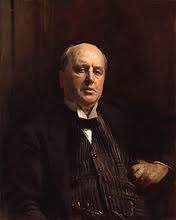
David Mitchell, Black Swan Green

Is it heretical to say that I appreciated Black Swan Green more than I did Cloud Atlas? Parts of Cloud Atlas completely captivated me, and there is no denying the Russian doll ingenuity of the overall construction, but I found it frustrating being jolted from one plot and genre to another, and as it went on I became distracted by the craft of the book and thus less and less able to get involved in its connecting themes and continuing stories. Mitchell is clearly a stylistic virtuoso, with a particular gift for inhabiting different voices. In Black Swan Green, though, we get to stay with one voice from start to finish, and though I suppose in some ways that makes it a more conservative or conventional novel, it also makes it a more immersive and, for me, more compelling read.
Continue reading

How to Read a Victorian Novel

a somewhat tongue-in-cheek contribution to the How-To Issue Tumblr

First of all, don’t listen to anyone who tells you not to. Middlemarch “kills book clubs”? Please! Unlike some highly-regarded classics, these novels were written to be read–by all of us.

But you do need to be properly equipped.

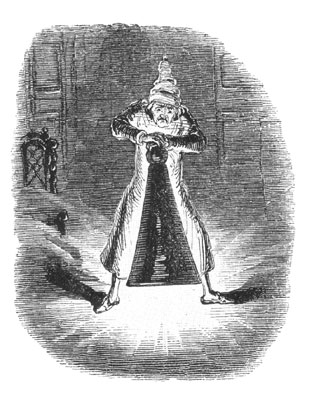
Bring both your head and your heart: these are books that want you thinking and feeling. While you’re at it, stock up on tissues. You may, like Oscar Wilde, consider yourself too sophisticated to cry at the sentimental bits, but you never know. It might be the tenderness of Silas Marner that gets you, or maybe silly Dora in David Copperfield will surprise you into sniffles–or maybe your downfall will be Mr Harding and his old friend the Bishop in Barchester Towers. If you think you’re immune, start with A Christmas Carol: Dickens has a name for people like you.

Don’t forget your social conscience, either–and maybe your checkbook. These are books that have designs on you, though in many cases they will be aiming at reforming you as much as (or more than) they aim at reforming society, so another useful accessory might be a mirror. If, at the end of the book, you can’t face yourself in it, I bet the book was Vanity Fair.

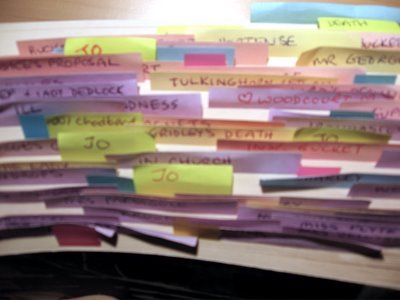
Post-Its are your friends. That passage that made you laugh or cry–the one you want to read to your friend, or copy into your commonplace book (or your Tumblr)–will rapidly be overwhelmed by all the other passages that make you laugh or cry: don’t lose track of any of them. A pen or pencil for jotting page numbers inside the back cover is handy too. You e-book users can take advantage of all the highlighting and bookmarking features your gadget provides.

Now that you’re properly equipped, your next challenge is time! You’re going to want to read, and read, and read–but modern life sometimes makes that difficult. What’s to be done?

Take the book with you everywhere, that’s what. Bank line-ups, buses, bathrooms, those precious 8 minutes while the pasta boils — you know what to do! A few pages here, a few pages there, and next thing you know, you’re 500 pages in, with only another 200 to go.

Then there’s all the time you’ll save by not watching television. Remember: the most highly-praised shows in recent years are always compared to … Victorian novels! Some of them are straight-up based on them! Just read the originals. They are always better.

When you’re actually reading, it will help to put aside modern(ist) assumptions about what novels should and shouldn’t do, such as “show, don’t tell.” Victorian novelists show plenty, but they are absolute masters of telling. They’re also kind of chatty–they like to talk to you. Yes, you, the reader. Don’t be rude. You’ll make a lot of new friends: though some of them may seem a little intrusive, and some tend to belabor the point, while still others make pretty silly jokes, well, I bet that’s true of your real-life friends too, and unlike your real-life friends, these ones will always be there when you need some intelligent, sympathetic company.

Do you assume Victorian novels are “realistic”? I do not think that word means what you think it means. Have you heard them called “traditional” a lot? Hardly! These folks were experimenting all the time. Frame narratives, multiple points of view, time-shifting, unreliable narrators, women with mustaches, people named ‘M’Choakumchild’ or, more slyly, ‘Slope’…there’s nothing they won’t try.

Have you heard that Victorian novels are loose and baggy? Not always (try Wuthering Heights), and besides, so what? That’s only a fault if you think a good novel has to be taut and linear. There are other kinds of unity. Think themes and variations for instance: Bleak House? Housekeeping. Or fog. Middlemarch? Webs. Vanity Fair? Vanity (of course). He Knew He Was Right? Husbands and wives. And so on.

Finally, try not to let Victorian novels spoil you for anything else. Sure, the work of hip contemporary novelists with promotional billboards may seem thin and reedy once you get used to the rich symphony of the great Victorians, and you’ll be forever comparing mystery novels unfavorably to The Moonstone and muttering “but he’s just not Mr. Thornton” at the end of every romance. But as Henry James (who, frankly, would have benefited from this how-to guide) pointed out, “the house of fiction has not one window, but a million.” There are other novels well worth reading.

henry-james

But if, once you get started, you never want to stop, you probably won’t have to. You think Trollope was prolific, with his 47 door-stoppers? He was a piker compared to Margaret Oliphant, who published 98. And we haven’t even talked about Bulwer-Lytton yet. Well, maybe we shouldn’t, actually. I’m trying to help you to read Victorian novels, after all, not scare you away. And to be honest, Bulwer-Lytton is a Victorian novelist I’ve never read myself. If any of you want to tell me “How to Read and Enjoy a Novel by Bulwer-Lytton,” I’ll be right over to read all about it.

Happy reading!

The Quality of Mercy: Edward St. Aubyn, The Patrick Melrose Novels

melrose“If I could imagine a mercy that was purely human, and not one that rested on the Greatest Story Ever Told, I might extend it to my father for being so unhappy.” — Patrick Melrose

This is the point at which I almost stopped reading Never Mind, the first of the four Patrick Melrose novels included in this collection:

During lunch David felt that he had perhaps pushed his disdain for middle-class prudery a little too far. Even at the bar of the Cavalry and Guards Club one couldn’t boast about homosexual, paedophiliac incest with any confidence of a favourable reception.

The rape itself is told, with harrowing obliqueness, from the point of view of David’s victim, his five-year old son Patrick. Patrick doesn’t know exactly what is happening to him, and he certainly doesn’t know why. He endures it by dissociating himself from his body:

He could hear his father wheezing, and the bedhead bumping against the wall. From behind the curtains with the green birds, he saw a gecko emerge and cling motionlessly to the corner of the wall beside the open window. Patrick lanced himself towards it. Tightening his fists and concentrating until his concentration was like a telephone wire stretched between them, Patrick disappeared into the lizard’s body.

It’s a scene unbearable to contemplate, and St. Aubyn presents it with clinical precision, not buffering the horror with euphemism, or with narrative intrusions to ventriloquize our shock and outrage. David’s afterthoughts (and indeed the whole of the novel) are handled the same way, with pitiless detachment, but even though I understand perfectly well that it’s David, not the novelist, being ironic here at the expense of a raped child, it’s still a sickening moment of levity. I didn’t know if I could bear another 600 pages in this company–not David’s company, as I knew he would be dead by the beginning of the second novel (though thanks to flashbacks this doesn’t altogether spare us his presence on the page, and of course his influence is pervasive) as the company of the novelist who could dedicate his conspicuous writerly gifts to creating such a bitterly unpleasant world.

Continue reading

Fear of Flying: K. M. Peyton, The Edge of the Cloud

The Edge of the Cloud is the sequel to Flambards and picks up very tidily exactly where Flambards leaves off. It also, with equal elegance, concludes with a scene that mimics the ending of Flambards almost exactly, but, as one of the characters observes, “We’ve grown up since then.” That’s what The Edge of the Cloud is, then: a novel of transition.

Flambards is too, as I noted in my post on it. In The Edge of the Cloud, the historical shifts invoked in the earlier book become even more explicit, to the point that Christina herself perceives very clearly the widening schism between the past and the present:

[Aunt Grace] would never understand, in her hidebound Victorian way, that on the aerodrome everyone was taken for granted if they were interested in the machines. There was no distinction of class or underdog; the mechanics, the pilots, the pupils and the owners all mingled without status. Brought up in what Christina now thought of as the medieval atmosphere of Flambards with its forelock-touching subservience on the part of the servants … she looked on the way of life at Elm Park as the normal order of life. Aunt Grace would never understand this attitude.

Life for Christina and Will and their peers at the aerodrome has a Utopian quality to it despite the financial challenges and the enormous risks (which are brought home quite harshly in an awful accident near the end of the book). But it’s hard not to be aware that this period, with all the excitement and adventure of both social change and technological innovation, is an interlude, the lull before the storm of war that is on the horizon when the book begins and just breaking out as it ends: Will turns the joyous thrill ride of aviation to the service of his country by enlisting in the Royal Flying Corps. Christina’s love for Will is shadowed throughout the novel by her fear for his safety; this personal anxiety transforms into a broad national and generational fear: “She knew now that life was suddenly dangerous for very many more people than just Will.” Like Vera Brittain and her fiancé Roland Leighton, this young couple finds their youthful romance overwhelmed by a very different story, one in which they will be reduced to bit parts. The title evokes both the literal clouds that turn planes back towards the ground, then, and the looming disaster from which there will, tragically, be no turning back, no shelter.

Continue reading

My Somerville Summer Continues: Course Planning!

I continue to read both primary and secondary sources in preparation for my fall seminar on “The Somerville Novelists.” Most recently I’ve been going through Holtby’s Women and a Changing Civilization and Brittain’s Lady into Woman: A History of Women from Victoria to Elizabeth II, as well as reviewing some of their journalism: my idea at this point is to launch the course with some excerpts that will both give a sense of their voices and use their own work to set up some of the major themes and contexts, from the history of women at Oxford to the relationship between gender and literary form. Ideally, the bits and pieces I choose will show off their personalities and get the group excited to learn more about them. Then I think we’ll read a small sampling of some relevant critical writing, again to set up themes and contexts and to give us some frameworks for discussion going forward into our four common texts: Testament of YouthSouth RidingGaudy Night, and The Constant Nymph.

I often organize my upper-level seminars around group presentations, usually one for each major reading, with individual reading responses and final papers for the other assignments. This time I’m thinking that one major component will be a collaborative wiki: given the relative obscurity of our readings, I think it’s apt (and hope it will be motivating) if we think about the class as an opportunity for genuine knowledge creation, building what might actually be a resource for other people interested in our authors and topics. I’ve used wikis in a larger lecture class before (following very much the model used by Jason Jones, described here) but that was less about generating ideas (though I hoped there would be some of that, and there was) and more about recording and synthesizing. In this case, with a smaller group of more advanced students, I imagine deciding as a group, after we’ve been reading and talking for a while, what kinds of information and what kind of organization will best serve what we are thinking and talking about. I’ll have to frame it carefully to make sure we have a shared sense of what we hope to accomplish and how their contributions will be evaluated–that’s going to be the tricky part, balancing what I want to be more open-ended and creative participation with the pragmatic bottom line that I have to give them grades and my expectations thus need to be clear and specific.

Continue reading

K. M. Peyton, Flambards

FlambardsProbably my favourite “YA” novels are K. M. Peyton’s Pennington novels, which I own in library discard copies and reread often. I’m sure I read Flambards in my youth too, but I had only a hazy memory of it, except that it involved a big house and horses. I was helping find books for my daughter at the library last week and, happening upon the handsome Oxford Children’s Classics edition of it on the shelf, grabbed it up for myself–and what a treat it was! It’s such an intelligent book, bringing together a range of historical changes all effectively dramatized through the clashes of personalities and values at Flambards, the house where young orphaned Christina is taken in by her bitter, violent uncle. His desire to hang on to a fading way of life is thwarted by his fallen fortunes as well as by his having been crippled in a fall so that he can no longer ride and hunt. His older son Mark is handsome, arrogant, and determined to follow in his father’s footsteps, a goal for which he will need Christina’s fortune, but it’s the younger son William, whose strengths are intellectual and who loves, not horses, but flying machines, who wins our sympathy as well as Christina–though not before she has a sort of romance with Dick the groom, thus bringing class, also, into the whole vexed business of personal lives that can’t help but reflect the conflicts of their times.

Peyton is a wonderful writer. I think Flambards actually lets her show off her descriptive talents more than the Pennington books do, and she’s very good with the landscapes especially. But she also captures the thrill of physical sensation as channeled for Christina through riding–along with its social themes, Flambards is very much about Christina’s maturation, including her coming to sexual awareness, and horseback riding is a time-honored way of displacing explicit discussion of those rising feelings in young women:

[Dick] grinned at her, and neither of them wanted to stop. It was too good, with the winter grass beneath them and the horses with their ears raked forward, their grey manes flying. Dick stood up in his stirrups and Woodpigeon started to gallop, Sweetbriar beside him, and this time Christina was confident, utterly trusting in her own ability, and in the infallibility of Dick. She looked across at him and laughed. Now it was right to be galloping: a great joy surged through her. And all the while the glory of it filled her with this new and incomparable happiness, she was conscious right at the back of her mind of a pity for William, and a little pit of contempt.

At this point William has yet to grow into the new model of masculinity he will embody, which will be marked by its own version of high daring and risk, but when his turn comes he will bring to it a scientific power that differentiates him from the more brutal passions of his father and brother, shown here as personally destructive and as part of a system of careless oppression: nobody but Christina is particularly concerned, for instance, when Dick is dismissed for helping her with a somewhat quixotic plan to rescue a lamed horse from being turned into dog meat. Christina becomes aware of social injustice even as she has to consider her own possible marriage to Mark and whether she will put her own resources into rebuilding Flambards or into the modern world that is making everything it represents obsolete.

It’s hard, reading Flambards today, not to see that it anticipates a lot of the themes and stories of Downton Abbey! It also fits aptly into my Summer of Somerville, at least in its historical setting. I’ve put a hold on the next volume in the series, The Edge of the Cloud, which takes us into WWI. I can’t remember it at all and am trying to avoid spoilers, but I don’t much like William’s chances if he goes into the war as a pilot…

Thomas H. Raddall and Stephen Kimber, Halifax: Warden of the North

Canadian history is not boring! Surprise!

As I romped through Thomas Raddall’s lively and very informative history of my adopted city, I found myself wondering why I have never been interested in Canadian history. Whose fault is that? I’d blame boring teachers except that I can’t really remember being taught any Canadian history in school. I started reading historical fiction at the tender age of five–I still have my tattered copies of Jean Plaidy’s The Young Elizabeth and The Young Mary Queen of Scots–so can I blame my total oblivion to Canadian history on the absence of equally romantic and accessible historical novels with Canadian heroines? (There was Anne of Green Gables, of course, but in my childish mind she was eternal, not historical, just like Meg, Jo, Beth, and Amy.) Though in later years I took some detours into American history (via Gone with the Wind, mostly) and occasionally into French or Russian, it was British history that had caught and held my imagination, and it really never occurred to me that I was missing anything by not exploring the history of my own country. That was a failure of patriotism as well as of curiosity, I suppose–but then I’ve never been much moved (in fact, I’m usually annoyed) by pressure to be more nationalistic, especially culturally (and Canadians actually get quite a lot of that kind of pressure, what with the incessant feeling of being encroached upon or drowned out by our noisy neighbours to the south).

Anyway, I remember various class trips to the Museum of Vancouver or the B. C. Provincial Museum, and to Fort Langley (where we’d get the obligatory square nail souvenirs) and I think at some point we made dioramas of scenes from Vancouver’s early years, but none of this competed with the thrilling stories of Lady Jane Grey or Eleanor of Aquitaine or Good Queen Bess. That was the good historical stuff! Later, as a history major in university, I stuck to Britain and America for my coursework, along with the intellectual history and historiography that were my main interests–there must not have been a Canadian history requirement, and of course it didn’t occur to me to take any Canadian history voluntarily!

Well, better late than never, right? I thoroughly enjoyed Halifax: Warden of the North, which I bought in the gift shop at the Halifax Citadel after touring the fort for the first time in my almost 17 years living here. I figured it was time I stopped moping quite so much about not living in Vancouver and tried to learn to love the east coast–and you know, the ironic thing is, Halifax actually has a lot more to offer a British history buff than Vancouver does, because so much of its early history actually is British history–obvious, I know, but reading Warden of the North finally made that sink in. From the earliest days of French and British competition for control over the area, through the drama of the War of 1812 to the nearby chaos of the American Civil War and the heyday of Victorianism–Halifax was a British outpost, for better or for worse, and right in the thick of things, too. Why, the British force that captured Washington and burned the White House was sent from the naval base in Halifax!

Continue reading

Guilty as Charged: Hilary Mantel, Bring Up the Bodies

Bring-up-the-BodiesThere’s a feeling of power in reserve, a power that drives right through the bone, like the shiver you sense in the shaft of an axe when you take it into your hand. You can strike, or you can not strike, and if you choose to hold back the blow, you can still feel inside you the resonance of the omitted thing. (Hilary Mantel, Wolf Hall)

“Did Anne,” Cromwell wonders towards the end of Bring Up the Bodies, “understand what was coming?” Even as the confessions are gathered that condemn her–even as her own uncle carries the warrant for her arrest, she goes “blindly through her last morning, doing what she always used to do.” What should she be doing, though? What could she be doing that would make any difference? We know, after all, how the story ends–but the fleeting poignancy is that she can’t be sure, can’t even altogether understand how she has lost the game she played with such brilliance. “Ready to go?” asks her uncle Norfolk; “I do not know how to be ready,” she replies.

It’s telling that Anne’s defeat manifests itself as disorientation: in the intricately plotted and plotting world Mantel has created across the first two books of her Cromwell trilogy, awareness is everything. Cromwell relies for his own power on his literal network of informants as well as on the relentless acuity of his inward eye, arranging and rearranging players and pieces in his mind until he is as sure of success in his political life as he is in the game of chess he portentously plays with Edward Seymour, brother of meek Jane, object of King Henry’s latest obsession. “A world where Anne can be queen is a world where Cromwell can be Cromwell,” it occurs to him in Wolf Hall. In Bring Up the Bodies he must discover how Cromwell can survive as Cromwell in a world where Queen Anne must be replaced. Anne’s rise enabled his, but her fall must not bring him down, and so with clinical precision he rearranges his alliances and once again commits himself to getting Henry what he wants. That this time his duty to his king coincides with his own longstanding grudges–against those who destroyed and then mocked his fallen mentor, Cardinal Wolsey–makes his job just that much sweeter.

Cromwell’s cold vengefulness, originating as it does in his love for Wolsey, paradoxically humanizes him: though instrumental in the suffering and death of many men (and one woman) whose guilt is at most ambiguous, nonetheless he is hardly a monstrous figure. Yet who could read his interviews with these victims of Henry’s caprice and not recoil? Wily, sophistical, manipulative, relentless, he twists both their words and their silences into the shapes that serve his single-minded purpose. “Did you think the king would die, so you could marry Anne?” he demands of Henry Norris. “Or did you expect her to dishonour her marriage vows during the king’s life, and become your concubine? It is one or the other.” “If I say either,” protests Norris, “you will damn me. You will damn me if I say nothing at all, taking my silence for agreement.” That is, exactly, Cromwell’s method. “And what do you think of brother George?” Cromwell asks him:

“You may have been surprised to encounter rivalry from that quarter. I hope you were surprised. Though the morals of you gentlemen astonish me.”

“You do not trap me that way. Any man you name, I will say nothing against him and nothing for him. I have no opinion on George Boleyn.”

“What, no opinion on incest? If you take it so quietly and without objection, I am forced to conjecture there may be truth in it.”

“And if I were to say, I think there might be guilt in that case, you would say to me, ‘Why, Norris! Incest! How can you believe such an abomination? Is it a ploy to lead me away from your own guilt?'”

He looks at Norris with admiration. “Not for nothing have you known me twenty years, Harry.”

What takes Norris longer to realize is that though he will die for his alleged guilt with the queen, his death settles a different debt, “a fat extract from the book of grief”: he and the other accused men once “turned the cardinal into a beast” in a play for the court, depicting him as “a howling animal, grovelling on the boards and scrabbling with his paws.” In the audience was Cromwell, “leaning against the panelling, silent, wrapped in a robe of mourning black.” “Would Norris understand it if he spelt it out?” wonders Cromwell;

He needs guilty men. So he has found men who are guilty. Though perhaps not guilty as charged.

On its own terms, it’s a faultless logic–perhaps even a faultless justice. Anne must go; adultery and treason will be the charges; the charges must be proven, so the men must be found guilty; once they are found guilty, Anne’s guilt too is concluded; they die, she dies, and the king is free to marry Jane Seymour and beget a son for England. The men must be found guilty of adultery and treason whatever the facts of their relations with the queen, but as they are at any rate guilty of something else, their deaths are deserved and no moral harm is done.

9be5a-scaffoldsite

If that reasoning makes you squirm, then you are onto what I suspect is Mantel’s game, which seems to be to test the limits of our sympathy (our complicity, even) with a protagonist driven increasingly by calculation and self-interest, one who, despite having strong loyalties and family affections himself, is all but unmoved by the human desperation his machinations engender. The Cromwell of Bring Up the Bodies is colder and more sinister than his counterpart in Wolf Hall — or perhaps the difference is that the earlier Cromwell is an underdog, on the rise, always a compelling dynamic, whereas in Bring Up the Bodies, though he is still disdained by the court for his lowly origins, now he is Master Secretary, seemingly both omniscient and omnipotent, and holding on to power is never as attractive as winning it. Mantel plays her hand deftly, though: Cromwell himself recoils just enough from his own cruelties to keep him on the right side of unforgivable. Interrogating young Francis Weston, child of privilege (“never a moment’s doubt about his place in the world, never a moment’s anxiety”) Cromwell sees “the boy’s head sink into his hands”– “Perhaps the facts will come out now?” And then, inexplicably, he excuses himself and leaves the room. Is it the truth he fears? Why, if it will legitimize the accusations, the sentences, the deaths that are already inevitable? To save Weston, perhaps, from denouncing his friends and then living — dying — with that betrayal? To preserve Weston’s innocence, such as it is, in a world where innocence seems impossible?

Or perhaps he just needed air. Let us say you are in a chamber, the windows sealed, you are conscious of the proximity of other bodies, of the declining light. In the room you put cases, you play games, you move your personnel around each other: notional bodies, hard as ivory, black as ebony, pushed on their paths across the squares. Then you say, I can’t endure this any more, I must breathe: you burst out of the room and into a wild garden where the guilty are hanging from trees, no longer ivory, no longer ebony, but flesh; and their wild lamenting tongues proclaim their guilt as they die. In this matter, cause has been preceded by effect. What you dreamed has enacted itself. You reach for a blade but the blood is already shed. The lambs have butchered and eaten themselves. They have brought knives to the table, carved themselves, and picked their own bones clean.

The horror is manageable as long as the unreality predominates. His lawyer’s skills entrap his victims and the credit is his for maneuvering them into position; they, on the other hand, believe that if they just tell the truth somehow they can restore themselves to life. Norris “seems to think that with eloquence, with sincerity, with frankness, he can change what is happening,” but already, to Cromwell’s eyes, he is “the dying man.”

Of Anne, especially, Cromwell prefers not to know too much, not to come too close. “You know, I created you,” she says to him when he comes with the others to take her to the Tower. He shows no particular malevolence towards her; in fact, he repents having brought the Constable of the Tower, William Kingston, along on this errand, as “his office, and his appearance have struck terror into the hearts of the strongest men.” She is more his antagonist than his enemy–though again there is satisfaction for Cromwell in seeing one who brought Wolsey down brought down in her turn. When he thinks she is about to speak to him sincerely, confessionally, he is momentarily touched with both compassion and unease:

She is on her feet, detaining him, timidly touching his arm; as if it is not her release she wants, so much as his good opinion. “You do not believe these stories against me? I know in your heart you do not, Cremuel?”

It is a long moment. He feels himself on the edge of something unwelcome: superfluous knowledge, useless information. He turns, hesitates, and reaches out, tentative . . .

But then she raises her hands and clasps them at her breast, in the gesture Lady Rochford had showed him. Ah, Queen Esther, he thinks. She is not innocent; she can only mimic innocence. His hand drops to his side. He turns away.

He is relieved — not that she is guilty, for he has nothing more certain than his own belief that “she would commit any sin or crime” to tell against her — but she does not intrude upon him any inconvenient truth. All he ever wants is “the truth little by little and only those parts of it we can use.” Anne’s protestations of innocence, especially if truthful, would not be useful at all for Cromwell’s purposes, or the king’s.

And what about Mantel’s purposes? “The evidence is complex and sometimes contradictory,” she says in her author’s note about the “circumstances surrounding the fall of Anne Boleyn”; “the sources are often dubious, tainted, and after-the-fact.” So there’s one reason to leave the case against her unresolved: we can’t, historically, be sure. Besides, what is sure is the necessity of the judgment against her: it was shockingly irrelevant whether the accused men were in fact her lovers, whether she did in fact commit incest with her brother. Her trial was never really about that, and so from that perspective Mantel is right to keep our attention on the process, the political and, we might say, genealogical forces arrayed against her. This focus, in turn, keeps our attention on Cromwell, on his successes and failures, and on the moral equivocations of his ultimately triumphant plot against her, given both the difficulty and the irrelevance of making the actual case. “Was she guilty or not?” is the question Thackeray refuses to answer about Becky Sharp in Vanity Fair, and as a result our judgment is deflected from her to those around her, as well as to ourselves. A guilty Anne is a weak opponent; an innocent Anne is a martyr. Mantel’s Anne, instead, is neither guilty nor innocent but defeated:

He believes he understands Anne, as Wriothesley does not. When she said the queen’s lodgings were too good for her, she did not mean to admit her guilt, but to say this truth: I am not worthy, and I am not worthy because I have failed. One thing she has set out to do, this side of salvation: get Henry and keep him. She has lost him to Jane Seymour, and no court of law will judge her more harshly than she judges herself. . . . She knows adultery is a sin and treason a crime, but to be on the losing side is a greater fault than these. . . .

He says, “Anne is dead to herself. We shall have no trouble with her now.”

wolf-hallUnlike Anne, we knew all along that this was how the game would end: though most of the multitudinous details Mantel provides will probably be unfamiliar to all but the Tudor connoisseur, Anne’s execution cannot surprise any reader. Mantel knows this perfectly well and even plays with it — the very title of Wolf Hall foreshadows Anne’s failure even as the novel details her success. Historical fiction can hardly be built around suspense. Bring Up the Bodies is gripping nonetheless because, knowing what will happen, we still wonder how and why events unfolded as they did, and because also Mantel is brilliant at the other aspects of the novelist’s craft: characterization above all (Cromwell, of course, and Anne, but also Henry, who is miraculously liberated from the burden of clichés and caricatures that have accreted around his bullish figure over five centuries) and setting, too, all of the elements contributing to our understanding of the world she has created, which is permeated with implications that reach well beyond plot:

These days are perfect. The clear untroubled light picks out each berry shimmering in a hedge. Each leaf of a tree, the sun behind it, hangs like a gold pear. Riding westward in high summer, we have dipped into sylvan chases and crested the downs, emerging into that high country where, even across two counties, you can sense the shifting presence of the sea. In this part of England our forefathers the giants left their earthworks, their barrows and standing stones. We still have, every Englishman and woman, some drops of giant blood in our veins. In those ancient times, in a country undespoiled by sheep of plough, they hunted the wild boar and the elk. The forest stretched ahead for days. Sometimes antique weapons are unearthed: axes that, wielded with double fist, could cut down horse and rider. Think of the great limbs of those dead men, stirring under the soil. War was their nature, and war is always keen to come again. It’s not just the past you think of, as you ride these fields. It’s what’s latent in the soil, what’s breeding; it’s the days to come, the wars unfought, the injuries and deaths that, like seeds, the soil of England is keeping warm.

Through the vehicle of Cromwell’s own peculiar, wide-ranging, far-seeing consciousness, Mantel transports us away from the particular towards the near mythic. Her prose oscillates between the immediate and the imminent, and thus, though we follow the individual stories intently, we can’t forget their small size, the small part her men and women play in the story that began long before them and will go on long after. “One day I will be gone,” reflects Cromwell at the end of this volume, “and as this world goes it may not be long”:

I will leave behind me a great mountain of paper, and those who come after me . . . will sift through what remains and remark, here is an old deed, an old draft, an old letter from Thomas Cromwell’s time: they will turn the page over, and write on me.

“Either my enemies will do for me or my friends,” he thinks wryly, and the final volume of Mantel’s trilogy will presumably tell the story of how this comes to pass. It will be interesting to see if, as Cromwell finally plays a losing hand, Mantel is tempted to sentimentalize him, or at least to be more decisive about his guilt or innocence than she is about Anne’s. She has established the basis for his defense: if he is cruel (and how easily Anne’s French-inflected version of his name, “Cremuel,” slurs into that word when you’re reading), if he is cunning and self-interested, he is also loyal and even loving. She shows him, not as an inherently evil man, but as a man who has sought to shape his destiny in an unforgiving environment and has adapted in order to survive. “The world corrupts me,” Cromwell says to Thomas More in Wolf Hall;

Or perhaps it’s just the weather. It pulls me down and makes me think like you, that one should shrink inside, down and down to a little point of light, preserving one’s solitary soul like a flame under glass. . . . I truly believe I should be a better man if the weather were better. I should be a better man if I lived in a commonwealth where the sun shone and the citizens were rich and free.

Is that where we should rest our case, then, on the flickering light of his best self? Or does this exculpatory statement sound a little too pat from the man who stands over the fallen body of the king and “seems to body out and fill all the space,” staring down his enemies and seemingly calling Henry back from the dead? Though the argument of the novels might be that Cromwell is no more (and no less) than an exemplary man of his age, the form of the novels, which keeps us up close beside him at all times, insists on the force of the individual character. So do we blame him for his conduct or not? So far, I think we are left hovering between excuses and accusations. Perhaps here too, as with Anne, judgment is beside the point, but if we reserve judgment in the case of a man like Cromwell (at least as Mantel has shown him to us) I also think that we have to feel within ourselves “the resonance of the omitted thing.”

From the Archives: In Memoriam–Escallonia Hedge

Samantha Li

Three years ago today, my student Samantha Li died in a terrible car accident. She was a brilliant, original thinker and a warm, gracious, witty person. I was touched and honored to be asked by her family to be one of the speakers at her funeral and also at a concert held in her memory later that summer. I still think about her often. I wrote this post soon after the funeral service.

It seemed fitting to write about her on my blog because she was one of its earliest readers and the first (and still almost the only) one of my students to comment on it.  That engagement, also reflected in the blog she wrote herself, was typical of Samantha: she cared about the books she read and the questions they raised for their own sake, not just as academic assignments. For her, the conversation neither began nor ended during class time; the page limits of an essay did not set the parameters of her inquiry. This could be challenging for her instructors: well after you thought you and she were done with something–after it was submitted or even graded–she might show up to discuss a new idea or example that she thought would make it better. She didn’t expect to get a chance to rewrite it: she was just still thinking about it. This is exactly what you hope for, of course, but it was often humbling to discover myself, amidst the rush of term, unable to sustain my own attention to her project well enough to respond as thoughtfully as she deserved. The best students inevitably show you your own limits. But with Samantha it was never about showing off, only about an utterly sincere desire to figure things out.

The English Department has established the Samantha Li Memorial Award, given annually to the student who in our estimation best reflects the same special qualities of literary passion, intellectual curiosity, and generosity.


July 17, 2009

Gently they go, the beautiful, the tender, the kind;
Quietly they go, the intelligent, the witty, the brave.
I know. But I do not approve. And I am not resigned.

One of my favourite quiet corners around here is a site called Escallonia Hedge. The name, as explained on the site, refers to the hedges surrounding the garden at Talland House, Virginia Woolf’s childhood summer home. Its author describes it as “a space through which things are meant to be discerned,” an opportunity for “trying to get comfortable with talking about texts in a comfortable but nonetheless what is called a ‘productive’ way. Maybe some dawdling along the way.”

I’ve read Escallonia Hedge since its inception. There aren’t many posts there, just over a dozen altogether, but every one showcases the author’s playful intellect and her delight in words and ideas. Here’s an excerpt, for instance, from a post on “Woolf and the Body”:

I have been thinking lately about Woolf and the body. Woolf is always thought of as being incredibly cerebral—which, no doubt, she was—but always to the point that I think there must be a popular misconception that she somehow rejects the body, does not think it important or take it seriously, just as there is the popular conception that she is somehow of a parcel with figures like T. S. Eliot, or how she must always and only be egotistical, when, really, she has one of the most sympathetic eyes ever.

Thinking about this I am of course reminded of a frequently cited passage in On Being Ill, on the body as a pane of glass:

“[L]iterature does its best to maintain that its concern is with the mind; that the body is a sheet of plain glass through which the soul looks straight and clear, and, save for one or two passions such as desire and greed, is null, and negligible and non-existent. On the contrary, the very opposite is true. All day, all night the body intervenes; blunts or sharpens, colours or discolours, turns to wax in the warmth of June, hardens to tallow in the murk of February. The creature within can only gaze through the pane—smudged or rosy; it cannot separate off from the body like the sheath of a knife or the pod of a pea for a single instant; it must go through the whole unending procession of changes, heat and cold, comfort and discomfort, hunger and satisfaction, health and illness, until there comes the inevitable catastrophe; the body smashes itself to smithereens, and the soul (it is said) escapes.”

It just occurred to me as I lay in bed this morning, procrastinating on my papers (actually, not wanting to face the world), that Woolf’s frequent use of metaphors of glass is connected to this. Why is it sometimes that these very obvious things take so long to process or register?

Here’s another excerpt, this one from some commentary on a collection of Woolf’s writings called The Platform of Time:

The satire “JB” I found especially striking: it’s full of very interesting nonsense. It reminds me of how I tried to write at one point because I couldn’t find a sentence or a sense-making group of words that expressed what I thought, only I was writing that way sincerely whereas VW parodies the practice as confusion and excess. The character VW tells the character JB to find a single “image” to express what he means instead of clumping together various descriptors, and then JB tries to figure out what an “image” (simile, metaphor) means! (What is its use; where he can find an example of one; how it’s no good because it’s not GE Moore-ish enough (“how can a thing be like anything else except the thing it is?”).) This in contrast to JB looking at a “male siskin under a microscope” in an effort to compose a poem “in the manner of Gerard Hopkins” (“The siskin’s been dead a week”):

“Seepy, creaking, sweeping, with a creaking kind of beating of the penultimate dorsal jutting out femoral crepitational tail. The siskin whisking round the peeled off mouldy bottle green pear tree rivers. Well, I flatter myself that’s a pretty good poem—all true to an inch.”

Then there’s a big fuss about finding an image for the siskin, which in the end is arrived at by what JB has for lunch: “The siskin lies like—like cold salt roast beef the siskin lies. My word—that does it.” It’s moments like this I feel like saying “Oh Virginia Woolf, you’re the best!” I think the interesting thing about that line “like cold salt roast beef the siskin lies” is that it sounds beautiful but is being a framed in a way that makes it silly, reaching, and untrue. This is always the interesting thing about Woolf’s satirical moments, I think, and why I would say “Oh VW you’re the best”—many of them are a mixture of a form of sympathy and ridicule. Like Samuel Johnson’s satire manqué.

The author, Samantha Li, graduated from Dalhousie in May with first-class Honours in English. She would have begun her M.A. in English at U.B.C. in September. Tragically, she died on July 11, in a terrible car accident. She was 24. Her funeral service was today; I had the honour of being one of those invited by the family to speak at this heartbreaking event. All of us who had the pleasure and the privilege of working with Samantha will always remember her questing intelligence, her self-deprecating grace, her vivacious warmth, and her kindness. She was much loved, and will be greatly missed.

The lines I’ve quoted at the head of this post are from Edna St. Vincent Millay’s “Dirge Without Music.” As Samantha was also an exceptionally talented musician, however, it seems fitting to remember her with music as well, though unfortunately the available samples are not great quality. In this video, she is playing the violin; she is second from the left as we watch.

Frank Conroy, Body and Soul

Body and Soul was a near miss for me. I thought it was really very good most of the time, especially through the first half, but there were parts in the second half that seemed really thin and reedy, and they stood out more because the other parts of the book were so strong. The novel tells the story of Claude Rawlings, a musical prodigy who, thanks to a series of rather unbelievably supportive and available mentors, rises from a grim neglected childhood to triumphant performances at Carnegie Hall. Though we follow Claude’s point of view throughout the novel, he remains a fairly flat, enigmatic character: one explanation for this would be that he represses so many of his reactions as a child that his life, as well as his story, is also quite repressed, but another is that for him, nothing matters as much as music–which makes it appropriate, really, that nothing in the novel is as exciting as the detailed descriptions of music.

Reading and writing about music is a tricky business. Conroy is, of course, aware of this, and even has Claude remark it at one point: “don’t you think it’s practically impossible to write about music directly? I mean, all you can do is skirt around it, sort of.”  I was thinking about the other novels I like in which music plays a big part — Lynne Sharon Schwartz’s Disturbances in the Field, or Vikram Seth’s An Equal Music, or Ann Patchett’s Bel Canto, for instance. In all of these, the writing drew me into the music intellectually as well as emotionally. Reading about music is never going to be the same as listening to it, so flowery attempts to sound ‘musical’ aren’t likely to be very effective. All of these writers focus on the ways the music feels to the musician or the audience, as well as on how the music is made or played. Conroy’s is, I think, by far the most analytic of this little group, with long discussions of technique and theory. He takes real risks here by putting in so much detail, and these passages do get a bit overwhelming, but they work because they are also carefully dramatized as part of Claude’s musical development, and it is fascinating to watch his comprehension grow and to experience the mental and emotional conflicts that emerge as his instinctive musical taste is challenged by his teachers. Here’s Claude working out an idea he has for subverting a composition assignment on atonality (I couldn’t explain exactly what he is doing, but it has something to do with Charlie Parker’s bebop changes, which in turn has to do with the novel’s larger interest in the musical integrity and seriousness of jazz in relation to classical music–one of its more interesting preoccupations):

Gradually, enough bits and pieces emerged, and held, for him to sense the general shape of the first four bars, which would contain all twelve tones, without a unison or a repetition. He worked it all out so as to include a certain four-note motive he was familiar with. When he had the complete tone row, he double-checked the math and began to explore the upside-down and retrograde forms.

At one point he almost lost heart. He’d written himself into a corner. There seemed no way to use the retrograde row against the original without a number of fairly strong tonal effects creeping in. He fooled with it in a dozen different ways, but as soon as he excised one tonal effect another would crop up somewhere else. It was like trying to pick up liquid mercury with your fingertips. Then he saw something. If he broke the original row into halves–a modest impurity even by Satterthwaite’s standards–and used the second half upside down, the tonal intervals were avoided.

A more ecstatic tone enters into the descriptions of performances:

Trading off with Fredericks, he felt almost outside himself, listening to the magic flow, the shift of colors, hearing the pulse, watching his hands do their amazing work. As he shaped the music in his mind and played it, he felt Fredericks shaping and playing right along with him, their souls joined in harmonious enterprise, like two old friends who can talk without words, who can communicate a thought even before it has fully emerged, because the same thought is nascent in the other. Claude knew he was on the stage, at the piano in Longmeadow, Massachusetts, but at the same time he was somewhere else, somewhere he could not describe even to himself–nor did he have the faintest urge to, so heavenly did it seem. Watch it! Watch it! Listen! Concentrate! Here it comes. Here it is. This!

It is thrilling to imagine what it must be like to break through in this way, and the most compelling parts of the novel for me were about precisely that experience–the near-miraculous, rare joy of transcending the technical skill and mental mastery and sheer hard work required to become an accomplished musician and being wholly released into the music itself. As someone who loves to play the piano but never had the talent or drive to become more than moderately skillful, I was moved by Claude’s development and impressed by Conroy’s evocation of it. As the mother of a much more gifted musician, I also felt that the novel gave me a glimpse into what music might be like for him, something much more organic and dynamic and inevitable and irresistible than it is for those of us forever stuck on the other side of that wall.

I didn’t care as much for the rest of the plot. Claude’s mother was interestingly conceived but I couldn’t connect her story to Claude’s (by which I don’t mean in the plot involving the hidden identity of his absent father or that kind of thing, but thematically, particularly her political entanglements–and the working out of the fatherhood plot was the thinnest part of the novel to me). I really didn’t like the whole ‘haunted by an inaccessible beloved’ storyline, or the story of Claude’s marriage: the former seemed clichéd, while the latter seemed kind of perfunctory. Claude’s relationship with his first mentor, Aaron Weisfeld, though, was a beautiful thing.