“As if she were a governess in a book”: Elizabeth Taylor, Palladian

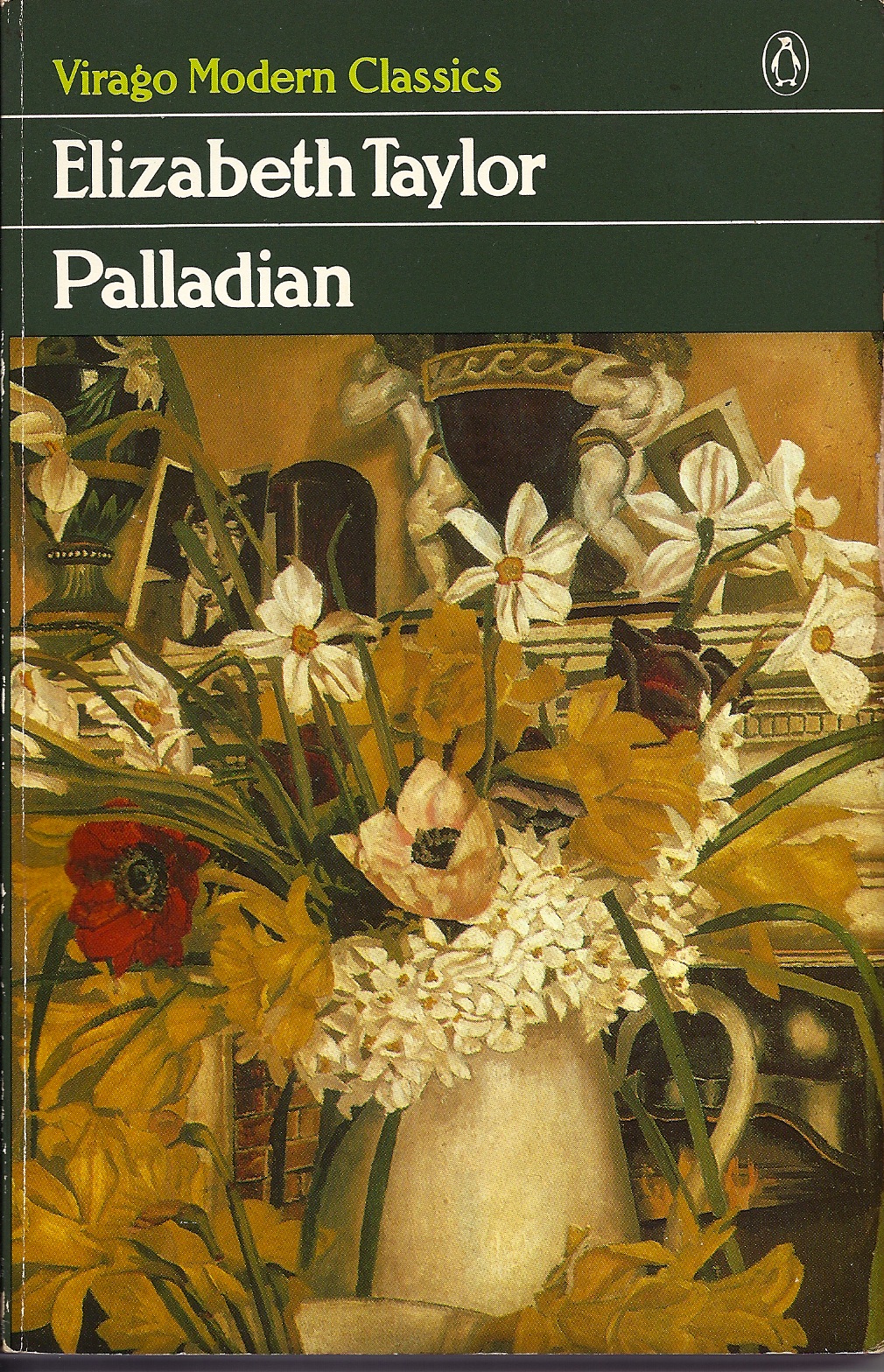
palladian2I can’t take any credit for interpreting Elizabeth Taylor’s strange, gloomily elegant Palladian as a pastiche of Austen and Brontë. Not only does the back cover of my Virago edition baldly state that the novel “examines the realities of life for a latter-day Jane Eyre” and explicitly compare Taylor’s method here to Austen’s in Northanger Abbey, but the main character is named “Cassandra Dashwood” and criticizes her own flustered greeting to her new employer on the grounds that “Jane Eyre had answered up better than that to her Mr. Rochester.” Subtlety about its intertextuality, in other words, is not the most striking feature of Palladian … and yet what do we really know about the novel once we’ve identified those obvious connections? I’m not sure that thinking of it as a twist on the “governess novel” — or on the romance, or the gothic, plot — helps me out very much, because we still need to figure out to what ends Taylor has repurposed such familiar materials.

Having just worked through Jane Eyre with my 19th-Century Fiction class, I should be primed to consider what Taylor is up to. There’s not actually much that’s the same besides the bare outline: unprepossessing orphan accepts governess position at remote, slightly creepy country house, falls in love, endures trauma that threatens happy resolution, ends up safely married. Cassandra couldn’t be less like passionate, rebellious, creative, principled Jane, for one thing: while I lament the number of times my students (despite explicit instructions not to use the word!) called Jane “relatable,” I agree that it’s hard not to root for her — even as her novel (through her own retrospective narration) cautions us not to champion her uncritically. Cassandra, on the other hand, is a limp wanna-be, moping and hoping to live out a more interesting destiny, like a good fictional heroine. “He will do to fall in love with,” she thinks on meeting Marion Vanbrugh; “Meeting him,” she reflects later, “had merely confirmed her intention, made possible what she had hoped.” Jane is a fighter; she spends her book learning what she values most and how to stand up for it. Cassandra spends her book … hmm. Well, she spends it being in it, anyway, but that’s about as much as can be said for her.

Marion is an equally pallid recreation of Mr. Rochester: reclusive, scholarly, haunted not by a raging mad wife in his attic but by memories of his beautiful first wife, Violet. Why does he fall in love with Cassandra? Is that even what happens? Like Cassandra, he seems compelled by his implicit awareness of how their story must turn out. There’s no spark, no passion. Like Jane and Rochester, they kiss as a storm thunders, but while Brontë’s lightning, splitting the great chestnut tree, reflects the dangerous immensity of their love, it just seems ironic that nature surrounds limp Marion and passive Cassandra with such tumult:

Still holding the candles high, he drew her closer to him and kissed her. She received his kiss, but did not return it, for she did not know how, nor did it occur to her, so netted up in bliss was she, so content to be held by him not stirring, heedless of the next day and the next minute.

In their world, it seems that the most they can hope for is to go through the motions.

And even that isn’t easy, partly because they aren’t the only people there, and everyone else gets in their way somehow. Taylor populates her desolate manor with an assortment of characters, all in their own ways damaged or grieving, their paths day-to-day criss-crossing in an uneven pattern of tension and disappointment: Tom, holding the sins and regrets of his past at bay with drink; Margaret, awaiting the birth of her child, wandering the musty hallways hungry, always hungry; their fretful mother Tinty, always “full of little worries”; Nanny, grimly hanging on to her position in the family; little Sophy, the unknowing crux of the family’s unhappy plot; Mrs. Veal at the pub, pathetically needy for Tom’s attention and affection, resentfully in awe of the family at the ‘Big House.’ Only Margaret, a doctor, has any sense of purpose in her life; the rest of them seem cut off, somehow, not just literally by their isolated setting but mentally, from a world in which they can’t imagine, or find, direction or comfort. While the ending of Jane Eyre brings Jane to the end of her journey of self-discovery, nobody in Palladian gets anywhere. When Cassandra returns to the manor as its mistress, it is more decrepit than it was before.

It’s not an arch or satirical rewriting of those canonical stories: it is too fraught and specific for that. Paul Bailey’s introduction proposes that Taylor sets up the literary homage deliberately to collide with “that other, larger world out there, in which hurt and humiliation take their daily toll.” But he concludes that the result is “a fairy-story of sorts, with a happy ending for only two of its participants.” I’m not convinced, because I don’t believe in their happiness: it seems so baseless, so formulaic, so unearned. The prospect of the book seems more desolate to me even than that limited a fairy-story. When Cassandra arrives at Cropthorpe Manor, she’s warned to stay away from the greenhouse, as the glass panes have become precarious. Near the end of the novel, it has collapsed:

Like a cataract gathering speed, the sheets of cracked and splintered glass had come down a night or two ago, started by some small thing, something never to be known, a twig falling, an owl flying, or merely the last imperceptible change of quantity, a foreshadowing of what might happen to the house itself, how, after a long process of decay, one day it would suddenly not be a house any more.

Marion and Cassandra, married, go out to survey the wreckage and consider repairs: could this be an image of the future, a symbol of renewed possibilities? Why should we be so optimistic? “Marion wonders what can be done with it,” says Tinty, watching from the house. “He will never get beyond wondering,” replies Tom.

No, the pleasures of Palladian are not emotional, or not in an uplifting way. There are no romantic gratifications, beyond the artificial ones of seeing the cliché carried to its conclusion. There’s no social analysis or critique that I can discern — unless you count the general presentation of modern life as a malaise, a blight. What’s left? Literary pleasures, of course, or perhaps I should call them aesthetic ones. Palladian is only Taylor’s second novel (and it’s only the fourth of hers that I’ve read), and it’s just as distinctive as the others for its direct yet resonant sentences. They carry a moment, a mood, a mind, with few overt flourishes but many interesting choices, so that you read them once and then look again, to be sure, or to appreciate.  She’s particularly good at laying out how what seems simple — love, marriage — is actually unbearably complicated:

His head felt as if someone were doing knitting in it. Nothing was simple. He believed that he loved Cassandra tenderly; but marriage is not simple. It brought with it, Nanny had reminded him, so many complications which were beyond his energies. Tinty stood before him, and Tom, Nanny with her talk of refrigerators and change, the thought of beginning a new life in that fast-crumbling house, of leaving a smouldering and rank corner of earth to sons, perhaps, and then engaging servants, spending money, laying down wine, planting and clearing. In the library last night, no one, nothing, had stood between him and Cassandra. Now so much interposed. She was a child merely, to be led into so dark, so lonely, a wilderness as his heart. For her, so much unravelling of people, so much sorting out of possessions would have to be done. He might draw her to him and ease the passion which lay under her silence, lead her into the circle of ice which encompassed him: but the obstacles were still outside, where the world was, and even within him, there was Violet.
This Week In My Classes: Hunkering Down!

Ah, the holiday weekend, with its leisure reading! It’s just a fond memory right now … Well, I exaggerate slightly, as I’ve certainly had more hectic terms than this one (this time last year, just for instance, I was teaching three courses, including one entirely new one), but I have been pretty busy with class preparation, grading, and meetings in the last couple of days, and so far I haven’t really focused on another fun book to read in the interstices.

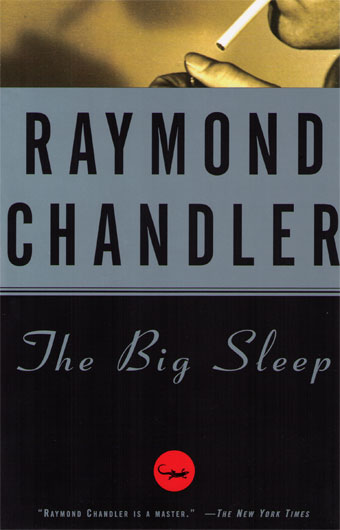
The-Big-SleepToday I finished marking the 75 midterms for my Mystery & Detective Fiction course (which means, in case any students are reading this, that the grades should be checked and posted to Blackboard tomorrow afternoon). In class, we’ve just started working through The Big Sleep. It’s my first time teaching it, after going endless rounds with The Maltese Falcon. I’ve been thinking about making this switch for years but it took me a while to get over my initial aversion to The Big Sleep (soon after that 2009 post, however, I did add The Hound of the Baskervilles to the syllabus, where I have enjoyed it ever since). There are a few things I already miss about Hammett, but I think Chandler is going to give us plenty to talk about, and now that I have the plot more or less sorted out and some interpretive threads to follow, I am relaxing enough into the book that I almost like it a little bit! (Hard-boiled fiction is never going to be my favourite thing, but note to David Gilmour: teaching outside of your comfort zone is good for the brain as well as the character…) Yesterday was mostly warm-up stuff, with background on hard-boiled detection, Black Mask, “The Simple Art of Murder,” and so on. Then we started in with some consideration of the title: how does the gently euphemistic The Big Sleep suit the novel in a way that, say, Stone Cold Dead would not? (“Why this, not that?” is one of my favourite conversation starters for class discussion.) We had time for a few preliminary comments on Marlowe and that’s where we’ll pick up tomorrow: what kind of knight-errant is he, what kind of candidates for his version of chivalry are the Sternwoods, what’s the world like that he moves in, what hope does a lone hero — however untarnished and unafraid — have against the kinds of crime and corruption he’s up against? I would like to be able to talk about Spenser, but there’s just no room for Robert B. Parker on this syllabus: if I were ever to propose a 4th-year seminar on this subgenre, it would be to have an excuse to assign him. Actually, a course like that would be a great complement to the one I already offer on Women & Detective Fiction (coming up next term). Hmmm…something to think about. It wouldn’t play to my own tastes the way the other seminar does (oh, how I’m looking forward to reading Gaudy Night again) — but given how hard it sometimes is to be scholarly and objective about books I really love, that might not be a bad thing.

In 19thC Fiction we’re done with Waverley (to everyone’s relief, I think) and on to Jane Eyre, which is always a much easier sell. I’m not as passionate about Jane Eyre as I once was. It’s partly that I’ve gone through it so often (though reiteration doesn’t seem to diminish my enthusiasm for Middlemarch), but this time I’m also finding its relentlessly high emotional pitch tiring and somewhat artless (can I say that? is it heresy, for a Victorianist?). And yet I suppose that’s kind of the point (one point, anyway) of the novel itself — that our passions need to be checked by reason, that rage (however justified) quickly becomes self-destructive. I find myself coaching my students in quite the opposite way than I was doing with Waverley: instead of saying ‘try to throw yourself into it more,’ I’m saying ‘be careful about identifying with Jane too quickly or easily.’ She gives us lots of clues that she herself has grown up since she was thrown into the Red Room for fighting back against John Reed’s oppression. My favourite parts of the novel are the sparring matches she has with Rochester: so much of their dialogue is just so unexpected. By tomorrow everyone should have read through to Jane’s discovery of her inheritance and her relationship to St. John and his sisters: I want to start with some discussion about why she doesn’t marry Rochester (not the plot reasons, of course, but the reasons that marrying him at that point would be risky even if he weren’t already married) — that means looking at the shopping spree, probably, and talking more about Bertha and whether she’s a cautionary tale for Jane, an ally of some kind, or an antagonist. Then we can consider what Jane gains at Marsh End, as well as what risks she faces there, too, to her personal development.

oxford jane eyreI’m feeling a bit mad at myself for not learning the lessons of last term about the assignment sequence I’m using in 19th-Century Fiction. I’m doing reading journals again, and I’m also repeating the strategy of allowing students to choose which of our first novels to write their short essay on. Last time I worried that the journal entries were not well distributed across the term, and I’m seeing the exact same pattern this year — I didn’t change the instructions and rules because the degree of micromanagement required to key credit to specific stages of the reading seemed too much, but I’m not sure I can justify (to myself) doing the same thing again, given what actually happens (as opposed to what I’d like to happen). It’s a process-vs.-product problem again: mostly, they want credit for doing the journals, not the benefit the journals could be to their learning experience. (As always, there are exceptions who are absolutely making the most of the journals.) This term, I’m also seeing really uneven distribution in the essays: fully a third of the class wrote on Persuasion, nobody at all on Waverley, and it looks like the remaining two thirds are planning to write on Jane Eyre, which means nobody is writing on David Copperfield. (They all have to write ‘mini-midterms’ on each novel, though, and then a final exam with an essay question on our last book, North and South.) I want them to write on the books that interest and motivate them, but one effect of this uneven selection is to unbalance my workload. Before I design next year’s 19th-C novels class, I’ll revisit the great coercion conundrum. Maybe I’ll do a different assignment sequence altogether — though at this point I don’t think I can go back to the letter exchanges that I used to like so much. They had just become too much of a logistical nightmare!

But it’s too soon to fret about 2014-15 when 2013-14 isn’t even half over yet.

Holiday Reading

Happy Canadian Thanksgiving! It is a beautifully crisp sunny fall weekend here: I treated myself to an amble through the Public Gardens on Saturday, where the gold-tinged foliage provided a lovely backdrop for the remaining bright flowers. The Gardens are my favourite spot in the city, a perfect place for “a green thought in a green shade.”

PublicGardensOct13

LoneBloom

For one reason or another, I was feeling pretty grim by the end of last week, so I decided to treat the holiday weekend like actual time off from my day job. This means that although today I have had to turn my attention back to reading for work (The Big Sleep and Jane Eyre are up next week), I managed to get through two books just for fun. They are polar opposites, too, which made it just that much more entertaining to read them one after another.

venetiaThe first was Georgette Heyer’s Venetia, which a number of Heyer fans I know have identified as one of their favorites. It also came up in a discussion here in the summer about whether Heyer’s books ever get sexy, as opposed to romantic. I thoroughly enjoyed Venetia: it is brisk and witty, which is typical, but also full of lines of poetry (which is not quite so typical). It also has a more adult heroine,  and it does have more of that frisson that I was wondering about: “She had not enjoyed being so ruthlessly handled,” Venetia reflects after the first, quite improper, kiss,

but for one crazy instant she had known an impulse to respond, and through the haze of her own wrath she had caught a glimpse of what life might be. . . . if Edward [her dull suitor!] had ever kissed her thus! The thought drew a smile from her, for the vision of Edward swept out of his rigid propriety was improbable to the point of absurdity. Edward was sternly master of his passions; she wondered, for the first time, if these were very strong, or whether he was, in fact, rather cold-blooded.

Meeting her morally problematic mother, Venetia is struck by her lacy lingerie:

It was not at all the sort of garment one would have expected one’s mama to wear, for it was as improper as it was pretty. Venetia wondered whether Damerel would like the sight of his bride in just such a transparent cloud of gauze, and was strongly of the opinion that he would like it very much.

Well! Hardly the ruminations I’m used to from a Heyer heroine! And much later, when the usual convolutions of the plot have been managed, she “melts” into her rakish lover’s arms:

He held her in a crushing embrace, fiercely kissing her, uttering disjointedly: ‘My love — my heart — oh, my dear delight! It is you!’

It was a bit of a relief to be able to enjoy the courtship plot without any shadow of concern that the heroine seemed just a bit too young and naive to play her part in it. But it was Venetia’s smart independence that made the book particularly delightful for me: she doesn’t appreciate anyone making decisions or speaking for her, and she doesn’t hesitate to do what she thinks is best to orchestrate the outcome she desires.

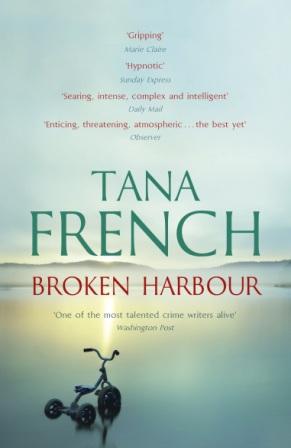
brokenMy other book was Tana French’s Broken Harbour. It seems odd to call it ‘fun,’ as it is just as dark and intense and frightening as the other books in her Dublin Murder Squad series. It’s also just as well and artfully written, with just as convincing and distinct a narrator and just as complex and psychologically fraught a plot. By the end, though, I found I was actually a little weary of the melodrama and the self-consciously brooding interiority, the heavy-handed revelations and insistent reminders of just how much the case resonated with (and screwed up) the detective. Rattling off my first impressions on GoodReads, I found myself wondering if my problem is related to the subgenre of crime fiction French is working in: I don’t usually read suspense novels or psychological thrillers, and Broken Harbour is as much of that kind as it is a detective  novel or police procedural. I found myself eventually skimming a bit through the confessions and backstories just to find out what had actually happened and what would come of it. This is my way of saying “it’s not you, it’s me,” I suppose! But the novel did seem too long (not unlike some of Elizabeth George’s more recent ones). There is an awful lot French does brilliantly though: setting, in particular, and the theme of people becoming desperate as they try to hang on to their dreams, or to reach the futures they yearn for — at whatever cost, it often turns out. French is definitely the best new crime writer I’ve tried in a long time — so thanks especially to Dorian for bringing her to my attention!

And now it’s back to work, though I will pick out something to read in the interstices. My book club has chosen The Talented Mr. Ripley for our next meeting, so it might be that, though I also recently picked up Beautiful Ruins (which looked like it might be refreshingly different).

What P. D. James Talks About When She Talks About Detective Fiction*

pdjamestalkingaboutI finally picked up P. D. James’s Talking About Detective Fiction, which I’ve been mildly interested in reading ever since it came out in 2009. I say ‘mildly’ because I’ve read all of James’s novels (some of them multiple times) as well as her autobiography and numerous interviews with her, not to mention essays, critical articles, and reviews about her work. I’ve also read quite a bit of historical and critical material on detective fiction more generally. So I didn’t expect any revelations from this little volume.

And there really aren’t any, although (because after all, James is both sharp and experienced!) her potted history of the genre is enriched by some interesting digressions on issues or writers of particular interest to her. She opens with a disclaimer — that she has “no wish to add to, and less to emulate, the many distinguished studies of the last two centuries,” aiming only at a “short personal account.” I actually wished her account had been more personal, as the survey material was so very familiar to me, whereas her commentary on, say, Ngaio Marsh, was more idiosyncratic and thus more thought-provoking:

Reading the best of Ngaio Marsh, I feel that there was always a dichotomy between her talent and the genre she chose. So why did she pursue it with such regularity, producing thirty-two novels in forty-eight years? . . . Marsh was a deeply reserved, indeed in some respects a private person, and she may well have felt that to extend the scope of her talent would be to betray aspects of her personality which she profoundly wished to remain secret.

 Her chapter on “four formidable women” of the Golden Age was in fact one of the most interesting parts of the book for me, along with her remark – made quite in passing – that if she’d begun her own series today “it is likely that I would choose a woman [detective]” as the main character. I find James somewhat evasive (here and elsewhere) on the gender politics of crime fiction. She says very little here about the woman detective she did create, Cordelia Gray (I think the only explicit reference to An Unsuitable Job for a Woman is in her discussion of setting), but I think it is widely agreed that in the second Cordelia Gray book she backed away from the feminist potential of the first, making Cordelia a much more conventional character and also much less effectual as an investigator. In the context of Kate Miskin, James has talked about the Met being a “very masculine organization,” though, and about the different experience women have of policing than men. In her chapter on the “four formidable women,” she emphasizes their work as “social history,” but also what they tell us of “the status of women in the years between the wars.” Then about Sara Paretsky (whom she calls “the most remarkable of the moderns”) she says,

No other female crime writer has so powerfully and effectively combined a well-crafted detective story with the novel of social realism and protest.

To me, James seems tempted towards a more explicitly feminist approach, but her Dalgleish novels, rich as they are as examples of social (and especially moral) exploration, have no air of “social protest.” It’s fun to imagine what kind of books — what kind of female protagonist — she would have given us if she had, as she imagines, started writing today!

But Talking About Detective Fiction is not the place to look for sustained analysis of either feminism and detection in general or of gender issues in James’s novels — or, indeed, of any aspect of detective fiction. Overall, the book is just an amiably brisk tour of the genre, and not even a very thorough one, as it spends a lot of its time on Golden Age figures, a bit on the hard-boiled turn, but none explicitly on, say, the police procedural (the subgenre to which most of James’s own novels belong). The discussion of recent developments in the genre has a haphazard quality because James draws her examples only from the writers she happens to have read –she makes the disarmingly honest comment that “new novels are being reviewed with respect, many of them by names unfamiliar to me.”

Still, if you didn’t know anything about detective fiction beyond the examples you yourself happened to have read, this would be a fine place to start, and it would give you lots of leads to follow up for further reading. (She completely convinced me that one Father Brown story is not enough.) And I admit that the absence of surprises or revelations was actually reassuring for me: it means I’m probably doing a decent job sorting things out for my Mystery & Detective Fiction class. As it happens, it turns out I’ve actually been using an excerpt from the book as the epigraph for my syllabus for many years — because I transcribed it from a lecture James gave in 1995 at the Smithsonian (once available online):

In his book Aspects of the Novel, E. M. Forster writes,

‘The king died, and then the queen died’ is a story. ‘The king died, and then the queen died of grief’ is a plot. . . . ‘The queen died, no one knew why, until it was discovered that it was through grief at the death of the king.’ This is a plot with a mystery in it, a form capable of high development.

To that I would add, ‘Everyone thought that the queen had died of grief until they discovered the puncture mark in her throat.’ That is a murder mystery, and it too is capable of high development.


*I feel as if I should apologize for reworking this tired titling trope. That the book really is called Talking About Detective Fiction made the temptation irresistible, but I promise not to do it again. Twice is enough! And, as my penance for being so unimaginative, I also promise never to title a post with any variation on the “Keep Calm and Carry On” meme either — fair enough?

“Good novels, nothing else”: Laurence Cossé, A Novel Bookstore

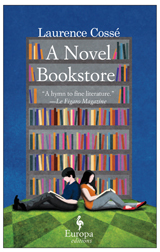
A_Novel_BookstoreWhat if Jonathan Franzen opened a bookstore, called it “The Good Novel” and refused to carry any of Jennifer Weiner’s books — not to mention Dan Brown’s, Tom Clancy’s, Jodi Picoult’s, or E. L. James’s?

It’s only too easy to imagine the brouhaha that would ensue, with cries of “excellence!” on one side and “elitism!” on the other, with one side proclaiming itself literary purists trying to break the cycle of commercialism that’s leading to the decline of Great Literature while the other side set itself up as democratic champions of the common reader, their store (call it “For Every Taste” ) selling pleasure rather than High Art. Who would be right? Which side would you be on? And, perhaps most to the point, where would you shop?

This is the basic premise of Laurence Cossé’s A Novel Bookstore, though the characters who establish “The Good Novel” bookstore are not set up as smug Franzen-style curmudgeons but as passionate idealists. When they come under attack for their governing principles, their patron issues a stirring defense:

For as long as literature has existed, suffering, joy, horror, grace, and everything that is great in humankind has produced great novels. These exceptional books are often not very well known, and are in constant danger of being forgotten, and in today’s world, where the number of books being published is considerable, the power of marketing and the cynicism of businesses have joined forces to keep those extraordinary books indistinguishable from millions of insignificant, not to say pointless books.

But those masterful novels are life-giving. They enchant us. They help us to live. They teach us. It has become necessary to come to their defense and promote them relentlessly, because it is an illusion to think that they have the power to radiate all by themselves. That alone is our ambition. . . .

We have no time to waste on insignificant books, hollow books, books that are here to please.

We have no time for those sloppy, hurried books of the ‘Go on, I need it for July, and in September we’ll give you a proper launch and sell one hundred thousand copies, it’s in the bag’ variety. . . .

We want splendid books books that immerse us in the splendor of reality and keep us there; books that prove to us that love is at work in the world next to evil, right up against it, at times indistinctly, and that it will always be, just the way that suffering will always ravage hearts. We want good novels.

Stirring, as I say, and because the founders of The Good Novel are A Novel Bookstore‘s protagonists, it seems pretty clear whose side Cossé is on and wants us to be on too. And it’s tempting, because after all, who wants to be on the side of insignificant books, hollow books, or sloppy hurried books?

But the devil is in the details, of course, or, in this case, in the identification of these unworthy books — in discriminating decisively between the good and the bad. The Good Novel team orders their stock following lists submitted by a secret committee of writers, among whom there are in fact some differences of taste and interest, and all of whom (along with the bookstore staff) relish the opportunity to be advocates for lesser-known novels they believe deserve a wider readership. (One of the treats of A Novel Bookstore is noting the authors and titles that are batted around, many of whom were certainly unknown to me.) They are united against most bestsellers and prize-winners, however. Are they doing readers a disservice by refusing to stock books that, as they point out when challenged, are available by the thousand in every other bookstore in town? Is their insistence on exercising their own exclusive literary judgment heroic or, as one critic argues, fascistic?

This . . . is nothing more nor less than a totalitarian undertaking . . . What does good novel mean? Who are these kapos who have the nerve to place their seal of approval on this book and not that one? Where are they coming from? What gives them the right?

Those most offended, of course, are the excluded novelists as well as those in publishing who rely on highly commercial titles for their profits.  The actual plot of the novel is put in motion when some members of the selection committee are attacked. The investigating officer sums up his theory of who’s behind the attacks and why:

The Good Novel has caused every element of a fairly limited socio-professional group to break out in hives. Far be it from me to suggest . . . that this group represents everyone in publishing, the media, or criticism, or bookselling. They are a sub-faction of people who share the view that a book is a product that can make a lot of money and that literature can be a rich seam.

He goes on to compare the cabal working against The Good Novel to Al Qaeda — there’s not much middle ground in A Novel Bookstore, and that’s actually one reason I didn’t love it the way I expected to. The oppositions seem polarized in a way that suits this novel’s concept better than the novel as a genre, or novel readers.

The mystery plot is one of several facets of A Novel Bookstore: there’s a love story as well, and a number of subplots, really more like anecdotal digressions, about the various characters involved in setting up the bookstore. It all has a certain charm, and it is certainly executed with panache. But without the central debate about the value of ‘great’ literature, it would be a fairly insubstantial book, and even with it, it seemed somehow superficial, the working through of an idea for a novel more than a novel of the kind that The Good Novel would stock.

Yet I couldn’t help thinking about Cossé’s conceptual gambit as I was shopping in an actual bookstore myself yesterday. As I browsed the fiction shelves, I was frustrated as always at the crowding out of backlist titles (or just less mainstream titles) by stacks of the latest releases. What a different experience it is to shop at the London Review Bookshop, clearly curated on different principles! Yesterday I was also plagued by an over-enthusiastic employee who (when he wasn’t badgering me to see if he could help me, which he couldn’t, except by stocking more good novels!) was selling — by which I mean both promoting and taking money for– a lot of James Patterson and Tom Clancy. My inner literary snob cringed at his loud sales pitches even as my better angel (or was it?) reminded me not to look down on other people’s genuine reading pleasures. I wouldn’t be able to find everything I like to read at The Good Novel (yesterday I bought Tana French’s Broken Harbour, for instance), but I’d still rather browse there than at Coles.

A New Month, A New Open Letters Monthly!

danziger

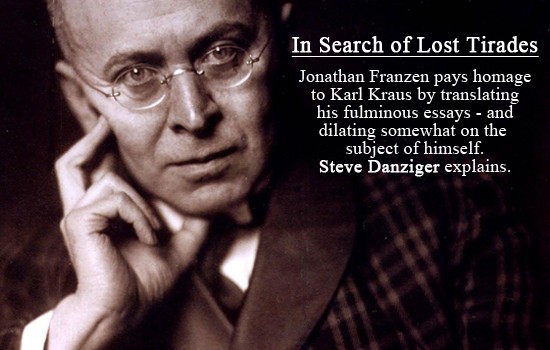
Once again, a new month has brought with it a sparkling new issue of Open Letters Monthly. If you haven’t already, I hope you’ll go check it out. As always, there’s a wide range of coverage and styles. We’re spotlighting Steve Danziger’s review of Jonathan Franzen’s new translation of Karl Kraus (you know, the one in which he tells us ‘what’s wrong with the modern world’). You’ll also find John Cotter’s review of Jeremias Gotthelf’s very creepy sounding The Black Spider, Steve Donoghue on Korak, son of Tarzan, poetry editor Maureen Thorson on the ‘piercing unreason’ of Ange Mlinko’s poetry, my own unimpressed take on Elizabeth Gilbert’s much-hyped The Signature of All Things, Justin Hickey on Abominable Science, Spencer Lenfield on the enduring mystique of Pompeii, and much more. If you like what you find, do help us get the word out.

This month marks exactly four years since my first ever contribution to Open Letters Monthly, which was this little essay on Trollope. It has been quite a four years for me: I can’t imagine how else I would have found the courage to write, never mind a venue in which to publish, the range of reviews and essays that followed. Here’s to our next four years!

This Week in My Classes: My Waverley Intervention

My sincere thanks to everyone who weighed in, here or on Twitter, with advice about handling the classroom slump brought on by Waverley. Here’s an update on what I decided to do.

highlanderFirst of all, I did decide to do something different, rather than just pressing on with my usual strategies. I had to admit to myself — and I admitted this morning to my class — that if year after year a critical mass of students just isn’t getting engaged by the novel, at least to some extent this is a failure on my part — a pedagogical failure. Dropping Waverley from my reading list was also a failure: some students in Waverley-free years have told me how happy they were to have missed it, but missing out on it was not a win for them any more than it was one for me. As I told my class this morning, it’s a novel that deserves its place on our syllabus, one that is well worth reading for our curriculum, whatever anyone’s personal response to it. But the failure isn’t all mine. To use the analogy I suggested to my class, if you’re stumped by a difficult calculus problem, you don’t blame the problem: you work it as hard as you can, get more help if you need it, and try to bring your skills up to the level you need to solve it.

I decided to approach the class, then, as a problem-solving opportunity: we all, collectively, needed to think about what was going on and what our own role could be in addressing it. I said frankly where I thought I had been going wrong: struggle is part of learning new things, and they needed to be free to talk about their difficulties without my getting all judgmental. I told them that I thought I needed to back off a bit, and listen, so that they could trust me to work with them. But so that we didn’t fall into an unproductive gripe session, I suggested they approach Waverley in the spirit of couples therapy: avoid “you” statements in favour of “I” statements, to stimulate not blame but agency. “Waverley is boring” doesn’t help: you can’t change Waverley, after all! “I am finding Waverley boring / frustrating / confusing” is more constructive because there may be something you (or I, as the teacher) can do differently.

All of this preamble took only a  few minutes at the start of class. Then I went to work on getting out of their way. I’d made up a handout with three simple questions:

  1. How is Waverley going for me? What do I like about it? What specific challenges does it pose?
  2. Given the specific ways I’m finding Waverley challenging, here are some ideas for things I could try to make it go better:
  3. Given the specific ways I’m finding Waverley challenging, here are some ideas for what Dr. Maitzen could do to help:

I gave them about 10 minutes to respond honestly to these questions — the handout was explicitly not to be submitted or evaluated. Then on the other side of the handout they each had one of five different passages I’d picked out, and they got into small groups with the other students who had the same passage. They had two tasks in their groups: first, to talk freely about how they’d answered their questions, then to read their passage aloud and discuss it, considering it in light of their general comments about reading Waverley as well as in the context of the issues we’d been working on in our previous classes. I left the room entirely for the first five minutes of the group work, literally getting out of their way so they would be uninhibited in their discussion.

The room erupted into noise behind me as I went out, and the conversation seemed energetic for the whole period. While they talked over their passages, I went around offering my help and inviting comments on the question about what I could do to help with their reading of the novel. I got some very specific requests: the most frequent was to go over the political / historical factions again, clarifying who was on what side. A couple of people thought a handout listing characters and their affiliations (and their various names) would be great, so I think I’ll do some version of that. Another suggestion was for some straightforward plot summary: because a number of them are really struggling through Scott’s prose, they lose track of what’s actually happening. Plot summary is not usually high on my priorities for class time, but I can see how confusion about the novel’s events would inhibit class participation! So I’ll do that too, though I’m going to think about ways to make it interactive.

As for things that they could do, a couple of students said that reading the passages out loud helped their comprehension, so that might be something they’ll try on their own (we talked about the audiobook option, though sadly there doesn’t seem to be a really good one available). I showed them the e-text available through the University of Adelaide, which might help anyone struggling with the small print of our Oxford edition. I think others realized that looking more words up in their dictionary will help, and I continued to urge them all to get started trying to write about the novel. It was clear that not everyone had the same issues, and not everyone even had any problems with it — I hope the students who were already getting along fine don’t feel the class was wasted: I think we will all benefit if our remaining two sessions go better.

However it goes on Wednesday and Friday, I won’t regret having tried to change the dynamic that was developing. Lecturing more is one way to get through a slump like this, but it isn’t the best way, since (as I often remind them) the objective of an English class is for them to be better readers themselves: the process of reading and discussion is not just important, but in some ways it’s the whole point.

This Week in My Classes: In which I return to Waverley after many years.

waverleyIn class this week one of my students asked me when I last taught Waverley. “2006-7,” I promptly replied — I knew this because I had gone back to my old files to see what notes and handouts I had in reserve.* It used to be a fixture on my syllabus for The 19thC Novel from Austen to Dickens — but it was also, without fail, the least popular book on the syllabus. While I don’t typically let such considerations steer me in choosing assigned texts (a literary education is about challenging and extending our existing taste and skills as readers, after all), it did get to be a drag coaxing and cheerleading and exhorting the students to get any kind of discussion going. Sure, Scott is probably the most popular and influential author of the early 19th century: all of our other novelists read him (mostly, with passionate affection) and learned from him. And sure, Waverley itself is heaps of fun if you can get into the spirit of things, and if you can get past the garrulous, curmudgeonly, oversharing, occasionally pedantic, highly self-conscious narrator … and sure, there’s all kinds of metafictional proto-post-modernist fun to be had with that narrator, too, if, again, you can get into it. But when at least 75% of the students really can’t get into it, then their boredom and resentment infects the classroom atmosphere, and not necessarily just for the two or so weeks spent on Waverley itself. So I stopped assigning it, and have been teaching Austen to Dickens with no Scott at all since then, except for “The Two Drovers” in a recent summer session of the course.

But I’ve missed Waverley: unpopular as it was, and its intrinsic merits aside, it provided an infinitely valuable touchstone for interesting features of our other novels. As I was already tilting this year’s incarnation of the course towards the Bildungsroman by including both Jane Eyre and David Copperfield, I knew I was going to miss it even more. So it’s back  — and, judging by the last two class meetings, so is the stupified resentment it inspires. Not, by any means, among all the students — but even those who are writing smartly in their reading journals seem uncharacteristically reticent in class, and I have numerous indications that a lot of students are falling behind in their reading as well as in their appreciation of the novel. And so I’m back wondering, as I was in 2006-7, what I could be doing differently to make things go better, or whether it’s just not worth the effort.

My basic approach is a ramped-up version of what I do with every assigned novel, which is to present the novel as enthusiastically as I can, front-loading our time on it with a lecture or two clearing up historical information and setting up some interpretive frameworks which then, in theory, enable everyone to read on and consider how the particulars of the novel fit into those broader patterns. There is a bit more context to be established here than usual, but as Scott himself says,

I beg pardon, once and for all, of those readers who take up novels merely for amusement, for plaguing them so long with old-fashioned politics, and Whig and Tory, and Hanoverians and Jacobites. The truth is, I cannot promise them that this story shall be intelligible, not to say probably, without it.

If that was true in 1814 (or 1805), it’s even more so today, when there’s barely any chance at all that those terms will mean anything, even to a History major. But once you see what the stakes are, it seems to me that it’s not impossibly difficult to follow the story! It takes patience for a modern reader to settle into the prosy narration, but it’s great stuff once you do, and there’s as much “action, laffs, and romance” as in any Captain Underpants novel!  So once we’re launched on the more discussion-based classes, I start from my stock of open-ended questions (“What kind of a fellow is Waverley?’) and then draw us along into analysis of the answers (“What’s the value of such a ‘wavering’ hero in a novel about civil conflict?’) — focusing, along the way, on particularly fun or revealing scenes. An early episode in Waverley that’s good to discuss, for instance (in theory) is the banquet at Tully-Veolan that ends in a drunken brawl at Luckie Macleary’s inn. In addition to being a great comic scene and one that illustrates Waverley’s uncanny (and symbolic!) habit of falling down in times of crisis, it shows the living importance and potentially violent results of the broad political conflicts we’ve gone over: the fight begins with “a toast which seemed . . . to have a peculiar and uncivil reference to the government that [Waverley] served.”

bustofscottAgain, this is all standard classroom procedure — lecture mixed with discussion prompted by questions designed to build interpretations out of observations. But it just doesn’t go well with Waverley, though there are always a few stalwart souls who put their hands up (thank you!). I’m always a bit puzzled by the conspicuous collapse: the novel doesn’t strike me as that opaque, especially once we’ve done our warm-up sessions. On the assumption that incomprehension is a problem, though, my first response is usually to step up what I think of as the ‘modeling’ component of class — that is, walking the students through those key episodes and showing them what’s in there to notice, enjoy, and work with. Then I try backing off again — but still with lackluster results. Is it me, I wonder? Perhaps I come on too strong: if they are feeling bemused or bored, then my enthusiasm, rather than ‘selling’ them on the novel, may just alienate them from both it and me. Also, sometimes I catch myself hectoring them: this week, for example, I gave them a heads-up that we’d be discussing three particular incidents, and when hardly anyone seemed prepared to do that, well, I did take them to task! But that backfires too, I bet: rather than feeling challenged to do better, they probably just feel defensive.

I really want them to rise to the challenge of this novel. I really don’t think it’s an impossible task. But for many of themI think it does require letting go of the expectation that class reading will be immediately accessible and ‘relatable.’ It’s a class , after all: you’re supposed to learn from it — cue the speech about this not being a book club! Last class I urged them to get started writing about it, if they hadn’t already: they’ve got study questions they can use as prompts for their journals, plus the questions we’ve been working on in class. Active engagement of that kind is a good way to learn, and Waverley is a genuinely interesting novel to write about even if you aren’t finding it a treat to read. But I’m stumped about what else to do, and about what attitude to take in class. I should probably just go on as usual and try not to make a big deal out of the slump we’re experiencing — but that’s easier said than done.

Any tips? Teachers, how do you handle it when you think you’re losing your students and, as a result, they’re missing out? Students, what tactic is most effective, in your experience, at motivating you to get on board with something you don’t find immediately compelling?

*2006-7! That means it was in the era Before Blogging, which is why I have never blogged before about the pleasures and perils of teaching Waverley.

Putting the Record Straight: Muriel Spark, Curriculum Vitae

Curriculum Vitae SparkWhen I’d finished puzzling over A Far Cry From Kensington, I decided I’d had enough Muriel Spark for now. There are just so many other books I really want to read, after all. But then I remembered that I’d picked up a copy of her autobiography, Curriculum Vitae, from the public library’s discard sale (it’s shocking, really, what great stuff I’ve found there!), so I used the last of my Spark momentum to give it a try — and I ended up reading it straight through with much enjoyment. The first lines alone are entirely winning:

I am a hoarder of two things: documents and trusted friends. The former outweigh the latter in quantity, but the latter outdo the former in quality.

Predictably, for Spark, there’s a sting lurking there: she’s writing because “so strange and erroneous accounts of parts of my life have been written since I became well known, that I felt it time to put the record straight.” That is, people who are not friends to be trusted have spread misinformation, and she is countering their version with her own, which contains “nothing that cannot be supported by documentary evidence or by eyewitnesses.” The book is, then, a kind of “gotcha!” But it doesn’t seem nasty so much as pointed: be careful what you say about me! And why not, after all? As she says, “Lies are like fleas hopping from here to there, sucking the blood of the intellect.”

The first part of Curriculum Vitae is a series of episodic pieces about Spark’s experiences growing up in Edinburgh in the twenties and thirties. It includes bits on buying bread and making tea, on shopping for “commodities,” and on neighbors, friends, and family. Though in some respects she had a hard childhood, she reflects on it with resolute satisfaction:

Sometimes I compare my early infancy with that of my friends whose very early lives were in the hands of nannies, and who were surrounded by servants and privilege. Those pre-school lives seem nothing like so abundant as mine was, nothing like so crammed with people and amazing information. I was not set aside from adult social life, nor cosied-up in a nursery, and taken for nice regular walks far from the madding crowd. I was witness to the whole passing scene. Perhaps no other life could ever be as rich as that first life, when, five years old, prepared and briefed to my full capacity, I was ready for school.

Her years at school were “the most formative years of my life, and in many ways the most fortunate for a future writer.” It was at Gillespie’s High School for Girls that she met Miss Christina Kay, who “bore within her the seeds of the future Miss Jean Brodie.” “She entered my imagination immediately,” Spark says of Miss Kay, and she offers her own as well as classmates’ recollections of this “exhilarating and impressive” woman.

After school Muriel worked in various secretarial positions, and then in 1937 she married Sydney Oswald Spark: “I was attracted to a man who brought me flowers when I had flu. (From my experience of life I believe my personal motto should be ‘Beware of men bearing flowers’).” They lived in Rhodesia, where he had a teaching job. “It was in Africa,” Spark says, “that I learned to cope with life”:

It was there that I learned to keep in mind — in the front of my mind — the essentials of our human destiny, our responsibilities, and to put in a peripheral place the personal sorrows, frights and horrors that came my way. I knew my troubles to be temporary if I decided so.

They weren’t easy years. She found the colonial apparatus and attitudes in Rhodesia bizarre and isolating. Her marriage fell apart due to her husband’s “severe nervous disorder,” and in 1939 she filed for divorce. In 1944 she moved back to England, where she went to work “in the dark field of Black Propaganda or Psychological Warfare,” helping to create misinformation campaigns to undermine German morale. Many of her experiences from this time ended up, she observes, in some of her later fiction, but it isn’t until after the war that her life comes to be shaped around her literary ambitions.

sparkwritingFirst she worked on a journal called Argentor, “the official quarterly journal of the National Jewellers’ Association.” Then she stepped in as editor of the Poetry Review — and it’s here, in recounting the eccentric personalities, egos, and feuds of the poetry world, that you sense her really settling in to put the record straight. She’s got a particular genius for quoting writers to their own disadvantage, like Robert Armstrong, “a physically and morally twisted, small, dark fellow, a veritable nightmare” who takes umbrage at her decision not to name him on the journal’s front cover. “I had been working hard for the opportunity to put the Society and yourself on the map,” he self-aggrandizingly complains; “I had also put in some groundwork with influential friends so I am puzzled and assume something must have arisen to sidetrack your promise.” “This was a mere taste of things to come,” Spark says, almost gleefully, before quoting her sharp reply and then noting, “I never in future put this man’s name on the front cover.” She was eventually dismissed from her position: “I was delighted to get out of that scene of strife and of that mortal sin of art, pomposity.”
The last part of Curriculum Vitae takes us through Spark’s various jobs and writing projects up to the completion and success of her first novel, The Comforters. Since then, Spark reports,

I have passed the years occupied with ever more work, many travels and adventures. Friends, famous and obscure, abound in my life-story. That will be the subject of another volume.

As far as I can tell, she never wrote that other volume. Too bad, because that I’d like to read! There’s a sense, at the end of Curriculum Vitae, that she’s really just getting started on the good stuff.

This Week in My Classes: Processes and Products

Bookworm's Table (Hirst)The second full week of term has gone by already: it’s amazing how time seems to accelerate when things get busier. In both my classes we have moved from throat-clearing and context-setting to richer discussions about our readings: in The 19th-Century Novel from Austen to Dickens, we’ve wrapped up our work on Persuasion, and in Mystery and Detective Fiction we’ve got only one more class on The Moonstone. Starting the term with these two novels eases the transition from summer’s languors to fall’s stresses because both are so delightful. At least, I think so — and it seems as if a lot of students are enjoying them as well. Discussion in the Mystery class has been particularly good so far this term, especially considering it’s a big class (capped at 90), which can sometimes be inhibiting. I hope they keep putting their hands up!

academicselfOne thing I’ve been thinking about as our work gets underway, and as I contemplate my own non-teaching ambitions for this term, is trying to make the process as meaningful and rewarding as possible, shifting some emphasis away from the product — which for students is often the course credit or the grade, and for me is the finished piece of writing. I’ve been reading Donald Hall’s The Academic Self: An Owner’s Manual (thanks to @MsEMentor for the recommendation!) and while I have some doubts about whether I want to be an ‘academic self’ of the kind he describes (more about that, perhaps, in another post), I have been struck by the wisdom of his emphasis on this process / product distinction, partly because I have found myself caught up in just the kind of results-oriented moping he describes (if not for exactly the same causes):
We all know (or should know by now) that we may complete professional tasks to the best of our abilities, “play by all of the rules,” so to speak, even overachieve and push ourselves to extremes, and still be denied the book contract we have been working for, the position we have applied for, or the raise that we feel we deserve. If we tie our sense of professional payoff only to a desired reception of the end product of a process, then we are setting ourselves up for disappointment, perhaps even a state of bitterness or burnout.

As he discusses, there are lots of reasons, some of them good ones, to be fixated on achieving particular goals, but “we simply do not have to have a specific reaction to the products of our processes for those processes to have been worthwhile.”

I think there is actually a close relationship here between my students’ situation, as they strive for grades and credits, and my own difficulty dissociating the worth of my work from the reactions or results it gets. After all, I spent a great deal of my own life as a student, and in many ways academics carry forward the mental habit of waiting for affirmation from other people’s evaluation. How different, too, is the hiring process, the tenure process, or the promotion process from being graded? Or, for that matter, the grant application process or the article submission process? Well, OK, of course there are differences, including the presumption that for most of these professional matters we are being evaluated by our peers, and the not-insignificant point that our success in some of them (hiring in particular) really shouldn’t be understood as measures of our merit so much as of our great good fortune. But these things all feel a lot like handing in an essay used to, and I’m someone who once locked herself in a bathroom in Buchanan Tower to weep over an A- from a professor whose approval I really wanted — which is to say, I’m someone who (like a lot of academics) has a hard time believing in my own judgments of my work, and a hard time separating judgments of my work from judgments of me personally. I am making progress on this front, I’m glad to say, but I still find myself waiting anxiously for external validation when, for instance, something of mine is published online. There’s still that part of me that is waiting for my grade, for the internet equivalent of an ‘A,’ whatever exactly that is.Grade A Plus result vector icon. School red mark handwriting A plus in circle

I know, I know: there are so many things wrong with this, and I don’t just mean that it’s kind of pathetic in a grown woman more than two decades along in her professional career (though that is certainly true). Having become self-conscious about it, I do at least now work consciously against it, and one way I do this is simply by rereading my own work, which (I am learning to assert, on my own behalf!) I think is pretty good! Why shouldn’t I be able to tell or say that, after all, considering it’s actually a big part of my job to evaluate writing? But the other thing I want to do is give more weight to, or feel more positive about, the process of doing the work. As Hall says,

I cannot know if the words that I am writing at this moment will ever appear in any form of print other than that which comes out of my computer. . . . But I can decide that this act of creation, this thinking through of ideas as they move from conscious and subconscious thought through my fingers and onto the screen is enough to satisfy and sustain me, even if the unfortunate were to occur.

He isn’t advocating that “we dispense with highly concrete goals” (as he points out, that would be “to court disaster” professionally, as well as to shirk other dimensions of our research and writing lives by not aiming to get our thoughts “disseminated”). But he’s right that “those processes . . . . must be more explicitly valued, must be recognized as professional ‘goods’ in and of themselves.”

To bring this discussion back to my teaching, I have realized that some of the greatest frustrations I’ve run into as a teacher have come from student priorities and behaviors that are results-oriented without due attention to the intrinsic value of the processes we go through (as well as to the benefits that careful attention to process can bring to achieving desired results). A simple example: papers that are clearly (or on the student’s own admission) started and finished the night before the deadline — I’m sure many other professors have had those dispiriting conversations that begin “I’m going to work on my essay tonight” and you cringe, knowing that means they won’t have time to rethink or revise, just as they very nearly have run out of time to consult. The essay-writing process matters less to that student than getting the credit for the finished essay. Or there are students who don’t finish the readings until they are studying for the final exam, or who never read them at all (I’ve had students note on their evaluations, almost as a point of pride, which books they never did actually read) — they too are circumventing the process (which is where a lot of the real learning can take place) and focusing only on the final product. I’m trying, increasingly, to disrupt these habits by building incentives to good process into the course requirements (reading journals, paper proposals, short tests). I’m also taking more time to discuss the relationship between our processes in class and the overall goals of the course, in terms of learning and practicing skills as well as in terms of getting good grades. Yes, students should aspire to earn good grades, and I should enable and support those aspirations. But the learning doesn’t take place at the moment I return the essay or exam: it takes place while we’re doing everything else, and especially while they are doing everything else. They should try to take a lot of satisfaction from those processes — from their own “thinking through of ideas.” Then even if they don’t get the grade they hoped for, they’ll be able to dry their eyes and come out of the bathroom a little bit sooner and a lot more confident.