I’m not in any position to evaluate how accurately American politics is depicted in Netflix’s remake of House of Cards, but if people even think that Congress and the White House are run solely on greed, ambition, and ruthless back-stabbing, as the show suggests, no wonder voter turnout is so low. The series is one of the most dispiriting things I’ve ever watched — not just because of its relentless cynicism about both human nature and democracy but because it seems to have embraced that nihilistic cynicism so wholeheartedly. Imagine how different the show would be if it wrapped the story of its sociopathic central characters in some irony, or developed their story as tragedy, so that we could be caught up in their rise — as we are with Shakespeare’s Richard III or Macbeth, or with Thackeray’s Becky Sharp — but also see them suffer and fall. Instead, their vicious dishonesty wins them triumph after triumph, while the few around them who so much as raise questions, never mind try to stand for something else, are weak and ineffectual — or just dull. “She did what she had to do,” one character says in Season 2 about another who betrayed him for her own political gain: the show does not provide any alternative narrative, so even if we are repelled watching we have to look outside the box (literally!) to find a critique that goes beyond wishful thinking.
Richard III is definitely an apt point of reference (even the wink-y addresses to the audience, which I know are a carry-over from the original British series, are reminiscent of Richard’s gleefully oversharing monologues). But Shakespeare’s play is about ambition and greed and politics in a way that I don’t think House of Cards is. The show seems to me to reduce villainy purely to spectacle. It was just interesting enough that I kept watching (how far can they go? will they perhaps meet their match, or get their comeuppance?) but it didn’t provoke any serious thought about the issues its plot-lines touch on: unlike, say, The Wire or Deadwood (both of which are much more graphically and disturbingly violent but which reach for insight and explanations — and improvement), House of Cards operates purely at the level of individual malice (or, much more occasionally, good intentions). Francis is also much less charismatic than Richard, which is at least partly the fault of the writers (who often mangle idioms or resort to cliches) but I think can also be blamed on Kevin Spacey’s performance, which (like everyone else’s in the show) seemed extraordinarily limited in range. Most of the characters require at most two facial expressions over the whole series, and since the show is premised on deceit, the dominant one for almost everybody is a kind of grim deadpan stare.
The other inevitable comparison is to The West Wing. I joked on Twitter during Season 1 that I’d need to watch it all the way through (again!) as an antidote to House of Cards, and now that I’ve finished both seasons of House of Cards I don’t see any reason to take that back. Whatever its faults, The West Wing at its best shows recognizably human people struggling to make the messy process of democracy — with its competing interests and different ideologies and, yes, its components of greed and ambition along with its idealism — serve the common good. It works with the clash between what Francis characterizes (self-servingly, of course) as “ruthless pragmatism” and a high-minded commitment to public service. It has a quality of sincerity as a show, and allows for the same possibility in its characters. Where are the people in House of Cards who give a damn about ideas, or about other people, including — crucially, in a show that could be about governance in some deep way — those they are supposed to serve? Where is even the possibility of gravitas? Where is the capacity for real and difficult moral struggle? You might with justice say that these are simply not House of Cards’s concerns: that it’s not that kind of show. And you’d be right — and that would be exactly why, though I did watch it all, I won’t watch it again, whereas the show that gave me the episodes “In the Shadow of Two Gunmen” or this extraordinary confrontation between an earthly and a higher power is one I’ll go back to over and over.
Hurricane Arthur passed over us yesterday. Happily, he was “only” a post-tropical storm when he got this far north, but he still packed a wallop. Our particular neighborhood in Halifax doesn’t seem to have been very hard hit. There are some branches down, including some pretty big ones, and we were without power for a few hours, but we got back on the grid before it became necessary to eat all the ice cream (shucks!). We got off lightly, then, compared to many. Here at least, too, the storm was pretty insignificant compared to 2003’s Hurricane Juan, which came onshore full force pretty much right where we live and took out 70% of the trees in nearby Point Pleasant Park as well as many of the biggest and most beautiful ones along our street (the before and after pictures here show clearly what a difference 70% makes).
Juan taught us respect for hurricane-force winds: the high reported gusts yesterday seemed to us good enough reason to keep off the streets and out of the way. So we had a quiet family day inside. Maddie and I did a sorting and reorganizing project in the basement while the lights were still on: its ostensible purpose was clearing out toys and supplies the kids have outgrown (brace yourself for donations, Salvation Army!), but a beneficent side effect is that we cleared three shelves in the bookcases down there, so my next project is reorganizing my mystery collection so the books aren’t two-deep. I also read deeper into King Hereafter (about which more in a moment). Then once we lost power it was, happily, still bright enough by the window to read most of the latest New York Review of Books. Owen has been spending most of his time lately turning a computer game he made into an iOS app (I’m counting on him to finance my early retirement through this or some similar project!) — a nice consequence of his losing power to his desktop is that he headed to the piano for amusement instead, so we whiled away the afternoon listening to his improvs plus some practice time on another of his summer projects, the cadenzas from the Ravel left-hand piano concerto.
We weren’t expecting power back until 9 p.m., but everything lit up again around 7, which was a relief. During winter storms you always have the reassurance that you can keep food fresh just by putting it outside, but the freezer packs we use to keep things chilled in summer wouldn’t probably get us through much more than a day. In then end, then, our storm day was just kind of a quiet break from routine. But we’re back in business today, which, along with making up for yesterday’s missed chores and errands, includes packing Owen off for math camp at Dalhousie. Here’s hoping the restored sunshine doesn’t turn his residence room into a sauna, and (more important) that he has fun bonding with other kids who really like math. He’s read math books for years, starting with picture books like G is for Googleand moving on to books like Clifford Pickover’s Wonders of Numbers. He and his dad have also worked their way through most of the Great Courses math options. I did well in math through high school but met my match in first-year calculus, so they leave me behind pretty quickly with this stuff. But in case your kid ever says “what will I ever use this for in real life?” it might be helpful to know that just this week Owen apparently solved a graphics problem in the design of his new game using calculus. Hard as it is for us to believe, he will be applying to Dalhousie for real this fall, presumably as either a math or a computer science major — or both! So this time on campus will be a good preview.
Another summer routine in our household is the library’s summer reading club. Maddie has signed up for it regularly in the past, and I was very happy that she agreed to do it again this year. Like last year, we’ve picked a small quantity of books for her to aim for (10) so that she doesn’t compromise on their quality — also, as usual, she’s got several weeks scheduled for summer camps that never leave time for reading during the day. As always, I’ve pledged to match her book for book (which shouldn’t be any problem for me, I hope!); our last day to meet our goal is September 6. You can see here how things have gone for us in previous years. We’ve both read our first book for this year’s tally: hers was Judy Blume’s Forever, and mine was Julie James’s It Happened One Wedding (which I quite enjoyed, though not as much as her Practice Makes Perfect). I’ve been reading a lot besides that one, but I’m not going to officially count books I read only as “filler” (familiar books I skim through for distraction when it’s too busy to concentrate properly, usually a Dick Francis or a Robert B. Parker, or, nowadays, a Jennifer Crusie or a Mary Balogh). The other real reading I’ve been doing is King Hereafter. Though it is going very slowly, I’m not at all sorry to be reading it: the first 250 pages were really tough, and even now, at 400 pages in, I still can’t always remember who’s who, or who’s related to whom, but it is working its inexorable Dunnett magic on me, and it’s wonderful to see her working through her great themes (leadership, nation building, love, war) in a different landscape. I’m also part way through A Time of Gifts: it got put aside for other things but not because I wasn’t interested in it. Next up after King Hereafter will be Miriam Toews’s All My Puny Sorrows, though, which my book club has chosen for its July meeting.
We did it again! And though I think this almost every month, this issue is a particularly good one. As has become traditional for our July issue, we all pitched in for a summer reading feature: this time we each recommend a book or two that’s hot hot hot! (My romance-reading friends will appreciate that one of my recommendations is Loretta Chase’s Mr. Impossible: I’ve come a long way!) A significant highlight is editor John Cotter’s account of what it’s like to lose music — gradually, stutteringly, but inexorably — in which he manages the very difficult feat of writing poignantly about personal loss without becoming lachrymose or sentimental. My colleague Alice Brittan reviews Michael Cunningham’s latest novel, The Snow Queen: how I love the graceful, meditative way she writes. Steve Danziger adds to his OLM credits with a look at the obsessive eccentrics who collect 78 rpms: Steve is another favorite contributor for me because he writes about subjects I don’t expect to be interested in but always draws me right in. Greg Waldmann takes on the Taliban; Justin Hickey continues his work on science fiction with Robogenesis; Steve Donoghue covers what sounds like a great book on jazz age New York; there are two new poems; and that’s not all!
My own main contribution is an essay on K. M. Peyton’s Pennington trilogy, a “YA” series that continues to be a favorite of mine. Inevitably, I found myself reflecting on the recent debate about whether adults should be embarrassed to read YA fiction, but rather than focusing on that argument in broad or abstract terms, I decided to write about Peyton’s books as I would any other. As far as I’m concerned, the proof is in the pudding: either they stand up to that kind of critical attention or they don’t.
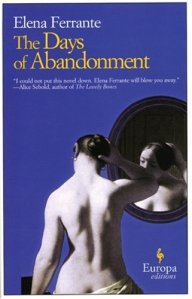
Remember when I said I couldn’t think of a book that I actively hated, that I truly regretted having read? Guess what: I found one! I did finish reading it, partly because I wanted to be sure it didn’t pull some kind of switch on me at the end and surprise me into liking it better, but mostly because it’s pretty short so reading it all the way through didn’t require a great investment of time. It took some will power, though, because I really wanted to get away from it as fast as I could.
Why did I pick out The Days of Abandonment in the first place? I had heard of it because I have been reading Ferrante’s Neapolitan trilogy, starting with My Brilliant Friend and The Story of a New Name, and though my initial reaction was not rapturous, I couldn’t deny the interest and power of her story of two girls grimly battling their way through childhood and adolescence. (I was interested enough to grab the third volume, Those Who Leave and Those Who Stay, away from Steve on my recent trip to Boston, and I’ll still read it.)
Why did I dislike The Days of Abandonment so much? Basically, take all the things I didn’t like about Claire Messud’s The Woman Upstairs, then remove all the things I did like about Messud’s novel and add a lot more bile (metaphorical bile, but also literal, as in the kind your dog would vomit up if he ate strychnine). The novel is about Olga, a writer with two children who collapses into rage and depression after her husband leaves her for Carla, a younger woman. He attributes his departure to “an absence of sense.” At the end of the novel, Olga tells him he was wrong to excuse himself that way:
Now I know what an absence of sense is and what happens if you manage to get back to the surface from it. You, you don’t know. At most you glanced down, you got frightened, and you plugged up the hole with Carla’s body.
“An absence of sense” does perfectly describe her life during those abandoned days: she spirals emotionally out of control, she can’t manage housekeeping or childcare, she loses the ability to do ordinary things like lock and unlock her doors. She tries with unsuccessful guile to track her husband down, and then when, quite accidentally, she happens across him and Carla on the street she viciously attacks them. She tries to have an affair with her neighbor. She starts swearing a lot, screams at and threatens her children, and basically behaves like a nasty, incompetent, raving idiot. That’s all, of course, in some ways perfectly appropriate and understandable in the circumstances. It seemed disproportionate to me, her complete disintegration less about grief than a woeful abdication of her self-respect and autonomy — but who am I to judge? So her dog dies and she puts her children through hell: everybody hurts, right? And I have to give Ferrante credit for presenting Olga’s bad behavior without a hint of softening or compromise. I can’t think of a novel I’ve read recently that has a main character so entirely devoid of redeeming qualities. She doesn’t do or say one nice or admirable thing for the entire 200 pages.
But why? Why put us — not to mention Olga — through that? In my post about The Story of a New Name, I wondered if “the critical enthusiasm for [Ferrante’s] novels is connected to the current anxiety about niceness in female characters: is anger the new obligation of the “serious” woman writer, or the new touchstone for critics of women’s writing?” I agree that the obligation of any novelist is not to be nice but to be interesting, but I found Nora’s anger in The Woman Upstairs tedious and Olga’s “absence of mind” repulsive. I guess I can’t rule out repulsion as an aesthetic effect, but I can opt against it, at least as the sole effect a novel has to offer. Just because for so long it was considered unladylike to show anger — just because anger needed to be admitted to the repertoire of women’s writing — doesn’t mean that in itself anger equals art. I thought Messud was “trying to make a broader political and feminist case for anger out of one woman’s very personal neuroses and bad judgment.” Now I think, well at least she was trying. I didn’t really see her point (I honestly didn’t think Nora had much to be angry about), but Ferrante doesn’t seem to have one: she’s just creating a spectacle, immersing us vicariously in Olga’s psychological and emotional catastrophe. It’s like confining her novel, rather than her protagonist, to the Red Room. Here, indeed, is “a mind filled with hunger, rebellion and rage.” But Bronte’s heroines are angry at something — and something systemic, too — and their novels are both protests against injustice and assertions of their right to transcend their oppression. The Days of Abandonment, in contrast, stakes everything on its skillful and ruthless portrayal of Olga’s unreason.
Olga does emerge, haltingly, from the depths. But here too what Ferrante offers is disappointing. Olga falls apart because her husband leaves her; her return to real life and self-control is measured through her response to another man. Again, you could say the same thing about Jane Eyre — but both she and Rochester work hard to earn their happy ending. I’m not against relationships in or out of novels; nowhere is it written that a love story must be a capitulation to patriarchy. But for me, Olga spends way too much time measuring her success according to how attractive or sexually active she is. Fine, this is the character Ferrante has created, and (again!) who am I to judge? I haven’t always handled my own personal traumas in ways that would stand up to scrutiny. I was sure happy, though, to reach the end and be done with her– not to mention relieved that, bad as the experience was for me, the only actual casualty in the novel was the dog.
Note that I have given my reasons for not liking this novel. Sometimes (can I mention Madame Bovary and Edward St. Aubyn just once more?) when I dislike a novel I can nonetheless appreciate it, even admire it. I didn’t find anything admirable about The Days of Abandonment except, perhaps, its consistency. Oh, and I got that the locked apartment doors were probably symbolic! But I can see how someone would make a better, or at least different, case for it. Indeed, the cover of my handsome edition is adorned (as covers always are these days) with samples of effusive praise. I hated it, but maybe it’s not a bad novel. Maybe it’s a great novel! I don’t know. Feel free to defend it — but you’re more likely to convince me about it if you can avoid the following words: “searing,” “honest,” “raw,” “brave,” “exposed,” “unflinching,” or “naked.”
Here, as promised, is the story of Stewart and Joan and their silver spoons.
Each Christmas the lot at the condominium get together for a huge dinner, catered, at the swanky social suite on the main floor. Each brings his own plate and cutlery. Stewart donned his neat green jacket and red tie and off they went. That night they discovered the heirloom silver spoons from Joan’s grandfather (who left her the fortune she is enjoying now) were missing. Stewart wanted to post a notice on the board but Joan held him back. “We will be making out everyone is a thief,” she cried. Time passed and now they are in the airport on February 1, ready to go through the gun frisking. Joan slides through then the machine let out a scream when Stewart’s body got in. They frisked him again, more screams as Stewart kept crying he had nothing on his body. Finally he found a few silver coins which went in a saucer and more tests. More screams. Passengers were now getting edgy and the official took a hand-held explorer and went over Stewart’s body pocket by pocket. Lo, when he hit one pocket the machine went berserk, and lo, there was a hole in the lining and in went the silver spoons where they had lain since Christmas. As the official drew them out and all heads craned to see what Stewart was trying to sneak into Hawaii, there was a loud cry from Joan: “MY SPOONS! MY SPOONS!” The official’s face was full of disbelief as Stewart tried to explain the long story and he hustled them through the turnstile. By now red-faced and overheated, they scurried down the aisle to the plane when loud cries brought them up short as the official came up with the silver change they had forgotten to pick up.
I wonder if the pleasure I take in these anecdotes is because when I read them, I seem to hear my grandmother recounting them. “No one can hide themselves in their writing,” she noted in one of her letters; “you just read them, then you know them.” Don’t you think that’s true? I suppose it does assume a fairly direct relationship between writing and identity, without due caution for the conscious and unconscious ways we construct ourselves in words. And yet it also seems a common-sense version of Booth’s theory of ethical criticism: writing always conveys an ethos, a sense of self. From my grandmother’s letters, I can pick out her flaws and blind spots, certainly, but what I see most of all is her zest for life, with all its ups and downs and mysteries and revelations. “I don’t envy people who have tension-free lives,” she writes in one; “how dull it must be.” No one with her flair for making drama out of the mundane could ever be dull, but also growing up in the Depression taught her to appreciate the little things. Reminiscing about her life-long friend Dorothy (shown with her in the 1929 photo on my previous post), she noted that when they were young “the biggest thing was to walk from the west end where we lived up to the old Carnegie library on Hastings Street for me to get my books. . . all we needed was an excuse to go somewhere.” Both the need and the destination sound just about right to me!
Anyway, as I said, I have only a small selection of her letters left, but I treasure them. How she would have loved email! I have a vast archive of messages from friends and family — especially from my dear mother, another excellent correspondent. The form really doesn’t matter: what counts is the connection. As my grandmother says, “Why is it so hard to explain to anyone what a joy a loving and news-filled letter does to the soul? It really is magic.”
My grandmother Louise Spratley was a real force in my young life: one particularly memorable thing she was responsible for was arranging for me to go backstage at the Vancouver Opera to meet Joan Sutherland. She died in 1993; I’m reminded of her often, not least because as I get older I look more and more like her. June 24 was her birthday, so in memory and celebration, I’m reposting this piece about her from my archives. When I posted it originally I said that I would follow it up with her story of Stewart and Joan and the silver spoons; this time I will do that, I promise, so stay tuned.
My grandmother was a remarkable woman–energetic, vivacious, difficult, independent. Above all, she was what she called a “word person”: she loved to read, and nearly half way through her life she discovered that she also loved to write. In 1955, after staying home for years to raise my father (her only child), she launched a new career for herself by offering to do a gardening column for the local paper, the Lions Gate Times. As she tells it, the editor learned she had once trained as an accountant and asked her to help with the books. Eventually she was sent on her first assignment, to cover a municipal council meeting. She had no training as either a writer or a reporter. She recalls,
I carefully wrote down every word, shaking with insecurity and fright, and filled the front page on press day. The mayor commented, “the best coverage we have ever had.” That was the beginning of my writing career. . . . The writing was easy. My drive came from an insatiable curiosity and an unquenchable urge to tell everyone what I found interesting.
Everyone who knew her would agree that she never lost either that curiosity or that urge to share her enthusiasms, which is one reason her letters were always such fun.
Editor, Lions Gate Times, c. 1965
In 1959, she became editor of the paper, which under her management was named “best community service paper” by the Canadian Weekly Newspaper Association, and her features on local issues won awards–including the MacMillan-Bloedel journalism award in 1966. She also did travel features, including several pieces on a trip to Germany in 1964. This anecdote, sadly, was not in the published version, but she wrote it up for a scrapbook she made for me about her work. It gives a great sense of her indomitable spirit, headlong writing style, and sense of humor:
My first trip to Germany was done in style–six people on Air Canada’s biggest jet; champagne all the way; playing bridge with the crew and ending up with a police escort to our destination in Hamburg.
It was a heady experience. The reporter from Sports Illustrated, NY, Tom (the CBC engineer from Montreal) and myself stayed at the same hotel for the ten days we were there. Near the end, the New Yorker went off to Denmark and I wanted to see West Berlin so Tom crept along. Tom was about my age, very tall with a small moustache. He was not an outgoing person, sort of mentally huddled, but pleasant enough to drag around with. He was drawn to the beer halls and me to the opera. Neither of us could understand the other’s tastes.
We had a small crisis in Berlin. We sought out the efficient hotel advice expert at the airport when we landed to find the city crawling with conventions. Not a hotel room to be found. I cried out in despair. What would we do? More phoning brought up a room in a pension with a double bed.
Tom had been lounging at the door but at this good news he turned linen white and seemed about to faint. However, I had no urge to sleep on a bench in the park all night and briskly took the room, feeling we could cope with the facilities later that night. . . .
Tom was inside our room reading when I got back and I decided on strategy. I had no illusions that my elderly presence and pinched face would set his blood boiling, so I just said, “Tom, you put the paper over your head while I get undressed, then it will be your turn.” He uttered not a sound and promptly obeyed.
I got into bed, he mumbled he was going to read, and I lay, stiff and uncomfortable, on the edge of the mattress. But I had forgotten the toll on a body of an early flight, incessant sightseeing, the Mexican show, and the tension of one bed. The next thing I knew it was 8 a.m. and Tom was snoring merrily beside me. We had a big laugh, launched into the trip to East Berlin and then flew back to Hamburg.
The newspaper stories themselves are wonderful time capsule pieces. “West Berlin is one city in the world where a tourist will never see a ‘Yankee Go Home sign,'” one of them opens,
Why? Because this free city, in an unfree, Russian-occupied East German zone, owes its very life to the benevolent protection of the United States.
It is true that the three western allies are committed to defend Berlin. But a traveller quickly learns it is to strong and democratic America that Berliners have given their hearts.
The flight from Hamburg to Berlin–it only takes an hour–is an eerie one along the 20-mile-wide corridor paced off by the Russians. . . .The Wall, an unbelievable object, runs 30 miles through the heart of this beautiful city. A German businessman told me passionately that it was not a wall but a wound cut across the body of Berlin, with the flesh dying on either side of it.
She loved politics (“I found I was what is called ‘a political animal,'” she says), and in 1968 she took a position as Special Assistant to Jack Davis, the federal minister of Fisheries and Forestry. After her ‘retirement’ in 1974 she continued to do freelance writing and editing projects, the biggest of which was the 1980 West Vancouver Community Plan, a project which reflected her deep love for local history and for the community where she lived.
At my U.B.C. graduation, 1990
I wish I had more of the letters she sent me over the years. We used to have long phone conversations too, but she always loved to rattle off her correspondence on her trusty manual typewriter, full of anecdotes and excerpts from her current reading. An ardent natural history enthusiast, she had a particular fondness for earthworms and often wrote about their contributions to our world (she would have loved George Levine’s podcast on ‘worm excrement,’ I know). In one of the letters I do have still in my box of family papers she has been reading a Carl Sagan book we’d sent her for Christmas–it was 1992, so I think the book may have been Shadows of Our Forgotten Ancestors–and after several paragraphs of excited summary there’s this:
I’ve come to the part where Sagan says, “It seems clear there is only one hereditary line leading to all life now on earth. Every organism is a relative, a distant cousin of every other. This is manifest when we compare how all organisms on earth do business, what genetic language they speak. All life is kin.”
I love that. Rohan, we are brethren of our worms that so fascinated us.
She was always so confident that her fascination would be contagious–and usually it was. She also could not resist making a story out of everything that happened, a trait that could sometimes be tiresome if you happened to be a character in one of them and weren’t sure her version represented your truth, never mind the truth. Here’s one that made me laugh and then cry a little bit, because it brings her back so vividly. It features her very best friend of many years and his long-suffering wife, who patiently tolerated their great closeness.
My news is all wrapped up with Stewart. He and Joan went to Hawaii for 2 weeks and arrived home Monday. It was the day I decided to make muffins. Baking has assumed a sinister character in my life. I hate it now and am glad my feelings parallel Dorothy’s so I know it is endemic with the elderly. Anything to put off even boiling an egg. But I decided to make bran muffins for health’s sake and my doctor’s orders and instead of getting dressed and clearing off the sink and lining up the ingredients like sensible people do I rushed into it in my usual sloppy fashion with my old dressing gown with its floppy sleeves in the act as well. I became depressed when I forgot if I had put 2 cups or 1 of brown sugar into what I was blending then hand beat up the eggs and when the handle got caught in my sleeve and whipped the eggs onto the carpet I was ready to throw everything into the garbage. But I pressed on which turned out to be a bad decision. I floundered along with the huge recipe — it makes 30 muffins — and flour and bran and chopped dates were all over the place as I got sick of the act and dumped everything in one huge bowl instead of folding and delicately coupling wet with dry as the recipe says. I then got the muffin cases in the pans, all 30 of them, and started to ladle out the sticky dough. By now it was over my fingers and I was wiping them on my dressing gown when the phone rang and I rushed to answer it. WHY? Don’t ask. Over the wire came the thrilling, sonorous voice — “greetings from Aloha!” It was Stewart, fresh off the plane and full of joy and good will. My eyes looked at the mess of dough and the 30 little beds awaiting it and decided it was not the time to have one of our long visits so cried that I was muffining and would call him back. He did not understand and waited 5 minutes with phone in hand for the sound of my voice. We finally got connected again and well into the news of Hawaii. . . . By this time my muffins were busy in the oven and a nice fragrance came into the office, followed by a darkening overtone. I searched my soul to cut my friend of 35 years short in his high-spirited saga of lotus land and felt the damn muffins were not worth such a long friendship. . . . We finished our talk on a high note and I drew the muffins out — burned thoroughly at the bottom and around the edges, and so well-cooked they fell apart when I tasted one. I stuffed the 29 in a plastic bag and threw them in the freezer and cleaned up the joint. Well, I had to, as Stewart was on his way, “with a gift,” he says.
There’s a lot more to be known about my grandmother and her family. For instance, my great-aunt, her sister Hilda Cryderman, received the Order of Canada for her efforts on behalf of women’s rights, especially her advocacy for equal pay for women teachers. If some enterprising historian with B.C. roots ever wants to undertake a family history, let me know! (Helen? What do you think?)
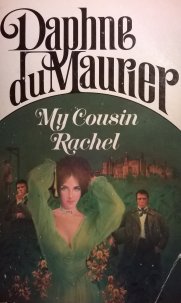
No one will ever guess the burden of blame I carry on my shoulders; nor will they know that every day, haunted still by doubt, I ask myself a question which I cannot answer. Was Rachel innocent or guilty? Maybe I shall learn that, too, in purgatory.
My Cousin Rachel is more understated than Jamaica Inn but, in its own way, it is just as perfect. It’s not just Philip Ashley, our narrator, who will never be able to answer his question about Rachel, but all of us, left by du Maurier suspended in uncertainty and thus in our judgment of Philip himself. Has he heroically resisted and survived one of the women his godfather warns him about, those who “impel disaster”? Or has his own suspicious misogyny made him not a hero, not a victim, but a villain himself? “She was my first, and last,” he tells us, but has his inexperience made him vulnerable to her wiles or liable to fevered obsession and delusions?
Jamaica Inn is romantic suspense: is there a name for this genre of not-knowing? And what other novels besides The Turn of the Screw belong to it? For a long time I felt sure that the verdict would go against Rachel, both because the circumstances of Ambrose’s death certainly seemed suspicious and because the novel seemed tilted against women’s power to disrupt men’s bluff tranquility. Then it dawned on me, rather belatedly, that I was taking Philip too much at his word, or at least taking his point of view too much for granted, something he had, after all, warned me about right at the beginning! It wasn’t until he had his hands around Rachel’s throat, though, that I really saw how du Maurier had suckered me into complacency with the familiar trope of the femme fatale. I just assumed I knew who — or rather what — she really was. But it’s a much more clever game du Maurier’s playing than, say, Braddon’s in Lady Audley’s Secret: there, we figure out quite soon that Lucy is not as she seems, and the suspense comes from seeing who wins the cat-and-mouse game between her and Robert Audley. That’s what I thought would happen here too — that Rachel’s malevolence would become clear and Philip would somehow have to fight and expose it — but how much less fun and original that would have been than what du Maurier does instead. “She may be innocent,” says Philip’s friend and ally Louise; “she may be guilty. You can do nothing.”
And du Maurier really does a lot of things well, provided you don’t mind a little melodrama along with your foreshadowing. I did think (if it’s not heresy to say so about a writer as skillful as du Maurier) that the balance was a little off: it seemed to take a very long time for Philip to emerge from his initial infatuation and thus for things to get really interesting. In the end, I still like Jamaica Inn better, mostly for Mary Yellan but also for its greater plottiness (is that a word?) and its more expansive descriptions, especially of the landscape. But the opening and closing are particularly shivery and splendid here, and frame the story perfectly:
They used to hang men at Four Turnings in the old days.
I’m back again from another trip to Boston, where I went for another of our more-or-less-biannual Open Letters Monthly editorial summits. Along with the pleasure of seeing my colleagues face to face comes the treat of visiting some of Boston’s many excellent bookstores. I brought back a more modest stack than last time (or the time before that): it’s dimly possible that I was chastened by my awareness that I have only just read some of the books from those previous expeditions (not that the others are wasting away – they are just still ripening on the shelf!). It was as much fun as ever lingering luxuriously over my options, though, and I had very good luck finding some things I have been particularly looking for.
One writer I’ve often been advised to try, especially because of my interest in philosophical fiction, is Iris Murdoch. I’ve gotten a lot of different recommendations on which novel to start with; of these, The Sea, The Sea (which won the Booker Prize in 1978) has always seemed like a good option, so when I saw a nice copy of it at the Brattle I grabbed it up. My recent reading of Angle of Repose had me on the look-out for more Wallace Stegner (the only other one I have is Crossing to Safety), so The Spectator Bird (which won the National Book Award in 1976) was also a happy find. My other Brattle pick was Janice Radway’s Reading the Romance, which I spotted on one of the dollar carts. It’s clearly a student copy (there’s a Brown Bookstore tag inside, and a lot of purple underlining), but it’s otherwise in good shape. Even before I started reading romance novels I knew that Radway’s was one of the key studies of the genre, and now that I have a little more experience both with the books themselves and with the interesting conversations people have about them, I’m curious to have a look at her arguments for myself. (The book is 30 years old now, and I know the field of romance studies has changed and grown a lot since it came out. But my guess is that a lot of those conversations still start with frameworks she set up.)
I usually love browsing the vast stretches of shelves at the Harvard Coop, but this time I actually found it a bit too much trying to make my way along them. Instead, I hunted up a few titles I have been wanting but unable to get a look at locally and finally settled on Dorothy Dunnett’s King Hereafter. It’s no secret that I am a ridiculous fan girl about Dunnett’s Lymond series. I love it so much I have never really wanted to read anything else by her…which is irrational in all kinds of ways! I have the first in the House of Niccolo series and one day may follow through on those, but I’ve heard from a few readers that King Hereafter (in which, the blurb tells us, she “peels away a thousand years of legend to uncover the historical figure of Macbeth”) is actually her very best historical novel. Better than The Ringed Castle? Incontheivable! But OK, I’m game. Stay tuned for a full report.
I was specifically hoping to find W. G. Sebald’s The Emigrants on this trip. I looked for it a few places and finally spotted it at the Barnes & Noble in the Prudential Center (where one or two of the OLM team can be found working most days of the week). Sebald is a writer I hear about often (most recently, in Tom’s comment here). I bought Austerlitz a few years ago and have started it once or twice but put it aside — it’s still ripening! The Emigrants looks like it might be a bit more accessible to me. Again, stay tuned!
We made a pilgrimage to the OLM post office box, where Steve unpacks an astonishing haul of books almost every day. Fortuitously, the day I was with him one of them was an advance copy of the third book in Elena Ferrante‘s Neapolitan trilogy, Those Who Leave and Those Who Stay, which I promptly took possession of. Then at the Harvard Book Store I picked up The Days of Abandonment. So I’m all set for harshly unsentimental Italian fiction.
I guess I’d better start reading if I’m going to get through all of these before my next trip! Though maybe I should start with those Ivy Compton-Burnett novels from my first visit…
Orlando had so ordered it that she was in an extremely happy position; she need neither fight her age, nor submit to it; she was of it, yet remained herself. Now, therefore, she could write, and write she did. She wrote. She wrote. She wrote.
Part way into my book club’s discussion of Orlando, one of my friends spoke out with the intensity of someone who has reached a difficult conclusion. “I think that’s my problem,” she said. “The world is overwhelming enough: I want my books to be little, to focus in on something, not to open out onto everything.”*
I liked Orlando better than she did, but it’s hard not to sympathize with that sense that it’s a book that is always on the verge of spiraling off into chaos. There’s just so much in it. It kept giving me a crazy mental image of Woolf at her desk dipping her hand into a bowl full of confetti representing everything she knew and had read and, with a flick of her wrist, tossing her handful into the air and letting it settle onto her pages — except that the result of that would be random, and Orlando is full of stories and patterns and repetitions. Still, it feels ebulliently excessive and joyfully disorderly, at least to someone approaching it more or less for the first time. (I had read it before, sort of, years ago, but since then I had only returned to the marvelous opening of Chapter 5, in which “the Eighteenth century was over; the Nineteenth century had begun” — which I have used many times as a part comic, part provoking starting point for courses on 19th-century fiction.)
It is so many things all at once: a satirical but erudite sketch of 300 years of English history; a sideways look at literary history; a feminist polemic; a love story; a hymn to what in A Room of One’s Own she calls being “man-womanly” and “woman-manly.” It offers meditations on time, on biography, on our many selves, on writing in general and poetry in particular, on nature, on gender. What doesn’t it address, really? And it does it all in those paragraphs that only Woolf writes: they start out so purposefully, then come unmoored and drift away, only to make their way confidently to what turns out to have been their destination all along.
I won’t pretend that I found reading Orlando entirely pleasurable. I was often a bit bored, a bit frustrated, a bit irritated. If I hadn’t spent a lot of time on A Room of One’s Own in class recently, trying my best to coach my students to cope with its meandering structure, I would probably have allowed myself to react even more negatively, but I tried to learn my own lesson and find the logic and the rhythm of it. I do think that A Room of One’s Own is easier to make sense of than Orlando, because after all, it states its thesis right away and proceeds to explore and defend it. Does Orlando have a thesis? Why should it? It’s a novel, after all. Does it have a point? a central “aboutness”? I’m not sure. I think if it does, it might lurk in one of the sentences I underlined as I was reading: “we write, not with the fingers, but with the whole person.” Or it might be in here somewhere: “when the shrivelled skin of the ordinary is stuffed out with meaning it satisfies the senses amazingly.” Or here: “everything was partly something else, and each gained an odd moving power from this union of itself and something not itself so that with this mixture of truth and falsehood her mind became like a forest in which things moved; lights and shadows became like a forest in which things moved; lights and shadows changed, and one thing became another.”
But why does it have to have one point or be about something? I think my friend is right that it’s about everything — at least, everything Woolf cared for. One of our group found it very sad, and there is a lot of failure and disappointment and heartbreak in it, but overall it didn’t seem dark to me. It seemed to me like Woolf was playing, having fun. It’s a pretty strange game, I suppose, but how else is a mind like hers supposed to enjoy itself? When I was bored, I think it was because I didn’t understand how to play along. That might get better if I kept rereading it, but I expect I would never quite be able to catch or match the spirit of the book.
Even this time, though, I did find plenty of moments delightful, beautiful, or wonderfully sharp. The parts I liked best (besides the onset of the Victorian period, which remains my favorite section) were soon after Orlando becomes a woman and she has to reconsider everything about her place in the world. It’s not that the gleefully surreal fantasy of the first half gives way to something altogether different, but you can sense the angry political Woolf of Three Guineas when Orlando has thoughts like “what an odd pass we have come to when all a woman’s beauty has to be kept covered, lest a sailor may fall from a mast-head. ‘A pox on them!'”
*Or at least, to the best of my recollection, she said something very close to this! It was a convivial night out and I wasn’t exactly taking notes.
 I’m not in any position to evaluate how accurately American politics is depicted in Netflix’s remake of House of Cards, but if people even think that Congress and the White House are run solely on greed, ambition, and ruthless back-stabbing, as the show suggests, no wonder voter turnout is so low. The series is one of the most dispiriting things I’ve ever watched — not just because of its relentless cynicism about both human nature and democracy but because it seems to have embraced that nihilistic cynicism so wholeheartedly. Imagine how different the show would be if it wrapped the story of its sociopathic central characters in some irony, or developed their story as tragedy, so that we could be caught up in their rise — as we are with Shakespeare’s Richard III or Macbeth, or with Thackeray’s Becky Sharp — but also see them suffer and fall. Instead, their vicious dishonesty wins them triumph after triumph, while the few around them who so much as raise questions, never mind try to stand for something else, are weak and ineffectual — or just dull. “She did what she had to do,” one character says in Season 2 about another who betrayed him for her own political gain: the show does not provide any alternative narrative, so even if we are repelled watching we have to look outside the box (literally!) to find a critique that goes beyond wishful thinking.


 Remember when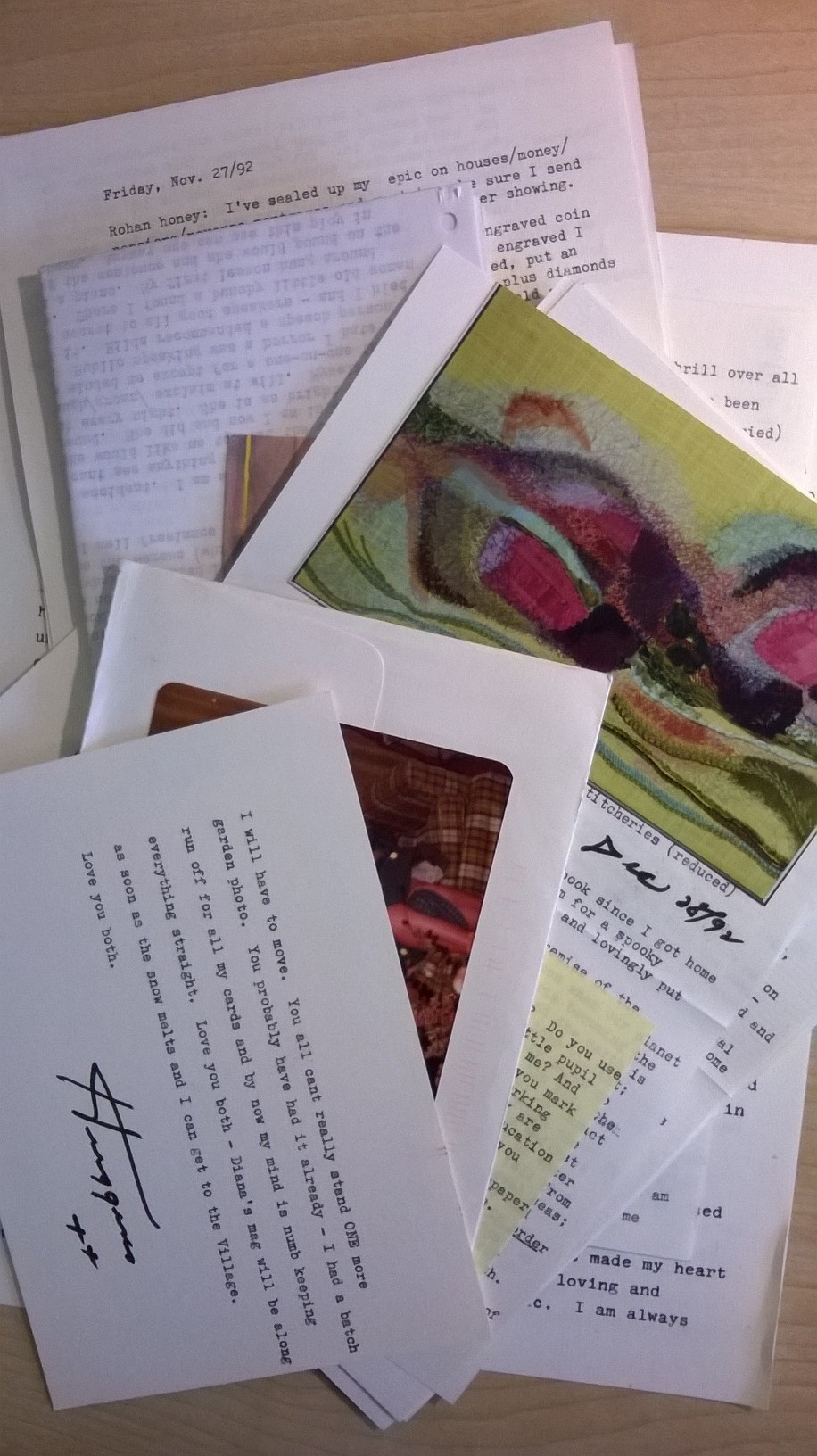




 Novel Readings