“A Solitary Woman on the Threshold of Winter”: Miral al-Tahawy, Brooklyn Heights

brooklynheights

The notebook meanwhile remained innocent of writing. She sketched one self-portrait after another in charcoal on the white pages, images of a woman with hollow cheeks and a long nose and curly black hair, hands clasped to her withered breast — a solitary woman on the threshold of winter.

That description is not actually of Hend, the protagonist of Miral al-Tahawy’s Brooklyn Heights: it’s of Lilith, one of the women we meet as we follow Hend in her wanderings around Brooklyn, where she has emigrated to from Egypt with her young son. Later, though, when Hend rifles through the books and papers Lilith leaves behind after her death, “a feeling of déjà vu sweeps over her”:

‘Emilia, I know these papers. . . .’ And I know that I’ve written every word in them myself, she thinks. This is my handwriting, they belong to me. . . . ‘I feel like I’ve lived all this before, that these letters are mine, these words are mine.’

Her friend Emilia is unmoved: “When you get to be my age,” she tells Hend, “you’ll realize that everything starts to look and feel the same when you’re old.” It’s not, in other words, a clever meta-fictional moment in which we are sent back to the beginning of Hend’s story to reconsider it as Lilith’s: it’s an acknowledgment of kinship across stories and lives.

The whole novel, which is both beautiful and melancholy, both bitter and touching, is made up of moments like that: encounters that awaken memories or evoke connections. There’s little plot in Brooklyn Heights, but that’s not to say nothing happens as we follow Hend around; it’s just that the happenings are more often in her past than her present, and as likely to be in the Egypt she has left as in the America where she has settled. People she meets remind her of those she used to know; places she visits take her back, in her mind, to where she used to be. Her wanderings through Brooklyn come to seem metaphorical, not just for Hend’s own journey through life but for all of ours, as the various elements that make up our histories and identities come and go.

Hend’s loneliness is profound, individual to her unique experience but also familiar; she is haunted by “a feeling of emptiness and futility and a yearning to share her loneliness with another human being.” But the new friendships she makes are fraught and impermanent, while her old relationships have simply “vanished from her life without a trace,” like the unfaithful husband who “walked out the door and never came back.” She lives a strange, sad, fragmented life that is nonetheless full of intensity:

Here in Brooklyn, she waits for the phone to ring or for a strange women to smile at her on the street. She doesn’t see Fatima any more either. “Everybody in this city is running around after something. Everybody is busy,” she would say to make herself feel better. She walks alone towards Atlantic Avenue. The winter rain falls steadily and the homeless people hide in the subway station or make a quick dash for the Dunkin’ Donuts. They sit alone and glance longingly at strangers with whom they hope to exchange a smile or a few words. The rain falls on the glass windows of the coffee shop and she watches the solitary drops and thinks how closely she fits in with the wretchedness around her. As she walks down the long avenue she passes the halal butchers, the Islamic Center, and the stores that sell fragrant oils and religious books about the torments of hell, pilgrimage clothes and velvet Meccan prayer rugs and short white Pakistani jalabas and so many different kinds of headscarves. Sometimes she rides the bus from Atlantic Avenue in the north of Brooklyn to Coney Island or Brighton Beach in the south. She sits next to the window and remembers how she used to love watching the world go by from the window of the old Cadillac. She stays on the bus till the end of the line and then rides back again, without getting off.

Her experience is highly specific, from the stories of her childhood in a Bedouin village to the dance class she takes in Brooklyn at the urging of a neighbor whose friendship subsides once Hend refuses his sexual overtures:

He had tried to convince her of the truth that love and hate mean nothing in the dance as in life, and that all she had to do was relax the muscles of her mind and give her body a chance to express itself, but Hend wasn’t convinced. The fragile spell cast by the wine and the circle of dancers was broken and Charlie went back to being a clay frog of a man she didn’t love.

Somehow the meticulous details do not restrict the novel’s meaning to Hend, though: without ever overtly pushing us towards universality, al-Tahawy seems to me to reveal it, in Hend’s yearning for companionship, in her puzzlement over her own unstable identity, her difficulty recognizing her self in her thoughts, or in her mirror. The other stories in the novel — of Lilith, of Hend’s family, of the retired bakery owner Naguib al-Khalili and his nephew, Ziyad, who “come to America to study film-making, but the real world got the better of him and he began to work full time in the bakery with his uncle” — are all also highly individualized, and yet they also play variations on Hend’s themes of displacement, memory, and identity, so that the book as a whole feels unified despite its episodic structure.

Brooklyn Heights has an elegaic quality: Hend is not old, but she is aging and unwell, and there is no sense in the novel of a new life unfolding in the new land she has come to. She believes herself born under an unlucky star: “it happens,” she thinks,

that you’re born on a summer night and suddenly find that you’ve been taken hostage by a star: always moving in the wrong direction, always pretending to be strong when in reality you quake in mortal fear, always wanting things but never reaching out for them, never knowing the difference between truth and illusion.

“The patterns traced by the stars gave some measure of meaning to her life,” but not any hope or confidence: Hend is constantly in motion but she’s not on a quest, not going anywhere except to return. She dreamed of being an actress; she thought, too, that she would be a writer: “all she wanted to do was write, so much so that she felt she would die if the bitter mountain of words stayed trapped inside her.” But she finds “writing is intractable, like a wounded woman, and at some point she realized that, after all was said and done, she was incapable of healing those wounds.” It’s not hard to imagine a different version of Brooklyn Heights that takes the hint from that moment and turns the novel into her novel. I was glad, though, that al-Tahawy does not offer us that facile reassurance that sorrow transmutes into art. There’s something beautiful about the bleakness of Hend’s meandering, and it seems fitting to be left with her on that cold threshold.

This Week In My Sabbatical: More of the Same

Sadly, that includes more winter: not only did we get another storm yesterday that dumped another foot or so of snow (it was hard to tell exactly, because it was very windy and so there were lots of big drifts), but apparently there’s yet another one looming. Whatever. It’s the kids’ March break; I’m not teaching; we don’t have anywhere we need to be before Friday: let it snow! But then, please, let it stop — because enough already.

In happier news, there has also been more reading and writing. If you’re reading this, you probably already saw my post on Ian McEwan’s The Children Act as well as the one on Rex Stout’s A Right to Die. Neither book was a great hit with me, but McEwan is a writer I’m never sorry to read — his worst recent books are still much better than most other books I read, at least in their scrupulous intelligence and their ambition to be about something interesting, and I always admire his prose. And I understand better now why Nero Wolfe is such a favorite for so many mystery lovers I know, even though I don’t think he’s going to become one of mine.

senseofanendingOver the weekend I also read Julian Barnes’s The Sense of an Ending and reread (most of) Loretta Chase’s Mr. Impossible. I didn’t feel like writing a “proper” post on the Barnes novel. I didn’t like it much while I was reading it — it seemed really heavy-handed in its not-telling, and unduly portentous given what turned out to be the big revelation, which was a lot less revelatory than I expected. I’m sure there are all kinds of nuances in the novel’s treatment of memory and evidence, but I couldn’t motivate myself to go back and work up an appreciation of them. There’s lots of good writing on it: I recommend the typically thoughtful post at Tales from the Reading Room (which includes links to some extended discussions about the “what actually happened”) or this trenchant critique from Jessica at Read React ReviewMr. Impossible was a perfect storm-day diversion: it’s a perfect example of one of my own favorite romance tropes, namely “severe bluestocking discovers passion with a man who finds her intelligence alluring.” (I’m sure that says nothing about me at all! But seriously, as I said the first time I wrote here about reading romances, it’s interesting to me how personal romance preferences seem, compared to, say, detective fiction.) Now I’m reading Miral al-Tahawy’s Brooklyn Heights. I’m liking it a lot so far: it’s quiet and a bit melancholy.

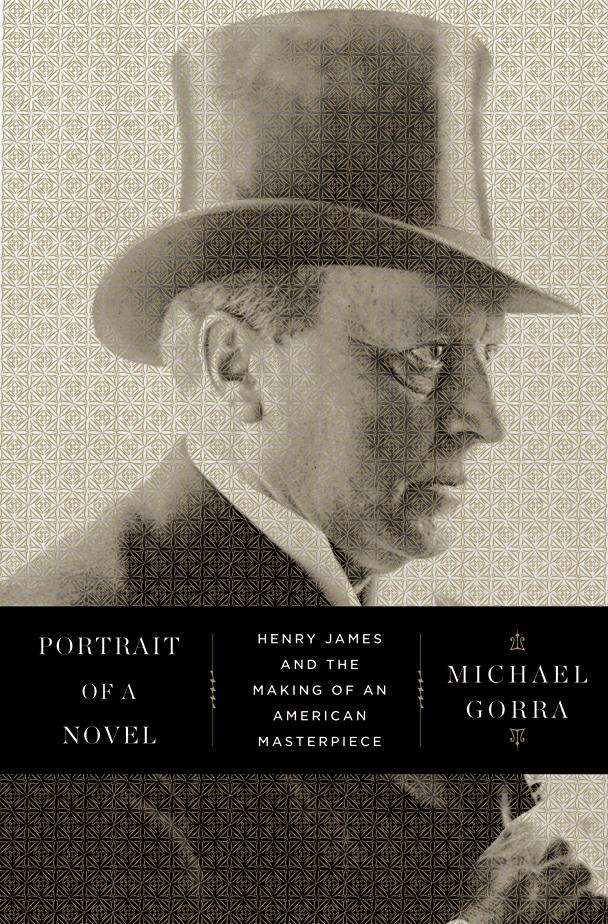
Besides the blog posts, I’ve also written more of my George Eliot chapter. It’s still a long way from being finished, but I think it would be a mistake to keep at it until it seems perfect and complete: I still don’t quite know what the larger project should be, and the more I polish this piece the harder it will be to mess it up again later. So I’ve resolved to stick with it for another week, at which point all of its parts will be there in rough form. Then I’m going to start the process again on the topic I’ve chosen for the second chapter, work away at it until it too is in rough but full form, and then take off the blinkers and try to figure out what I’ve done, whether I should persist along similar lines, or reconsider altogether, or what. I have been feeling a bit grim about all this effort going into something that may be entirely quixotic — but I got a boost today reading Dan Green’s review of Michael Gorra’s Portrait of a Novel“Ultimately,” Dan says,

[Gorra’s] goal is to enhance our appreciation of this novel (and indirectly of Henry James as a fiction writer), in the most old-fashioned sense to account for its greatness. What Gorra has really produced in Portrait of a Novel is a work of critical eclecticism. He borrows from a number of critical approaches, including some of those currently ascendant in academic criticism, as well as more traditional “scholarly” concerns, and in the process demonstrates how criticism can draw on a variety of ways of thinking about literature as a phenomenon of human expression and culture in order to satisfy the ultimate goal of providing a clarifying perspective on a morally and aesthetically complex work of literature.

gorra“Our current literary culture,” he concludes, “could certainly benefit from more books like Portrait of Novel, books that avoid both the intellectual trendiness and abstraction of academic criticism and the undisciplined impressionism of popular criticism.” I’m not (at the moment, anyway) including much biography, but I am trying to do “the sort of ‘in-between’ criticism” Gorra’s book apparently provides (I’ve put a hold on it at the library and will take a look for myself as soon as I can), and as Gorra’s book has been well received, maybe Dan isn’t the only one who likes to read that kind of thing. Gorra, of course, already had the right profile to make a book like this seem to a publisher like a plausible venture, but that’s an anxiety for another day. David Pierce’s Reading Joycewhich I have already looked at pretty carefully, is another example of “in-between” criticism — more than, say, Rebecca Mead’s My Life in Middlemarch, which for all its good qualities, really does not offer a rigorous reading of its touchstone novel.

“Meaning”: Ian McEwan, The Children Act

ChildrenAct_Canada_200

She thought her responsibilities ended at the courtroom walls. But how could they? He came to find her, wanting what everyone wanted, and what only free-thinking people, not the supernatural, could give. Meaning.

I love reading Ian McEwan’s prose. It’s so satisfyingly meticulous, every word the right one, every one placed just so. It’s not that he’s a relentlessly spare or minimalist stylist: he likes a detailed description, an apt but surprising simile, even the occasional conspicuous flourish, like the Bleak House allusion that opens The Children Act: “London. Trinity term one week old. Implacable June weather.”

But that allusion was just the first of many aspects of The Children Act that I found puzzling. Is it an interpretive hint or just a literary nod? What does this novel ultimately have to do with Bleak House? Both books have a dying child at their moral center, I guess, so that’s something. There’s Chancery Lane, too, and the whole legal context, but is Adam Henry’s case to be read as a metaphor for a broader social catastrophe, the way Jarndyce v. Jarndyce is? In Bleak House the legal system is a black hole into which not just money but lives, loves, good intentions, kind hearts, hopes, dreams are all inexorably drawn. The family court over which Fiona Maye presides certainly seems like a similar vortex of unreason and despair:

The new coinage was half-truth and special pleading. Greedy husbands versus greedy wives, maneuvering like nations at the end of a war, grabbing from the ruins what spoils they could before the final withdrawal. Men concealing their funds in foreign accounts, women demanding a life of ease, forever. Mothers preventing children from seeing their fathers, despite court orders; fathers neglecting to support their children, despite court orders. Husbands hitting wives and children, wives lying and spiteful, one party of the other or both drunk, or drug-addled, or psychotic; and children again, forced to become carers of an inadequate parent, children genuinely abused, sexually, mentally, both . . . And beyond Fiona’s reach, in cases reserved for the criminal rather than the family courts, children tortured, starved or beaten to death, evil spirits thrashed out of them in animist rites, gruesome young stepfathers breaking toddlers’ bones while dim compliant mothers looked on, and drugs, drink, extreme household squalor, indifferent neighbors selectively deaf to the screaming and careless or hard-pressed social workers failing to intervene.

In Bleak House Jo’s plight comes to represent that of all the children failed, not just by their parents, but by a state that proclaims its patriarchal authority but has abandoned its paternal responsibilities — more than that, the inability, or unwillingness, of anyone in power to save him is a symptom of a moral decay infecting the whole nation. “And dying thus around us every day,” charges the narrator, implicating his entire audience. England itself is the real “Bleak House” — and Esther, of course, is its symbolic housekeeper-savior. McEwan too shows us a world that is spectacularly failing its children, its dysfunctional families a sign of a society come unmoored.  But from what? Not from religion, which features in several of Fiona’s cases as just another source of conflict, one powered by its own forms of irrationality. Against its destabilizing power is set the organizing intelligence of the law: Fiona’s work is to wrestle all the chaotic elements into order, to sort and weigh and evaluate and ultimately rule, with the “welfare” of the children her top priority — which, compared to Bleak House at least, seems like progress.

And yet The Children Act is surprisingly equivocal about both law and religion. I say “surprisingly” because McEwan is well-known to be one of Richard Dawkins’s “brights,” that is, an atheist, and The Children Act seems perfectly set up to enact a decisive confrontation between the sacred and the secular. Fiona’s ruling on Adam’s case was just what I expected — well, I couldn’t have filled in the specifics in advance, but the decision itself seemed predictable, and yet it is also eloquent:

his welfare is better served by his love of poetry, by his newly found passion for the violin, by the exercise of his lively intelligence and the expressions of a playful, affectionate nature, and by all of life and love that lie ahead of him.

Adam, too, is initially converted, embracing his new chance at life and rejecting the rule of the “tooth fairy.” He sees Fiona as his savior:

You were calm, you listened, you asked questions, you made some comments. That was the point. It’s this thing you have. It added up to something. You didn’t have to say it. A way of thinking and talking. . . . It wasn’t about God at all. That was just silly. It was like a grown-up had come into a room full of kids who are making each other miserable and said, Come on, stop all the nonsense, it’s teatime! You were the grown-up.

Indeed she was, so why is this not the happy ending, for Adam and for the novel?

ChildrenAct-542x800The loose thread that unravels this tidy resolution is Fiona herself, who is not an abstraction, a theoretical embodiment of law or principle, but a person preoccupied by the fraying edges of her own once-elegant life: a discontented husband looking for the passion they no longer share; discontent of her own about her lack of “significant relations defined above all by love,” including having no children of her own (“Her failure to become a woman, as her mother understood the term”); doubts about the efficacy of her work, for which she has given up so much else (“she belonged to the law as some women had once been brides of Christ”). When Adam seeks her out as a … what? mentor? teacher? guru? sponsor? … she’s uncomfortable, understandably, as his impetuous proposals cross boundaries between the personal and the professional, between her public role as a judge and her private life:
I love being ‘young and foolish’ and if it wasn’t for you I’d be neither, I’d be dead! I wrote you lots of stupid letters and I think about you all the time and really want to see you and talk again. I daydream about us, impossible wonderful fantasies, like we go on a journey together around the world in a ship and we have cabins next door to each other and we walk up and down on the deck talking all day.

“I want to come and live with you,” he says; “I could do odd jobs for you, housework, errands. And you could give me reading lists, you know, everything you think I should know about.” Is it his failure or hers that, with the whole world now open to him, Adam sees in it only Fiona — or, at any rate, sees Fiona as the only source of wisdom and guidance? “Without faith,” she thinks later, when — turned away, or turned loose, by Fiona, Adam has made a drastic return —

how open and beautiful and terrifying the world must have seemed to him. . . . Adam came looking for her and she offered nothing in religion’s place, no protection, even though the Act was clear, her paramount consideration was his welfare. How many pages in how many judgments had she devoted to that term? Welfare, well-being, was social. No child is an island. She thought her responsibilities ended at the courtroom walls. But how could they? He came to find her, wanting what everyone wanted, and what only free-thinking people, not the supernatural, could give. Meaning.

Is that the message behind Adam’s sad fate, that something needs to fill the gap left by religion’s absence? If so, why is it Fiona’s individual responsibility to provide it? Or is the failure a collective one — or is Fiona falling, at Adam’s naive prompting, into solipsism, imagining that somehow she (the “grown-up”) has all the answers, when the responsibility really lay with Adam to embrace his hard-won independence and make meaning for himself?

McEwan doesn’t make the novel the polemical knock-down case he surely could have against Jehovah’s Witnesses in particular or religious believers more generally; The Children Act is a less schematic novel, I think, than Saturday, in which the contest between artistic and scientific worldviews plays out in a clear, if not quite clearly resolved, counterpoint. But neither does he concede that religion is a particular force for good, or a particular good source of meaning. Does he mean to leave us agnostic? “Why replace one tooth fairy with another?” asks Adam, to which Fiona replies, “Perhaps everyone needs tooth fairies.” It’s a bit of a let-down, not to mention a rather big concession to the tooth fairy crowd, if the novel’s best idea is that everyone needs something to believe in.

And what is the connection between this contest (if that’s what it is) and the details of Fiona’s personal life? Is her faltering marriage another symptom of the need for some more enduring belief, or some governing authority? Or is it just further evidence that the world is “open and beautiful and terrifying” depending on our own choices? Is it human love that should provide what Adam is looking for? Or perhaps is it music, which plays a large part in Fiona’s story? Walking to work Fiona mentally practices the Bach partita she has been memorizing:

The notes strained at some clear human meaning, but they meant nothing at all. Just loveliness, purified. Or love in its vaguest, largest form, for all people, indiscriminately.

 The novel’s climax is her triumphant performance with a fellow lawyer, a singer, in which they “entered the horizonless hyperspace of music-making, beyond time and purpose” — but the promise of this moment, that here, somehow, is the transcendence we all need, is undermined by Fiona’s lurking conviction that “something waited for her return.” She walks out on their standing ovation and returns home to the devastating news of Adam’s death, her failure in one realm overwriting her success in another. That’s life, I suppose, and perhaps that’s what we’re left with, what we have to make our own meaning out of. Amid the resulting emotional morass Fiona’s marriage “uneasily resumes,” and she and her husband lie “face to face in the darkness.”

“They’ve got that word in them”: Rex Stout, A Right to Die

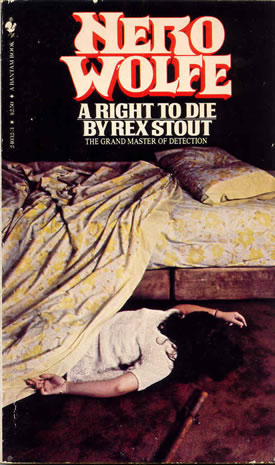
righttodieA while ago word got out that I hadn’t read any of Rex Stout’s Nero Wolfe mysteries. It didn’t take long for a certain thoughtful someone to make sure I had a good selection to choose from — and now I have read 1.5 of them! Why the .5,you ask? Because I started (dutiful as always) with the first one, Fer de Lance, and couldn’t finish it. I liked Nero and Archie just fine, but the mystery itself was too far the wrong side of absurd, and to top it off, the style seemed stilted. Also, in general I have difficulty making new detective friends: there are so many, after all, and I’ve been in my relationships with some of them for so long. It takes a lot to make me want to persist, especially if my first impressions are not great.

But I suspected I wasn’t done with these fellows (so many other smart readers can hardly be wrong!) so I kept the stack nearby, and recently I picked up A Right to Die more or less at random as I was heading to an appointment and needed a small book to stash in my purse for the waiting room. (We all know never to go anywhere without a book, right?) It turns out to be quite a leap forward from Fer de Lance — literally, as it’s both written and set 30 years later (though, as the Wikipedia page for A Right to Die points out, Wolfe and Goodwin haven’t aged a bit). I wouldn’t say it’s light years beyond the earlier book in other ways, but it certainly seemed more smoothly written and constructed, not to mention more grounded in reality. In fact, its specificity was its most striking feature: it is very deliberately about current events, and keeps reminding us just how current they are by having Archie regularly forget and then remind himself that Idlewild Airport has recently been renamed in honor of JFK.

RexStoutThe case involves two members of a civil rights organization, a black man and his white fiancée, Susan Brooke, who is the (first) victim. It seems pretty likely at first that race is a key factor in her death: I think it’s not giving away too much to say that this assumption is itself a symptom of the racial tensions the novel depicts, while the resolution of the mystery seems designed, not necessarily to move us past race, but to remind us that there are plenty of other sources of homicidal hatred that a preoccupation with race ought not to blind us to. The plot is set up by a visit from Paul Whipple, who was inspired to give Wolfe some crucial information in a long-ago case after Wolfe made an impassioned speech against shielding a murderer “because he is your color.” Whipple shows up and quotes the speech verbatim, including this bit:
You are helping to perpetuate and aggravate the very exclusions which you justly resent. The ideal human agreement is one in which distinctions of race and color and religion are totally disregarded; anyone helping to preserve those distinctions is postponing that ideal; and you are certainly helping to preserve them.

Racist assumptions get Paul’s son Dunbar accused of Susan’s murder: “Because she and I — we were friends. Because she was white and I’m black.” Wolfe, on the other hand, doesn’t assume anything. While his investigation (or, Archie’s investigation, really, since he does 90% of the actual work) does turn up plenty of nasty prejudice, the puzzle’s solution eventually turns on a diphthong and the culprit’s motives … well, that would be telling!

In a way, I think Stout’s choice of plot depoliticizes the novel (though you could also argue that Wolfe’s stated ideal of making race irrelevant is itself a political position, a particular vision that emphasizes ignoring or erasing, rather than understanding or celebrating, difference). By comparison, the crime story in Walter Mosley’s Devil in a Blue Dress is very much about race and identity, and the novel as a whole emphasizes systemic injustices that make solving one crime seem like not much. It’s not that Stout ignores such systemic problems, but by not tying his murder to them he reduces them to context or setting, rather than developing them as a theme, and as a result A Right to Die ends up being less interesting, just as a novel, than it might have been. It’s still got some pretty powerful moments arising from that context, though, including the impassioned explanation from the accused about why he hesitated to call the police after finding the body. “About motive, with a Negro they take motive for granted,” he tells Wolfe. “He’s a shine, he’s a mistake, he was born with motives white men don’t have. It may be nonsense, but it’s the way it is.” “With the scum, yes,” agrees Wolfe. “With dolts and idiots.” “With everybody,” Dunbar replies:

Lots of them don’t know it. Most of them up here wouldn’t say that word, nigger, but they’ve got that word in them. Everybody. It’s in them buried somewhere, but it’s not dead. Some of them don’t know they’ve got it and they wouldn’t believe it, but it’s there. That’s what I knew I’d have to face when I sat there on the bed last night and tried to decide what to do.

I was initially tempted to label A Right to Die a “period piece,” but like Mosley’s “historical” Los Angeles, there’s a strong enough resemblance to our own period, to our present, that it would be much too easy to set it aside and say “case closed.”

“I Have Married England”: Dorothy L. Sayers, Busman’s Honeymoon,” Part II

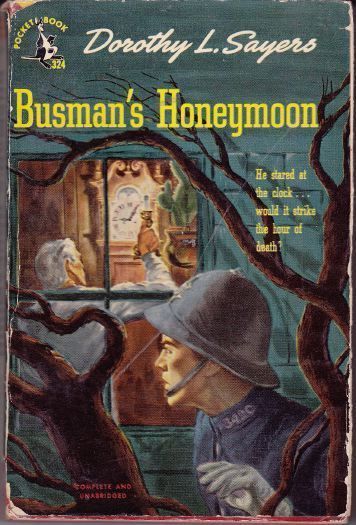
busmans2Now for the things I don’t love about Busman’s Honeymoon. [If you missed it, Part I, “Love with Honour,” explains the things I do love.] Some of these I’ve always noticed, some stood out particularly on this reread; some are small irritations, and some make me uneasy that, in spite of them, I still love the book. In the discussion that followed my earlier post about making excuses for Gaudy Night I suggested that some books are “like a slightly embarrassing relative you still adore.” I think it’s not just loyalty that keeps Busman’s Honeymoon in my good books (so to speak!): I think the good in it really does outweigh the bad. But I can’t deny that it has some real problems.

Worst is the novel’s off-hand antisemitism, which surfaces in the context of not one but two “financial gentlemen” who get involved in squabbling over the victim’s estate. The first, Mr. MacBride, is anticipated as “an inquisitive Hebrew”; he turns out to be”a brisk young man, bowler-hatted, with sharp black eyes that seemed to inventory everything they encountered, and a highly regrettable tie.” He also has “a trifling difficulty with his sibilants.” The second, Mr. Solomons, is “a stout, elderly Hebrew” with a pronounced lisp (“Very thorry to intrude . . . I have here a bill of thale on the furniture . . .”). They are both presented as slightly comical figures and treated with perfect, if faintly condescending, amiability by our main characters, but there’s no doubt that they are meant to represent an exotic and not altogether desirable genus characterized by money-grubbing and sharp dealing. This is the kind of thing that could be shrugged off as “a product of its times” but is more appropriately pointed out as a symptom of what was wrong with those times, or at least with too many people living in those times. In Gaudy Night villainy is strongly associated with Nazism, but antisemitism and fascism had a pretty strong hold in 1930s England too: Mr. MacBride and Mr. Solomons could come across as quaintly offensive anachronisms, but they are also salutary reminders of the conditions that made Oswald Mosley’s Blackshirts possible.

Next up is the novel’s snobbery. In Gaudy Night, where so much of what matters is educational and intellectual, I tend to think in terms of elitism instead, and to see Oxford as a place that (in Sayers’s admittedly idealized version) renders class barriers, if not irrelevant, at least less relevant. But in Busman’s Honeymoon you really can’t ignore the power of class hierarchies. Though there are references to Harriet’s past life as an ordinary person (you know, the kind who buys tea biscuits in a shop and so knows which ones from the package have the cheese in the middle), she’s living in Peter’s world now, and she adapts with discomfiting ease. It takes no apparent effort at all for her to refer to the gardener simply as “Crutchley,” to accept Bunter’s deferential services, or to be high-handed with the (admittedly dreadful) housekeeper Mrs. Ruddle.

In taking on Peter’s rank, Harriet is taking up a new place in a strictly ordered world, one the novel portrays with more nostalgia and idealism than mistrust or critique:

Whatever fantastic pictures she had from time to time conjured up of married life with Peter, none of them had ever included attendance at village concerts. But of course they would go. She understood now why it was that with all his masquing attitudes, all his cosmopolitan self-adaptations, all his odd spiritual reticences and escapes, he yet carried about with him that permanent atmosphere of security. He belonged to an ordered society, and this was it. More than any of the friends in her own world, he spoke the familiar language of her childhood. In London, anybody, at any moment, might do or become anything. But in a village — no matter what village — they were all immutably themselves; parson, organist, sweep, duke’s son and doctor’s daughter, moving like chessmen upon their allotted squares. She was curiously excited. She thought, “I have married England.” Her fingers tightened on his arm.

vintagebusmanIt’s one thing to be “immutably yourself” when you’re the duke’s son (or his new bride), but it’s another if you are a struggling mechanic or anyone else who might like to “do or become” something else. Even though Harriet’s own story could be read as one of disruptive social mobility (and that’s exactly how she is seen by the more hidebound of Peter’s family and aristocratic peers), in Busman’s Honeymoon social aspiration is cause for ridicule (the absurdly pathetic Miss Twitterton, for instance, who gives herself airs because her mother was a school teacher) or a sign of villainy; the cynicism of a world in which Mrs. Ruddle initially suspects Harriet and Peter of being film stars and “no better than they should be” is contrasted unfavorably with the noblesse oblige that requires dutiful attendance at village concerts and the vicar’s sherry party.

Peter is often a bit awkward or apologetic about the anachronism of his aristocratic identity, but he’s also profoundly attached to the continuity it represents, and Busman’s Honeymoon really indulges that feeling, particularly when he brings Harriet at long last to visit the family “pile,” Duke’s Denver, with its antiques and its peacocks and its well-mannered ghosts. The tour of the family portrait gallery brings to mind Trollope’s remarks about the wealth of the church: “Who could lie basking in the cloisters of Salisbury, and gaze on Jewel’s library, and that unequalled spire, without feeling that Bishops should sometimes be rich?”

The afternoon sun slanted in through the long windows of the gallery, picking out here a blue Garter ribbon, there a scarlet uniform, lighting up a pair of slender hands by Van Dyck, playing among the powdered curls of a Gainsborough, or throwing into sudden startling brilliance some harsh white face set in a sombre black periwig.

We are all, in some ways, beneficiaries of such privilege: shouldn’t we be glad that some people have, historically, been able to collect and preserve so much beauty, to patronize artists and commission great buildings? But while it’s true that Busman’s Honeymoon does include reminders that democratic forces are at work — that in London, as Harriet observes, for instance, this “ordered society” is in flux — there’s something conservative about its yearning to keep those forces at bay and to protect “impeccable Inigo Jones staircases” from the encroachments of modern life. Along with the novel’s other nastier prejudices, this raises questions about just what kind of England Harriet has married: it doesn’t seem an altogether welcoming or progressive place.

Finally, there’s the crime itself, which Chandler was quite right to point to as contrived. The Golden Age aspects of the mystery are mostly good fun. I especially like Peter’s self-consciously Holmes-like reading of the vicar:

 “This is magnificent,” said Peter. “I collect vicars.” He joined Harriet at her observation post. “This is a very well-grown specimen, six foot four or thereabouts, short-sighted, a great gardener, musical, smokes a pipe — “

“Good gracious,” cried Miss Twitterton, “do you know Mr Goodacre?”

” — untidy, with a wife who does her best on a small stipend; a product of one of our older seats of learning — 1890 vintage — Oxford at a guess, but not, I fancy, Keble, though as high in his views as the parish allows him to be.”

“You know my methods, Watson,” he says self-deprecatingly to Harriet when she exclaims that “to the best of my knowledge and belief you’re right.” Unrealistic as they may be, too, the array of clues including clocks and cacti and wireless settings make for a good puzzle, Inspector Kirk is excellent, and the subplot with Constable Sellon adds a nice human touch. But it all feels like a puzzle set up to be solved, not (as Chandler wanted) a story of a murder by “the kind of people that commit it for reasons, not just to provide a corpse.” Our killer does have his reasons, but given them, and given his character, there are much simpler, more obvious methods he’s more likely to have resorted to. There’s also the typical Golden Age implausibility of a body turning up on the sleuth’s honeymoon in the first place, not to mention in his own home. These are, of course, the kinds of things about which this subgenre of crime fiction requires suspension of disbelief, but there’s too much genuine human drama and feeling in Busman’s Honeymoon for them to sit quite right. While Gaudy Night elegantly fuses its mystery plot with its other elements, Busman’s Honeymoon feels like a mish-mash, an uneasy and ultimately unsuccessful compromise between two kinds of books.

“Love with Honour”: Dorothy L. Sayers, Busman’s Honeymoon (Part I)

busmansI’ve written at length about my love for Gaudy Night, but I have never really tried to sort out my views on its sequel, Busman’s Honeymoon. As I have owned and loved Busman’s Honeymoon as long as I have Gaudy Night (I have them in matching editions, inscribed to me on my 13th birthday), I thought it would be an appropriate book to write on for my 1000th post here at Novel Readings! But it turns out that I have so much to say that I’m going to do it in two posts.

I think the general consensus, even among Sayers fans, is that Busman’s Honeymoon is a bit of a let-down, not just as a detective story but for the ways it carries forward the relationship between Peter and Harriet — though I may be extrapolating much too far from the dismissive comments of critics like Julian Symons, who complained about the ‘dismal sentimentality’ of Sayers’s later novels. Still, it seems to be Gaudy Night that’s usually cited as the pinnacle, not of Sayers’s whole oeuvre necessarily, but of the four that make up the Harriet Quartet. I actually used to prefer Busman’s Honeymoon, which makes sense given how much more abstract some of the issues are in Gaudy Night, and how cerebral its romance. Busman’s Honeymoon has more going on right on the surface: both emotionally and criminally, it has more blunt objects! I don’t know quite what my 13-year-old self made of some of its details, such as the discussions of “shabby tigers,” or Peter’s “fits of exigent and exhausting passion” during the agonizing wait for the killer’s execution. There weren’t many limits on my youthful reading, so my guess is that these allusions to Harriet and Peter’s sex life raised fewer questions for me than their struggles to define their marriage as a relationship of equals. Rereading the novel now, it’s those struggles that stand out, and that remind me why Peter and Harriet have so long seemed to me one of the most interesting and important literary couples I know.

Gaudy Night makes a powerful case for finding a balance between head and heart – but accepting that as the ideal isn’t the same as living up to it in perpetuity. Busman’s Honeymoon is the next step: what does this really look like in practice? One thing I really liked about Busman’s Honeymoon this time (in my next post, I’ll get to the things I really disliked) is that we see these two fiercely independent and highly intelligent people trying very self-consciously to make sure their romantic relationship reflects their principles, not just their passions. The personal equality they value isn’t an easy thing to achieve in a world that is otherwise defined by inequalities — not least of wealth and power, of which Peter has a disproportionate share. Once they are married, of course, Harriet enjoys much of the same privilege (about which more next time), but Sayers is savvy about the challenges she faces to both her finances and her pride as she prepares for the wedding. “Oh, Mr. Rochester!” she says to Peter on receiving his extravagant gift of a mink coat, while she earns the money for the Donne manuscript that is her gift to him by writing “three five-thousand-word shorts at forty guineas each for the Thrill Magazine.” At Oxford, in Gaudy Night, none of that mattered: the interchangeability of their academic gowns stands for the meeting of their minds, for the freedom to face and love each other as peers. It’s very clear in Busman’s Honeymoon that they aren’t at Oxford any more.

Neither Harriet nor Peter wants marriage to mean compromise. After their first real disagreement — which arises when Harriet questions whether Peter needs to get involved in investigating the sordid murder that turns out to have taken place in their honeymoon home just before their arrival — she backs off quickly when faced with his argument that he shouldn’t “pick and choose what I’ll meddle in” to suit his own convenience. “This business of adjusting oneself was not so easy after all,” she thinks, and she can’t smooth things over with girlish ploys:

He wasn’t the kind of man to whom you could say, ‘Darling, you’re wonderful, and whatever you do is right’ — whether you thought so or not. He would write you down a fool. . . . He wanted you to agree with him intelligently or not at all.

Imagine that! Later, when the argument recurs, with the added stress that now there are real suspects who stand to pay the price for Peter’s “meddling,” Harriet rejects the power she wields because of his love for her, scorning to be the kind of woman who boasts “My husband would do anything for me.” “What kind of life could we have,” she demands, “if I knew that you had become less than yourself by marrying me?” “Love with honour” is their goal, and they know it’s not a conventional one: “If you go on behaving with all this reason and generosity,” Peter says admiringly to Harriet, “everybody will think we don’t give a damn for one another.”

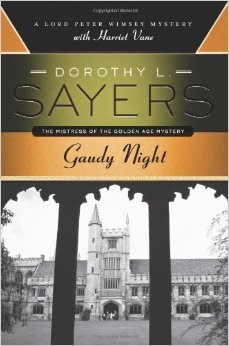
newgaudynightIn Gaudy Night another sign of their equality is their collaboration on solving the mystery. It’s true that in the grand reveal it’s Peter who dominates, and the attack on Harriet could be seen as marking her as a victim in need of rescue (and there’s the whole dog collar thing too). Harriet works on her own at first, though, and prepares the dossier on which the solution depends. That they work so closely on the mystery reinforces both the novel’s overall theme of balance and its promise that the two of them are truly partners. In Busman’s Honeymoon the investigation is more clearly Peter’s turf: in those quarrels, he’s the one insisting that detection is his work, his vocation; it’s Peter who really puts the pieces of the puzzle together and who carries the guilt, in the end, of having brought the criminal to justice and thus (after due process) to his own violent death. Harriet still has a lot of input, though: it’s not the case that she simply stands by and observes. I don’t think she needs to get redefined as a sleuth herself to sustain the balance of their relationship: she has a career, as a writer, and that’s the expertise she brings to the case.

Something else Harriet’s presence does in Busman’s Honeymoon that has real generic significance, particularly for a novel that belongs to the “Golden Age,” is galvanize Peter’s transformation from sleuth into complex, flawed, and intensely vulnerable human being. This is a process Sayers herself undertook deliberately once she’d introduced Harriet into her novels. I don’t much like the early Wimsey books, as Peter’s such a chattering fop in them compared to the layered character he eventually becomes (he does still play the part of upper-class twit occasionally). Sayers knew he had to become someone Harriet could say yes to; that’s only accomplished by the end of Gaudy Night (in Have His Carcase, there are moments, but overall he’s not quite there). The implications of that for him as a detective are particularly interesting in Busman’s Honeymoon, as the ending of the novel is anything but triumphant for Peter even though he has solved the puzzle. Instead of this “success” setting him up as a heroic avenger, it brings back all the trauma of his wartime experience and leaves him broken and weeping. In “The Simple Art of Murder” Raymond Chandler quite reasonably mocks the artifice of English puzzle mysteries, including Sayers’s — in fact, he singles out Busman’s Honeymoon for its admittedly absurd scenario (“a murderer who needs that much help from Providence must be in the wrong business”). It’s interesting that he doesn’t comment on the novel’s conclusion, which could surely be read as a repudiation of the entire form of the book itself, or at least of the type of mystery it sort of is, which as Chandler noted, could force “real people” (which he admits Sayers could create) to “do unreal things in order to form the artificial pattern required by the plot.”

With all this attention on reason and intelligence and principles and genre, I don’t want to miss the one other thing I have always loved about Busman’s Honeymoon, which rather pushes against the more intellectual merits I’ve been highlighting: it is utterly sentimental, full of declarations of love, some playful, some breathtakingly sincere. How wonderful to be caught up in these moments with Harriet and Peter, to be in a world, and a relationship, and a novel, in which the demands of reason and intelligence, and the conflicts that inevitably arise between two strong wills, don’t rule out the emotional abandonment — the ecstasy –of love. Peter and Harriet are both ever-ready with literary quotations, a game that’s played perhaps to excess (and sometimes to comic effect) in Busman’s Honeymoon. But it’s also here that poetry becomes, at last, the truth of their experience. “How can I find words?” asks Peter, in frustration at his own struggle to articulate his feelings on his own behalf. “Poets have taken them all, and left me with nothing to say or do — ”

“Except to teach me for the first time what they meant.”

He found it hard to believe.

“Have I done that?”

“Oh, Peter — ” Somehow she must make him believe it, because it mattered so much that he should. “All my life I have been wandering in the dark — but now I have found your heart — and am satisfied.”

“And what do all the great words come to in the end, but that? — I love you — I am at rest with you — I have come home.”

It seems fitting that Donne (that most cerebral of love poets) is always their touchstone. “This is joy’s bonfire, then,” reads his “Eclogue for the Marriage of the Earl of Somerset,” which ends the novel,

where love’s strong arts
Make of so noble individual parts
One fire of four inflaming eyes, and of two loving hearts.


Ausma Zehanat Khan, The Unquiet Dead

khanunquietdeadI have really mixed feelings about Ausma Zehanat Khan’s debut mystery The Unquiet Dead. For starters, I think it’s built around a good concept, one with a lot of potential for drama and moral seriousness. The contemporary crime turns out to be rooted in the evil and cruelty of the Bosnian War, particularly the massacre at Srebrenica; there’s a lot of historical back story, then, based in those events, as well as reflection on the inadequate international response at the time and since. The author’s expertise in these areas means that the novel is rich in chilling details, the accuracy of which is borne out by her footnotes. The generic form of a mystery sets up good opportunities for exploring connections between past and present as well as abstract problems, such as the interplay of justice and vengeance. The particular crime story Khan tells, too, invites debate about vigilantism in the face of bureaucratic inertia or, worse, indifference.

Also in the novel’s favor: the parts of The Unquiet Dead that are directly about the war and genocide are gripping in the way terrible true things are, the flashback interludes especially — though I found them a bit heavy-handed in the telling. The interspersed witness statements that form part of the case are an artful device, as well. And the mystery certainly aspires to be the kind I usually like: character-driven, multi-faceted, specific to a time and place and community, embedding its whodunit in socially and morally provocative material.

But notice that I say it “aspires to be” this kind: it doesn’t seem to me to succeed, quite, and so I felt really frustrated reading it, because I so wanted it to be better than it is. The characters that drive it, especially the detectives, never seemed entirely believable to me, never really came to life, despite the author’s insistent efforts to make them complicated and three-dimensional. I have a hard time putting my finger on just what doesn’t work: there are too many things going on at once, maybe, including family backgrounds that aren’t relevant to the unfolding crime story, and references to previous events and cases that we’re told resonate deeply for the characters but that can’t possibly do the same for us. The main detective pairing is too pat and familiar in too many ways: Rachel Getty, in particular, seemed like a watered-down Barbara Havers. Finally, the prose isn’t quite good enough to carry the book along. It too seemed to be trying too hard, insisting on profundity but falling into melodrama and cliches. By far the best part of the book for me was the “Author’s Note” at the end, where Khan reviews the story of the Bosnian War: it’s written with such clarity and unpretentious energy that I wished she had stuck to non-fiction for the whole project.

But (again), as her note makes evident, there are already plenty of non-fiction books about these events (some of which I’ve read), and yet I don’t think this is a particularly well-known or well-understood context, at least to North American audiences — not, at any rate, compared to the First World War, or the Holocaust, or other common settings for historical fiction and film. Popular fiction can reach readers who might never pick up Michael Sells’s The Bridge Betrayed or Samantha Powers’s A Problem from Hell — so from that angle, The Unquiet Dead is doing something important in drawing attention to the horrors of what happened and provoking consideration of what could ever count as “solving” a crime with such origins. Still, what matters most, since Khan did choose to write fiction, is whether the result is a good novel, and I just don’t think The Unquiet Dead is, much as (given how many things are smart and interesting about it) I wish it were.

Reading it I found myself wondering: what must it be like to a book editor working on a project like this? Clearly the editor at Minotaur (which is an imprint of St. Martin’s Press) thought the book was done, ready to face readers and critics. So maybe I’m just being unduly hard on it! Or else the conclusion was reached that this particular book was as good as it was ever going to be — something that any graduate supervisor has probably thought about at least one thesis at some point. I have no idea what specific advice I could have given Khan to make the book better in the ways I wanted: “make your characters seem like people, not ideas for people” or “write better” both seem too vague to be genuinely helpful, while “give Ian Rankin your idea and research and let him write the book” would probably have been an unwelcome suggestion!

This Week In My Sabbatical: Reading, Writing, Winter

IceThe winter of our discontent continues: with sidewalks already impassable across most of the city and side roads treacherous tracks of rutted ice, there’s yet another storm bearing down on us that promises the same cycle of snow followed by rain (and thus flooding) followed by a deep freeze. Usually rain is helpful as it means things warm up and snow gets washed away, but this winter it has just been bad news every time. I think it’s really the terrible sidewalks that are breaking people’s spirits — and it’s hard to imagine what can be done about them now that the ice has got such a grip. The whole “if winter comes, can spring be far behind” line is not much help when the answer is “yes, very far”!

But life goes on, and I’m trying not to get too disheartened by the feeling that I’m losing a lot of one of my precious sabbatical months to the extra work and stress this kind of weather brings in its wake. In spite of everything, I haven’t missed a Monday session of “A Meeting With Your Writing” yet, and though sometimes that’s the only time I get much done on my George Eliot project, it’s always very productive time. I was up to almost 20,000 words of my “shitty first draft,” [PDF] and now I’ve started trying to wrestle that material into a slightly better second draft, one that’s more organized, more selective (I actually cut 2000 words this week!), but also more finished, as many parts of it are very sketchy. One of the big challenges for me at this point is that — having generated such a lot of very rough material — I’m struggling to manage it: it has been a long time since I worked with such a long document, but it’s still too messy for me to break it confidently into smaller separate ones. (Does anyone have a good strategy for managing long documents? I’ve used the outline feature to create a table of contents for navigating, but otherwise I’m just paging around.) The other thing that’s very hard for me at this point is believing in the project itself, but I’m making a deliberate effort not to think too hard about whether all this effort will come to anything (meaning, for instance, whether it will ever become a publishable book) and just write.

Speaking of writing, I wanted to spend less time working on campus this term, and that has certainly happened, partly because just getting to campus has seemed like too much of a hassle. I had hoped that the new Halifax Central Library might be a place I’d want to work, but it has proved to be far too bustling a space to suit me. (I’m actually quite crushingly disappointed in the new library overall, not least because I looked forward to it so much for so long … but that’s for another post.) I’m mostly working in my usual basement office at home, as result, but I’ve also been taking my laptop occasionally to the nearby Atlantic School of Theology, where the library is pretty much the polar opposite of the public one: old, musty, and sparsely populated. It also doesn’t allow food or drink in the stacks (so there’s no socializing) and I’m not allowed to use their wi-fi, which is reserved for their own faculty and students: while this annoyed and inconvenienced me at first, because I store so much of my work in the cloud and rely a lot on web resources, I’ve made a few adjustments (such as making sure I have e-books of Eliot’s novels available off-line), and now I think it’s actually a good thing. During the MWYW sessions (and at other times when I know I need to really focus) I cut myself off from the internet anyway, but the temptation is always there; at AST I know I can’t check email or twitter no matter what, so I just putter away. The other nice thing about the AST library is that it overlooks the Northwest Arm. So far the view hasn’t been particularly inspiring (because winter) but it’s nice to at least have a window.

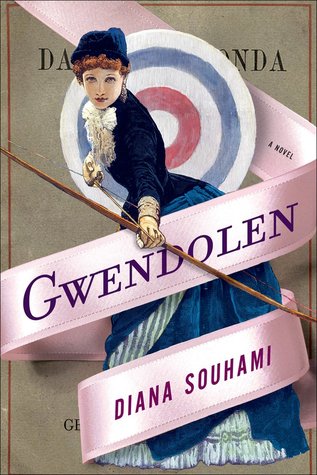
souhamiI haven’t been working exclusively on the book chapter: over the past couple of weeks I was also working on my review of Diana Souhami’s Daniel Deronda spin-off, Gwendolen. It hasn’t been a pleasant task, because I really (really, really) disliked the novel, which means the time spent reading and rereading it was not at all rewarding, and the time spent writing about it triggered a lot of questions about what a review of it was really worth (and to whom). On Twitter a while ago Ron Charles sparked a conversation about the value of book reviews for readers compared to the time and effort they take. I wish I could manage to do a review in 21 hours! Maybe if I took out all the complaining and procrastination that is close to how much time this one literally took — but that kind of deferral itself represents a severe cost in terms of mental energy, and there’s all the agonizing over how to write a really negative review that isn’t gratuitously mean or just a gleeful hatchet job. In any case, however long they take, I’ve been wondering how good a use of my time book reviews are, because it seems like they just go out into the ether and don’t make any difference. The book is already published, readers will read it or they won’t, and my little opinions, over in an obscure corner of the internet, aren’t exactly going to shape any broader conversation about the book if there even is one. On the other hand (and I excel at offering myself counter-arguments!) I do think books and reading matter and that attentive, honest criticism is a crucial part of literary culture, so participating in it is the right thing to do. As for being mean, well, if I think a book is really bad, there’s no point in my writing the review if I’m not going to say so, but I also have a responsibility to explain my judgment as thoroughly and thoughtfully as I can. I hope I’ve done that in this case.

I’ve already written up the other recent reading I’ve done, including Arctic Summer for my book club. I can add that we met Monday night and had quite a vigorous discussion about the novel, which was not very popular with the group. In general, people found it dull and/or badly written — which I didn’t — while a number of us puzzled over the difference between the Forster it showed us and the Forster we thought could have written Howards End. I didn’t think of it quite this way at the time, but one way to reflect on this would have been to think about the biographical author vs. the implied author, except that there’s the added complication that Galgut’s Forster is himself a literary character. I was kind of surprised that the overall reaction to Arctic Summer was so negative, but one thing I enjoy about the group is that often it’s the books that aren’t favorites that end up provoking the best conversation. Rather than following up with another book about India (I had been thinking of pitching Kipling’s Kim as a possibility) or something else somehow Forster-related (for instance, we considered Maurice as a logical next step) we ended up following Galgut to South Africa, and then settling on Doris Lessing’s The Good Terrorist for our next meeting.

I have some other things lined up to read before then, though. I’ve just started Ausma Zehanat Khan’s The Unquiet Dead, which is actually a kind of teaching-related task: following up some links to it that went around on Twitter, I thought it sounded like a contender for my mystery class, both because of its interesting historical context and because its author is Canadian. I don’t like it much so far, though: the writing and the set-up of the plot both seem very labored. I plucked Kazuo Ishiguro’s Nocturnes off the shelf the other day because all the talk about The Buried Giant reminded me that, much as I adore The Remains of the Day, I haven’t read much of Ishiguro’s back catalog. Finally, just for pure fun I’m rereading Busman’s Honeymoon. I talk all the time about how much I love Gaudy Night; although I think it is generally regarded as a sappy disappointment, I’ve also always loved this sequel too. I haven’t read it closely, though, since I started teaching and writing more about detective fiction, so I’m curious to discover how it holds up. The first 30 pages have been just as delightful as always!

“Encircled by Invisible Emotion”: Damon Galgut, Arctic Summer

galgut

This kind of companionship had far more value to Morgan than their few, fumbling physical encounters. Sex could be forgotten, or made into something that it wasn’t, but feelings were much harder to erase. There had been moments, from their time in Alexandria, when they had simply sat together talking quietly, or smoking cigarettes in brotherly contentment, when he’d felt that they were removed from other people. Paired off. And it had come to him then that there might be many men like them, in the past as well as the present, who had been together in a similar uncelebrated way, encircled by invisible emotion.

My book club chose Damon Galgut’s Arctic Summer to follow Howards End. Not only did I enjoy Howards End so much that I liked the idea of hanging around with Forster a bit longer (which is also why I reread A Room With a View), but I’ve been curious about Arctic Summer since I read Steve’s review in Open Letters Weekly, and got even more interested when it made the Stevereads “Best of 2014: Fiction” list.

I enjoyed Arctic Summer quite a bit — though maybe “enjoyed” is the wrong word, as it’s such a low-key, melancholy novel. Unlike Steve, who has always already read everything else (in this case, specifically the Forster biographies on which Galgut’s novel is heavily dependent), I knew little about Forster the man before I started, and now I feel that I have gotten to know him pretty well. I like him, too, though I think there’s a side of him I might like even better than the somewhat mopish, solitary man we mostly see here, where we hardly ever spend time with him when he’s actually having fun. “On a surface level, he was quite sociable,” we’re told at one point, “seeing a great many people and acquitting himself well in company, but an essential part of him had become deeply withdrawn, hardly noticing the outside world.” It’s that withdrawn man, steeped in reticence, who is Galgut’s main character, not (or only very rarely) the man who holds his own (just for instance) in conversation with the Woolfs and their friends at Monks House. That his reserve is in many respects a necessity only makes it more poignant: Galgut’s muted tone nicely matches the emphasis he puts on the emotional costs, to a man as hesitant and sensitive as Forster, of a life so shrouded in secrecy.

It’s that “surface level,” I guess, so much more confident, assertive, and optimistic, that comes across in Howards End or A Room with a View, or in The Art of Fiction or the radio broadcasts Zadie Smith discusses in her wonderful essay “E. M. Forster, Middle Manager.” Because this is the Forster I knew, I was surprised to find Arctic Summer so sadly yearning. “Only connect” seems a more wishful (or wistful) credo here — but connection is certainly what Galgut’s Forster longs for. He does achieve it, but only equivocally, in both of the two friendships that dominate the novel: with his Indian friend Masood, to whom A Passage to India is ultimately dedicated, and his Egyptian friend Mohammed, with whom he comes closest to the kind of intimacy he most desires (“To touch, to hold. To be touched. The yearning was so strong that sometimes it hurt. The more so because it could not be spoken”). His final affirmation is also equivocal, hardly a happy ending but not unhappy either: “I have loved. That is, I mean to say, lived. In my own way.”

Mark Athitakis has a really smart, eloquent review of Arctic Summer in the Barnes and Noble Review in which he discusses the relationship between Galgut’s novel and A Passage to India:

Misunderstanding, prejudice, and power are the lenses through which Galgut tries to position a sexually repressed Forster, introduced in 1912 making his first trip to India. Though he’d written four novels attuned to the relationships of men and women, he struggled to apply his plea to “only connect” to his own life. His homosexuality was unspeakable: “He could not refer to his condition, even in his own mind, with too direct a term; he spoke of it obliquely, as being in a minority. But via Galgut, unspoken lusts abound within him, especially for Masood, a young Muslim he met as a Latin tutor in London six years earlier. The opening pages capture the first stirrings of that repression becoming unlocked. The sentences are thick with heat and lust, felt by a man fit to burst.

That Forster — Morgan as his friends call him — will be liberated over the course of the novel isn’t in doubt. The tension within Arctic Summer is how much, and how that urge for sexual liberation was sublimated into the novel. To the second point, Galgut cannily invests picayune details from Passage into his own novel and invests them with a sensual weight: help with a collar stay, for instance, or Masood’s observation of Forster’s “pinko-gray” skin. But the novel’s engine is Morgan’s broader anxieties.

It has been too long since I read Passage for me to add anything to Mark’s analysis, though now of course I want to reread it, partly to complement Arctic Summer, partly to test Mark’s comment that Passage “is showing signs of age.” (I read The Jewel in the Crown not that long ago, however, and got intermittently confused by recollections of it that surfaced during discussions of Passage. Parts of Arctic Summer also reminded me of J. G. Farrell’s The Siege of Krishnapur, particularly the descriptions of Bapu Sahib’s chaotic household.)

passageBecause I couldn’t sustain a properly intertextual reading, what I found myself thinking about the most with Arctic Summer was the question of genre. In his original OLW review, Steve describes it as a “mildly inert reading experience” because of “the novel’s curiously timid approach to its own novelhood.” He concludes with dissatisfaction, but clearly reconsidered by the time he was assembling his ‘best of’ list. Maybe because I didn’t have the “two great templates” mentally to hand, I didn’t find Arctic Summer thin in the way he describes, but I agree that, interesting and touching as I found it as biography, it doesn’t ever really take off as a novel, so I ended up wondering what is really gained, or lost, or intended, in rendering Forster’s life story in fiction in this way. If it doesn’t break any new ground (and I have to take Steve’s word for it that it “virtually never strays from Furbank’s biography in its details”), and it doesn’t do anything striking formally or artistically (though it is certainly well written and crafted) — is it really just taking Forster’s story and making it more accessible, more digestible? Is it the novelistic equivalent of a docu-drama or a re-enactment?

Not that there’s anything wrong with that, of course, especially since I’m someone who is (evidently!) much more likely to read about someone’s life in a novel than in a full-fledged biography. (The opposite is true of my husband, who very much enjoyed Robert Kanigel’s The Man Who Knew Infinity: A Life of the Genius Ramanujan but has repeatedly declined offers of David Leavitt’s The Indian Clerk.) But somehow in this case I was left fretting about whether reading fiction in lieu of fact was such a good idea: Arctic Summer seems so much like straight-up biography that I might be misled into believing things about Forster that weren’t really true.

What kind of concern is this, though? It’s not something that bothers me at all about Wolf Hall, where surely the odds are much greater that I’m getting a Cromwell wholly unlike the man who actually lived. Wolf Hall is “historical fiction”: is it just the longer expanse of time between us and its subject that changes the terms on which we read it? I’m not saying it doesn’t matter whether Mantel did her research: it does, and she did. Wolf Hall is anything but timid as a novel: is that what makes me feel differently about it? You couldn’t read it and forget you were getting an artistically-shaped treatment: maybe it’s Arctic Summer‘s semblance of transparency that provokes this line of questioning. Just by being a novel, though, it’s setting aside its claims to be telling the truth. Furbank’s biography, which is also, inevitably, made up (because, as we all know, narratives must always be imposed on chaotic, amorphous reality, or carved out of it) probably presents itself much more authoritatively. In retelling Forster’s story as a story, maybe that’s Galgut’s signal contribution: a reminder that however scrupulous we are about the facts, the result will always in some sense be fiction.

Clear Conscience, Brave Heart, Can’t Lose! Elizabeth Gaskell, Wives and Daughters

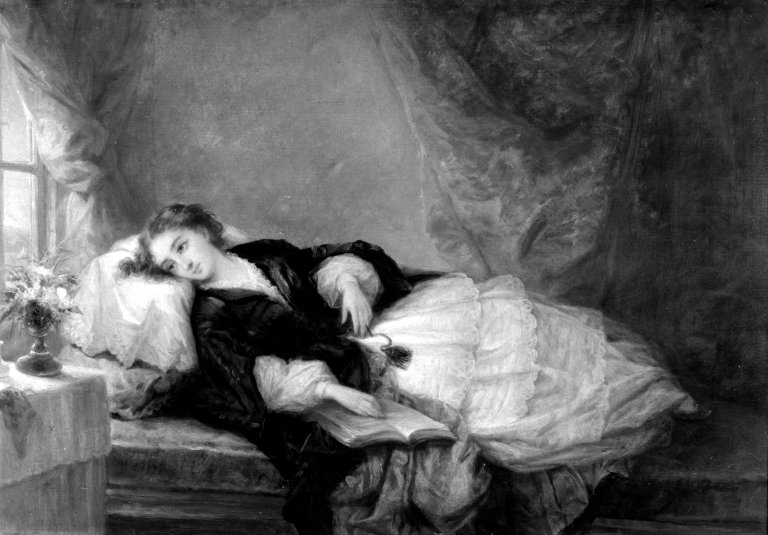
Brooklyn_Museum_-_The_Invalid_-_Louis_Lang_-_overallA good friend of mine has been making a long, difficult recovery from not one but two concussions. You hear about these injuries all the time — or you do, at least, in a country as hockey-obsessed as Canada — but (perhaps because hockey players are rashly determined to get back on the ice a.s.a.p.?) I had never fully understood how debilitating, not to mention depressing, they can be. So I have learned a lot from my poor friend’s experience, though mostly from a distance, because one of the keys to her rehabilitation has been near-total isolation.

She recently published a superb little essay that describes her suffering in terms sure to resonate with those of us who live a lot in our heads. “My brain is not my home anymore,” she explains;

When you feel angry or sad, you might retreat to a space you know well and take for granted – a space comfortably furnished, where things are in their places. It’s as though my home has been vandalized, the furniture thrown around and the walls defaced. An alarm system rings and rings and cannot be shut off. But I have nowhere else to go. There is no shelter from this, no comfort.

She was put on the kind of “rest cure” most of us have only read about in “The Yellow Wallpaper” (which, ironically, she had not read until she was confined to her room and climbing the walls herself): she was “ordered to retreat to a cone of silence and darkness – no music, no talk, no light, no reading, no computer.” No reading! The horror. But eventually she was at least allowed to listen to books, and she credits Victorian fiction in particular with saving her: in it she “found a world not unlike my own – inhabited by invalids in dark sick rooms.”

She’s moving gradually back into the outside world and so I had the pleasure of running into her recently at work, where I complimented her on her returning health and on her essay. But, I had to ask, which Victorian novels had she been reading that were so full of invalids? I could think of plenty of characters who get ill, but I somehow couldn’t recall a novel that kept us for long in the kind of sickbed environment she described. “Well, Wives and Daughters, for one,” she replied — and that made me realize how long it had been since I’d read Gaskell’s final work. It seemed about time, plus these grim winter days I too could use some “lessons of endurance, patience in suffering and of the deep consolation of human companionship.” So I loaded it up on my trusty Sony Reader from Project Gutenberg (how can it be that I don’t own a hard copy?) and settled in — and it proved just what I needed to read this week.

wivesanddaughtersoxford If I were a publicist, I’d probably pitch Wives and Daughters as “Jane Austen meets Anthony Trollope, with a dash of George Eliot”: it has Austen’s minute attention to social behavior, and something of her stinging satirical wit, too, but it’s paced like a Trollope novel and dwells with Eliot-like interest on moral quandaries and their repercussions. Yet to package Gaskell as a composite of other writers is to do her an injustice by implying that there isn’t a voice or quality that’s distinctly her own. What is it exactly, though? Here’s what the editor of the Cornhill Magazine had to say in the “Concluding Remarks” added in lieu of a conclusion to the novel, which was unfinished at Gaskell’s death in 1865:

While you read any one of the last three books we have named [Sylvia’s LoversCousin Phyllis, and Wives and Daughters], you feel yourself caught out of an abominable wicked world, crawling with selfishness and reeking with base passions, into one where there is much weakness, many mistakes, sufferings long and bitter, but where it is possible for people to live calm and wholesome lives; and, what is more, you feel that this is at least as real a world as the other. The kindly spirit which thinks no ill looks out of her pages irradiate; and while we read them, we breathe the purer intelligence which prefers to deal with emotions and passions which have a living root in minds within the pale of salvation, and not with those which rot without it.

I barely remember Sylvia’s Lovers and have never read Cousin Phyllis, but this is certainly a good description of the world and the tone of Wives and Daughters. The novel is hardly full of exemplary people: there’s a great deal of pettiness, jealousy, spite, even coercion. But they are concentrated primarily in a few people less pleasant than the rest, and while the other characters have plenty of flaws and make plenty of mistakes, they are, by and large, trying to do their best to live honest, kind, “wholesome” lives, even when circumstances (personal or even historical) conspire against them.

There’s a wonderful fairy-tale quality to the novel’s opening line:

To begin with the old rigmarole of childhood. In a country there was a shire, and in that shire there was a town, and in that town there was a house, and in that house there was a room, and in that room there was a bed, and in that bed there lay a little girl . . .

The rest of the novel follows this little girl, Molly Gibson, to adulthood. Molly is an extremely likable heroine. She’s honest, intelligent, sincere, loyal, and conscientious. She speaks her mind, but she couldn’t be less like sassy Elizabeth Bennet; she stands up for herself, but there’s no trace of Jane Eyre in her. In other words, she’s not in any way a rebel: rather than fighting against injustices or making demands for herself, she stands by or fights for the people she loves. She’s a strong feminine character, you could say (rather than the trendy “strong female character) which means she is a close cousin (unsurprisingly) to Margaret Hale in North and South, who also seeks to maximize the strengths she has as a woman — though Margaret presses harder than Molly against the ways her sex limits her actions.

Molly’s path is occasionally thorny, especially after her widowed father (with the best intentions) marries again. She doesn’t exactly get an evil step-mother, but the second Mrs. Gibson is passive-aggressive in ways that are mostly comical but also sometimes borderline sociopathic. Gaskell is particularly snarky about her self-serving pretensions about her relationship with the aristocratic family where she was once the governess: after one visit from Lady Harriet, “all the rest of that day her conversation had an aristocratic perfume hanging about it.” Mr. Gibson’s remarriage also brings his daughter a step-sister, Cynthia, whose vivacity and lightness of character make her a perfect foil to earnest Molly.

Wives and Daughters is another in the great catalog of what I think of, following Anita Brookner, as “tortoise literature”. “In my books,” Brookner notes,

 it is the mouse-like unassuming girl who gets the hero. . . . The tortoise wins every time. This is a lie, of course. . . . In real life, of course, it is the hare who wins. . . . Aesop was writing for the tortoise market. Axiomatically, . . . hares have no time to read. They are too busy winning the game. The propaganda goes all the other way, but only because it is the tortoise who is in need of consolation.

Cynthia is every bit the hare, but Wives and Daughters is Molly’s book from start to finish. Because reticence is one of her virtues, at times it is as painful as Persuasion as she keeps her own feelings to herself while becoming the faithful confidante of pretty much everyone else. Early on, in fact, she is troubled by the moral pressure she feels to suppress herself:

Thinking more of others’ happiness than of her own was very fine; but did it not mean giving up her very individuality, quenching all the warm love, the true desires, that made her herself? Yet in this deadness lay her only comfort; or so it seemed.

This quandary puts her in good literary company, but it’s more likely in Gaskell’s world than in Eliot’s that patient altruism will be rewarded eventually, so the overall atmosphere is less fraught. Still, Molly needs plenty of stoicism. She faces loss and even scandal:

Every one was civil to her, but no one was cordial; there was a very perceptible film of difference in their behaviour to her from what it was formerly; nothing that had outlines and could be defined. But Molly, for all her clear conscience and her brave heart, felt acutely that she was only tolerated, not welcomed. She caught the buzzing whispers of the two Miss Oakes’s, who, when they first met the heroine of the prevailing scandal, looked at her askance . . .

There’s not much suspense in following Molly’s progress towards the inevitable happy ending, but there’s a great deal of satisfaction in watching her make her steadfast way along and knowing that she will finally earn the recognition and love she deserves.

Wives and Daughters seems to me a very accomplished novel. The various family and romantic entanglements of the plot are deftly handled, and there’s plenty of humor and pathos in them. There’s also plenty of interest in the novel’s historical setting, and in the way the characters embody different forces of social change or stasis — the Hamley brothers, for instance, with one a languidly ailing aristocrat and the other a rugged scientist who earns, rather than inherits, his place in the world. Though in this way it is at least implicitly political, Wives and Daughters is a much subtler book than North and South, one that takes more time just to enjoy the scenery:

It was one of those still and lovely autumn days when the red and yellow leaves are hanging-pegs to dewy, brilliant gossamer-webs; when the hedges are full of trailing brambles, loaded with ripe blackberries; when the air is full of the farewell whistles and pipes of birds, clear and short—not the long full-throated warbles of spring; when the whirr of the partridge’s wings is heard in the stubble-fields, as the sharp hoof-blows fall on the paved lanes; when here and there a leaf floats and flutters down to the ground, although there is not a single breath of wind.

Oh, and there are indeed lots of invalids in Wives and Daughters. From kind Mrs. Hamley to crusty Lady Cumnor — and even, on occasion, Molly herself — my friend had plenty of fellow sufferers. I’m so glad that she found at least this comfort during her darkest days — and I hope her recovery continues!