To Teach or Not to Teach: The Case of Case Histories

case_historiesAs promised, I have reread Kate Atkinson’s first Jackson Brodie novel, Case Histories, and I’m reporting back. My motive in rereading it was partly just to refresh my experience of it, as I remembered having thought it was very good. It is! But I was also rereading it to see if I thought it would work as an assigned text in my class on mystery and detective fiction, and I don’t think it will. Or, at any rate, I don’t think I’ll try it.

There are various reasons for this, none of which reflect badly on Case Histories and some of which may reflect badly on me, or on the way I teach my class. The main reason is that while Case Histories is a very good novel about crime, it’s fairly odd as a ‘crime novel.’ I might even go so far as to say that it isn’t really a crime novel, in the (admittedly narrow) sense that a crime novel is a novel primarily dedicated to presenting and then solving a crime (or crimes). Definitions like this are at once pointless and essential, especially when selecting a reading list. It’s pointless for reasons that Case Histories illustrates perfectly — about which, more in a moment. But it’s necessary because (as I discuss with my class in the first session or two) we always need a reason to focus on one thing rather than another, and though the boundaries around crime fiction as a genre are uncertain, porous, misleading, you name it, nonetheless we do recognize it as a genre, as definable in some sense, to some degree, which is why we can have sections for it in the book store or talk about it as our favorite kind of reading or award prizes for writing it especially well. One of the ways we can differentiate between crime fiction and other kinds of novels that include crimes in them (Adam Bede, say, or — to pick a nearby example — A God in Ruins) is by the extent to which a specific crime and its solution are a novel’s raison d’être — its primary interest, its organizational principle. That’s a simple rubric that distinguishes the vast majority of the books we confidently refer to as crime novels, detective novels, or mysteries.

“But wait,” I hear you protesting. “Doesn’t Case Histories fit that model?” You’re right, it does — kind of. Yes, it is organized around specific crimes, and around solving them, if by “solving” you mean “finding out what actually happened.” Like a more conventional crime novel, it has a central character who acts as chief investigator for the crimes, and whose personality and processes shape our sense, or the novel’s sense, of values by testing and perhaps redefining ideas about law, justice, crime, and punishment. (In Case Histories, for instance, Brodie decides not to turn over his discovery about one of the novel’s crimes to the authorities, keeping it instead inside the family most affected by it.) Brodie himself fits easily into a well-established pattern: he’s a former soldier and police officer, divorced, depressed, with a young daughter whose vulnerability chafes at him — it’s like hanging out with Rebus’s first cousin! (In fact, on this reading, I was struck by the many echoes of Knots and Crosses, particularly the emphasis on missing girls. “Lock up your daughters,” say the headlines as the Edinburgh Strangler terrifies the town. “If only you could lock girls away,” we hear in Case Histories, “in towers, in dungeons, in their bedrooms, anywhere that would keep them safe.”) There are clues (sort of) and the novel as a whole is shaped by revelations about where they lead.

So why would I hesitate to call Case Histories a crime novel? Because it seems to me more a novel about loss, for which crime becomes the vehicle, and about character, especially as revealed by crimes and their aftermaths. There’s relatively little attention given to the investigations, most of which are taking place so long after the crimes themselves that the solutions matter very little except as opportunities for closure — it’s too late for justice, too late for retribution. The weight of Case Histories is on its people, not its cases, and while that may sound like a meaningless distinction (what are “cases,” after all, if not things done by or happening to people?), I think the reading experience nonetheless bears it out.

As I said, this is not a knock against Case Histories. It’s a very good novel. I’m just not sure how I would approach it as an example in my class. The best way, the right way, would probably be to use it to push against too restrictive an idea of the genre: to discuss what difference it makes when the puzzle element is subordinated this thoroughly to other concerns, to examine Case Histories as a possible test case of the putative distinction between “literary” and “genre” fiction, one marker of which is sometimes taken to be exactly this kind of difference in priorities. Like Ian Rankin, I don’t like the implicit hierarchy of terms like “transcending the genre,” but Case Histories challenges us to keep thinking about how we define it. That would be a good conversation to have — and in fact other books on my reading list provoke it already (including P. D. James’s An Unsuitable Job for a Woman, which I teach as both a crime novel and a variation on the Bildungsroman, or Knots and Crosses, which Rankin claims not to have written as a crime novel).

Case Histories would give us at least as much else to talk about as any of our other readings: the links (thematic and emplotted) between the different cases, provocations about what justice means or is worth, explorations of identity, particularly for women, of sexuality, and of family. There’s a lot going on in the novel, including a lot that is relevant to the fundamental issues of my class. And yet… Talking about Case Histories in these ways would be intrinsically interesting, but I’m not convinced it would further my objective in the course of exposing students to as many varieties of detective fiction as I can: the class is a lower-level survey course, and we have a lot of subgenres to cover. Which one would Case Histories represent? Also, a related question: which book would it displace? Knots and Crosses, probably, especially since lately I have another police procedural on the list (The Terrorists). But Knots and Crosses is a crowdpleaser in ways I doubt Case Histories would be. When I assign An Unsuitable Job for a Woman in this class, it’s usually the least popular book on the list: if students find it too slow, how would they fare with Case Histories’ slow burn? The book never really picks up much momentum, either, despite the occasional burst of drama. The crimes are brutal and disturbing, but the time-shifting of the narrative means that we keep starting and stopping with them, circling around, not so much accumulating information as accreting emotional residue. It works as a novel — but is it teachable as a crime novel?

Of course, the only way to find out for sure would be to assign it, set it up as well as I could, and see how it went.

From the Archives: Pondering the ‘Utilitarian’ Humanities

pigI’ve been thinking about this old post a lot lately because it’s hard to escape the discouraging conclusion that — despite having plenty of data on our side — humanists aren’t doing well convincing people that a humanities major is a perfectly practical choice. (I’m glad people are doing research on why better evidence against a pet theory actually makes people less likely to change their minds, because the problem seems pretty widespread these days.) And yet arguments for the intrinsic value and broader benefits of such studies, of the sort I gestured to here, also seem to be losing propositions, as if it is either an unaffordable luxury or self-indulgent navel-gazing to seek deep understanding of art, literature, philosophy, history, or any of the aspects of our rich and complex world that the humanities address.

Maybe it’s just media coverage that makes things seem so dire, but politicians (many of whom, of course, have liberal arts degrees themselves) seem relentlessly anti-intellectual these days, and they say and do what gets them votes, so that’s some kind of indicator of general trends. The comments thread on any story about higher education is also bound to be full of people decrying the waste of time the humanities are. And though students actually in our classes more often than not seem to find them plenty interesting and valuable, enrollments are falling.

Have we gone about this the wrong way? What else can we say or do except what we believe to be true about the subjects we study and teach? I really don’t know, but “don’t be a pig” remains a motto I think we should all seek to live by.*


Is Arguing for the Practical Utility of Literary Studies Ultimately Self-Defeating?

There’s a review of Louis Menand’s The Marketplace of Ideas up at Slate:

The Marketplace of Ideas is a diagnostic book, not a prescriptive one, and Menand’s proposals for how we might invigorate the academic production of knowledge are added as afterthoughts. He thinks we ought to shorten the length of study required for graduate students; the fact that it takes three years to get a law degree and close to a decade to get a humanities doctorate, he writes, is just another symptom of professors’ anxiety about the worth of their trade. We also ought to invite more applications from students who might not have self-selected as academic specialists. The notional aims of the academy—the lively and contentious production of new scholarship—would be better served by making academic boundaries more permeable rather than less.

But in the end, Menand’s proposals, smart and coherent though they are, seem less important than the case study provided by his career. He has managed to stay accountable at once to his colleagues in English departments and to his audience of general readers, and he has pulled this off without sacrificing either rigor or range. Menand is proof that an academic can be a great prose stylist, and that a journalist doesn’t have to be a dilettante—and that having a commitment to one community enriches one’s contribution to the other. He makes it hard to take seriously the rhetoric of crisis, and helps us get on with the important business of creating the problems of the future.

Reading it led me to look back at the excerpt from it published in Harvard Magazine last fall. I had a few ideas in response to it which I wrote about then. One of my remarks at that time was this, made in the context of the difficulty of defining a coherent curriculum when our discipline has become so undisciplined that there is really no way to justify doing one thing rather than another, and thus it becomes increasingly challenging to justify doing any of the things we do at all:

Too often, I think, we resort to a rhetoric of skills (critical thinking!) that (as Menand points out with his remark about the dubious efficiency of studying Joyce to achieve more general ends) rather strips away the point of working through literature to achieve such general, marketable ends.

I heard similar arguments being made again this week as we worked on setting up a “capstone” course for our honours students: in response to my observation that some proposed ingredients were designed to groom the students for graduate school in English (something about which I am currently filled with anxiety, thanks to the kinds of discussions underway here and here and here and here, not to mention these classics of the scarifying ‘just don’t go’ genre), I was reminded that good research and writing skills, as well as oral presentation skills, would benefit students in “law school or publishing or journalism or really any other jobs.” And don’t forget that we can teach them how to write a cv and a resume, and writing grant applications is not just for SSHRC but something you may have to do in many different contexts.

First of all, I totally agree. Research and writing and oral presentations are all excellent things to be good at, as are synthesizing a range of material and learning to build a strong evidence-based argument and proofreading and making a persuasive case for the value of a project you want other people to pay for and filling out forms and all the other transferable skills we know are part of what our students are learning and practising through their work in our classes.

That said, the more I think about it the more I wonder whether, in playing the game of “we’re useful too” we don’t actually end up rendering ourselves irrelevant by so happily setting aside the specificities of our work. Isn’t literary analysis (not to mention the extensive reading of, you know, literature, that it requires) a fairly roundabout route to those practical goals? If that’s what the students really want from us, we could save them a lot of time by not making them read so much Chaucer or Dickens or Joyce or Rushdie, that’s for sure. If we play the game that way, it seems to me we are bound to lose eventually. Yes, like writing, critical thinking requires content: “writing across the disciplines” makes sense because you need something to write about, and you can’t teach critical thinking unless you have something to think about either. But if you can learn to write anywhere, you can learn to think (and all the rest of it) anywhere too. Why English?

We need a pitch for ourselves that makes literature essential, but not in the self-replicating terms Menand rightly identifies as characteristic of professionalized literary studies (that is, by contributing to our profession according to existing norms and as judged by the profession itself, and the profession alone). We need to justify the study of literature for reasons literature alone can satisfy. We need to stand up, not for our methodology (doing so, after all, has meant warping that methodology to make it look as much as possible like some kind of science, or being so inscrutable that outsiders can’t tell what we’re doing anyway), but for the poems and novels and plays we take with us into the classroom every day. We need to be arguing, not that studying literature is just another way to do the same things every other discipline does (what university major won’t help you with critical thinking, research, writing, and presentation skills?), but that there are things–valuable things–about literature that you just can’t get any other way.

I’m thinking the way there is through aesthetics, on the one hand, and ethics on the other, and that the pitch should somehow involve a commitment to the importance of cultural memory and cultural critique, to character building and self-reflection, and to the needs as well as the ideals of civic society. If that sounds old-fashioned, I guess I don’t mind, though I’m not sure it needs to be.

millIn his account of utilitarianism, John Stuart Mill famously urges us away from too narrow a notion of the pleasures to be valued under his system:

Now it is an unquestionable fact that those who are equally acquainted with, and equally capable of appreciating and enjoying, both, do give a most marked preference to the manner of existence which employs their higher faculties. Few human creatures would consent to be changed into any of the lower animals, for a promise of the fullest allowance of a beast’s pleasures; no intelligent human being would consent to be a fool, no instructed person would be an ignoramus, no person of feeling and conscience would be selfish and base, even though they should be persuaded that the fool, the dunce, or the rascal is better satisfied with his lot than they are with theirs. They would not resign what they possess more than he for the most complete satisfaction of all the desires which they have in common with him. . . .

Whoever supposes that this preference takes place at a sacrifice of happiness — that the superior being, in anything like equal circumstances, is not happier than the inferior — confounds the two very different ideas, of happiness, and content. It is indisputable that the being whose capacities of enjoyment are low, has the greatest chance of having them fully satisfied; and a highly endowed being will always feel that any happiness which he can look for, as the world is constituted, is imperfect. But he can learn to bear its imperfections, if they are at all bearable; and they will not make him envy the being who is indeed unconscious of the imperfections, but only because he feels not at all the good which those imperfections qualify. It is better to be a human being dissatisfied than a pig satisfied; better to be Socrates dissatisfied than a fool satisfied. And if the fool, or the pig, are a different opinion, it is because they only know their own side of the question. The other party to the comparison knows both sides.

We should similarly urge our administrators away from too narrow an idea of the useful. Our motto could be, “Don’t be a pig.”

*All due respect to pigs, of course, whom we now know to be among the smartest (and cleanest) of our animal friends!

[Originally published January 20, 2010. In a follow-up post, I suggested that “The ‘Skills Argument’ Sounds Even Worse When We’re Talking About PhD’s in the Humanities.” That’s another set of concerns I still puzzle over a lot, as seen also in my 2011 post on “The PhD Conundrum.”]

Weekend Miscellany: Atkinson, Chase, Wallander

godinruinsI haven’t been a very diligent blogger lately! Well, I did write up another ‘This Week In My Sabbatical’ post on Thursday, but it was so dull I deleted it without posting. The gist of it was that I have been writing more stuff (quite a bit of it, which is good, at least), and doing some reading, but there really didn’t seem to be much to say about any of it, and who wants more moping from me about how difficult it gets for me when my schedule is so amorphous (and it isn’t even summer yet!) or more angst-ridden second thoughts about the state of my career?

Actually, one of the things I read was Kate Atkinson’s A God in Ruins, and there is plenty to say about that — but I’m going to write up a “proper” review for Open Letters Monthly, so I don’t want to say much about it here. Is it silly to worry about “spoilers” for a review? That’s not exactly the concern, but duplication is. I will just say, then, that I read the book with absolutely rapt attention and, eventually, helpless tears, but that nonetheless I ended up feeling extremely frustrated, not so much with the novel itself but with Atkinson as a novelist, which may, I suppose, be a distinction without a difference.

I was so impressed with so much of A God in Ruins, though, that I’ve taking Case Histories off my shelf for a reread. I don’t think I’ve read it since I first got it, which was not long after it came out in 2004. I remember thinking it was very good, and I’ve read all the subsequent Jackson Brodie books, but I’ve never really considered them as options for my mystery class. Since I’m not teaching it until the winter term, I have a bit of time to consider tweaking the reading list (again!). It’s easier to switch up older books from the classic subgenres than to find recent books that have a tempting balance of innovation and thematic complexity. (Two recent contenders were Finding Nouf and The Unquiet Dead, but neither quite convinced me.) I’ll report back! And as always, if you have suggestions, let me know. Another option I’ve been thinking about is including a “literary” crime novel (Alias Grace, for instance), since one of our ongoing topics in the class is precisely the validity and/or usefulness of the whole notion of “genre” vs. “literary” fiction, or to add Paul Auster’s City of Glass back to the list — but its postmodern posturing was getting on my nerves the last time I assigned it, so maybe not. Someone recently recommend Jonathan Lethem’s Motherless Brooklyn to me: thoughts on that one? Should I give it a try?

hellionI’ve been reading some romance novels in between other things. One of them was Loretta Chase’s The Last Hellion — which I didn’t really like. Chase’s Lord of Scoundrels was one of the first historical romances recommended to me back when I was taking my tentative (and skeptical) first steps into the genre. I thought it was ludicrous! But I’ve come a long way since then, and now it is among my favorites, though I still find the prose a bit too purple for my taste at times, and the last 25% of it doesn’t interest me very much. (I’ve mentioned before, I think, that I often don’t like or don’t even read the conclusions of romance novels — once the tension goes out of them, my inner cynic kicks in, or something.) Chase’s Mr. Impossible has become even more of a favorite. But something about The Last Hellion just didn’t work for me. The hero was uncomfortably aggressive in his advances, the story around the central romance seemed unnecessarily contrived, the heroine was too beautiful — which has become a bit of an ongoing annoyance. As an antidote, I returned to Judith Ivory’s The Proposition, which I remembered having a heroine who for once was not conventionally beautiful. What a relief! And the story is fun: it’s basically Pygmalion meets Dirty Dancing.

For our evening TV, my husband and I have started watching the Wallander adaptations starring Kenneth Branagh. I didn’t get along very well with Wallander in the books (though to be fair I haven’t read many of them). The show is no less grim, but everyone who told me how good the adaptations are was right. In particular, I think they are among the most beautifully filmed TV shows I’ve ever watched: stills from many of the scenes would look wonderful mounted and framed, though they are a bit stark or melancholy — which of course is appropriate for the series. Branagh is superb, as well: the show is as much (maybe more) a character study as a crime drama, and without his charisma it would be too dreary to bear, but he pulls it off. We’ve only watched the first three installments (we’re taking a break to watch Season 3 of Homeland, about which I am pretty ambivalent) but I expect we’ll come back to it. I’m excited that Netflix Canada (which is pretty badly stocked compared to the American version) has just added Miss Fisher’s Murder Mysteries! We ran a good essay on the series at OLM a while back that piqued my interest, and having now watched the first episode, it definitely seems like good fun, if that isn’t too perverse a thing to say about murder!

“The Light of the World”: Nicola Griffith, Hild

hild

I found Hild shelved in the Fantasy and Science Fiction section at Bookmark, which means I almost didn’t realize they had it in stock, as I don’t usually browse that section. (I was poking around in case they had John Crowley’s Little, Big, which Tom had got me interested in.) I can see why the staff had put it there: the front cover blurb compares it to The Lord of the Rings and Game of Thrones. But it isn’t fantasy: it’s historical fiction, if based, Griffith says in her Author’s Note, on a particularly scanty record: “We have no idea what [Hild] looked like, what she was good at, whether she married or had children.” “But clearly,” Griffith goes on, “she was extraordinary,” and that’s certainly true of the protagonist Griffith has created from the sparse materials available.

Maybe, though, considering Hild “fantasy” is not altogether a category mistake. “I made it up,” Griffith says about her story, while explaining that it is also deeply researched: “I learnt what I could of the late sixth and early seventh centuries: ethnography, archaeology, poetry, numismatics, jewellery, textiles, languages, food production, weapons, and more. And then I re-created that world . . . ” — that is, she engaged in “worldbuilding,” which is a fundamental (perhaps the fundamental?) task of the fantasy or science fiction author. Of course, her world is built out of real pieces, but it’s an artificial construction nonetheless. I suppose this could be said of any historical fiction, or any fiction at all, so maybe I’m trying to blur a line that’s already indistinct. But there’s something about Hild — the strangeness of its world, but also  of Griffith’s evocation of it — that makes it haunting and uncanny, as if we are not so much in an earlier version of our own world but in an alternative version.

It’s mostly Hild herself who’s responsible for that sense that we’re looking through, rather than at, the world: she is the king’s “seer,” the “light of the world,” and thus it is her job, her destiny, her “wyrd” or fate, to perceive the world differently than others. She is constantly seeking patterns, in nature and in the shifting relationships of the court and the kingdom. Her powers of perception set her apart: she is admired, revered, and feared. Her gifts are not necessarily supernatural, though: her “visions” are the results of long thought and sharp intelligence, and sometimes they are also simply predictions shaped to suit what her listeners (especially the King) want most to hear or do. Signs and omens must be interpreted, and that too requires political savvy and deft diplomacy more than any preternatural insight. Hild’s status as the King’s “light” defines her from birth and shapes both how she is treated and how she must behave: it is a burden, a responsibility, a terrible risk and a great liberation, because it exempts her from the ordinary constraints of a woman’s life.

Hild is an extraordinary character: strong, charismatic, intelligent, intensely physical, remarkably whole and convincing. One of the most interesting aspects of her characterization is the novel’s certainty about her woman’s body: it’s a central fact of her life and Griffith makes that clear without apology, voyeurism, or special pleading. I can’t think, for instance, of another novel in which starting to menstruate is a plot point in quite the way it is here — incorporated with perfect naturalness into the ongoing story of the heroine’s physical and psychological maturation, experienced as an initiation into an alliance of other women, associated with independence from authority rather than readiness for male sexual attention. That’s not to say that sexuality isn’t also an important part of Hild’s story, but though there is a love story of sorts running through the novel, her desires are hers, physical feelings she can satisfy on her own, or with women: they are not (or not just) ties that bind her emotionally to a man, and they certainly do not define her ambitions or determine the arc of her story.

The shape of that story is only partially revealed by the end of Hild. (Griffith is working on the sequel now, but I almost wish she’d waited and published one epic novel, as Hild so obviously stops rather than concludes.) Hild eventually becomes Saint Hilda of Whitby, but she isn’t there when we leave her this time. What we have seen to this point, though, is her development from an uncanny child into a fierce woman. The overall trajectory of Hild is all upward in that way: not just Hild herself, but the world she lives in is taking on a different form over the novel. The most important change is the rise of Christianity, which is gradually replacing the old forms of worship which Hild, as a seer, initially represents and serves. The transition is an uneven and not entirely welcome one. For one thing, people are reluctant to give up their old beliefs, and the representatives of the new God are not altogether persuasive. The God they represent, too, is very different from the old gods, who were more personal and more fun. “They don’t like jokes,” says one of Hild’s women about the Christians; “I don’t think their god does either.” And the new God is demanding in unfamiliar ways, insisting on obedience and reverence, and preoccupied with the unfamiliar notion of original sin. He’s also “squeamish,” inexplicably hostile to women’s bodies: “No blood in the church. No woman with her monthly bleeding. It makes no sense,” says Hild’s friend.

Will this new God diminish or invalidate Hild’s power, as a seer or as a woman? Will He punish her, perhaps, for the evils she has committed as a warrior or a prophet of other gods? Hild approaches her own baptism with trepidation, but then feels renewed courage:

She breathed deep. She was Anglisc. She would not burn. She would endure and hold true to her oath. An oath, a bond. A truth, a guide, a promise. To three gods in one. To the pattern. For even gods were part of the pattern, even three-part gods. The pattern was in everything. Of everything. Over everything. . . .

Her heart beat with it, her tears fell with it, her spirit soared with it. Here, now, they were building a great pattern, she could feel it, and she would trace its shape one day: that was her wyrd, and fate goes as ever it must. Today she was swearing to it, swearing here, with her people.

I wondered (given that she becomes a Christian saint) whether Hild’s baptism would stand as an epiphanic moment of faith — as a revelation. While the language and the mood here is uplifted, though, the strongest sense is one of continuity: “she was still herself,” the scene concludes. Christianity never seems to be the one right way: it’s just another way, and one that is as prone as the old ways to express the will, greed, and ambition of its adherents rather than any divine plan. Hild’s strength continues to be herself — her limbs, trained for fighting, and her mind, astute and endlessly observing.

The other thing that’s rising in the world of the novel is literacy. This is tied to Christianity, in that it’s the priests who are usually the most ‘lettered’ of the characters. But Hild quickly perceives the value of writing as a way of maintaining networks across distances. Her ability to read and write is valuable to her politically, as her success and survival as a seer depends on good and abundant information. But it means most to her personally, as the typical fate of women is to be sent far from home and family in their roles as “peaceweavers,” cementing alliances as wives then securing kingdoms with their heirs. Hild realizes that if she could write, for instance, to her married sister Hereswith, Hereswith “wouldn’t be lost to her”: for someone in Hild’s anomalous and therefore lonely position, letters would be a lifeline, bringing her news and also preserving her own private identity while living among those to whom she is “the maid who killed, the maid who felt nothing. The maid with no mother or sister or friend.”

kinghereafterThe novelist Griffith most reminds me of is Dorothy Dunnett. She luxuriates in tactile details the way Dunnett does, for one thing, as in this description of a waterfront marketplace:

Rhenish glass: cups and bowls and flasks. Wheel-thrown pottery, painted in every colour and pattern. Cloth. Swords — swords for sale — and armor. Jewels, with stones Hild had never seen, including great square diamonds, as grey as a Blodmonath sky. Perfume in tiny stoppered jars, and next to them even smaller jars — one the size of Hild’s fingernail — sealed with wax: poison. . . . A six-stringed lyre inlaid with walnut and copper, and the beaver-skin bag to go with it. A set of four nested silver bowls from Byzantium, chased and engraved with lettering that Fursey, peering over her shoulder, said was Greek. But Hild barely heard him: Somewhere a man was calling in a peculiar cadence, and he sounded almost Anglisc. Almost. Instead of the rounded thump of Anglisc, these oddly shaped words rolled just a little wrong. Not apples, she thought. Pears. Heavy at the bottom, longer on the top.

The extraordinary complexity of the created world is also reminiscent of Dunnett — the intricate family trees, the tangled web of alliances, the unfamiliarity of the names and vocabulary, and thus the associated down side of such authorial mastery: our (or at any rate, my) difficulty keeping track of who’s who, of who’s doing what to whom and why. Like King Hereafter, for example, Hild is full of passages that perplex rather than clarify the action:

As the weather improved, messages began to come in from all over the isle. Two, from Rheged and from Alt Clut, said the same thing: Eochaid Buide of the Dál Riate was sending an army to aid the Cenél Cruithen against Fiachnae mach Demmáin of the Dál Fiatach, and chief among the Dál Riatan war band were the Idings — though the man from Rheged thought two, Oswald and Osric, called the Burnt, while the messenger from Alt Clut thought three, Oswald, Osric the Burnt, and young Osbald.

Or how about this one;

The murdered Eorpwald had been the godson of Edwin. Sigebert was of a different Christian lineage. he had spent his time across the narrow sea at the Frankish court of Clothar, and now Dagobert. If Sigebert was bringing threescore men, they would be Dagobert’s. If he won with their help, he would be obliged to align himself with the Franks. What would that mean for Edwin? Where was Dagobert in relation to the growing alliances of the middle country and the west — Penda and Cadwallon — and the men of the north: Idings, Picts, Scots of Dál Riata, Alt Clut, perhaps Rheghed?

Where was Dagobert, indeed? It helped a bit when I found a partial guide to pronunciation in the back of the book, and a glossary, and there’s a family tree too, but my experience reading Dunnett helped the most, particularly my conclusion that I don’t need to keep up with all the details to stay interested. Both authors are good enough story tellers that the necessary drama rises above the morass of confusing specifics. If I didn’t always know exactly why Hild was fighting someone in particular, it was enough to know that she had her reasons: the heat and blood of the battle was no less intense because I had to suspend, not disbelief, but my desire for perfect comprehension. The absolutely key characters — her mother Breguswith, her best friend, sparring partner, half-brother, and eventual husband Cian, or her “gemaecce” (“female partner”) Begu, for instance — are wholly distinct, and above it all is always Hild herself, “the pattern-making mind of the world.”

This Week In My Sabbatical: Bits and Pieces

escher12The most important bits and pieces at issue this week, sabbatical-wise, are those I’ve been breaking off from the large chunk of writing I worked on through January, February, and March. At 18,000+ words it was unwieldy for any purpose, including a potential book chapter, and it was always going to need pruning, but the more I stared at it the more it seemed to me that in putting everything I could think of into it, I had smothered rather than revealing its purpose. There were always some smaller parts that in my mind were the really key ones, so over the past week or so I experimentally cut them out and patched them together into something much smaller and more focused. Now I’m cautiously adding material to this new micro-version, trying to find the sweet spot at which the main idea is sufficiently amplified without being either tediously repetitive or blurry from extraneous details.

I have no idea if, strategically, it is right to be working on refining smaller pieces right now rather than churning out more messy rough material. It has certainly helped my day-to-day motivation and focus, but of course that might be relief at turning away from something more difficult (because more inchoate) rather than a sign that I’ve found my way. On the other hand, it is easier to build something larger out of good small pieces that (cross your fingers) have already been published than to go the other way. Also, as I’ve talked about here before, I’ve had ongoing doubts about whether my approach really lends itself to a book-length project, and this feeling had only been growing as I tried to work out my ideas in book-sized forms. I’m not abandoning a book as a possible outcome down the road, but right now it feels important that I just keep writing, and it turns out I feel much more comfortable doing that on a smaller scale. So I’ll keep doing that for a while and then take stock of the results.

todolistI’ve also been adding bits and pieces to my fall syllabi. I had vowed not to turn my attention to class prep until my sabbatical was over at the end of June (with the exception of book orders, which were due April 1). The temptation is very strong, though, because the tasks are so definite, and it’s a relief to do something so familiar. I also really enjoy preparing syllabi! It’s such an optimistic thing to do. My other justification for poking away a little at teaching stuff now is that neither of my fall classes exactly reiterates a previous offering. It’s true that I have taught them both before (I’m doing a section of one of our intro classes and a graduate seminar on George Eliot) — but the intro section is going to be the largest version I’ve ever done (it’s capped at 90), while I want to integrate some different ideas and materials into the graduate seminar. So both are going to take some careful planning, and, for the grad seminar, some advance reading. That’s a good excuse for drawing up some tentative schedules, at least, just to see what the options and challenges are going to be.

Untitled-2Finally, I’ve been reading in bits and pieces too. After I finished Station Eleven, I relaxed with some Julie James, whose romances usually amuse me — they are like reading romantic comedies. My favorite is Practice Makes Perfect (which should really be a movie already), but this time I picked up Just the Sexiest Man Alive, an early one that I hadn’t read before. It was just OK — I guess she got better with practice. Two things do bother me about her books, though, that were definitely problems in this case. One is that I think they are badly edited: there are recurrent errors, particularly confusing “lay” and “lie,” and there are also lots of examples of awkward exposition, as if nobody could think of a graceful way to give us relevant facts except to add “he said, referring to X” after a bit of dialogue. The other is that her people are just too good-looking: the men are always “tall, dark, and smoldering” (or, in a variation, “tall, dark, and glowering”) with great physiques, while her women are all stereotypically gorgeous, with long wavy hair, perfect skin, and dream bodies. Not that there’s anything wrong with that! Or, actually, yes there is, because people who aren’t beautiful do in fact fall in love, and there’s something boring about perfection.

Then I decided it was time I try some of Colin Dexter’s Inspector Morse books, which (shockingly, I know) I haven’t read any of. This didn’t go well: I started at the beginning, as I usually do, with Last Bus to Woodstock, and I disliked Morse so intensely I had to stop. Is he always such a sexist pig, or does Dexter outgrow that?

HildNow I’m reading Nicola Griffith’s Hild and really enjoying it. It is giving me much the same trouble that King Hereafter did, as it is full of names I can’t pronounce* or remember, so I’m frequently confused about who is doing what to whom and why, but Hild herself is a brilliantly realized character, and the larger arc of the story is quite gripping. The prose, too, is really wonderful. The overall effect is kind of Dunnett-like, with the lavish details that sensually evoke a strange time and place, but the language is more poetic, with lighter exposition and more reliance on striking moments or images. At this point (about half way through) I’m particularly interested in the emphasis on reading as something that makes new kinds of communication possible, across distances but also between women, who are often separated from friends and family because of their roles as “peaceweavers,” used to create and sustain strategic alliances. The reading is going quite slowly, but now that I’m well into the book and have a sense of how it works, I think it will move faster for me. I’m looking forward to writing about it in more detail when I’m done.

*Updated: I have belatedly discovered a note on pronunciation at the end of the book — and a glossary! Very helpful. That will teach me not to read through the whole table of contents before starting the novel itself.

Between Two Worlds: Emily St. John Mandel, Station Eleven

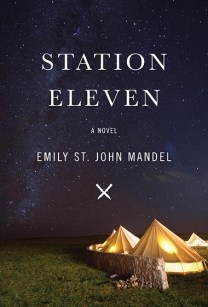
cover-station-elevenI surprised myself when I picked Station Eleven to read next — and in fact there’s a pretty close possible world in which I don’t read it because it has two big knocks against it: it’s post-apocalyptic fiction, which is not a genre I’m usually drawn to, and it’s a recent book by a hip young writer and has been getting a lot of hype, which tends to make me suspicious. “Time will tell,” says my inner curmudgeon; “read the book if people are still talking about it after the initial buzz dies down.”

Two things overcame these prejudices. One of them was remembering my experience reading (and then teaching) The Road. Clearly my initial recoil against the genre can be overcome — and if once, why not twice? And the other is that I happened to catch some of Shelagh Rogers’s interview with Emily St. John Mandel on CBC’s “The Next Chapter” and between them they made the book sound pretty interesting. Also, I am still not getting along very well with The World Before Us (which on the face if it is just the kind of book I usually do enjoy!) so when Station Eleven turned up as Kobo’s ‘deal of the day,’ the timing was perfect.

Station Eleven actually (inevitably, I guess) has a lot in common with The Road. Everybody in it is on the road, basically, or was, after what is commonly referred to as “the collapse,” until settling somewhere. There are abandoned cars, ransacked stores, and empty houses that are like ghostly remnants of the lost world. There are “feral” gangs and violent desperadoes. But everybody’s moving in a much less hostile landscape in Station Eleven, because the catastrophe was a flu virus that wiped out most of the world’s population but left the natural habitat unharmed (if mostly untended). There are forests and butterflies, cows and chickens, sunsets and clean lakes and rivers for washing and drinking. It’s a kinder, gentler dystopia! As a result there’s a hopeful strain running through the novel alongside the grief, terror, and nostalgia: civilization has collapsed, but there’s a chance it can be built up again, and the creativity and cooperation among at least some of the survivors is proof of that promise.

It’s still a pretty grim novel. How could it not be, with a death rate in the general population of something like 90%? The premise itself is plenty terrifying, more so in a way than McCarthy’s rather vague flash-and-bang disaster simply because its horror is more intimate and familiar: there have been flu pandemics before, and in today’s incessantly mobile world a truly deadly one could hardly be contained. Mandel effectively conjures up the disbelief, confusion, horror, and then gradual adaptation that follows the pandemic, as the assumption that eventually help (the Red Cross, the military) will show up — as it always has before — yields to the realization that this time it won’t, that everything has changed, that the old world really has given way to a new one. Her story includes people who remember both worlds, because they were adults when the collapse occurred; people who recall only fragments that they struggle to reconcile with their new lives; and then the new generation, those who have never used electricity or the internet or a phone or antibiotics, who know airplanes only as places to camp and cars only as obstacles. Which is better, her characters often wonder: to have known that other world, with all its wonders, and to have lost it? or to take the new stunted life for granted?

Like The RoadStation Eleven provokes fundamental questions about meaning, value, and identity. If you have lost everyone who once knew you, and can no longer do the work that once defined you, who are you? If you survive, what will you need to know, and what will you want to do? The novel’s main characters belong to The Symphony, a group of traveling actors and musicians who perform Beethoven and Shakespeare; their motto (taken from an episode of Star Trek: Voyager) is “Because Survival Is Insufficient,” which struck me at first as too pat but which ends up illuminating the range of things people do in this new, devastated world, not just to fill their time but to motivate and define themselves: starting a newspaper, creating a museum, putting on plays. Both the instinct to create and the desire to preserve take on fresh urgency in this context of loss and erasure: an awareness that other things were possible supports the belief that the terrible present too is not forever: “if there are symphonies and newspapers, then what else might this awakening world contain?”

Station Eleven turned out to be, then, a really engrossing read. And yet I actually found the general situation  of the novel — its big questions — more interesting than its specific plot, which by the end I found too contrived, too full of coincidences and connections that seemed unnecessarily clever, as if Mandel distrusted the simple humanity of her people to support the novel. She shouldn’t have: they are well drawn, and I wanted to know their stories and their fates. If the plot occasionally turned melodramatic, I suppose that comes with the post-apocalyptic territory (though did we really need a messianic cult, or a final confrontation at gunpoint?). There were some moments in the prose that struck me as lazy: phrases like “survived against unspeakable odds,” for instance. I also thought that, since everyone knows the novel’s premise going in, we could have done without heavy-handed proleptic announcements of impending doom, or painstaking enumerations of what’s lost (“No more cities. No more films … No more pharmaceuticals. . . No more countries … No more fire departments, no more police…”).

Or maybe I’m wrong about that last complaint, as both the vastness and the fragility of everything we could lose is truly hard to comprehend. Perhaps the most surprising thing about Station Eleven is that it celebrates, rather than excoriates, the way we live now, with its “taken-for-granted miracles that had persisted all around.” Ironically, it may be only in imagining “the end of the world as we know it” that we can understand how astonishing, even magical, that world really is.

Weekend Miscellany: Reading, Writing, Renos, and Buffy

IMG_0332Why does it seem as if my days are more miscellaneous than usual lately? I suppose one cause is the relative lack of routine that comes with being on sabbatical. This week was also another busy one in the kitchen make-over that we began in April: we finally got the countertop installed on Monday, which meant that the final plumbing and electrical work could get done on Tuesday. Hooray for having a proper sink again! All that remains to be done is the wall tile and then some touch-up painting, so I’ve been moving our plates and cups and pots and pans into the cabinets and getting back to cooking regular meals. The whole project was a lot of work, especially for my husband (who basically did all the work of a general contractor, plus a remarkable amount of research into fixtures and appliances), and also quite a bit of disruption, but we managed better than we’d feared with our temporary kitchen set-up and somewhat ad hoc menus including several casseroles that I made and froze ahead of time. It is nice to be putting things to rights again — and especially to have everything in the kitchen all shiny and new and in perfect working order!

I didn’t get a lot of really focused work done this week as a result of the commotion and distractions. But I did finish up and submit one writing project, and that means I’ve cleared the deck for another one with an early June deadline. (As that’s a book review for a book I haven’t actually received yet, I’m getting a bit anxious about the timing — I read (and reread, and write) pretty slowly when I’m doing a formal review. On the other hand, there’s nothing more motivating than a looming due date!) I had a work-related meeting to go to on Thursday and used the rest of my time on campus to do some administrative chores, like completing my Annual Report. This is actually a good stock-taking exercise, and it’s interesting to look back at earlier ones to see not just what I’ve accomplished but how the nature of my accomplishments has changed over time. I’m an examiner for a PhD comprehensive exam that’s taking place next week, so the committee has also been finalizing exam questions.

As for my reading, well, it has mostly been quite desultory since I finished Unbroken. I started Aislinn Hunter’s The World Before Us and was liking it fine until it turned out to be inhabited by some kind of ghosts or spirits — I guess by the time I finish it I will be better able to grasp why they seemed like something the novel needed, but at this point they just seem a rather twee distraction.

conradI put that book aside to concentrate on my book club reading for Monday, Conrad’s The Secret Agent (which we chose as a good follow-up to Lessing’s The Good Terrorist. It’s funny: there are markings in my copy that suggest I read it once before (presumably for an undergraduate course, as it has my unmarried name on the flyleaf and) but I have absolutely no recollection of doing so, or of any of its details. Once I got going I found it quite engrossing. I was also pleasantly surprised by how much I enjoyed Conrad’s style, which struck me as conspicuously Dickensian here, in its flourishes and its imagery as well as in its evocation of London’s crowded streets and peculiar characters. It seems much clearer here than in Lessing that there’s no sympathy to be had for those who plot destruction. I found myself wondering if it would even be possible to write a novel that takes the other point of view. Generalizing about “the novel” is always risky, of course, and I’m sure someone will set me straight (Tom, probably) with examples that make nonsense of this suggestion, but the novel seems so directed towards individuals — and certainly both Lessing and Conrad emphasize that terrorism requires thinking instead about abstractions. The same is true (isn’t it?) about war: its requirements are dehumanizing, which is precisely the tendency great war novels such as All Quiet on the Western Front resist. I can imagine a novel that makes a much stronger case for political revolution or violence than either The Good Terrorist or The Secret Agent, but it certainly would need radicals who don’t speak in empty slogans, or appear either ridiculous (as both Michaelis or Ossipon, in their own ways, do) or flat out terrifying, like the Professor.

buffyFinally, I’ve been giving Buffy the Vampire Slayer another try, as I needed another TV show to distract me on the treadmill. (As it has warmed up — somewhat, some days — I’m almost ready to start running outside again, though I’m a bit wary because I’m still struggling with leg and foot pain, diagnosed in the fall as a variety of tendinitis, and the switch to running on pavement last summer seems to have been one cause.) This is my third attempt at Buffy, and it’s motivated by knowing how many of my friends think the show is just great. I’m about 5 episodes into Season 1, which is three further than I’ve ever made it before, but I’m still really turned off by how cheesy the vampires (and other supernatural beings) are, by the hokey melodramatic plots about them, by the cliched dialogue (I realize some of it is tongue-in-cheek), and by the rest of the show basically seeming like a low-grade teen drama. I guess my question for Buffy fans is: does it change? or is this what it’s like, and I either have to get in the groove or go back to watching The West Wing for the fourth time? Maybe I’m just too earnest for its arch style, or too literal for its blood-sucking, shape-shifting gimmickry.

“He had survived”: Laura Hillenbrand, Unbroken

unbrokenI finished Unbroken last night in a good long stretch of reading — it’s a testament to the inherent drama of the story and the pace, if not necessarily the style, of its telling that I wasn’t tempted away from it by the myriad distractions that are always lurking. And this is in spite of knowing more or less how it turns out, since it’s no secret that Louis Zamperini survived his many ordeals. The title itself is kind of a spoiler too, isn’t it? But it’s also a key to Hillenbrand’s theme, and probably to the book’s commercial success: Unbroken seems somehow such an archetypal American success story, with its athlete-turned-soldier hero facing both physical and spiritual hardships, refusing to bow down to tyranny, and ultimately triumphing while learning to give thanks to God. It would be a string of clichés if it weren’t all true!

Even knowing the story was true didn’t keep me from sometimes feeling its details were just a bit too pat, and I ended up feeling that there was something overdetermined, not about Zamperini’s experience (which wouldn’t make any sense) but about his story being the one Hillenbrand tells. I was glad when, late in the book, she alludes to a feature of the book that is at once inevitable and problematic: talking about Allen Phillips, who also survived the crash of their B-24, who drifted across the ocean and into captivity along with Louie, and who then lived through an equally hellish captivity, Hillenbrand says,

He never returned to Japan, and he seemed, outwardly, free of resentment. The closest thing to it was the flicker of irritation that people thought they saw in him when he was, almost invariably, treated as a trivial footnote in what was celebrated as Louie’s story.

There’s nothing wrong in principle, of course, with focusing on one man among many, and the celebrity sparkle of Louie’s Olympic history makes him a natural choice, but even in Unbroken we meet a lot of other soldiers whose stories sound like they deserve their own books, and many of their stories are in fact literally condensed into footnotes, and after a while the spotlight on Louie started to seem pretty arbitrary to me. I don’t mean in any way to diminish his courage, but I wasn’t convinced that his story really was as extraordinary as all that, given the company he clearly kept.

I realize this isn’t really a fair criticism: Hillenbrand’s book simply is about Louie — he’s her protagonist, and why not? Focusing on him also lets her do things that a historical, rather than biographical, approach could not: although she does tell us quite a bit about the larger numbers and broader contexts, zooming in on the harrowing experience of one individual keeps things personal. It’s precisely the strategy often heralded in historical novels — it’s exactly what, to pick a non-random example, The Narrow Road to the Deep North does. Or Waverley, which Carlyle praised for teaching us that “the by-gone ages of the world were actually filled by living men, not by protocols, state-papers, and abstractions of men.” Or, for that matter, All Quiet on the Western Front. Instead of soldiers, we get one particular soldier, and that helps us grasp just what the war was like. (To be fair to Hillenbrand, too, she does try to do justice, if only in passing, to the other men whose stories are incidental to her main narrative, especially Phillips.)

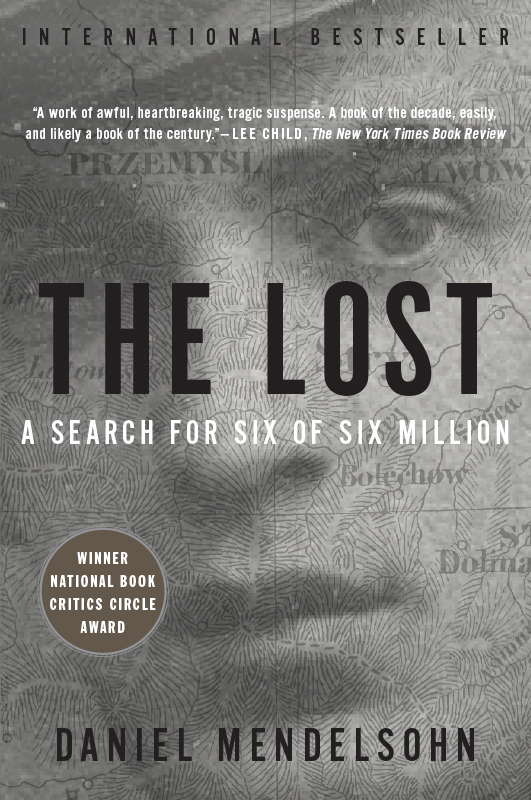
thelostEven granting that it’s perfectly legitimate to single out one person, one story, though, I think Hillenbrand could have made something more — something greater — out of her materials if she’d made that selectivity a more self-conscious part of her book. Unbroken is a really competent account of Zamperini’s war-time experiences, but that’s all it is. Given the research and other labor involved in putting it together, that’s still an accomplishment. But once I started thinking about the stories not told, I couldn’t help comparing Hillenbrand’s fairly pedestrian result (philosophically, intellectually) with Daniel Mendelsohn’s The Lost, which also focuses on one story at the expense of many, many others, but which is always aware, even haunted, by its own exclusions. Here’s what I said in my post on The Lost,

Early in the book Mendelsohn points out that “it is naturally more appealing to readers to absorb the meaning of a vast historical event through the story of a single family.” Such, clearly, is the strategy of this book. And yet we are often reminded, because Mendelsohn too is often reminded (sometimes, deservedly, harshly), that in focusing so exclusively on six of six million, others whose lives were equally “specific” are being sidelined, turned into secondary characters. He interviews Jack Greene, “born Grunschlag,” who once dated Ruchele:

I can tell you, he began, that Ruchele perished on the twenty-ninth of October 1941.

I was startled, and immediately afterward moved, by the specificity of this memory.

I said, Now let me just ask you, why–because you remember the date so specifically–why do you remember the date?

As I wrote down Ruchele–>Oct 29 1941, I thought to myself, He must have really loved her.

Jack said, Because my mother and older brother perished on the same day.

I said nothing. We are each of us, I realized, myopic; always at the center of our own stories.

There is no way, of course, to include every story, but Mendelsohn’s strategy of frequently spiralling away from the “main” narrative, following memories and anecdotes as they come into his mind or come from those he is interviewing, is a constant reminder that each story we do hear is one branch on a vast spreading tree. The sheer scope of the horror and loss would be overwhelming even if it were possible to represent it all, so instead we get glimpses, again and again, so that like Mendelsohn himself, though we are focusing on the Jagers, we can never forget that there were many, many others.

The Lost is a very different book from Unbroken — in many ways, but especially in its attempt to do more than simply reconstruct a series of events. Instead, it uses those events, and Mendelsohn’s own attempts to find out about them, as opportunities for deeper explorations into questions of memory, loss, and meaning. I think The Lost is a truly great book; Unbroken just tells a good (gripping, sometimes shocking, neatly uplifting) story. I don’t think Hillenbrand tried and failed to do more — rather than faulting her for her straightforward journalistic approach, I’m really expressing my renewed appreciation for what else nonfiction can do.

The Past Couple of Weeks In My Sabbatical: Various!

How’s that for a vague title for a blog post? But it is accurate, really: for the past couple of weeks my attention and energy have been focused on a range of different things. I  haven’t felt inspired to write a sabbatical update for a while precisely because my activities seemed so miscellaneous, and not that variable, either, from week to week. But it seems like time to round things up.

First, some good news! One of the questions Jo asks us at each ‘Meeting With Your Writing‘ session is how we’d like to feel while we’re working. At the top of each new entry in my MWYW notebook is my answer, which has become a kind of mantra for me this term: “engaged, optimistic, productive.” It’s optimism that has given me the most trouble, what with winter and all, but sometimes it has also been hard to tell if I’m being productive because I haven’t been quite clear on my goals. The past week has been a particularly good one in all these respects, though, because I decided on a concrete task I wanted to accomplish that turned out to be really fun to work on. Imagine that: I have been enjoying writing! In fact, it came so (relatively) easily and has caused, so far, so little hair-tearing and second-guessing that I’m starting to think I must have gone horribly astray. It’s a subset of the larger plans I have been following for the George Eliot book project, something I thought would work well at essay-length. It’s now in a reasonably clean draft awaiting a final round of editing and revision. We’ll see what becomes of it, but right now I’m just happy and energized by the experience of pulling it together.

In other good news, the May issue of Open Letters Monthly went up on schedule; if you haven’t already checked it out, I hope you will! As always, the pieces range very widely — more widely, we think, than in most other literary journals. Books reviewed include Ishiguro’s The Buried Giant, Ian Bostridge’s Schubert’s Winter Journey, Han Kang’s The Vegetarian, and Helen Vendler’s The Ocean, The Bird, and the Scholar; John Cotter contributed a thought-provoking essay on the possibility that the gigantic glass atrium at Boston’s MFA is a symptom of our changing relationship with art; Steve Donoghue tests (as only he can) the claims of a new translation of the Iliad to be “declaimable”; and I offer a “Second Glance” at Braddon’s Lady Audley’s Secret. I thought about Open Letters today when I read this piece on the effects of Britain’s REF: “Taking on a journal editorship? That means you’ll be helping other scholars publish their REF research, but what about yours? Can you spare that kind of time?” I realize that Open Letters is not necessarily the kind of journal editorship she has in mind (though I have had British scholars tell me that writing for it is something that they think works in their favor), but I have often felt particularly pleased that one thing I’ve been able to do there is show off how smart and interesting my academic colleagues and connections are. I don’t know if that kind of editorial role will count in my favor if I ever go up for promotion, but I think (I hope) that we are still clinging to more generous and collegial models of scholarship on our side of the pond — for now, and maybe just barely, as that piece emphasizes.

unbrokenThe other writing I’ve done has already shown up here, in my posts on my recent reading. I’m currently completing my “war in the Pacific” unit with Laura Hillenbrand’s Unbroken, which I gave my husband for Christmas. I rarely risk buying him books, but he likes good nonfiction, and this one seemed ready-made for him, as he’s a long-time track and field enthusiast and his father piloted a B-24 during WWII. He really enjoyed it, and I’m enjoying it too — though “enjoy” probably isn’t quite the right word for either of us, since it’s rather a grim story! A lot of it is, naturally, very reminiscent of elements of both The Narrow Road to the Deep North (particularly the treatment of the Allied POWs in the Japanese camps) and Shame and the Captives (especially the context and commentary Hillenbrand provides on the aspects of Japanese culture that contributed to the extreme brutality of the camps). I find Hillenbrand’s narrative a bit clunky or heavy-handed at times: it has that “one damn thing after another” rhythm that is perhaps inevitable when you’re putting together a lot of material into a fairly straightforward chronological account. I suspect that images from the novels will stick with me longer than anything from her book except the outline of Zamperini’s undeniably astonishing story.

Once I’m done with Unbroken I think I’ll be happy to read something that doesn’t involve beatings, excrement, or hungry sharks. I picked out Nicola Griffith’s Hild and Sybille Bedford’s A Legacy with my birthday gift card to Bookmark, so one of them will likely be next, though I also got Aislinn Hunter’s The World Before Us from the library today because a friend highly recommended it. I’m starting to be more aware of the luxury it is to be choosing my reading material this freely: it won’t be long before my sabbatical is officially over (June 30 suddenly doesn’t seem so far away!), and I’ve already started thinking a bit about fall classes, as book orders were already due. I’m second reader on an MA thesis that should get to me in early June, and I’m also participating in a PhD comprehensive exam coming up in just a couple of weeks, for which I’ve been having semi-regular meetings with the student. A sabbatical is not, in fact, ever a period of complete isolation or exemption from one’s regular duties! But come September I’ll be doing required reading again.

“A Burden of Mortification”: Thomas Keneally, Shame and the Captives

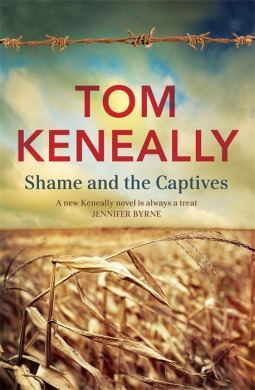
shameAnyone who’s ever graded essays has probably struggled to balance execution and aspiration in their evaluations. For me, a paper that’s ambitious and original but doesn’t quite succeed often ends up with the same grade as one that’s better written or argued but takes a safer or more conventional approach: the interest and challenge of the task you undertake affects the credit you get for accomplishing it well.*

I was thinking about this as I finished Thomas Keneally’s Shame and the Captives, which inevitably provoked comparisons to Richard Flanagan’s The Narrow Road to the Deep North. If (for some strange reason) I had to give both novels a letter grade, they’d both get an A-, but they miss out on the top grade for opposite reasons. I already wrote in some detail about Flanagan’s book: overall, it struck me as uneven, largely because it was straining after a level of profundity and artistry that it couldn’t quite reach. Its language and structure were both imperfect, and it never really leads us to a particular insight about the harrowing experiences the book covers. Still, I was gripped by its story and impressed not just by its ambition but also (if only intermittently) by its literary qualities. Shame and the Captives, on the other hand, is as competent as Narrow Road is hit-or-miss: its design is clear from early on and it proceeds with level-headed determination through to its conclusion. That in the end it’s also disappointing is due to the predictability of that design, and the flatness — even dullness — of its treatment.

It’s not that Flanagan and Keneally were trying to write the same book, of course. But the novels have a lot in common: both focus primarily on Australians and Japanese interacting as prisoners and guards during the Second World War. But in Shame and the Captives the POW camp is in Australia and the POWs are mostly Japanese and Italian. Keneally’s preface tells us that the book is a fictionalized version of a real event: “an outbreak of Japanese prisoners from a camp on the edge of the New South Wales Central West town of Cowra.” We know from the outset, then, what the main plot event is going to be. But the novel is a very slow burn — so slow that I was actually bored at first. Everything about Shame and the Captives is in a lower key than Narrow Road: the prose is unremarkable as Keneally recounts with a minimum of emotion and no melodrama the stories of a range of characters with different roles in the community in and around the prison.

These include Alice Herman, who lives and works on her father-in-law’s farm while her husband is a POW in Austria; prison commander Colonel Ewan Abercare, who knows “that he was one of those men of limited gifts who might be asked to make a stand somewhere” but will never rise to military preeminence, and who “rules the camp with a light hand as instructed”; Major Suttor, commander of Compound C where the Japanese prisoners are confined, who writes popular radio dramas which allow him “to visit a more kindly planet with a better climate,” and which are declared valuable to national morale; the pilot known as Tengan, a “man of martial purpose” who is embarrassed by his captivity and determined to redeem his honor; the female impersonator Sakura, who is protected from her antagonists by his (her) own strength and popularity among the prisoners, who love her theatrical performances and ballads; and the young Italian prisoner Giancarlo Molisano, who is assigned to work on the Hermans’ farm.

That this is only a partial list of Keneally’s cast of characters, and that he divides our attention almost equally among them, reveals his intent, which is close to what I suggested I would have preferred for Flanagan’s novel: he spends most of the novel building our relationships with characters on all sides of what becomes an explosive conflict. Thus when it takes place our interest and sympathy is also dispersed: it’s not a case of good guys and bad guys, heroes and villains, but a story of the convergence of very different ways of living in the world which have been only provisionally held in balance by the artifice and coercion of the prison camp. The title tells us about Keneally’s chief interest: the effect of the captives’ shame at their moral failure (which is how most of them view their failure to die in combat) on their behavior, and also the inability of the captors to understand well enough how shame motivates their prisoners. “There is a new world coming,” says the translator to the prisoners when they arrive at the camp, “and those extreme warrior codes are now obsolete and do not serve as a useful guide.” But they are the guide by which the majority of the prisoners still live, under their “burden of mortification.”

shame2Keneally works harder than Flanagan to make this point of view something more than a caricature: however foreign it might be to us as well as to the other characters (“an entire ocean and all its archipelagos had been captured by a cult of death,” thinks the one Christian in their ranks), it’s a code to which most residents of Compound C are sincerely committed. Still, it’s not until the actual uprising that most of the Australians realize quite what this death wish means — not just ruthlessness against others, but a deliberate effort to bring death on themselves which makes real victory during violent confrontation almost impossible. When your enemy wants you to kill them, and will pursue you with deadly force to ensure you do, what use is your own code, which values life? When your deadly weapons are opportunities rather than deterrents, too, how do you prevent or protect yourself against insurrection?

Keneally takes his time setting up his pieces and then patiently plays out the game, the nature and outcome of which seems, in retrospect, inevitable, though there are certainly surprises in the specifics. All the time we spend with the various characters creates real suspense, or at least curiosity, about what part they will have in the impending catastrophe. But in the end he doesn’t make a great novel out of these promising elements — just a good one. I’ve already mentioned the unexciting prose and flat tone: to me, the writing sounded like someone getting the job done. (You’ll notice I haven’t been tempted to include any longer quotations: that’s because I don’t think they would add much except more words.) I know that self-conscious minimalism is a thing these days (Exhibit A: Colm Toibin). But even for people who like that kind of thing, I don’t think Shame and the Captives is quite the sort of thing they’d like: Keneally’s is not a particularly elegant or literary style, just a straightforward, almost plodding one, one statement following on another. The only other novel of his that I’ve read is Schindler’s List and that was a long time ago: I remember being moved and impressed at the time by what struck me as remarkable understatement given the story he was telling. Saying too little seemed much preferable, in that case, to saying too much, getting too ornate and drawing undue attention to the writing rather than its subject. Now I wonder if it wasn’t deliberate but is just how Keneally writes. Which is fine — but not exciting.

Shame and the Captives also seemed perfunctory in other ways, though. It doesn’t offer us anything beyond what the characters themselves see and experience: there’s no commentary, no sense that the disparate elements in the novel might add up to an idea about the world, or about violence, or death, or honor. I couldn’t figure out the thematic unity of Narrow Road, but at least it gestured towards bigger ideas: Flanagan clearly sees the novel as something potentially transcendent. Keneally’s vision is more mundane, and that limits him. I thought Shame and the Captives could have used a harder-working narrator, one who would come between us and the characters and offer more understanding or insight about their situation than they individually are capable of. Perhaps the absence of that kind of unifying perspective is itself a kind of comment, a rejection of the idea that events mean much. Since I tend to side with David Masson that “the desirable arrangement might be either that our novelists were philosophers, or that philosophers were our novelists,” I find that an unsatisfying result!

Still, once I adapted to its pace I read Shame and the Captives with interest. The very normalcy of the many lives it follows, with their loves and lies and failures and mistakes, becomes a useful reminder that historical events are not abstractions, and that there are always as many aspects to them as there are people involved. He clearly had his concept, and he carried it out capably: A-!


*In case this doesn’t go without saying, it’s important, obviously, to explain this from the start, and to give students guidance in developing a thesis that has a good chance of making their work as interesting as it is articulate! I include essay-writing workshops in all of my classes now in which this is a central focus. This is also why detailed feedback on essays (along the way and at the end) is so much more important than the letter grade itself, which is necessarily a very reductive shorthand.