Finished with Ferrante. Probably Forever.

lostchildI actually hadn’t intended to read The Story of the Lost Child. By the time I finished Those Who Leave and Those Who Stay, I felt that three long volumes of minutiae (however intense) and interpersonal angst (especially between two characters who never seemed either particularly plausible or particularly interesting) was plenty. It’s not that I didn’t think the first three Neapolitan novels were any good. They are good — probably better than most recent novels I’ve read. But after a point, it was impossible to read them without sky-high expectations, because their overall reception has been both so positive and so uncannily uniform. Raw! Honest! Confessional! Brave! (I wrote about the critical phenomenon already in some detail, in a piece that I thought might generate some self-conscious discussion among the feverish Ferrante fans or just people interested in the general issue of women’s writing and its reception. It didn’t.) And how many novels are really that great?

I got a tempting invitation to review the fourth volume, though, and so I did end up reading it. I’m not entirely sorry that the review has ultimately dead-ended, as during the editorial back-and-forth it was turning into something I didn’t really care for, that didn’t even sound like me. (That’s undoubtedly because it also didn’t start out very well, at least for its intended purpose: I’m not blaming anyone but myself.) I’m not entirely sorry I read The Story of the Lost Child either, though, because like its predecessors, it is pretty good, and after the investment of reading the first 1000 pages of a series, it is nice to know how it all wraps up. At this point, though, especially after two frustrating weeks immersed all over again in her work, I’m fed up with both thinking and writing about Ferrante. Anyone who wants to read a deep, thoughtful commentary about her should read Alice Brittan’s “Elena Ferrante and the Art of the Left Hand” in this month’s Open Letters. Alice loves the novels, but she also comes at them, as she comes at every book she writes about, from an unexpected angle, so though there’s plenty of enthusiasm on display, it’s not of the “these books are the awesomest, bravest, most honest, truthful, confessional, searing, epic portraits of women’s lives and female friendships ever” variety. (I’m sure not every other review is like that either, but that’s certainly the general flavor of Ferrante criticism.)

Here is the short version of my ‘take.’ The Neapolitan novels are good books, but to me they represent novels as blunt instruments. They have a lot of detail, but not a lot of nuance, especially stylistically. (Requisite caveat: maybe in the original Italian, they are different, better, more subtle.) In particular, the first-person narration is ultimately a disappointment, both artistically and thematically. Elena is not much of anything: she is neither unreliable nor interestingly retrospective (by which I mean, though she is remembering and reconstructing her past, her narration does not show her learning or developing from it). In the review you won’t ever read, I compare her unfavorably to Pip in Great Expectations (and why not, since every much-hyped novel these days seems to explicitly invite the comparison). Reading Great Expectations, you realize early on that Pip the character is not (until the end) Pip the narrator. There is great artistry in that palimpsestic effect, as well as real moral significance in his changing perspective. I did not find any comparable achievement by (either) Elena. As a Kunstlerroman, also, which is what the Neapolitan novels could (perhaps should) be, the series is unconvincing, or at least not compelling. Elena talks a lot about her writing, about its deficiencies and changes, and especially about women’s writing and women in writing as creatures of the male imagination and aesthetic. Her chronicle of her life, of Lila’s life, and of their friendship does not strike me as a powerful or empowering alternative: it’s too linear, too literal, and in its own ways, too reductive. If it is (as, say, Aurora Leigh is for Aurora Leigh) the culmination of her artistic development, then for me (despite all its emotional power, and the richness and complexity of its historical and sociological description) it’s underwhelming. (Maybe if I’d been this blunt in my draft review, we would have gotten somewhere!)

Lots of readers disagree with me, and plenty of critics have written at length about what they see as the brilliance of the series. Every major critical outlet (well, except one, I guess) has or will have an opinion on offer and I have yet to see one that isn’t pretty much ecstatic. So you have lots of support if you think I’ve read uncharitably or stupidly. My review, however, would have been mixed, for the reasons I’ve given. I found Nicola Griffith’s Hild a much more exciting literary experience: I’m really looking forward to reading its second volume. I’m keen, too, to read Adam Johnson’s new collection of short fiction, because I thought The Orphan Master’s Son was extraordinary. I will read anything else that Helen DeWitt publishes, because The Last Samurai was brilliant on every level. Having given Ferrante my best shot as a reader and critic, here and elsewhere, though, I think I’m done with her.

I wouldn’t even care — or bother saying anything — about this except that if you want (as I sometimes want, or think I want) to participate in ‘the literary world,’ the books everyone is talking about exert a certain pressure on you. (Recent exhibit A: The Goldfinch.) Sometimes, that’s fine: it’s a good book, it’s a good conversation, it’s a good intellectual exercise. Even when I write what I think is a really good piece of criticism about a current hot title, though (Life After Life, say — and there‘s a review I’m proud to have my name on), I often end up feeling a bit disappointed in the process. What (as Dorothea says) could be sadder than so much ardent labor all in vain? Because there’s always another, and another, and another good but probably not great book coming down the pipe that we’ll all feel we have to read and talk about.

The joy of blogging is the total freedom it brings from publishers’ schedules and publicists’ blandishments. I’m sure my current feelings of exasperation will abate, but you can probably expect a lot more Dorothy Dunnett around here for a while, until they do.

“We Are At Peace”: Mollie Panter-Downes, One Fine Day

one-fine-dayMollie Panter-Downes’s One Fine Day was a good book to read at the start of term: it’s both short and exquisite. Reading it reminded me why I do what I do, why reading is both my work and my play, my vocation and my indulgence. I luxuriated in the language, which is just self-conscious enough to feel artful without becoming precious:

Once the jolly monks had ambled across these meadows to fish up their Friday dinner. Now only a heron, grave as an abbot, attended to his fishing among the broad leaves. The pale fluff of meadowsweet and the tarnished buttercups shimmered in the heat and the dancing, humming flies. Was there thunder about? Laura still felt her face burning as it had burnt in the Trumpers’ shop. How little one understood anything or anybody, after all. One or two people in one’s life really well, and the rest walled up in their separate cells, walking around walled up in darkness which a sentence would suddenly, appallingly, illuminate.

The novel is the story of a single day in 1946, when the memory of war is still fresh and its remnants are everywhere — barbed wire across the fields, German prisoners on the farms — and peace is still a fragile joy:

Planes were no longer something to glance up at warily. The long nightmare was over, the land sang its peaceful song. Thank God, thought Laura … Let us give thanks, Mr. Vyner said, very simple, very quiet, when the handful of the faithful bowed their tired knees before God. But never, even then, had Laura felt quite this rush of overwhelming thankfulness, so that the land swam and misted and danced before her. She had had to lose a dog and climb a hill, a year later, to realize what it would have meant if England had lost. We are at peace, we still stand, we will stand when you are dust, sang the humming land in the summer evening.

It’s a world at peace but also a world in transition: Laura and her husband Stephen do their own housekeeping now, without the servants who once kept the house neat and put the food on the table. “There seemed to be few of the old quiet moments for talking,” Stephen reflects; “all through their meal they would be jumping up and down.” And yet, uncomfortable as he finds it, it also strikes him “as preposterous,” looking back, “how dependent he and his class had been on the anonymous caps and aprons who lived out of sight and worked the strings”:

All his life he had expected to find doors opened if he rang, to wake up to the soft rattle of curtain rings being drawn back, to find the fires bright and the coffee smoking hot every morning as though household spirits had been working while he slept.

The change is even greater for the local squire’s family, who are turning their home over to the National Trust and moving into a flat over the stables. “The group over the fireplace gazed down at [Laura] with well-fed amiable arrogance” when she visits the family just before their move:

declaring that they were English ladies and gentlemen who would for ever inherit the earth. Thus should life be, they said, the green garden and the trout rising in the river … Thus will life always be, stated their healthy confident faces. But in a minute there was nobody in the room but Aunt Sophia.

The house will no longer belong to them; instead it will belong, in stately anonymity, to the nation — “Visitors … would ask their host intelligently, What is that? instead of Who lives there? For so obviously its personal life had ended.”

The novel is not a lament for these losses, though, so much as a tribute to the nation’s continuity in spite of them — to the persistence of a larger history, greater and more enduring than any of its individual parts. From the top of Barrow Down, Laura looks out over a landscape that speaks “of the Druids, of Drake, of this precious stone set in a silver sea, of the imminent Sunday roast beef and Yorkshire pudding.” “Easy come, easy go,” thinks Laura, as she feasts her eyes on the view, which “drew the eye on to distant hills, to aerial villages, to unsubstantial, heavenly wraiths of towns which flashed a sudden signal from a golden window.”

The novel’s not all at this elevated pitch, though, and in fact I liked the unexpected comedy of it the best — like Laura coming unexpectedly on the earthy Mr. Prout “enthroned” on his outdoor privy,

peacefully smoking, a fat old man in his shirt sleeves, not visible deranged by the spectacle of a lady appearing between the lilac bushes. He looked like an enormous Buddha, meditating beneath the clustering green berries. Grossness disappeared from the situation, and now the only problem seemed to be: To bow or not to bow, to break in upon that tranquil solitude or to tiptoe respectfully away?

And there are sharp moments too. “He looked at her amiably, as though she were a nice sofa,” Laura thinks, meeting a handsome young man; “that must be the penalty of the grey hairs, the tired shadows under the eyes, that must be the beginning of getting old … the young men like George looked at you and saw a sofa.”

Exquisite, comic, sometimes tender. And yet I did end up with a faint reservation about the novel, because it is a kind of paean to England. I was reminded of some criticisms of Kate Atkinson’s A God in Ruins (Dorian’s, for example) as a book that’s just a bit too self-congratulatory about “the Greatest Generation.” One Fine Day is written in the aftermath of war’s trauma, and perhaps its investment in victory and its tributes to those who paid for it with their lives is easier to sympathize with. They date the book somewhat, though: it’s not just evocative of a period, but also, itself, a period piece. That doesn’t mean it’s dated, in the pejorative way we usually mean that, though. It’s just too well-written for that, and its people, too, are not simply ciphers in service of nationalism. At the end, when Laura runs down the hill, back to her husband and her daughter, her increasingly shabby home, her life of lost privilege and new privations, she’s also running towards happiness and love.

The Estranging Sea: Emily White, Lonely

lonely“The main thing I did with this book,” Emily White says on her website, “was break the taboo against talking about loneliness.” I felt the weight of that taboo as I debated whether to blog about having read her book. It seems obvious that I wouldn’t have looked it up if I weren’t lonely myself, after all — lonely enough, indeed, to be looking for insight and support.

Actually, I’m not sure that what inhibits me is thinking there’s a “taboo” around the subject so much as unease about what the admission of loneliness means, and how people might respond, or feel they should respond. I don’t want anyone’s sympathy, or offers of companionship, or invitations that come from obligation or pity. I also don’t want well-intentioned but ultimately fatuous advice, because trust me, anyone who’s looking up a book called Lonely at the library has already thought if it, whatever your suggestion is, and probably tried it too! As I have mentioned before, I also tend to avoid getting really personal here, in this public space (which is also, in whatever vexed and complicated a way, a professional, or semi-professional, space). And in whatever space, I don’t usually like to expose my vulnerabilities. I suspect that if asked, people who know me personally would likely describe me as someone who’s almost always fairly poised and in control. More turbulent emotions certainly leak out, in real life, here and (more often) on Twitter, where the brevity and fluidity of the form makes revelations feel less undermining (an illusion? perhaps!). But I’m not by instinct or habit particularly demonstrative or confessional in any context. (That’s probably why there’s a long history of friends of mine trying to get me to “let my hair down” — but that’s the subject of another post, or could be, if this were a different kind of blog!)

Reading Lonely helped me realize, though, that this tendency to keep my private feelings even as private as I do is actually a contributing factor to some of their negative effects on my life. Don’t worry: I’m not about to start oversharing! What the research White summarizes clarified, however, is that loneliness is less a function of sociability or social connections in and of themselves than of intimacy, or, properly, the lack of intimacy. (It is, as all of us have probably experienced, possible to feel much lonelier when among other people than when alone.) This information clarified, among other things, why joining clubs, taking up group activities, or otherwise doing the obvious things to “meet people” can exacerbate rather than resolve loneliness. I think this is also why, for all the wonderful and cherished friendship and support I get from people I know only or mostly online, sometimes loneliness can still hit me like a punch in the gut, because my own careful (though not airtight) curation of my social media presence enforces boundaries that limit these relationships even as they necessarily protect me and mine. This is why Facebook can sometimes be so inadvertently hurtful, and why a busy day at work, surrounded by students and colleagues, can bring no relief at all to this underlying feeling, though it can be an excellent distraction from it. And this is why even an hour in the company of someone who really (really) knows you can be so profoundly restorative, both emotionally and psychologically (White discusses some research linking these effects to a fundamental human need for connection as a form of safety) — and why it is thus so difficult when these people are both rare and far away, in different time zones.

Finally, this also explains why even a very lonely person can crave solitude: it’s not just that one’s own inner resources and individual interests are crucial to resilience and personal fulfillment, but that when you are alone, you can (for better and for worse) just be yourself. I have thought a lot, recently, about the Marianne Moore line that “the cure for loneliness is solitude.” I don’t think that’s true (though I continue to be fascinated by stories of meaningful solitude). But in my experience at least, however paradoxical this seems, solitude can abate feelings of loneliness, offering emotional ease or tranquility that soothes even as it risks becoming melancholy.

In the end, I didn’t find Lonely a particular powerful book. It was too much of a memoir — for my purposes, it spent too much time on White’s own experience. As a “self-help” book it also doesn’t offer much constructive advice: White pushes for us to understand loneliness as a psychological condition that calls for therapeutic intervention as much as anything else, and I never did get much concrete sense of what such treatment might accomplish, of whether it’s ultimately a coping strategy (which, given her emphasis on chronic loneliness, is what I suspect) rather than a program for building the kinds of intimate relationships that seem to be the real fix. (I admit, though, that as I lost interest in the wealth of detail about White’s personal situation, I did start skimming, so perhaps I missed some information.) It was certainly interesting to know that loneliness is a genuine research field (White’s own generalizations, though, are based on detailed interviews with about 20 people, which doesn’t seem like that broad a sample) and to think about the ways researchers differentiate loneliness from, for instance, depression. Most of all, though, it was just useful to see loneliness parsed out in the ways White and the experts she consulted do. Understanding a problem better isn’t, in itself, necessarily going to change or fix anything, but naming things — describing them accurately — is always somewhat reassuring. With that improved understanding comes a bit of courage, I think.

Is there a better poetic evocation of loneliness than Arnold’s “To Marguerite, Continued”? Maybe, but its combination of personal yearning and existential angst still thrills me as much as it did when I was a yearning and somewhat solitary teenager.

Yes! in the sea of life enisled,
With echoing straits between us thrown,
Dotting the shoreless watery wild,
We mortal millions live alone.
The islands feel the enclasping flow,
And then their endless bounds they know.

But when the moon their hollows lights,
And they are swept by balms of spring,
And in their glens, on starry nights,
The nightingales divinely sing;
And lovely notes, from shore to shore,
Across the sounds and channels pour—

Oh! then a longing like despair
Is to their farthest caverns sent;
For surely once, they feel, we were
Parts of a single continent!
Now round us spreads the watery plain—
Oh might our marges meet again!

Who order’d, that their longing’s fire
Should be, as soon as kindled, cool’d?
Who renders vain their deep desire?—
A God, a God their severance ruled!
And bade betwixt their shores to be
The unplumb’d, salt, estranging sea.

This Week In My Classes: Back to School Edition

September-Calendar-ClipartI haven’t been in the classroom since December 2, 2014, so I guess it’s no wonder I’m experiencing more than my usual start-of-term jitters as well as a general sense of disorientation! It’s not as if I haven’t been thinking about teaching a lot since then, especially in the last several weeks, but I can tell it’s going to be a challenge readjusting to the rhythm and relentless pace of the teaching term after the relative freedom (in both my mental life and my schedule) of my sabbatical and then the summer months.

I’m fortunate to be teaching only two classes this term. The oscillation between them will be interesting, as they are at the two extremes of our curriculum: one is a section of English 1010 (Introduction to Prose and Fiction), while the other is a graduate seminar, English 545o (George Eliot). I have taught English 1010 quite a few times, most recently in Winter 2014. This time, however, I have a significantly larger group: then, I had one of our special “baby” sections, capped at 30, while this year my section is capped at 90 (enrollment is currently hovering around 70). This means I will do a bit more semi-formal lecturing, though most of the time I will incorporate some back-and-forth discussion; it also means that I will have teaching assistants who will each work with a smaller tutorial group once a week (as will I). Tutorials obviously help make the class a more personal experience for the students, and they enable us to do the kind of hands-on work on writing skills that is essential to a class like this one (worksheets, drafts, peer editing, and so forth).

Durade GEI feel pretty sure that I know what I’m doing in English 1010. But I haven’t taught a graduate seminar since 2010, and I feel somewhat more uncertain — not about the day-to-day activities of this year’s version, but about its overall purpose. One reason I stepped back from graduate teaching was my own disaffection with some aspects of academic research, writing, and publishing, as well as with the whole teetering structure of graduate studies in the humanities. What was I doing — what were we doing — or what should we be doing, when carrying on blithely with what was (is) more or less an apprenticeship model seemed wrongheaded? I have never really been able to swallow the argument that our graduate programs still make perfect sense even if most of our students aren’t going to continue into academia (see my post on The Ph.D. Conundrum, including the comments thread, for further discussion about this) — or that if we tweak them by adding some discussion of “alt-ac” or non-academic careers, we’re fine.

At the same time, I certainly see the intrinsic value of advanced study in our discipline, and I know that graduate degrees are not dead ends. Many of my reservations fall away when we’re talking about M.A. students, also. Finally, finding new ways to use the specialized training I received myself has helped me think more positively about the whole process. So I put my name back on the roster and now I’m almost ready to go. One change I’ve made since the last time I taught a graduate seminar on George Eliot is building in some attention to her place in current literary culture: I hope that will broaden the conversation we have about her work in ways that complement the reading we’ll do in academic criticism.

I meet with English 1010 for the first time tomorrow, and with English 5450 for the first time on Monday. I think I have all the paperwork ready — attendance sheets, spreadsheets for keeping records, syllabi, handouts. I have built the Blackboard sites and, for English 5450, a (private) WordPress site. I have printed tomorrow’s lecture notes and done Monday’s readings. Now I just have to show up!

I’m not the only one starting school this week: my son begins at Dalhousie this term, as a student in the Faculty of Computer Science. I wrote an open letter to him for the excellent blog Hook and Eye that includes my general advice for all students just starting down this path. Good luck to all of them, including Owen, and may we all have a stimulating, thought-provoking time!

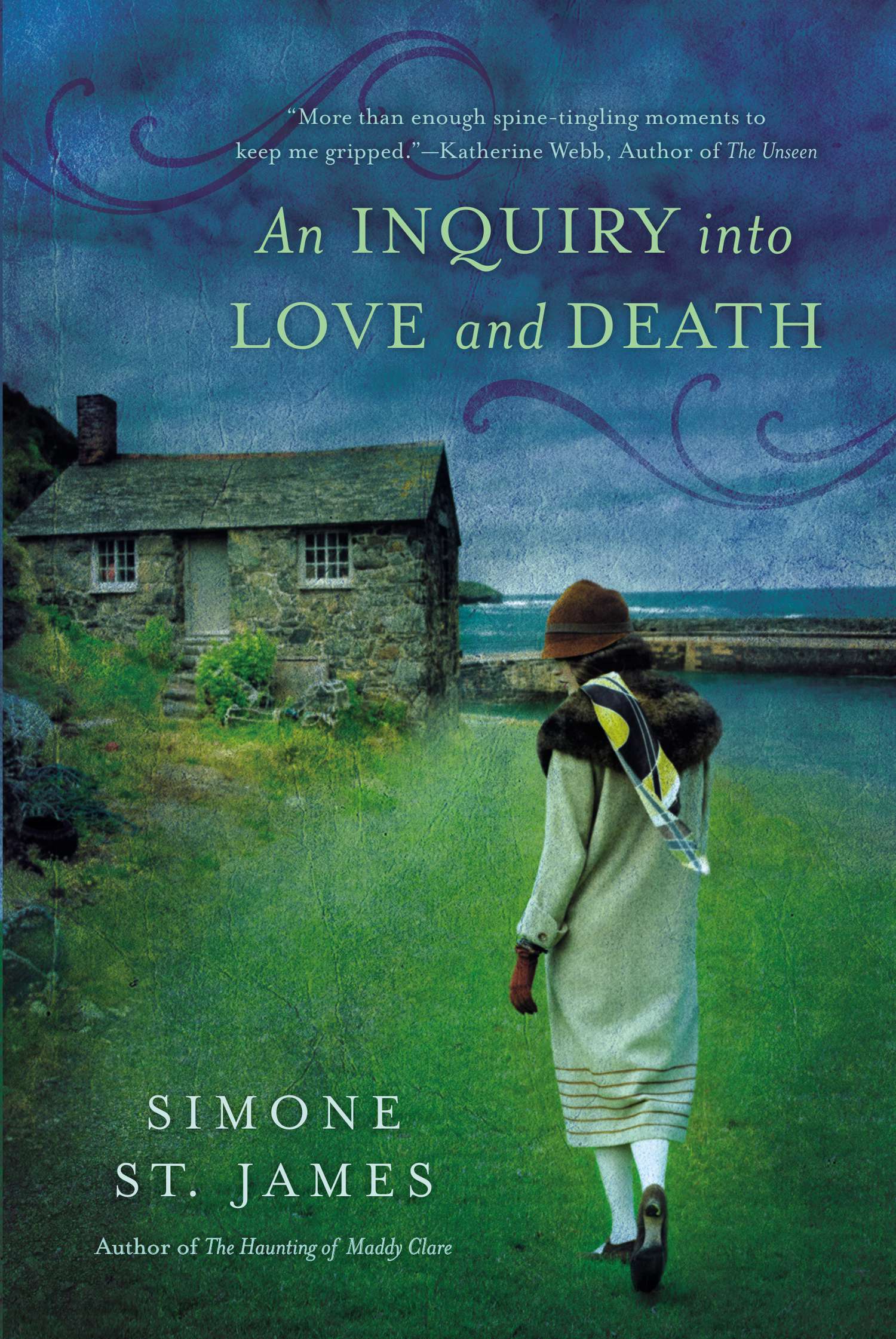
“Definitely something”: Simone St. James, An Inquiry into Love and Death

inquiryI wouldn’t probably have given Simone St. James a try if it weren’t for Miss Bates‘s recommendation on Twitter. I don’t really do ghost stories — my inner skeptic interferes with my enjoyment. The last truly supernatural story I can remember reading is Susan Hill’s The Woman in Black, which for me was just OK, with some good “shivery moments” but an undermotivated ghost. I’m glad I followed up with St. James, though, as I quite liked An Inquiry into Love and Death and am looking forward to The Haunting of Maddy Clare.

On Twitter, folks agreed St. James is basically writing romantic suspense, in the spirit of, say, Mary Stewart, and that seems right to me so far. An Inquiry into Love and Death also reminded me faintly of Jamaica Inn, except that Jamaica Inn has a much richer texture. Here too we have a coastal setting, with rugged rocks and rough surf, a handsome and somewhat threatening hero, a bold but innocent heroine, and a lot of mysterious goings-on involving boats. The difference is that An Inquiry into Love and Death also has a ghost, Walking John, whose existence is not only believed in by pretty much all the villagers as well as the heroine, but seems to be backed by the novel itself rather than resolved into rationality. I suppose we’re left with a bit of wiggle room: “There was something,” says our Scotland Yard detective — “definitely something,” agrees his more skeptical partner. But neither commits altogether to a supernatural explanation, and we could always take their irresolute side. That seems contrary, though, to the haunted spirit of the book.

I found the ghostly parts of the story the least interesting, and that was something of a problem for me, since they are fundamental to its genre as well as its plot. They were certainly a bit creepy: I listened to the first half of the novel as an audio book, and eventually decided I didn’t love being alone in my basement office while immersed in it — partly for that reason and partly because I wanted to be able to skip a long a bit faster sometimes. But after a while they just seemed gratuitous to me. There’s plenty to be scared of, interested in, and mystified by in the plain old natural world, as I see it, and indeed as St. James shows it, and so all the ghostly parts ultimately distanced me from, rather than involving me in, the story.

On the plus side, I thought St. James did a really good job integrating her story with her historical setting. I liked that her heroine is a student at Somerville, and that the other characters observe and sometimes dislike the anomaly of that; the aftermath of World War I is thoughtfully described and personalized through a range of characters, and the central crime turns on the war’s lingering trauma in an interesting way. The romance, however, struck me as implausibly sudden and heated, given how unlike the characters are. On reflection, that might be partly Rosalyn Landor’s fault, as her reading of Jillian’s first-person narration made her sound prim rather than passionate — one way in which an audio book can affect your reception of the text “itself.”

I’m Listening! My Tentative Steps Towards Audio Books

audiobooks imageI seem to know a lot of people who read (listen to) audio books. They often report what they’ve been listening to, and in addition to my interest in the books they discuss, I’m always interested too in their comments on the narrators — who make a big difference, of course, to the overall experience, adding a dimension that’s not present when we read books to ourselves “silently.” (I put “silently” in scare-quotes because I wonder if we are in fact “hearing” the words in our heads in some way, if that makes sense — we do always talk about “voice” and “tone” in fiction, after all.)

I really like the idea of listening to audio books, but I have always found it difficult to concentrate on them. I don’t feel comfortable simply staring into space while I listen, which would be the audio equivalent of the total concentration I give most books when I read them in print. But even innocuous tasks to keep my hands busy while I listen (crochet, for instance) can occasionally take my mind off the words long enough to throw me off, and there are far too many distractions and interruptions when I’m walking or driving for me to stay focused. Though I sign audio books out of the library intermittently, then, I almost never manage to actually read (listen to) them all the way through.

I realize that there’s absolutely no reason why I need to adapt to audio books. I spend a lot of time with books as it is! And I’m busy and about to get busier, so I should not be looking for ways to while away the time — except that precisely because I’m busy, I like to have pleasant ways to relax, including ways that aren’t watching TV. So I’m trying something slightly different with audio books: instead of signing out new books I’ve been hoping to read, recently I’ve borrowed a couple that I already know well, on the theory that for them it won’t hurt if my attention wanders once in a while. And while I’m listening, I’m coloring, which is both soothing and suitably non-verbal, so I can concentrate quite well on the story.

baloghThe first book I tried this way was Mary Balogh’s Simply Perfect, 2/3 of which is my favorite Balogh novel (the other 1/3, which is scattered across the book, I find kind of annoying, so I skipped bits here and there as I listened). I quite liked the narrator, Rosalyn Landor, though I wish she had not felt obliged to put on “manly” voices for the male characters, especially the hero. Is this a typical thing, to do the characters in different voices? I hope not, but Susan Boyce, the reader of the second book I’ve listened to (Jennifer Crusie’s The Cinderella Deal), did different accents, so I fear it may be. I’d be fine with narrators just reading the dialogue in a natural way, rather than trying to dramatize it. I did still enjoy the stories, though, and listening to a chapter while doing a bit of coloring is definitely a nice way to unwind after a stressful day.

I probably won’t have a lot of time for listening and coloring once term begins, but I will keep experimenting. I’ve been thinking that listening to books is actually a skill of a different kind from reading them on the page, and maybe as I get accustomed to it, I will be able to work in new books and keep track of them better. I don’t think listening would be a good option for really dense or complexly structured books, certainly not for books I intend to write about in detail. But for lighter books that I read for diversion anyway, audio books might be a fine option, if I can learn to listen well enough.

I have already become a bit frustrated with our library’s selection, though. I thought, for instance, that I’d really enjoy listening to Little Women, which I haven’t read in many years, but I sampled the library’s only version and I don’t like the narrator at all. There are very few classics, and none of the ones I’ve heard particularly recommended (Juliet Stevenson reading Middlemarch, for example, or Timothy West reading Trollope). Simply Perfect is actually the only Balogh in the library’s collection, and The Cinderella Deal is the only Crusie….and so on. Still, I am not about to sign up for Audible unless this listening experiment really takes, so for now I’ll have to make do. I’ve got Anne Tyler’s Back When We Were Grownups on hold: I think that will be a good one for me.

Any tips from you more experienced audio book listeners — favorite narrators, good sources, ways to keep focused? Also, what do you especially like about listening to books — is it mostly about the convenience of being able to play them while you do other things, or do you find you have a different relationship with books you hear rather than read?

Another New Month, Another New Open Letters!

RWA-300x242We did it again! A rich new issue of Open Letters Monthly is up, with something in it for every interest and taste. This month’s seems particularly good to me, and I don’t say that just because it includes four pieces for which I was the lead editor. A few highlights:

Victoria Olsen reports from the Romance Writers of American convention in NYC:

There are a lot of sexist assumptions behind the devaluation of the genre and its community . . . but here I’m most interested in the fact that these readers know all this already, they’ve heard it all before, and their pens are primed with rebuttals. The RWA convention made their self-awareness visible and explicit. These are women who know exactly what they are doing, who mean what they say, and who are willing and able to defend themselves.

Levi Stahl introduces us to Anthony Powell’s lesser-known novel Venusberg:

this is prose that is beginning to move like thought, to wend back in on itself and make discoveries along the way, an approach that will reach its apotheosis in the watchful narrative musings of Nick Jenkins in Dance. It also helps us begin to understand Powell’s protagonist, Lushington, revealing how observant he is, the first step toward helping us see him as something different from, and more thoughtful than, his giddier peers.

Alice Brittan examines Elena Ferrante’s phenomenally successful Neapolitan novels

I can think of many novelists whose prose is more startling or beautiful than Ferrante’s, whose plots and structures are more ingenious, whose anger at the systemic abuse of women and the poor is as explosive, whose depiction of motherhood is as unsentimental, and whose exposure of the hidden threads that turn the individual into the puppet of the state is as rigorous. But I don’t love most of their books like I love Ferrante’s, because they don’t make me feel what she does, which is that I am in the presence of “a bare and throbbing heart.”

Dorian Stuber adds to his growing body of work for us on Holocaust writing with his review of Jim Shephard’s The Book of Aron:

Children are always trying to decode a world that exceeds their understanding. Children in the Holocaust experienced this imperative in particularly powerful and perverse form. Where normal children wonder about life — where do babies come from? — these children wondered about death — what is happening to my world? Shepard suggests that a child’s point of view both incites and stymies readers’ ability to comprehend an overwhelming, traumatic event like the Holocaust. Children offer a powerful metaphor for the bewilderment and fear that adults too — both then and now — experience in the face of something like the Ghetto.

And that’s definitely not all: James Ross looks critically at the TV adaptation of George R.R. Martin’s Song of Ice and Fire; Stephen Akey thinks back on the book that transformed his idea of what it meant to be a reader; Steve Donoghue reviews a history of the world’s most famous chessmen; Dan Green reviews a book on the strange art of literary biography; and that is still not all — so go on over and explore for yourself.

I have a writing deadline that may keep things a bit quiet around Novel Readings for the next little while. But I’m also reading Maus, and hope to have a chance to put some thoughts together about it after that, and classes start for me at the end of next week, so the new season of “This Week In My Classes” will also be kicking into gear.

A Taste of Nova Scotia

My lovely mother has been visiting us, and today we went exploring a bit. I don’t like highway driving (or really any driving, though of course I do what I have to), so I was happy to find an article about fun things to do around Halifax without a car. One suggestion was taking the bus out to Fisherman’s Cove. Here are a few pictures of this lovely spot. They will remind me, when I get cranky in a few months about being trapped in the winter hell-hole that is Halifax, that there are nice things about being in Nova Scotia!

FishermansCove

IMG_2924

IMG_2923

IMG_2929

IMG_2936

IMG_2932

IMG_2955

Also, if you actually do want a “taste” of Nova Scotia, this is the book for you.

“A Real Book”: Barbara Comyns, Our Spoons Came from Woolworths

spoons

This book does not seem to be growing very large although I have got to Chapter Nine. I think this is partly because there isn’t any conversation. I could just fill pages like this:

‘I am sure it is true,’ said Phyllida.

‘I cannot agree with you,’ answered Norman.

‘Oh, but I know I am right,’ she replied.

‘I beg to differ,’ said Norman sternly.

This is the kind of stuff that appears in real people’s books. I know this will never be a real book that business men in trains will read, the kind of business men that wear stiff hats with curly brims and little breathing holes let in the side. I wish I knew more about words. Also I wish so much I had learnt my lessons at school. I never did, and have found this such a disadvantage ever since. All the same, I am going on writing this book even if business men scorn it.

It is very tempting to fit Barbara Comyns’s strange, sad novel of Bohemian poverty and domestic distress into the ongoing literary sparring match between Jonathan Franzen and Jennifer Weiner. Just as I was settling in to write this post, for instance, I followed a link from Weiner’s twitter feed to Christian Lorentzen’s New York Magazine review of Franzen’s Purity in which he calls Weiner a “best-selling but subliterary novelist.” If he meant to say Weiner does not write what is commonly (if, for some, controversially) called “literary fiction,” he’s probably right. If he meant that her novels are not “great literature,” he’s probably right about that too. But the term “subliterary” is not just hierarchical, it’s deliberately confrontational: Weiner’s novels are below literature, less than literature, beneath (it surely follows) serious consideration, or certainly the serious consideration that (love him or hate him) Franzen inevitably gets. Weiner’s novels are not “real books”; they are the kind “business men” scorn. (The implications for the readers who have made Weiner a bestseller are no more complimentary.)

All the same, Weiner keeps on writing her books, just as the narrator of Our Spoons Came from Woolworths keeps on writing hers. Both, it seems, have their own bookish mission that doesn’t depend on the approval of men in hats. Does that mean that they both write “women’s fiction“? Is that fiction for women or fiction about  women, or some third thing — perhaps, fiction that feels a certain way, or faces in a certain direction — or is the category an artificial imposition, not a real thing at all, though the label persists — and has its side-effects, many of them undesirable?

Our Spoons Came from Woolworths has many of the qualities often (usually pejoratively) assumed to define women’s fiction: it is undemanding in both scope and style, focused on the domestic and romantic life of its protagonist, Sophia. “I told Helen my story and she went home and cried,” is its unexpected and enticing beginning; that story turns out to be the story of Sophia’s unhappy, impoverished marriage to Charles, a dedicated but unsuccessful painter. The novel follows her through three pregnancies, an affair, a divorce, and an eventually happy remarriage. But if one supposedly defining quality of women’s fiction is a feel-good sentimentality, Our Spoons Came from Woolworths rather confounds expectations. It’s not that the novel is consistently grim or tragic, but the private life it depicts is — uncomfortable, is the best word I can think of.

“Frank” is another word that fits well. I was surprised, for instance, at how bluntly Comyns described the misery of Sophia’s first labor and delivery:

Two nurses came and examined me. I heard one say it would be about two hours before the baby came. Two more hours seemed an awful long time. The pains got much worse again, and I tried saying ‘Lord Marmion’, but they told me to be quiet. I longed to cry out, but knew they would be angry, so bit my hands. There are still the scars on them now. My hands seemed to smell of Grapenuts and I remembered a white dog we used to have when we were children and she kept having puppies all the time — I felt very sorry for her now. They gave me a bowl to be sick in and I managed not to get any on the bed, but without any warning the wicked castor oil acted and I was completely disgraced. The nurse was so angry. She said I should set a good example and that I had disgusting habits. I just felt a great longing to die and escape, but instead I walked behind the disgusted nurse, all doubled up with shame and pain.

At least this unpleasantness has a happy ending, but Sophia’s second pregnancy turns into a much sadder tale, as Charles says “he wouldn’t give up his painting for beastly babies” and pressures her into having an abortion:

I don’t feel much like writing about the actual operation. It was horrible, and did not work at all as it should. I couldn’t go to hospital, because we would all have gone to prison if I had. Even the doctor did his best to help me recover, although he was scared stiff to come near me when he saw it had all gone wrong, but eventually I became better. But my mind didn’t recover at all. I felt all disgusted and that I had been cheated from having my baby.

spoons2If Charles were an unappreciated genius, his absolute refusal to put his painting anything but first would be, if not forgivable, at least interesting: what price genius, in a prosaic world of bills and nappies? But we never get any hint that Charles excels at anything except being selfish, so when Sophia gets involved with the “tall, dark, sinister” art critic Peregrine Narrow, it seems a pretty reasonable move: for one thing, Peregrine “listened most intently to every word I said, as if it was very precious,” which is certainly an attractive quality.The first time they make love, Sophia “felt quite bewildered” by the experience of pleasure: “I had had one and a half children, but had been a kind of virgin all the time.”

Things don’t work out with Peregrine, but they also don’t work out with Charles, who eventually abandons his family entirely. “I am very fond of you,” he tells Sophia,

but I loath this domestic life. The children are quite beautiful, but they don’t mean a thing to me. I don’t feel like a father and have never wanted to be one. I may be inhuman and selfish, but I must be, life is so short, and the young part of our lives is going so quickly. I must be free to enjoy it and not be weighted down by all these responsibilities.

Sophia astutely diagnosis him with “a kind of Peter Pan complex,” but it’s no practical use understanding his skewed perceptions: she’s still on her own. A particularly sad sequence follows that culminates in the death of her little daughter from scarlet fever. Then things take a turn for the better, though it takes Sophia a while (understandably) to care. The quiet domestic happiness she finds at the end of the novel hardly feels triumphant after the poverty and suffering that has gone before, but the ending nicely conveys the bittersweet pleasure of being happy after being sad: “It was a waste to talk about such distressing subjects on a lovely spring afternoon,” Sophia thinks when her friend Helen asks to know her story — but she answers, and, as she says, bringing us neatly back to where we began, “that is really how I came to write this story.”

Our Spoons Came from Woolworths is not a very interesting book stylistically: there’s nothing showy or elegant or poetic or complex about its sentences, which follow one another with a kind of journalistic inevitability: this happened, then this, then this, then this. For me, the interest of its writing lay in its tone, which seemed flat, almost affectless, except for the occasional drift into a kind of wry humor, as when Sophia’s description of Peregrine’s rapt attention doubles back to undo the compliment she initially took it as:

This had never happened to me before, and gave me great confidence in myself, but now I know from experience a lot of men listen like that, and it doesn’t mean a thing; they are most likely thinking up a new way of getting out of paying their income-tax.

I don’t think Sophia is sly or unreliable, but she often gives the sense that there is more to her story than she is telling us — emotionally, not literally. I think that’s because of her retrospective narration. As she tells as at the outset, after all, she’s happy now: “I seldom think of the time when I was called Sophia Fairclough; I try and keep it pushed right at the back of my mind.” Though she’s recalling her unhappy past, she’s also, paradoxically, repressing it, minimizing her feelings about it. The overall effect is unstable or uneasy, then, rather than unreliable. The elements of the book that are most concrete are the material ones: it is extremely specific about, for instance, how far a pound or two does or doesn’t go when you’re trying to house, clothe, and feed a family of three or four. Sophia herself only becomes really distinct as a character at the end of the book. She works as an artist’s model for most of it, which aptly reflects the insignificance of her own perspective and agency in directing her life. Near the end of the novel, she finally looks intently at herself in a mirror. “I looked almost beautiful,” she says, and somehow it seems about time.

Our Spoons Came from Woolworths is definitely a novel about a woman, then, and about the physical and psychological experience of being a woman. There’s no reason that should be a particularly comfortable kind of fiction (if anything, as history teaches us, it hasn’t usually been a comfortable — or comforting — experience at all) — but if that’s what the label “women’s fiction” means to most people, it definitely doesn’t apply in this case. I kind of think it should apply, though, if only to destabilize the marketing category. The downside would be that if we called it that, men in hats might not read it. They should, though: it’s a real book, though a strange one, and what’s fiction for, if not to be at least sometimes estranging?

Appearing Elsewhere: “Middlemarch and the ‘Cry From Soul to Soul'”

Dorothea_and_Will_LadislawAn essay I worked on during my sabbatical on faith and fellowship in Middlemarch has just been published in Berfrois. The general themes will not surprise any regular visitors to Novel Readings (or readers of my other essays on George Eliot, particularly my essay on Silas Marner in the Los Angeles Review of Books). In fact, the germ of this essay was a blog post I wrote years ago on George Eliot and prayer; ever since then I have wanted to expand those passing comments into a fuller reading of Middlemarch along those lines, and now I have!

I’ve also written about Middlemarch in a somewhat less consoling way, in my essay on the novel’s “miserable morality” at Open Letters Monthly.