This Week In My Classes: Teaching as Therapy

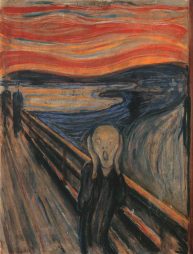
ScreamNot for them — for me!

I have actually noticed this often over my teaching career, but it has been particularly evident to me this week, when I have been feeling quite frustrated, angry, and disheartened by things that need to stay off this blog (at least for now): teaching is good for my mental health. However glum or grim I feel as I head over to my classroom, by the time I come out I almost always feel better: more energetic, more focused, happier about my job and even, usually, happier about my life in general. Why do you suppose that is? Fellow teachers, do you also experience this effect?

I think for me at least one reason it happens is that I always inhabit a persona when I’m teaching: class is always a bit of a performance, with me playing the role of “Myself, Only More So, And More Positive.” Though I am always sincerely enthusiastic about our readings and topics of discussion, I make a point of showing that enthusiasm and being as upbeat and energetic as I can manage about our work. My hope, of course, is that this enthusiasm is contagious, or at least that it gets and maybe even keeps people’s attention, if only in the spirit of “What is this strange woman so excited about?” Even when I’m depressed or cranky otherwise, I try to get into this role once class begins, and after a while, especially if participation is good and the discussion is interesting, I usually forget I’m in a bad mood and just carry on as usual. Advice to “fake it till you make it” has always sounded shallow, even a bit creepy, to me, but in this context, there’s definitely something to it.

marybartonAnother reason teaching is a tonic for me, though, is precisely that I am not faking my interest in the course materials, and time spent really focusing on them brings me back in touch with the things that brought me into this profession in the first place. I loved being an English student myself (well, I loved being an undergraduate student – I mostly hated being a graduate student), and it’s in the classroom that the reasons for that are most present to me: the books themselves, of course, but also the open-minded engagement with them — teasing out what is most interesting, looking at the details and trying to put them into patterns that illuminate the whole, thinking and talking about the ideas that animate them, and all this, best of all, in conversation with other keen readers who bring their own questions and ideas to the process. This week’s readings are very purposeful, too, which gives our work on them extra urgency: in Mystery & Detective Fiction, we’ve just wrapped up Sjöwall and Wahlöö’s The Terrorists, and in 19th-Century Fiction we’ve just started Gaskell’s Mary Barton, so  in addition to their literary particulars, they raise lots of questions about art and politics, about class conflict, about women and economics and law and justice and equality … about values, in other words, and how novels can serve them. That’s good stuff! I have spent a fair amount of time in recent months dealing with the aspects of academia that I like the least. Time in the classroom reminds me that all the rest of it is, ultimately, in service of something I really do cherish.

It’s also just a good thing in general to be forcibly distracted from the source of one’s stress. I am something of a brooder, and when things are giving me trouble they go round and round in my mind, interfering with my concentration during the day, keeping me up at night, and generally infecting my consciousness. At these times, it’s not ideal to have reading as my chief hobby and pleasure, as it is a relatively passive activity and does not necessarily keep the troubled mind from wandering. Writing, too, can become pretty compromised by stress. If I do get caught up in either reading or writing, it can be wonderfully transporting and restorative, but sometimes that turns out to be a big “if.” Teaching, however, absolutely demands my full attention — which is why it can be so exhausting, but also, I think, why it can be so therapeutic. If for an hour or more you simply can’t get on that mental hamster wheel of doubt or anxiety or confusion, you may be a little slower clambering back on it when you return, and who knows, eventually you may even bypass it entirely and find a clear, positive path forward.

“There Was More To It”: Elmore Leonard, Valdez Is Coming

valdeziscoming

He would say to Tanner, ‘You see how it is? The woman doesn’t have a man, so she needs money. You have money, but you don’t have a woman. All right, you pay for the man and you get your woman.’

It seemed simple because in the beginning it was simple, with the Lipan woman sitting at her husband’s grave. But now there was more to it. The putting him against the wall and tying him to the cross had made it something else.

Elmore Leonard’s Valdez Is Coming is the second Western I’ve read and the first real Western, since I gather True Grit is properly considered more of an anti-Western, a self-conscious (if appreciative) tongue-in-cheek revision of Western tropes rather than a sincere instance of them.

Although I already feel as if these two might be enough Westerns for me, I thoroughly enjoyed Valdez Is Coming, partly because it is so sincere, not to mention suspenseful. It is also stylish: the prose is terse, repetitive, and epigrammatic in ways that reminded me of hard-boiled detective fiction — which makes sense, of course, as the two genres are closely related. When setting up Hammett or Chandler in my Mystery & Detective Fiction class, I always talk about frontier justice and the appeal of the vigilante, and also about the idea of the hard-boiled hero as (quoting Robert B. Parker) “the last gentleman”: he belongs, Parker says,

to the chivalric tradition — a tradition he shares in this country with the Westerner. He is not of the people; he is alone.  His adventures are solitary statements.  his commitment is to a private moral code without which no other code makes sense to him.  He regularly reaffirms the code on behalf of people who don’t have one.  He is the last gentleman, and to remain that he must often fight.  Sometimes he must kill.

It’s a central paradox of the hard-boiled private eye that his violence elevates rather than condemns him: for us to accept that, we have to be convinced of his “private moral code,” to believe that he kills for the right reasons. This means that though the stories are filled with action, they really turn on principle — and that is exactly true of Valdez Is Coming. By the end of the novel Valdez has killed over a dozen men, but even though by then things are more complicated than they seemed at first, there’s no doubt that he’s in the right, that we are rooting for him as he picks them off one by one in defense of himself but also of the code he can’t quite articulate but follows without equivocation.

What exactly is that code? It begins with an instinct for justice: Valdez kills a man for the wrong reasons, not without meaning to but certainly without wanting to, and figures that he and the others responsible owe the man’s pregnant widow reparations. The dead man is black, however, and his woman is Apache, so nobody else believes they owe her anything. When Valdez confronts Tanner, whose wrong identification led to the shooting, with his proposals, Tanner’s men test his nerve by using the wall around him for target practice:

Valdez felt his hat move and felt powder dust from the adobe brick in his eyes and in his nose and felt chips of adobe sting his face and hands and felt a bullet plow into the wall between his knees and a voice say, “A little higher you get him good.”

He keeps his cool, staring them down and eventually, when Tanner’s “segundo” calls enough, riding away. But when he comes back a second time with the same request, Tanner’s men beat him, tie him to a cross, and send him crawling home — or, more likely, to die in the dust and the sun. Now it’s not just about justice for the woman: it’s also about his own honor and the need to turn this humiliation and defeat into victory. I won’t spoil the fun by giving away any more details. It’s enough to quote the pitch-perfect cover blurb: “They were still laughing when Valdez came back. And then they began to die . . . ”

valdez2Valdez himself is an interesting character: though he feels no ambivalence about his specific conflict with Tanner, he is less certain about his own role in life more generally, and the relationship he develops with Tanner’s fiancée Gay (whom he kidnaps as leverage) adds more nuances. It’s to be expected, though, that the protagonist will have some depth, so what I appreciated more is the way key secondary characters also have their own motives and their distinct roles to play in the denouement, including Gay herself but also Tanner’s “segundo.” One of the best bits in the novel is wholly inessential to its plot but adds a great deal to the atmosphere and to our sense of the kind of world its characters live in. Valdez shoots one of Tanner’s men and sends him back with a message. He delivers it and then lies dying, and we spend nearly two pages with him as he reflects on Valdez, and on his own life and immanent death:

He should have thought more about the way the man stood at the wall and watched them shoot at him. He should have remembered the way the man got up with the cross on his back and was kicked down and got up again and walked away. Look — someone should have said to him, or he should have told himself — the man wears three guns and hangs a Remington from his saddle. What kind of man is that? And then he thought, You should know when you’re going to die. It should be something in your life you plan. It shouldn’t happen but it’s happening. He tried to raise his left arm but could not. He had no feeling in his left side, from his chest into his legs. His side was hanging open and draining his life as he looked at the sky. He said to himself, What is the sky to me? He said to himself, What are you doing here alone?

Life may be cheap in this world, death may be fast and sure, but the existential pathos here counteracts the indifference, courage, or grim determination with which the characters otherwise seem to confront their harsh circumstances.

I’m surprised, really, how much fun I found Valdez Is Coming. Still, I can’t imagine reading a lot of books like this — not in a row, certainly. I also have some hesitations about teaching it: it is full of racial slurs, for one thing, and while I think it’s pretty clear not just that they are historically and contextually appropriate but also that the novel as a whole rejects the attitudes they express, that does create some pedagogical challenges. There’s also a lot about its contexts that I don’t know, and of course this is not the kind of novel that’s available in a helpfully annotated edition! That can be rectified with research, though, and for better and for worse it does seem more “pulpy” than True Grit.

This Week In My Classes: Catching Up

When it’s quiet over here at Novel Readings, that’s generally a sign that I’m busy elsewhere, and that is more or less what’s been up this week. After I got back from Louisville, I had some catching up to do, especially with midterms that needed to get graded so we could all move on to the next thing. Don’t you find, too, that a break in routine throws you off when you get back? I felt really off my teaching game last week, though I hope it didn’t show too badly in the classroom. There are non-teaching things that have also been taking my attention away from teaching more than is usual during the term: our workload is usually described as 40% teaching, 40% research, and 20% administration, but for me the distribution during a teaching term tends to be closer to 60-20-20, with the summer months bringing things back into alignment. For various reasons the balance has been different for me this year — not, perhaps, officially, but at least in where my attention is. So I don’t think I’ve been at my best in class.

Still, we are moving along. In Mystery & Detective Fiction we’ve wrapped up our discussions of The Big Sleep, and in 19th-Century Fiction today was our last day on Jane Eyre. Next week we start Mary Barton, and I’m looking forward to it partly because it’s not a novel that’s well known, in itself or through adaptations. I mentioned before the challenge of teaching a book as beloved as Pride and PrejudiceJane Eyre isn’t quite as much of a general favorite, but it definitely still a personal favorite for many students — which, again, is great in some ways but occasionally challenging. I don’t think anyone has any preconceptions or cherished readings of Mary Barton (well, except me, and that kind of goes with the territory!). I began my own rereading of it while the students were writing their Jane Eyre “mini-midterm” today, and I felt a momentary pang that I’d chosen it over North and South (my usual Gaskell), but then I started to get drawn into both its personal stories and its class politics. It isn’t as neat and artful as North and South, but that very untidiness can be something of an advantage for discussion.

I’ve been doing some reading outside of school, but the two books I’ve finished are both ones I’m reviewing elsewhere, so I didn’t want to blog about them. (In case you’re interested, they are Dan Vyleta’s Smoke and Dinitia Smith’s The Honeymoon; details about the reviews will be forthcoming if all goes well.) I guess if you want some nice fresh book writing you’ll have to go to Open Letters instead, where the March issue — our 9th anniversary issue — is full of good things, from Sam’s review of A. O. Scott’s Better Living Through Criticism to Steve’s happy appreciation of a gorgeous new book on frogs. But come back soon! Because I’ve got Valdez is Coming to read this weekend, and I promise to post about it.

On Having and Earning Critical Authority

IMG_3141I don’t want to leave the impression that frustration with the rigidity of academic practices is all I took away from my Louisville conference experience. There was definitely value for me in the work I put into my own paper, as well as in hearing and discussing the papers my co-panelists presented. So I thought I’d follow up my previous post with a sketch of the questions I went to Louisville to talk about.

My paper was called “Book Blogging and the Crisis of Critical Authority.” During the discussion after our papers, all of the panelists agreed that things have died down since the days when you could hardly turn around without seeing yet another “bloggers ruin everything” article. A few diehards still take every opportunity to decry the temerity of feckless amateurs who think they can just go online, say whatever they want, and call themselves “critics” (I’m looking at you, William Giraldi), but by and large (as Dan’s paper convincingly argued) the success of many serious web magazines has proven that online criticism can be as good as if not better than its old media competition, and book blogs in all their idiosyncratic variety are now a familiar, if not always respected, feature of the critical landscape.

Daniel Mendelsohn’s conspicuously temperate “Critic’s Manifesto” was one sign of the changing times; in it he acknowledged (as so many of his professional colleagues would not) the existence of “serious longform review-essays by deeply committed lit bloggers.” Mendelsohn did still conclude that “everyone is not a critic”; he cites “expertise and authority” as crucial qualifications (“knowledge … was clearly the crucial foundation of the judgment to come”) along with a more ineffable quality that he sums up as “taste” (“whatever it was in the critic’s temperament or intellect or personality that the work in question worked on“). Though he concedes that the requisite knowledge does not depend on formal credentials such as Ph.D.s, he does ultimately describe the critic’s job as being “to educate and edify” — so, it’s still a top-down or hierarchical model.

ao scottMendelsohn’s article was one of the sources I cited in my paper, in which I explored some questions about what we mean by “critical authority.” As he notes, once you move outside the academy degrees are neither a necessary nor a sufficient measure of the relevant expertise. But it’s not easy to pin down what does count, how authority is established, especially in a field of inquiry where there are no sure or absolute standards of judgment. Literary critics know that their authority is unstable because the history of criticism teaches us how judgments change over time, while simple experience shows us how much they differ among individuals. We can call variant assessments “gaffes” or “errors in individual taste,” as Mendelsohn does in his recent New York Times review of A. O. Scott’s Better Living Through Criticism, but he can’t actually prove that “early and wince-inducing takedowns of John Keats’s poetry, [or] of “Moby-Dick” are flat-out wrong any more than I could convince my Modernist colleagues that George Eliot is objectively a better novelist than James Joyce. Still, the rhetoric of criticism as well as its traditional methods of delivery typically seek at least the appearance of offering definitive judgments. As Sebastian Domsch argues in his interesting essay about ways the internet transforms critical genres, criticism has typically attempted to be and sound “monologic,” as if “everything that needed to be said has been said and there are no more follow-up questions possible.”

One reason blogging aroused such hostility, I proposed, was that it exposed the artifice of this model, and indeed of any idea of literary criticism as a series of edicts issued from on high, leaving critics themselves exposed, not as frauds, but as less authoritative than they pretended to be. As Mendelsohn says in his review of Scott, “the advent of the Internet” has “rais[ed] still further questions about authority, expertise and professionalism”; I argued that it has done so by breaking down monologic forms and exposing the inherently dialogic nature of both critical judgments and critical authority. Domsch defines “critical authority” as “the level of acceptance that is conceded by a reader to an aesthetic value judgment”: I think he is right to emphasize that this kind of authority is not inherent in the speaker but conferred by context and audience. In my paper I drew on Wayne Booth’s notion of “coduction” to make the case for the importance of dialogue in developing critical judgments, and I pointed to blogging as a form that establishes “follow-up questions” as both a natural and an inevitable part of criticism.

MendelsohnBarbariansIf critical authority is not something you simply have but something you have to earn and maintain by your own participation in a dialogue — if it is best understood not so much as a top-down assertion of superiority (“the critic’s job,” Mendelsohn proposes in his recent review, “is to be more educated, articulate, stylish, and tasteful … than her readers have the time or inclination to be”) but as a process of establishing yourself as someone whose input into an ongoing conversation is sought and valued — that helps explain why “expertise” is such a tricky thing to define for a critic. Mendelsohn’s original formal training is as a classicist — despite his wide-ranging erudition and critical prestige, he would almost certainly not qualify for an academic position in any other field — but obviously he has written with considerable insight on a wide range of subjects, from Stendhal to Mad Men. That so many of us read Mendelsohn’s criticism with interest and attention no matter what he writes about is a sign that we have come to trust him, not as the last word on these subjects, but as someone who will have something interesting (“meaningful,” to use one of his key terms) to say about them. If we disagree with him, we are not challenging his authority but continuing the conversation — and in fact one thing I’ve been thinking a lot about is how little disagreement really matters to this kind of critical authority. If what we go to criticism for is a good conversation, then engaged disagreement can be seen as a sign of authority — a sign that you care enough about the critic’s perspective to tussle with it, if you like. I can think of a number of critics in venues from personal blogs to the New Yorker whose views I would not defer to, but which I want to know because they provoke me to keep thinking about my own readings — which (however definitive the rhetoric I too adopt in my more formal reviewing) I always understand to be provisional, statements of how something looked to me in that moment, knowing what I knew then, caring about what I cared about then.
boothcompanyI’m not saying we can’t or shouldn’t defend our critical assessments, but awash as we are and always have been in such a variety of them, it would be naively arrogant at best and solipsistic at worst to imagine ourselves as “getting it right,” no matter who we are or where we publish. Blogging very often reflects that open-endedness in its tone, and its form is based on just the process Booth describes as “coduction”:

‘Of the works of this general kind that I have experienced, comparing my experience with other more or less qualified observers, this one seems to me among the better (or weaker) ones, or the best (or worst). Here are my reasons.’ Every such statement implicitly calls for continuing conversation: ‘How does my coduction compare with yours?’

The comment box makes that implicit call explicit. This doesn’t mean “erudition, taste and authority” (the qualities Mendelsohn repeatedly invokes) don’t matter — though the extent to which they matter will depend on what you want from criticism. Domsch argues, for instance, that Amazon reviewing ultimately returns us to the most monologic form of criticism: people seek out, or are steered to (by algorithms, ‘like’ buttons and so on) the reviewer whose views and tastes are closest to their own, and once they find their “virtual” critical self, their critical proxy, as it were, they have found their perfect authority, a guarantor of their own well-established tastes. But Amazon is fundamentally about shopping. If you read criticism for some reason other than deciding which book to buy next, you are likely to look for and concede authority to different qualities. In my paper I noted that I don’t want to be told about books — I want to talk about books. So sympathetic as I am with most of what Mendelsohn says, I resist his insistence on the critic’s superiority as a necessary or structural part of the relationship.

The result of accepting, rather than resisting, the challenge blogging poses to old-fashioned critical forms is, I argued, not a catastrophically relativistic criticism of the kind Peter Stothard dreaded but a pluralistic criticism, such as that described by Carl Wilson in Let’s Talk About Love:

a more pluralistic criticism might put less stock in defending its choices and more in depicting its enjoyment, with all its messiness and private soul tremors — to show what it is like for me to like it, and invite you to compare. This kind of exchange takes place sometimes on the internet, and it would be fascinating to have more dialogic criticism: here is my story, what is yours?

I’d be very interested to know what you think about this argument, particularly about my proposal to redefine “critical authority” in a more reciprocal and context-dependent way than the anti-bloggers always do. What makes a critic “authoritative” to you? Or is “authority” not something you think or care about? If it isn’t, how would you explain what makes a critic someone you want to listen to or engage with? Are there critics you pay attention to because their taste (I might prefer the term “sensibility” myself) reflects yours, or because they push you to less familiar points of view? Does disagreeing with a critic make you doubt them, or does it depend on the critic, or the context? More generally, what do you want from criticism, and how do you think that affects where you read it and who you listen to?

The first picture here is one I took of the Big Four Bridge across the Ohio River from Louisville to the Indiana side. It was a really nice walk across and back!

The Conference Convention

campusI’m back from Louisville, where Dan Green, David Winters, and I presented a panel of papers on criticism in the internet age at the 44th annual Louisville Conference on Literature and Culture since 1900. The panel itself was something of an anticlimax (more on that in a bit), but it was a genuine pleasure to meet both Dan and David in person and share stories and ideas about blogging, criticism, and working online. Another highlight was hearing Mat Johnson read from and discuss his latest novel Loving Day, and I also really enjoyed chatting with the amiable Woolf scholars I sat with at the conference dinner.

I built some slack into my travel schedule as I was quite anxious about being delayed by winter storms, if not here, then in one of the other wintry airports I had to pass through coming or going (Ottawa, Chicago, Montreal): miraculously, even the record-breaking snowfall in Ottawa that hit just as I was passing through did not hold up my flights, so I arrived a day before the conference began and had a little time to play tourist (on my own dime, don’t worry). I passed up the Louisville Slugger Museum in favor of the Frazier Museum, as I’m not a baseball fan and I like to get a sense of the local history; then, when that turned out not to be a particularly time-consuming expedition (it’s not the biggest or most fascinating museum in the world), I headed to the Kentucky Derby Museum where I paid tribute to the spirit of Dick Francis. After a lot of diligent conference-going, I took a bit more time near the end of my stay to walk in Waterfront Park, including trekking across the Big Four Bridge to the Indiana side and back. It’s probably a prettier park when it greens up, and the river itself seemed kind of a muddy mess, but (after a bitter cold start to my visit) it was 21 C that day and a treat to be outside coatless in the sunshine.

derbyEven taking these good things into account, though, I left Louisville feeling more than ever that, as a profession, we need to rethink how we do things. One of the main incentives for me to participate in this panel was that I have recently been given emphatic notice that I haven’t been going to the number of conferences expected of someone in my position. A significant number of academics apparently consider frequent conference-going a key measure of scholarly productivity and knowledge ‘dissemination.’ Frankly, I thought this was bollocks when it first came up as a criticism of my record, and my experience in Louisville only confirmed me in that view. Here’s why: Under pressure to show I am doing the “right” things professionally, I traveled a long distance at great expense (a significant amount borne by me personally, as the funding available did not cover nearly the full cost) to present a 20 minute paper to an audience of 8 people. All around me, hundreds of other academics were there doing the same, sometimes to even smaller audiences (the smallest I saw was 3 people plus the panelists, the largest, excluding keynotes, was about 16 — for a panel on Joyce — and one of the keynotes itself had an audience of maybe 15). Though there’s no doubt that some of the attendees were genuinely engaged with the papers they heard, most of them will take little concrete away besides a vague sense of the argument. One questioner at a panel I attended prefaced his remarks (as usual, questions were usually of the discursive rather than inquisitive variety) by saying that he’d heard a paper at another conference by someone whose name he couldn’t remember making an argument he dimly recalled had been somewhat similar to the one he’d just heard: though I’m sure there are some exceptions, that impressionistic result seems to me pretty typical, at least of a conference as diffuse as this one.

MLA-logoThe small audiences and inchoate overall experience is in part a function of the kind of conference this was: papers were collected under a very large umbrella, and (I suspect) accepted somewhat indiscriminately, perhaps with the admirable goal of being inclusive. But when there are 10 or more concurrent sessions in every time slot, there’s little chance of robust numbers at any given panel, and even less chance of a sizable cohort of conference-goers having much of a common experience and thus much deep, shared conversation. My experience of ACCUTE (not to mention the MLA) has been very similar: I’m not faulting the Louisville organizers in particular. Even the BAVS conference that I went to in 2011, though considerably more focused and thus more productively collegial, was fairly dispersed. At BAVS, though, I felt my own contribution got more attention and thus generated more valuable discussion for all concerned: remember, the purpose of these events is not supposed to be accumulating lines on one’s c.v. but having a face-to-face intellectual experience that matters so much it’s worth the time and money and environmental impact of all this gadding about.

twitterlogoOnce upon a time going to conferences really was our best option for letting a wider audience know what we are working on, for getting feedback on work in progress, and for networking with colleagues in our field. But while I think it is possible for a conference experience to be genuinely valuable, particularly if the conference has a narrower focus and a different format (a friend of mine speaks very highly, for instance, of the Shakespeare Association‘s annual meetings), we really do have other options today for many of the functions conferences used uniquely to serve. Just for instance, Novel Readings may be very small potatoes as blogs go, but I still reach more people with every post here than I have ever spoken to at a conference (sometimes more than all of my conference audiences combined), and the comments are every bit as engaged and engaging as any in-person sessions, and often more because they arise from a written text (not, as with most conference papers, a written text read aloud, with all the attendant disadvantages). Here I can link to things I’m talking about, creating a tangible network of related material, and my writing can be referred and linked to in turn. As I have often observed, my blog is not a particularly “academic” blog (setting aside for the moment the question of when reading, or writing about reading, counts as research) — but the form of a blog is perfectly suited to sharing just the kind of thing usually presented as a conference paper and getting feedback and suggestions for furthering “the larger project” (if I had a dime for every time I heard that phrase in Louisville, I think it would have covered the rest of my hotel bill!). Twitter is great for networking — admittedly, there’s a learning curve, but compared to the dreary 24 hours (literally) I spent traveling to and from Louisville, the time it takes to populate a useful Twitter feed and learn how to use a hashtag is nothing. And these are just the most obvious alternatives to flying half way across the continent to sit in a dingy room telling a few hardy souls (some of whom, it must be said, are actually editing their own papers or checking Facebook rather than listening intently to you) about your insight into Woolf’s aesthetics.
southridingI think I personally would have found the Louisville conference more intellectually stimulating if I were a modern literature scholar myself: I had a harder time even than usual latching on to the papers’ arguments because they were typically quite specialized contributions to scholarly inquiries I know little about. I went mostly to Woolf panels because at least there I knew the primary sources a bit! (I was interested to note that there were no papers, much less panels, on Winifred Holtby or Vera Brittain at all; there was one paper on Sayers, but I saw no sign of Rebecca West or Rosamond Lehmann or Mollie Panter-Downes or Elizabeth Taylor or Olivia Manning or any of those I think of as the ‘Virago’ set. Eliot, Pound, Woolf, Joyce, a bit of Lawrence and Forster — this was a pretty canonical outing. You 20thC people can tell me if that’s typical or just Louisville.)

I’m not sorry I went: it was an adventure, it was a change of scenery (which I really needed), I spoke with a number of really interesting people and made a couple of new friends. But why anyone would insist I should do this kind of thing more often, while shrugging off the other ways I share my writing, network with other academics, and facilitate not just my own but other people’s ‘knowledge mobilization’ completely escapes me. Just because that’s how the profession has operated for a long time, or just because it is the kind of scholarly activity some academics are used to and perhaps even enjoy, simply does not mean it is the best use of my time or the university’s resources. We need to be open-minded about other options that serve the same purposes, often more efficiently and effectively. In this, as in scholarly publishing, it seems to me that the familiar form is too often valued over the real function of the work itself.

“The Whole Tragedy of Her Life”: Edith Wharton, The House of Mirth

whartonpenguin

In the long moment before the curtain fell, he had time to feel the whole tragedy of her life. It was as though her beauty, thus detached from all that cheapened and vulgarized it, had held out suppliant hands to him from the world in which he and she had once met for a moment, and where he felt an overmastering longing to be with her again.

The House of Mirth reminded me again and again of other novels. In Lily Bart I saw Gwendolen Harleth, proud and sure in her beauty and her certain good fortune until she learns she cannot in fact control her own fate; I saw Isabel Archer, similarly proud and sure and beautiful, then caught in traps set by people more subtle and more corrupt than she is; perhaps because I just read Vanity Fair, I also saw Becky Sharp, motherless, nearly friendless, determined to invest the capital of her wiles and charms where she will get the best return at the least risk. Lawrence Selden plays an off-center Deronda to Lily’s conscience, which like Gwendolen’s is capable of a saving (but paradoxically destructive) clarity about moral hazards and compromises; Mr. Rosedale is Sir Pitt without the peerage, or Grandcourt without the malice.

I don’t mean that The House of Mirth is derivative, only that these books all present us with variations on a theme: what is a young woman of high spirits to do in a world that limits her options so severely and judges her equally harshly for trying to make something of herself and for failing in the attempt? “It was a hateful fate,” reflects Lily, contemplating marriage with a rich man who will “do her the honour of boring her for life” — “but how escape from it? What choice had she?” Brought up to see marriage as their only means of survival (and perhaps of happiness), equipped to do little more than charm but convinced at first of the sufficiency of this necessary skill, all of these women learn hard lessons about their real lack of social, economic, and even personal power. Their novels are all, as a result, deeply depressing and openly condemnatory — not, ultimately, about their heroines (with the possible exception of Becky), but about the hypocrisy and vapidity of the worlds they portray. Lily “could not hold herself much to blame” for her failures to find a productive alternative to the role she has been raised to fill:

Inherited tendencies had combined with early training to make her the highly specialized product she was: an organism as helpless out of its narrow range as the sea-anemone torn from the rock. She had been fashioned to adorn and delight; to what other end does nature round the rose-leaf and paint the hummingbird’s breast?

“It was the life she had been made for,” she concludes:

every dawning tendency in her had been carefully directed toward it, all her interests and activities had been taught to centre around it. She was like some rare flower grown for exhibition, a flower from which every bud had been nipped except the crowning blossom of her beauty.

penguinportraitIt’s an image that is specific to Lily’s situation and history, but it’s also the familiar refrain of women seeing the myth of their influence, and the perfection of their weakness, exposed as lies that serve everyone but them. It’s not just Becky shamelessly marketing herself, but Amelia, trying to scrape together enough money to keep her son at home, and Gwendolen presenting herself to Klesmer in the vain belief that she can be a great singer just by wishing it so, and Isabel imagining she has not just the freedom but the wisdom to choose her future.

For all the similarities, what’s so interesting is how differently the story plays out in each case, not just in the plot but in the whole mood the authors establish, which becomes part of the moral vision they present. Wharton is the only one who takes us all the way to tragedy: she is the only one who risks despair, rather than offering remedies, which is perhaps a sign of her modernity. Even James leaves Isabel standing, and at least by the end of the novel she has become more knowing, which in James’s universe may be the equivalent of grace (to be saved is to be one of the people on whom nothing is lost). Lily and Selden have a final encounter that is very much in the spirit of Eliot’s moments of redemptive fellowship, and Lily’s meeting with Nettie Struther and her baby offers her (and thus us) a vision that transcends the relentless downward spiral of her life:

In whatever form a slowly-accumulated past lives in the blood — whether in the concrete image of the old house stored with the visual memories, or in the conception of the house not built with hands, but made up of inherited passions and loyalties — it has the same power of broadening and deepening the individual existence, of attaching it by  mysterious links of kinship to all the mighty sum of human striving.

Such a vision of the solidarity of life had never before come to Lily.

In Eliot’s fiction that wider perspective is precisely what draws a suffering protagonist out of her own misery and into sympathy with the larger world. But though Lily’s “surprised sense of human fellowship took the mortal chill from her heart,” it does not help her but only fills her with a deeper horror at the isolation and futility of her own lonely existence. Perversely, the “height of her last moment” with Selden and the unexpected glimpse of something sweeter become moments too precious to survive: “If only life could end now — end on this tragic yet sweet vision of lost possibilities, which gave her a sense of kinship with all the loving and foregoing in the world!”

mirth2Lily’s life does end on a “tragic yet sweet” note: tragic because she is hopeless and, she believes, loveless; sweet because she spares herself (or is spared — Wharton carefully avoids the specificity of suicide) the further — perhaps even worse — compromises she sees in her future, and also because at least in death she is loved for herself, not just for the market value of her beauty. I don’t think Wharton means to leave us in despair, despite Lily’s catastrophic decline: Selden’s belated arrival is one sign that something better is at least imaginable. As he thinks, kneeling by her death bed, “at least … if the moment had been fated to pass from them before they could seize it, he saw now that, for both, it had been saved whole out of the ruin of their lives.” That such a moment is even possible is a slim but real victory for optimism. That its promise is unfulfilled leaves us with the dissatisfaction that we also feel finishing Daniel Deronda and The Portrait of a Lady. Surely something better should be possible for these remarkable women: what a waste their worlds have made of them!

I read The Age of Innocence a few years ago but retained little specific impression of Wharton’s style, so I didn’t really know what to expect when I began The House of Mirth — something, I feared, closer to Henry James than to George Eliot. But while Wharton is nearly as minute in her attention as James, her prose is much more direct and energetic. She rarely reaches for the kind of broad philosophical perspective George Eliot always offers, but at times (and particularly in the bit I’ve quoted above about the “mysterious links of kinship to all the mighty sum of human striving”) she sounded a lot like Eliot, so much that I wondered if for her as for James, Daniel Deronda was a specific influence. Though the books are very different in structure and scale, Wharton also shares Eliot’s ruthlessness about the moral consequences of our actions, and her compassion for someone who has tried to be better and failed. Lily would have suffered much less (as would Gwendolen) if she were less self-aware and better insulated against her own conscience. The milieu in which Wharton’s characters move is as compressed in its own way as any of Austen’s country towns, and the social interactions have the same intensity of implication. In a way, I felt I was getting the best of all these worlds: a crisper, brisker narrative but one that is at least as incisive and certainly as pathetic as any of the others.

This Week In My Classes: Team Brontë!

Tweet.jpgI got a bit snippy with the tweeters from Oxford World’s Classics a couple of days ago. Poor things: they were just doing their job, spreading some news about great books and trying to get people to click through and read it. How could they know that I was already feeling grumpy, for reasons quite beyond their control, and that this particular gimmick pushes my buttons on a good day?

Despite recent strident proclamations about the importance of critical partisanship, the wonder of literature is that we don’t have to take sides — except, at any rate, against the cheap or the shoddy. (And though I am as quick to attack these when I think I detect them as the next critic, I think Weseltier moves rather too quickly past the problem of the critic’s inevitable “fallibility” in his call for “mental self-esteem” — his complaint about A. O. Scott’s “epistemological humility” as a critic actually plays neatly into the topics of the talk I’ll be giving in Louisville next week.) It’s a good thing, too, because who would want to decide which of Pride and Prejudice or Jane Eyre should get voted off the literary island? To be forced into such a choice would be truly tragic, because it would be choosing not between the good and the bad, or the good and the better, but between two competing goods, each equally deserving of our passionate loyalty. We would become critical Antigones — and our literary lives would suffer accordingly.

oxford jane eyreBut (and you knew it was coming, right?) if for some absurd reason I absolutely had to choose, not which novelist is in any absolute sense “the greatest” but whose team to play on, it would be Brontë all the way — and I say that having only just enjoyed Pride and Prejudice entirely and absolutely for about the 50th time. We’ve just started working our way through Jane Eyre in the 19th-century fiction class and what a thrill it is. I know it’s a cliche to associate the Brontës with the moors, but it does feel as if a fresh, turbulent breeze is rushing through, stirring things up and bringing with it a longing for wide open spaces. The freedom and intensity of Jane’s voice, the urgency of her feelings, and of her demands — for love, for justice, for liberty — it’s exhilarating! I brought some excerpts from contemporary reviews to class today to demonstrate the shock and outrage with which some 19th-century critics received the novel: it’s striking how much the very qualities that enraged and terrified them are the same ones that make so many of us want to cheer Jane on. By the end we know that we should not have allied ourselves so readily with Jane’s violent rebellion, and we may even be equivocal about the conclusion to her story, but I think it’s impossible to read the novel and not be wholly caught up in her fight to define and then live on her own terms.

It’s not all about feeling, though: there is tremendous artistry in the telling as well, and of course the novel is endlessly provocative to interpret too, from its imagery and symbolism to its evocations of fairy tales, from its religious debates to its feminist declarations, from its colonial entanglements and psychological intimations to its re-imagining of the marriage plot and the novel of development. I think that in some ways it anticipates Gaudy Night in its exploration of the relationship between head and heart, and in the radicalism of its heroine’s (and its author’s) refusal to succumb to the fantasy that love alone is all we need.

pride-and-prejudice-penguinI started rereading Emma recently and had to put it aside. I appreciate that it is aesthetically and morally complex and infinitely nuanced, but I felt smothered by it: I found it claustrophobic. Brontë’s criticism of Austen is well known: she told G. H. Lewes that in Pride and Prejudice she found only “an accurate daguerrotyped portrait of a commonplace face; a carefully fenced, highly cultivated garden, with neat borders and delicate flowers; but no glance of a bright vivid physiognomy, no open country, no fresh air, no blue hill, no bonny beck. I should hardly like to live with her ladies and gentlemen,” she went on, “in their elegant but confined houses.” I think she underestimated the novel — a lot of people do, still, who see just the delightful characters moving on the surface and not the currents of social and historical change carrying them along. I’m also sure that my trouble with Emma is about me, not Austen. But I understand Brontë’s reaction, and it is just the one you would expect, too, from the author of such an entirely different book, one that opposes itself in every way to both literal and mental confinement. I think that’s why Jane Eyre refreshes my soul: it rushes with us out into the hills. Jane is so defiant, so passionate, so forthright: she speaks  up so fearlessly, for herself and for the right! I wish I could always do the same: I admire her principles and envy her courage. So much as I would miss Elizabeth Bennet if for some reason I had to give her up, Jane’s the one I really couldn’t do without.

Still, I’m very glad I don’t actually have to choose, not least because without the the two of them together, surely Margaret Hale, and Maggie Tulliver, and Dorothea Brooke, and Gwendolen Harleth all become unthinkable — and that would be tragic indeed!

“Many wise and true sermons”: Louisa May Alcott, Little Women

threadscover

Amy stood a minute, turning the leaves in her hand, reading on each some sweet rebuke for all heart-burnings and uncharitableness of spirit. Many wise and true sermons are preached us every day by unconscious ministers in street, school, office, or home; even a fair-table may become a pulpit, if it can offer the good and helpful words which are never out of season.

It’s not really possible for me to read Little Women: even though the last time I turned every page of the book was probably more than thirty years ago, it’s so familiar that all I can do now is remember it. Here are the four girls, cheerfully reconciled to giving away their Christmas breakfast; here’s Amy, falling through the ice after the terrible breach with Jo; here are the slippers Beth (dear Beth!) worked with pansies, for Mr. Laurence; here’s Meg, blushing with her John on her wedding day then ruining all the jelly and their first dinner party; here’s Laurie, dashing and impetuous and all wrong for Jo; here’s Professor Bhaer, warmhearted and avuncular as the last time he offered the shelter of his umbrella. Such good old friends!

ebeditionI used to read about them in my mother’s old, cherished copy: I discover, peering around online, that it was the “Illustrated Junior Library” edition from Grosset and Dunlap, with an original copyright date of 1947. The cover alone is immediately evocative of my childhood! I loved the novel and reread it often; I had been feeling mournful that I didn’t have a nice copy of my own, so I put the Penguin Threads edition on my Christmas wishlist this year and was thrilled to get it. It’s very satisfactory: not only is the cover delightful to an embroidery buff like me, but the whole volume is tactile in all the right ways, from the raised graphics on the artwork to the heavy, deckle edged pages. It feels the way a classic should.

I can’t remember a time when I didn’t know the stories of the March girls, from the opening line (“Christmas won’t be Christmas without any presents”) to their varied but all equally happy endings. I suppose I identified most with Jo, or wanted to (I was never so daring!), but it was the quartet as a whole, I think, that made the greatest impression on me — that, different as they were from each other, they loved and stood by each other. I don’t remember ever noticing how didactic the novel is, or how quietly but assertively religious, or how conservative some of its lessons are, especially about women’s roles (“a woman’s happiest kingdom is home, her highest honor the art of ruling it – not as a queen, but a wise wife and mother”). These qualities did all stand out to me this time, and I wondered why I didn’t — indeed, why I still don’t — chafe against them. I think it’s because Alcott suffuses her story with such humane tenderness: all of its lessons are so thoroughly embodied, especially in Marmee but also in the girls as they struggle to grow into their best selves.

It was interesting reading Little Women at the same time as Vanity Fair. They are companion pieces in a way, really: both built on the model of The Pilgrim’s Progress, but one a cautionary tale about folly and vice, teaching its lessons entirely by negative example, the other a reassuring story about the possibility of virtue. In class today we discussed Thackeray’s ambition to make us all dissatisfied, as a means of goading us into being and doing better. His characters die alone, unhappy, unloved, and unwept; in Vanity Fair, he offers us a saving deathbed revelation, a chance to save ourselves from such a miserable end. How different is Beth’s sad but beautiful death:

As Beth had hoped, the ‘tide went out easily’; and in the dark hour before the dawn, on the bosom where she had drawn her first breath, she quietly drew her last, with no farewell but one loving look and a little sigh.

With tears, and prayers, and tender hands, mother and sisters made her ready for the long sleep that pain would never mar again — seeing with grateful eyes the beautiful serenity that soon replaced the pathetic patience that had wrung their hearts so long, and feeling with reverent joy, that to their darling death was a benignant angel — not a phantom full of dread.

Where is the “Celestial City” in Thackeray’s vision? We couldn’t find a glimpse of it in his book — which seems all part of his lesson that we have to seek it out for ourselves, and resist the lures and temptations arrayed in Vanity Fair. In contrast, Little Women doesn’t just hold it out as a final destination but insists that we can create it around ourselves in this world if we are just honest and kind, generous and loving, patient and disciplined. Alcott’s final message is actually very similar to Thackeray’s: “The world is a looking-glass,’ his narrator observes, “and gives back to every man the reflection of his own face.” It’s just that unlike Becky (or Amelia, for that matter) the March girls learn to turn their best faces to the world — and they are richly rewarded for it. I made the argument today that the dissatisfaction Thackeray urges is a necessary component of moral and social change: if all’s well that end’s well, what is left for us to do, after all? But in its own way, Little Women is at least as motivating. And it’s certainly a lot more comforting!

“That Silent Creature”: Elizabeth Jane Howard, The Beautiful Visit

howardcoverLike a lot of other early – to mid- 20th-century women’s fiction I’ve read (Elizabeth Taylor’s A Game of Hide and Seek comes to mind, or Rose Macaulay’s The Towers of Trebizond, or most of Winifred Holtby’s novels, or Margaret Kennedy’s) Elizabeth Jane Howard’s The Beautiful Visit was a disorienting reading experience: I finished it feeling I did not have the right critical apparatus to make interpretive sense of it. Although my interest never flagged, I could not see where it was going or what it was meant to be about: though the experiences related are often emotionally intense, the tone is generally flat, almost affect-less, while the plot is not really a plot so much as a series of random incidents connected only by a general pattern of faint hopes raised and then dashed. Though it tells the story of a young girl’s maturation, it lacks the momentum of a bildungsroman; though it turns out to be a story of artistic development, or at least emergence, it lacks the inspiration of a kunstlerroman. What is its point? Where is it meant to take us, intellectually and imaginatively?

howardI ended up thinking that its lack of direction and energy was its governing idea. The narrator is stifled by her family life and by the social constraints on her behavior as well as her options: she would like to have a vocation, but she can’t really imagine what it might be. The visit that changes everything by showing her how other people live actually changes very little, at least about how she can live: its effects arise only through the new connections she makes, most of which turn out to be far less consequential than she expects. Even when they do lead to something significant (like a marriage proposal), the promised transformation ultimately has no appeal. The one big change that finally occurs at the novel’s end is so artificial, so unanticipated, that it doesn’t seem to solve or promise anything either, except perhaps that it is the beginning of the real bildungsroman, the real story of her life, which we don’t get because our novel is the story of the stuttering, inchoherent, mostly pathetic existence that preceded it. (Is it also factitious? There’s an odd moment when she frankly remarks her difficulty in figuring out how to end the autobiographical novel she’s writing / we’re reading.)

I can see that the novel is in part a critique of women’s stifled lives, and of the marriage plot they are so relentlessly expected to embrace. The narrator’s mother is a sad example of the error of living for someone else: “Your father believed in music,” she tells her daughter,

and I believed in your father. By the time he died, I don’t think he believed in anything, and now I find it very difficult to believe in him.

The story of beautiful Deb and her disappointments is another striking case in point: “life stops when one is married,” she says as she urges the narrator towards her own engagement, “and one ought to take care that it stops in a very good place.” The narrator (nameless, as befits her unformed identity) doesn’t want to marry, at least not just for the sake of marrying. “What will happen to you, if you don’t marry him?” demands Deb; “You surely do not intend spending the rest of your life doing those dreary jobs, do you?”

This seems a fair enough question, in the circumstances, so there’s something at least potentially heroic about our protagonist’s determination to resist her seemingly inevitable fate. She’s hardly rewarded for choosing independence, though, until she’s rescued improbably with a scheme to travel the world and determine its shape — a symbolic quest, I assume, meant to invoke visions of exploration and discovery, of new horizons both literal and metaphorical. Her previous inability to make any real changes is not really her fault, though it is her tragedy (more even than her sad but almost accidental wartime love affair). Her unexpected savior rightly observes that for all her attempts to escape, she has carried her “family atmosphere” along with her. I wonder why it doesn’t feel more triumphant, then, when she seizes opportunity to do, and be, something else: “On board a great deal of unpacking was necessary,” she reports without excitement; “I was given a cabin to myself with a good small table for writing.”

visitcoverThat she is well-suited to be a writer is often asserted by people she meets, mostly because she is so observant. I suppose The Beautiful Visit does give us some evidence of that: mostly silent herself, the narrator watches those around her with a sharp, if often somewhat puzzled, eye. Her lack of experience limits her insights into others as well as herself, but what she sees, she describes. That her account is so episodic suggests her own lack of direction. Other people find her more interesting than I did: when the young man she met on the initial visit reappears and declares his passionate love for her, I wondered if he had mistaken her for someone else because she seemed such a shadow of an actual person. Is that the necessary quality of a writer, to be self-effacing enough that they elude our attention even as they claim it?

My book club chose The Beautiful Visit in December, as a follow-up to Kingsley Amis’s Ending Up. Not for the first time, we accidentally coincided with the zeitgeist, as just last week a piece by Hilary Mantel championing Howard ran in The Guardian. Mantel skips quickly past The Beautiful Visit (though she notes it was a prize winner) and focuses primarily on the Cazalet Chronicles:

The novels are panoramic, expansive, intriguing as social history and generous in their storytelling. They are the product of a lifetime’s experience, and come from a writer who knew her aim and had the stamina and technical skill to achieve it.

longviewMantel makes the Cazalet Chronicles sound well worth reading. I’m not sure how convinced I am, however, by her broader argument that Howard is relatively unknown “because she’s a woman” writing what were perceived of as “woman’s books.” “Good books by women,” Mantel rightly  notes, “fell out of print and vanished into obscurity: not just because, as in the case of male writers, fashion might turn, but because they had never been properly valued in the first place.” But I’d have to read more of Howard’s novels to see if I think they are as good as Mantel does. “Her virtues are immaculate construction,” she asserts, “impeccable observation, persuasive but inexorable technique.” I didn’t discern these qualities in The Beautiful Visit: nothing about it seems to justify falling into critical rhapsodies. I’m quite prepared to believe I am missing something about it, though — that I could learn to read it better. I’m looking forward to our discussion on the weekend.

This (Short) Week In My Classes: Canons and Catastrophes

Houn-05_-_Hound_of_Baskervilles,_page_24Thanks to Dalhousie benefactor George Munro, we have Friday off, which means that I’ve already wrapped up my teaching week. Hooray! Because although we are in the midst of some great books in both classes, I am feeling both tired and distracted, and an extra day or two to get my brain caught up with my schedule is very welcome.

In Mystery and Detective Fiction, we wrapped up The Hound of the Baskervilles on Monday and started on The Murder of Roger Ackroyd today. I’m not a Sherlockian at all — for me, a little bit of Holmes goes a pretty long way — but I like Hound a lot. There are always students in the class who are very keen on Sherlock Holmes (and, often, on his many reincarnations), so I count on them to fill in extra details about his history and character that aren’t directly presented in our readings. I, on the other hand, can point out the dangling modifiers in Doyle’s otherwise gripping prose: I figure that’s a fair trade. 🙂 More seriously, our discussion tends to focus on the tension between natural and supernatural explanations, which follows nicely on our earlier discussions of the emergence of detective fiction from the gothic tradition and leads nicely into our work on Golden Age mysteries, in which supernatural elements are strictly ruled out by documents like The Detective Decalogue.

I always particularly enjoy the first class on Agatha Christie: I have some fun setting her up as a victim of the modernist preoccupation with difficulty and the related elitism about work that is really popular. It’s not that I actually claim The Murder of Roger Ackroyd is a better novel than Ulysses, or even its equal — not in so many words, anyway! But I do try to stir up questions about the idea of “literary merit,” and to historicize some of the presuppositions that often work against genre fiction. I also bring up related points about the literary curriculum (I’m reasonably certain, for instance, that Agatha Christie is never taught in classes on “20th-Century British Literature”) as another way of getting everyone thinking about what books we pay attention to or take seriously, and in what contexts.

vanityfaircoverIn 19th-Century Fiction, we focused today on Chapter 53, “A Rescue and a Catastrophe.” This is such an exciting moment in the novel, not just because it is full of dramatic action, but because it brings so many aspects of the novel into focus, from the real costs and risks of Becky’s climb up the social ladder to the narrator’s role as guide and moralist. “Was she guilty or not?” he asks at the end — and refuses to tell us, an evasion which I think is central to his insistence that the novel is not ultimately about Becky but about us. Chapter 53 also includes this memorable tableau of Becky after her great catastrophe:

She remained for hours after he was gone, the sunshine pouring into the room, and Rebecca sitting alone on the bed’s edge. The drawers were all opened and their contents scattered about — dresses and feathers, scarfs and trinkets, a heap of tumbled vanities lying in a wreck. Her hair was falling over her shoulders; her gown was torn where Rawdon had wrenched the brilliants out of it. She heard him go downstairs a few minutes after he left her, and the door slamming and closing on him. She knew he would never come back. He was gone forever. Would he kill himself? — she thought — not until after he had met Lord Steyne. She thought of her long past life, and all the dismal incidents of it. Ah, how dreary it seemed, how miserable, lonely and profitless! Should she take laudanum, and end it, to have done with all hopes, schemes, debts, and triumphs?

What a moment to incite us to pity! But this too seems to me strategically essential: like all of us, she’s really just another player, after all — just another fool “striving for what is not worth the having.”

saturday-canadianI got to do an extra class this morning, making a guest appearance in a colleague’s first-year seminar. I say “got to” because although it was extra work, it was of a particularly pleasing kind, as she asked me in to speak on the role of “Dover Beach” in Ian McEwan’s Saturday. I taught the novel myself an astonishing (to me) nearly 10 years ago, so I had some notes to draw on but, oddly, none specifically on the scene with “Dover Beach,” so that left me some work to do! I am a big admirer of McEwan in general, or at least of his later novels (I have not has as much success with his pre-Atonement works). Atonement remains my favorite, but reviewing Saturday I was impressed by it all over again. In this morning’s class I gave some context for “Dover Beach” then we talked a bit about the poem itself before turning to why it has the effect it does on the various characters, and whether McEwan is using its presence in the novel to assert the value of art against his protagonist’s resolute scientism. Perhaps he’s suggesting that we still need the consolations of poetry, despite our progress in other realms, especially if we (like Arnold’s speaker) don’t have the comforting “girdle” of faith. Rereading the poem in preparation for class, I admit that I felt consoled by it — it made me feel that I need to get more poetry into my own life.

For a short week, it has still been a busy one, then, and next week will be even more so, with paper proposals and midterms coming in on top of the usual class preparation. I also need to finish up the paper I’m writing for the Louisville Conference: I hope to make real progress on that on my day “off” this week. I’m kind of excited about the trip to Louisville, though I dread the travel days, especially with the risk that somewhere along the way everything will get screwed up by winter. Because our panel is on the first day, I’ve allowed a whole extra day so if things go awry with my flight schedules I still have a fighting chance of arriving in time. And if things go smoothly, I can play tourist for a day! Maybe it will even be above freezing there. Any suggestions for things to do in Louisville? I’m thinking about a visit to the Frazier History Museum.