Now that I had barely anything left, I could sit in peace on the bench and watch the stars dancing against the black firmament. I had got as far from myself as it is possible for a human being to get, and I realized that this state couldn’t last if I wanted to stay alive. I sometimes thought I would never fully understand what had come over me in the Alm. But I realized that everything I had thought and done until then, or almost everything, had been nothing but a poor imitation. I had copied the thoughts and actions of other people . . . There was nothing, after all, to distract me and occupy my mind, no books, no conversation, no music, nothing. Since my childhood I had forgotten how to see things with my own eyes, and I had forgotten that the world had once been young, untouched, and very beautiful and terrible. I couldn’t find my way back there, since I was no longer a child and no longer capable of experiencing things as a child, but loneliness led me, in moments free of memory and consciousness, to see the great brilliance of life again.
Marlen Haushofer’s strange, haunting novel The Wall is without a doubt one of the best books I’ve read in a long time. It is such an unlikely book to be so good: I think that’s part of its power, that its premise doesn’t seem very promising, that it is such an odd mixture of elements. It’s May Sarton’s Plant Dreaming Deep if that reflective meditation on solitude were also speculative fiction, existential meditation, and wilderness adventure. It should never work! And yet I found it completely gripping, consistently thought-provoking, and deeply moving.
It is most gripping when you take it most literally: what if one day there was an invisible wall separating you from everything and everybody else, and as far as you can tell, nobody else has survived whatever the wall is a manifestation of? For the narrator, the inexplicability of the situation quickly becomes less important than what to do about it, how to survive, how to take care of the small family of animals that will be her only companions. Her sense of responsibility for them is what really motivates her to keep struggling along, and the love she feels for them—the cow Bella, the dog Lynx, the cat and her kittens—is beautiful and also terrible, as it makes any losses incredibly painful.
The reason The Wall will stay with me, though, is not because Haushofer does such a good job chronicling the gruelling practicalities of growing potatoes and scything grass and killing deer and cleaning floors but because the narrator’s plight so insistently raises, for her and for us, questions about why she should do any of this and not just give up, not just burrow under the wall to what she is sure will be an immediate end—questions that extend to why any of us persist in living at all. The narrator’s extraordinary loneliness is not, perhaps, really that extraordinary: we are all fundamentally alone, isolated, cut off in invisible ways from even those closest to us. Sure, we form relationships and surround ourselves with distractions, but Matthew Arnold wasn’t wrong when he described us as being “in the sea of life enisled.” What is all this effort for, then? What, if anything, makes it worthwhile?
 In her extreme solitude, with no prospect of ever reconnecting with another human being, the narrator faces the world with no insulation between herself and everything else, from the vastness of the landscape to the equal vastness of these existential questions. Sometimes, of course, she is too worn out from the digging and scything and hiking and chopping and hunting to think about them, or about much of anything, but at other times she thinks back on her life before (or is it outside?) the wall, on “the woman I once was” and on the people she once knew:
I now knew what had been wrong, and how I could have done it better. I was very wise, but my wisdom had come too late, and even if I’d been born wise I couldn’t have done anything in a world that was foolish. I thought about the dead, and I was very sorry for them, not because they were dead, but because they had all found so little joy in life. I thought about all the people I had known, and I enjoyed thinking about them; they would be mine until the day I died. I would have to clear a safe place for them in my new life if I was to live in peace.
She is awed and moved by the beauty of nature, including the night sky that used to frighten her:
If I narrowed my eyes to slits I could see the infinite abysses opening up between the constellations. Huge black hollows behind dense star clusters . . . I had never really known it before, locked in stone houses behind blinds and curtains. The night wasn’t dark at all. It was beautiful, and I started to love it. Even when it rained and a layer of clouds covered the sky, I knew that the stars were there, red, green, yellow and blue.
Similarly, she realizes that in her old life she never really saw the other living things around her because she was moving too fast:
A running person can’t look around. In my previous life, my journey took me past a place where an old lady used to feed pigeons. I’ve always liked animals, and all my goodwill went out to those pigeons, now long petrified, and yet I can’t describe a single one of them. I don’t even know what color their eyes and their beaks were. I simply don’t know, and I think that says enough about how I used to move through the city.
 It’s no paradise she is living in now, and all this time to think is a curse as well as a blessing, bringing bitter grief as well as epiphanies. Who even is she, anyway, with nobody else to be present for? In one particularly striking scene she sees her own reflection and wonders what her face is for now, if she even needs it any more. Her narrative, which she calls a “report,” is her one act of resistance against her own erasure: perhaps, when she is gone, it at least will persist.
Near the end of the novel, there is an episode of such grim and gratuitous brutality that it makes the eerie death zone outside the wall seem peaceful by comparison. I think I’m glad Haushofer does not explain this part to us anymore than she explains the wall; the novel would lose something if it relied more on plot. (I’m also glad there’s no clever framing device to cheapen it: we don’t know how we come to be able to read this report.) To look for meaning its violence might also be to make the mistake the narrator notes is typical of humans, in their “megalomania,” assuming significance where there is just accident: “things happen.” At the same time, she sees humans’ capacity to think and to choose as itself significant. “Maybe,” she considers,
people are more deserving of pity because they have just enough intelligence to resist the natural course of things. It has made them wicked and desperate, and not very lovable. All the same, life could have been lived differently. There is no impulse more rational than love. It makes life more bearable for the lover and the loved one. We should have recognized in time that this was our only chance, our only hope for a better life. For an endless army of the dead, mankind’s only chance has vanished forever. I keep thinking about that. I can’t understand why we had to take the wrong path. I only know it’s too late.
Is it too late, for her, or for us? We don’t know the end of her story, which does not conclude but simply stops, when she runs out of paper. Our story isn’t over yet. It’s not looking too good for us—but if Ian McEwan can find grounds for optimism, I’m not giving up hope for us yet.
 It is a wonder that a poem, let alone an unread poem, could have such a vigorous life in the culture–and its story still had decades to run before the present day. In the late twenty-first century, even as wars broke out in the Pacific (China against South Korea, Malaysia, the Philippines and others), vanished poem and vanished opportunities coalesced into a numinous passion for what could not be had, a sweet nostalgia that did not need a resolution . . . The Corona was more beautiful for not being known. Like the play of light and shadow on the walls of Plato’s cave, it presented to posterity the pure form, the ideal of all poetry.
 The second half of the novel offers a first-hand account of the poem’s origins, including backstory on all the figures in the poet’s life that Tom has obsessed over throughout his career. It is more conventional, high concept only in its relationship to the futuristic framing. It’s well done, though predictable and occasionally (I thought) a bit too contrived in some of its details. When I reached its rather pat ending, I found myself wondering if I had missed something that would be apparent on a re-reading of the whole novel: I think of how the early parts of Atonement, for example, vibrate with new meaning once you have read to the end, including not just the metafictional twist but also the way Briony’s fictionalization turns out to have incorporated advice you later learn she got from readers and editors. Tom’s version of the story is, I think it’s fair to say, an idealization, a kind of wishful thinking, a story that fits the evidence he has together to suit his vision of the people and events. It is inaccurate, not just because his information is copious but incomplete, but because what he wants to do (as Dorothea Brooke would put it, to reconstruct a past world, with a view to the highest purposes of truth!) is always already impossible. OK, I get it! I got that before I read the ‘real’ version—which is also, of course, inevitably partial, perhaps dubiously reliable. But do we learn something more specific about Tom’s version, are there specific things he gets wrong, or (to consider another possibility) is there evidence he mentions that undermines the version that makes up the novel’s second half? I didn’t notice any such clever moments, but there’s a lot I didn’t notice about Atonement on my first reading.
 Engine 721 doesn’t take it personally. She is made of wood and metal, and her temperament is stoic. Besides, she recognizes something kindred in Mado Pelletier’s iron conviction and unstoppable momentum. The bomber believes the world men have made is terrible, and so it is. Nor can the train deny that there is a certain beauty in the idea of burning, since she runs on flame herself.
That lunch bucket is an explosion waiting to happen. Its unstable elements sing out their longing so loudly, the train can hear them like a battle cry. All the force of combustion that makes the express the fastest vehicle on earth, this device has harnessed for instant havoc. It can take every part of an object, and every cell in the human body, and fire them in different directions.
So, for now, on we go.
Engine 721 doesn’t take it personally. She is made of wood and metal, and her temperament is stoic. Besides, she recognizes something kindred in Mado Pelletier’s iron conviction and unstoppable momentum. The bomber believes the world men have made is terrible, and so it is. Nor can the train deny that there is a certain beauty in the idea of burning, since she runs on flame herself.
That lunch bucket is an explosion waiting to happen. Its unstable elements sing out their longing so loudly, the train can hear them like a battle cry. All the force of combustion that makes the express the fastest vehicle on earth, this device has harnessed for instant havoc. It can take every part of an object, and every cell in the human body, and fire them in different directions.
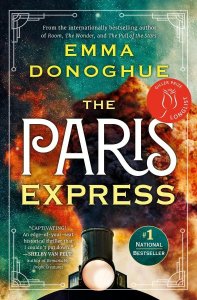
So, for now, on we go. Since the railway disaster Emma Donoghue recreates in The Paris Express is a documented historical event, I think a spoiler alert is not really called for. That said, I did not already know what actually happened, and I suspect Donoghue is counting on our not knowing, which is what kind of spoiled the novel for me. If you knew that THE BOMB DOES NOT GO OFF and NOBODY ON THE TRAIN DIES, the sense of impending doom that she does such a good job of building up would reveal itself immediately as shameless manipulation, which it turns out it is.
The Paris Express is not a bad novel. Donoghue is too adept for that. Given how it ends, though, I don’t really see the point of it. It’s just people on a train. She does a good job imagining them all for us (and if you like this sort of thing, there’s a long note at the end telling you who is real and which bits are made up). I got pretty invested in some of them, especially in the young anarchist who spends the whole trip clutching her homemade bomb, hoping there will be a big enough wig on the train to make detonating it the kind of political statement she aspires to. As the train raced along from stop to stop and the passengers met and mingled and shared quiet moments and lustful interludes and ate lunch and gave birth, there seemed to be a lot of potential ways their interactions could pay off. But even without climactic revelations or epiphanies (maybe assisting in a delivery would change Mado’s mind about blowing everyone up, for instance), there was power in the dramatic irony, this motley assemblage of different people all unknowingly hurtling towards disaster.
BUT THEY ALL WALK AWAY FROM IT. Geez. I mean, that’s nice for them (and rough for the one person who does actually die in the accident), but what that leaves us with is a whole bunch of people on a train. A series of character sketches, vignettes. It’s so deflating!
Since the railway disaster Emma Donoghue recreates in The Paris Express is a documented historical event, I think a spoiler alert is not really called for. That said, I did not already know what actually happened, and I suspect Donoghue is counting on our not knowing, which is what kind of spoiled the novel for me. If you knew that THE BOMB DOES NOT GO OFF and NOBODY ON THE TRAIN DIES, the sense of impending doom that she does such a good job of building up would reveal itself immediately as shameless manipulation, which it turns out it is.
The Paris Express is not a bad novel. Donoghue is too adept for that. Given how it ends, though, I don’t really see the point of it. It’s just people on a train. She does a good job imagining them all for us (and if you like this sort of thing, there’s a long note at the end telling you who is real and which bits are made up). I got pretty invested in some of them, especially in the young anarchist who spends the whole trip clutching her homemade bomb, hoping there will be a big enough wig on the train to make detonating it the kind of political statement she aspires to. As the train raced along from stop to stop and the passengers met and mingled and shared quiet moments and lustful interludes and ate lunch and gave birth, there seemed to be a lot of potential ways their interactions could pay off. But even without climactic revelations or epiphanies (maybe assisting in a delivery would change Mado’s mind about blowing everyone up, for instance), there was power in the dramatic irony, this motley assemblage of different people all unknowingly hurtling towards disaster.
BUT THEY ALL WALK AWAY FROM IT. Geez. I mean, that’s nice for them (and rough for the one person who does actually die in the accident), but what that leaves us with is a whole bunch of people on a train. A series of character sketches, vignettes. It’s so deflating!
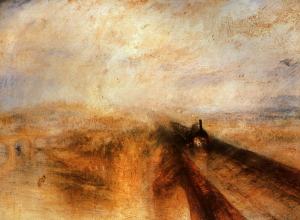 Also, she personifies the train. It makes some sense: apparently trains, like ships, are “she” to those who make them go. I like the idea that the train is a symbol: destructive technology, human ingenuity pushing too hard against the natural world, something like that. But the minute you say “You wonder how a train can read her passengers’ minds?” you’ve lost me. Keep it a metaphor, don’t over-literalize it, don’t tell me “she savours their memories and jokes, their doubts and rages, the way a worm tastes the earth.” Let us think for ourselves why a train might be antipathetic to something else that matters; let us experience the passengers’ humanity as something in tension with it.
I’ve read quite a few of Donoghue’s novels. I thought The Wonder (which I reviewed for the TLS) was really good, and Haven (which I reviewed for Canadian Notes and Queries) was too. I think she’s a good enough novelist that I wish she would write fewer novels—something I realize
Also, she personifies the train. It makes some sense: apparently trains, like ships, are “she” to those who make them go. I like the idea that the train is a symbol: destructive technology, human ingenuity pushing too hard against the natural world, something like that. But the minute you say “You wonder how a train can read her passengers’ minds?” you’ve lost me. Keep it a metaphor, don’t over-literalize it, don’t tell me “she savours their memories and jokes, their doubts and rages, the way a worm tastes the earth.” Let us think for ourselves why a train might be antipathetic to something else that matters; let us experience the passengers’ humanity as something in tension with it.
I’ve read quite a few of Donoghue’s novels. I thought The Wonder (which I reviewed for the TLS) was really good, and Haven (which I reviewed for Canadian Notes and Queries) was too. I think she’s a good enough novelist that I wish she would write fewer novels—something I realize 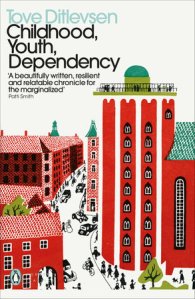 I made my way to the end of Tove Ditlevsen’s Copenhagen Trilogy without ever deciding if I was enjoying it or not. Enjoying might be the wrong word in any case: it’s not really a fun or pleasant story, and Ditlevsen herself does not come across as likeable, so what’s to enjoy? The better question is whether I was appreciating or admiring it, or interested in it. I am undecided on these questions as well. And yet her account of her childhood, youth, and “dependency” (meaning addiction) did exert a kind of pull on me, enough that I persisted to the end. One of the rewards, as I mentioned before, is coming across passages that hit hard. Some samples:
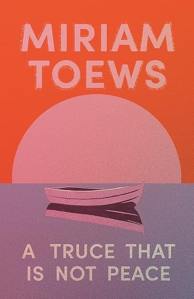 I also finished Miriam Toews’s A Truce That Is Not Peace, which is not really a memoir, I suppose, but I’m not sure what else to call it. It is about her life and about writing and about the death by suicide of her father and her sister—which is to say, it is about the same subjects as most of her other books, which is sort of the point, as it is written in response to a question she cannot clearly answer: “Why do you write?”
 I’ve been meaning to catch up on my recent reading for weeks now: it has been a month since I wrote up
 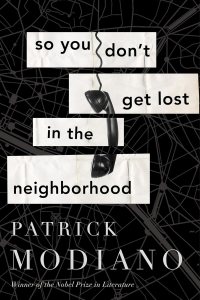 —which is not a bad description of how I decided to read the book. I don’t think I want to read anything else by Modiano, though. For a better-informed commentary, read
 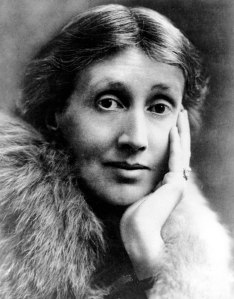 How I hate the word “relatable,” which is so often a shorthand for “like me and thus likeable,” which in turn is both a shallow standard for merit and a lazy way to react to a character. And yet sometimes it’s irresistible as a way to capture the surprise of finding out that someone who otherwise seems so different, elusive, iconic, really can be in some small way just like me—a writer of genius, for example, who reacts to invitations by worrying that she has nothing nice to wear and doesn’t look very good in what she does have. Yes, the period of Woolf’s diary I am reading is one of great intellectual and artistic flourishing, and this makes it all the more touching as well as oddly endearing that she frets so much about “powder & paint, shoes & stockings.” “My own lack of beauty depresses me today,” she writes on March 3, 1926;
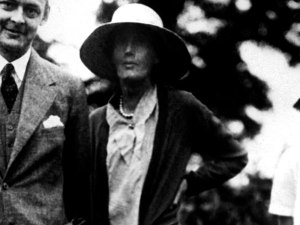 No sooner is she feeling more at ease, even easy, about how she looks, then stupid Clive Bell has to go and ruin everything: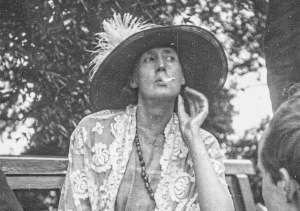
 It was just about a month ago that I last posted in this series.
  Noble aspirations, and already ones I have had a few stumbles living up to, but I have resolved not to spend the twilight years of my career in the classroom assuming the worst and chasing demons. After all, the highest incident of (discovered) plagiarism I have ever had was the dismal year that 1 in 5 of my intro students ended up in a hearing (with a near 100% finding that they had committed an offence)—and this was all cut-and-paste plagiarism of the most discouraging kind (much of it on pass-fail exercises, including supposedly personal writing like reading journals! I still can’t get over that!). Yes, AI is a game-changer, but I refuse to play, and I especially refuse to dedicate a single minute of precious class time to “training” students how to use it “responsibly” (as if there is such a way) instead of using our time on what they and I are actually there for.
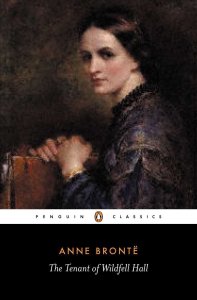 I have taught the Austen to Dickens class since then, but I assigned Jane Eyre. Much as I love Jane Eyre, I think I enjoy teaching Tenant more: its structure is so smart and complex, and the problems it tackles are, sadly, still so timely. I also appreciate that Anne Brontë’s attention is more clearly on social and systemic problems and solutions, while Jane Eyre is relentlessly personal—which is not to say, of course, that Jane’s story isn’t embedded in wider contexts, but her first-person narration focuses our attention constantly on what it is all like to her, on her individual feelings and values and decisions.
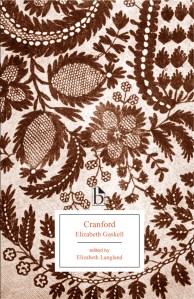 One of the biggest tasks I have underway at the moment as Undergraduate Coordinator is drafting a first attempt at what next year’s slate of classes will look like. As I pencil in my own courses (or whatever the Excel equivalent is of that!), I find myself reflecting that I won’t be on the timetable for that many more years. When I’m tired and grumpy, I feel some relief about this, but when I have just been in class and riding that adrenaline rush, I feel wistful, even bereft. What will make up for the loss of that energy, of that sense of purpose, of being on the front lines of something that matters, of being pretty good at something? I know there are other things that matter and I am trying to figure out what else I might be good at. Still, this is something that actually causes me more work-related stress than AI. I will try not to make these posts a dreary refrain about either of these topics! And on that note, we have two more weeks to spend on Tenant and then we are on to David Copperfield, and then, thanks to the added week in December, there will still be time for Cranford: hooray!
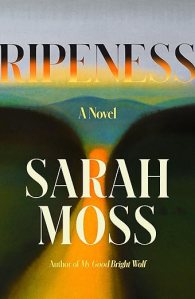 You must have a plum. Or three. Only they’re so ripe some of them burst when you pick them. Ripeness is all, I said. Men must endure their going hence even as their coming hither. I’d managed to get it into my Oxford entrance exam, my idea that Lear is a darker play than Hamlet. Readiness is all, Hamlet says, and readiness is voluntary, an act of will, where Lear’s ripeness happens to us as to plums and pears, regardless of agency or volition.
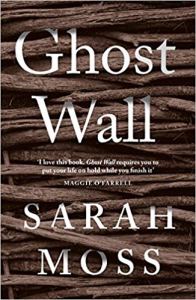 I don’t mean it would have been hard to express an opinion about its merits. I would not say I loved the novel, but I have never read anything by Moss that isn’t both meticulously crafted and convincingly intelligent. Every book of hers has left me appreciating the undercurrent of ideas in it, the sense throughout that something interesting is at stake. The same is true with Ripeness, on both counts, and in addition I think there is more lushness in her prose this time than in either Ghost Wall or Summerwater, both of which left me wishing she would return to the more expansive scope of her 19th-century series.
 Edith is in Italy to help out her sister Lydia, who is in a kind of moral as well as literal exile because she is unmarried and pregnant and it’s the 1960s. Their mother has made “arrangements”: when the child is born, the nuns will spirit it away and pass it on to its new family. Lydia is fine with this: the pregnancy is not just unwanted and awkward but the result of an assault, and all she wants is to be done with it and return to her life as a ballerina. She and Edith are not close and are not drawn closer by this interlude. When it is done, she returns to her dancing; it is Edith who is haunted by the baby she cared for when Lydia would not, and who writes her account of those strange months “for Lydia’s son to find if he comes looking.”
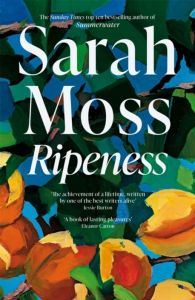 If I were properly reviewing, I would reread the novel until I could explain better how the parts hang together. Big words like “belonging” or “identity” feel relevant but also too general. Lydia and Edith’s mother was herself a refugee, sent away from France just in time to save her from the fate the rest of her Jewish family met. She thought often of her own mother and sister, who were put on trains and then put to death. Whose claims to refuge are met with kindness and whose with protest? Who has the right to say that they are “from” anywhere? What does it mean to be separated from your family, by violence or by the kind of cold pragmatism that removes tiny Gabriel (named by Edith, as Lydia refuses to care, or at any rate to acknowledge her care, for him) and sends him off to strangers? But then, as Méabh’s new-found brother’s story highlights, how much does it matter where you were born, or to whom, if that has never been your home and they have never been your family?
 But this slight depression—what is it? I think I could cure it by crossing the channel, & writing nothing for a week . . . But oh the delicacy & complexity of the soul—for, haven’t I begun to tap her & listen to her breathing after all? A change of house makes me oscillate for days. And thats [sic] life; thats wholesome. Never to quiver is the lot of Mr. Allinson, Mrs. Hawkesford, & Jack Squire. In two or three days, acclimatised, started, reading & writing, no more of this will exist. And if we didn’t live venturously, plucking the wild goat by the beard, & trembling over precipices, we should never be depressed, I’ve no doubt, but already should be faded, fatalistic & aged.
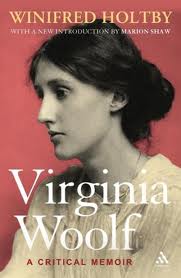 Winifred Holtby’s chapter on this period of Woolf’s life is called “The Adventure Justified”: “she was more sure now,” Holtby writes, “both of herself and of her public. She dared take greater risks with them, confident that they would not let her down.” It’s a wonderful chapter, rising almost to ecstasy about Woolf’s achievement in To the Lighthouse:
 It has been very quiet here lately, for reasons that may seem counterintuitive: I have had very little going on, because (long story short) the faculty at Dalhousie has been locked out by the administration since August 20, and while I am not in the union (I’m a member of the joint King’s – Dalhousie faculty) I have been instructed to do no Dal-specific work while the labour dispute continues. You’d think that this would mean I have all kinds of time to read books and write about them here, and yet what has happened instead is that the weird limbo of this situation has prolonged
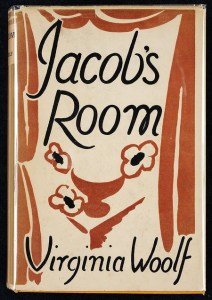 I have also been continuing my read-through of Woolf’s diaries. I am into 1923 now. 1922 seemed like a slow year and then she published Jacob’s Room and read Ulysses, both of which events generated a lot of interesting material. I am fascinated by her self-doubt: we meet great writers of the past when that greatness is assured, and also when their writer’s identity is established, but Woolf is not so sure on either count, and is hypersensitive—as George Eliot was—to criticism, especially when she felt her work was misunderstood, not just unappreciated. Jacob’s Room is significant because it is the first novel that, to her, really feels like her own voice: “There’s no doubt in my mind,” she says, “that I have found out how to begin (at 40) to say something in my own voice; & that interests me so that I feel I can go ahead without praise.” I am always fascinated and inspired by accounts of artists of any kind who find their métier and know it; I still think often of
 Novel Readings